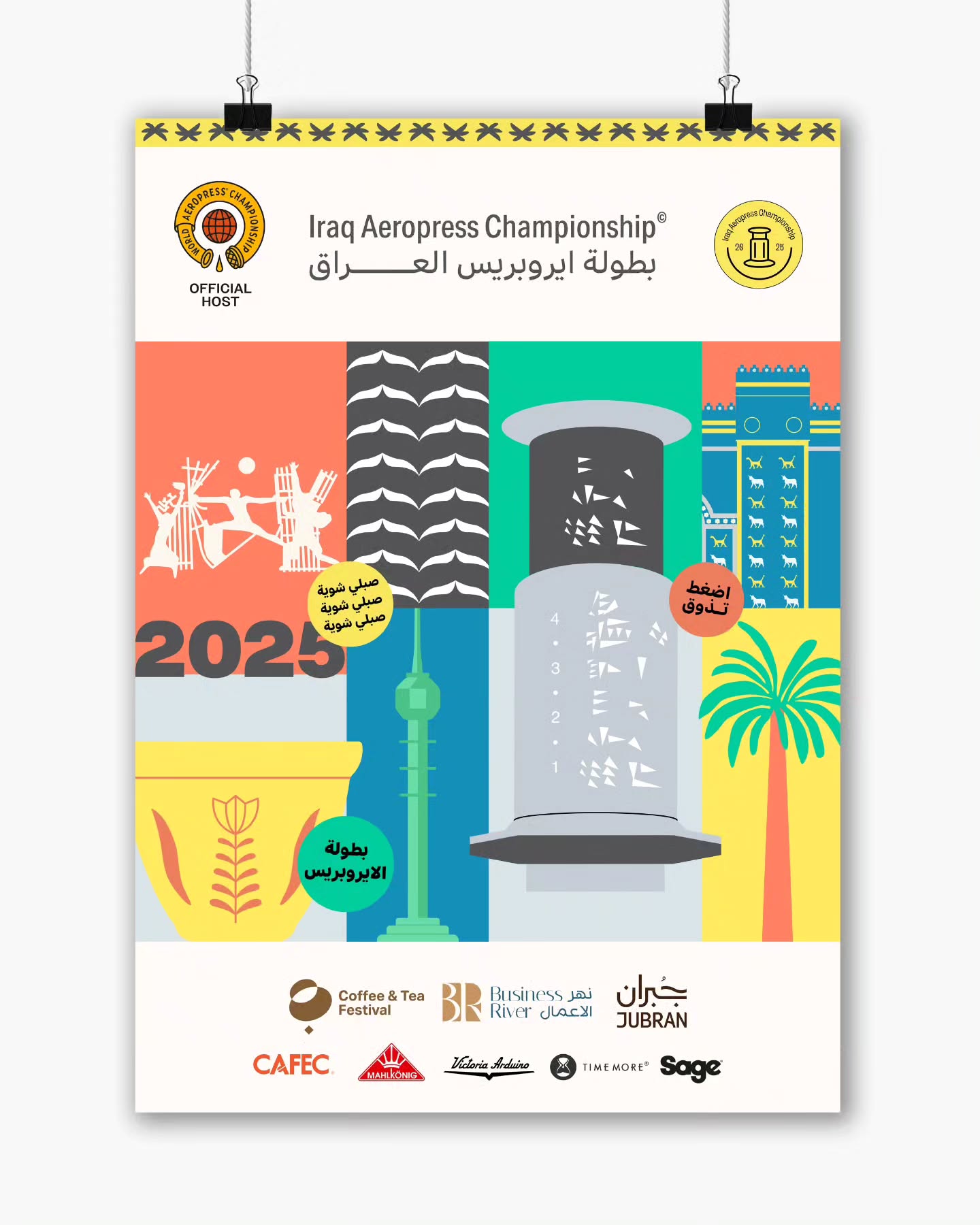
Registration Opens for the Saudi AeroPress Championship 2025

Riyadh, September 7, 2025 (Qahwa World) – Sulalat Coffee has officially opened registration for the 9th edition of the Saudi AeroPress Championship, set to take place in October 2025. The competition is expected to attract a wide field of coffee enthusiasts and professionals from across the Kingdom.

This year’s poster design draws inspiration from outer space, symbolizing ambition, exploration, and the pursuit of new horizons. Just as Saudi Arabia aspires to lead globally in space sciences, the championship aims to place the Kingdom firmly on the world coffee map—where passion meets skill and creativity meets innovation.

Qualifiers and Final

The qualifiers will begin on October 4, 2025, across eight Saudi cities:

  • Riyadh: Sulalat

  • Jeddah: Kaffa

  • Khobar: Sloop

  • Jubail: Latte Works

  • Buraidah: Caffeine Club

  • Madinah: Kaffa

  • Abha: Khotwat Jaml

  • Tabuk: C&B

The official coffee of the competition will be roasted by Edmi Roastery, while the final will take place on October 11, 2025, at Piccolo Roastery in Riyadh, where the new Saudi Champion will be crowned and earn the honor of representing the Kingdom at the World AeroPress Championship.

Saudi Arabia entered the global AeroPress stage in 2016, when Mohammed Alghamdi became the country’s first champion and represented the Kingdom at the world finals in Dublin. Since then, the Saudi AeroPress Championship has grown into a highly anticipated annual event, showcasing national talent and fostering a thriving specialty coffee culture.

In the most recent edition in 2024, Mohammed Aldakhilallah claimed the national title, joining the ranks of Saudi champions who have proudly carried the Kingdom’s name onto the international stage.

The Saudi AeroPress Championship has become a key platform for discovering local talent and propelling them to the global arena. Known for its spirit of creativity and innovation, the competition allows participants to craft unique recipes and flavors using the AeroPress. The judging process relies on blind tasting, ensuring fairness, transparency, and that victory is based solely on taste and quality.

Through this championship, Saudi Arabia continues to strengthen its position in the global coffee community—not only as a consumer nation but also as a stage for competition, innovation, and excellence in specialty coffee.

Countdown Begins for the 8th Iranian AeroPress Championship 2025

Dubai, September 7, 2025 (Qahwa World) – The Iranian coffee community is preparing to host the 8th Iranian AeroPress Championship, which will take place from September 19 to 21, 2025, at Bamland Recreation Complex in Tehran, bringing together coffee enthusiasts and professional brewers from across the country.

The championship has become one of the most prominent national events for specialty coffee lovers in Iran, offering the winner the opportunity to represent the country at the World AeroPress Championship finals.

Competition Rules

  • Registration cancellations are only allowed up to seven days before the start of the championship; no requests will be accepted afterward.

  • Registration fees are non-refundable once paid.

  • Participants must arrive at the venue at least one hour before the start of the competition.

  • Official announcements and updates will be published exclusively through the official Instagram page of AeroPress Iran: @iranianaeropress.

Every year, Iran hosts a variety of specialized coffee competitions, including Barista Championships, Latte Art contests, Brewing competitions, and the AeroPress Championship. Competitors from across the country take part, enjoying both the spirit of friendly competition and the opportunity to sharpen their skills.

The Iranian Women Coffee Association also plays a vital role in supporting and encouraging female participation in all coffee competitions. This consistent support provides women with invaluable motivation and self-confidence, further strengthening their presence in the specialty coffee scene both nationally and internationally.

Oman Coffee Community Announces the AeroPress Championship 2025

Muscat, September 7, 2025 (Qahwa World) – The Oman Coffee Community has officially announced the launch of the Oman AeroPress Championship 2025, set to take place from October 3 to 4 at Rozna Hall in Muscat. The highly anticipated competition promises two days of excitement, creativity, and skill, where coffee enthusiasts and professionals will compete for the national title and the chance to represent Oman at the World AeroPress Championship finals.

The event will span two consecutive days: the qualifiers on October 3 and the final showdown on October 4, where the champion will be crowned.
Competitors will face off in head-to-head elimination rounds, with each participant given just five minutes to grind, brew, and present their coffee using the AeroPress brewer. The submissions will be evaluated through a blind tasting process, ensuring impartiality and fairness.

Rules and Regulations

The competition follows the official World AeroPress Championship guidelines, designed to guarantee transparency and equal opportunities. Key highlights include:

  • Format: Multi-round, elimination-style tournament.

  • Time limit: Five minutes per competitor for the complete process.

  • Brewer specifications:

    • Only AeroPress Original or AeroPress Clear are permitted.

    • Use of the Flow Control Filter Cap is allowed if it is a genuine AeroPress product.

    • Other versions (Go, XL, Premium) are not allowed.

    • Custom-painted or trophy AeroPress brewers are permitted, provided they are original and unaltered.

  • Filters: Any type (paper, metal, cloth, etc.) may be used, as long as it fits inside the cap and does not alter flavor.

  • Ingredients: Only ground coffee and water are permitted. If official coffee or water is provided by the host, competitors must use them exclusively.

  • Dosage: Maximum of 18g of ground coffee, with a minimum output of 150g of brewed coffee.

  • Accessories: Grinders, kettles, scales, stirrers, thermometers, WDT/RDT tools, chillers, and other brewing aids are permitted, provided they do not violate the brewer specifications.

The Judging

Judges will taste each entry blind, with competitor names hidden to ensure neutrality. Each judge makes an independent decision without discussion, pointing simultaneously to their preferred cup on a synchronized count of three. In case of a full tie, the Head Judge makes the final decision after tasting all entries.

Registration

The registration fee is set at 12 OMR + 5% (total 12.6 OMR). Registration is confirmed only after payment and submission of the receipt via the official form. Participants are required to provide their full details, including civil number, email, and contact number. The full competition rules and regulations can be found here.

The winner of the Oman AeroPress Championship will secure the honor of representing the Sultanate at the World Finals. Should the champion be unable to attend, eligibility will pass to the runner-up, then the third-place competitor. This ensures Oman’s representation on the international stage, reinforcing the country’s growing presence in the specialty coffee community.

The World AeroPress Championship was launched in 2008 in Oslo, Norway, with only three competitors. It quickly grew into a global event, now held across dozens of countries and attracting thousands of participants each year. The championship is unique in being open to everyone — both professionals and amateurs — making it one of the most popular and inclusive competitions in the world of specialty coffee.

Roasted and Soluble Coffee Exports Decline in July 2025

Dubai, September 6, 2025 (Qahwa World) – The International Coffee Organization’s (ICO) August 2025 report has revealed a significant decline in exports of both roasted and soluble coffee in July, underscoring new challenges facing the global coffee sector as it navigates volatile prices, shifting demand, and rising production costs. The data highlights not only pressure on green coffee but also on finished products that reach consumers directly, raising concerns about structural changes in the industry.

According to the report, roasted coffee exports fell by a dramatic 63%, reaching only 30,000 bags compared to 81,000 bags in July 2024. This steep contraction marks one of the sharpest drops in recent years for a category that reflects direct consumer demand for value-added coffee products. Soluble coffee exports also registered a decline, albeit more modest, down 5% to 1.08 million bags from 1.13 million bags a year earlier. While less severe, the slowdown in soluble exports is significant because this category has long been considered one of the most resilient and widely consumed segments in global markets, particularly in emerging economies.

Analysts attribute the decline in roasted coffee exports to several interlinked factors. The most immediate is the surge in global coffee prices, with the ICO Composite Indicator Price (I-CIP) climbing by 14.6% in August to 297.05 US cents per pound, its highest level since 2024. Such historic price levels have curbed demand for high-cost roasted products, especially in advanced markets such as Europe and North America, where consumers are already grappling with inflation and higher living expenses. At the same time, exporters face mounting challenges from rising production and shipping costs. Energy, labor, and logistics expenses have all increased in recent months, eroding margins and forcing some companies to scale back international shipments in favor of local markets where conditions are more stable.

For soluble coffee, the 5% drop highlights a different dynamic. Traditionally, this segment has thrived in developing and price-sensitive markets due to its affordability and convenience. Yet even here, demand appears to be shifting. In mature markets, growth has slowed as consumers gravitate toward specialty coffee and fresh roasted options, reflecting a broader trend toward quality and experience rather than convenience alone. In competitive producing countries such as Vietnam and India, rising production capacity has intensified rivalry, putting pressure on exporters to maintain prices and market share. Younger generations in many countries are also seeking more diverse coffee experiences, leading to gradual erosion in the dominance of instant coffee.

The decline in both roasted and soluble exports has broader economic implications. It signals that pressure in the coffee sector is not limited to green coffee or raw supply but extends throughout the value chain. Combined with the ICO’s data showing global coffee stocks at their lowest level since April 2024, the contraction in finished product exports adds another layer of vulnerability to a market already characterized by price volatility and supply uncertainty. Experts warn that if these trends persist, the industry could face an extended period of turbulence, with higher prices for consumers and tighter margins for producers.

Still, opportunities remain in certain regions. Demand for soluble coffee continues to expand in parts of Africa and Asia, albeit at a slower pace, offering some relief for exporters. However, regulatory challenges such as the upcoming EU Deforestation Regulation (EUDR), set to take effect at the end of 2025, are expected to add new hurdles for suppliers attempting to maintain access to key European markets. For roasted coffee, niche segments such as specialty blends and locally branded products may offer pathways to sustain growth, but producers will need to adapt quickly to changing consumer preferences.

The ICO emphasized that roasted and soluble coffee exports should be monitored closely as indicators of global consumption trends. If the declines seen in July extend over the coming months, it could mark the beginning of a deeper shift in how coffee is traded and consumed worldwide. In that scenario, volume alone would no longer be the main metric of success; value-added innovation, consumer engagement, and adaptability to regulatory and market changes would become critical to survival. For now, the combined 63% plunge in roasted coffee exports and the 5% drop in soluble shipments serve as a stark reminder that the challenges facing the coffee sector go beyond farms and warehouses and reach all the way to the consumer’s cup.

From Roasting Champion to Global Educator: The Journey of Davide Cobelli, Evolved Q Grader Instructor

Dubai – Ali Alzakary

In the world of specialty coffee, very few have achieved the rank of Evolved Q Grader Instructor until now. We are sure that in a few weeks there will be many more, but Davide Cobelli, Coffee Expert and Consultant, Italian Roasting Champion 2020, is the first European to obtain it. From competition stages to origin farms, and from leading SCA Italy to winning the Italian Roasting Championship, his story is one of relentless passion, resilience, and a constant drive to raise the bar in coffee education and evaluation. Join us as we dive into his remarkable journey, lessons learned, and vision for the future of coffee.

You recently announced that you became one of the very few people worldwide to complete the Evolved Q Grader Instructor program — and with a perfect 100% score. How challenging was this process for you, and what does this achievement mean personally and professionally?

He is one of the very first instructors to pass the Evolved Q Grader exam. At the time he did, there were probably only 3–4 in the whole world. Today, quite a few more have passed. Achieving this milestone has been incredibly rewarding, especially considering the significant investment of time and energy it required. The standards for instructors are exceptionally high. To put it into perspective, there is zero margin for error, and candidates must achieve a perfect 100% score on a 50-question exam covering the entire Evolved Q Grader course. This is what makes earning the license so challenging, but also entirely appropriate. Through this rigorous process, the SCA makes it clear that the new Q Grader course is in no way inferior to the previous CQI program, particularly regarding the quality of its trainers.

You started in the food service industry before dedicating yourself fully to coffee. What was the turning point that made you choose this path, and how did those early experiences shape the professional you are today?

I started in the hospitality industry over 30 years ago, but for nearly 15 years, I have been completely devoted to the world of coffee. In the first part of my career, my devotion was to the beverage itself. Then, for more than seven years, I also embraced the entire supply chain, which has become increasingly important in my professional journey, leading me to open a roastery and travel to origin countries to provide sensory training. I don’t know exactly how the switch to coffee happened—passions are often born and grow without a specific reason. But every day, I wake up happy and fulfilled doing the best job in the world: the one I love.

You’ve trained hundreds of professionals across Europe, Asia, and the Middle East, while also building a reputation as a consultant. How do you manage to keep both hats on—educator and business advisor—without compromising the quality of either?

In my 15 years as a trainer in the coffee world, I believe I’ve trained well over a thousand professionals. Every time, this has been my motivation to keep going. My goal has always been to share my expertise with students, learn from them in return, and create a genuine exchange—an objective I still pursue today. It’s not one-way training, but a true exchange of professional skills. When you’re driven by true passion, you can do anything. For me, coffee is pure passion and sincere dedication.

Few people cover as many areas as you do—Barista, Brewing, Green Coffee, Sensory, and Roasting. How did you build that range of expertise, and what advantages does it give your students?

There’s a saying, “a jack of all trades is a master of none,” and I tend to agree with that idea. In my case, I began my coffee journey by dedicating the first half of my career to the world of the barista and the beverage—first by competing, and later serving as an international judge for barista championships. From there, I expanded to embrace sensory analysis, roasting, and the supply chain. It’s not impossible to do everything well, but I don’t see myself as a superhero who has somehow managed it. I simply believe that when you are driven by true passion (and not primarily by business), it is possible to succeed. As I’ve said before, I am devoted to coffee. It’s an all-consuming passion in my life; aside from travel, I have no others. I believe the advantage for my students is that my broad experience allows us to explore a wide range of topics holistically, both in and out of the classroom. After all, in a supply chain like coffee, every element intersects with and influences the others. Furthermore, I’m not one of those trainers who sticks strictly to the course material without leaving room for discussion. I encourage questions—in fact, I love them.

Winning the Italian Roasting Championship in 2020 was a milestone, and you later ranked among the best in the world. What did those competitions teach you about coffee—and about yourself?

In 2020, just two years after I started roasting, I won the Italian Roasting Championship. What an incredible feeling that was! I was the first to not believe it, especially since I only went hoping not to finish last and just to get a bit more experience. But after placing seventh at the World Championship in 2022 and second at the nationals in 2023, I started to think that maybe, just maybe, I’m not completely terrible at this whole roasting thing. Above all, it silenced my detractors and haters, which are always in plentiful supply in the coffee world. That made the satisfaction twofold.

As a national and international judge, you’ve seen the best baristas and roasters on stage. What do you look for in a champion, and what separates a good competitor from a great one?

Being a judge is a responsibility—or at least, that’s how I’ve always seen it. It’s incredibly satisfying to be able to support the industry’s framework and, often, the next generation of professionals. But that’s not all. In recent years, I’ve been called upon more and more to participate as a sensory judge on tasting panels for coffee farmers, right at the source of the production chain. This has really become my focus since the COVID pandemic. That is a true responsibility of another kind, because you feel that your judgment can influence the future of farming families. This responsibility weighs heavily on me, compelling me to be exceptionally professional and accurate in my assessments.

When you were elected National Coordinator of SCA Italy, you spoke about bringing specialty coffee out of its niche. What steps have you taken toward that goal, and what challenges remain in making specialty coffee more accessible to everyday Italians?

In my role as National Coordinator from 2022 to 2024, I worked to expand the specialty coffee market beyond the narrow niche it has occupied in Italy in recent years. Growth in this sector had become nearly stagnant, largely because specialty coffee was increasingly perceived as just an expensive and acidic product, rather than one of value for the entire supply chain. Together with the coordinating team for that two-year term, we implemented communication strategies to take the product beyond the small circle of “coffee geeks.” Our goal was to make specialty coffee accessible to a broader audience by using simpler language and by highlighting the importance of a sustainable supply chain.

The Specialty Coffee Association recently introduced the Coffee Value Assessment (CVA), joined also by the Coffee Quality Institute. Some see this as a groundbreaking step forward, while others worry about confusion or competition with existing protocols such as CQI certifications. How do you see this new system shaping the future of coffee evaluation, and what impact will it have on farmers, producers, and the industry as a whole?

When the CVA was introduced in 2022, many wouldn’t have bet on its success. There was significant skepticism (a small amount of which still lingers), especially from professionals who grew up with and were tied to the 2004 SCA Cupping Form (later used by CQI). This also included those who had invested a great deal of money and energy over the years to become Q Graders or Q Instructors. (I don’t blame them, but it’s clear that the new CVA is the modern approach to sensory science, while the previous system is not). Today, there is no competition between the SCA and CQI, because CQI focuses on origin countries and field work, while the SCA focuses on Sensory Analysis, which includes the new Evolved Q Grader course. (Then again, perhaps there was never any real competition; it’s impossible to compare an outdated system that hasn’t been updated in over 20 years with one that takes a modern, scientific approach). The real and immediate revolution is that today, a coffee’s value throughout the chain is no longer left to a single, subjective score. Instead, value is redistributed across multiple attributes, each of which is important in determining the final worth. The impact is direct: farmers are no longer forced to submit to a sterile, unexplained score. Instead, they can discuss value by leveraging multiple attributes to justify it.

Specialty coffee has changed dramatically in the past decade. Where do you see the next big opportunities for growth and innovation in Europe’s coffee sector?

The coffee world has undergone a radical transformation. Specialty coffee consumption has evolved and continues to grow consistently year after year across all markets, with consumers paying closer attention to the products they purchase and consume. The key to the future is undoubtedly product information, specifically the combination of extrinsic value and the sensory profile. Looking ahead, I foresee a future for specialty coffee defined by greater transparency, with a focus on metrics like the Farm Gate Price for the final product, rather than just a cupping score. I believe the opportunities will only continue to grow for professionals who specialize and carve out their own niche in the market.

Looking back at your journey—from trainer to champion, consultant, and SCA leader—what achievement gives you the greatest satisfaction? And what keeps you motivated to push forward?

Life is constant evolution. To me, that is the very definition of living. Sometimes you adapt, but often you must evolve—that is my guiding principle. This isn’t about the pursuit of a happiness that is never reached. Instead, it’s about the constant effort to improve, accumulating more and more experience in everything you do. My father taught me to always give my all, so that I could fully enjoy the journey, whether it leads to the summit or not. Success is just the tip of an iceberg built on defeats, frustration, disappointment, struggles, laughter, excitement, and a host of other emotions. From the outside, people only see the destination, never what happens during the journey. For me, every milestone—positive or negative—has been an experience that has helped me mature and grow as a human being. That is true success. For this reason, I don’t have a single achievement that stands out as the most satisfying; rather, it is the sum of them all that makes me a better person.

For young coffee professionals who dream of following in your footsteps, what advice would you give them about standing out in such a competitive global industry?

Never give up on something you believe in, but above all, believe in yourself. Superheroes and super-gurus don’t exist; there are only people who give their absolute all to reach their goals. Set an objective and then, step by step, work to achieve it. If you create intermediate milestones along the way, it will seem far less impossible.

Viral Sensation: Chinese Café Serves Coffee at -86°C

Chengdu, China – September 6, 2025 (Qahwa World) – Luna Café in Chengdu has gone viral for its unusual twist on coffee service: drinks served in glasses chilled to an astonishing -86 degrees Celsius.

The idea, showcased by food vlogger Shufosho in a widely shared Instagram video, eliminates the need for ice while creating a dramatic sensory experience. The process begins with staff retrieving a frosted glass from an ultra-cold freezer, filling it with milk, and topping it with freshly brewed espresso. The icy cup ensures that the drink stays cold without dilution.

The café recommends drinking the coffee immediately in large sips to enjoy the striking contrast between the hot espresso and super-chilled milk—a taste sensation the vlogger compared to “ice cream on warm apple pie.”

Located on 24 Fanghua Street in Chengdu, Luna Café’s inventive beverage has sparked widespread curiosity online. The Instagram reel featuring the drink has already gained over 120,000 likes and a flood of comments from intrigued coffee lovers eager to try it themselves.

With netizens worldwide asking for similar creations in their own countries, this innovative take on iced lattes has firmly placed Luna Café at the center of a global coffee conversation.

Starbucks Moves Ahead with Major U.S. Coffeehouse Revamp

Dubai, 5 September 2025 (Qahwa World) – Starbucks is reporting strong progress on its ambitious plan to refresh its U.S. coffeehouses, with redesigned stores in New York and Southern California already showing encouraging results.

The global coffee chain began remodeling select outlets in July 2025 as part of CEO Brian Niccol’s Back to Starbucks strategy, which aims to restore the brand’s traditional “coffeehouse atmosphere” and counter declining sales in its home market.

According to Starbucks, customers at the updated stores are spending more time in-store, visiting more frequently, and responding positively to the changes. The redesign includes:

  • Cozy seating and warmer lighting to create a more inviting environment

  • Vibrant artwork and ceramic mugs to highlight a café-style experience

  • A redesigned espresso bar that showcases coffee preparation and barista skills

  • Improved pickup zones that are streamlined and less disruptive

Starbucks intends to remodel more than 1,000 company-owned U.S. stores by the end of 2026 — nearly 10% of its U.S. network. The revamp is designed to strengthen connections with customers, replacing the “overly transactional” feel of some locations.

In addition, Starbucks announced it will phase out its 90 mobile order and pickup-only sites across the U.S. by the end of 2025. First introduced in 2019, these outlets will be closed to prioritize spaces that foster human interaction and community engagement.

Despite challenges in the U.S. market, Starbucks posted solid results in its latest financial report. For the quarter ending 29 June 2025, the company achieved 4% year-on-year revenue growth, reaching $9.5 billion globally. In the U.S., revenue increased by 1% to $6.45 billion, with Starbucks operating 17,230 outlets nationwide.

The coffee giant believes that its large-scale store refresh will play a crucial role in boosting customer loyalty, improving in-store experiences, and reinforcing its leadership in the U.S. coffee market.

Announcement of the UAE AeroPress Championship 2025

Dubai, September 5, 2025 (Qahwa World) – The organizers of the UAE AeroPress Championship 2025 have announced that the competition will take place over three days, from November 6 to 8, hosted by the Coffee Centre of the Dubai Multi Commodities Centre (DMCC), bringing together coffee lovers and professionals from across the Emirates.

In the 2024 edition, Sonam Sherpa of Kranti Coffee claimed the title, while John Patric Elazegui of Amongstfew secured second place, and Alfred Samson took third. Organized by Mokha 1450, the event drew more than 400 participants and spectators from across the UAE.

Last year’s competition featured Yemeni coffee sourced from the Talooq Women’s Association in Jabal, Taiz Governorate, Republic of Yemen, under the theme “Breaking Boundaries,” which reflected innovation and creativity. The event also included coffee tastings and exclusive AeroPress giveaways, supported by sponsors such as Slayer, Coffee Desk, TSAK Trading Company, and Coffee Market Innovations.

2025 Competition Structure

  • November 6–7: Regional rounds across the Emirates.

  • November 8: The grand finale bringing together qualifiers from each Emirate to crown the UAE AeroPress Champion 2025.

Road to the World Championship

The UAE champion crowned on November 8 will represent the country at the World AeroPress Championship, to be held in Seoul, South Korea, on December 5–6, 2025.

Luckin Coffee Gains Market Share as Rivals Struggle

Dubai, September 5, 2025 (Qahwa World) – Luckin Coffee continues its rapid ascent in the global coffee industry, expanding aggressively while key competitors like Starbucks face declining sales.

The Chinese coffee chain, which has already surged ~35% this year, recently entered the U.S. market with new stores in New York City. This move comes as Starbucks undergoes a difficult transformation in both its American and Chinese operations.

Strong Same-Store Sales Growth

Luckin Coffee reported a 13% year-on-year increase in same-store sales at company-owned outlets in Q2 2025. This marks its fourth consecutive quarter of acceleration, rising from a decline in late 2024. In comparison, Starbucks posted a 2% sales decline in the U.S. and only 2% growth in China, where it introduced discounts to counter Luckin’s aggressive promotions.

By outperforming Starbucks’ same-store sales growth by 11 percentage points, Luckin has proven resilient in a strained global economy where many restaurant chains are seeing contractions.

Aggressive Expansion Strategy

The company’s expansion strategy remains unmatched. In Q2 alone, Luckin opened 2,109 new stores, lifting its total footprint to 26,200 – a 31% year-on-year increase. Over the past year, Luckin has added more than 6,200 stores, averaging 17 openings per day.

In contrast, Starbucks expanded its network by just 5% over the same period, adding 1,600 stores worldwide. Luckin’s U.S. debut has been met with favorable reviews, with New York outlets receiving 4–5 star ratings on Google and Yelp.

With RMB 8.2 billion ($1.1 billion) in cash reserves and no debt, Luckin has ample resources to finance its ambitious global rollout.

Differentiation: Menu Innovation and Value Pricing

Luckin distinguishes itself through a bold menu and competitive pricing. While offering classic beverages, it experiments with unique flavors – from fruity Americanos to limited-edition drinks like Roast Duck coffee in China.

Equally important is its pricing advantage: brewed coffee at its U.S. outlets starts at $3.45, below the average price in many American cities. This value-driven approach has fueled customer growth while maintaining a 21% store operating margin.

Valuation Advantage

Despite its momentum, Luckin trades at a far lower valuation than U.S. peers. Its price-to-earnings ratio is around 19x, half that of Starbucks. On revenue multiples, Luckin is valued at a quarter of fast-growing competitor Dutch Bros, even though it is expanding at a faster pace.

Risks and Outlook

While Luckin’s history includes challenges—such as price wars and over-discounting in 2024—the company has since shifted strategy to balance promotions with profitability.

Analysts see more upside than downside as Luckin strengthens its position in China while expanding overseas. Its combination of innovation, affordability, and financial strength makes it one of the most compelling players in the global coffee industry today.

Mexico Launches Instant ‘Wellness Coffee’ Sourced from Small Farmers

Mexico City, September 4, 2025 (Qahwa World) – Mexico’s Food for Well-Being program has officially introduced “Wellness Coffee” to the national market, expanding its growing line of government-backed wellness products that already includes honey, chocolate, and beans.

Announced by President Claudia Sheinbaum during her Wednesday press conference, the new product reflects consumer preferences: with 84% of Mexican households opting for instant coffee, the government chose this format to ensure accessibility and popularity.

According to María Luisa Albores González, head of the Food for Well-Being program, Wellness Coffee will be available in three sizes:

  • 50 g at 35 pesos (US $1.86)

  • 90 g at 65 pesos (US $3.46)

  • 205 g at 110 pesos (US $5.86)

Unlike many instant coffees permitted by Mexican standards to contain up to 30% non-coffee ingredients, this new product is 100% coffee — free from additives, colorings, or artificial flavors. The blend consists mainly of Arabica and parchment coffee, with a small proportion of Robusta, cultivated under agroforestry systems that benefit both the environment and local communities.

Supporting Small Producers and Women Farmers

The initiative required an investment of 59.4 million pesos (US $3 million) to purchase 913.56 tons of coffee. More than 6,600 small farmers from Oaxaca, Puebla, Veracruz, and Guerrero supplied the beans, with 50% of them located in the Guerrero Mountains. Remarkably, women account for six out of every ten producers.

Albores emphasized that the program strengthens Indigenous communities, including Mixes, Mixtecs, Nahuas, and Otomis, by ensuring fair purchasing prices and sustainable livelihoods.

Nationwide Distribution

Wellness Coffee will be distributed gradually through the national network of Wellness Stores. The first rollout begins in central Mexico, including Mexico City, Estado de México, Michoacán, Morelos, Puebla, and Tlaxcala, before expanding across the country.

With its launch, Mexico positions coffee not only as a cultural staple but also as a tool for social equity and environmental sustainability.

Indian Coffee Producers Welcome GST Reduction to 5%

New Delhi, September 5, 2025 (Qahwa World) – India’s coffee sector has warmly welcomed the government’s decision to cut the Goods and Services Tax (GST) on coffee from 12% and 18% down to 5%, describing it as a historic move that will boost domestic consumption and strengthen the country’s competitiveness in global markets.

The decision, adopted during the 56th GST Council meeting chaired by Finance Minister Nirmala Sitharaman, simplified the tax system into two primary slabs: 5% for essential and merit goods, and 18% as the standard rate, while keeping a 40% rate for de-merit goods such as tobacco and luxury items. Coffee was placed under the merit category, and starting September 22, roasted, instant, and processed coffee products will all benefit from the reduced tax rate.

Fresh Momentum for Domestic Consumption

For Neleema Rana George, Managing Director of Kelachandra Coffee, one of India’s oldest plantation companies dating back to 1786, the move marks a defining moment. She stressed that classifying coffee as an essential good would make it more widely available and affordable, thereby encouraging daily consumption, opening new avenues for growth, and creating greater balance between farmers, processors, and retailers. She emphasized that the positive impact of this decision “will extend from farm to cup.”

Neleema Rana George, Managing Director of Kelachandra Coffee

Specialty Coffee Poised for Growth

In the specialty sector, Devesh Khushalani, Co-Founder of Kranti Coffee, described the tax cut as “a ray of hope after a difficult period,” noting that lowering GST to 5% translates into fairer prices for consumers, allowing them to access Indian nano-lots and strengthening café culture.

He also pointed to pioneers such as Ashok Patre of Ratnagiri Estate and Hamsini of Sangameshwar Coffee Estate, who have positioned Indian coffee on the global stage through innovative processing methods and micro-lots that have scored above 90 points.

Devesh Khushalani, Co-Founder of Kranti Coffee

Export Competitiveness and Sustainability

From Rajasthan, Radhika Kabra, Founder of Qetli Coffee, underlined the global impact of the reform. She explained that cutting taxes on processing, packaging, and logistics by up to 6% gives Indian coffee a stronger edge against major producers like Vietnam and Brazil. According to the Coffee Board of India, export volumes are expected to grow by 15–20% in the coming year. Kabra said she plans to reinvest these savings in sustainable practices such as water-efficient drip irrigation, which will generate jobs and support local farmers.

She also noted that importers stand to benefit: “Lower GST makes Indian coffee more competitive, reducing prices by 4–5% and enabling access to GI-tagged varieties such as Coorg Arabica and Wayanad Robusta at better rates for international markets.”

Radhika Kabra, Founder of Qetli Coffee

A New Chapter for Indian Coffee

Across the sector, there is consensus that this tax reform is not merely a financial adjustment but a transformative milestone. It promises to drive domestic demand, fuel innovation, and reinforce India’s standing as a rising force in the global coffee trade.

As the September deadline for implementation approaches, optimism is running high. For many, the reform signals the beginning of a new chapter: one in which coffee becomes more accessible to millions of Indian consumers while also expanding its footprint on the world stage.

Global Coffee Stocks Fall to Lowest Level Since April 2024

Dubai, September 4, 2025 (Qahwa World) – The International Coffee Organization’s (ICO) August 2025 report has revealed a sharp decline in global coffee stocks, falling to their lowest level since April 2024. The drop in inventories comes just weeks after prices reached a historic high, highlighting a fragile market caught between soaring demand and tightening supply.

According to the ICO, certified Arabica stocks held at the New York Exchange dropped 7.9% to 0.77 million bags, marking a 16-month low. Robusta inventories at the London Exchange also fell by 4.6%, standing at 1.13 million bags. The simultaneous reduction across both major coffee types signals a broad squeeze on available supply.

Why Stocks Are Falling

Analysts point to several reasons behind the decline:

  • Weaker export flows – Global green coffee exports fell for the sixth consecutive month in July 2025, tightening supplies into key markets.

  • Crop concerns – Brazil, the world’s top producer, reported larger bean sizes but weaker density, which reduced overall yield estimates.

  • Climate risks – A frost in Brazil earlier this year damaged an estimated half a million bags.

  • Regulatory pressure – European roasters have been stockpiling ahead of the EU Deforestation Regulation (EUDR) that comes into force at the end of 2025, drawing beans out of certified warehouses into private storage.

Connection to Soaring Prices

The fall in stocks coincided with a dramatic rise in prices. In August, the ICO Composite Indicator Price (I-CIP) climbed 14.6% to 297.05 US cents per pound, the highest since 2024. With inventories shrinking, the likelihood of further price volatility is increasing, especially if supply disruptions persist.

Regional Dynamics

  • South America posted the steepest decline, with exports down 18.5%, driven by a 28.6% fall in Brazil.

  • Asia & Oceania moved in the opposite direction, growing exports 22.7%, led by Vietnam (+29.4%) and Indonesia (+20.4%).

  • Africa also contributed positively, with exports rising 4.4%, thanks to strong performance in Uganda (+51.4%) and Ethiopia (+12.5%).

  • Mexico & Central America recorded moderate growth of 7.2%, helping to diversify global supply, though not enough to offset South America’s losses.

What It Means for the Market

Industry experts warn that the current drawdown in stocks leaves the coffee market more vulnerable to external shocks. Further weather events in Brazil or Vietnam could deepen the supply gap, while the EUDR may slow exports to Europe. Rising shipping and labor costs add another layer of pressure on the supply chain, feeding into higher costs for roasters and consumers alike.

Outlook

The ICO emphasized that stock levels will remain a critical indicator for the market in the coming months. Any further declines could trigger another round of price surges, prolonging uncertainty for producers, traders, and consumers. With prices already at historic highs and inventories at multi-year lows, coffee is entering one of its most volatile periods in recent memory