Ahmed Bin Sulayem Highlights Expansion Plans at DMCC Coffee Centre

Dubai — Qahwa World

Ahmed Bin Sulayem, Executive Chairman and Chief Executive Officer of DMCC, announced new initiatives aimed at strengthening the regional coffee ecosystem and supporting emerging coffee entrepreneurs through the DMCC Coffee Centre.

Speaking about the Centre’s future plans, Bin Sulayem said the organization is exploring the launch of a community co-roasting space designed to support the next generation of coffee entrepreneurs. At the same time, plans are underway to develop a coffee wholesale facility that would further improve market access for the diverse network of producers and traders operating within the DMCC Coffee Centre.

You may like: DMCC Coffee Centre: Specialty Coffee Redefines the Global Market

According to Bin Sulayem, the DMCC Coffee Centre has handled more than 30,000 metric tonnes of green coffee since its establishment, working with over 30 coffee origins worldwide. In addition, the facility has completed more than 1,000 metric tonnes of value-added processing, serving both the United Arab Emirates’ growing domestic market and over 50 major re-export destinations.

As the coffee sector in the UAE and the wider region continues to expand, the Centre has maintained close engagement with the local coffee community. Through partnerships and industry collaboration, DMCC has supported several major regional events, including World of Coffee Dubai.

DMCC has also launched a number of initiatives aimed at strengthening the specialty coffee sector. These include the Dubai Coffee Auction by DMCC, organized in collaboration with M-Cultivo, an initiative focused on supporting next-generation coffee farmers. The organization also introduced the UAE AeroPress Championship, which forms part of the global World AeroPress Championship.

Read Also: DMCC Coffee Centre: Supply Chain Pressures and Tariffs Threaten Global Coffee Trade

Bin Sulayem added that, in support of growing coffee brands, DMCC has introduced a JLT collection point, enabling members of the Coffee Centre and their customers to conveniently collect roasted coffee.

These initiatives reflect the Centre’s ongoing role in developing Dubai’s position as a growing hub for the global coffee trade and specialty coffee community.

UAE AeroPress Championship 2025 Kicks Off Tomorrow

A Celebration of the UAE’s “Qahwa Culture” in an Atmosphere of Challenge and Creativity

Dubai – Qahwa World

The UAE AeroPress Championship 2025 kicks off tomorrow in its ninth edition, bringing together more than 250 competitors from across the Emirates — alongside café owners, coffee experts, and enthusiasts — in a spectacular celebration of coffee culture under the theme “A Celebration of Qahwa Culture in the Emirates.”

Proudly supported by Qahwa World as the official media partner, the three-day event will take place from November 6th to 8th at Almas Tower – Jumeirah Lake Towers, Dubai. Doors open at 4:30 PM, with competitions beginning at 6:00 PM daily. Admission is free for all coffee lovers across the UAE.

Building on the tremendous success of last year’s championship — recognized as the largest AeroPress competition in the world by number of participants — this year’s edition highlights the harmony between traditional Arabic coffee and modern brewing methods such as the AeroPress, reflecting the UAE’s dynamic and culturally rich coffee landscape.

Ahmed Bin Sulayem, Executive Chairman and Chief Executive Officer of DMCC, said: “The AeroPress Championship serves as a platform that unites excellence in brewing, cultural expression, and global connection. Hosting this event at Almas Tower, supported by the DMCC Coffee Centre — which processed more than 7,400 metric tonnes of coffee in 2024 — reaffirms our ongoing commitment to strengthening Dubai’s position as a global hub for coffee heritage, trade, and innovation.”

Garfield Kerr, CEO of Mokha 1450 and the event’s organizer, added: “The UAE has become one of the world’s leading destinations for specialty coffee, thanks to its long-standing relationship with Arabic qahwa. This championship celebrates that heritage and gives participants the opportunity to showcase their passion, creativity, and brewing artistry.”

Championship Schedule

  • November 6th: Regional Championship 1 – Abu Dhabi, Ras Al Khaimah, Sharjah, Umm Al Quwain

  • November 7th: Regional Championship 2 – Dubai, Ajman, Fujairah

  • November 8th: National Championship – featuring 21 finalists from across the Emirates

The national champion will go on to represent the UAE at the World AeroPress Championship in Seoul, South Korea, on December 5th and 6th, 2025.

More Than a Competition

Beyond its competitive spirit, the UAE AeroPress Championship is a community celebration, offering coffee tastings, interactive experiences, and AeroPress giveaways, along with opportunities to connect with local roasters and coffee brands — all in a vibrant, inclusive atmosphere that embodies the true spirit of qahwa culture.

Sponsors and Partners

Organizer: Mokha 1450
Host: DMCC Coffee Centre – Almas Tower
Gold Sponsors: Polpanorte, Aiya Matcha, CMI Coffee, Boncafé, Oatly, Lohas Beans
Silver Sponsors: Stree F&B, KGN Coffee, RAW Coffee Company, Coffee Museum, Karam Coffee
Bronze Sponsors: Steens Middle East, Brewing Gadgets, Victoria Arduino
Media Partner: Qahwa World

The UAE AeroPress Championship is more than just a brewing competition — it is a living expression of community, creativity, and the enduring spirit of coffee in the Emirates.

Golden Ticket Offers New Chance for Direct Entry to UAE AeroPress Championship 2025 Finals

Dubai – Qahwa World

In a first-of-its-kind initiative, and following yesterday’s call for anticipation, the organising committee of the UAE AeroPress Championship 2025 announced the launch of the Golden Ticket Competition, which will grant three participants direct qualification to the finals scheduled for November 6 – 8, 2025, at the DMCC Coffee Centre in Dubai.

How to Participate

Entrants are required to produce a creative video showcasing the AeroPress in a way that reflects UAE culture, incorporating elements of heritage, landmarks, colors, and traditions.
The video must be posted on Instagram as a Reel, tagging the official account and using the hashtag #2025GoldenTicketChallenge, in addition to uploading it through the official registration link available in the championship’s Instagram highlights.

Key Dates and Conditions

Submissions are open from September 30 to October 25, 2025.

Entries received after this deadline will not be accepted.

Only one entry is allowed per participant.

Judging

The championship team will review all entries and select the three best videos. Winners will each be awarded a Golden Ticket, granting them direct access to the finals without participating in the preliminary rounds.

The committee emphasized that the initiative is designed to foster creativity, expand participation, and provide coffee enthusiasts with an additional opportunity to take part in one of the country’s most prominent coffee competitions.

Tomorrow Could Be Your Lucky Day: UAE AeroPress Championship Announces Competitors

Dubai – Qahwa World

Tomorrow could be your lucky day! For everyone who didn’t make it onto the competitor list for the UAE AeroPress Championship 2025, which will be held from November 6–8, 2025, don’t lose hope… the organizers have promised a surprise announcement tomorrow that could change everything. No one knows what it will be, but everyone is invited to stay tuned.

The organizers of the UAE AeroPress Championship 2025, which will take place at the DMCC Coffee Centre in Dubai, have announced the full list of competitors from across the Emirates.
Check the list to see if your name is among them!

Abu Dhabi

Adriane Tigatoola – Siglo Cafe
Ahmed Mahmoud Mohamed Hasanin – Rain Cafe
Alyazia Ahmad Abdulla Alameri – Opulent
Anahita Ghasemi – Meraki Cafe And Roastery
Archie Cadiz – Independent
Awadh Abdalla Abdulrahman – The Qc Cafe
Bibek Tamang – Radio Roastery
Carlos Pesons Manulat – Emirates Hospitality Restaurant Management
Chris David Paquera – Royal Simplicity Coffee Trading LLC
Christopher Lance Masacayan – Roastrip
Dikdik Ahmady – Meraki Cafe And Roastery
Filip Tesani – Things Specialty Cafe
Hue William Gorit – Seed Coffee Roasters
Jea Ann Malanum – Laura Coffee
Jerick Sarmiento – Ast Green Coffee
John Philip Bautista – Brewlab Roastery
Johnmica Pelayo – Independent
Khalid Nsubuga – Link Lounge Cafe
La Crista Usal – Daily Press
Ma. Mirasol Go – The Echo Machine
Mark Edwin Dela Vega – Ten11
Monther – Independent
Neil Golez – Form Roastery
Paul John B. Suba – The Brew Crew
Pradeep Rai – Refill Reserve
Raju Tamang – 125 Specialty Coffee
Rema Charlon – The Qc Roastery And Academy
Rey Laud – Shot Speciality Cafe
Richard Carullo – Elmatador Roastery
Rohit Ashok Salunke – Irdk Cafe LLC
Rovic Geronimo – Risen
Siyeyondji Djoumbissie Ezekiel Maurel – Grandmother Coffee Roastery
Su Sandar Zaw – The Optimist Cafe
Tariq Almazrouei – Independent
Usama Hasnain – Coffee Zero Three
Yaneth Martínez – The Coffee Birds

Dubai

Aaron Jeremaiah A. Dela Rosa – The Soul Specialty Coffee
Abdul Kader – Wawé Specialty Coffee
Ali Tahmasebi Azad – The Espresso Lab
Ammar – Independent
Amna Almansoori – Independent
Anderson Dante – Harvester
Andre Raka Dewa – White Mantis Roastery
Aung Ko Oo – Caffeine Connoisseurs Academy
Benedick Cera Beredo – Dory Cafe
Bernadeth Marie Salazar – Nomads Roastery
Bishesh Thapa – The Barn Coffee Roaster Berlin
Cecilia Njeri Munjeru – Costa Coffee UAE
Daudi Kubona – Ror Coffee Solution
Hnin Kha Nady – Slick Brew
Jason Rey Galinea – Ubec Coffee Roasters
Jayson Ocampo – Rstd Roasters
Jhonald Romanes – Monza LLC
Jimuel Merjilla – Syteo International
Joel Subba – Dunes Specialty Coffee
John Patrick Anar – Forma
Khalid Ahmed Hafez – Cartel Coffee Roasters
Komal Magar – Scorestore
Krizzia Mae L. Tan – Ror Coffee Solutions
Moises Mayorca – Cascara Coffee Trading LLC
Nelson Allado – Costa Coffee UAE
Nickolson Factura – Laura Coffee
Nicolás Montero Solorzano – Independent
Nour Al Baash – Independent
Prabin Rai – Column Specialty Coffee
Pradip Basnet – Gerbou
Raihan Setia Permana – Orto Cafe
Renato Jr Sunga – Halfcup
Richa Shrestha – Okpasa Coffee Trading Co. L.L.C
Romario Syahri Yunior – Independent
Umesh Maduwathna – Royal Simplicity Coffee
Usman – Ethr Cafe

Sharjah

Abdallah Alobaidly – Independent
Abubakarr Koroma – Batter & Butter Café
Arjun Tamang – Gnad Cafe
Arvin Joseph Bien – Dunes Cafe
Ashim Gurung – The Hut
Carlitos B. Candido Jr. – Heirloom Cafe
Christopher Joseph Rasay – Espressi Coffee Shop LLC
Danlen Figueroa Basilio – Retro7 Cafe
Dorah Naluyima – Laura Coffee
Efryl Mabalot Tampoli – Drowsycafe
Elton Echavez Gono – South Roastery
Haseeb Ahmad – Massimos
Ibrahim Alketbi – Ibk
Jeffrey Charies M. Bañez – Scale Food LLC (Drowsy Cafe)
Jose Manrico Mendoza – Abc Coffee Roasters
Joseff Rioveros – The Basement
Kabindra Pun – Black Coffee House
Karen Grace Gatmaitan – Project Coffee Roaster
Ken Villar – Fyn Specialty Coffee
Kevin Jay Bayudan – Born Bakery And Bistro
Kisha Charmane Cruz – Sdd
Maria Juvirose Reyes – Fltr
Masood Khan – Good Neighbor Coffee
Maybelle Sopena – Kaf Cafe LLC
Michael Angelo – Pawdy Neighbors
Mohammed Adnan Alhuwaidi – Musaeed Cafe
Neil Aldrin Lacson – Toga Coffee House
Rollen Bacani – Heirloom Cafe
Runday Boyonas – Saraya Roastery
Rupa Gurung – South Coffee And Rostery
Saah Caleb Che – Devmark Group Real Estate
Samson Kibunja – Baitna Cafe
Sara Rai – Grandmother Roastery
Sarriel Cruz – Toga Coffeehouse
Wenson Orzame – Sharjah Rulers Office
Yancy Kim D. Perona – Not A Space

Fujairah

Ali Mohammed Almazroui – Independent
Arck Anjel R Corpin – Windmill Roastery
Arjun Rai – Cupital Cafe
Beveraly Castrodes – Blackout Specialty Coffee
Bidhan – Saraya Roastery
Bilal Hassan – Grid Cafe
Birendra Tamang – Raw Coffee Company
Cathleen Kyle Recera – Heirloom Cafe
Cindy Reign Joaquin – The Warehouse Ae
Damilare Samson Alabo – Oatly
Fahrul Rachman – Laura Coffee
Fernan Murillo – Archers Coffee
Gene Carlo Arias – Vibrant Cafe And Roastery
Gerypaul Ramillano – Hayyy Cafw
Hsu Yin Mon Aung – Coffee Architecture
Illia Habibu Abdul – Retro 7 Cafe
Ismail Arinda Ramadhan – Grateful Roastery
Jeffrey Jade Fule – Craftsman
Kerwin Alcoriza – Caffeinection
Khaled Rashed Hassan Bin Zayed – Independent
Kirk Aqaid Moises – Blackout Coffee
Leah – Sabaku
Lorie Jean Juanson – Drowsy Cafe
Maitha Al Ali – Independent
Mark Henry Compendio – Sadu Cafe
Mohammed Rafik – Blackcoin Cafe & Roastery
Muhammad Mustakim – Gerfa Caffe
Muhammad Nadeem – North Cafe
Ricky Mendoza Arquero – Emirati Coffee Co.
Rijeo O Castrodes – Sla Cafe
Shang Delota – Llama Cafe
Singgih Erianta Wibawa – Ororo Experience Green Beans Trading
Sui Ndzemoben Haruna – Limited Roaster
Wendy Gian Indra Yawan – Hygge Cafe
Yacub Dwihartono – Thiago & Co
Yakub Lepcha – Qc Roastery

Ras Al Khaimah

Aldrin Lumaban – Ark Roastery
Arjay Ivan Gesmundo Ubalde – Section Coffee Roaster
Asmita Gaire – Caffeine & Culture
Audie D. Sales Jr. – The Qc Roastery And Academy
Bibek Pandey – Sweven Cafe
Bishal Gurung – Friends Avenue Cafe
Christian Charls Obregon – Glug Coffee House
Deepak Ale – Coterra Coffee Roasters
Dominic John Resurrecion – The Lua Cafe
Faisal Abdulla Almansoori – Independent
Faisal Alawani – E18 Coffee Shop
Felister Mwangi – Drip And Whisk Specialty Coffee
Gervin Dagle – Moonlit Cafe
Gian Parado – Craftsman
Hemraj Bhatta – Wawé Specialty Coffee
Ian Smith Mwassah – Foret Cafe Dubai
James Mark Cularte – Architecture Coffee
Jasem Alsuwaidi – Crew Cafe
Jayson Mendoza Nacpil – Noor Alain
Jeza Mae Magallanes Panangit – Happy Box
Johair H. Rasol – E18 Specialty Coffee
John Patrick Elazegui – Therapie Cafe
Jomarie Licas – Hoof Cafe
Katherine Joy – Glug
Khaiesla Romantico – Splt Cafe
Mazhar Qureshi – Trees Cafe
Muhammad Fadli Bagaskara – Saraya Cafe
Prakash Basnet – 21 Grams
Rajat Thapa – ROR
Sarah Jane Sebastian – Rain Cafe
Semaganda Nicholas – Laura Coffee
Shamma Alsharhan – Doctor Caffeine Specialty Coffee
Sultan Abdullah Alawani – The Perk Cafe
Suraj Jirel – Trio
Win Min Htike – Jebena Coffee Roaster
Zeeshan Haider – Spill the Bean

What’s Next?

All competitors will receive official confirmation via email on October 6, 2025. Confirmed participants must pay the AED 150 nonrefundable registration fee in cash and collect their practice coffees between October 8–10, 2025, at Mokha 1450, Palm Jumeirah, Dubai, UAE.

Big thanks to Mokha1450 for organizing and to the DMCC Coffee Centre for hosting this event.

Stay tuned. Tomorrow could truly be your lucky day!

Smallholder Farmers at the Heart of the Global Coffee Crisis

Dubai, 18 September 2025 (Qahwa World) – Coffee, consumed in more than two billion cups every day, is more than a morning ritual. It is a global industry worth over $200 billion and a lifeline for more than 25 million smallholder farmers worldwide. Yet, according to a new report by the DMCC Coffee Centre, part of the Dubai Multi Commodities Centre, these farmers—responsible for about 80% of global coffee supplies—are facing unprecedented challenges that put the future of the crop at risk.

The report highlights the extreme vulnerability of coffee to climate change. Unlike many other agricultural commodities, coffee depends on very specific geographic and climatic conditions. Minor shifts in temperature or rainfall patterns can devastate entire harvests.

By 2050, up to half of the land currently used for coffee cultivation could become unsuitable. Arabica, which accounts for 60–70% of global production and is prized for its high quality, is the most at risk. It requires a delicate balance of cool temperatures and clearly defined wet and dry seasons. Even robusta, known for its heat tolerance, may not escape the impact of intensifying climate shocks.

Recent years have already provided glimpses of this looming reality. In Vietnam, prolonged drought in the 2023/24 season cut output by 20% and exports by 10%. In Brazil, the world’s largest coffee producer, one of the worst droughts in its history caused arabica prices to surge by more than 80% in 2024.

Broken Pricing Systems

Beyond the climate, smallholder farmers are caught in an unequal trading system. The report warns that global price-setting mechanisms, once seen as reliable, have grown increasingly speculative and disconnected from actual production costs.

While coffee sells at high prices in consumer markets, farmers often receive only a fraction—barely enough to cover basic expenses. With little access to financial safety nets, crop failures or market shocks quickly translate into crises for farming households, undermining food security, education, and healthcare for millions.

To counter these pressures, smallholders are turning to collective solutions. In Rwanda, cooperatives such as COOCAMU have helped farmers adopt sustainable practices and gain better market access. Across Kenya, Uganda, and Ethiopia, governments and NGOs are supporting similar cooperative models that enhance bargaining power and provide training.

The report cites the ARABIKA project, which brings together over 30,000 farmers from 21 cooperatives in East Africa. By offering income management training and tools to improve yields, the project has boosted resilience against both climate and market volatility.

Coffee Value Assessment

The Coffee Value Assessment, developed by the Specialty Coffee Association, also emerges as a significant tool for empowering smallholders. Unlike traditional systems that focus narrowly on physical or sensory attributes, this framework integrates quality metrics with market preferences.

Garfield Kerr, President of the Specialty Coffee Association, explains: “Coffee may be sold several times before reaching the consumer, and the farmer often has no idea of its true value. If we can equip farmers with scientific tools for assessment, they will be able to exert greater influence over its journey to market.”

By helping producers better understand the unique qualities of their harvests, the system opens doors to more accurate pricing and targeted market opportunities.

The DMCC Coffee Centre report points to a range of promising adaptation strategies. Agroforestry—growing coffee alongside trees and diverse crops—offers shade, soil protection, water conservation, and alternative income streams. Breeding drought- and disease-resistant varieties is another urgent frontier.

On a global scale, institutions such as the International Coffee Organization and the International Trade Centre are supporting a sustainability database covering more than 400 climate-focused initiatives. These range from training programs on organic fertilization to cooperative-led climate adaptation projects.

At its core, the report stresses, the future of coffee is inseparable from the fate of its smallholder farmers. Without them, the industry cannot sustain itself, and the daily flow of billions of cups of coffee around the world could falter.

While blockchain, artificial intelligence, and other innovations are reshaping coffee trade, the most urgent priority remains ensuring farmers have the tools, financing, and fair policies to continue producing. The real battle for coffee’s survival is not fought in cafés or trading floors, but in remote fields where smallholders cultivate the beans that unite cultures and economies across continents.

The DMCC Coffee Centre concludes that urgent investment and global collaboration are essential. Supporting smallholder farmers is not only a matter of preserving a crop but of safeguarding livelihoods, communities, and an irreplaceable cultural heritage.

From Blockchain to Artificial Intelligence: Technology Reshapes the Future of Coffee

Dubai, 17 September 2025 (Qahwa World) –The DMCC Coffee Centre, part of Dubai Multi Commodities Centre, has stressed in its latest Future of Trade Agri Series report that technological innovation is becoming a decisive force in reshaping the global coffee industry. At a time when the sector is grappling with climate change, market volatility, and fragile supply chains, tools such as blockchain, artificial intelligence (AI), and circular economy models are no longer optional experiments but essential solutions that can secure coffee’s future.

For decades, the industry has struggled with a lack of transparency. Coffee beans often move through complex trade routes, making it difficult for consumers to know their origin or production conditions, while smallholder farmers rarely capture the full value of their work. The report highlights blockchain as a game-changer, offering tamper-proof digital records that track beans “from farm to cup.” Every shipment can be linked to certified data on origin, processing, and storage. This level of transparency not only builds consumer trust but also allows farmers to earn fairer prices by showcasing quality and differentiation, narrowing the gap between farmgate prices and final retail value.

The digital transformation extends to trade and finance. The DMCC Coffee Centre emphasizes the role of infrastructure like the Tradeflow platform, where coffee ownership is transferred only after arrival, inspection, and storage under controlled conditions. This system reduces informational risks and enhances trust between buyers and sellers. It also enables the use of digitally tokenized products that provide greater security and clarity of ownership, paving the way for smoother inventory financing and working capital solutions in a sector long plagued by data gaps. In short, Dubai’s coffee hub combines reliable digital records with physical oversight to reduce friction and empower smaller players.

Artificial intelligence is another pillar of this transformation. On the farm, predictive algorithms analyze climate, soil, and humidity data to guide planting and harvesting schedules, mitigating the effects of droughts and erratic seasons while improving yields. At the market level, AI-powered demand forecasting helps roasters and traders anticipate shifting consumer preferences, particularly the rise of specialty coffee among millennials and Gen Z. This allows for better inventory management, targeted product development, and even the creation of blends tailored to specific taste profiles.

The report also points to the rapid shift toward direct-to-consumer channels. Coffee brands are increasingly bypassing traditional retail by building digital platforms, offering subscription models, virtual tasting experiences, and loyalty programs. These innovations shorten the distance between roaster and consumer, while giving small businesses tools to tell the “story of coffee”—origin, processing, and roast profile—in ways that translate into real economic value.

Meanwhile, the circular economy is redefining coffee’s environmental footprint. Millions of tons of coffee waste once treated as byproducts are now being converted into new resources. Startups are turning spent coffee grounds into biofuels, fertilizers, and even textile materials. Packaging innovation is also gaining traction, with compostable capsules, recyclable materials, and structured collection programs that reduce waste and lower carbon emissions. These efforts, the report argues, are not only about image but also about cutting costs and meeting stricter sustainability criteria in key markets.

At the heart of this transformation remains the human factor. Coffee depends on more than 25 million smallholder farmers worldwide, and digital adoption must ultimately improve their livelihoods, not just introduce high-tech systems. The DMCC Coffee Centre underscores the importance of affordable tools—such as low-cost sensors and mobile advisory apps—combined with fair contracts that reflect the quality of specialty coffee. When digital transparency is paired with equitable pricing, the weakest link in the chain becomes stronger, and smallholders can withstand climate and market shocks more effectively.

The report also draws attention to rising compliance demands, including deforestation regulations and origin tracking requirements, which are pushing the industry toward standardized data systems. By providing exporters with shared verification platforms and importers with unified benchmarks, compliance becomes less of a burden and more of an opportunity to unlock premium markets. With Dubai evolving into a logistics and cultural hub for coffee—offering shared roasting, packaging, and storage facilities—the emirate demonstrates how producers in Africa and Latin America can connect to demanding consumers in Asia and the Gulf through clearer traceability, faster access, and reduced risk.

In conclusion, the DMCC Coffee Centre makes clear that coffee’s survival will not depend on wishful thinking but on the adoption of a responsible digital transformation. Blockchain provides transparency, AI enhances precision, direct digital channels strengthen relationships, and circular economy solutions turn waste into resources. Yet the true value of these tools lies in translating them into better farmer incomes, greater consumer confidence, and a more resilient industry. Far from replacing the cultural essence of coffee, technology is extending it: knowledge accumulated through centuries, now reinforced by intelligent systems that give the sector a realistic path to endure and thrive in an era of uncertainty.

Yemen: The Future of Drought-Resistant Coffee Amid Climate Change

Dubai, 17 September 2025 (Qahwa World) –Coffee in Yemen has never been just a crop. It is deeply rooted in the nation’s history, culture, and identity. From these rugged mountains and arid landscapes, coffee spread across the seas more than five centuries ago to conquer global markets. Today, as climate volatility poses unprecedented threats to the coffee industry worldwide, Yemen is once again at the centre of attention—not only as the birthplace of coffee but also as a potential leader in producing drought-resistant varieties that could safeguard the sector’s future.

According to the latest DMCC Coffee Centre report, part of its Future of Trade Agri Series, climate change may render half of today’s coffee-growing land unsuitable for production by 2050. Arabica beans, which account for 60–70% of global production and are prized for their superior quality, are the most at risk. They require cooler climates and well-defined wet and dry seasons, making them highly sensitive to even slight shifts in rainfall and temperature.

Robusta, known for its resilience and tolerance to higher temperatures, may also face threats from ongoing climate disruptions. The report highlights that recent years have already offered a preview of this uncertain future. In Vietnam, prolonged drought caused production to fall by 20% and exports by 10% during the 2023/24 season. In Brazil, the world’s largest coffee producer, one of the most severe droughts in its history pushed Arabica prices up by more than 80% in 2024. These are not isolated incidents but warning signs of a shifting climate reality that threatens global supply.

Against this backdrop of instability, the DMCC report underscores Yemen’s exceptional position. For centuries, Yemeni farmers have cultivated coffee under harsh conditions—scorching heat, scarce rainfall, and limited water resources—yet the crop has endured. This historic resilience is what makes Yemen uniquely qualified to lead the development of drought-resistant coffee varieties that could redefine global production.

Garfield Kerr, president of the Speciality Coffee Association (SCA) and founder of Mokha 1450 in Dubai, put it bluntly: “I expect Yemen to become an industry leader in producing drought-resistant coffees, because farmers and agronomists there are already producing coffee in higher temperatures with less water.”

Garfield Kerr, President of the Specialty Coffee Association (SCA) and founder of Mokha1450

This statement reflects a growing global recognition that Yemen’s traditional practices and harsh realities may hold the key to coffee’s survival in the face of climate change.

The significance of Yemen lies not only in its ability to grow coffee under extreme conditions but also in the potential role it can play in stabilising global supply. If Yemen succeeds in pioneering drought-resistant varieties, it could help reduce the risks facing millions of smallholder farmers across Latin America, Africa, and Asia who are far less equipped to adapt to environmental shocks.

Economically, this advantage positions Yemen to capture new opportunities. With demand for resilient coffee varieties expected to rise, Yemen could evolve from a historically modest producer into a global laboratory for agricultural innovation. Strategic investment in research, farmer training, and international partnerships will be key to transforming this potential into reality.

The report also emphasises that farmers cannot bear the burden of climate adaptation alone. Institutions, trade bodies, and global buyers must work together to foster resilience across the supply chain. Yemen’s experience offers valuable lessons, but scaling them up will require cooperation, knowledge-sharing, and financial backing.

As consumer demand for sustainability and transparency intensifies, regulatory frameworks such as the European Union’s Deforestation Regulation are reshaping access to global markets. For Yemen, aligning with such frameworks could open doors while reinforcing its role as a pioneer in climate-smart coffee production.

Conclusion

The DMCC Coffee Centre report places Yemen firmly back in the global spotlight—not only as the birthplace of coffee but also as a crucial player in shaping its future. At a time when the sector faces escalating risks from droughts, heatwaves, and unpredictable weather, Yemen emerges as a beacon of resilience and possibility.

For the global coffee industry, the message is clear: climate change is already altering production landscapes, and the risks are intensifying. Yet Yemen’s centuries-old experience in cultivating coffee with fewer resources provides hope that adaptation is possible.

If the right investments and collaborations are put in place, Yemen could help secure coffee’s future—not just for itself, but for the millions worldwide whose livelihoods and cultures depend on this extraordinary crop.

DMCC Coffee Centre: Specialty Coffee Redefines the Global Market

DUBAI, 16 September 2025 (Qahwa -World) – Coffee is no longer just a daily beverage. It has become a cultural experience, a marker of taste, and a symbol of identity. Around the world, the specialty coffee sector is witnessing unprecedented growth, transforming the industry and reshaping global trade patterns. In its latest Future of Trade Agri Series report, the DMCC Coffee Centre emphasizes that this boom in specialty coffee is creating new opportunities but also deep challenges for producers, roasters, and supply chains.

From a simple drink to a global culture

Over the past decade, consumer behavior has shifted dramatically. Younger generations, particularly millennials and Gen Z, are no longer satisfied with a standard cup of coffee. They are seeking quality, transparency, and stories behind their brew. Today’s consumers want to know where their beans come from, how they were cultivated, and the social and environmental impact of the farms that produced them. This demand for authenticity and excellence has fueled explosive growth in the specialty coffee sector, which is expanding at a pace far faster than the commercial coffee market.

According to the report, demand for specialty coffee in Asia alone has surged by 30% over the past five years. Cities such as Shanghai, Tokyo, and Seoul have become leading destinations for coffee culture, rivaling long-established centers in Europe and North America. In the Middle East, Dubai has emerged as a hub for specialty coffee, where entrepreneurs, importers, and consumers converge in a market that views coffee as more than a drink—it is a lifestyle, a cultural statement, and a shared experience.

Yet behind this expansion lies a paradox. While specialty coffee commands premium prices in consumer markets, smallholder farmers—who account for about 80% of global production—struggle to secure a fair share of that value. The DMCC Coffee Centre report highlights the growing disconnect between international futures market pricing and the specialty coffee segment. Futures contracts may indicate falling prices, but specialty beans often continue to rise, placing roasters and consumers under pressure and leaving farmers in a vulnerable position.

Garfield Kerr, President of the Specialty Coffee Association and founder of Dubai’s “Mokha 1450,” describes the situation: “The gap between traditional pricing mechanisms and the real specialty market is destabilizing. We need systems that reward quality fairly and ensure that farmers share in the added value created by specialty coffee.”

Garfield Kerr, President of the Specialty Coffee Association (SCA) and founder of Mokha1450

The report also underscores the role of technology in supporting this sector. Tools such as blockchain and artificial intelligence are becoming essential for verifying sustainability claims and ensuring traceability from farm to cup. These innovations build consumer trust while giving farmers a platform to demonstrate the authenticity of their practices. With regulatory frameworks such as the European Union’s anti-deforestation law, transparency is no longer optional but a requirement for accessing major markets.

Meanwhile, emerging regions like the Gulf are helping shape new patterns of demand. In cities like Dubai, Riyadh, and Doha, specialty coffee has become integral to modern lifestyle and self-expression, placing the Middle East firmly on the global coffee map as both a consumer base and a trade hub.

Dubai’s role is especially significant. The DMCC Coffee Centre not only provides world-class infrastructure for storage, roasting, and packaging but also offers pay-as-you-go services that lower barriers for small producers in Africa and Latin America. By connecting them directly to international buyers, Dubai positions itself as a stabilizing force in a rapidly shifting specialty coffee economy.

Looking ahead, the future of specialty coffee appears both bright and complex. Growth projections estimate annual expansion of over 7% in the coming decade, signaling strong demand. Yet challenges remain. Farmers must invest in training, innovation, and resilience to maintain quality, while roasters and traders must navigate volatile pricing and rising logistics costs.

The DMCC Coffee Centre’s report concludes that the specialty coffee boom is not simply a trend but a structural transformation of the global coffee market. Success will depend on the industry’s ability to balance demand with sustainability, fairness, and transparency. If achieved, specialty coffee will not only be a product of distinction but also an economic and cultural cornerstone capable of redefining global trade—and reinforcing Dubai’s role as a hub at the heart of this transformation.

Registration Dates Announced for UAE AeroPress Championship 2025

Dubai, September 10, 2025 (Qahwa World) – The organizers of the UAE AeroPress Championship 2025 have announced the official registration dates for the regional competitions, ahead of the highly anticipated event taking place over three days, from November 6 to 8, at the Dubai Multi Commodities Centre (DMCC) Coffee Centre. The championship is one of the UAE’s most prominent coffee events, bringing together professionals and enthusiasts, and will determine the competitor who will represent the country at the World AeroPress Championship in South Korea.

Registration Dates

🔹 Abu Dhabi, Ras Al Khaimah, Sharjah, Umm Al Quwain: September 22, 2025, from 9am to 5pm.
🔹 Dubai, Ajman, Fujairah: September 25, 2025, from 9am to 5pm.

According to the updated World AeroPress Championship guidelines, competitors may register in any Emirate of their choice, provided they hold permanent residency in the UAE and a valid Passport or Emirates ID. Applicants must upload a copy of the required documents during online registration. Only one registration per person is allowed, and duplicate submissions will result in automatic disqualification.

Requirements and Conditions

Each Emirate will host a maximum of 36 competitors on a first-come, first-served basis. Successful applicants will receive an official confirmation email no later than October 6, 2025. Confirmed competitors must pay a non-refundable registration fee of AED 150 in cash upon collecting practice coffee between October 8 and 10 at Mokha 1450, Palm Jumeirah, Dubai.

Championship Schedule

🔹 November 6–7: Regional rounds across the Emirates.
🔹 November 8: The grand finale featuring the top competitors from each Emirate, where the UAE AeroPress Champion 2025 will be crowned.

Road to the World Stage

The winner crowned in Dubai on November 8 will go on to represent the UAE at the World AeroPress Championship, set to take place in Seoul, South Korea, on December 5–6, 2025.

2024 Recap

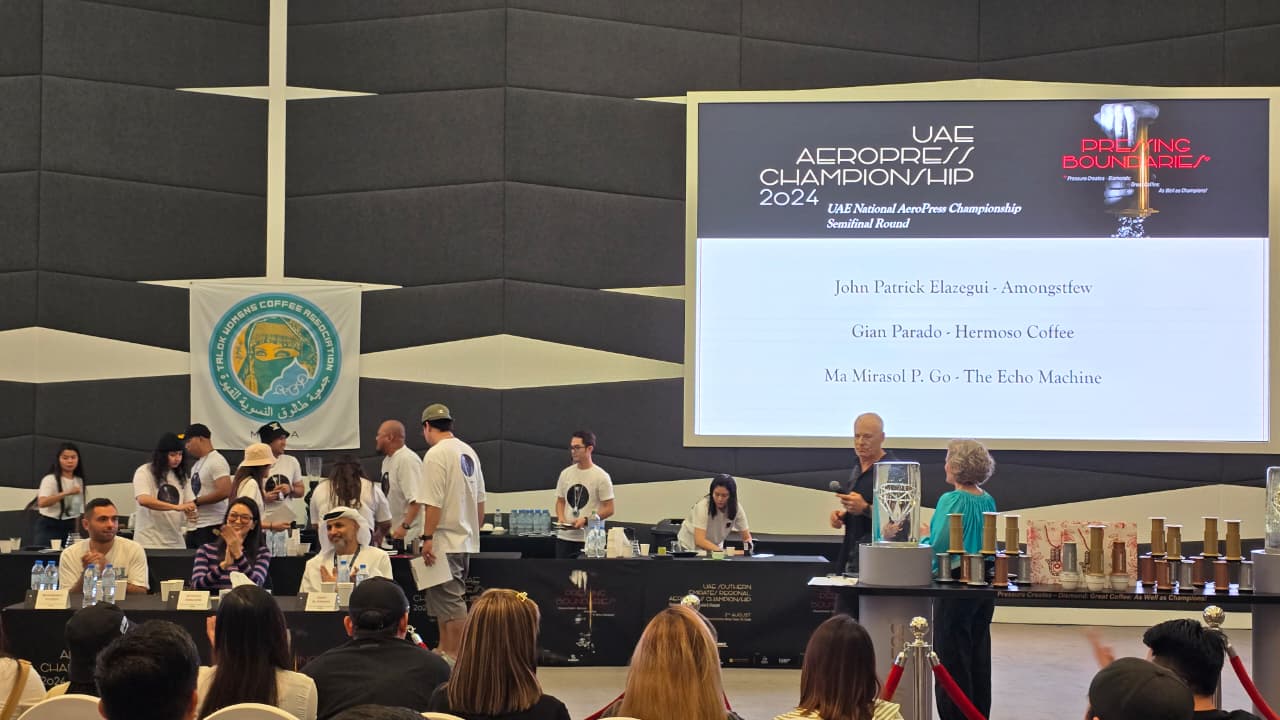
The 2024 edition crowned Sonam Sherpa of Kranti Coffee as the UAE Champion, with John Patric Elazegui of Amongstfew in second place and Alfred Samson in third. Organized by Mokha 1450, the event attracted more than 400 participants and spectators. It featured Yemeni coffee sourced from the Talooq Women’s Association in Jabal, Taiz Governorate, under the theme “Breaking Boundaries.” The program also included coffee tastings, AeroPress giveaways, and strong sponsorship support from Slayer, Coffee Desk, TSAK Trading Company, and Coffee Market Innovations.

Registration Links

The organizers confirmed that registration links will be shared on Instagram and on the official website to ensure accessibility for all competitors.

Announcement of the UAE AeroPress Championship 2025

Dubai, September 5, 2025 (Qahwa World) – The organizers of the UAE AeroPress Championship 2025 have announced that the competition will take place over three days, from November 6 to 8, hosted by the Coffee Centre of the Dubai Multi Commodities Centre (DMCC), bringing together coffee lovers and professionals from across the Emirates.

In the 2024 edition, Sonam Sherpa of Kranti Coffee claimed the title, while John Patric Elazegui of Amongstfew secured second place, and Alfred Samson took third. Organized by Mokha 1450, the event drew more than 400 participants and spectators from across the UAE.

Last year’s competition featured Yemeni coffee sourced from the Talooq Women’s Association in Jabal, Taiz Governorate, Republic of Yemen, under the theme “Breaking Boundaries,” which reflected innovation and creativity. The event also included coffee tastings and exclusive AeroPress giveaways, supported by sponsors such as Slayer, Coffee Desk, TSAK Trading Company, and Coffee Market Innovations.

2025 Competition Structure

  • November 6–7: Regional rounds across the Emirates.

  • November 8: The grand finale bringing together qualifiers from each Emirate to crown the UAE AeroPress Champion 2025.

Road to the World Championship

The UAE champion crowned on November 8 will represent the country at the World AeroPress Championship, to be held in Seoul, South Korea, on December 5–6, 2025.

DMCC Coffee Centre Announces Exciting Coffee Cupping Session in 2024

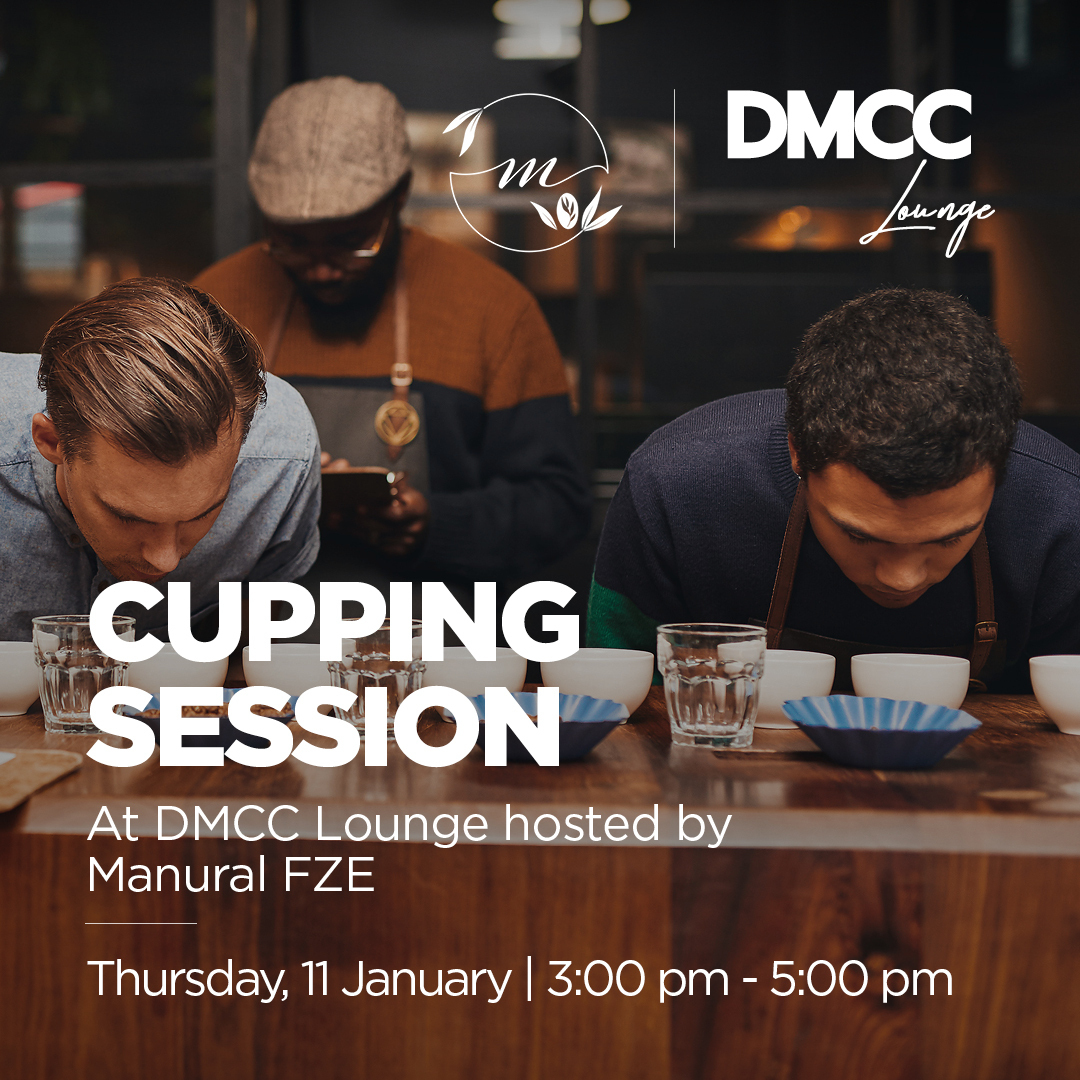
The DMCC Coffee Centre is thrilled to unveil the first coffee cupping session of the year, presented in collaboration with Manural.co. Taking place on January 11, the event will be held at the prestigious DMCCLounge, offering coffee enthusiasts an opportunity to delve into the distinct characteristics of Costa Rican coffee beans.

Manural Cupping Session

ABOUT THE EVENT

Manural FZE is set to host an engaging open cupping session at the DMCC Lounge in Almas Tower, JLT. This unique session will showcase a curated selection of premium coffee beans sourced from the vibrant coffee landscapes of Costa Rica.

To register for the event, please contact Catalina Castillo:

[email protected]

+971 58 606 0112

SESSION DETAILS

WHERE: DMCC Lounge, Almas Tower, JLT

WHEN: 3:00 PM – 5:00 PM, January 11, 2024

Join us for an afternoon of exploration and appreciation for the rich flavors and aromas that Costa Rican coffee has to offer. Don’t miss out on this exciting opportunity to enhance your coffee palate. We look forward to welcoming you at the DMCC Coffee Centre’s first cupping session of the year.

Follow the DMCC Coffee Centre’s official Instagram account for more updates and insights: @DMCCCoffeeCentre