Yemeni Coffee Culture Expands Rapidly Across the United States

SUNNYVALE – AP

Hundreds of years ago, Yemen helped introduce coffee to the world. Today, the mountainous, war-affected country is exporting something new: its distinctive coffeehouse culture.

Yemeni coffeehouses are rapidly expanding across the United States. According to Technomic, a restaurant industry consulting firm, the number of cafés operated by six major Yemeni-style chains grew by 50% last year, reaching 136 locations. This figure does not include the many independent cafés and smaller chains serving Yemeni coffee and tea.

Several factors are driving this growth. Many Yemeni cafés stay open late—sometimes past 3 a.m., especially during Ramadan—offering a social alternative for Americans who do not drink alcohol. A recent Gallup poll found that only 54% of U.S. adults reported drinking alcohol last year, the lowest rate in 90 years.

“Generally in the Middle East, our nightlife is coffee,” said Ahmad Badr, a franchise owner of Arwa Yemeni Coffee in Sunnyvale. “People gather in coffee shops, play games, and talk. We wanted to bring that here.”

Demographic shifts are also contributing to the trend. The Arab American population in the U.S. grew by 43% between 2010 and 2024, compared to roughly 10% growth for the overall population, according to the Arab American Institute.

While many Yemeni cafés are located in states with large Arab American communities—such as Michigan, California, and Texas—they are also appearing in more diverse locations, including Georgia, Kansas, and Maine.

A taste of home

For many Yemeni Americans, these cafés offer more than just beverages—they provide a connection to home.

Faris Almatrahi, co-founder of Texas-based Arwa Yemeni Coffee, said Yemen’s ongoing civil war, which began in 2014, has made travel difficult. His company, which operates 11 cafés and has 30 more in development, aims to recreate the atmosphere of Yemen.

Locations feature desert-inspired tones, mosque-like archways, and decorative elements reminiscent of traditional Yemeni culture.

“One way to experience Yemen without traveling there was to bring it here,” Almatrahi said. “It’s emotional—it really transports us back.”

However, he noted that most customers are not of Arab descent. Growing interest in global flavors and authentic cultural experiences—often fueled by social media—has broadened the appeal.

Menus typically include traditional drinks like Adeni tea, a spiced tea similar to chai, and qishr, made from dried coffee cherry husks. Familiar beverages such as lattes are often infused with spices or honey.

Food offerings may include khaliat nahal (Yemeni honeycomb bread filled with cheese and drizzled with honey) and basboosa, a syrup-soaked semolina cake flavored with lemon or rose water. Many cafés also serve more familiar items like matcha lattes and fruit-based drinks.

Expanding tastes

Industry experts say culturally specific cafés have become a major driver of growth in the U.S. coffee sector.

Peter Giuliano of the Specialty Coffee Association noted similar trends among Latin and Vietnamese coffee brands expanding their presence.

Customers are increasingly curious about new coffee profiles. Cindy Donovan, who recently visited a Yemeni café in Sunnyvale, described the experience as eye-opening.

“The flavors are more refined and mellow, but also richer,” she said. “The cardamom adds something really special—very flavorful without being heavy.”

Yemeni coffee is often sun-dried, a process that enhances its complexity, bringing out notes of chocolate and fruit. Many drinks are prepared using hawaij, a traditional spice blend that may include cardamom, ginger, cinnamon, cloves, coriander, or nutmeg.

Preparation methods also differ. “Our coffee and tea are not made with fully automatic machines,” said Mohamed Nasser of Haraz Coffee House. “We manually blend, boil, and prepare everything to achieve the perfect taste and color.”

A rich history

Coffee’s roots run deep in Yemen. While the plant is believed to have originated in Ethiopia, it was cultivated in Yemen by the 15th century, where it was used by monks to stay awake during prayers.

For about 200 years, Yemen controlled the global coffee trade before coffee plants were transported to other regions, breaking its monopoly.

In recent decades, renewed investment from entrepreneurs, organizations, and coffee specialists has helped revive Yemen’s coffee industry. Despite ongoing challenges, coffee remains one of the country’s most promising economic sectors.

“We see ourselves as ambassadors of our culture,” Almatrahi said. “Through these cafés, we share our hospitality and show what Yemen has to offer.”

Read the related stories:

Qahwah House: Bringing the Soul of Yemeni Coffee to Cahaba Heights

Yemeni Coffee Shops Expand Across Ann Arbor

Yemeni Coffee Craze Reaches Visalia with Bold Flavors and Slow Brews

Top 5 US Most Expensive Cities for Coffee

Dubai – Qahwa World

Coffee is never just a daily habit. It reflects place, culture, and the real cost of bringing coffee from farm to cup.

Across the United States, the price of a standard coffee varies widely. On average, a regular hot coffee costs between $3.50 and $3.65. In Hawaii, that same cup often exceeds $5, while cold brew can reach nearly $6.75.

Recent data from coffee shop systems places Hawaii firmly at the top, with a median price of about $5.23 for hot coffee and $6.74 for cold brew.

Why Hawaii Leads

Hawaii is one of the only regions in the United States where coffee is grown commercially, most notably Kona coffee. Here, coffee is cultivated on volcanic soil and shaped by a unique climate.

Producing coffee in Hawaii is expensive. Labor costs are high, farms are smaller, and production requires careful handling.

The islands’ remote location adds further pressure. Supplies such as milk, equipment, and packaging must be shipped across the ocean. High rents and an elevated cost of living also push prices higher.

The result is a cup of coffee that reflects both premium quality and the realities of island economics.

You may like to read: The 10 Most Expensive Cappuccino Cities in 2025

The Top 5 Most Expensive U.S. Cities for Coffee

1. Honolulu, Hawaii, around $5.23
Honolulu combines local production with high operating costs. Coffee here carries the full weight of island life and tourism demand.

2. Los Angeles, California, around $4.99
Coffee is part of lifestyle and culture in Los Angeles. High demand and expensive real estate keep prices elevated.

3. San Francisco, California, around $4.92
A strong focus on craftsmanship and quality drives coffee culture in San Francisco, alongside high business costs.

4. Seattle, Washington, notably high with strong recent increases
Seattle remains a central hub for coffee culture in the United States. Rising wages and demand continue to push prices upward.

5. New York, New York, around $4.80 to $5.00
In New York, coffee supports a fast-paced lifestyle. High rents and constant demand make it one of the most expensive markets.

You may also read: Coffee Etiquette in 2026: 12 Rules for an Elegant and Mindful Café Experience

A Cup That Tells a Story

While these cities lead in price, more affordable coffee can be found in states like Mississippi and West Virginia, where a cup costs closer to $3.

From Kona coffee grown on Hawaiian soil to a simple cup served in smaller towns, every price reflects a broader story of geography, cost, and culture.

Coffee, in the end, is not just about what is in the cup, but everything behind it.

US Coffee Market: The End of a Monopoly

Dubai – Qahwa World

The United States retail sector in 2026 is undergoing a radical economic shift that financial market analysts describe as the “loosening of the caffeine grip”. While Starbucks dominated the “third place” concept for decades, it now finds itself trapped between two forces: the Chinese technological expansion of Luckin Coffee and the rise of Yemeni coffee empires that have restored the soul of the original product—most notably Qamaria, Qahwah House, and Haraz. This report reveals through figures and field analysis how the green giant’s market share has declined from 52% in 2023 to 48% today.

  • The Triangle of Authenticity and the Erosion of Luxury

Starbucks committed a major strategic error by pivoting toward full automation and reducing seating areas to accelerate digital orders. This cultural vacuum was brilliantly filled by high-end Yemeni coffee houses, led by Qamaria, Haraz, and Qahwah House.

The Economics of Authenticity at Qamaria: Yemeni coffee is no longer just a niche beverage; it has transformed into a luxury brand. In Qamaria branches stretching from Michigan to Manhattan and California, the price of a cup—sourced from rare mountain strains—reaches $9. Nevertheless, consumers stand in long lines. The value added here is the “story and ritual”, something missing for the Starbucks customer who now feels they are buying from a factory rather than a café.

Restoring the Social Dimension: While major chain branches have turned into rapid “pickup stations”, Qamaria and its peers have revived the concept of the café as a social and cultural hub. Field data indicates that the average customer dwell time in these cafes is 40% longer than in traditional chains. This boosts sales of secondary products such as traditional sweets, dates, and private blends, supporting a higher average transaction value.

  • Chinese Tech Expansion and Cost Efficiency

From the other side, Starbucks faces an existential technological threat coming from China, as Luckin Coffee began an aggressive expansion in major US cities using the “Smart Mini-Store” model.

Cost Analysis: This model relies on rental spaces 60% smaller than traditional stores, with minimal human staff. This efficiency has allowed them to provide coffee of competitive quality at a price 25% lower, attracting the younger generation looking for fast, digitally programmed caffeine.

Algorithms vs. History: While American chains rely on their history, Chinese startups rely on demand-prediction algorithms. This reduces waste by 15% and increases service speed, placing legacy chains in the category of “bloated corporations”.

  • Market Saturation and the Supply Surplus Dilemma

Retail experts point to a bitter reality: there is too much coffee and too little distinction. With more than 34,500 chain-affiliated cafes in America, the market has reached a point of complete saturation.

The Rise of Drive-Thru: Drive-thru chains are no longer just kiosks; they have turned into massive profit engines thanks to their absolute specialisation in speed. This sector has syphoned off the “rushed” customers from major chains, who represent 60% of morning traffic.

Operational Inflation: The year 2026 saw a 12% increase in labour wages and an 8% rise in commercial real estate rents. For chains with large branches, this was a painful blow to profit margins, while Yemeni cafes like Qamaria were better able to absorb costs due to their premium pricing aimed at the elite.

  • Is the Era of the Single Pole Over?

Starbucks’ attempts to add 25,000 seats and launch smaller-format stores are seen by analysts as a late attempt to repair its identity. The problem is not the number of seats but the loss of specialisation.

The success of Qamaria and Haraz proves that the American consumer in 2026 has become “brand-agnostic”. They seek authentic Yemeni coffee on weekends for social connection, choose fast tech-driven coffee while heading to work, and only return to traditional chains when specialised alternatives are unavailable.

  • Economic Conclusion

We are witnessing the end of the “Universal Platform” era. The US coffee market today is shaped by two poles: the cultural quality pole (led preeminently by Yemen) and the technological efficiency pole (led by China and drive-thru chains). As for traditional powers, they are struggling to survive in the “middle”—the most dangerous place in modern retail economics, where price advantage is absent and cultural authenticity fades.


This report is based on performance data analysis for the period 2024–2026, periodic financial reports, and a field survey of the growth of Qamaria, Qahwah House, and Haraz branches in Michigan, New York, Texas, and California, in addition to National Coffee Association data on new American consumption patterns.


Trump Administration Considers Coffee Tariff Reduction

Dubai – Qahwa World

President Donald Trump indicated in a televised interview that his administration is preparing a policy shift aimed at reducing tariffs on coffee imports, a move expected to influence one of the most widely consumed commodities in the United States. His comments, though brief, come at a moment when households across the country are facing increased pressure from rising food and beverage prices.

In the interview, Trump noted that the upcoming steps will include lowering certain tariffs on coffee, framing the measure as part of a wider initiative to ease living costs for American families. Coffee, which the United States does not produce domestically in commercially viable quantities, remains heavily dependent on global supply chains and import regulations, making it sensitive to trade decisions and tariff schedules.

The president’s statement has drawn significant interest among economic analysts and industry observers who view the potential tariff reduction as a meaningful intervention in a market shaped by fluctuations in global supply, shipping disruptions, and heightened consumer demand. Within Washington, discussions have reportedly been underway regarding adjustments to tariffs on essential goods that form part of Americans’ daily consumption patterns, including coffee.

Reports suggest that the Treasury Department has explored possible frameworks for easing import duties on coffee shipments entering U.S. ports. Supporters of the proposed change argue that reducing these duties could contribute to lower retail prices, provided that broader logistical pressuressuch as freight costs and delivery bottlenecksdo not counteract the effect. Businesses operating in the coffee sector, particularly roasters, cafés, and national chains, have long highlighted tariff costs as a contributing factor in pricing decisions.

In parallel to the domestic policy review, the administration is described as engaging in trade dialogues with key coffee-producing countries such as Argentina, Guatemala, El Salvador, and Ecuador. These discussions reportedly address streamlining import procedures and reducing barriers that have complicated the movement of coffee into the U.S. market. Strengthening these trade channels could not only benefit exporting nations but also help stabilize supply routes that have experienced strain in recent seasons.

The U.S. coffee market has faced sustained price pressures driven by global climate challenges affecting crop yields, elevated transportation costs, and persistent shifts in consumption patterns. Retail prices have climbed steadily, prompting questions from consumers and businesses alike about the underlying factors contributing to the upward trend. Given that the United States relies almost entirely on imported green coffee beans, the sector remains highly exposed to external shocks.

From a political standpoint, the potential tariff reduction may signal an effort by the administration to respond to public concerns about inflation and household affordability. Coffee holds a unique place in daily American life, making any decline in its price particularly visible to voters. Policies that directly influence the cost of essential consumer goods can carry notable political implications.

Internationally, a U.S. decision to ease coffee tariffs could reshape commercial relationships between the United States and producing countries seeking reliable high-volume markets. Depending on the scale and timing of the policy, the move might also influence global coffee price dynamics, especially if exporters adjust their strategies in anticipation of changing demand from American buyers.

As the industry awaits more concrete details, companies across the supply chainimporters, roasters, distributors, and retailersare assessing how the potential adjustment might affect their operations. Lower tariffs could relieve some of the financial pressure that has accumulated due to higher operating costs, enabling businesses to revisit pricing models and long-term procurement strategies.

Although the president’s remarks did not include a timeline or formal policy outline, they represent the clearest indication to date that the administration is preparing to intervene directly in coffee-related import costs. The statement has already prompted expectations of a forthcoming announcement, as market participants and consumers closely watch Washington for the next development. The outcome of this initiative could have substantial implications for the future of coffee prices and availability across the United States.

Trump Faces Bipartisan Backlash Over Coffee Tariffs

Washington, D.C. – Qahwa World

A bipartisan group of U.S. lawmakers is urging President Donald Trump to exempt coffee imports from new reciprocal tariffs that have driven up consumer prices nationwide.

Representatives Ro Khanna (D-CA) and Don Bacon (R-NE) sent a joint letter to the White House requesting that coffee be added to the list of goods excluded under Executive Order 14257, arguing that tariffs on a commodity the U.S. scarcely produces only hurt consumers.

“We respectfully request your administration exempt coffee from reciprocal tariff measures that are drastically increasing its price,” the lawmakers wrote. “Given that our nation consumes around 400 million cups per day, this is one modest but meaningful way to help the American people.”

According to the Bureau of Labor Statistics, coffee prices in the U.S. rose 20.9% year-over-year in August 2025. The National Coffee Association reports that roughly 99% of all coffee consumed in the country is imported, mainly from Latin America and Africa.

Trump’s “Liberation Day” tariffs aim to level global trade terms, but coffee — not listed among exempt goods — has seen costs rise sharply. Khanna and Bacon note that Hawaii and Puerto Rico produce only small specialty quantities, representing less than 1% of domestic consumption.

“Tariffs on coffee do not protect domestic businesses and interests—they only raise costs and amount to an additional tax on American consumers,” the letter said. “It is not practical to tariff a product that our nation does not meaningfully produce.”

The lawmakers warned that higher import costs are forcing small coffee shops and hospitality businesses to raise prices or close altogether. Khanna, whose district covers Silicon Valley, said he regularly hears from café owners struggling to stay afloat.

The two legislators also recently introduced the “No Coffee Tax Act”, seeking to repeal coffee-related tariffs entirely. Bacon, who will retire from Congress next year, called the policy “a punishment to Americans,” adding, “There is no American alternative to coffee — why tariff something we can’t grow?”

A White House spokesman, Kush Desai, responded that the President had already included coffee among goods eligible for tariff-free treatment under certain trade deals, and blamed global supply disruptions in producing regions for recent price hikes.

Despite that clarification, the bipartisan pressure reflects growing unease over the wider economic impact of Trump’s tariff agenda — from agricultural exports to daily consumer goods such as coffee, a staple for two-thirds of American adults.

Worth $58.5 Billion: US Coffee Market Slows Under Cost Pressures

Dubai Qahwa World

The US branded coffee shop industry, one of the largest in the world, is showing signs of strain as growth slows amid rising costs and a tough economic climate. According to new industry research, the market is now worth around $58.5 billion, achieving 6.6% annual sales growth a dip from last year’s 7%.

Despite the cooling pace, the market continues to expand in size and scale. Net outlet growth reached 4.2% in 2025, bringing the total to more than 45,200 stores across 588 brands, although this marks a slowdown from the 5.1% growth recorded in 2024.

Expansion Meets Resistance

Big players are still adding stores. Starbucks, Dunkin’, Dutch Bros, and 7 Brew each expanded by more than 100 outlets over the past year. Yet, broader growth has been curbed by record-high green coffee costs, persistent inflation, and a 50% tariff on Brazilian imports, which together create unprecedented pressure on operators.

Drive-thru coffee chains are leading the charge. Dutch Bros surpassed 1,000 locations, while Arkansas-based 7 Brew posted the fastest expansion rate in the sector. Black Rock Coffee Bar, following its $294 million IPO in September 2025, is also preparing for nationwide growth.

Adding to the competitive landscape, China’s Luckin Coffee and Cotti Coffee have entered the US market. At the same time, more than 50 independent café businesses grew to five or more outlets, officially stepping into the branded chain category.

Consumers Pay More, Confidence Drops

Sales figures were propped up by higher menu prices. Over the last year, the average cost of a 16oz latte, cappuccino, or filter coffee rose by 3%, while iced coffee went up by nearly 5%.

Although more than half of US industry leaders reported positive sales, fewer than a third described overall trading conditions as favorable down sharply from 2024. Just 20% of executives expect conditions to improve in the coming year, and more than one-third now predict that coffee shop sales will lag behind US GDP growth.

Non-Dairy Options Go Mainstream

One of the most notable shifts in consumer trends has been the removal of surcharges for plant-based milks. Eighteen of the 20 largest coffee chains including Starbucks, Dunkin’, and Dutch Bros now serve oat, almond, and other dairy alternatives without extra charges.

Still, nearly two-thirds of industry leaders believe that surcharges remain justified due to higher costs, and more than half of customers indicated they would pay extra for their preferred alternative milk. Almond milk continues to dominate demand.

Outlook to 2030: Resilience and Adaptation

Even with mounting headwinds, the sector shows long-term resilience. Market forecasts project that the US branded coffee shop industry will exceed $63 billion within a year and reach $82.4 billion by 2030, supported by outlet growth to more than 57,700 stores nationwide.

Industry experts say growth will increasingly depend on portfolio adjustments and new strategies to meet evolving customer expectations in a challenging economy.

Black Rock Coffee Bar Raises $294 Million in Nasdaq Debut, Surpassing Expectations

Dubai – 12 September 2025 – Qahwa World – Black Rock Coffee Bar, the Arizona-based café chain, has made a strong entrance into the public markets with its initial public offering (IPO) on the Nasdaq Global Market, raising $294.1 million — above its original $265 million target.

The chain sold 14.7 million shares at $20 each, higher than the marketed range of $16–18, securing a market valuation of $956.3 million, compared to the $861 million it had projected earlier this month. Trading begins today under the ticker symbol BRCB, with underwriters also holding an option to purchase up to 2.2 million additional shares at the same price.

Founded in 2008, Black Rock Coffee Bar has grown steadily to operate 160 company-owned stores across seven US states: Arizona, California, Colorado, Idaho, Oregon, Texas, and Washington. The company intends to use the IPO proceeds to fuel its ambitious expansion plans, aiming to grow its network to 1,000 outlets by 2035.

The chain has demonstrated strong financial performance. In 2024, revenues rose 21% to reach $161 million. By August 2025, revenue for the first half of the year climbed 24% year-on-year to $95 million, with like-for-like sales growing 10.1%.

With its IPO success and solid growth trajectory, Black Rock Coffee Bar positions itself as a rising force in the US coffee market, aiming to challenge larger competitors through rapid expansion and a focus on company-owned outlets.

Pret A Manger Aims to Double UK Stores Following Strong 2024 Growth

Pret A Manger is preparing for a major expansion across the UK after reporting robust growth in 2024.

The London-based coffee and food-to-go chain, which currently operates 500 stores in the UK and another 200 across 20 international markets, achieved 10% year-on-year revenue growth in 2024, reaching £1.2bn ($1.6bn). Adjusted EBITDA rose 36% to £98m ($133m).

Chief Executive Pano Christou, who has led the JAB Holding-backed business since 2019, said Pret aims to double its UK footprint to 1,000 outlets by focusing on city centres and transport hubs. “Customers love the brand on the go. Our travel business has really exploded in recent years. We have eight locations at Heathrow and will add two more next year,” he told reporters.

Pret ended 2024 with 717 outlets across 21 global markets. Alongside its expansion plans, the chain will introduce new value-driven offerings, including a £6-£7 ($8.14-$9.50) lunchtime meal deal trial in the UK. The initiative, already successful in France, is expected to boost sales and afternoon footfall.

The company has also launched a premium ‘Super Plates’ salad range in 250 UK stores and overhauled its Club Pret subscription, scrapping its five-coffees-a-day offer for £30 ($38.99). Additionally, a new store format targeting dine-in and family groups has been unveiled in its home market.

Beyond the UK, Pret is seeking significant growth in the US, where it operates 70 stores generating approximately $100m annually, mainly in New York. Christou highlighted transport hubs along the East Coast as the primary focus for expansion. In October 2023, Pret signed a joint venture with franchise partner Dallas International to triple its US footprint by 2029, and in July 2025, it appointed former Tim Hortons executive Felipe Athayde as President of its North America business.

“2024 was another year of growth for Pret, where we took disciplined decisions to protect sales despite intense pressures on the hospitality industry. Our priority now is to drive transactions and sustainable growth by offering great value for Pret customers,” Christou said.

The Rise of Coffee Chains

By: Serkan Oral

The 21st century is the age of coffee chains more than any other. Coffee beans are becoming as valuable as gold. The sector continues its upward trend, driven by the rapid expansion of coffee chains worldwide.

Let’s talk numbers.
Between 2015 and 2024, global coffee imports reached a total of $370.3 billion. The United States accounted for $69.2 billion of this total, followed by Germany with $41.9 billion and France with $28.9 billion. Other major importers included Italy, Canada, Belgium, Spain, Japan, the Netherlands, and Switzerland, with their combined imports amounting to $238.5 billion. Altogether, the top 10 coffee importers represented 64.4% of the global market during the past decade.

There are also emerging markets on the rise.

Meanwhile, Brazil stood as the world’s largest coffee exporter, with exports over the past decade totaling $360.3 billion, followed by Switzerland with $28.7 billion and Colombia with $28.6 billion. Other significant exporters were Germany, Vietnam, Italy, Honduras, France, Belgium, and Indonesia.

Türkiye carries a dual identity in the global coffee story — as both the heir to the Ottoman coffee legacy and as a modern hub for new-generation coffee culture.

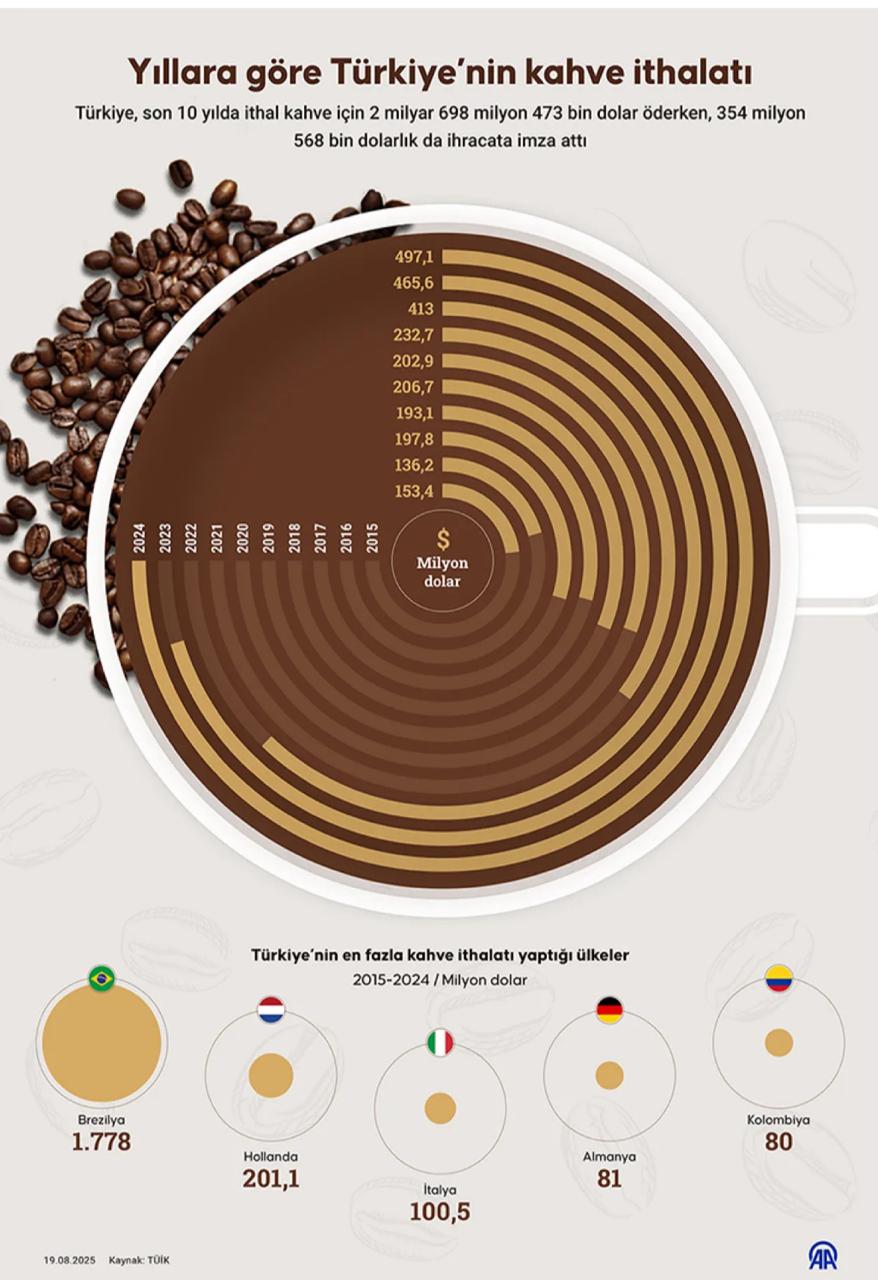
Türkiye’s coffee imports between 2015 and 2024 reached $2.7 billion, with prices for imported coffee rising from $153.4 million in 2015 to $497.1 million in 2024, marking an increase of 224%, according to the national statistical bureau TurkStat.

On the export side, Türkiye recorded $354.5 million worth of coffee exports over the last decade, including $55.6 million in the first half of this year alone.

Türkiye imported most of its coffee from Brazil, totaling $1.7 billion, followed by the Netherlands with $201.1 million, Italy with $100.5 million, Germany with $80.9 million, and Colombia with $79.9 million. The country’s imports stood at $472.5 million as of June, with Brazil remaining its top supplier.

The world’s coffee consumption — both hot and iced — over the past decade totaled $370.3 billion, according to data from the International Trade Center (ITC). The United States was the largest importer, while Brazil dominated exports.

Personally, I prefer iced coffee on summer afternoons, but I always start my day with a hot Turkish coffee. For Turks, the tradition of the 11 a.m. coffee break continues as a nationwide ritual. Around the world, specialty coffee is also gaining momentum, and habits are evolving quickly.

The golden era of coffee and coffee shops has already begun, spreading across continents. More lovely qahwa days are on the horizon.