Brazil Dryness Ahead of Flowering Period Boosts Coffee Prices

Dubai, September 8, 2025 (Qahwa World) – Coffee prices surged today, with December arabica futures rising by +9.65 cents per pound (+2.58%) and November robusta contracts climbing +$119 per ton (+2.76%). The rally comes as severe dryness in Brazil’s coffee-growing regions raises concerns about yields ahead of the critical flowering period. Meteorology agency Somar reported that Minas Gerais, Brazil’s largest arabica-producing state, received no rainfall during the week ending September 6.

Additional support came from Brazil’s crop forecasting agency Conab, which cut its 2025 arabica crop estimate by -4.9% to 35.2 million bags, down from 37 million bags projected in May. Conab also lowered its total coffee production forecast for 2025 by -0.9% to 55.2 million bags.

Meanwhile, the International Coffee Organization (ICO) reported that global coffee exports in July fell -1.6% year-on-year to 11.6 million bags, while cumulative exports for October through July were down -0.3% at 115.6 million bags.

Tighter stocks at the ICE exchange are also supporting prices. ICE-monitored arabica inventories dropped to a 1.25-year low of 686,863 bags last week before slightly rebounding to 692,766 bags. Robusta inventories remain close to a 1.5-month low at 6,552 lots.

U.S. supplies are under additional pressure from trade measures. American buyers have begun canceling contracts for Brazilian beans following the imposition of 50% tariffs on imports, tightening supply as about one-third of U.S. unroasted coffee comes from Brazil.

Harvest progress in Brazil is also influencing prices. Cooxupé, the country’s largest coffee cooperative, reported that its members’ harvest was 94.9% complete by August 29. Separately, Safras & Mercado estimated the national 2025/26 crop at 99% complete by August 20, with robusta fully harvested and arabica 98% complete.

Export data shows a sharp decline. Brazil’s Trade Ministry reported that unroasted coffee exports in July fell -20.4% year-on-year to 161,000 tons. Exporter group Cecafe said green coffee exports were down -28% to 2.4 million bags, with arabica shipments falling -21% and robusta plunging -49%. Total shipments from January through July dropped -21% to 22.2 million bags.

Vietnam, the world’s second-largest coffee producer, also faces challenges. Its 2023/24 crop fell -20% to 1.472 million tons, the smallest in four years, while 2024 exports dropped -17.1% to 1.35 million tons. However, January–August 2025 exports rose +7.8% year-on-year to 1.141 million tons. The Vietnam Coffee and Cocoa Association reduced its 2024/25 output estimate to 26.5 million bags, down from 28 million bags.

Looking ahead, the U.S. Department of Agriculture (USDA) projects global coffee production for 2025/26 to rise +2.5% to a record 178.7 million bags. Arabica output is expected to fall -1.7% to 97 million bags, while robusta production is forecast to grow +7.9% to 81.6 million bags. Ending stocks are projected to climb +4.9% to 22.8 million bags. However, trading group Volcafe warns of an -8.5 million bag global arabica deficit in 2025/26, compared with a -5.5 million bag deficit in 2024/25—marking the fifth consecutive year of shortages.
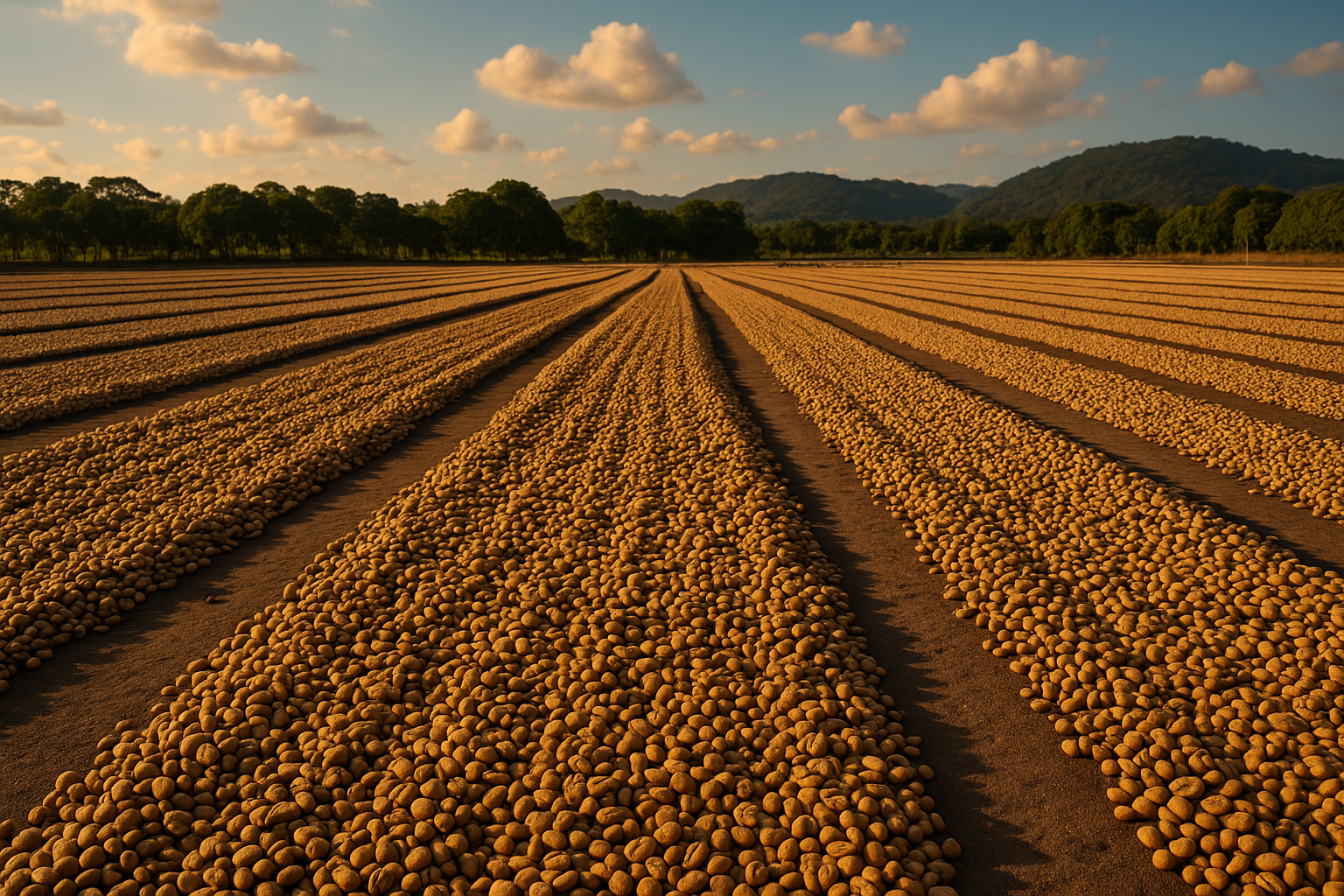
Global Coffee Prices Surge as Brazil Faces Weather Woes and US Tariffs

São Paulo, August 25, 2025 (Qahwa World) – Coffee markets remain under heavy pressure from climate shocks in Brazil and trade tensions with the United States, pushing prices sharply higher in recent weeks, even as a stronger U.S. dollar triggered modest profit-taking on Monday.

Arabica futures in New York had surged to a 3.5-month high earlier in the day but ended lower, with December contracts closing down 0.15% after investors booked profits. September robusta contracts were idle due to a UK holiday. Analysts said the dollar’s strength spurred liquidation, though underlying supply concerns continue to dominate the market.

In Brazil, retail coffee prices that had fallen an average of 12% earlier in August are now expected to reverse course. According to the Brazilian Coffee Industry Association (ABIC), raw coffee prices rose almost 25% between July and August, reaching 2,191 reais ($395) per 60-kilogram bag. Despite this surge, supermarket prices in August averaged 58.99 reais (around $10) per kilogram, still below May’s peak of 70 reais/kg. ABIC’s executive director, Celirio Inacio, warned that if futures remain elevated, higher shelf prices are “inevitable.”

The main external factor driving the rally remains the 50% tariff imposed by the U.S. government on Brazilian goods, including coffee. Brazil normally supplies about one-third of U.S. unroasted coffee imports, and American buyers have already begun canceling contracts. Marcio Ferreira, president of Brazil’s Coffee Exporters Council (Cecafé), called the tariffs “the main driver” of the sharp price increases in New York.

Weather concerns add another layer of pressure. Somar Meteorologia reported that Minas Gerais, Brazil’s largest arabica-producing state, received no rainfall in the week ending August 23. Frost damage earlier in the month has also raised fears of reduced yields. Despite this, Brazil’s 2025/26 harvest is almost complete: Safras & Mercado estimated 99% of the crop had been gathered by August 20, with robusta fully harvested and arabica at 98%. Cooxupé, the country’s largest cooperative, reported its members’ harvest at 86.1% by mid-August.

Exports are slowing dramatically. Brazil’s July shipments of unroasted coffee dropped 20.4% year-on-year to 161,000 metric tons, while Cecafé data showed green coffee exports fell 28% to 2.4 million bags. Arabica exports fell 21%, robusta plunged 49%, and total shipments from January through July were down 21% from last year at 22.2 million bags. Meanwhile, inventories tracked by ICE remain at multi-year lows: arabica stocks hit a 15-month low of 726,661 bags in mid-August, while robusta fell to its lowest in four weeks.

Global dynamics reflect the same strain. The USDA’s Foreign Agriculture Service (FAS) projects world coffee production in 2025/26 will rise 2.5% year-on-year to a record 178.7 million bags, with robusta up nearly 8% but arabica slightly down. Brazil’s production is forecast to rise only 0.5% to 65 million bags, while Vietnam could rebound 6.9% to 31 million bags, its largest in four years. Yet despite the higher output, trading house Volcafe predicts an arabica deficit of 8.5 million bags for 2025/26 — the fifth consecutive year of shortfalls.

Brazil, as the world’s top coffee producer and exporter and the second-largest consumer after the United States, stands at the center of these global shifts. With tariffs restricting trade, exports slowing, inventories tightening, and weather threats mounting, analysts warn that consumers should brace for rising retail coffee prices both domestically and worldwide — even if day-to-day trading sometimes pulls prices lower.