Lavazza Launches Regenerative Coffee for Professionals

Dubai – Qahwa World

On Earth Day, Lavazza has introduced La Reserva de ¡Tierra! Selection, its first coffee for the professional channel certified under the regenerative agriculture standard developed by the Rainforest Alliance.

The launch marks a new step in the company’s sustainability strategy, combining existing Rainforest Alliance Sustainable Agriculture certification with the newer regenerative agriculture certification. The dual certification reflects farming practices aimed at restoring ecosystems, improving soil health, protecting biodiversity, and supporting coffee-growing communities.

The development follows a multi-year effort by Lavazza to integrate regenerative agriculture across its supply chain. Since 2023, the group has advanced projects through its research, development, and corporate social responsibility teams in origin countries, focusing on agronomic practices, environmental impact measurement, traceability, and farmer engagement.

In parallel, the company has supported an early implementation program in Honduras, where more than 70 farms have achieved certification under the Rainforest Alliance Regenerative Agriculture Standard. The initiative included technical training, operational support, and structured guidance to assist farmers in transitioning to regenerative practices.

According to Lavazza, this combined approach has enabled the faster introduction of a coffee product meeting both certification standards, building on its partnership with the Rainforest Alliance that dates back more than two decades.

The Rainforest Alliance Regenerative Agriculture Standard is designed to promote a “Nature Positive” approach to farming. It emphasizes soil restoration, climate resilience through agroforestry, biodiversity protection, improved water management, and better livelihoods for farming communities.

La Reserva de ¡Tierra! Selection is a 100% Arabica blend, combining natural coffees from Brazil with washed coffees from Honduras. Developed for the food service sector, it offers a balanced flavor profile with notes of jasmine, almonds, and milk chocolate, and is designed for consistent extraction in professional settings.

The blend includes coffee sourced from certified farms in Brazil and Honduras, along with a portion from a project supported by the Lavazza Foundation in Brazil’s Minas Gerais region. The initiative focuses on farmer training, agricultural planning, and improvements to living conditions.

Lavazza said the new product will be available in international markets starting in June, supported by a digital campaign highlighting its regenerative agriculture efforts and collaboration with certified farms.

Founded in Turin in 1895, Lavazza operates in more than 140 markets and remains one of the leading global coffee companies, with a portfolio that includes several international brands. The Rainforest Alliance continues to work with farmers, companies, and communities worldwide to promote sustainable agriculture and environmental conservation.
Sustainability Day Sets the Technical and Policy Tone at AFCC&E

Addis Ababa – Qahwa World × Buna Kurs

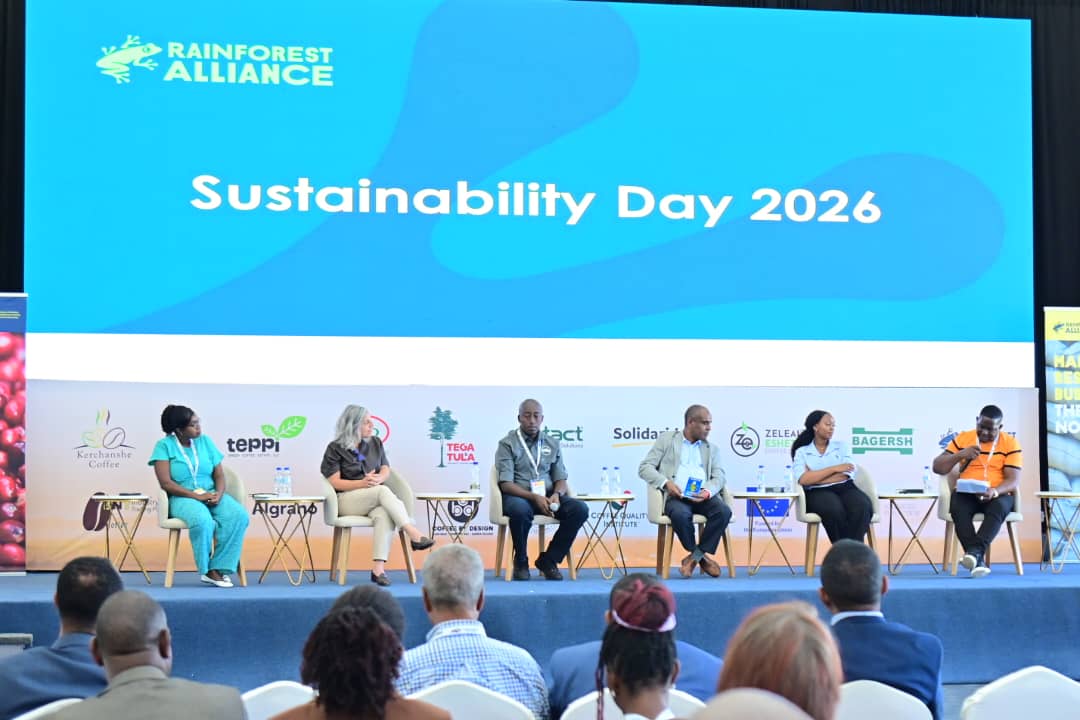
Day One of the 22nd African Fine Coffees Conference & Exhibition (AFCC&E) concluded in Addis Ababa with sustainability firmly positioned as the cornerstone of this year’s continental coffee dialogue. Following the morning’s high-level opening ceremony, the conference program transitioned into the 7th AFCA Sustainability Day, delivered in partnership with the Rainforest Alliance under the theme “Sustainability in Every Cup: Brewing a Regenerative Future, Today.”

At the center of the day’s agenda was the presentation and launch of the Rainforest Alliance Regenerative Agriculture Standard (RAS), a new certification framework designed to move beyond compliance toward ecosystem restoration and long-term farmer resilience across tropical landscapes.

Across the venue, the exhibition hall remained active throughout the day, with strong foot traffic from producers, exporters, buyers, service providers, and development partners. Exhibitors noted a visibly expanded floor layout and higher engagement compared to previous editions, reflecting both the growing scale of the event and renewed market interest in African coffee origins.

The Sustainability Day program highlighted how regenerative agriculture is being applied in practice across East Africa, with experiences shared from Kenya, Uganda, and Ethiopia, including MSuLLi, Mountain Harvest, Moplaco Farm, and sector partners working at farm, landscape, and market levels. A dedicated youth testimony segment reinforced a growing generational consensus: sustainability is no longer an add-on, but a prerequisite for remaining competitive in the global coffee sector.

Afternoon sessions shifted the discussion to the value of sustainability standards within the global supply chain, examining how certification, traceability, and transparency are increasingly shaping trade relationships. Panels featuring exporters, producers, and international buyers addressed the commercial realities of sustainability, with participation from Midrock Investments Group, Touton, ECOM, AMG Coffee Export, Preferred by Nature, and regional producer representatives.

Beyond the conference hall, B2B cupping sessions continued alongside networking activities, offering international buyers early exposure to coffees from across Africa while reinforcing the link between quality, sustainability, and market access.

Day One concluded with an invitation-only policy and networking reception, followed by the Opening Cocktail at the AICC Amphitheater, marking the informal start of a week expected to shape Africa’s coffee sustainability agenda for years to come.

EU Eases EUDR Rules to Ensure Smooth Rollout by 2025

Brussels – Qahwa World

The European Commission has announced adjustments to the EU Deforestation Regulation (EUDR) aimed at ensuring its timely implementation by 30 December 2025. The changes include lighter reporting requirements, deadline extensions for small businesses, and simplified due diligence obligations to reduce administrative complexity and IT system strain.

The EUDR, which targets commodities linked to deforestation such as coffee, cocoa, palm oil, paper, and wood, will require importers to prove that their products have not contributed to forest degradation anywhere in the world after 31 December 2020. Initially scheduled for December 2024, the regulation was postponed by one year to give coffee producers and other stakeholders additional time to comply.

Under the updated proposal introduced on 21 October 2025, micro and small enterprises will receive an additional 12-month extension to 30 December 2026. Large and medium-sized companies must still meet the 30 December 2025 deadline but will benefit from a six-month grace period for checks and enforcement. To streamline the process, the Commission will now require only a single due diligence statement across a product’s entire supply chain, easing the burden for businesses and simplifying data management within the EU’s internal systems.

The revised framework maintains that “upstream” operators—those first placing regulated commodities on the EU market—will continue to exercise due diligence. “Downstream” operators, typically traders handling products already imported into the EU, will no longer be obligated to submit separate compliance statements.

Environmental groups have cautiously welcomed the move, seeing it as a pragmatic step to avoid further delays, though some have expressed concern that the changes could weaken the regulation’s impact. “We reiterate our call to address the specific challenges millions of smallholders face in producing EUDR-compliant products and the disproportionate burden placed on their shoulders,” the Rainforest Alliance said in a statement.

The WWF offered a stronger critique, calling the decision “a shameful surrender to political pressure.” Anke Schulmeister-Oldenhove, Senior Forest Policy Officer at WWF, said the Commission’s reference to IT system issues “feels like a perfect scapegoat to water down the regulation.”

The proposed amendments will still need formal approval by the European Parliament and the European Council before implementation. If adopted, they would mark a significant shift in how the EU enforces environmental due diligence, with major implications for global trade in deforestation-linked commodities, including coffee.

Rainforest Alliance Launches First Regenerative Agriculture Certification for Coffee

Dubai, 9 September 2025 (Qahwa World) – The Rainforest Alliance has announced the launch of the world’s first dedicated regenerative agriculture certification for coffee, a milestone that seeks to transform farming practices from simply reducing harm to actively restoring ecosystems and improving farmer livelihoods. The new “regenerative” seal is expected to appear on consumer coffee bags starting in 2026.

This initiative follows the release of version 1.4 of the Sustainable Agriculture Standard, which will take effect in October 2025. The revised standard reduces the number of requirements from 221 spread across seven categories to 148 requirements consolidated into three, making certification more straightforward for farmers while maintaining its credibility. Alongside this streamlining, certificate holders now have the option to add 17 regenerative requirements to their existing certification, or to pursue a standalone regenerative certification consisting of 119 requirements focused on soil health, biodiversity, water management, climate resilience, and farmer livelihoods.

The Rainforest Alliance has framed regenerative agriculture as a shift beyond a “do no harm” mindset toward one of repair and restoration. The new certification aims to make coffee part of an ecological recovery process that benefits both the land and the farming communities that depend on it. The organization emphasized that every future cup of coffee should give back more than it takes. A recent report by TechnoServe supported this view, finding that the transition to regenerative agriculture in key coffee-producing countries could significantly increase exports and raise farmer incomes.

Implementation of the new certification has already begun in coffee farms across Brazil, Costa Rica, Mexico, and Nicaragua. The first coffees carrying the regenerative seal are expected to reach international markets in 2026, targeting consumers who increasingly demand sustainable and credible products. The launch also coincides with sector-wide initiatives such as RegenCoffee, introduced by the Global Coffee Platform to create a common language around regenerative agriculture, further strengthening Rainforest Alliance’s leadership in this field.

Beyond the environmental and social dimensions, the development comes at a critical moment as the European Union’s deforestation-free supply chain law (EUDR) is set to take effect on 30 December 2025. The law will require companies to prove that commodities entering EU markets are not linked to deforestation. Observers note that the regenerative certification could provide companies with an essential tool to comply with these new requirements, especially in the coffee sector, which faces growing regulatory scrutiny.

Despite the enthusiasm, there are concerns that additional certification layers could impose extra burdens on smallholder farmers who already struggle with limited resources. The Rainforest Alliance has responded by stressing that the new standard was developed over years of research and consultation with farmers, companies, and civil society groups. The goal, it said, is not to increase burdens but to build long-term resilience and open new opportunities for market access.

By combining the streamlined Sustainable Agriculture Standard with the launch of the first regenerative certification for coffee, the Rainforest Alliance is signaling a strategic shift in its vision. The initiative goes beyond traditional sustainability frameworks, aiming to create a new agricultural model that balances environmental protection, agricultural economics, and social development. With this step, the global coffee sector enters a new chapter in which every cup of coffee is not just a beverage, but a contribution to restoring the planet and securing a more sustainable future.