Dubai, September 12, 2025 – Qahwa World – Global coffee markets surged sharply on Friday, with December arabica futures climbing +10.75 cents (+2.78%) to a four-month high and November robusta futures rising +$80 (+1.77%) to a one-and-a-half-week peak.
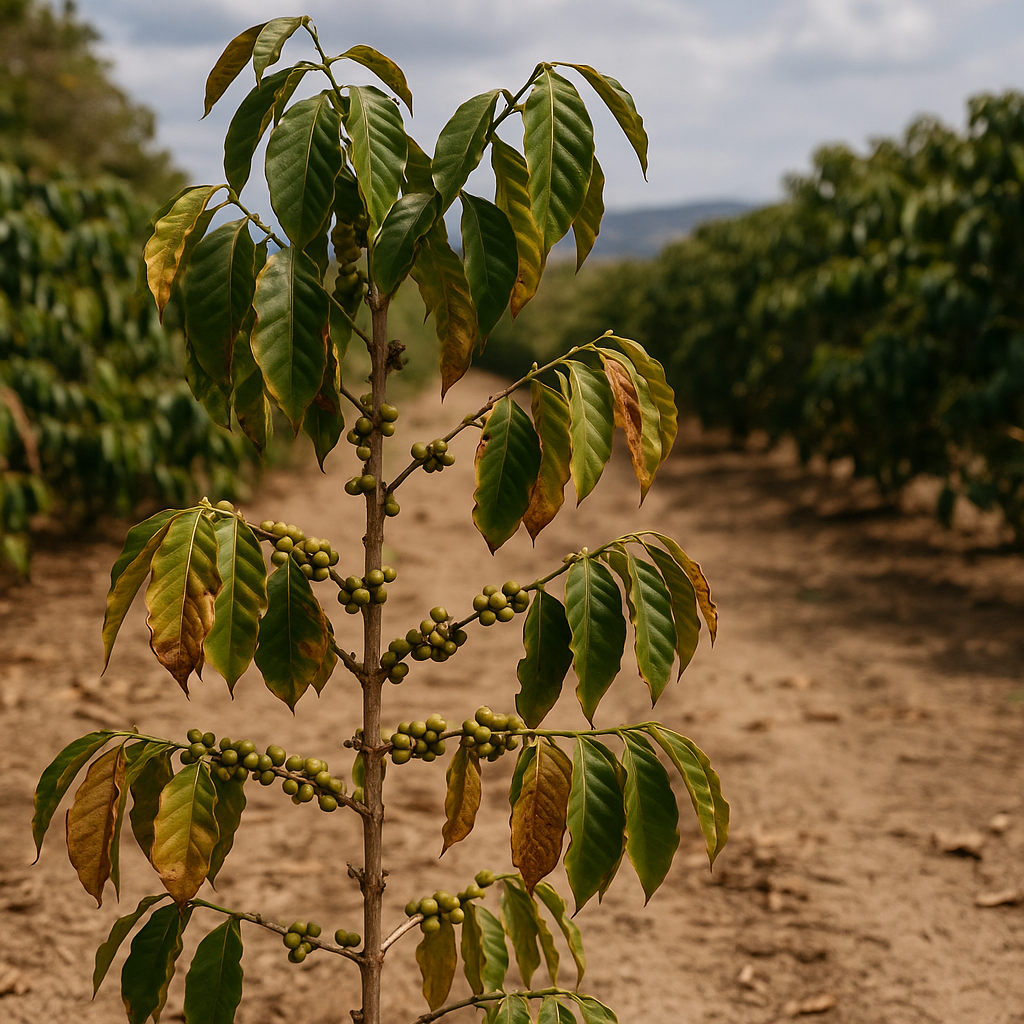
The rally is being driven primarily by ongoing drought in Brazil, the world’s largest coffee producer. Weather agency Somar Meteorologia reported that Minas Gerais, Brazil’s largest arabica-producing state, received no rainfall during the week ending September 6 — a critical period just ahead of the flowering stage for coffee trees.
A stronger Brazilian real added further bullish momentum, rallying to a 15-month high against the US dollar on Friday. A stronger real typically discourages coffee exports, as producers are less incentivized to sell abroad.
In the United States, concerns over tighter supplies are mounting as buyers cancel new contracts for Brazilian beans following the imposition of 50% tariffs on imports. Roughly one-third of America’s green coffee supply comes from Brazil, making the tariffs a significant disruptor for the US market.
Tightness in ICE-monitored inventories has also supported prices. Arabica stocks fell to a 16-month low of 669,251 bags, while robusta inventories declined to a two-week low of 6,557 lots.
Adding to the bullish outlook, Brazil’s crop forecasting agency Conab cut its 2025 arabica production estimate by -4.9% to 35.2 million bags from its May forecast of 37 million. Total Brazilian coffee output for 2025 was also revised lower by -0.9% to 55.2 million bags.
On the trade side, the International Coffee Organization (ICO) reported that global exports in July fell -1.6% year-on-year to 11.6 million bags. Cumulative exports from October to July slipped -0.3% year-on-year to 115.6 million bags.
Brazil’s July shipments added more pressure to the supply side. The Trade Ministry reported that unroasted coffee exports dropped -20.4% year-on-year to 161,000 metric tons. Exporter group Cecafe confirmed a steeper fall, with green coffee exports plunging -28% to 2.4 million bags. Arabica exports dropped -21% while robusta exports plunged -49%. Cecafe added that total July shipments fell -28% to 2.7 million bags, while cumulative January–July exports fell -21% to 22.2 million bags.
Meanwhile, Brazil’s harvest is nearly complete. Cooxupé, the country’s largest coffee cooperative, reported that 97% of its members’ harvest was completed by September 5. Separately, consultancy Safras & Mercado noted that the national 2025/26 harvest reached 99% by August 20, including 100% completion of robusta and 98% of arabica.
In Vietnam, the world’s second-largest producer, 2023/24 coffee output fell -20% year-on-year to 1.47 million metric tons, the smallest crop in four years. Exports in 2024 fell -17.1% to 1.35 million metric tons. However, the General Statistics Office reported that January–August 2025 exports rose +7.8% to 1.14 million metric tons.
Looking ahead, the USDA’s Foreign Agricultural Service (FAS) projected on June 25 that global coffee production in 2025/26 will rise +2.5% year-on-year to a record 178.68 million bags. The forecast includes a -1.7% decline in arabica to 97.02 million bags and a +7.9% increase in robusta to 81.65 million bags. Brazil’s 2025/26 crop is expected to rise +0.5% to 65 million bags, while Vietnam’s production is forecast to grow +6.9% to 31 million bags, a four-year high. Global ending stocks are forecast to rise +4.9% to 22.8 million bags, up from 21.7 million in 2024/25.
However, trader Volcafe has issued a more cautious outlook, projecting a global arabica deficit of -8.5 million bags in 2025/26, compared with a -5.5 million bag deficit in 2024/25. This would mark the fifth consecutive year of deficits for arabica, underscoring structural supply concerns.
The combination of Brazil’s drought, lower exports, shrinking inventories, and global trade pressures highlights the fragility of the balance between supply and demand — setting the stage for further volatility in one of the world’s most important agricultural commodities.

