ICO: Coffee Prices Hit Historic Surge as Exports Decline

Dubai, September 3, 2025 (Qahwa World) – The International Coffee Organization (ICO) in its August 2025 report revealed unprecedented shifts in the global coffee market, with the ICO Composite Indicator Price (I-CIP) rising by 14.6% to 297.05 US cents per pound – its highest level since 2024 and 24.3% higher year-on-year. At the same time, the report highlighted that global green coffee exports continued to contract for the sixth consecutive month, underscoring the dual pressure of soaring prices and shrinking supplies.

Historic Price Surge
According to the ICO, all coffee groups recorded strong gains. Robusta led the surge with a 19.1% increase to 199.13 US cents per pound, while Colombian Milds, Brazilian Naturals, and Other Milds rose between 12% and 14%. Futures prices also jumped sharply, with New York contracts up 13.6% and London contracts up 18.2%, signaling broad-based upward momentum.

Market Drivers
The report identified multiple factors fueling the rally:

  • The United States’ 50% tariff on Brazilian coffee, slowing down commercialization.

  • Brazil’s government support through the Funcafé fund, allocating BRL 6.8 billion (USD 1.29 billion) to finance the 2025/26 harvest.

  • Reports of lower bean density in Brazil despite large screen size, reducing crop estimates.

  • European roasters stockpiling ahead of the EU’s Deforestation Regulation (EUDR) deadline in December 2025.

  • A minor frost in Brazil damaging up to half a million bags.

  • Roasters increasing long positions in futures markets to hedge against further price hikes.

Export Downturn
The ICO report also showed global green coffee exports reaching 10.3 million bags in July 2025, down 0.7% from July 2024. South America posted the steepest decline (-18.5%), driven by Brazil’s 28.6% fall in shipments.

Regional Contrasts

  • Asia & Oceania exports surged by 22.7%, led by Vietnam (+29.4%) and Indonesia (+20.4%).

  • Africa’s exports rose 4.4%, with Uganda (+51.4%) and Ethiopia (+12.5%) as key contributors.

  • Mexico & Central America posted a moderate increase of 7.2%.

Looking Ahead
The ICO emphasized that the combination of rising prices and falling exports places the global coffee market in a volatile phase. With the EUDR coming into effect by year-end and climate-related risks looming over major producers, coffee is set to remain one of the most vulnerable agricultural commodities to both economic and environmental shocks.

Brazil Estimates Coffee Export Losses at $196.5 Million

Cecafé: Brazilian coffee exporters lost nearly $200 million in July 2025

Dubai, September 3, 2025 (Qahwa World) – Brazil, the world’s largest coffee producer and exporter, has faced severe challenges due to disruptions in its port infrastructure. According to the Brazilian Coffee Exporters Council (Cecafé), total exporter losses in July 2025 amounted to $196.5 million.

Cecafé reported that overloaded and strained port facilities caused massive delays and forced changes in shipping routes. As a result, more than 598.7 thousand 60-kg bags of coffee could not be shipped in July. The average value of a bag was $385.4, while the longest idle period reached 35 days. In total, exporters lost the equivalent of 1.1 billion reals ($196.5 million), and shipments to the global market fell by 27%, dropping to 164 thousand tons.

Beyond logistical problems, Brazilian farmers also faced prolonged frosts. Experts warned that these unfavorable weather conditions triggered stress flowering, which could negatively impact not only the 2025 harvest but also next year’s production.

The disruptions in Brazil and Vietnam have already intensified pressure on the global coffee market. In New York, arabica prices rose to a two-month high in July, while in London, on November 27, the January futures price for robusta reached $5,547.5 per ton (+7.55%), setting a record since at least January 2008, according to ICE Futures.

Luza Baiguzina, Associate Professor at IMES, previously warned that difficulties with exports from Brazil and Vietnam could push coffee prices in Russia up by as much as 20% in 2026.

Vietnam Coffee Industry Poised to Benefit from Global Price Surge

HANOI – August 30, 2025 (Qahwa World) — Vietnam’s coffee industry is moving to capitalize on soaring global prices, with exports recording strong growth and experts urging greater investment in processing and branding to ensure long-term sustainability.

According to the Ministry of Agriculture and Environment, Vietnam’s coffee export turnover reached more than $560 million in July, bringing the total export value for the first seven months of 2025 to $3.6 billion. This represents a 20 percent year-on-year increase and underscores the industry’s ability to leverage favorable international conditions.

The growth comes amid a rally in global coffee prices. A study by the Food and Agriculture Organization reported that prices rose globally by about 40 percent in 2024, driven by unfavorable weather conditions linked to climate change. Production declines in Brazil, Colombia, and Indonesia reduced global supply, while demand in Europe, the United States, and Asia continued to expand.

A strong market position
Vietnam is the world’s largest exporter of Robusta coffee, accounting for around 40 percent of the global market. This dominance, combined with stable supply, gives the country a competitive edge at a time when many producers are struggling with weather disruptions.

Nguyen Nam Hai, president of the Vietnam Coffee and Cocoa Association, emphasized that “the international coffee market has never been as favorable as it is now. With high prices, strong demand, and Vietnam’s reliable supply, the industry is in an advantageous position.”

However, Hai and other experts caution that to take full advantage of these conditions, Vietnam must expand into deep processing and value-added products instead of relying primarily on raw bean exports.

Processing gap remains wide
While exports are rising in value, the structure of Vietnam’s coffee trade remains heavily skewed toward raw beans. Deep-processed coffee, including roasted, instant, and specialty products, currently accounts for just 12–15 percent of total exports. This is significantly lower than in Brazil and Colombia, where processed coffee represents 30–40 percent of total shipments.

Industry leaders say this gap leaves Vietnam vulnerable to fluctuations in global commodity prices. Le Hoang Diep Thao, founder and chief executive of King Coffee, told local media that investing in processing allows companies to “multiply the value of their products significantly.”

But she acknowledged that the financial barriers are steep. Instant coffee production technology alone requires capital investments running into hundreds of billions of dong, which many small and medium-sized enterprises cannot afford. In addition to high costs, technological limitations and branding weaknesses continue to slow progress.

Technology and branding challenges
Large enterprises such as Vinacafe, Trung Nguyen, and Nestlé have invested in processing facilities, but many smaller businesses lack the technological capacity to compete. The industry’s processing base remains uneven, particularly in the specialty coffee and instant coffee segments.

Branding is another critical challenge. Internationally, Vietnam is recognized for its export volume, but its consumer brands have yet to achieve significant recognition. Global buyers often associate coffee with well-known international names such as Starbucks from the United States, Lavazza from Italy, or Nestlé from Switzerland. This lack of global brand presence makes it harder for Vietnamese processed coffee to compete in premium markets.

Agricultural economist Dinh Van Thanh warned that “if Vietnam continues to depend mainly on raw exports, it will remain only an ingredient supplier for large multinational corporations.” He stressed the need for a long-term national strategy to boost processing capacity and to build a recognized coffee brand that can stand alongside global competitors.

Positive signals from the industry
Despite these challenges, signs of progress are emerging. Trung Nguyen Legend has been expanding its instant coffee exports to markets in the Middle East and Eastern Europe. Vinacafe has shifted focus toward developing sales within the ASEAN region. Meanwhile, several start-ups in Lam Dong and Gia Lai are working to establish specialty coffee brands targeting premium consumers in Japan and South Korea.

Rather than exporting raw beans, some of these start-ups are partnering with international buyers to roast and process coffee locally before shipping it abroad. According to Thao, this model doubles the selling price compared to raw beans while also ensuring farmers receive higher incomes.

Strategic recommendations
Industry specialists believe that to maintain momentum and secure its place in the global market, Vietnam must adopt a three-pronged strategy.

First, investment in deep processing technology must be accelerated. Government support through preferential credit policies could play a crucial role in enabling businesses to acquire the necessary machinery and production lines for instant and specialty coffee.

Second, Vietnam must prioritize the development of a strong national coffee brand. Experts point to models such as Thailand’s Jasmine rice and Colombia’s Arabica coffee, both of which have achieved global recognition. A similar effort in branding would enhance Vietnam’s visibility and competitiveness on the international stage.

Third, attention should be directed toward emerging markets such as the Middle East, South Asia, and Eastern Europe, where demand for coffee is growing rapidly. These regions present opportunities for processed Vietnamese coffee to establish new distribution channels and expand market share.

At a turning point
With international coffee prices at record highs and global consumption continuing to rise, Vietnam’s coffee sector stands at a turning point. The ability to move beyond raw exports and build a stronger international identity could define its future role in the global coffee trade.

As industry experts stress, Vietnam now faces a critical choice: remain a bulk supplier of raw beans, or transform into a producer of high-value, branded coffee products that command a stronger position in world markets.

Arabica Coffee Slips as Brazil’s Harvest Nears Completion

Dubai, August 27, 2025 (Qahwa World) – Arabica coffee futures fell on Tuesday as pressure from Brazil’s near-complete harvest weighed on the market, while robusta prices gained on tightening supply signals. On the ICE exchange, December arabica coffee (KCZ25) closed down 1.44% at -5.45, while November robusta (RMU25) climbed 0.86% (+40). The divergence reflects the complex forces shaping global coffee markets at the end of August.

Brazil’s influential Cooxupé cooperative announced that as of August 22, its members had completed 91.3% of their 2025/26 harvest, signaling an abundant flow of fresh beans into the market. Independent consultancy Safras & Mercado reported even higher progress, noting 99% of Brazil’s harvest complete, including 100% of robusta and 98% of arabica. Such rapid progress has increased selling pressure, pushing arabica futures lower despite ongoing concerns about weather damage in Minas Gerais, the country’s top arabica-growing region. Somar Meteorologia reported no rainfall in the week ending August 23, following frost damage earlier in the month.

Counterbalancing the harvest pressure, exchange-monitored stocks remain tight. ICE arabica inventories dropped to a 1.25-year low of 717,113 bags, while robusta inventories fell to a one-month low of 6,614 lots, underpinning prices. Additional upward pressure stems from U.S. market disruptions, where buyers are canceling contracts for Brazilian coffee following the imposition of 50% tariffs on Brazilian exports. With Brazil supplying nearly one-third of unroasted beans to the U.S., the restrictions are tightening American supplies.

Brazil’s July export data highlighted another bullish element. The Trade Ministry reported a 20.4% year-on-year decline in unroasted coffee exports to 161,000 metric tons. Exporter group Cecafé confirmed the trend, citing a 28% fall in green coffee exports to 2.4 million bags. Arabica shipments dropped 21%, while robusta exports plunged 49% compared to July 2024. For the first seven months of 2025, Cecafé recorded a 21% decline in Brazil’s overall coffee exports, totaling 22.2 million bags.

Global indicators, however, showed a mixed picture. The International Coffee Organization reported that global June exports rose 7.3% year-on-year, reaching 11.69 million bags, although October–June cumulative exports slipped slightly by 0.2%. In Vietnam, drought weighed heavily on 2023/24 production, which fell 20% to 1.47 million metric tons, the smallest crop in four years. Exports also slumped 17% in 2024, though this year’s January–July shipments rose 6.9%.

Looking ahead, the USDA’s Foreign Agricultural Service projects record global coffee production in 2025/26 at 178.68 million bags, led by a 7.9% increase in robusta output. Arabica production, however, is expected to decline by 1.7% to 97 million bags. Despite this, traders remain cautious, as Volcafé forecasts an arabica deficit of 8.5 million bags in 2025/26, marking the fifth consecutive year of supply shortfalls, compared with a 5.5 million bag deficit in the current cycle.

Global Coffee Prices Surge as Brazil Faces Weather Woes and US Tariffs

São Paulo, August 25, 2025 (Qahwa World) – Coffee markets remain under heavy pressure from climate shocks in Brazil and trade tensions with the United States, pushing prices sharply higher in recent weeks, even as a stronger U.S. dollar triggered modest profit-taking on Monday.

Arabica futures in New York had surged to a 3.5-month high earlier in the day but ended lower, with December contracts closing down 0.15% after investors booked profits. September robusta contracts were idle due to a UK holiday. Analysts said the dollar’s strength spurred liquidation, though underlying supply concerns continue to dominate the market.

In Brazil, retail coffee prices that had fallen an average of 12% earlier in August are now expected to reverse course. According to the Brazilian Coffee Industry Association (ABIC), raw coffee prices rose almost 25% between July and August, reaching 2,191 reais ($395) per 60-kilogram bag. Despite this surge, supermarket prices in August averaged 58.99 reais (around $10) per kilogram, still below May’s peak of 70 reais/kg. ABIC’s executive director, Celirio Inacio, warned that if futures remain elevated, higher shelf prices are “inevitable.”

The main external factor driving the rally remains the 50% tariff imposed by the U.S. government on Brazilian goods, including coffee. Brazil normally supplies about one-third of U.S. unroasted coffee imports, and American buyers have already begun canceling contracts. Marcio Ferreira, president of Brazil’s Coffee Exporters Council (Cecafé), called the tariffs “the main driver” of the sharp price increases in New York.

Weather concerns add another layer of pressure. Somar Meteorologia reported that Minas Gerais, Brazil’s largest arabica-producing state, received no rainfall in the week ending August 23. Frost damage earlier in the month has also raised fears of reduced yields. Despite this, Brazil’s 2025/26 harvest is almost complete: Safras & Mercado estimated 99% of the crop had been gathered by August 20, with robusta fully harvested and arabica at 98%. Cooxupé, the country’s largest cooperative, reported its members’ harvest at 86.1% by mid-August.

Exports are slowing dramatically. Brazil’s July shipments of unroasted coffee dropped 20.4% year-on-year to 161,000 metric tons, while Cecafé data showed green coffee exports fell 28% to 2.4 million bags. Arabica exports fell 21%, robusta plunged 49%, and total shipments from January through July were down 21% from last year at 22.2 million bags. Meanwhile, inventories tracked by ICE remain at multi-year lows: arabica stocks hit a 15-month low of 726,661 bags in mid-August, while robusta fell to its lowest in four weeks.

Global dynamics reflect the same strain. The USDA’s Foreign Agriculture Service (FAS) projects world coffee production in 2025/26 will rise 2.5% year-on-year to a record 178.7 million bags, with robusta up nearly 8% but arabica slightly down. Brazil’s production is forecast to rise only 0.5% to 65 million bags, while Vietnam could rebound 6.9% to 31 million bags, its largest in four years. Yet despite the higher output, trading house Volcafe predicts an arabica deficit of 8.5 million bags for 2025/26 — the fifth consecutive year of shortfalls.

Brazil, as the world’s top coffee producer and exporter and the second-largest consumer after the United States, stands at the center of these global shifts. With tariffs restricting trade, exports slowing, inventories tightening, and weather threats mounting, analysts warn that consumers should brace for rising retail coffee prices both domestically and worldwide — even if day-to-day trading sometimes pulls prices lower.

Coffee Prices Surge on Brazil Weather Concerns and Supply Tightness

Dubai, 23 August, 2025 (Qahwa World) – Coffee futures surged sharply on Friday, reaching multi-month highs as weather concerns in Brazil and tightening global supplies continued to fuel bullish momentum. December arabica coffee (KCZ25) closed up +13.30 cents (+3.64%), marking a 3.5-month high, while September ICE robusta (RMU25) gained +108 points (+2.27%), its strongest level in three months. The rally extended a three-week upward trend, with traders reacting to reports of dry conditions and frost damage in Brazil, the world’s largest coffee producer.

According to Somar Meteorologia, Minas Gerais, Brazil’s leading arabica coffee-growing region, recorded no rainfall during the week ending August 16. This lack of precipitation, coupled with recent frost damage, raised concerns over crop yields and pushed prices higher. Additional upward pressure came from the United States, where coffee supplies are tightening as buyers void new Brazilian contracts in response to a 50% tariff on Brazilian exports. With nearly one-third of U.S. coffee imports traditionally sourced from Brazil, the restrictions have intensified market concerns over availability.

Brazil’s Trade Ministry reported that July unroasted coffee exports fell by 20.4% year-on-year to 161,000 metric tons. Exporter group Cecafe confirmed an even steeper decline in green coffee shipments, which dropped 28% in July to 2.4 million bags. Arabica exports fell 21%, robusta plunged 49%, and overall shipments for the January–July period slipped 21% to 22.2 million bags. Meanwhile, ICE-monitored arabica inventories fell to a 1.25-year low of 726,661 bags before recovering slightly to 729,606 bags on Friday. Robusta inventories also dropped to a four-week low of 6,642 lots, down from a two-year high of 7,029 lots at the end of July.

On the other hand, progress in Brazil’s harvest is adding a bearish element. Safras & Mercado reported that 99% of the 2025/26 crop was harvested as of August 20, with the robusta harvest completed and 98% of arabica finished. Brazil’s largest cooperative, Cooxupé, announced that its members had completed 86.1% of their harvest by August 15.

Global developments continue to influence sentiment. The International Coffee Organization reported that world coffee exports rose 7.3% in June to 11.69 million bags, although cumulative shipments from October through June were slightly lower at 104.14 million bags. In Vietnam, drought reduced 2023/24 production by 20% to 1.472 million metric tons, the smallest crop in four years, while 2024 exports dropped 17.1%. The Vietnam Coffee and Cocoa Association has since lowered its 2024/25 production forecast to 26.5 million bags. However, government data showed that exports from January to July 2025 rose 6.9% to 1.05 million metric tons.

The USDA’s Foreign Agriculture Service projects that global coffee production in 2025/26 will rise by 2.5% to a record 178.68 million bags, with robusta output increasing by 7.9% to 81.66 million bags and arabica output slipping 1.7% to 97.02 million bags. Ending stocks are forecast to climb 4.9% to 22.82 million bags. Despite these figures, trader Volcafe projects a widening arabica deficit of 8.5 million bags for 2025/26, compared with 5.5 million in 2024/25, marking the fifth consecutive year of shortages.

Coffee markets are now navigating the opposing forces of immediate weather-driven supply risks and harvest progress in Brazil against longer-term forecasts of record global output, leaving traders alert to further volatility in the weeks ahead.

The Rise of Coffee Chains

By: Serkan Oral

The 21st century is the age of coffee chains more than any other. Coffee beans are becoming as valuable as gold. The sector continues its upward trend, driven by the rapid expansion of coffee chains worldwide.

Let’s talk numbers.
Between 2015 and 2024, global coffee imports reached a total of $370.3 billion. The United States accounted for $69.2 billion of this total, followed by Germany with $41.9 billion and France with $28.9 billion. Other major importers included Italy, Canada, Belgium, Spain, Japan, the Netherlands, and Switzerland, with their combined imports amounting to $238.5 billion. Altogether, the top 10 coffee importers represented 64.4% of the global market during the past decade.

There are also emerging markets on the rise.

Meanwhile, Brazil stood as the world’s largest coffee exporter, with exports over the past decade totaling $360.3 billion, followed by Switzerland with $28.7 billion and Colombia with $28.6 billion. Other significant exporters were Germany, Vietnam, Italy, Honduras, France, Belgium, and Indonesia.

Türkiye carries a dual identity in the global coffee story — as both the heir to the Ottoman coffee legacy and as a modern hub for new-generation coffee culture.

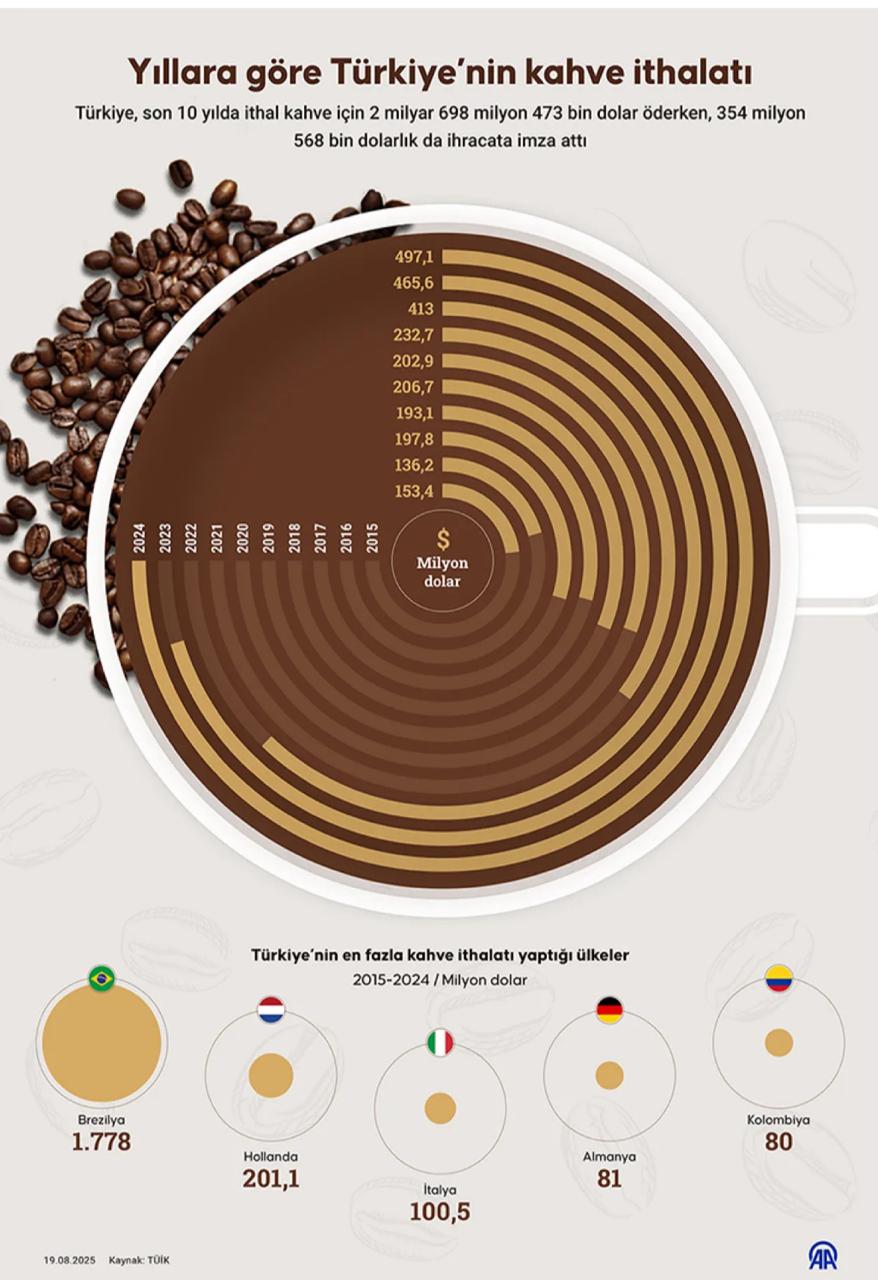
Türkiye’s coffee imports between 2015 and 2024 reached $2.7 billion, with prices for imported coffee rising from $153.4 million in 2015 to $497.1 million in 2024, marking an increase of 224%, according to the national statistical bureau TurkStat.

On the export side, Türkiye recorded $354.5 million worth of coffee exports over the last decade, including $55.6 million in the first half of this year alone.

Türkiye imported most of its coffee from Brazil, totaling $1.7 billion, followed by the Netherlands with $201.1 million, Italy with $100.5 million, Germany with $80.9 million, and Colombia with $79.9 million. The country’s imports stood at $472.5 million as of June, with Brazil remaining its top supplier.

The world’s coffee consumption — both hot and iced — over the past decade totaled $370.3 billion, according to data from the International Trade Center (ITC). The United States was the largest importer, while Brazil dominated exports.

Personally, I prefer iced coffee on summer afternoons, but I always start my day with a hot Turkish coffee. For Turks, the tradition of the 11 a.m. coffee break continues as a nationwide ritual. Around the world, specialty coffee is also gaining momentum, and habits are evolving quickly.

The golden era of coffee and coffee shops has already begun, spreading across continents. More lovely qahwa days are on the horizon.

Brazil Weather and U.S. Tariffs Drive Coffee Prices to Multi-Month Highs

Dubai, August 19, 2025 (Qahwa World) – Coffee prices surged on Tuesday, with arabica futures climbing to a 2.25-month high and robusta reaching a two-month high, supported by dry conditions in Brazil’s key growing regions and tightening U.S. supplies following new tariffs on Brazilian coffee.

September arabica coffee (KCU25) rose 1.85% (+6.35¢/lb), while September ICE robusta (RMU25) gained 4.04% (+$168). The rise reflects mounting concern over Brazil’s weather, particularly in Minas Gerais, the country’s largest arabica-producing state, where Somar Meteorologia reported no rainfall during the week ending August 16.

Market support is also coming from the United States, where buyers are avoiding new contracts for Brazilian coffee due to a 50% tariff imposed on imports. Brazil typically supplies about one-third of U.S. unroasted coffee, making the tariff impact significant for roasters and traders.

Brazil’s July export figures further underscored supply concerns. According to the Trade Ministry, unroasted coffee exports fell 20.4% year-on-year to 161,000 metric tons. Exporter group Cecafé reported that green coffee shipments dropped 28% y/y to 2.4 million bags, while total coffee exports fell to 2.7 million bags. From January to July, Brazil’s overall exports declined 21% to 22.2 million bags.

Certified exchange inventories remain tight. ICE arabica stocks fell to a 1.25-year low of 726,661 bags on August 14 before recovering slightly to 733,105 bags this week. ICE robusta stocks dropped to a three-week low of 6,749 lots, down from late-July’s two-year high of 7,029 lots.

On the supply side, Brazil’s 2025/26 coffee harvest is advancing. Research firm Safras & Mercado estimates the crop was 94% complete as of August 6, with robusta nearly finished (99%) and arabica at 91%. Cooxupé, Brazil’s largest coffee cooperative, reported its members had completed 80.4% of their harvest by August 8.

Beyond Brazil, Vietnam’s coffee industry continues to influence robusta prices. Drought reduced 2023/24 production by 20% y/y to 1.47 million metric tons, the lowest in four years, while 2024 exports fell 17.1% to 1.35 million metric tons. However, recovery signs emerged with January–July 2025 exports up 6.9% y/y to 1.05 million metric tons.

The International Coffee Organization (ICO) reported that global coffee exports in June rose 7.3% y/y to 11.69 million bags, though October–June totals slipped 0.2% to 104.14 million bags.

Looking ahead, the USDA’s Foreign Agricultural Service (FAS) projects 2025/26 world coffee production at a record 178.7 million bags, up 2.5% year-on-year. Arabica output is expected to fall 1.7% to 97 million bags, while robusta is forecast to rise 7.9% to nearly 82 million bags. Ending stocks are projected to grow 4.9% to 22.8 million bags.

However, trader Volcafe sees a very different balance: a global arabica deficit of 8.5 million bags in 2025/26, the fifth consecutive year of shortages and larger than the 5.5 million bag deficit recorded in 2024/25. This highlights continued market tightness despite record overall supply projections.

Vietnam Coffee Prices Hit Historic High at 117,500 VND/kg

Dubai, 18 August 2025 (Qahwa World) – Coffee prices in Vietnam continued their sharp upward trend on August 17, climbing by 2,500–2,800 VND per kilogram across major producing regions. Average domestic purchase prices now range between 116,800 and 117,500 VND/kg, marking one of the highest levels recorded this season, according to Báo Gia Lai.

Regional Price Updates

  • Gia Lai Province: Prices rose by 2,600 VND/kg to reach 117,200 VND/kg.

  • Lam Dong Province: Prices increased by 2,800 VND/kg, bringing the average to 116,800 VND/kg.

  • Dak Nong Province: Prices advanced by 2,500 VND/kg to 117,500 VND/kg, the highest among major regions.

  • Dak Lak Province: Coffee traded at 117,300 VND/kg, up 2,500 VND/kg from the previous day.

Drivers Behind the Price Rally

Economic experts attribute the surge primarily to dwindling domestic supplies. After months of intensive harvesting, coffee stocks held by farming households have fallen to low levels. Meanwhile, exporters are aggressively buying to fulfill international contracts, intensifying pressure on local prices.

Global Coffee Market Trends

Vietnam’s domestic rally comes against the backdrop of strong movements in global futures markets:

  • Robusta futures (November 2025 delivery) rose by USD 506 per tonne, equivalent to a 14.2% weekly gain.

  • Arabica futures (December 2025 delivery) surged by USD 340 per tonne to USD 7,370 per tonne (about 192,100 VND/kg), a 10.5% rise compared with the previous week.

This follows four consecutive sessions of triple-digit increases in Robusta futures, underscoring heightened volatility driven by tight supply concerns worldwide.

Context and Outlook

The latest jump builds on an already rapid price escalation earlier this month, when domestic coffee crossed the 107,000 VND/kg threshold for the first time. Analysts warn that continued low inventories combined with strong export demand could sustain upward pressure in the coming weeks.

Vietnam, the world’s largest Robusta producer, plays a critical role in global supply. Any prolonged imbalance in its domestic market may have ripple effects internationally, particularly in Europe and Asia where Robusta beans are heavily used in instant coffee and espresso blends.

AFCA and ICO to Hold Webinar on EUDR Compliance in African Coffee Sector

Dubai, August 16, 2025 (Qahwa World) – The African Fine Coffees Association (AFCA), in partnership with the International Coffee Organization (ICO) and with support from the project “Unlocking the Potential of African Coffee” funded by the Belgian Development Agency (ENABEL), announced an upcoming webinar on the European Union Deforestation Regulation (EUDR) and its implications for Africa’s coffee sector.

The 90-minute online session will take place on September 10, 2025, from 3:00 to 4:30 PM EAT. It will cover the new requirements of the EU regulation, supply chain responsibilities, digital traceability tools, and case studies from African countries that have begun implementing compliance measures. A live Q&A with trade, sustainability, and legal experts will also be included.

EUDR: A New Era for Coffee Trade

The EUDR entered into force in December 2024. From December 30, 2025, large operators must comply, followed by small and medium businesses from June 30, 2026. Coffee entering the EU must be:

  • Proven deforestation-free after December 31, 2020

  • Traceable with precise geolocation data (GPS)

  • Supported with production dates, volumes, and sub-regional origin

  • Covered by a due diligence statement

Non-compliance could lead to import bans, product confiscation, and fines of up to 4% of annual EU turnover.

Africa’s Reliance on the EU Market

Europe is the largest destination for African coffee, importing more than €2 billion annually. Recent figures show:

  • Uganda: 72% of exports went to the EU in 2024.

  • Kenya: 57.8% of exports were EU-bound in MY 2023/24.

  • Ethiopia: Over 30% of exports went to Germany, Belgium, and Italy.

  • Rwanda: Nearly 18% of exports went to EU countries including the Netherlands and Germany.

  • Burundi: At least 45% of exports in 2023 went to Europe, mainly Germany and Italy.

  • Tanzania: Italy and Germany purchased almost $98 million worth of coffee in 2023.

A Defining Moment for African Coffee

Experts note that while compliance poses challenges for millions of smallholder farmers, who produce over 70% of Africa’s coffee, it also represents an opportunity to enhance the reputation of African coffee globally and secure long-term access to premium markets.

Registration is open via AFCA’s official channels.

Tight Supplies Push Coffee Prices to Multi-Week Highs in September 2025

Dubai, 12 August 2025 (Qahwa World) – The global coffee market saw a sharp rally at the start of August, with September Arabica futures (KCU25) rising by 14.00 cents (+4.53%) to hit a seven-week high, while September Robusta futures (RMU25) climbed 188 points (+5.28%) to a four-week high. The surge was fueled by clear signs of tightening supply in the world’s largest producing countries, driven by lower exports and falling inventories.

Brazil’s Trade Ministry reported that the country’s exports of unroasted coffee in July dropped 20.4% year-on-year to 161,000 metric tons. At the same time, ICE-monitored Arabica inventories fell to a 14.5-month low of 738,095 bags, while Robusta stocks declined to a two-week low of 6,981 lots.

Markets are closely watching the United States’ stance on import tariffs, as President Trump has yet to announce an exemption for coffee from the 50% import duty on Brazilian exports — a move that could impact U.S. sales and boost domestic inventories in Brazil.

In weather developments, Minas Gerais, Brazil’s largest Arabica-growing region, recorded 4.8 mm of rainfall during the week ending 9 August, amounting to 109% of the historical average, easing drought concerns. Harvest progress remains swift, with Safras & Mercado estimating that 94% of the 2025/2026 crop had been completed as of 6 August (99% for Robusta and 91% for Arabica). Cooxupé, the country’s largest coffee cooperative and exporter, reported its members had harvested 74% of their crop by 1 August.

Globally, the International Coffee Organization’s monthly report showed that June exports rose 7.3% year-on-year to 11.69 million bags, while cumulative exports from October to June slipped 0.2%.

In recent months, prices have faced downward pressure from expectations of abundant supply. In June, the U.S. Department of Agriculture forecast Brazil’s 2025/2026 coffee production at 65 million bags (+0.5%), and Vietnam’s output at 31 million bags (+6.9%, the highest in four years). The USDA also projected record global output of 178.68 million bags (+2.5%), with Arabica production down 1.7% and Robusta production up 7.9%. Ending stocks are expected to rise 4.9% to 22.82 million bags.

Brazil’s Coffee Exporters Council (Cecafe) reported that June green coffee exports fell 31% year-on-year to 2.3 million bags, with Arabica shipments down 27% and Robusta down 42%. In Vietnam, 2023/2024 production dropped 20% year-on-year due to drought, hitting a four-year low, while exports from January to July 2025 rose 6.9% to 1.05 million metric tons.

Volcafe projects that the global Arabica market will post a deficit of 8.5 million bags in 2025/2026, compared to a 5.5 million-bag deficit in 2024/2025, marking the fifth consecutive year of shortfall.

Rising Production and Exports Put Kenya Back on the Global Coffee Map

Dubai – Qahwa World

Kenya is witnessing a strong rebound in its coffee sector, with production forecast to grow by 13.3% in the 2025/26 marketing year, reaching 850,000 sixty-kilogram bags. This recovery is driven by high global prices, government reforms, and farmer support programs. Exports are also projected to rise by 10%, while domestic consumption is expected to increase by 6.9%. With these promising indicators, Kenya is reclaiming its place among the world’s top Arabica coffee producers.

According to the USDA’s Coffee Annual Report (May 2025), Kenya’s coffee production is forecast to increase from 750,000 bags in 2024/25 to 850,000 bags in 2025/26. Farmers have responded to favorable prices with improved agricultural practices—applying more fertilizer, controlling pests more effectively, and capitalizing on Arabica’s natural biennial production peak.

In February 2025, the Nairobi Coffee Exchange (NCE) recorded a historic high of $363 per 50-kg bag, up from $254 in October 2024. Although a slight price correction is expected in the second half of the year, prices remain favorable and have reinvigorated investment in farms.

Slight Expansion in Planted Area

While harvested area is expected to remain at 105,000 hectares, planted area will increase slightly as the Kenyan government rolls out its Coffee Expansion Program in both traditional and new growing regions across Central, Eastern, and Rift Valley Kenya. The program includes subsidized seedlings, supported by county-level grants and expanded production at the Coffee Research Institute to meet increased demand.

Urbanization Slows, Coffee Area Stabilizes

Between 2020 and 2024, coffee area declined from 112,000 to 105,000 hectares due to urban development, particularly around Nairobi, Kiambu, and Nyeri. However, this trend has slowed, thanks to a stagnating real estate market, offering the sector a chance to stabilize.

Marketing Reforms and Structural Overhaul

Roughly 80% of Kenya’s coffee is sold through producer cooperatives, while the remaining volume is marketed by private farms and estates. The Nairobi Coffee Exchange remains the country’s primary marketplace, handling over 90% of coffee sales.

Since 2023, Kenya has implemented significant reforms in marketing and regulation. The NCE is now under the Capital Markets Authority, which licenses brokers responsible for classification and auction procedures. There are currently 15 licensed brokers. Additionally, licensing of millers was decentralized to county governments.

A pending Coffee Bill in Parliament seeks to formalize these changes by creating a new Coffee Board of Kenya and an independent Coffee Research and Training Institute, to be funded through a coffee sales levy.

Exports Rising but Facing EU Deforestation Law

Coffee exports are expected to grow by 10% to 840,000 bags in 2025/26, up from 763,000 bags the previous year. Green beans dominate Kenya’s export portfolio, with major buyers including:

  • European Union: Over 57%

  • United States: 16.75%

  • South Korea: 5.16%

  • United Kingdom: 3.43%

  • Other emerging markets: China, Australia, India

However, the upcoming EU Deforestation Regulation, taking effect in January 2026, poses a potential challenge. In response, Kenya has formed a multi-agency committee to evaluate readiness and establish compliance mechanisms.

Domestic Consumption on the Rise

Domestic coffee consumption is projected to grow by 6.9%, reaching 62,000 bags in 2025/26. This growth is driven by the rapid expansion of coffee shops, particularly in Nairobi, and a 15% surge in tourism in 2024. Kenya’s coffee culture is evolving, with increasing demand for specialty brews and locally roasted varieties.

Despite this growth, soluble coffee consumption remains low due to the lack of local processing facilities. Kenya imports approximately 45,000 bags of instant coffee annually.

Stock Levels and Imports

Ending stocks are expected to increase to 86,000 bags in 2025/26, reflecting higher production. For 2024/25, stock estimates have been revised downward to 63,000 bags due to higher exports and tighter output.

Conclusion: Kenya’s Return to Coffee Leadership

With production, exports, and consumption all trending upward, Kenya is once again asserting itself on the global coffee stage. While challenges like EU environmental compliance lie ahead, the country’s proactive reforms and farmer-focused strategies signal a new era of growth and global relevance for Kenyan coffee.