China Opens Market to African Coffee from July 20, 2026

Author: Qahwa World
Source: Xinhua News Agency
Date: May 29, 2026

China Opens Market to African Coffee from July 20, 2026

Executive Summary:

  • China’s General Administration of Customs announced it will allow qualified coffee beans from 53 African countries starting July 20, 2026.
  • Coffee is the second African agricultural product to receive full phytosanitary clearance after dried chili peppers.
  • Ethiopia and Burundi have already obtained export permits, while others like Mauritius, Angola, and Togo have applied.
  • China has introduced unified phytosanitary requirements, eliminating the need for separate bilateral agreements.
  • The clearance does not exempt shipments from border inspections; all must comply with customs announcement No. 68 of 2026.
  • China will continue green channel facilitation for high-quality African agricultural products.

China’s General Administration of Customs has announced that the country will allow qualified coffee beans from all 53 African countries with which it has diplomatic relations to enter its market starting July 20, 2026. Coffee is a distinctive agricultural product and a key economic pillar for many African nations. It is the second African agricultural product to receive full phytosanitary clearance to enter the Chinese market after dried chili peppers, according to customs data.

Official data indicates that African countries such as Ethiopia and Burundi have already obtained permission to export coffee beans to China, while other countries including Mauritius, Angola, Togo, Guinea, Liberia, and Sao Tome and Principe have submitted export applications.

Simplified Phytosanitary Procedures

After a comprehensive assessment of African coffee production systems and pest risk management frameworks, the customs administration has established unified phytosanitary requirements. This step eliminates the previous practice of negotiating separate bilateral quarantine agreements with each applicant country, significantly streamlining entry procedures. Industry experts noted that obtaining full phytosanitary clearance does not mean exemption from border inspections. All shipments must comply with the requirements set forth in customs announcement No. 68 of 2026.

Strengthening Trade Cooperation with Africa

A customs official added that the administration will continue to apply advanced facilitation measures under the “green channel” to bring more high-quality, safe African agricultural and food products to the Chinese market. This step is part of broader efforts to enhance trade cooperation between China and African countries, open new markets for African producers, and meet the growing demand for coffee in China’s rapidly expanding coffee market.

Frequently Asked Questions (FAQ)

1. When does the policy take effect?

Starting July 20, 2026.

2. How many African countries are eligible?

53 African countries with diplomatic relations with China.

3. Does clearance mean no border inspections?

No, all shipments must comply with customs announcement No. 68 of 2026 requirements.

4. Which African countries already have export permits?

Ethiopia and Burundi, with others like Mauritius, Angola, Togo, Guinea, Liberia, and Sao Tome and Principe having applied.

5. What is the goal of this measure?

To enhance China-Africa trade cooperation, simplify import procedures, and meet China’s growing coffee demand.

6. What was the first African product to receive full clearance?

Dried chili peppers, with coffee as the second.

Qahwa World – Based on Xinhua News Agency reporting.
Published: May 29, 2026

Russia’s Green Coffee Market Records Historic Growth in 2026

Mocow-QahwaWorld

Russia’s green coffee market posted significant growth in 2026, supported by rising global prices and sustained domestic demand, according to a recent analysis by ROIF Expert. The expansion reflects not only higher market value but also increased import volumes and consumption levels, reinforcing Russia’s position as a key destination for global coffee exporters.

Market Value Jumps by 92 Billion Rubles

The market value of green coffee increased by approximately 92 billion rubles between its lowest and highest recent levels, marking one of the strongest gains in the sector. The growth is largely attributed to higher global coffee prices, influenced by weather-related challenges in major producing countries such as Brazil and Vietnam.

While import volumes continued to rise, value growth outpaced physical expansion, reflecting sustained price pressure across global supply chains.

Imports Remain the Core Driver

Russia relies almost entirely on imports to meet its green coffee demand. Between 2025 and 2026, total import volumes reached around 286,000 tons.

  • Import value increased by 45.5% in the first nine months of 2025, reaching $924.7 million
  • Vietnam recorded a 1.5x increase in exports
  • Brazil nearly doubled its export volumes
  • Indonesia strengthened its position among top suppliers with 1.6x growth

Despite ongoing sanctions, supply flows remained stable. The primary challenge involved payment restrictions, prompting companies to adapt through alternative channels, including intermediary countries such as Turkey, China, and the UAE, as well as increased direct shipping routes.

Consumption Reaches Record Levels

Consumption indicators show continued growth, with per capita coffee consumption reaching its highest recorded levels. Approximately 70% of the population consumes coffee daily, while a majority consider it an essential part of their routine.

Home consumption is expected to grow by 15% by the end of 2026, alongside increasing demand for specialty coffee and whole beans.

Shifts in Supply Chains

Supply chains are gradually shifting toward Asian producers, particularly Vietnam and Indonesia, while overall trade flows remain relatively stable. At the same time, the market continues to face pricing pressures and logistical risks linked to geopolitical factors.

Outlook Through 2033

The baseline scenario outlined in the report suggests steady growth over the coming years, supported by consistent demand and expanding import activity.

  • Projected annual growth between 3% and 5.5%
  • Moderate increase in global price levels
  • Continued rise in per capita consumption
  • Further diversification of import sources

The market is expected to maintain positive momentum, demonstrating resilience in the face of external pressures.

Implications for Industry Stakeholders

The Russian market offers strong opportunities for global exporters, given its full dependence on imports. Domestic players are increasingly focused on higher-quality offerings and cost management, while consumers benefit from a broader range of products.

From an investment perspective, the sector shows the ability to convert price pressures into growth drivers, enhancing its medium-term appeal.

Conclusion

Russia’s green coffee market in 2026 reflects a mature and resilient sector. The sharp increase in market value and sustained demand indicate a continued upward trajectory, with growth expected to extend through the end of the decade.


70% of Russians drink coffee daily

Moscow – Qahwa World

The Russian coffee market in 2026 is hitting record milestones, with nearly 70% of the population consuming the beverage every day. Recent analytical data confirms that coffee has firmly established itself as the primary national drink, shaping a new and sophisticated culture of consumption across the country.

Consumption Statistics and Habits

A detailed breakdown of daily rituals among Russians reveals a clear hierarchy:

  • Daily Consistency: 68.4% of respondents cannot imagine their day without a cup of coffee.

  • The Golden Mean: Nearly half of those surveyed (49.5%) limit themselves to 1–2 cups per day.

  • High Intensity: Approximately 12% consume 3–4 cups, while 6.9% exceed this limit.

  • Alternative Choices: Only 31.6% of citizens prefer other beverages or decaffeinated options.

You may like to read: Russian Instant Coffee Exports Rise 28% to $366 Million

2026 Market Transformation: Logistics and Specialty

In 2026, import structures have undergone significant shifts. Russia has expanded direct supply chains from Latin America and East Africa, bypassing traditional European intermediaries. This strategic pivot has maintained access to high-quality specialty coffee despite global price volatility.

Analysts note a surge in interest for “micro-lots”—beans from specific individual farms. This indicates a maturing Russian consumer who now values terroir and unique flavor profiles over generic commercial branding.

2026 Trends: The Home Barista and AI Technology

The headline trend of the industry is the massive shift toward professional-grade brewing at home. With a projected 20% increase in the cost of imported raw green coffee, consumers are rapidly changing their habits:

  1. Economic Advantage: Home brewing costs an average of 5–6 times less than a purchase at a high-end coffee chain.

  2. AI Integration: 2026 has seen the rise of AI-powered espresso machines that automatically adjust extraction parameters based on specific bean density and water hardness.

  3. Sustainability: There is a growing demand for biodegradable packaging and reusable capsules, which has become a decisive factor for the younger demographic (ages 18–35).

Experts predict that by the end of 2026, the home consumption segment will grow by another 15%, turning the morning cup from a simple habit into a conscious, high-tech, and premium ritual.

You me also like to read: Russian Coffee and Roasted Coffee Market 2026

Vietnam Suspends Decree 46, Easing Coffee Trade

Dubai – Qahwa World

Vietnam’s suspension of Decree 46, a new food safety regulation governing all imported food and ingredients, has brought temporary relief to the coffee industry after weeks of disruption to supply chains.

Introduced at the end of January, Decree 46 tightened how food imports are managed at Vietnam’s borders. It replaced a more flexible framework with stricter approval procedures, including additional certification, registration, and physical inspections before products could enter the market. For many import-reliant sectors, including coffee, the impact was immediate.

Coffee businesses were hit on multiple fronts. Shipments of high‑quality green coffee, roasted products, and key processing inputs began to slow as importers adjusted to the new documentation and inspection requirements. Clearance times that previously took only a few days stretched to several weeks, creating bottlenecks at major ports as containers waited for checks and approvals. For an industry built on tight delivery schedules and thin margins, these delays quickly translated into operational and financial pressure.

Vietnam plays a central role in global coffee flows, not only as the world’s largest robusta producer but also as a processing and re‑export hub. Coffee is imported into the country for blending and processing before being shipped back out to international markets. That system depends heavily on efficiency and predictability at the border. By imposing full food‑safety compliance procedures on a wide range of imports, Decree 46 disrupted both.

One of the most sensitive areas was raw materials imported for re‑export. Under the previous rules, such shipments often benefited from simplified procedures because they were not intended for domestic consumption. Decree 46 removed much of that flexibility, requiring full compliance even for goods destined for re‑export. This added time, cost, and administrative complexity for coffee traders who route beans and semi‑finished products through Vietnam as part of global supply chains.

The specialty coffee segment also felt the strain. Imports of premium green coffee, small‑batch roasted products, flavorings, and other inputs used in high‑value offerings faced additional testing and approval steps. Smaller businesses, which typically operate with lean inventories, reported immediate pressure as delays threatened their ability to meet contracts and serve customers on time. Packaging materials and additives used in roasting, processing, and manufacturing coffee products were similarly drawn into the stricter regime, forcing companies to contend with more extensive compliance demands across their operations.

Industry reaction was swift. Business associations and trade groups representing food and beverage importers warned that the abrupt shift had created serious bottlenecks, with large numbers of shipments held at ports and border gates. They raised concerns about rising storage costs, the risk of contractual penalties, and knock‑on effects on domestic production that depends on imported inputs, including those used in coffee manufacturing and export.

In response, the government moved to stabilize the situation. On 4 February, authorities suspended the effectiveness of Decree 46 and temporarily reinstated the previous regulatory framework. This decision effectively returned import procedures to the more familiar rules that had been in place before the decree, allowing stuck shipments to begin moving again and easing congestion at key ports. For coffee traders and processors, the suspension has provided short‑term relief and a chance to clear backlogs.

However, the issue is far from settled. Officials have framed the suspension as a temporary measure while they review implementation challenges and consider adjustments to the regulation. Trading partners and industry groups have called for clearer guidance, more transparency, and adequate transition periods before any new rules take effect. The government has indicated that tighter control over food imports remains a strategic goal, suggesting that some form of stricter regime will likely return once technical and procedural issues are addressed.

For the coffee sector, this pause is being treated as a preparation window rather than a return to business as usual. Companies are reassessing their documentation workflows, compliance systems, and supply chain structures in anticipation that more demanding requirements will come back in some form. Import‑dependent roasters and exporters are also exploring options to diversify logistics routes, adjust contract terms, or build greater buffer stocks to cope with potential future disruptions.

The recent experience has highlighted just how sensitive the coffee trade is to regulatory shifts at key origin and transit points. Delays at Vietnam’s ports can quickly cascade into late deliveries, contract disputes, and price volatility along the supply chain. While the suspension of Decree 46 has eased immediate pressure, it has also sent a clear message: the operating environment for food and coffee imports in Vietnam is changing, and adaptation will be essential to maintain a smooth flow of trade.

You can adjust this text by shortening the background on regulation if your audience already knows Decree 46, or by expanding the “industry reaction” and adding quotes if you have direct sources from coffee companies or associations.

South Korea’s Coffee Import Bill Hits Record $1.38 Billion in 2025

SEOUL – Qahwa World

South Korea’s coffee import bill reached a record high in 2025, driven by rising global coffee prices and a weakened local currency, according to data released on Sunday.

According to Yonhap News Agency, South Korea imported more than 2 trillion won (US$1.38 billion) worth of coffee in 2025, marking the first time in the country’s history that coffee imports have surpassed the 2-trillion-won threshold.

Data from the Korea Agro-Fisheries & Food Trade Corporation showed that the total value of coffee imports climbed to 2.65 trillion won, representing a 41% increase compared to 2024. In U.S. dollar terms, coffee imports rose 35% year on year to US$1.86 billion, up from US$1.38 billion the previous year.

The sharp increase was largely attributed to a surge in global coffee prices, which reached a record high of more than US$4 per pound in February 2025 before easing to around US$3.5 per pound. The impact of higher prices was compounded by the weakness of the Korean won, which traded near multi-year lows for much of the year, pushing up import costs when calculated in local currency.

Despite the rise in import value, coffee import volumes declined slightly. Total coffee imports fell by 46 tons from the previous year to 215,792 tons in 2025, indicating that higher prices and currency effects—rather than increased volumes—were the primary drivers behind the record import bill.

South Korea remains one of Asia’s most active coffee markets, with sustained consumer demand continuing to support imports amid ongoing volatility in global coffee prices.

Russia Sets Record for Brazilian Coffee Imports

Moscow – Qahwa World

Russia significantly increased its imports of coffee from Brazil between January and November, with the total value reaching nearly $390 million — the highest level recorded to date, according to official Brazilian statistics.

Since the beginning of the year, Brazilian coffee shipments to Russia amounted to approximately $392.6 million, compared with about $232.3 million over the same period last year, highlighting a sharp expansion in bilateral trade within this segment.

Import volumes also rose in physical terms, totaling 62.3 thousand tonnes, which represents a 13% year-on-year increase.

As a result of the higher purchases, Russia ranked 11th among the world’s largest importers of Brazilian coffee. Germany remained the leading destination with imports worth around $2.1 billion, followed by the United States at $1.8 billion and Italy at approximately $1.2 billion.

Other major markets for Brazilian coffee during the period included Japan and Belgium, as well as the Netherlands, Türkiye, and Spain, while China also featured among the top ten importing countries.

U.S. Senate Bid to Fast-Track “No Coffee Tax Act” Denied

Dubai – Qahwa World

As U.S. coffee prices continue to climb, an effort in the U.S. Senate to fast-track the bipartisan “No Coffee Tax Act” stalled on Wednesday after a single Republican senator objected.

On the Senate floor, Sen. Catherine Cortez Masto (D-Nev.) requested unanimous consenta procedure allowing noncontroversial bills to pass without a roll-call voteto advance the bill she co-authored with Sen. Rand Paul (R-Ky.).

Video footage of the session shows Sen. Mike Crapo (R-Idaho), chair of the Senate Finance Committee, raising an objection. His move sends the measure back to the committee for further review.

The proposed legislation is part of a broader effort by lawmakers and coffee industry groups to exempt coffee from President Donald Trump’s “reciprocal tariffs”—import fees applied to a wide range of goods. Current tariffs on imports from nearly all coffee-producing nations range from 10% to 50%, with the 50% tariff on Brazil having a particularly strong impact on U.S. coffee prices.

Meanwhile, the cost of coffee for consumers continues to surge. In September, the average grocery price for a pound of roasted, ground coffee reached $9.14, an increase of 41% from a year earlier. According to the Bureau of Labor Statistics, the coffee index rose 18.9% year-over-year, far outpacing overall food and beverage inflation.

The No Coffee Tax Act seeks to exempt coffee from such tariffs, emphasizing that the United States cannot produce coffee at a scale sufficient to meet domestic demand. Combined coffee production from Hawaii and Puerto Rico accounts for less than 1% of total U.S. green coffee consumption.

“I know that responsible, targeted tariffs on our adversaries can be good for American workers and our national security,” said Cortez Masto. “There’s a smart way to do thisbut taxing our coffee and raising prices for Americans isn’t it.”

In response, Crapo argued that the Senate should not make “one-off exceptions” for individual goods “in isolation of a larger negotiating strategy and broader stakeholder concerns.”

He also noted that coffee already benefits from tariff exemptions through recent trade agreements with Cambodia and Malaysiathough those two nations together account for less than 0.1% of global coffee production, according to USDA data.

Trump Faces Bipartisan Backlash Over Coffee Tariffs

Washington, D.C. – Qahwa World

A bipartisan group of U.S. lawmakers is urging President Donald Trump to exempt coffee imports from new reciprocal tariffs that have driven up consumer prices nationwide.

Representatives Ro Khanna (D-CA) and Don Bacon (R-NE) sent a joint letter to the White House requesting that coffee be added to the list of goods excluded under Executive Order 14257, arguing that tariffs on a commodity the U.S. scarcely produces only hurt consumers.

“We respectfully request your administration exempt coffee from reciprocal tariff measures that are drastically increasing its price,” the lawmakers wrote. “Given that our nation consumes around 400 million cups per day, this is one modest but meaningful way to help the American people.”

According to the Bureau of Labor Statistics, coffee prices in the U.S. rose 20.9% year-over-year in August 2025. The National Coffee Association reports that roughly 99% of all coffee consumed in the country is imported, mainly from Latin America and Africa.

Trump’s “Liberation Day” tariffs aim to level global trade terms, but coffee — not listed among exempt goods — has seen costs rise sharply. Khanna and Bacon note that Hawaii and Puerto Rico produce only small specialty quantities, representing less than 1% of domestic consumption.

“Tariffs on coffee do not protect domestic businesses and interests—they only raise costs and amount to an additional tax on American consumers,” the letter said. “It is not practical to tariff a product that our nation does not meaningfully produce.”

The lawmakers warned that higher import costs are forcing small coffee shops and hospitality businesses to raise prices or close altogether. Khanna, whose district covers Silicon Valley, said he regularly hears from café owners struggling to stay afloat.

The two legislators also recently introduced the “No Coffee Tax Act”, seeking to repeal coffee-related tariffs entirely. Bacon, who will retire from Congress next year, called the policy “a punishment to Americans,” adding, “There is no American alternative to coffee — why tariff something we can’t grow?”

A White House spokesman, Kush Desai, responded that the President had already included coffee among goods eligible for tariff-free treatment under certain trade deals, and blamed global supply disruptions in producing regions for recent price hikes.

Despite that clarification, the bipartisan pressure reflects growing unease over the wider economic impact of Trump’s tariff agenda — from agricultural exports to daily consumer goods such as coffee, a staple for two-thirds of American adults.

US Congress Moves to Exempt Coffee from Tariffs

Dubai – Qahwa World 

A bipartisan bill titled the “No Coffee Tax Act” has been introduced to the United States Congress, aiming to repeal tariffs placed on coffee imports under the Trump administration.

The United States is the largest coffee importer in the world, with production limited only to Hawaii and Puerto Rico. Yet, tariffs currently affect major exporting nations. Goods from Brazil face a 50% tariff, Vietnam 20%, India 50%, Mexico 25%, and Indonesia 19%, all above the administration’s base rate of 10%.

The bill, sponsored by Nebraska Representative Don Bacon and California Representative Ro Khanna, has already drawn support from Virginia’s Don Beyer and New Hampshire’s Maggie Goodlander.

Bacon emphasised that taxing a crop not grown at scale in the US is harmful to consumers: “Families across America are already paying 21% more for coffee. Tariffs on a product we cannot produce commercially only make things worse. They are simply a tax on consumers, raising costs without creating jobs.”

He further highlighted that Congress, under Article One of the Constitution, holds tariff-setting authority, and this legislation reasserts that power.

If passed, the bill would exempt coffee—green, roasted, decaffeinated, husks, skins, and substitutes containing coffee—from any tariffs imposed after January 19, 2025.

The US coffee industry has strongly supported the measure, arguing that coffee cannot be grown at a scale sufficient to meet demand. A petition launched by roaster Coffee Bros in April 2025 has already gathered nearly 15,000 signatures.

Khanna compared the tariffs to Britain’s tax on tea before the American Revolution: “Americans started a revolution over a tax on tea. Today, US coffee prices have surged in part due to these tariffs. Our bipartisan bill is simple—it removes Trump’s tariffs on coffee to bring down costs.”

According to Reuters, the legislation is expected to be formally introduced on Friday. Bacon expressed optimism that the measure would not only reduce prices for consumers but also prompt a wider debate on Congress reclaiming its constitutional role in tariff policy.

The Rise of Coffee Chains

By: Serkan Oral

The 21st century is the age of coffee chains more than any other. Coffee beans are becoming as valuable as gold. The sector continues its upward trend, driven by the rapid expansion of coffee chains worldwide.

Let’s talk numbers.
Between 2015 and 2024, global coffee imports reached a total of $370.3 billion. The United States accounted for $69.2 billion of this total, followed by Germany with $41.9 billion and France with $28.9 billion. Other major importers included Italy, Canada, Belgium, Spain, Japan, the Netherlands, and Switzerland, with their combined imports amounting to $238.5 billion. Altogether, the top 10 coffee importers represented 64.4% of the global market during the past decade.

There are also emerging markets on the rise.

Meanwhile, Brazil stood as the world’s largest coffee exporter, with exports over the past decade totaling $360.3 billion, followed by Switzerland with $28.7 billion and Colombia with $28.6 billion. Other significant exporters were Germany, Vietnam, Italy, Honduras, France, Belgium, and Indonesia.

Türkiye carries a dual identity in the global coffee story — as both the heir to the Ottoman coffee legacy and as a modern hub for new-generation coffee culture.

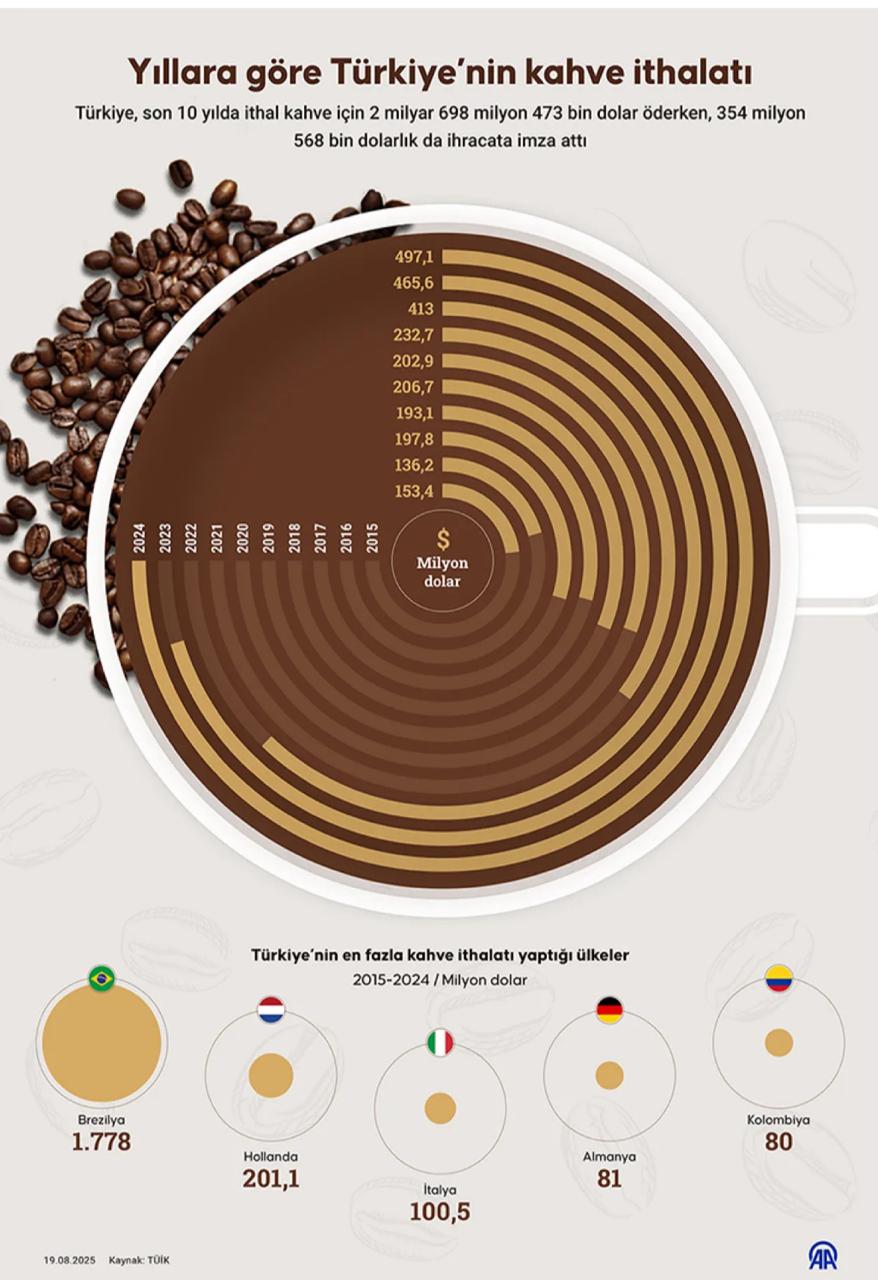
Türkiye’s coffee imports between 2015 and 2024 reached $2.7 billion, with prices for imported coffee rising from $153.4 million in 2015 to $497.1 million in 2024, marking an increase of 224%, according to the national statistical bureau TurkStat.

On the export side, Türkiye recorded $354.5 million worth of coffee exports over the last decade, including $55.6 million in the first half of this year alone.

Türkiye imported most of its coffee from Brazil, totaling $1.7 billion, followed by the Netherlands with $201.1 million, Italy with $100.5 million, Germany with $80.9 million, and Colombia with $79.9 million. The country’s imports stood at $472.5 million as of June, with Brazil remaining its top supplier.

The world’s coffee consumption — both hot and iced — over the past decade totaled $370.3 billion, according to data from the International Trade Center (ITC). The United States was the largest importer, while Brazil dominated exports.

Personally, I prefer iced coffee on summer afternoons, but I always start my day with a hot Turkish coffee. For Turks, the tradition of the 11 a.m. coffee break continues as a nationwide ritual. Around the world, specialty coffee is also gaining momentum, and habits are evolving quickly.

The golden era of coffee and coffee shops has already begun, spreading across continents. More lovely qahwa days are on the horizon.