Tightening ICE Stocks Push Coffee Futures Higher

Dubai – Qahwa World

Global coffee futures climbed as stocks registered on the Intercontinental Exchange (ICE) continued to shrink, tightening availability and pushing traders to reprice risk. December Arabica (KCZ25) rose about 1.78%, while November Robusta (RMX25) gained roughly 1.9%, reflecting increased buying interest across both contracts.

The market has been reacting to a notable decline in ICE-tracked inventories: Arabica holdings dropped to roughly 534,665 bags, a low not seen in about 18 months, and Robusta balances fell to near 6,237 lots, the lowest in a few months. A major contributor to tighter U.S. supplies has been new trade barriers: a 50% tariff on Brazilian coffee imports has prompted some American buyers to cancel or delay contracts, and because Brazil supplies about one-third of U.S. unroasted coffee, the effect has been pronounced.

Weather worries have compounded supply concerns. Key Arabica zones in Brazil — notably Minas Gerais — received barely measurable rainfall in early October, raising alarms about the crop’s flowering stage for 2026/27. Forecasters have also increased the odds of a La Niña episode through the October–December window, a pattern that can bring drier conditions to Brazil and add further downside pressure to yields.

Still, the global picture contains mixed signals. The International Coffee Organization reported a small year-on-year rise in exports for the current marketing window, pointing to continuing flows of coffee around the world. At the same time, Vietnam’s strong Robusta shipments — up double digits year-to-date — are helping keep robusta markets supplied.

Brazilian crop agencies and exporters have trimmed recent estimates or recorded export slowdowns: domestic forecasts for Arabica output have been revised lower and export volumes in some months have fallen sharply from year-earlier levels. Conversely, U.S. Department of Agriculture outlooks point to a modest increase in total world production for 2025/26, driven largely by a stronger Robusta harvest, while some trade houses continue to flag an Arabica shortfall.

The interplay of shrinking registered stocks, tariff-driven trade shifts and weather risks leaves prices vulnerable to swings — and keeps market attention trained on inventories, crop forecasts and buyer behavior in the coming weeks.
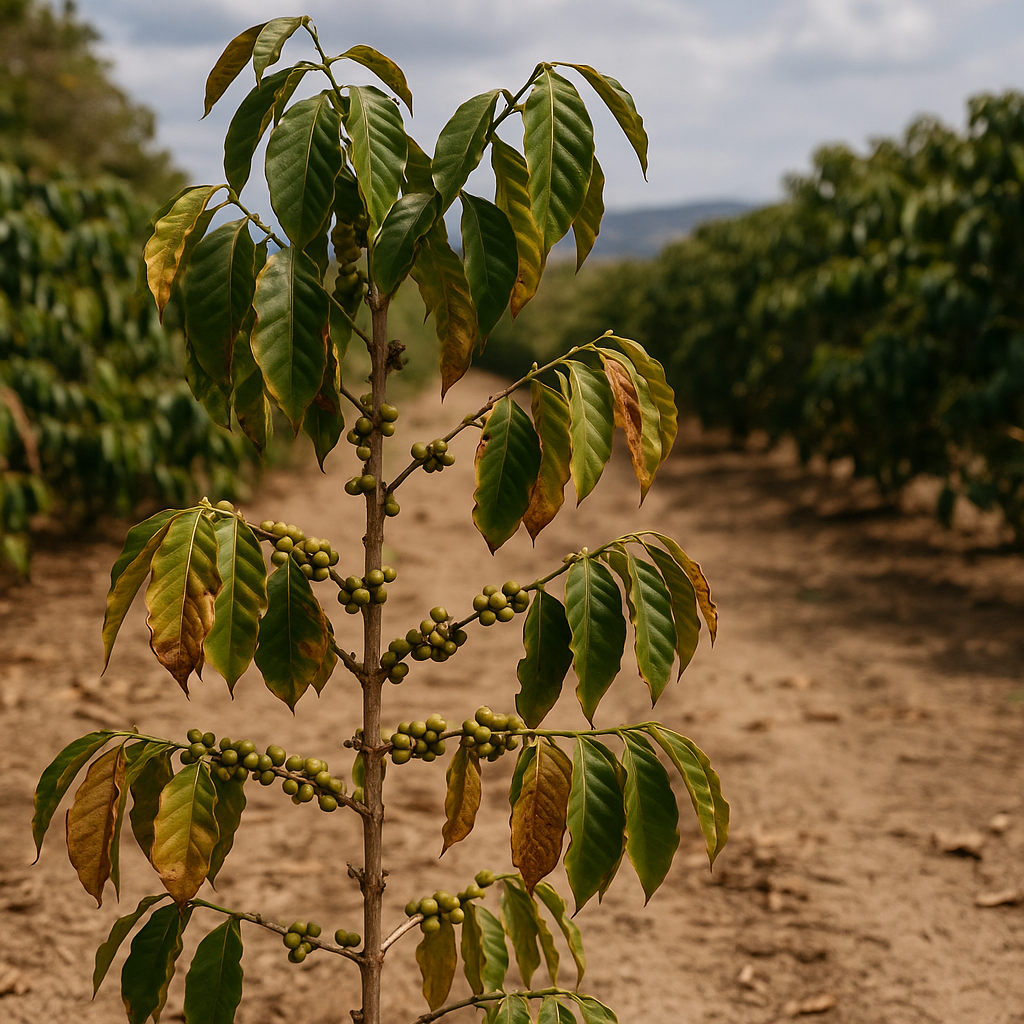
Brazil’s Dryness Continues to Fuel Global Coffee Price Surge

Dubai, September 12, 2025 – Qahwa World – Global coffee markets surged sharply on Friday, with December arabica futures climbing +10.75 cents (+2.78%) to a four-month high and November robusta futures rising +$80 (+1.77%) to a one-and-a-half-week peak.

The rally is being driven primarily by ongoing drought in Brazil, the world’s largest coffee producer. Weather agency Somar Meteorologia reported that Minas Gerais, Brazil’s largest arabica-producing state, received no rainfall during the week ending September 6 — a critical period just ahead of the flowering stage for coffee trees.

A stronger Brazilian real added further bullish momentum, rallying to a 15-month high against the US dollar on Friday. A stronger real typically discourages coffee exports, as producers are less incentivized to sell abroad.

In the United States, concerns over tighter supplies are mounting as buyers cancel new contracts for Brazilian beans following the imposition of 50% tariffs on imports. Roughly one-third of America’s green coffee supply comes from Brazil, making the tariffs a significant disruptor for the US market.

Tightness in ICE-monitored inventories has also supported prices. Arabica stocks fell to a 16-month low of 669,251 bags, while robusta inventories declined to a two-week low of 6,557 lots.

Adding to the bullish outlook, Brazil’s crop forecasting agency Conab cut its 2025 arabica production estimate by -4.9% to 35.2 million bags from its May forecast of 37 million. Total Brazilian coffee output for 2025 was also revised lower by -0.9% to 55.2 million bags.

On the trade side, the International Coffee Organization (ICO) reported that global exports in July fell -1.6% year-on-year to 11.6 million bags. Cumulative exports from October to July slipped -0.3% year-on-year to 115.6 million bags.

Brazil’s July shipments added more pressure to the supply side. The Trade Ministry reported that unroasted coffee exports dropped -20.4% year-on-year to 161,000 metric tons. Exporter group Cecafe confirmed a steeper fall, with green coffee exports plunging -28% to 2.4 million bags. Arabica exports dropped -21% while robusta exports plunged -49%. Cecafe added that total July shipments fell -28% to 2.7 million bags, while cumulative January–July exports fell -21% to 22.2 million bags.

Meanwhile, Brazil’s harvest is nearly complete. Cooxupé, the country’s largest coffee cooperative, reported that 97% of its members’ harvest was completed by September 5. Separately, consultancy Safras & Mercado noted that the national 2025/26 harvest reached 99% by August 20, including 100% completion of robusta and 98% of arabica.

In Vietnam, the world’s second-largest producer, 2023/24 coffee output fell -20% year-on-year to 1.47 million metric tons, the smallest crop in four years. Exports in 2024 fell -17.1% to 1.35 million metric tons. However, the General Statistics Office reported that January–August 2025 exports rose +7.8% to 1.14 million metric tons.

Looking ahead, the USDA’s Foreign Agricultural Service (FAS) projected on June 25 that global coffee production in 2025/26 will rise +2.5% year-on-year to a record 178.68 million bags. The forecast includes a -1.7% decline in arabica to 97.02 million bags and a +7.9% increase in robusta to 81.65 million bags. Brazil’s 2025/26 crop is expected to rise +0.5% to 65 million bags, while Vietnam’s production is forecast to grow +6.9% to 31 million bags, a four-year high. Global ending stocks are forecast to rise +4.9% to 22.8 million bags, up from 21.7 million in 2024/25.

However, trader Volcafe has issued a more cautious outlook, projecting a global arabica deficit of -8.5 million bags in 2025/26, compared with a -5.5 million bag deficit in 2024/25. This would mark the fifth consecutive year of deficits for arabica, underscoring structural supply concerns.

The combination of Brazil’s drought, lower exports, shrinking inventories, and global trade pressures highlights the fragility of the balance between supply and demand — setting the stage for further volatility in one of the world’s most important agricultural commodities.

Coffee Prices Surge on Brazil Weather Concerns and Supply Tightness

Dubai, 23 August, 2025 (Qahwa World) – Coffee futures surged sharply on Friday, reaching multi-month highs as weather concerns in Brazil and tightening global supplies continued to fuel bullish momentum. December arabica coffee (KCZ25) closed up +13.30 cents (+3.64%), marking a 3.5-month high, while September ICE robusta (RMU25) gained +108 points (+2.27%), its strongest level in three months. The rally extended a three-week upward trend, with traders reacting to reports of dry conditions and frost damage in Brazil, the world’s largest coffee producer.

According to Somar Meteorologia, Minas Gerais, Brazil’s leading arabica coffee-growing region, recorded no rainfall during the week ending August 16. This lack of precipitation, coupled with recent frost damage, raised concerns over crop yields and pushed prices higher. Additional upward pressure came from the United States, where coffee supplies are tightening as buyers void new Brazilian contracts in response to a 50% tariff on Brazilian exports. With nearly one-third of U.S. coffee imports traditionally sourced from Brazil, the restrictions have intensified market concerns over availability.

Brazil’s Trade Ministry reported that July unroasted coffee exports fell by 20.4% year-on-year to 161,000 metric tons. Exporter group Cecafe confirmed an even steeper decline in green coffee shipments, which dropped 28% in July to 2.4 million bags. Arabica exports fell 21%, robusta plunged 49%, and overall shipments for the January–July period slipped 21% to 22.2 million bags. Meanwhile, ICE-monitored arabica inventories fell to a 1.25-year low of 726,661 bags before recovering slightly to 729,606 bags on Friday. Robusta inventories also dropped to a four-week low of 6,642 lots, down from a two-year high of 7,029 lots at the end of July.

On the other hand, progress in Brazil’s harvest is adding a bearish element. Safras & Mercado reported that 99% of the 2025/26 crop was harvested as of August 20, with the robusta harvest completed and 98% of arabica finished. Brazil’s largest cooperative, Cooxupé, announced that its members had completed 86.1% of their harvest by August 15.

Global developments continue to influence sentiment. The International Coffee Organization reported that world coffee exports rose 7.3% in June to 11.69 million bags, although cumulative shipments from October through June were slightly lower at 104.14 million bags. In Vietnam, drought reduced 2023/24 production by 20% to 1.472 million metric tons, the smallest crop in four years, while 2024 exports dropped 17.1%. The Vietnam Coffee and Cocoa Association has since lowered its 2024/25 production forecast to 26.5 million bags. However, government data showed that exports from January to July 2025 rose 6.9% to 1.05 million metric tons.

The USDA’s Foreign Agriculture Service projects that global coffee production in 2025/26 will rise by 2.5% to a record 178.68 million bags, with robusta output increasing by 7.9% to 81.66 million bags and arabica output slipping 1.7% to 97.02 million bags. Ending stocks are forecast to climb 4.9% to 22.82 million bags. Despite these figures, trader Volcafe projects a widening arabica deficit of 8.5 million bags for 2025/26, compared with 5.5 million in 2024/25, marking the fifth consecutive year of shortages.

Coffee markets are now navigating the opposing forces of immediate weather-driven supply risks and harvest progress in Brazil against longer-term forecasts of record global output, leaving traders alert to further volatility in the weeks ahead.

Brazil Weather and U.S. Tariffs Drive Coffee Prices to Multi-Month Highs

Dubai, August 19, 2025 (Qahwa World) – Coffee prices surged on Tuesday, with arabica futures climbing to a 2.25-month high and robusta reaching a two-month high, supported by dry conditions in Brazil’s key growing regions and tightening U.S. supplies following new tariffs on Brazilian coffee.

September arabica coffee (KCU25) rose 1.85% (+6.35¢/lb), while September ICE robusta (RMU25) gained 4.04% (+$168). The rise reflects mounting concern over Brazil’s weather, particularly in Minas Gerais, the country’s largest arabica-producing state, where Somar Meteorologia reported no rainfall during the week ending August 16.

Market support is also coming from the United States, where buyers are avoiding new contracts for Brazilian coffee due to a 50% tariff imposed on imports. Brazil typically supplies about one-third of U.S. unroasted coffee, making the tariff impact significant for roasters and traders.

Brazil’s July export figures further underscored supply concerns. According to the Trade Ministry, unroasted coffee exports fell 20.4% year-on-year to 161,000 metric tons. Exporter group Cecafé reported that green coffee shipments dropped 28% y/y to 2.4 million bags, while total coffee exports fell to 2.7 million bags. From January to July, Brazil’s overall exports declined 21% to 22.2 million bags.

Certified exchange inventories remain tight. ICE arabica stocks fell to a 1.25-year low of 726,661 bags on August 14 before recovering slightly to 733,105 bags this week. ICE robusta stocks dropped to a three-week low of 6,749 lots, down from late-July’s two-year high of 7,029 lots.

On the supply side, Brazil’s 2025/26 coffee harvest is advancing. Research firm Safras & Mercado estimates the crop was 94% complete as of August 6, with robusta nearly finished (99%) and arabica at 91%. Cooxupé, Brazil’s largest coffee cooperative, reported its members had completed 80.4% of their harvest by August 8.

Beyond Brazil, Vietnam’s coffee industry continues to influence robusta prices. Drought reduced 2023/24 production by 20% y/y to 1.47 million metric tons, the lowest in four years, while 2024 exports fell 17.1% to 1.35 million metric tons. However, recovery signs emerged with January–July 2025 exports up 6.9% y/y to 1.05 million metric tons.

The International Coffee Organization (ICO) reported that global coffee exports in June rose 7.3% y/y to 11.69 million bags, though October–June totals slipped 0.2% to 104.14 million bags.

Looking ahead, the USDA’s Foreign Agricultural Service (FAS) projects 2025/26 world coffee production at a record 178.7 million bags, up 2.5% year-on-year. Arabica output is expected to fall 1.7% to 97 million bags, while robusta is forecast to rise 7.9% to nearly 82 million bags. Ending stocks are projected to grow 4.9% to 22.8 million bags.

However, trader Volcafe sees a very different balance: a global arabica deficit of 8.5 million bags in 2025/26, the fifth consecutive year of shortages and larger than the 5.5 million bag deficit recorded in 2024/25. This highlights continued market tightness despite record overall supply projections.

Tight Supplies Push Coffee Prices to Multi-Week Highs in September 2025

Dubai, 12 August 2025 (Qahwa World) – The global coffee market saw a sharp rally at the start of August, with September Arabica futures (KCU25) rising by 14.00 cents (+4.53%) to hit a seven-week high, while September Robusta futures (RMU25) climbed 188 points (+5.28%) to a four-week high. The surge was fueled by clear signs of tightening supply in the world’s largest producing countries, driven by lower exports and falling inventories.

Brazil’s Trade Ministry reported that the country’s exports of unroasted coffee in July dropped 20.4% year-on-year to 161,000 metric tons. At the same time, ICE-monitored Arabica inventories fell to a 14.5-month low of 738,095 bags, while Robusta stocks declined to a two-week low of 6,981 lots.

Markets are closely watching the United States’ stance on import tariffs, as President Trump has yet to announce an exemption for coffee from the 50% import duty on Brazilian exports — a move that could impact U.S. sales and boost domestic inventories in Brazil.

In weather developments, Minas Gerais, Brazil’s largest Arabica-growing region, recorded 4.8 mm of rainfall during the week ending 9 August, amounting to 109% of the historical average, easing drought concerns. Harvest progress remains swift, with Safras & Mercado estimating that 94% of the 2025/2026 crop had been completed as of 6 August (99% for Robusta and 91% for Arabica). Cooxupé, the country’s largest coffee cooperative and exporter, reported its members had harvested 74% of their crop by 1 August.

Globally, the International Coffee Organization’s monthly report showed that June exports rose 7.3% year-on-year to 11.69 million bags, while cumulative exports from October to June slipped 0.2%.

In recent months, prices have faced downward pressure from expectations of abundant supply. In June, the U.S. Department of Agriculture forecast Brazil’s 2025/2026 coffee production at 65 million bags (+0.5%), and Vietnam’s output at 31 million bags (+6.9%, the highest in four years). The USDA also projected record global output of 178.68 million bags (+2.5%), with Arabica production down 1.7% and Robusta production up 7.9%. Ending stocks are expected to rise 4.9% to 22.82 million bags.

Brazil’s Coffee Exporters Council (Cecafe) reported that June green coffee exports fell 31% year-on-year to 2.3 million bags, with Arabica shipments down 27% and Robusta down 42%. In Vietnam, 2023/2024 production dropped 20% year-on-year due to drought, hitting a four-year low, while exports from January to July 2025 rose 6.9% to 1.05 million metric tons.

Volcafe projects that the global Arabica market will post a deficit of 8.5 million bags in 2025/2026, compared to a 5.5 million-bag deficit in 2024/2025, marking the fifth consecutive year of shortfall.