USDA Report: Record World Coffee Production in 2026/27

Source: USDA Foreign Agricultural Service (FAS) – Coffee: World Markets and Trade
Author: Qahwa World
Date: July 23, 2026This article covers important findings from the world coffee market report 2026.

USDA Report: Record World Coffee Production in 2026/27

  • World coffee production forecast at a record 189.7 million bags in 2026/27, up 10.8 million from the previous year.
  • Brazil leads the surge with a record 71.9 million bags, driven by a 9.5 million bag Arabica rebound.
  • Global consumption rises to a record 179.7 million bags, with the European Union and United States leading gains.
  • World bean exports forecast at a record 131.4 million bags, up 11.9 million from 2025/26.
  • Ending stocks rise for a second consecutive year to 26.3 million bags.
  • Coffee prices have fallen 25% over the last seven months as additional supplies become available.
  • Vietnam, Colombia, Ethiopia, and Uganda all post production increases, while Indonesia declines.

The USDA Foreign Agricultural Service released its latest Coffee: World Markets and Trade report. Global coffee production for 2026/27 is forecast at a record 189.7 million bags. This represents an increase of 10.8 million bags from the previous year.

Record output in Brazil, Ethiopia, Uganda, and Vietnam drives this growth. These gains more than compensate for losses in India and Indonesia. World coffee bean exports are expected to reach a record 131.4 million bags. Global consumption is forecast to rise to a record 179.7 million bags.

World Production at Record High

World coffee production for 2026/27 is forecast 10.8 million bags higher than the previous year. Production is expected to reach a record 189.7 million bags. Brazil accounts for the largest share with a record 71.9 million bags. The rebound in Arabica production is particularly notable after five years of underperformance.

World Coffee Production 2026/27 (Million 60-kg Bags)
Category 2025/26 2026/27 Forecast Change
Total Production 178.8 189.7 +10.8
Arabica Production 94.4 105.9 +11.4
Robusta Production 84.4 83.8 -0.6

Brazil: Record Production and Arabica Rebound

Brazil’s combined Arabica and Robusta harvest is forecast at a record 71.9 million bags in 2026/27. This represents an increase of 8.9 million bags from the previous year. Arabica output is expected to rebound 9.5 million bags to 47.5 million, ending a five-year period of underperformance due to adverse weather conditions.

Timely rainfall during flowering in September and October ensured favorable fruit development. Near-record yields were achieved in Minas Gerais, where over 70% of Arabica coffee is grown. Robusta production is forecast to retreat 600,000 bags to 24.4 million following last year’s record harvest. Cooler temperatures combined with elevated rainfall lowered yields in Espirito Santo, where approximately 70% of Robusta is grown.

Brazil accounts for nearly 40% of world production and exerts significant influence on global supplies and prices. Brazil’s role in Arabica markets is even more pronounced, typically supplying between 40% and 50% depending on the biennial crop production cycle.

Brazil Coffee Production Outlook 2026/27
Category 2025/26 2026/27 Forecast Change
Arabica Production 38.0 million bags 47.5 million bags +9.5 million
Robusta Production 25.0 million bags 24.4 million bags -0.6 million
Total Production 63.0 million bags 71.9 million bags +8.9 million
Bean Exports 34.0 million bags 45.0 million bags +11.0 million
Ending Stocks 3.9 million bags 4.4 million bags +0.5 million

Global Consumption and Trade

World coffee bean exports are forecast 11.9 million bags higher to a record 131.4 million bags. This is driven by higher output in major producing countries. Global consumption is expected to rise to a record 179.7 million bags. The largest gains are occurring in the European Union and the United States.

Ending stocks are expected to rise for a second consecutive year to 26.3 million bags. This follows a significant drawdown between 2020/21 and 2024/25, when global ending stocks fell 15.5 million bags. While stocks are recovering, they remain below the long-term average.

World Coffee Summary 2026/27 (Million 60-kg Bags)
Category 2025/26 2026/27 Forecast Change
World Production 178.8 189.7 +10.8
World Bean Exports 119.5 131.4 +11.9
World Consumption 173.5 179.7 +6.3
Ending Stocks 24.4 26.3 +1.9

Country-by-Country Production Highlights

Vietnam production is forecast to increase 800,000 bags to a record 32.5 million. Expanding area and higher yields drive this growth. Recent high prices allowed growers to increase expenditures on fertilizers. Bean exports are forecast up 300,000 bags to 25.4 million. Domestic consumption is expected to reach a record 5.0 million bags.

Colombia output is expected to rise 900,000 bags to 13.4 million. Adequate soil moisture from last year’s excessive rains supports this growth. Increased utilization of fertilizers and pesticides also contributes. Bean exports, mostly to the United States and European Union, are forecast up 500,000 bags to 12.2 million.

Ethiopia is forecast to increase output by more than 500,000 bags to a record 12.1 million. Higher area and yield drive this growth. Over the last four years, growth has been driven by replacement of over half of the cultivated area with higher-yielding varieties. Bean exports are forecast up nearly 200,000 bags to 7.1 million.

Central America and Mexico production is forecast to rise nearly 600,000 bags to 17.7 million. Rebounding output in Costa Rica, Guatemala, Honduras, Mexico, and Panama contribute to this growth. Honduras is expected to account for nearly all the region’s growth, rebounding 500,000 bags to 6.0 million.

Indonesia production is forecast to drop 1.0 million bags to 11.4 million. Robusta output is expected to decrease 1.0 million bags to 10.0 million due to lower yields. Excessive rainfall disrupted flowering and cherry formation in Southern Sumatra and Java. Reduced output is expected to cut bean exports by over 800,000 bags to 7.0 million.

Key Country Production 2026/27 (Million 60-kg Bags)
Country 2025/26 2026/27 Forecast Change
Brazil 63.0 71.9 +8.9
Vietnam 31.7 32.5 +0.8
Colombia 12.5 13.4 +0.9
Ethiopia 11.6 12.1 +0.5
Indonesia 12.4 11.4 -1.0
Honduras 5.5 6.0 +0.5
Uganda 7.1 7.2 +0.1

Price Impact of Rising Supplies

Coffee prices have dropped 25% over the last seven months as additional supplies became available. This is measured by the International Coffee Organization monthly composite price index. The improving supply situation reflects record production and rising ending stocks.

However, ending stocks remain below the long-term average. Weather developments in key producing regions, particularly Minas Gerais in Brazil, remain the primary indicator for world market conditions. The biennial production cycle in Brazil continues to shape global supply and price expectations.

Revisions to 2025/26 Estimates

World production is unchanged from the December 2025 estimate of 178.8 million bags. Vietnam is raised 900,000 bags to 31.7 million on higher yields. Peru is up nearly 600,000 bags to 4.8 million. Colombia is lowered 1.3 million bags to 12.5 million due to excessive rain and cloud cover. Guatemala is reduced nearly 400,000 bags to 3.2 million due to coffee cherry borer and coffee rust.

World bean exports are revised down 4.3 million bags to 119.5 million. Brazil is lowered 3.0 million bags to 34.0 million due to lower shipments to the EU and United States. Ethiopia is reduced over 800,000 bags to 6.9 million on higher-than-anticipated domestic consumption. Vietnam is up 500,000 bags to 25.1 million on higher output.

Key Takeaways for the Coffee Industry

Record global production is expected to boost supplies significantly. Brazil’s Arabica rebound after five years of underperformance is particularly notable. This could help replenish global inventories that were drawn down in previous years.

Ending stocks are forecast to rise for a second consecutive year. However, they remain below the long-term average. Weather developments in Minas Gerais remain the primary indicator for world market conditions. Coffee prices have fallen 25% in seven months, reflecting improved supply. Producers and traders should monitor Brazil’s production cycle closely, as it heavily influences global market conditions.
Frequently Asked Questions

What is the forecast for global coffee production in 2026/27?World production is forecast at a record 189.7 million bags, up 10.8 million from the previous year.

What is Brazil’s production forecast?Brazil is forecast at a record 71.9 million bags, driven by a 9.5 million bag Arabica rebound.

What is the global consumption forecast?Global consumption is expected to rise to a record 179.7 million bags, with the largest gains in the EU and US.

What are ending stocks expected to be?Ending stocks are expected to rise for a second consecutive year to 26.3 million bags.

How have coffee prices responded to increased supply?Coffee prices have dropped 25% over the last seven months as additional supplies became available.

Which countries are driving production growth?Brazil, Vietnam, Colombia, Ethiopia, and Uganda are all posting production increases, while Indonesia declines.

What Must Be Done to Stop Exporting Raw Coffee and Selling It Cheap?

Source: Qahwa World World (translated from Vietnamese) |
Author: Nguyễn Nghĩa |
Date: June 7, 2026

What Must Be Done to Stop Exporting Raw Coffee and Selling It Cheap?

Key Points:

  • Lam Dong, Vietnam’s largest coffee-growing province, still exports nearly 100% raw beans at low prices.
  • In the first 4 months of 2026, export volume rose 9.4% but value fell 10.3% year-on-year.
  • Processing accounts for 60% of a coffee’s quality and refinement.
  • International standards (EUDR, Net Zero, ESG) are becoming mandatory market access requirements.
  • A strategic shift to deep processing and modern technology is urgently needed.
  • Cooperatives must become the pillar linking small farmers.

Despite being the largest coffee province in Vietnam, Lam Dong remains trapped in the cycle of exporting raw beans at low prices. The time has come for this strategic commodity to undergo a revolution, shifting from raw beans to refined processing to enhance value.

The Paradox of the “Brown Gold” Capital

In 2025, among agricultural, forestry, and fishery exports to key markets such as the European Union, coffee, together with seafood and cashew nuts, led the value, accounting for 49%, 15%, and 14% respectively.

In the first four months of 2026, Vietnam’s coffee export picture remained dynamic, with volume reaching approximately 791,090 tonnes and value reaching 3.66 billion USD. However, behind these numbers lies a troubling reality: export volume increased by 9.4%, but value decreased by 10.3% compared to the same period last year.

This decline exposes a fundamental weakness of the coffee industry: over-reliance on raw bean exports. Lam Dong province has the largest coffee growing area in the country, with about 314,000 hectares currently under harvest, average yield of 3.2 tonnes of green beans per hectare. The paradox is stark: nearly 100% of export output remains raw green beans. Yet processing accounts for up to 60% of a coffee’s flavour and refinement.

Technology as the Gateway to the Value Chain

According to the Vietnam Coffee and Cocoa Association, Vietnam has joined a total of 17 bilateral and multilateral free trade agreements (FTAs). New generation FTAs such as EVFTA, CPTPP and RCEP open up favourable tariff opportunities, but the path is also full of technical barriers.

If Lam Dong continues with a small-scale, fragmented production model lacking long-term chain linkages, the coffee industry will be pushed into a weak position. “Large markets do not just buy coffee beans; they buy the ‘environmental ethics’ of the production process. International standards are becoming increasingly stringent: the EU Deforestation Regulation (EUDR), Net Zero commitments, labour rights, and ESG governance standards are becoming mandatory passports for market access,” Mr. Tuan emphasised.

Standard / Requirement Impact on Coffee Exports
EUDR (Anti-deforestation) Traceability and proof of forest-free production
Net Zero / ESG Carbon footprint, social responsibility, governance
4C, Rainforest Alliance, VietGAP Minimum entry certificates for premium markets

What Must Be Done?

To stop exporting raw beans and selling cheap, Lam Dong’s coffee industry needs a restructuring strategy. The core focus is to strongly attract investment in deep processing technology. “We need to design and issue preferential policies on taxes, land funds, and green credit to invite large investors to build modern, large-scale integrated processing plants.

Attention should be paid to attracting investment in producing ground roasted coffee, specialty instant coffee for export. Only by boldly investing in modern drying technology can the value of coffee beans be multiplied,” shared Mr. Bach Thanh Tuan, Vice President of the Vietnam Coffee and Cocoa Association.

Alongside attracting investment, economists also argue that internal strength must be consolidated by promoting collective economic development. Cooperatives and co-operative groups must truly become the backbone to link small farm households, consolidate output, and thereby enhance negotiation and pricing power.

The shift from quantity to quality, from raw exports to refined processing, requires the joint effort of government, businesses, and farmers. When cultivation, care, and deep processing technology are prioritised, combined with market-oriented thinking, Lam Dong’s coffee beans will certainly shed the “cheap price tag” and confidently compete through the brand and value of the very land that grew them.

Original Vietnamese article by Nguyễn Nghĩa – Translated and adapted by Coffee World.

All rights reserved. Republication with attribution permitted.

Publication date: June 7, 2026

Robusta Coffee Rallies on Vietnam Dry Weather

Author: Qahwa World
Source: Barchart (Rich Asplund)
Date: May 23, 2026

Robusta Coffee Rallies on Vietnam Dry Weather

Executive Summary:

  • July robusta coffee closed up 1.68 percent on Friday, while July arabica fell 0.38 percent.
  • Dry weather in Vietnam’s Central Highlands raised concerns about the robusta crop, with forecasters calling for more rain to aid cherry growth.
  • El Niño weather patterns may delay rains in Brazil during flowering season (September-October), potentially hurting the 2026/27 crop.
  • NOAA estimates an 82 percent chance of El Niño conditions between May and July, with a 67 percent chance of a Super El Niño.
  • ICE robusta inventories recovered to a 6 week high of 3,968 lots on Friday, while arabica inventories fell to a 3 month low.
  • Brazil’s April green coffee exports fell 1.3 percent year on year to 2.76 million bags, supporting prices.
  • The closure of the Strait of Hormuz continues to disrupt global coffee supplies, adding bullish pressure.

Coffee prices settled mixed on Friday, May 22, 2026. July robusta coffee futures closed up 1.68 percent, rising sharply amid dry weather in Vietnam that is raising concerns about the country’s robusta coffee crop. July arabica coffee futures closed down 0.38 percent.

Weather forecaster Vaisala reported that recent showers in Vietnam’s Central Highlands, the country’s main growing region, have been spotty. More rain is needed to aid cherry growth. This supply concern helped drive robusta prices higher.

El Niño Risks and Brazil Crop Outlook

Concerns that an El Niño weather pattern could hurt Brazil’s coffee crop next year are also supporting prices. Coffee trader Commercial said El Niño may delay rains in Brazil during September and October, when tree flowering normally occurs, potentially damaging the 2026/27 coffee crop.

The US National Oceanic and Atmospheric Administration (NOAA) estimates an 82 percent probability that El Niño conditions will emerge between May and July and persist through the end of the year, with a 67 percent chance of a Super El Niño.

Despite these risks, larger Brazilian crop forecasts have weighed on arabica prices. On May 7, the Coffee Trading Academy projected Brazil’s 2026/27 coffee harvest will increase 12 percent year on year to 71.4 million bags. On March 19, Marex Group projected a record Brazilian crop of 75.9 million bags.

On March 12, StoneX raised its estimate to a record 75.3 million bags. StoneX also projected the 2026 global coffee surplus will expand to 10 million bags from 1.8 million bags in 2025, the largest surplus in six years.

Vietnam Exports and Inventory Trends

Soaring coffee exports from Vietnam, the world’s largest robusta producer, are bearish for robusta prices. On May 9, Vietnam’s National Statistics Office reported that Vietnam’s coffee exports in the first four months of 2026 rose 15.8 percent year on year to 810,000 metric tons.

Vietnam’s 2025 coffee exports jumped 17.5 percent to 1.58 million metric tons. Production for the 2025/26 season is projected to climb 6 percent to a four year high of 1.76 million metric tons (29.4 million bags).

ICE coffee inventories have trended lower over the past two months, which is supportive of coffee prices. ICE robusta inventories fell to a two year low of 3,631 lots last Friday but recovered to a six week high of 3,968 lots on Friday. ICE arabica coffee inventories fell to a three month low of 449,567 bags on Friday.

Key Market Data

Indicator Value
July robusta coffee close (May 22) Up 1.68%
July arabica coffee close (May 22) Down 0.38%
Vietnam coffee exports (Jan-Apr 2026) 810,000 MT (+15.8% y/y)
ICE robusta inventories (May 22) 3,968 lots (6 week high)
ICE arabica inventories (May 22) 449,567 bags (3 month low)
Brazil April green coffee exports 2.76 million bags (-1.3% y/y)
El Niño probability (NOAA) 82% between May-July, 67% Super El Niño

Other Market Factors

Smaller exports from Brazil are supportive of coffee prices. Last Tuesday, Cecafe reported that Brazil’s April green coffee exports fell 1.3 percent year on year to 2.76 million bags. The ongoing closure of the Strait of Hormuz has disrupted global coffee supplies and is bullish for prices. The closure has increased shipping rates, insurance, fertilizer, and fuel costs, raising costs for importers and roasters.

As a bearish factor, the International Coffee Organization reported on November 7 that global coffee exports for the current marketing year (October to September) fell 0.3 percent year on year to 138.658 million bags.

The USDA Foreign Agriculture Service bi-annual report of December 18 projected world coffee production in 2025/26 will increase 2.0 percent year on year to a record 178.848 million bags, with a 4.7 percent decrease in arabica production to 95.515 million bags and a 10.9 percent increase in robusta production to 83.333 million bags.

The USDA forecast Brazil’s 2025/26 coffee production will decline 3.1 percent to 63 million bags and Vietnam’s output will rise 6.2 percent to a four year high of 30.8 million bags. Ending stocks for 2025/26 are projected to fall 5.4 percent to 20.148 million bags.

Frequently Asked Questions (FAQ)

1. Why did robusta coffee prices rally on Friday?

Robusta rallied on dry weather concerns in Vietnam’s Central Highlands, where spotty rains raised worries about cherry development.

2. What is the El Niño risk for Brazil coffee?

El Niño may delay rains in Brazil during September and October, the typical flowering period, potentially hurting the 2026/27 coffee crop.

3. How much did Vietnam’s coffee exports increase?

Vietnam’s coffee exports rose 15.8 percent in the first four months of 2026 to 810,000 metric tons.

4. What happened to ICE coffee inventories?

Robusta inventories recovered to a six week high of 3,968 lots, while arabica inventories fell to a three month low of 449,567 bags.

5. How did Brazil’s April coffee exports perform?

Brazil’s April green coffee exports fell 1.3 percent year on year to 2.76 million bags.

6. What is the global coffee production forecast for 2025/26?

The USDA projects record world production of 178.848 million bags, with arabica down 4.7 percent and robusta up 10.9 percent.

Qahwa World – Based on Barchart commodity bulletin by Rich Asplund.
Published: May 23, 2026

Vietnam Coffee Output Rises to 32.5 Million Bags in 2026

Author: Qahwa World – Ho Chi Minh City
Source: USDA Foreign Agricultural Service – Report VM2026-0016
Date: May 20, 2026

Vietnam Coffee Output Rises to 32.5 Million Bags in 2026

Executive Summary

  • Vietnam coffee production for 2026/2027 is forecast at 32.5 million 60 kg bags, comprising 31.4 million bags of Robusta and 1.1 million bags of Arabica.
  • Harvested area expands to 644,000 hectares, driven by replanting programs and price incentives from 2024-2025 peaks.
  • Exports are forecast at 28.95 million bags, up 2% from 2025/2026, with strong demand from Germany, Italy, the United States, and emerging Asian markets.
  • Domestic consumption continues to grow, reaching 5 million bags, supported by rising middle class and tourism.
  • Falling prices from recent peaks have prompted producers to release stocks, supporting strong export performance.
  • Fertilizer and fuel costs up 30%, labor costs up 33%, pressuring farmer income.
  • El Niño with 62% probability expected in mid-2026, threatening dry conditions in the Central Highlands.

The USDA Foreign Agricultural Service office in Ho Chi Minh City forecasts Vietnam coffee production for marketing year 2026/2027 at 32.5 million 60 kg bags, comprising 31.4 million bags of Robusta and 1.1 million bags of Arabica. This represents an increase from the revised 2025/2026 estimate of 31.7 million bags.

The increase is driven by production expansion following the price peaks of 2024-2025, replanting programs, and expansion by large private enterprises such as Hoang Anh Gia Lai Group and Vinh Hiep Co., Ltd.

Exports are forecast at 28.95 million bags in 2026/2027, up 2% from the revised 2025/2026 estimate of 28.5 million bags. The first half of 2025/2026 saw exports reach 15.7 million bags, a 27.5% increase year-on-year.

Domestic consumption continues to grow, forecast at 5 million bags in 2026/2027, up from 4.9 million bags. GDP grew above 8% in 2025, and tourism reached 21 million international visitors, boosting coffee demand.

According to the Ministry of Agriculture and Environment, Vietnam’s total coffee area has reached approximately 730,000 hectares. Harvested area for 2026/2027 is forecast at 644,000 hectares, up from 630,200 hectares in 2025/2026.

Improved productivity and climate-resilient varieties drive steady Robusta growth, while Arabica area remains stable. Replanted areas under the Coffee Replanting Program (2021-2023) will enter stable harvest phase with high-yield potential.

However, the Western Highland Agriculture and Forestry Science Institute warns that approximately 30% of current coffee area is 20 years or older and requires replanting or renewal to maintain productivity.

Rising Input Costs and Farmer Concerns

High coffee export prices in 2024-2025 created strong production incentives but also risks to long-term sustainability. Farmers increased input applications, often applying fertilizer beyond recommended levels, resulting in excess nitrogen, phosphorus, and potassium in some areas of the Central Highlands.

Early or excessive irrigation may increase coffee yield in the short term, but depletes groundwater and increases production costs over time. Local farmers report that production costs have increased significantly, with fertilizer and fuel rising approximately 30% and labor costs rising 33% compared to the previous year.

Farmers express concern about reduced rainfall and drought conditions in the Central Highlands. Precipitation fell below normal from January to March 2026 in major coffee-producing provinces including Dak Lak, Gia Lai, Kon Tum, Dak Nong, and Lam Dong.

NOAA forecasts a 62% probability that El Niño conditions will emerge during June to August 2026 and persist through at least the end of 2026. El Niño typically brings warmer and drier conditions to parts of Southeast Asia, which could reduce coffee productivity and production.

Sustainability and EUDR Compliance

Vietnam is steadily transforming from a quantity-focused coffee exporter into a globally competitive producer of high-quality, innovative, and sustainable coffee products. As of 2025, approximately 40% of Vietnam’s coffee area has achieved sustainability certification standards such as Rainforest Alliance, Fairtrade, 4C, and UTZ.

The Specialty Coffee Program, developed by MAE in 2021, continues to focus on improving bean quality through better farming practices, selective harvesting, and post-harvest processing techniques. This shift attracts attention from global buyers seeking distinctive flavor profiles and traceable origin stories.

MAE and coffee export companies are actively working to fulfill EU Deforestation Regulation (EUDR) requirements, which take effect in December 2026. However, challenges remain with more than 600,000 smallholder households involved in coffee production.

Intercropping and Crop Diversification

In recent years, many farmers in the Central Highlands converted portions of their coffee-growing areas to higher-value crops like durian, which can generate profits 2.5 to 3 times higher than coffee per unit area. However, the sharp rise in coffee export prices in 2024 reversed this trend, prompting farmers to return to coffee cultivation.

The traditional coffee monoculture model is gradually shifting toward intercropping systems, where farmers grow coffee alongside durian, avocado, macadamia, or pepper. While intercropping helps diversify farmer income, it reduces coffee tree density per unit area, complicating accurate acreage measurements.

Exports and Markets

Vietnam exported approximately 15.7 million bags in the first half of 2025/2026, a 27.5% increase compared to the same period in 2024/2025. Major markets demonstrated strong export growth, including Germany (up 46%), Italy (up 31%), the United States (up 37%), Spain (up 22%), Russia (up 35%), and Japan (up 19%).

Asian markets also recorded significant growth, including India (up 1,022%), Cambodia (up 473%), Thailand (up 56%), and China (up 50%). Soluble and roasted coffee exports account for approximately 13% of total exports, with forecast at 3.55 million bags in 2026/2027.

During the first half of 2025/2026, Laos was Vietnam’s largest coffee supplier, accounting for 45% of total imports, followed by Indonesia (19%), Brazil (16%), and Uganda (10%).

Prices and Stocks

The average export price reached $5,127 per ton in the first half of 2025/2026, down 9% compared to the same period of 2024/2025. In March 2026, the export price was $4,553 per ton, a 22% decrease compared to March 2025. However, coffee prices remain elevated compared to 2023/2024.

Domestic Robusta coffee prices in the Central Highlands averaged approximately VND 102,800 per kg in the first half of 2025/2026, a 16% decrease compared to the first half of 2024/2025.

Ending stocks for 2025/2026 are revised down to 689,000 bags based on stronger exports and higher domestic consumption. Stocks are forecast to continue declining to 489,000 bags in 2026/2027.

Table 1: Vietnam Coffee Production, Supply and Distribution (1,000 60 kg bags)

Item 2024/2025 2025/2026 2026/2027
Beginning Stocks 889 1,089 689
Arabica Production 1,000 1,200 1,100
Robusta Production 28,000 30,500 31,400
Total Production 29,000 31,700 32,500
Total Imports 1,200 1,300 1,250
Total Exports 25,200 28,500 28,950
Domestic Consumption 4,800 4,900 5,000
Ending Stocks 1,089 689 489

Frequently Asked Questions

How much coffee will Vietnam produce in 2026/2027?

Production is forecast at 32.5 million 60 kg bags, including 31.4 million bags of Robusta and 1.1 million bags of Arabica.

What is driving the increase in production?

Expansion in harvested area, replanting programs, and high price incentives from 2024-2025 peaks.

What are the main export destinations for Vietnamese coffee?

Major markets include Germany, Italy, the United States, Spain, Russia, Japan, and emerging Asian markets like India, Thailand, and China.

How are prices trending?

Export prices have declined 9% from the same period last year, and domestic Robusta prices are down 16%.

What is the El Niño risk for Vietnam’s coffee crop?

NOAA forecasts a 62% probability of El Niño emerging by mid-2026, which could bring drier conditions to the Central Highlands and reduce productivity.

How much of Vietnam’s coffee area is certified sustainable?

Approximately 40% of Vietnam’s coffee area has achieved sustainability certifications such as Rainforest Alliance, Fairtrade, 4C, and UTZ.


Author: Qahwa World – Ho Chi Minh City | Source: USDA Foreign Agricultural Service – Report VM2026-0016 | Date: May 20, 2026

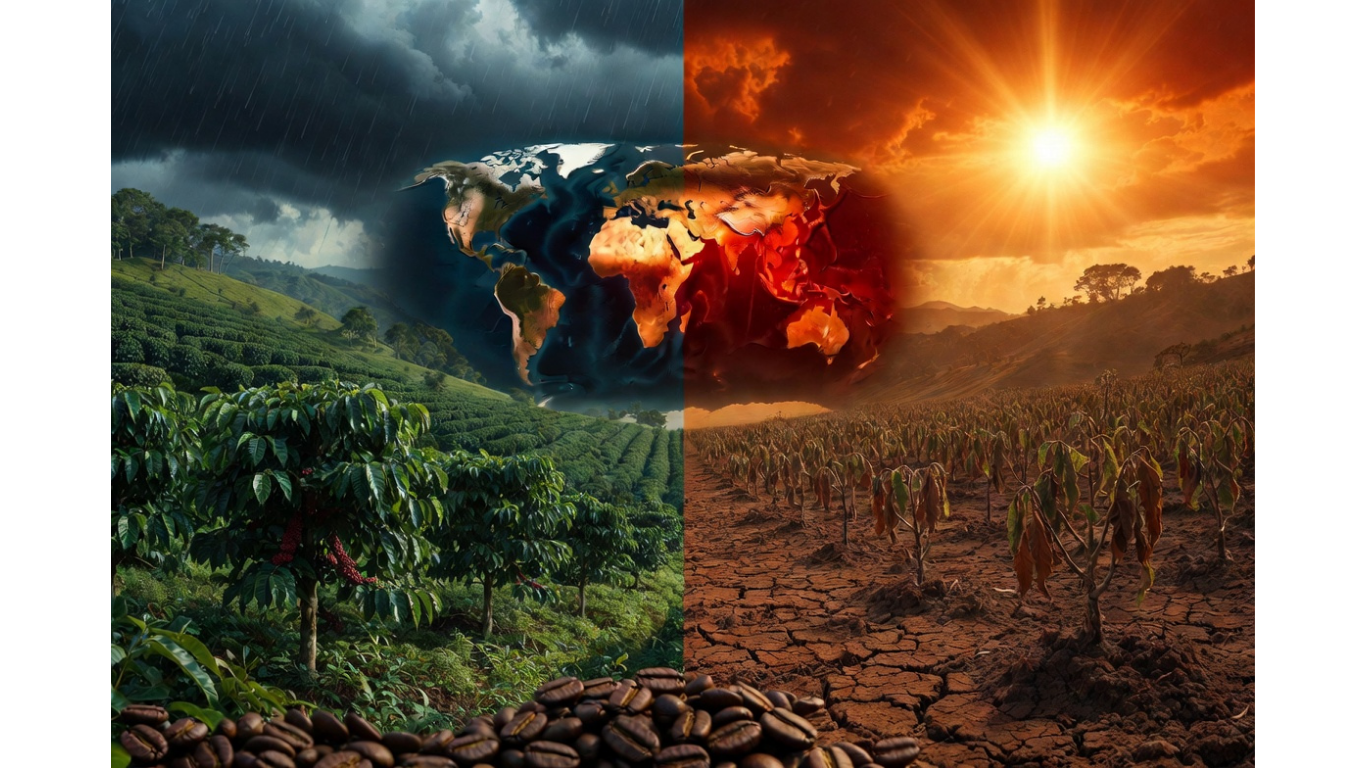
El Niño: What It Is and How It Affects Coffee

Author: Qahwa World – Climate Desk

Source: NOAA, WMO, ICO, StoneX, industry sources
Date: May 22, 2026

Executive Summary

  • There is a 96% probability that El Niño will persist through the Northern Hemisphere winter of 2026‑2027.
  • Sea surface temperatures in the Niño 3.4 region have already exceeded the +0.5°C El Niño threshold.
  • Vietnam and Indonesia face drought and higher temperatures, threatening Robusta yields.
  • Brazil may see irregular rainfall during critical flowering (August‑October 2026), reducing Arabica quality.
  • Colombia and Central America face mixed risks: excess rain (leaf rust) or drought.
  • Analysts expect higher coffee price volatility in 2027, with Robusta supply risks pushing futures higher.
  • Smallholder farmers in vulnerable regions could face income losses, food insecurity, and migration pressure.

As of mid‑May 2026, the tropical Pacific is showing unmistakable signs of a rapid transition toward El Niño conditions.

According to the NOAA Climate Prediction Center’s ENSO Diagnostic Discussion released on May 14, there is an 82% probability that El Niño will emerge between May and July 2026, rising to a 96% chance that it will persist through the Northern Hemisphere winter of 2026‑2027.

Scientists are closely monitoring whether this event could evolve into a Super El Niño, potentially rivaling the record‑strength episodes of 1982‑83, 1997‑98, or 2015‑16. With sea surface temperatures in key Niño regions already warming sharply, the stage is set for significant disruptions to global weather patterns — from devastating floods in South America to severe droughts across Southeast Asia and parts of East Africa.

What Is El Niño?

El Niño (Spanish for “The Little Boy” or “Christ Child”) is the warm phase of the El Niño‑Southern Oscillation (ENSO), Earth’s most influential climate variability pattern. Under normal conditions, strong easterly trade winds push warm surface water westward across the equatorial Pacific toward Indonesia, allowing cold, nutrient‑rich water to upwell off the coasts of Peru and Ecuador. During El Niño, these trade winds weaken or reverse. Warm water spreads eastward, suppressing upwelling and altering atmospheric circulation patterns worldwide.

The counterpart, La Niña, brings cooler waters and opposite weather effects. ENSO events typically occur every 2‑7 years and last 9‑18 months.

Current Status – May 2026

The equatorial Pacific is currently in a transitional state following a weak La Niña. Sea surface temperatures in the Niño 3.4 region have risen rapidly, with recent weekly values exceeding the +0.5°C El Niño threshold.

Multiple international models, including those from NOAA, the ECMWF, and the WMO, show high confidence in El Niño development by mid‑to‑late 2026. While peak strength remains uncertain, some projections suggest anomalies could exceed +2.0°C, raising the possibility of a strong‑to‑very‑strong event.

Global Weather Impacts

El Niño redistributes heat and moisture across the planet:

  • South America (Peru, Ecuador, northern Brazil): Increased rainfall and flooding risks, potential damage to infrastructure and agriculture.
  • Southeast Asia, Indonesia, Australia: Significantly reduced rainfall, drought, higher wildfire risk, water shortages.
  • East Africa: Wetter‑than‑average conditions, increased flood and disease risks.
  • Southern United States: Wetter winters; Northern US and Canada often milder.
  • Global: Elevated average temperatures (El Niño typically adds ~0.1–0.3°C to global surface temperatures).

Impact on Global Coffee Production

Coffee is one of the most climate‑sensitive major commodities. With roughly 12.5 million farming families dependent on it worldwide, any major ENSO event sends ripples through prices, quality, and livelihoods. The 2026‑2027 El Niño is expected to affect both Arabica and Robusta differently across key origins.

1. Brazil – The World’s Largest Producer

Brazil faces a complex outlook. While the current 2026/27 harvest is projected to be strong, El Niño could disrupt the critical flowering period (August‑October 2026) through irregular rainfall or excessive heat. Historical patterns show El Niño often brings drier conditions to key Arabica regions in Minas Gerais and São Paulo, potentially reducing bean size, increasing defects, and lowering quality.

2. Vietnam and Indonesia – Robusta Heartlands

These two giants are highly vulnerable to El Niño‑induced drought and elevated temperatures. Reduced rainfall and prolonged dry seasons can stress Robusta trees, leading to smaller beans, lower yields, and higher production costs due to increased irrigation needs. The 2015‑16 El Niño caused notable declines in Robusta output in these regions.

3. Colombia, Central America, and East Africa

Colombia and Central America face mixed signals: potential for excessive rainfall in some areas (increasing fungal diseases like coffee leaf rust) or drought in others. Ethiopia and Kenya may see wetter conditions that boost yields in some highlands but heighten disease pressure and complicate harvesting.

Overall Market Outlook

Analysts anticipate higher price volatility in 2027 as the event peaks. While Brazil’s large crop may buffer total volume in the short term, quality concerns and Robusta supply risks could push Arabica and Robusta futures higher. The ICO and major traders are already factoring these risks into their forecasts.

Broader Economic and Humanitarian Implications

  • Price Spikes: Coffee futures have already shown sensitivity to El Niño headlines, with short covering observed.
  • Smallholder Farmers: Millions in vulnerable regions face income losses, food insecurity, and potential migration pressures.
  • Supply Chain: Roasters, traders, and consuming countries should prepare for tighter specialty‑grade supplies and elevated costs.
  • Compounding Factors: Persistent low stocks, high input costs (fertilizers, labor), and climate change amplify risks.

Recommendations and Preparedness

For Governments and International Organizations: Strengthen early warning systems, support farmers with drought‑resistant varieties, irrigation, shade management, and crop insurance. The WMO, FAO, and ICO should coordinate contingency planning.

For the Coffee Industry: Diversify sourcing strategies, invest in sustainable practices that build resilience, and monitor ENSO updates monthly.

For Consumers: Expect potential price increases in premium and everyday coffee blends throughout 2027. Supporting traceable, climate‑smart coffee can help mitigate long‑term risks.

Frequently Asked Questions

What is the probability that El Niño will persist through winter 2026/2027?

NOAA estimates a 96% probability that El Niño will persist through the Northern Hemisphere winter of 2026‑2027.

Which coffee origins are most at risk from this El Niño?

Vietnam and Indonesia (Robusta) face drought; Brazil (Arabica) may see irregular flowering; Colombia and Central America face mixed flood/drought risks.

How could El Niño affect coffee prices?

Analysts expect higher price volatility in 2027. Robusta supply risks could push futures higher, and specialty‑grade supplies may tighten.

What can smallholder farmers do to prepare?

Governments and organizations should provide drought‑resistant varieties, irrigation support, shade management, and crop insurance.

How does this El Niño compare to past events?

Models suggest it could become a strong‑to‑very‑strong event, potentially rivaling 1982‑83, 1997‑98, or 2015‑16, but final strength remains uncertain.

What are the broader economic risks beyond coffee?

Smallholder farmers face income losses and food insecurity; supply chains face tighter supplies and elevated costs; migration pressures may increase.


Author: Qahwa World – Climate Desk | Source: NOAA, WMO, ICO, StoneX, industry sources | Date: May 22, 2026

Shanghai Overtakes New York as Global Coffee Capital as Ethiopia and Vietnam Compete in China

Author: Sahl Maryam Jabra Madhin
Source: ECTA, GACC, ICO
Date: May 21, 2026

Executive Summary:

  • Shanghai now hosts over 9,115 cafes, making it the world’s leading coffee city, double New York and five times Paris.
  • China’s coffee consumption has grown 15 percent annually over the past three years.
  • Ethiopia ranks second as a coffee supplier to China after Brazil, with premium specialty coffee at $6,310 per ton.
  • Vietnam ranks third, offering robusta at $4,176 per ton, benefiting from geographic proximity (4-6 days shipping).
  • China’s zero tariff policy for Ethiopian products has boosted Ethiopian coffee exports, moving Ethiopia from 33rd to 3rd place in five years.
  • In the first ten months of the 2018 budget year, Ethiopia exported 37,711 tons of coffee to China worth $270.73 million.

For many years, the global coffee industry had its eyes fixed on New York, Milan, and Paris. Today, the new growth center of the coffee industry has shifted to Asia. Shanghai now hosts over 9,115 cafes, making it the world’s leading coffee city. This is double the number in New York and approximately five times that of Paris.

Beyond the numbers, the key story is that China’s coffee consumption has grown 15 percent annually over the past three years. This has created a major shift in the global coffee supply chain. While many businesses still focus only on Western markets, China is quietly becoming a major destination and opportunity gateway for Ethiopian and Vietnamese coffee.

Ethiopia vs Vietnam in Shanghai (2025-2026)

Indicator Ethiopia Vietnam
Import rank in China 2nd (after Brazil) 3rd
Supply volume ~50,000 tons ~36,000 tons
Price per ton $6,310 (premium) $4,176 (mid-range)
Growth rate +79.1% revenue +65.8% supply
Key advantage Zero tariff, natural varieties, specialty quality Proximity (4-6 days), lower price

How Each Coffee is Perceived in Shanghai

Ethiopia: The Quality Standard
In Shanghai’s 9,000 cafes, Ethiopian coffee is viewed like fine wine. It is mostly found in specialty coffee shops and premium chains like Blue Bottle. It is preferred for pour-over black coffee. Young Shanghai coffee enthusiasts see Ethiopian coffee as the peak of complexity, with notes of wine, chocolate, spice, fruit, or citrus. Despite its higher price, it remains highly sought after.

Vietnam: The Reliable Workhorse
Once known only for instant coffee, Vietnam has rebranded itself by producing high quality robusta. Vietnamese coffee is commonly found in large chains like Luckin or Cotti, as well as popular cafes in the Jing’an district. It is known for its strong, nutty, chocolatey flavor and is seen as a reliable, affordable option, often mixed with milk.

Zero Tariff Policy and Ethiopia’s Rise

In 2025, a major change occurred: China’s zero tariff policy for Ethiopian products. This duty free access, along with growing strategic cooperation in agriculture, technology transfer, e-commerce links, and Shanghai’s role as a trading hub, has made Ethiopian coffee more price competitive in China.

Five years ago, China was the 33rd destination for Ethiopian coffee exports. By 2017, it rose to 4th place. In the first ten months of the 2018 budget year, Ethiopia exported 37,711 tons of coffee to China, worth $270.73 million, moving up to 3rd place. This demonstrates the rapid growth of Ethiopia’s presence in the Chinese market.

Frequently Asked Questions (FAQ)

1. How many cafes does Shanghai have?

Shanghai has over 9,115 cafes, more than double New York and about five times Paris.

2. How fast is China’s coffee consumption growing?

China’s coffee consumption has grown 15 percent annually over the past three years.

3. Which countries are the top coffee suppliers to China?

Brazil ranks first, followed by Ethiopia (second) and Vietnam (third).

4. What is the price difference between Ethiopian and Vietnamese coffee?

Ethiopian coffee averages $6,310 per ton, while Vietnamese coffee averages $4,176 per ton.

5. What is the zero tariff policy?

China granted duty free access to Ethiopian products in 2025, boosting Ethiopian coffee’s price competitiveness.

6. How much coffee did Ethiopia export to China in 2018?

In the first ten months of the 2018 budget year, Ethiopia exported 37,711 tons of coffee to China, worth $270.73 million.

Sahl Maryam Jabra Madhin – Based on reports from ECTA, GACC, ICO, and Allegra World Coffee Portal.
Published: May 21, 2026

Michael Trung: After 50, I Became a Beginner in Coffee

An interview with Michael Trung,  Authorized SCA Trainer, coffee consultant, and founder of iO Coffee

Dubai – Ali Alzakary

Most coffee conversations start with a tasting note: chocolate, jasmine, dried fruit. But what if we started instead with a shipping container stuck at customs? Or a farmer watching months of work split open in a single rainstorm?

Michael Trung spent 25+ years in international logistics , moving goods, solving port crises, chasing paperwork. Then, after 50, he did something unexpected: he became a student of coffee. Today, he’s an Authorized SCA Trainer, a Specialty Coffee consultant, and the founder of iO Coffee, where he roasts in Vietnam to keep value with the people who grow the beans.

In this candid interview, Michael shares why COVID forced him to restart, what “the coffee smile” really means, and how logistics taught him to respect not just the bean, but every pair of hands that touches it.

If you care about where your coffee actually comes from not just the origin story, but the real supply chain.. read on.

  • You spent over 25 years in logistics, then suddenly moved into specialty coffee. How did that happen? And did logistics help you see coffee differently?

I come from the service industry. I spent more than 25 years in international freight forwarding—handling customs problems, shipment delays, port congestion, and phone calls at all hours just to keep cargo moving. That was my life for a long time.

Then COVID came and everything slowed down. For the first time in many years, I had time to sit quietly and think. I realized I knew how to move coffee around the world, but I knew nothing about the people growing it. I didn’t know the farming, the soil, or the hard work that happens before a bean even reaches a warehouse or café.

This became my startup life after 50. At an age when many people think about slowing down, I became a beginner again. Coming from logistics, I did not enter coffee as an expert, I entered as a student. In logistics, you learn to respect the journey from point A to point B. In coffee, I learned to respect the people standing at the beginning of that journey. Honestly, coffee taught me one thing: the more I know, the more I know I don’t know.

  • You founded iO Coffee after a long logistics career. How do you use that experience to improve the coffee chain? Have you changed how coffee is shipped because of the mistakes you saw?

Yes, very much. In logistics, one small mistake early on becomes a giant problem later. I’ve lived through the real-world headaches: the “HS code trap” at customs, missing certificates, or your cargo getting “rolled” at the port because of congestion. Coffee is very sensitive to all of this. If it sits in a hot container during a port delay or near something smelly because of a bad equipment choice, the flavor is gone.

Because of my background, I naturally pay attention to airflow, moisture control, packaging, and container cleanliness to protect the bean from farm to cup. But the biggest thing was seeing how little value stays with the farmers. That is why we roast in Vietnam at iO Coffee. I believe the origin should keep more of the reward, not just export the raw material.

For me, sustainability isn’t just a marketing word; it’s about protecting the hard work behind the coffee. That is why we always say: ‘Respect the Bean. Respect the hands.’

  • What pushed you to become an SCA Authorized Trainer and start “Michael Barista” on YouTube?

I used to think coffee was simple. But once you go deep, you see it’s a whole university inside a small bean—chemistry, farming, roasting, and sensory science all connected. I didn’t want to just be a guy with an opinion; I wanted to learn the professional international standards. That led me to become an SCA Authorized Trainer.

YouTube happened naturally. I started ‘Michael Barista’ to document my journey honestly, including my mistakes. I’m not a professor. I’m just an outsider sharing what I discover so that the younger generation feels coffee is something they can approach. I’ve also learned that today, good coffee alone is not enough—you need storytelling and a real connection with people.

  • Uring your many trips to coffee farms, what are three things you never expected to see?

The Sacrifice: I never expected the sheer level of labor. Seeing farmers picking cherries in the heat—that’s a man’s life, not just a product.

The Fragility (The ‘Coffee Smile’): In logistics, timing is important. In coffee, it’s everything. I learned a sad story on the farms: if it rains unexpectedly during harvest, the ripe cherries burst open. We call it the ‘coffee smile,’ but when the coffee smiles, the farmer cries. In just a few hours of rain, months of hard work are destroyed. It made me realize how sensitive this journey really is.

The Hope: I see younger farmers returning to the farms with new ideas while still respecting the older generation. They are bringing science and sustainability to the dirt, and that gives me hope for the future of Vietnamese coffee.

  • Vietnam is a top producer of Robusta. How do we move toward “value” instead of only “volume”?

For many years, Vietnam was known mostly for volume. But now I see more people focusing on quality, transparency, and Fine Robusta. People around the world now want more than just flavor notes; they want to know who produced the coffee and how it was handled.

I’m still learning how to balance my operational ‘logistics’ brain with the storytelling side. In logistics, we just moved cargo. In coffee, we have to share the heart behind the work. I don’t think we need too much noise. Good coffee speaks slowly. The best we can do is keep improving—little by little, season by season, cup by cup.


Michael Trung is an Authorized SCA Trainer and founder of iO Coffee in Vietnam. Find his educational content on YouTube as “Michael Barista.”

Vietnam Coffee Exports Rise 16% in Early 2026 While Revenue Falls

Dubai – Qahwa World

Vietnam’s coffee sector recorded a strong increase in export volumes during the first four months of 2026, while total export revenues declined due to easing global prices following the record highs of the previous year.

According to official government data, Vietnam exported approximately 810,000 tons of coffee between January and April 2026, representing a 15.8% year-on-year increase. The rise reflects continued strength in production and logistics, reinforcing Vietnam’s position as the world’s largest robusta coffee producer.

However, despite higher shipment volumes, export revenues fell by 7% compared to the same period in 2025, totaling 3.69 billion dollars. This divergence between volume and value reflects a clear correction in global coffee prices, particularly in the robusta segment.

  • Volume and Value Gap in Market Performance

The latest figures highlight a widening gap between export volume and export value. While shipments increased significantly, the average export price declined to around 4,555 dollars per ton, down from the elevated levels seen in mid-2025.

This price normalization follows a period of tight global supply that previously pushed prices to historic highs. Improved harvest conditions in Vietnam’s Central Highlands and recovering output from other producing countries have eased supply constraints, contributing to softer prices.

  • Market Dynamics and Domestic Trends

The decline in export revenue is primarily linked to weaker global coffee prices as markets adjust to expectations of higher supply. Increased production in Vietnam, along with competitive exports from countries such as Indonesia, has contributed to a more balanced global market.

Domestically, farm-gate prices in key coffee-producing provinces such as Dak Lak and Lam Dong fluctuated between 88,700 and 89,300 Vietnamese dong per kilogram in April. These movements encouraged cautious selling behavior among farmers, who are closely monitoring price trends before releasing stocks.

Earlier in the year, export momentum was already strong. Shipments in January and February 2026 were reported to be up by around 14 percent in some datasets, with the first quarter maintaining solid volume growth despite continued pressure on export values.

  • Strong Crop Outlook Supports Export Growth

Vietnam’s 2025 to 2026 coffee crop is expected to remain strong, with earlier projections indicating a potential increase of around 10 percent compared to the previous season. This growth is supported by improved weather conditions following earlier drought-affected periods.

The favorable production outlook has helped sustain high export volumes and ensured stable supply availability in global markets.

  • Strategic Shift Toward Value Addition

In response to ongoing price volatility in raw coffee markets, Vietnamese authorities and industry stakeholders are accelerating efforts to expand deep processing.

This strategy focuses on increasing exports of roasted, ground, and instant coffee products rather than relying mainly on green bean shipments. Investments are being directed toward advanced processing facilities to strengthen value addition and improve competitiveness in global supply chains.

  • Outlook

Industry analysts expect Vietnam to maintain strong export volumes throughout 2026, potentially reaching near-record levels if current production trends continue. However, revenue growth may remain under pressure unless global prices recover or demand strengthens in key markets such as the European Union, the United States, and Japan.

Vietnam’s performance in early 2026 highlights a key trend in global coffee trade: rising supply is driving higher export volumes, while price normalization is limiting overall export value.

Source: General Statistics Office (GSO) / Ministry of Agriculture and Rural Development

Trump Tariffs Reshape Global Coffee Trade

Dubai – Qahwa World

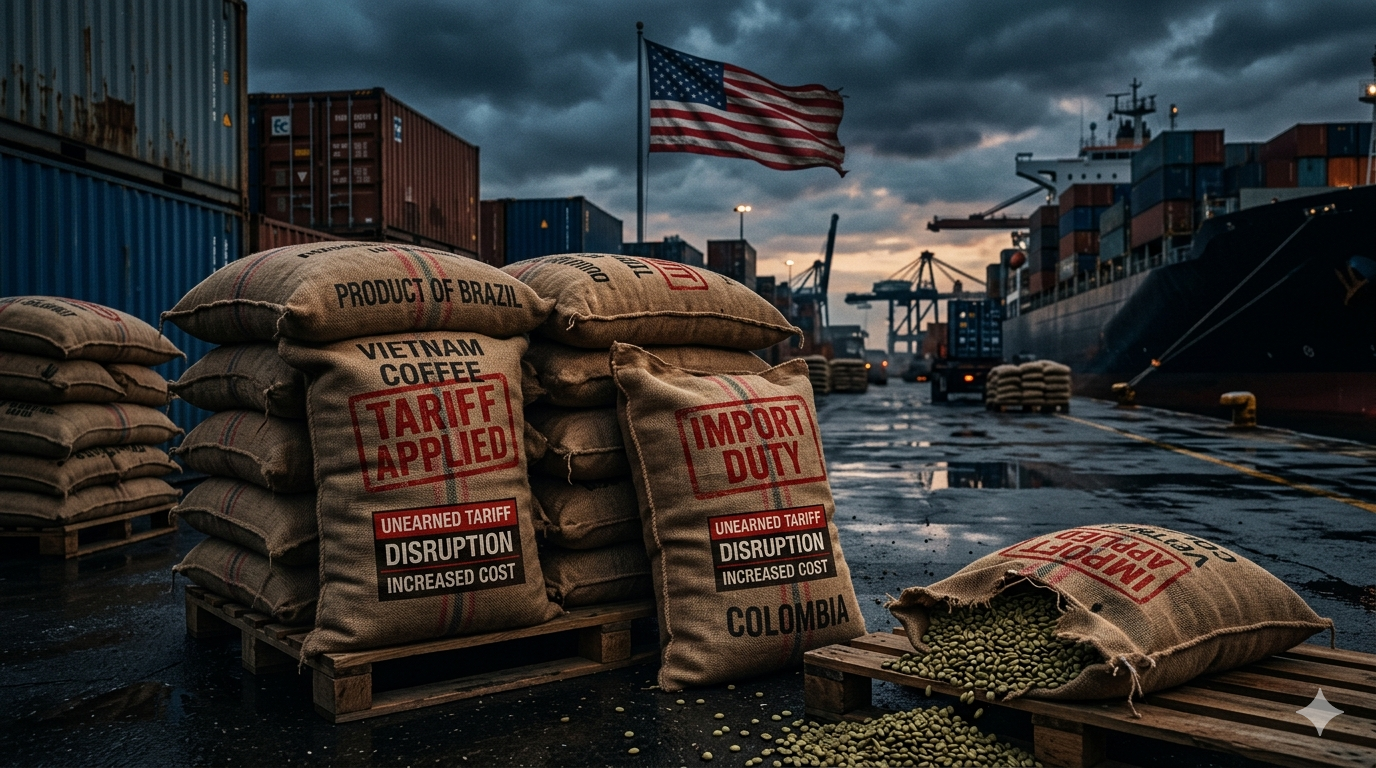
Tariff policies introduced during 2025 have contributed to significant shifts in the global coffee trade, pushing industry players to rethink supply chains and accelerate structural changes across the sector.

In 2025, broad tariff measures were imposed on imports of green coffee beans and roasting equipment. The initial rate started at around 10%, but in some cases increased substantially on major coffee-producing countries such as Brazil, Vietnam, Indonesia, and Mexico.

These measures were not applied consistently over time. Later adjustments, exemptions, and partial rollbacks were introduced following trade negotiations and policy revisions, including relief for certain agricultural goods that are not domestically produced, such as coffee. Despite this, the early phase of the tariffs had already created noticeable disruption.

The impact included higher roasted coffee prices in certain markets, shifts in export flows, and widespread instability across global supply chains.

  • Supply Chain Disruption

The changes exposed how sensitive the global coffee system is to trade policy shifts. Key developments included:

A decline in exports from Brazil to the United States, with redirected shipments toward Asia and the Middle East
Increased tariff pressure on exports from Vietnam, Indonesia, and Mexico, pushing buyers to search for alternative origins
Rising costs for coffee equipment such as grinders and espresso machines due to import dependencies

Frequent policy changes made long-term planning difficult, increasing operational uncertainty and raising costs across the supply chain.

  • Beyond Beans: Equipment and Infrastructure

The impact was not limited to green coffee. Imported roasting and café equipment also became more expensive, increasing the cost of opening or upgrading coffee shops.

This added pressure came on top of ongoing global supply chain disruptions, including higher raw material costs and shipping delays in recent years.

  • Market Adaptation Strategies

As costs rose, market participants explored different ways to adapt, including:

Rerouting shipments through countries with lower tariff exposure
Reclassifying origin within multi-stage production chains
Establishing roasting and packaging operations in third countries to alter customs classification

Large multinational companies were generally better positioned to implement such strategies due to capital availability and infrastructure flexibility.

  • Historical Context of Coffee Trade Workarounds

Attempts to bypass trade restrictions are not new in coffee history. Over centuries, coffee spread globally through a mix of legal trade, secrecy, and strategic relocation of plants and beans.

Historical examples include:

Early movement of coffee cultivation from its origin regions into Asia and the Americas through controlled and often restricted transfers
The spread of coffee plants to Southeast Asia and Latin America via maritime trade routes in earlier centuries
Historical episodes in Europe where coffee was heavily taxed or restricted, leading to informal trade networks and enforcement efforts

These patterns show that trade restrictions have historically encouraged alternative distribution channels.

  • Shifting Global Demand

Several broader trends accelerated during this period:

Growth in coffee consumption in Asia and the Middle East
Expansion of domestic consumption in producing countries
Increasing focus on supply diversification by major importers
Stronger regulatory attention in some markets on sustainability and climate-related sourcing

Together, these shifts suggest a gradual rebalancing of global coffee consumption and trade flows.

  • Uncertain Long-Term Outcomes

The long-term effects of these tariff-related disruptions remain unclear. Some analysts expect elevated price levels to persist even after policy normalization, due to accumulated supply chain inefficiencies.

While tariffs are often intended to support domestic industries, the observed effects in many cases have included:

Increased costs for importers and roasters, particularly smaller businesses
Higher consumer prices in retail and café markets
Reduced supply chain efficiency due to rerouting and compliance complexity
Limited direct benefit to producers in developing countries in many cases

Larger companies have generally been better able to absorb shocks, potentially contributing to greater consolidation within the industry.

  • Conclusion

The tariff developments of 2025 may represent a turning point in the global coffee trade system. Combined with shifting consumption patterns, rising new markets, and evolving supply chain strategies, the industry appears to be entering a new structural phase.

The key question moving forward is whether these changes will lead to a more resilient and balanced global coffee economy, or further concentrate influence among large multinational players.

Coffee has always moved across borders in response to economic and political pressure. Once again, it is adapting—reshaping itself along with the global systems that depend on it.

Indonesia Eyes Further Growth in Coffee Exports to Russia

Moscow — Qahwa World

Indonesia may continue expanding its coffee exports to Russia following strong growth in 2025, although logistical and financial hurdles remain, according to an industry representative.

A supplier speaking at the “Coffee Tea Cacao & HoReCa Expo” in Moscow said that while Indonesia is unlikely to surpass Vietnam as Russia’s top coffee exporter, there is still room to increase overall shipment volumes.

Trade data previously showed that Indonesia strengthened its position among Russia’s leading coffee suppliers during the first nine months of 2025, with export values rising significantly compared to the previous year. Vietnam, however, maintained its lead by a wide margin.

Industry participants point to transportation difficulties and payment processing issues as the main constraints affecting further expansion. Despite these challenges, there is optimism that improving bilateral relations could help ease some of these barriers.

Russia is not yet among Indonesia’s top coffee export destinations, but demand in the market has been steadily increasing in recent years, making it more attractive for exporters.

Recent high-level talks between officials from both countries have also included discussions on facilitating financial transactions, which could support future trade growth.

Coffee Markets Decline as Supply Fears Subside

Dubai – Qahwa World

Coffee futures moved lower at the end of the week, with both arabica and robusta contracts posting notable losses. Arabica dropped to its lowest level in about a week, while robusta also weakened.

The decline was linked in part to improving conditions in global shipping. Iran’s announcement that the Strait of Hormuz has reopened helped calm earlier concerns about disruptions, suggesting smoother trade flows and reducing anxiety over supply constraints.

Earlier in the week, arabica had already been under pressure, touching a one-month low as expectations grew for a strong harvest in Brazil. Several industry forecasts point toward a record crop in the 2026/27 season, with estimates clustering above 75 million bags. Some analysts also anticipate a significant expansion in the global coffee surplus, potentially reaching its highest level in several years.

Meanwhile, Vietnam continues to play a major role on the supply side. The country, the leading producer of robusta coffee, has reported rising export volumes. Shipments in the first quarter increased compared to the same period last year, and full-year exports have also shown solid growth. Production in the current season is expected to climb to a multi-year high, adding further pressure to prices.

Despite this broader supply outlook, some factors are offering limited support. Inventories of robusta monitored by the ICE exchange have declined to their lowest level in over a year, indicating tighter availability in certified stocks.

In Brazil, export data has been mixed. Recent figures show a drop in shipments compared to last year, which may lend some support to prices. Weather is also being closely watched, as below-average rainfall in key growing regions like Minas Gerais could affect crop yields.

On the global stage, export volumes have edged slightly lower in the current marketing year, according to international data. However, overall production is still expected to rise in the 2025/26 season, driven by gains in robusta output despite a projected decline in arabica production.

Looking ahead, forecasts suggest Brazil’s total production may ease slightly, while Vietnam’s output is likely to increase. At the same time, global ending stocks are expected to shrink, reflecting ongoing shifts in supply and demand dynamics.

Brazil Export Decline Supports Coffee Prices

Dubai – Qahwa World

Coffee prices moved higher midweek, with both arabica and robusta futures posting gains. Robusta led the advance, reaching its strongest level in roughly one and a half weeks, supported by tightening near-term supplies.

A key factor behind the upward movement is reduced export activity from Brazil. Recent figures indicate that shipments of green coffee declined in March compared to the same month last year. Broader trade data also shows a sharp drop in overall coffee exports, reinforcing concerns about limited supply from the world’s leading producer.

In the robusta segment, falling inventories have added to the bullish sentiment. Exchange-monitored stockpiles have dropped to their lowest levels in more than a year, highlighting ongoing supply tightness in the physical market.

Weather conditions are also contributing to price support. Brazil’s main arabica-growing region, Minas Gerais, has received significantly less rainfall than usual in recent weeks. Reduced precipitation during key crop development stages may affect yields, adding uncertainty to future supply.

However, the broader outlook remains complex. Earlier projections of a large upcoming Brazilian crop continue to weigh on market sentiment. Several forecasts point to record production in the 2026/27 season, with global supply potentially expanding into a sizeable surplus.

At the same time, rising certified inventories for arabica have recently pressured prices, reflecting improved availability in some segments of the market.

Global logistics challenges are adding another layer of influence. Disruptions to major shipping routes have increased freight, insurance, and fuel costs, raising expenses for importers and roasters and contributing to overall market volatility.

Meanwhile, Vietnam continues to strengthen its position in the robusta sector. Strong export performance and expectations of increased production could help offset supply constraints from Brazil.

Earlier in the year, coffee prices declined sharply amid expectations of abundant global output. Forecasts suggest that worldwide production could reach record levels in the coming seasons, driven largely by Brazil and Vietnam.

Even so, global stock levels are expected to edge lower, with ending inventories projected to decline compared to the previous season. This balance between strong production and tightening stocks underscores the mixed and evolving outlook for the global coffee market.