DMCC Webinar Highlights Growth in Coffee Trade Between Colombia and the UAE

Economic and Logistics Partnerships Drive Record Trade Expansion and Strengthen Global Presence of Colombian Coffee

Dubai – Qahwa World

The Dubai Multi Commodities Centre DMCC organized a virtual webinar titled “Made for Trade Live: Colombia in Focus”, in partnership with the Embassy of the United Arab Emirates in Colombia, the Chambers of Commerce of Manizales, Armenia and Quindío, and Cali, as well as IKOR Global. This DMCC Colombia coffee webinar highlighted trade growth by bringing together public and private sector stakeholders to explore trade, investment opportunities, and developments in the coffee sector between Colombia and the UAE. Notably, the DMCC Colombia coffee webinar trade growth emphasis reflects the expanding role of Colombian coffee in international markets.

Ahmed Bin Sulayem, Executive Chairman and Chief Executive Officer of DMCC, stated that the Comprehensive Economic Partnership Agreement signed in 2024 eliminated 95% of tariffs, noting that bilateral trade is expected to exceed USD 1 billion within five years. Moreover, as discussed during the DMCC Colombia coffee webinar, trade growth for Colombian coffee is likely to accelerate under these new measures.

He added that DMCC hosts more than 26,000 companies, contributes over 15% of Dubai’s foreign direct investment flows, and around 7% of Dubai’s GDP. The member base includes more than 200 companies from Latin America, including 30 from Colombia, with Colombian membership growing by 50% over the past two years, representing nearly 20% of DMCC’s South American companies. This expansion aligns with the ongoing DMCC Colombia coffee webinar trade growth strategy.

Colombia, the world’s third-largest coffee producer and exporter, recorded export growth of 17% in 2024, driven by a 132% increase in exports to China, which is expected to overtake the United States as Colombia’s second-largest export destination. Furthermore, the DMCC Colombia coffee webinar trade growth was a key driver discussed during this international event.

The DMCC Coffee Centre spans 15,000 square meters and includes temperature-controlled storage, processing, roasting, packaging, and distribution facilities, serving 350 companies. A total of 8,200 metric tons of coffee were processed in 2025, including Colombian coffee, as highlighted in the DMCC Colombia coffee webinar focused on trade growth.

During the second coffee auction at World of Coffee Dubai World of Coffee Dubai, Geisha coffee from Panama achieved a record price of USD 30,240 per kilogram in 2025. The 2026 edition recorded the highest number of international origins ever represented, attracting more than 17,000 participants, with plans for further expansion in 2027. Also, the DMCC Colombia coffee webinar trade growth focus signaled continued opportunities in global coffee markets.

The webinar also announced the launch of the DMCC Cacao Centre, with the global cacao market projected to reach USD 26.2 billion by 2035. The centre currently hosts 88 companies operating in cacao trading, chocolate manufacturing, and confectionery. During the DMCC Colombia coffee webinar trade growth topic, diversification into cacao was discussed as complementary to coffee.

DMCC also hosts more than 4,000 technology companies active in artificial intelligence, robotics, crypto, tokenization, and trade finance. The DMCC Phoenix initiative was launched last November, while DMCC FINEX includes around 2,000 companies and is expected to exceed 5,000 in the future, bringing the total ecosystem close to 50,000 companies. Innovation was a key theme in the DMCC Colombia coffee webinar’s trade growth agenda.

Mohammed Al Shamsi, Ambassador of the United Arab Emirates to Colombia, stated that the UAE has expressed concern regarding recent regional tensions, noting 50 years of diplomatic relations between the two countries. This milestone was acknowledged during the DMCC Colombia coffee webinar trade growth segment.

He said non-oil trade in 2025 exceeded USD 2 billion, surpassing the CEPA target of USD 1 billion within less than two years, even before ratification, with expectations of further doubling after approval. He also highlighted the growing presence of the Juan Valdez brand across UAE cities. Additionally, the DMCC Colombia coffee webinar trade growth theme supports greater market access for Colombian coffee brands.

The Chamber of Commerce of Manizales por Caldas reported that Caldas ranks as the ninth-largest exporting department in Colombia, with exports exceeding USD 1,363 million, representing 3.4% of national exports. Coffee remains the flagship product, with external sales reaching USD 19 million and growth of 52% between 2020 and 2024. This reflects the DMCC Colombia coffee webinar trade growth impact.

The Chamber of Commerce of Cali highlighted a model based on four pillars: investment, internationalization, innovation, and integration. In Valle del Cauca, 71 companies exported coffee in 2025 across 362 export operations, reaching USD 318 million in international sales. Cali accounts for 50% of exporting companies, followed by Cartago at 23% and Sevilla at 14%. The United States represents 46% of exports, followed by Germany, Japan, Canada, the Netherlands, and China. These trends were reviewed in the DMCC Colombia coffee webinar, emphasizing trade growth.

Ricardo Muñoz, Coordinator of the Specialty Coffee Program at the Chamber of Commerce of Armenia and Quindío, stated that the program has been active for 15 years, with coffee accounting for around 80% of Quindío’s exports despite its small size. The region focuses on micro-lots and has developed infrastructure for milling, processing, and roasting. DMCC Colombia coffee webinar trade growth themes were mentioned in relation to the specialty coffee sector.

A DMCC presentation highlighted Dubai’s strategic location, enabling access to 2.5 billion people within a four-hour flight radius and up to 5 billion people within broader connectivity. Dubai is ranked as the most competitive economy in the Arab world and a global hub hosting more than 200 nationalities. The DMCC Colombia coffee webinar trade growth was a major consideration in positioning Dubai as a hub.

Mohammed Mohammed, Senior Manager Corporate Sales at DMCC: “Dubai offers you accessibility and connectivity. With a four-hour flight, Dubai offers you access to around 2.5 billion population. If you double that number of flights, it will get you access to 5 billion population. The most important part, you don’t need to fly to Dubai to set up your business. You can do it digitally.” For example, when considering DMCC Colombia coffee webinar trade growth, digital connectivity makes expanding into new markets easier.

Gulfood Gulfood recorded more than 6,800 participants and 133,000 visitors, generating over USD 20 billion in trade deals, while GITEX GITEX attracted more than 5,500 participants from over 190 countries. Dubai’s trade and wholesale sector accounts for around 23% of its economy, with more than 90 million passengers passing through its airports annually. Notably, DMCC Colombia coffee webinar trade growth supports wider trade events and partnerships.

Mike Butler, Coffee Ecosystem Manager at DMCC, stated that the Coffee Centre was established in 2019 in Jebel Ali Free Zone on a 15,000 square meter site powered by 75% solar energy. It hosts more than 300 members across the global coffee value chain and provides services including storage, logistics, processing, roasting, and capsule production. This infrastructure was highlighted as part of the DMCC Colombia coffee webinar trade growth model.

IKOR Global Managing Director Tatiana Córdoba stated that Colombian coffee exports to the UAE reached USD 16 million in 2024 and USD 17.3 million in 2025, reflecting 9% growth, with 70% of exports directed to the United States, Europe, and Canada. These figures were analyzed at the DMCC Colombia coffee webinar focused on trade growth.

She highlighted that the UAE connects more than 2 billion people within less than four hours of flight time. Additionally, DMCC Colombia coffee webinar trade growth opportunities were emphasized regarding global connectivity.

Anastasia, from Finca Dontulio Group: “When we think about DMCC we consider it’s the backbone of our green coffee logistics… DMCC helps us to eliminate that risk. When we talk about our business model, we definitely think about the coffee and the quality of it, but more importantly we think about building something meaningful across borders, bringing finest Colombian coffee to the world without compromise and this is where DMCC played a key role, it enabled us to scale sustainably and maintain excellence at every step.” The DMCC Colombia coffee webinar trade growth findings support this international approach.

The webinar concluded with the announcement of upcoming events, including World of Coffee from 26 to 28 January, Gulfood from 15 to 19 March Gulfood, and an additional event scheduled in Abu Dhabi in November. This schedule was part of DMCC Colombia coffee webinar trade growth announcements.


Coffee Break Dubai: Government Confidence, Market Shifts, and Hard Truths Facing the Coffee Industry

Dubai — Qahwa World

The first Coffee Break forum, held yesterday in Dubai, brought together senior leaders from the coffee, hospitality, logistics, media, and investment sectors to discuss the growing structural pressures facing the global coffee industry.

Organized by Mokha 1450 in partnership with Modora, the event went beyond discussion, offering a detailed real-time reading of how the sector is reacting to overlapping global disruptions.

Despite the complexity of challenges, a consistent theme emerged throughout the sessions: Dubai’s business environment continues to operate with a high level of institutional confidence, repeatedly linked by speakers to government crisis management performance and long-term economic stability.

  • SPEAKERS LIST (FULL PARTICIPANTS)

The session featured a high-level panel including:

  • Abdulla Al Shaibani — Group CEO, Axceed LLC
  • Garfield Kerr — CEO, Mokha 1450 and Former President of the Specialty Coffee Association
  • Khalid Al Mulla — CEO, Dubai Coffee Museum
  • Jennifer Pettinger-Haines — Founder and CEO, The GRIF Collective
  • Paul Clifford — Industry Editor and Analyst
  • Zeena Zalamea — Moderator, Broadcaster and Entrepreneur

GOVERNMENT CONFIDENCE AS A CORE BUSINESS FOUNDATION

A central thread across discussions was the role of government performance during crises, particularly the COVID 19 pandemic.

Speakers described how the UAE maintained operational continuity during global shutdowns, reopened faster than most major economies, and minimized long-term disruption to business ecosystems.

This experience created what participants described as a “structural confidence layer” that continues to shape decision-making today.

Rather than reacting defensively to current market pressures, companies are maintaining operations, focusing on internal stability, and prioritizing workforce wellbeing.

One speaker emphasized that during crises, the primary concern shifted away from business survival toward emotional and organizational stability within teams, supported by confidence in national systems.

  • ABDULLA AL SHAIBANI: LEADERSHIP UNDER STRUCTURAL CHANGE

Abdulla Al Shaibani highlighted that leadership in the current cycle is no longer defined by expansion, but by resilience management.

He emphasized that the priority for landlords and operators alike is stability rather than aggressive growth, stressing that maintaining continuity with tenants and partners is now the key objective.

He also noted that supporting smaller business ecosystems through flexible operational frameworks is essential during periods of uncertainty.

  • GARFIELD KERR: SUPPLY CHAIN DISRUPTION AND INDUSTRY PRESSURE

Garfield Kerr described significant disruption across global coffee logistics, particularly in air freight and container movement.

He explained that shipping costs have increased sharply, forcing businesses to pause shipments, delay projects, and reallocate inventory already positioned at origin.

He added that specialty coffee operators are now managing a fragile balance between cost pressure and quality preservation, especially as green coffee prices continue to rise globally.

  • JENNIFER PETTINGER-HAINES: THE TWO SPEED MARKET

Jennifer Pettinger-Haines presented data analysis covering approximately 400 venues across Dubai, revealing a clear structural divide:

  • Community cafés and neighborhood venues: growth of 30 to 40 percent in some cases
  • Fine dining restaurants: declines reaching 70 to 80 percent

She explained that this divergence reflects a fundamental shift in consumer behavior toward proximity, affordability, and familiarity.

Community driven venues are benefiting from consistent local demand, while high-end restaurants remain heavily dependent on tourism and discretionary spending.

  • PAUL CLIFFORD: PRICING STRATEGY AND BRAND RISK

Paul Clifford warned against aggressive discounting strategies, stating that repeated price reductions can permanently damage brand perception.

Once a brand is positioned at a lower price point, restoring premium positioning becomes significantly more difficult.

He noted that many operators are instead restructuring offerings by simplifying menus, reducing service formats, adjusting portions, and forming supplier collaborations rather than competing through pricing alone.

  • KHALID AL MULLA: LOGISTICS AND SYSTEM STABILITY

Khalid Al Mulla emphasized that government intervention extends beyond regulation into active operational support during crises.

He referenced past interventions that protected businesses from immediate financial collapse and ensured continuity of operations.

He also highlighted current logistics diversification strategies, including alternative shipping routes and regional port redistribution to reduce dependency on single supply corridors.

  • INDUSTRY TRANSFORMATION ACROSS OPERATIONS

Across the sector, businesses are adjusting core operations:

  • Reduced operating hours in line with demand
  • Workforce restructuring
  • Menu redesign due to cost inflation
  • Ingredient substitution and sourcing recalibration
  • Training program expansion

At the same time, companies are investing in internal capability development to prepare for post-crisis recovery cycles.

  • DIFFERENT ECONOMIC REALITIES WITHIN ONE MARKET

Speakers noted a widening gap between companies:

  • Well capitalized operators are investing and repositioning
  • Smaller operators are focused on survival and liquidity management

Overall performance remains below historical averages, with many businesses operating near break-even thresholds.

  • HOSPITALITY ASSET UNDERUTILIZATION

Hotel infrastructure was identified as an underutilized resource due to reduced occupancy rates.

Proposals included repurposing unused spaces into coworking environments, delivery kitchens, and hybrid operational models to improve asset efficiency.

  • SHIFTING CUSTOMER DEMOGRAPHICS

A key strategic concern raised was the under engagement of younger consumer groups.

Speakers noted that this demographic represents a growing opportunity but requires new approaches in branding, product development, and communication strategy.

  • ORIGIN LEVEL PRESSURE IN THE COFFEE CHAIN

At production level, rising costs and low farmer returns continue to threaten long-term sustainability.

Some producers are exiting the industry entirely, while younger generations are increasingly avoiding agricultural participation.

Sustainability investment and fairer value distribution were highlighted as critical structural requirements.

  • OUTLOOK: CONTROLLED OPTIMISM

Despite challenges, sentiment remained cautiously positive.

Most participants expect partial recovery within 12 to 24 months based on historical cycles in hospitality markets.

A widespread view emerged that current disruptions are cyclical rather than structural, shaping investment and operational decisions across the sector.

  • CONCLUSION

The Coffee Break forum in Dubai highlighted an industry under simultaneous global pressures but actively adapting across every layer of its value chain.

From supply chains to consumer behavior, the sector is undergoing structural recalibration.

At the center of this transition is sustained confidence in the UAE’s institutional stability and crisis management capability, which continues to influence strategic decisions across the industry.

Caffè Nero Forecasts Rising Prices Amid Steady Global Growth

Dubai – Qahwa World

Caffè Nero is pressing ahead with its international expansion, even as it warns that the price of a cup of coffee is likely to keep climbing. The premium coffee house group cited a volatile mix of geopolitical conflict, rising labor costs, and climate-driven supply shortages as the primary drivers behind the anticipated hikes.

The family-owned business, which operates 1,151 outlets globally, is targeting significant growth this year. The group plans to open 30 new stores in the UK and up to 70 additional locations across its 10 international markets. This expansion follows the recent acquisition of Washington D.C.-based Compass Coffee, a move that integrated 15 new sites and a dedicated roasting facility into the brand’s North American infrastructure.

  • A Different Rhythm

Gerry Ford, who founded the chain in 1997, suggests that Caffè Nero’s private ownership has allowed it to weather the current economic storm better than its publicly traded rivals. While competitors like Starbucks and Costa have struggled with store closures or stalled sales plans, Ford attributes Nero’s resilience to a “steady pace” and longer-term planning.

“We don’t want to take over the world,” Ford noted. “We have more flexibility because we aren’t trying to hit a quarterly reporting target. We move to our own rhythm.”

  • Financial Headwinds

Despite a 13% jump in annual sales to £587.6 million, the group’s pre-tax losses widened to £41 million. This was largely due to the rising cost of servicing its £481 million debt, fueled by recent interest rate hikes and a string of strategic acquisitions, including 200 Degrees and Harris + Hoole.

Caffè Nero Forecasts Rising Prices Amid Steady Global Growth

To manage these costs, Ford confirmed that the group will pause further acquisitions for at least a year to focus on integrating its latest purchases and meeting upcoming debt repayments.

  • The Cost Crisis

The industry is currently facing a “perfect storm.” Coffee prices tripled between 2023 and early 2025 as the climate crisis ravaged crops in Brazil and Colombia. While wholesale prices have recently stabilized, they remain nearly double what they were three years ago.

Ford warned that consumers shouldn’t expect relief at the till anytime soon. The ongoing conflict in the Middle East continues to drive up energy and shipping costs, while rising business rates and wages in the UK add further pressure. Data shows that the average price of a latte has already surged by 35% over the past five years, now sitting at approximately £3.76.

Despite these challenges, Ford remains bullish on the future of the specialty coffee sector, insisting that there is still plenty of “white space” for independent, premium brands to thrive globally.

High Coffee Costs Force Americans to Change Their Daily Habits

DUBAI – QAHWA WORLD

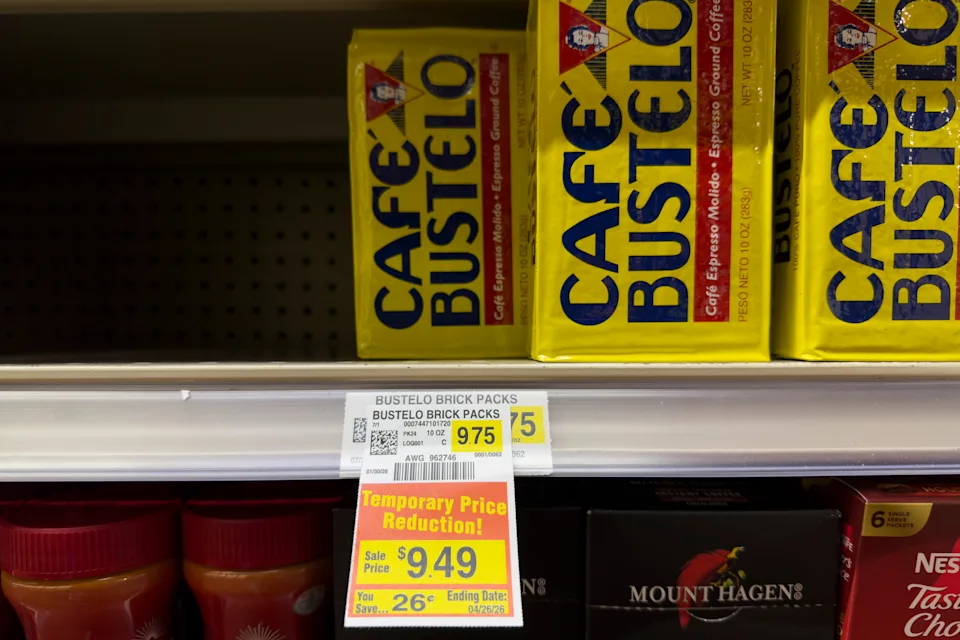
A grocery store in Chicago displayed coffee for sale on February 9, 2026, as rising prices continue to impact consumers nationwide.

For a long time, Chandra Donelson’s morning started with a trip to McDonald’s for a coffee with five creams and ten sugars, later evolving into Starbucks caramel macchiatos. The 35-year-old from Washington, D.C., has treated coffee as a vital ritual since her youth. However, the surge in prices eventually led her to an unexpected decision: quitting her daily habit. “I did that daily for years. I loved it. That was just my routine,” she explained. “And now it’s not.”

Across the United States, coffee enthusiasts are being forced to modify their behaviors—either by skipping the café, opting for cheaper alternatives, or stopping altogether. In January 2026, the Consumer Price Index revealed that coffee prices jumped 18.3% compared to the previous year. Looking back over five years, the government reported a staggering 47% increase.

YOU MAY LIKE: Coffee Prices Rise as Brazilian Real Strength Sparks Short Covering

These financial pressures have led people like Liz Sweeney, 50, of Boise, Idaho, to take drastic steps. Once a self-described “coffee addict,” Sweeney used to drink three cups at home and visit a café whenever she went out. Now, she has limited herself to a single cup at home and occasionally grabs a Diet Coke for a cheaper caffeine fix.

Similarly, 34-year-old Dan DeBaun from Minnesota has reduced his café visits to save money for a new home. He noted that what once cost $2 has now become a $5 or $6 expense. He now prepares ground coffee from Trader Joe’s and carries it in a travel mug. Data from the payment platform Toast indicates that the median price for a hot coffee reached $3.61 in December, while cold brew climbed to $5.55.

The vast majority of coffee in the U.S. is imported. Although some tariffs briefly impacted the market in 2025 before being revoked, the primary culprits for the price surge are environmental. Severe droughts in Vietnam, excessive rainfall in Indonesia, and harsh weather in Brazil have devastated crop yields and pushed global market prices higher.

Despite the financial strain, the National Coffee Association notes that two-thirds of Americans still consume coffee every day, and overall consumption has remained relatively stable. However, for those feeling the pinch of rising rent and food costs, the habit is becoming harder to maintain.

Sharon Cooksey, 55, of North Carolina, used to visit Starbucks every morning but eventually switched to brewing at home. After discovering that a bag of Lavazza coffee was significantly cheaper, she realized that an entire bag—which lasts for weeks—costs the same as one latte at a shop. “I’ll be damned if it didn’t taste so good,” she said, surprised to find she preferred her own brew.

For Chandra Donelson, the final straw came during a government shutdown that paused her paycheck. She traded her $8 coffee for a tea blend that costs about twenty cents per cup. As she puts it, “The math just makes sense.”

Uganda’s Ambition Shakes Coffee Markets: A Historic Leap Toward 20 Million Bags

DUBAI – QAHWA WORLD

While global markets remain preoccupied with weather volatility in Brazil, Uganda continues its steady and confident rise to solidify its position as the largest coffee exporting power in Africa, surpassing all conventional expectations.

According to data from the International Coffee Organization (ICO) Report for January 2026, Uganda recorded a historic surge in its exports with a growth rate of 52.5%, serving as a primary contributor to the increase in the continent’s total exports.

This exceptional performance was no coincidence; rather, it is the result of a national strategy that enabled the country to exceed the 8.2 million bags (60 kg each) annual threshold, placing it seventh globally and transforming it into a “pivotal player” that cannot be ignored in the global supply equation.

Analytical insights from the report indicate that Uganda successfully exploited the “price vacuum” left by production disruptions in other regions by improving production quality and expanding cultivated areas.

The Ugandan success story relies on a unique diversity; the country balances the production of “Robusta,” which forms the backbone of its exports, and high-quality “Arabica” grown on mountain slopes.

This diversity has granted it high flexibility in facing global exchange fluctuations, as Ugandan coffee has become the first choice for roasters seeking “value for money,” especially with increasing demand for both varieties in emerging European and Asian markets.

Behind these figures lies Uganda’s most ambitious plan in the continent’s history, aiming to double production to reach 20 million bags by 2030.

This government vision includes a comprehensive modernization of the post-harvest sector, the distribution of disease-resistant seedlings, and enhancing the capacities of smallholder farmers who represent 90% of the productive force.

Analysts believe that Uganda reaching this figure will make it a direct competitor to countries the size of Vietnam, redrawing the power map of the global coffee market and reducing total dependence on Latin American production.

The recent export leap is not just a number in an international report; it is a clear signal to investors that the center of gravity in coffee production has begun to shift toward East Africa. The ambition of 20 million bags is no longer a distant dream but an economic reality taking shape under the mantle of sustainable development and agricultural leadership.

Coffee Prices Drop Sharply Amid Record Global Supply Projections

Dubai – Qahwa World

Coffee market prices ended Friday’s sessions with a significant decline, as March Arabica coffee contracts dropped by 3.84% to close at -11.85, while March Robusta coffee fell by 1.75% to close at -67. This downward trend persisted throughout the week, with Arabica hitting a 6-month low and Robusta reaching its lowest level in nearly 6 months, pressured by reports confirming robust global supplies.

The Brazilian crop forecasting agency, Conab, reported that coffee production in Brazil for 2026 is expected to rise by 17.2%, reaching a record 66.2 million bags. This includes a projected 23.2% surge in Arabica production to 44.1 million bags and a 6.3% increase in Robusta to 22.1 million bags. In Vietnam, the world’s leading Robusta producer, exports in January jumped by 38.3%, adding further bearish pressure on prices, especially after 2025 exports had already risen by 17.5% to 1.58 million metric tons.

Additionally, above-average rainfall in Brazil eased drought concerns. Minas Gerais, the largest Arabica-growing region, received 69.8 mm of rain in the week ending January 30, representing 117% of the historical average. Vietnam’s production for the 2025/2026 season is also projected to climb 6% to a 4-year high. Meanwhile, ICE-monitored inventories have begun to recover from previous lows; Arabica stocks rose from a nearly 2-year low to a 3-month high, and Robusta inventories showed a similar recovery.

Despite some supportive signals for prices, such as the Brazilian Trade Ministry reporting a 42.4% drop in January exports and the International Coffee Organization (ICO) noting a slight 0.3% dip in global shipments, the overall outlook remains focused on surplus. The USDA’s bi-annual report projects that world coffee production for 2025/2026 will increase by 2% to a record 178.8 million bags, with a significant 10.9% rise in Robusta output, even as total ending stocks are forecasted to decline by 5.4%.

Trump Faces Bipartisan Backlash Over Coffee Tariffs

Washington, D.C. – Qahwa World

A bipartisan group of U.S. lawmakers is urging President Donald Trump to exempt coffee imports from new reciprocal tariffs that have driven up consumer prices nationwide.

Representatives Ro Khanna (D-CA) and Don Bacon (R-NE) sent a joint letter to the White House requesting that coffee be added to the list of goods excluded under Executive Order 14257, arguing that tariffs on a commodity the U.S. scarcely produces only hurt consumers.

“We respectfully request your administration exempt coffee from reciprocal tariff measures that are drastically increasing its price,” the lawmakers wrote. “Given that our nation consumes around 400 million cups per day, this is one modest but meaningful way to help the American people.”

According to the Bureau of Labor Statistics, coffee prices in the U.S. rose 20.9% year-over-year in August 2025. The National Coffee Association reports that roughly 99% of all coffee consumed in the country is imported, mainly from Latin America and Africa.

Trump’s “Liberation Day” tariffs aim to level global trade terms, but coffee — not listed among exempt goods — has seen costs rise sharply. Khanna and Bacon note that Hawaii and Puerto Rico produce only small specialty quantities, representing less than 1% of domestic consumption.

“Tariffs on coffee do not protect domestic businesses and interests—they only raise costs and amount to an additional tax on American consumers,” the letter said. “It is not practical to tariff a product that our nation does not meaningfully produce.”

The lawmakers warned that higher import costs are forcing small coffee shops and hospitality businesses to raise prices or close altogether. Khanna, whose district covers Silicon Valley, said he regularly hears from café owners struggling to stay afloat.

The two legislators also recently introduced the “No Coffee Tax Act”, seeking to repeal coffee-related tariffs entirely. Bacon, who will retire from Congress next year, called the policy “a punishment to Americans,” adding, “There is no American alternative to coffee — why tariff something we can’t grow?”

A White House spokesman, Kush Desai, responded that the President had already included coffee among goods eligible for tariff-free treatment under certain trade deals, and blamed global supply disruptions in producing regions for recent price hikes.

Despite that clarification, the bipartisan pressure reflects growing unease over the wider economic impact of Trump’s tariff agenda — from agricultural exports to daily consumer goods such as coffee, a staple for two-thirds of American adults.

U.S.-Made Coffee Remains More Expensive Than Imports Despite Tariffs

Dubai – Qahwa World

Throughout 2025, U.S. consumers have witnessed a steady rise in prices across nearly all goods following the administration’s decision to impose tariffs on imported products from global trade partners. Coffee has been no exception, even though the United States relies almost entirely on imported beans to satisfy domestic demand.

Data shows that coffee prices rose by 14.5% between July 2024 and July 2025, while roasted and packaged coffee in supermarkets increased by 21.7% between August 2024 and August 2025. These price hikes are largely attributed to tariffs affecting major coffee-producing nations such as Brazil, which supplies around 40% of the world’s coffee, and Vietnam, the second-largest global exporter.

Despite rising international prices, coffee produced within the United States remains significantly more expensive — a trend unlikely to change. Coffee cultivation requires specific geographical and climatic conditions found only in limited areas of the country, most notably Hawaii, where the right soil and altitude allow for small-scale production of high-quality beans. Even so, the total domestic yield accounts for barely 1% of what Americans consume annually.

Experts in both agriculture and finance agree that the United States lacks the natural and environmental capacity to achieve self-sufficiency in coffee production, even if domestic and imported prices were equal. Consumption far exceeds what local producers can supply, and expanding cultivation faces both economic and ecological constraints. The country’s main coffee-growing regions — Hawaii and Puerto Rico — can only cover a fraction of nationwide demand.

While tariff policies are intended to strengthen local industries and reduce reliance on imports, coffee remains a clear exception. Natural limitations make large-scale domestic production unfeasible, and imported coffee continues to be more affordable and abundant despite higher tariffs. Analysts conclude that the American coffee market will remain deeply tied to global supply chains — particularly to producers in Brazil, Vietnam, and Ethiopia — regardless of future policy changes or tariff increases.