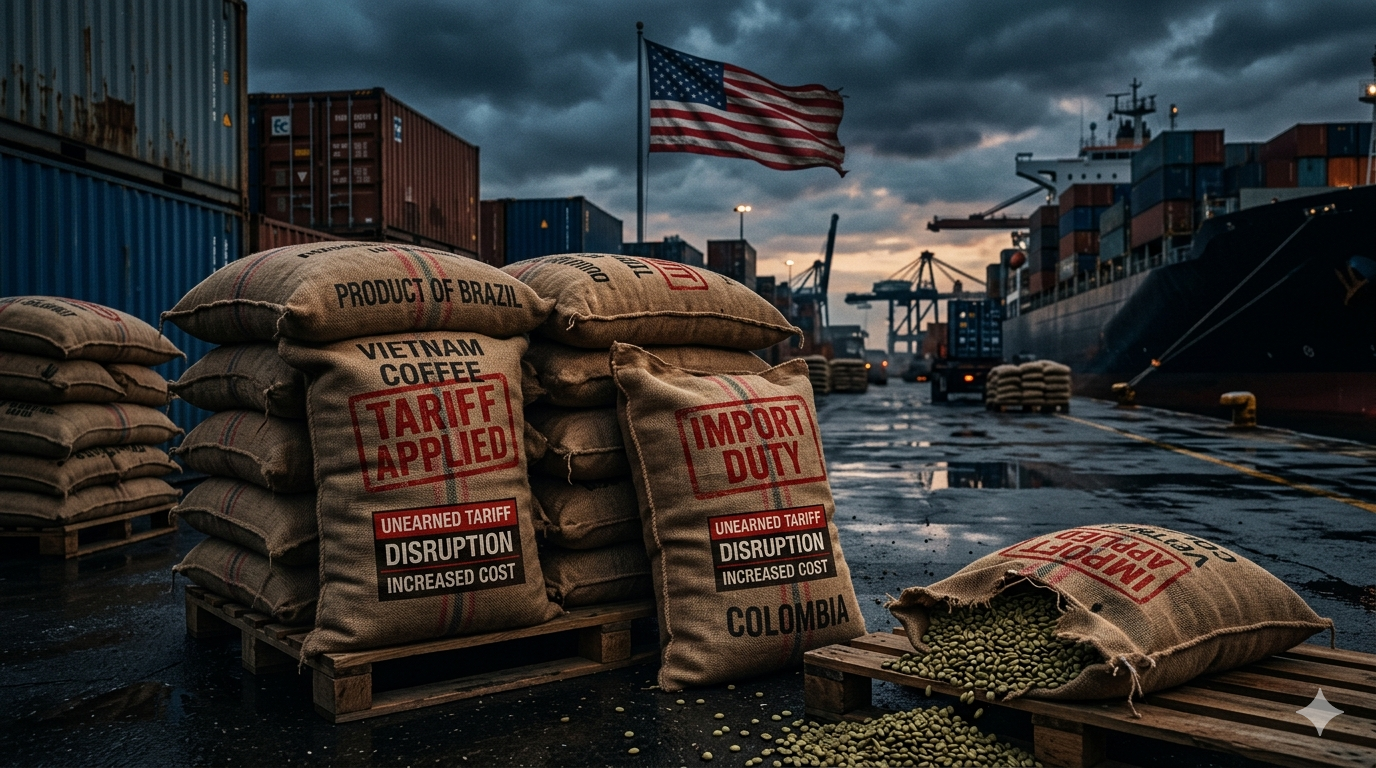
Trump Tariffs Reshape Global Coffee Trade

Dubai – Qahwa World

Tariff policies introduced during 2025 have contributed to significant shifts in the global coffee trade, pushing industry players to rethink supply chains and accelerate structural changes across the sector.

In 2025, broad tariff measures were imposed on imports of green coffee beans and roasting equipment. The initial rate started at around 10%, but in some cases increased substantially on major coffee-producing countries such as Brazil, Vietnam, Indonesia, and Mexico.

These measures were not applied consistently over time. Later adjustments, exemptions, and partial rollbacks were introduced following trade negotiations and policy revisions, including relief for certain agricultural goods that are not domestically produced, such as coffee. Despite this, the early phase of the tariffs had already created noticeable disruption.

The impact included higher roasted coffee prices in certain markets, shifts in export flows, and widespread instability across global supply chains.

  • Supply Chain Disruption

The changes exposed how sensitive the global coffee system is to trade policy shifts. Key developments included:

A decline in exports from Brazil to the United States, with redirected shipments toward Asia and the Middle East
Increased tariff pressure on exports from Vietnam, Indonesia, and Mexico, pushing buyers to search for alternative origins
Rising costs for coffee equipment such as grinders and espresso machines due to import dependencies

Frequent policy changes made long-term planning difficult, increasing operational uncertainty and raising costs across the supply chain.

  • Beyond Beans: Equipment and Infrastructure

The impact was not limited to green coffee. Imported roasting and café equipment also became more expensive, increasing the cost of opening or upgrading coffee shops.

This added pressure came on top of ongoing global supply chain disruptions, including higher raw material costs and shipping delays in recent years.

  • Market Adaptation Strategies

As costs rose, market participants explored different ways to adapt, including:

Rerouting shipments through countries with lower tariff exposure
Reclassifying origin within multi-stage production chains
Establishing roasting and packaging operations in third countries to alter customs classification

Large multinational companies were generally better positioned to implement such strategies due to capital availability and infrastructure flexibility.

  • Historical Context of Coffee Trade Workarounds

Attempts to bypass trade restrictions are not new in coffee history. Over centuries, coffee spread globally through a mix of legal trade, secrecy, and strategic relocation of plants and beans.

Historical examples include:

Early movement of coffee cultivation from its origin regions into Asia and the Americas through controlled and often restricted transfers
The spread of coffee plants to Southeast Asia and Latin America via maritime trade routes in earlier centuries
Historical episodes in Europe where coffee was heavily taxed or restricted, leading to informal trade networks and enforcement efforts

These patterns show that trade restrictions have historically encouraged alternative distribution channels.

  • Shifting Global Demand

Several broader trends accelerated during this period:

Growth in coffee consumption in Asia and the Middle East
Expansion of domestic consumption in producing countries
Increasing focus on supply diversification by major importers
Stronger regulatory attention in some markets on sustainability and climate-related sourcing

Together, these shifts suggest a gradual rebalancing of global coffee consumption and trade flows.

  • Uncertain Long-Term Outcomes

The long-term effects of these tariff-related disruptions remain unclear. Some analysts expect elevated price levels to persist even after policy normalization, due to accumulated supply chain inefficiencies.

While tariffs are often intended to support domestic industries, the observed effects in many cases have included:

Increased costs for importers and roasters, particularly smaller businesses
Higher consumer prices in retail and café markets
Reduced supply chain efficiency due to rerouting and compliance complexity
Limited direct benefit to producers in developing countries in many cases

Larger companies have generally been better able to absorb shocks, potentially contributing to greater consolidation within the industry.

  • Conclusion

The tariff developments of 2025 may represent a turning point in the global coffee trade system. Combined with shifting consumption patterns, rising new markets, and evolving supply chain strategies, the industry appears to be entering a new structural phase.

The key question moving forward is whether these changes will lead to a more resilient and balanced global coffee economy, or further concentrate influence among large multinational players.

Coffee has always moved across borders in response to economic and political pressure. Once again, it is adapting—reshaping itself along with the global systems that depend on it.

Rains in Brazil and Tariff Hopes Shake Global Coffee Markets

Dubai – Qahwa World

The global coffee market experienced another week of turbulence as changing weather conditions in Brazil and renewed hopes for a U.S.–Brazil trade deal sent Arabica prices on a volatile ride. December Arabica futures opened the week of October 13 at 373.20 cents per pound, marking the weekly low, climbed to 418.50 cents on Wednesday, and closed Friday at 397.45 cents per pound. The 45.30-cent range reflected a market increasingly driven by both climate and political signals.

The week began with upward momentum, supported by a stronger Brazilian Real and dry weather forecasts across southeastern Brazil. However, optimism faded midweek as rainfall finally reached the coffee-growing regions. Brazil’s Somar Meteorologia reported significant precipitation in Minas Gerais, the country’s largest Arabica-producing state, with further showers expected through the week. The long-awaited rains prompted traders to liquidate long positions, easing the price rally that had dominated previous sessions.

Market sentiment shifted further when U.S. President Donald Trump announced plans to meet Brazilian President Luiz Inácio Lula da Silva to discuss trade cooperation. The news sparked speculation that the two countries might resolve the ongoing tariff dispute affecting coffee exports. Brazilian coffee currently faces a 50% import tariff in the U.S., and even the prospect of relief was enough to trigger additional selling pressure. Analysts cautioned that, while both governments have expressed willingness to negotiate, no official policy change has yet been confirmed, leaving American buyers facing the same challenges in securing Brazilian coffee.

In Brazil, farmers welcomed the long-awaited rainfall after weeks of drought, though experts noted that one week of showers will not immediately reverse months of stress endured by coffee trees. The timing and consistency of upcoming rainfall will be critical to support flowering and the next harvest cycle. While weather conditions dominated origin discussions, another noteworthy development came from West Africa. Liberia announced plans to introduce Coffee Liberica as its national flagship crop under the FAO’s One Country One Priority Product initiative, expected to launch in December 2025. The program aims to elevate the indigenous Liberica species to global recognition alongside Arabica and Robusta, potentially revitalizing Liberia’s agribusiness sector by creating jobs, attracting investment, and expanding its international presence. Although Liberica remains unfamiliar to many consumers, industry observers believe this move could generate renewed curiosity and demand for the rare variety.

In currency markets, the U.S. Dollar Index traded within a narrow range as traders monitored political developments and awaited signals from the Federal Reserve, which entered its communication blackout period ahead of its next policy meeting. Concerns about a potential government shutdown in the United States persisted but lacked the urgency seen earlier in the month. Both the British Pound and the Euro strengthened modestly against the Dollar as global markets remained steady. By the end of the week, GBP/USD stood at 1.34 and EUR/USD at 1.165, marking a calm close to an otherwise eventful week in the coffee and currency markets.

China Simplifies Registration for Imported Roasted Coffee

Beijing – August 21, 2025 (Qahwa World) – A report released by the United States Department of Agriculture (USDA) titled China: Trade Alert – GACC Amends CIFER Self-Registration Process on August 20, 2025, revealed that the General Administration of Customs of China (GACC) has introduced new adjustments to the self-registration system for overseas food production enterprises. Among the product categories affected is roasted coffee, a key commodity for exporters targeting the rapidly growing Chinese market.

According to the USDA report, the changes took effect on August 14, 2025, when the Bureau of Import and Export Food Safety under GACC announced functional adjustments to the China Import Food Enterprise Registration (CIFER) system. The new requirements apply to manufacturers of products such as vegetables and their processed forms, grain-based products, tea, nuts and seeds, alcoholic beverages, beverages and frozen drinks, biscuits, pastries, bread, sugars including raw and edible sugar, lactose and syrups, candies, chocolates including cocoa butter substitutes, seasonings, roasted coffee beans, cocoa beans and their products, fruit-based products, and other miscellaneous food items.

The main adjustment is the removal of the requirement for self-registered enterprises to identify Harmonized System (HS) codes and China Inspection and Quarantine (CIQ) codes for the products they intend to export. Previously, exporters of roasted coffee beans and similar products risked rejection of applications if the codes were incorrectly entered. Under the new system, HS and CIQ codes are no longer required for self-registration of roasted coffee beans, cocoa beans, and a wide range of processed foods. However, some categories such as vegetables, vegetable products, grain products, and tea still require HS and CIQ code selection.

At the same time, the revised CIFER system introduces a mandatory page of enterprise commitments, which overseas manufacturers must complete before proceeding with registration. These commitments require applicants to confirm they are genuine manufacturers or operators of processing or cold storage facilities, explicitly excluding trading companies from applying. Applicants must be approved by, and under the effective supervision of, the food safety authority in the country of origin, and must upload valid production licenses issued by that authority. They are also required to maintain effective food safety and hygiene systems, ensure products comply with Chinese food safety laws and standards, and guarantee that the information submitted matches supporting documents in both content and authenticity.

The USDA report highlights that false declarations or inconsistencies can result in serious consequences, including revocation of Chinese registration, rejection or destruction of products, and potential investigation by the competent food safety authority in the exporting country. Enterprises must also pledge cooperation with GACC during food safety reviews, including providing additional verification materials or facilitating cross-checks with their national food safety authorities. Furthermore, registered enterprises are required to proactively assume responsibility for food safety, suspending exports to China and taking corrective measures if risks or non-compliance are detected.

The adjustments also cover additional reporting content such as production type and actual production or processing capacity, which must be provided within the CIFER system. Enterprises that have already been registered can view their specific approved products through the “Comprehensive Query – Registered in China” section of the system.

The USDA clarified that these changes do not apply to U.S. exporters of meat, poultry, dairy, infant formula, and seafood products, which remain subject to procedures established by FSIS and FDA. The new self-registration requirements are also not relevant for exporters whose products fall under the review of the GACC Department of Animal and Plant Quarantine (DAPQ) or other Chinese regulatory agencies.

By removing the need to provide HS and CIQ codes, the registration process for roasted coffee beans and other products is expected to become faster and less prone to administrative errors. However, the introduction of strict enterprise commitments underscores China’s emphasis on food safety, regulatory compliance, and accountability from overseas manufacturers. For coffee exporters, this combination of simplified technical requirements and strengthened legal obligations could reshape access to one of the world’s most dynamic and fast-growing coffee markets.