Stella: The Coffee Passport Menu Under Addis Ababa’s Guiding Star

Author: Tewodros Balcha
Source: Qahwa World×Buna Kurs – Addis Ababa
Date: May 22, 2026

Stella: The Coffee Passport Menu Under Addis Ababa’s Guiding Star

Executive Summary

  • Stella is an intimate coffee destination in Addis Ababa’s Wollo Sefer neighborhood, named after the Italian word for “star.”
  • The café offers a “coffee passport menu” featuring Ethiopian jebena, Turkish coffee, V60 pour-overs, Japanese-style iced brews, and Arabic qahwa.
  • Stella’s founder, a mother of three, grew up watching her father in Yirgacheffe and her grandmother’s ceremonial coffee rituals in Asmara.
  • Each brewing method receives its own distinct preparation and ritual, including individual jebenas and precise pour-over techniques.
  • The space includes a functioning roastery, allowing customers to experience coffee as a living craft.
  • Clients range from diplomats and expatriates to Gulf visitors, who often say Stella reminds them of Dubai or Jeddah.
  • Stella herself refuses to drink coffee when angry or exhausted, believing coffee deserves a better emotional environment.

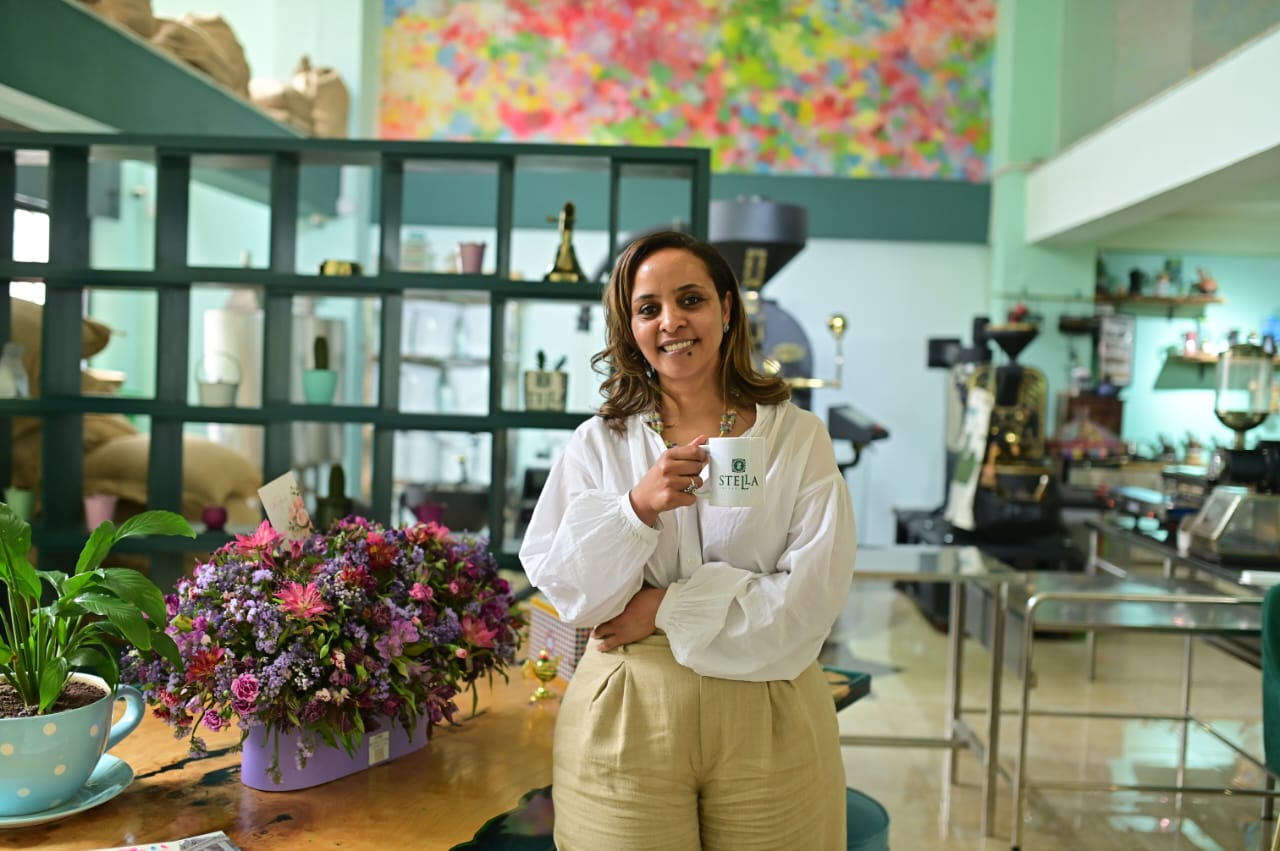
A few kilometers from Addis Ababa Bole International Airport, tucked quietly into the constantly moving neighborhood of Wollo Sefer, there is a coffee space that feels strangely detached from the city around it.

The transition begins almost immediately upon entering. Before the coffee arrives, before the brewing equipment catches your attention, there is scent — oud, deep and woody, the kind more commonly associated with Gulf hospitality and luxury hotels in Dubai or Jeddah than with cafés in Addis Ababa. For a brief moment, the city outside seems to dissolve.

Inside, Stella unfolds slowly. The space is spacious without feeling cold, elegant without becoming performative. Warm wood dominates the interior while plants and flowers soften nearly every corner. The furniture carries a classic sensibility — colorful, though never loud — and the seating feels intentionally cozy, designed less for quick turnover and more for lingering conversations. Nothing about the atmosphere feels accidental.

In specialty coffee language, places like this are increasingly called destination cafés: spaces people visit not simply to drink coffee, but to experience hospitality, ambiance, and ritual together. Stella belongs naturally in that category.

A Coffee Philosophy Rooted in Memory

At the center of it all is Stella herself, a mother of three whose relationship with coffee began long before she ever became a coffee drinker. Her father was a green coffee exporter and supplier, and some of her earliest memories were formed during school holidays spent with him in Yirgacheffe, one of Ethiopia’s most celebrated coffee-growing regions.

While many children return from vacations remembering games or family trips, Stella remembers coffee landscapes, processing stations, farmers, and long days observing people whose lives revolved around coffee. She learned quietly, simply by watching.

When she speaks about her father, her admiration is immediate and unmistakable. “He is my superstar,” she says with a smile.

Yet the roots of Stella’s coffee philosophy stretch back even further, to Asmara, where her grandmother’s coffee held an almost legendary status within the family. Stella remembers how devoted her father was to it. Despite spending his professional life around coffee, he drank only his mother’s preparation. Somewhere within those childhood observations, a deep impression formed. Coffee, Stella realized early, could carry emotion, reverence, and memory.

Interestingly, she did not begin drinking coffee seriously until much later in life. What fascinated her first was not the beverage itself, but everything surrounding it. As a child, she helped prepare ceremonial spaces around her grandmother’s coffee gatherings, learning instinctively that ambiance mattered as much as taste. The arrangement of the room, the rhythm of serving, the atmosphere of hospitality — all of it became inseparable from coffee itself.

A Coffee Passport Menu

Three years ago, those memories evolved into Stella. Calling it simply a café, however, feels insufficient. Boutique coffee house comes closer. Coffee atelier perhaps comes closer still. Because what Stella has created feels less like a conventional menu and more like a coffee passport.

Traditional Ethiopian jebena coffee shares space with Turkish coffee, V60 pour-overs, Japanese-style iced brews, Arabic qahwa, and brewing traditions from several other corners of the world. Yet the café’s defining quality is not variety alone. It is fidelity to ritual.

In many modern cafés, brewing tools have become visual symbols more than functional traditions. A V60 cone becomes decoration. A jebena becomes aesthetic identity. At Stella, however, the ritual itself remains intact. Order traditional jebena coffee and an individual jebena is prepared specifically for you rather than poured from a shared batch. Your coffee receives its own ceremony, its own pacing, its own attention.

The same philosophy extends across every brewing method on the menu. Turkish coffee is treated with its own distinct preparation. Japanese-style iced pour-overs are brewed with precision. Arabic qahwa receives the same careful attention Gulf guests expect back home.

During my visit, I ordered an iced V60 — a Japanese-style iced pour-over brewed directly over ice to preserve aromatic clarity and brightness. The preparation reflected the larger philosophy of the space itself: deliberate, patient, and deeply attentive to detail. Nothing felt rushed. Nothing felt industrialized.

A Living Roastery and Diverse Clientele

Inside the café, a functioning roastery further deepens the experience. Customers are not separated from coffee’s transformation. Roasting aromas drift naturally through the room while conversations continue nearby, allowing visitors to experience coffee not merely as a finished beverage, but as a living craft unfolding around them in real time.

That immersive atmosphere has attracted a remarkably diverse clientele ranging from diplomats and expatriates to high-profile Ethiopian figures and a growing number of visitors from Gulf countries. According to Stella, GCC guests often react most emotionally to the experience. Many tell her they briefly forget they are in Addis Ababa altogether. Instead, the atmosphere reminds them of Dubai, Jeddah, or other familiar spaces across the Gulf.

The reaction is hardly surprising. Stella speaks about Arabic coffee culture with something close to reverence. Not only the coffee itself, but the patience, hospitality, generosity, and ritual surrounding it. Her qahwa has become especially sought after, with Arab customers frequently purchasing her roasts in bulk after discovering the level of precision and authenticity she brings to the preparation.

Coffee Deserves a Better Emotional Environment

For Stella, coffee was never meant to become a hurried grab-and-go drink swallowed between appointments. She laughs while explaining one of her personal rules: she refuses to drink coffee when angry, emotionally unsettled, or exhausted. Most people use coffee to survive stressful days. Stella prefers water instead. Coffee, in her view, deserves a better emotional environment.

Spend enough time inside Stella and it becomes clear that this place was never built around caffeine alone. It was built around feeling. Around memory. Around slowing down.

Perhaps that is why the name feels unexpectedly perfect. Stella — “star” in Italian — suits the café in more ways than one. Because somewhere in Wollo Sefer, beneath the scent of oud and freshly roasted coffee, Stella has quietly created a guiding star of her own: a world of coffee traditions gathered together under one roof, where ritual still matters and hospitality still feels sacred.

Frequently Asked Questions

Where is Stella located?

Stella is located in the Wollo Sefer neighborhood of Addis Ababa, a few kilometers from Bole International Airport.

What makes Stella unique?

Stella offers a coffee passport menu with multiple brewing traditions including Ethiopian jebena, Turkish, V60, Japanese-style iced, and Arabic qahwa, each prepared with its own distinct ritual.

Who is Stella’s founder?

Stella is a mother of three whose father was a green coffee exporter and whose grandmother’s coffee ceremonies in Asmara deeply influenced her philosophy.

What is the signature coffee at Stella?

There is no single signature; the café is known for its variety and fidelity to ritual. Her Arabic qahwa has become especially popular with Gulf visitors.

Does Stella roast its own coffee?

Yes, the café includes a functioning roastery, allowing customers to experience coffee as a living craft.

What is Stella’s personal coffee rule?

She refuses to drink coffee when angry, emotionally unsettled, or exhausted, believing coffee deserves a better emotional environment.


Author: Tewodros Balcha | Source: Qahwa World – Addis Ababa | Date: May 22, 2026

Black Coffee Twig Borer: A Growing Threat to Robusta and Arabica

Author: Qahwa World – Agricultural Desk
Source: International Coffee Pest Monitor, USDA, and industry research (2025-2026)
Date: May 22, 2026In this article, we discuss Black Coffee Twig Borer pest control solutions and strategies for the coming seasons.

Executive Summary

  • The Black Coffee Twig Borer (Xylosandrus compactus) is an invasive ambrosia beetle native to Southeast Asia, now damaging coffee in East Africa, Hawaii, and Latin America.
  • It primarily attacks Robusta but also infests Arabica and over 200 host plants. Yield losses can reach 20-50% in severe infestations.
  • Female beetles bore into small twigs, introduce ambrosia fungi, and cause branch dieback within 5-14 days.
  • Factors favoring infestation: high planting density, poor pruning, water stress, and unsuitable shade trees (e.g., Maesopsis eminii).
  • Integrated Pest Management (IPM) combines sanitation pruning, ethanol‑baited bottle traps, and maintaining tree health. Chemical control is a last resort.
  • In Uganda, annual losses are estimated in tens of millions of dollars. Community‑wide trapping and pruning are the most effective.
  • For growers in arid regions like the Gulf, prevention through certified pest‑free material and rigorous scouting is critical.

The Black Coffee Twig Borer (Xylosandrus compactus), also known as the shot‑hole borer, is a small ambrosia beetle native to Southeast Asia. It has become a significant invasive pest in many coffee‑growing regions, including East Africa (especially Uganda), Hawaii, parts of Latin America, and Southeast Asia.

It primarily affects Robusta coffee (Coffea canephora) but also attacks Arabica and over 200 other host plant species across 62 families. The beetle is considered one of the most economically damaging pests in affected areas, with reported losses reaching up to 20‑50% in severe infestations through branch dieback and reduced yields.

Biology and Life Cycle

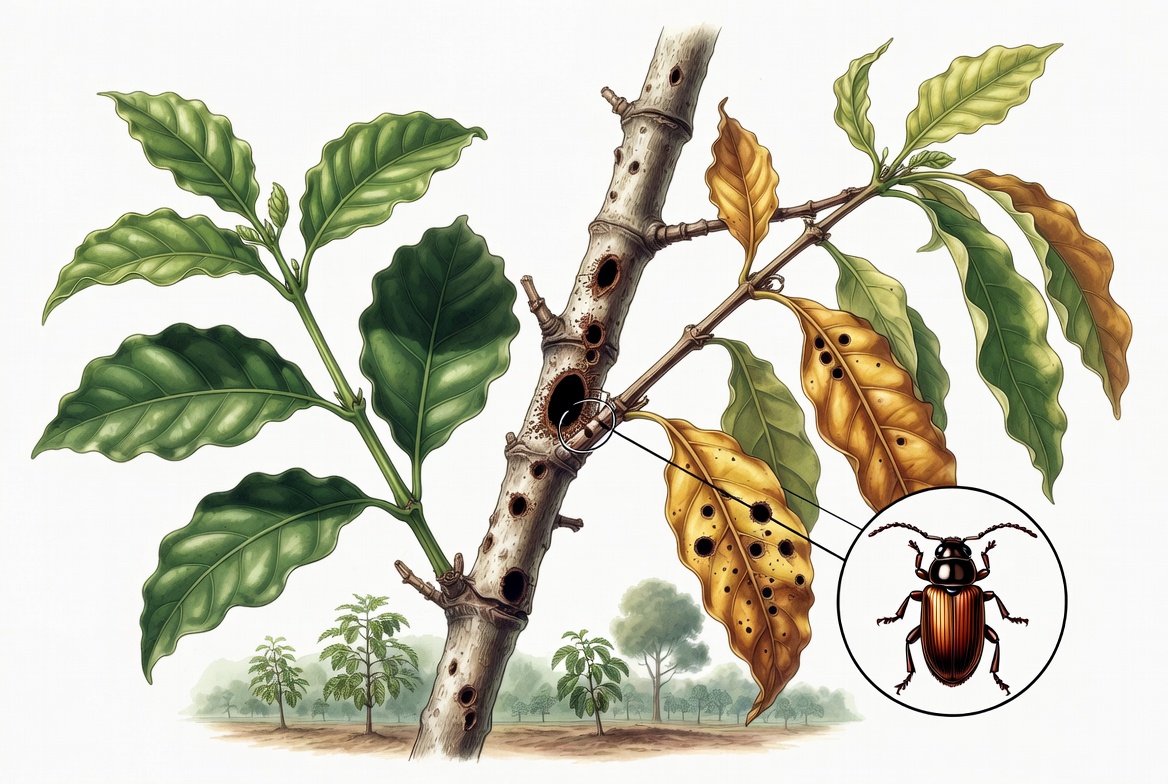
Adult females are 1.4–1.7 mm long, dark brown to black and shiny. Males are smaller (0.9–1.3 mm), flightless, and rarely seen outside galleries.

Only females initiate attacks. They bore into small twigs and branches (usually less than 2 cm in diameter) and introduce symbiotic ambrosia fungi (Raffaelea spp. or similar) that grow inside the tunnels and serve as food for adults and larvae.

The full life cycle takes about 3–5 weeks depending on temperature. Females mate inside the gallery (or via parthenogenesis) and lay eggs. Larvae feed on the fungus. New females emerge to attack other branches.

The pest attacks stressed, weakened, or overcrowded plants more aggressively, especially during dry seasons. However, it can also infest apparently healthy trees.

Symptoms and Damage on Coffee Trees

External signs include tiny circular entry holes (about 1 mm) on twigs, often with frass (sawdust‑like material) or sap oozing. Sudden wilting and yellowing of leaves on affected branches (flagging) appears within days. Dieback of twigs and small branches occurs within 5–14 days.

Internal damage involves fungal growth that blocks the xylem (water‑conducting tissues), causing rapid desiccation. Infested branches often show dark staining inside.

Economic impact is severe: loss of fruit‑bearing branches reduces yield directly. Repeated attacks weaken trees, increase susceptibility to other diseases, and can kill young plants or seedlings. In Uganda, annual losses have been estimated in tens of millions of US dollars. In other regions, branch loss can reach 20–40%.

Factors Favoring Infestation

High planting density and poor pruning (bushy canopies) create favorable conditions. Excessive or unsuitable shade trees, such as Maesopsis eminii (musizi) and Markhamia platycalyx (musambya), also increase risk. Water stress during dry periods, poor soil nutrition, and low tree vigor are additional factors. The presence of alternate hosts nearby further exacerbates the problem.

Integrated Pest Management (IPM) – Current Best Practices (2025-2026)

The most effective and sustainable approach combines cultural, mechanical, and monitoring methods. Chemical use is generally discouraged as a primary strategy.

Cultural practices form the foundation of control. Sanitation pruning is highly effective: regularly inspect and prune infested twigs or branches, then immediately burn or bury them deeply to prevent re‑infestation. However, it is labor‑intensive.

Tree health management is critical: ensure optimal fertilization, irrigation during dry spells, proper spacing (e.g., 3 m x 3 m), and balanced shade. Healthy, vigorous trees are far less susceptible.

Shade management involves using suitable shade trees (e.g., papaya may reduce infestation) and avoiding known host shade trees. Older, taller shade systems often show lower infestation levels. Remove or avoid planting nearby susceptible species.

Monitoring and mass trapping are highly recommended. Ethanol‑baited bottle traps are low‑cost and effective. Use empty plastic bottles with soapy water plus ethanol (or local alcohol like waragi at ~75% concentration) as attractant. Place 7–15 traps per acre, preferably in the lower canopy. Community‑wide trapping is most successful.

Chemical control should be a last resort. Systemic insecticides like imidacloprid (e.g., after pruning) have shown efficacy in some studies, but resistance risks and negative effects on beneficial insects limit long‑term use.

Emerging approaches include push‑pull strategies using repellents (e.g., verbenone + methyl salicylate) combined with attractant traps (2024 studies). Biological enhancement through biodiversity and natural enemies is also being explored.

Recommendations for Farmers (Particularly in UAE/Gulf Region)

Although Xylosandrus compactus is not yet widely reported in the UAE, vigilance is important if importing coffee plants or growing in similar climates. Source certified, pest‑free planting material. Maintain excellent tree nutrition and irrigation (critical in arid conditions).

Implement routine scouting, especially in dry or hot seasons. Adopt area‑wide management by coordinating with neighboring farms. Combine pruning, sanitation, and mass trapping as the core strategy.

Key principle: prevention through plant health is more effective and economical than curative measures.

Frequently Asked Questions

What is the Black Coffee Twig Borer?
It is an invasive ambrosia beetle (Xylosandrus compactus) that attacks coffee twigs, causing branch dieback and yield losses of 20-50%.

Which coffee varieties are most affected?
Robusta is the primary host, but Arabica and over 200 other plant species are also attacked.

How can I identify an infestation?
Look for tiny entry holes (1 mm) on twigs, sawdust‑like frass, sudden wilting of branches (flagging), and dieback within 5-14 days.

What is the most effective control method?
Sanitation pruning (removing and destroying infested branches) combined with ethanol‑baited bottle traps and maintaining tree health.

Are chemical insecticides recommended?
Only as a last resort. Imidacloprid has some efficacy, but resistance and environmental risks limit its use.

Can I use traps for mass trapping?
Yes. Ethanol‑baited bottle traps are low‑cost, simple to make, and highly effective when used community‑wide (7‑15 traps per acre).


Author: Qahwa World – Agricultural Desk | Source: International Coffee Pest Monitor, USDA, and industry research (2025-2026) | Date: May 22, 2026

El Niño: What It Is and How It Affects Coffee

Author: Qahwa World – Climate Desk

Source: NOAA, WMO, ICO, StoneX, industry sources
Date: May 22, 2026

Executive Summary

  • There is a 96% probability that El Niño will persist through the Northern Hemisphere winter of 2026‑2027.
  • Sea surface temperatures in the Niño 3.4 region have already exceeded the +0.5°C El Niño threshold.
  • Vietnam and Indonesia face drought and higher temperatures, threatening Robusta yields.
  • Brazil may see irregular rainfall during critical flowering (August‑October 2026), reducing Arabica quality.
  • Colombia and Central America face mixed risks: excess rain (leaf rust) or drought.
  • Analysts expect higher coffee price volatility in 2027, with Robusta supply risks pushing futures higher.
  • Smallholder farmers in vulnerable regions could face income losses, food insecurity, and migration pressure.

As of mid‑May 2026, the tropical Pacific is showing unmistakable signs of a rapid transition toward El Niño conditions.

According to the NOAA Climate Prediction Center’s ENSO Diagnostic Discussion released on May 14, there is an 82% probability that El Niño will emerge between May and July 2026, rising to a 96% chance that it will persist through the Northern Hemisphere winter of 2026‑2027.

Scientists are closely monitoring whether this event could evolve into a Super El Niño, potentially rivaling the record‑strength episodes of 1982‑83, 1997‑98, or 2015‑16. With sea surface temperatures in key Niño regions already warming sharply, the stage is set for significant disruptions to global weather patterns — from devastating floods in South America to severe droughts across Southeast Asia and parts of East Africa.

What Is El Niño?

El Niño (Spanish for “The Little Boy” or “Christ Child”) is the warm phase of the El Niño‑Southern Oscillation (ENSO), Earth’s most influential climate variability pattern. Under normal conditions, strong easterly trade winds push warm surface water westward across the equatorial Pacific toward Indonesia, allowing cold, nutrient‑rich water to upwell off the coasts of Peru and Ecuador. During El Niño, these trade winds weaken or reverse. Warm water spreads eastward, suppressing upwelling and altering atmospheric circulation patterns worldwide.

The counterpart, La Niña, brings cooler waters and opposite weather effects. ENSO events typically occur every 2‑7 years and last 9‑18 months.

Current Status – May 2026

The equatorial Pacific is currently in a transitional state following a weak La Niña. Sea surface temperatures in the Niño 3.4 region have risen rapidly, with recent weekly values exceeding the +0.5°C El Niño threshold.

Multiple international models, including those from NOAA, the ECMWF, and the WMO, show high confidence in El Niño development by mid‑to‑late 2026. While peak strength remains uncertain, some projections suggest anomalies could exceed +2.0°C, raising the possibility of a strong‑to‑very‑strong event.

Global Weather Impacts

El Niño redistributes heat and moisture across the planet:

  • South America (Peru, Ecuador, northern Brazil): Increased rainfall and flooding risks, potential damage to infrastructure and agriculture.
  • Southeast Asia, Indonesia, Australia: Significantly reduced rainfall, drought, higher wildfire risk, water shortages.
  • East Africa: Wetter‑than‑average conditions, increased flood and disease risks.
  • Southern United States: Wetter winters; Northern US and Canada often milder.
  • Global: Elevated average temperatures (El Niño typically adds ~0.1–0.3°C to global surface temperatures).

Impact on Global Coffee Production

Coffee is one of the most climate‑sensitive major commodities. With roughly 12.5 million farming families dependent on it worldwide, any major ENSO event sends ripples through prices, quality, and livelihoods. The 2026‑2027 El Niño is expected to affect both Arabica and Robusta differently across key origins.

1. Brazil – The World’s Largest Producer

Brazil faces a complex outlook. While the current 2026/27 harvest is projected to be strong, El Niño could disrupt the critical flowering period (August‑October 2026) through irregular rainfall or excessive heat. Historical patterns show El Niño often brings drier conditions to key Arabica regions in Minas Gerais and São Paulo, potentially reducing bean size, increasing defects, and lowering quality.

2. Vietnam and Indonesia – Robusta Heartlands

These two giants are highly vulnerable to El Niño‑induced drought and elevated temperatures. Reduced rainfall and prolonged dry seasons can stress Robusta trees, leading to smaller beans, lower yields, and higher production costs due to increased irrigation needs. The 2015‑16 El Niño caused notable declines in Robusta output in these regions.

3. Colombia, Central America, and East Africa

Colombia and Central America face mixed signals: potential for excessive rainfall in some areas (increasing fungal diseases like coffee leaf rust) or drought in others. Ethiopia and Kenya may see wetter conditions that boost yields in some highlands but heighten disease pressure and complicate harvesting.

Overall Market Outlook

Analysts anticipate higher price volatility in 2027 as the event peaks. While Brazil’s large crop may buffer total volume in the short term, quality concerns and Robusta supply risks could push Arabica and Robusta futures higher. The ICO and major traders are already factoring these risks into their forecasts.

Broader Economic and Humanitarian Implications

  • Price Spikes: Coffee futures have already shown sensitivity to El Niño headlines, with short covering observed.
  • Smallholder Farmers: Millions in vulnerable regions face income losses, food insecurity, and potential migration pressures.
  • Supply Chain: Roasters, traders, and consuming countries should prepare for tighter specialty‑grade supplies and elevated costs.
  • Compounding Factors: Persistent low stocks, high input costs (fertilizers, labor), and climate change amplify risks.

Recommendations and Preparedness

For Governments and International Organizations: Strengthen early warning systems, support farmers with drought‑resistant varieties, irrigation, shade management, and crop insurance. The WMO, FAO, and ICO should coordinate contingency planning.

For the Coffee Industry: Diversify sourcing strategies, invest in sustainable practices that build resilience, and monitor ENSO updates monthly.

For Consumers: Expect potential price increases in premium and everyday coffee blends throughout 2027. Supporting traceable, climate‑smart coffee can help mitigate long‑term risks.

Frequently Asked Questions

What is the probability that El Niño will persist through winter 2026/2027?

NOAA estimates a 96% probability that El Niño will persist through the Northern Hemisphere winter of 2026‑2027.

Which coffee origins are most at risk from this El Niño?

Vietnam and Indonesia (Robusta) face drought; Brazil (Arabica) may see irregular flowering; Colombia and Central America face mixed flood/drought risks.

How could El Niño affect coffee prices?

Analysts expect higher price volatility in 2027. Robusta supply risks could push futures higher, and specialty‑grade supplies may tighten.

What can smallholder farmers do to prepare?

Governments and organizations should provide drought‑resistant varieties, irrigation support, shade management, and crop insurance.

How does this El Niño compare to past events?

Models suggest it could become a strong‑to‑very‑strong event, potentially rivaling 1982‑83, 1997‑98, or 2015‑16, but final strength remains uncertain.

What are the broader economic risks beyond coffee?

Smallholder farmers face income losses and food insecurity; supply chains face tighter supplies and elevated costs; migration pressures may increase.


Author: Qahwa World – Climate Desk | Source: NOAA, WMO, ICO, StoneX, industry sources | Date: May 22, 2026

Green Coffee Defects: What the Bean Reveals

Author: Dr. Steffen Schwarz
Date: May 21, 2026
Executive Summary:

  • A green coffee defect is not an object but a trace. It is the visible end of an invisible process that may begin with overripe cherries, drought stress, insect damage, poor drying, or inadequate storage.
  • Defects have families: extrinsic (stones, sticks, husks) cause physical damage to machinery, while intrinsic (black, sour, immature, fungus-damaged, aged) change the cup profile significantly.
  • Fermentation is not the enemy; uncontrolled fermentation is. The same microbial routes that produce desirable fruit complexity can also produce sour, phenolic, or acetic defects.
  • The Rio defect, associated with 2,4,6-trichloroanisole (TCA), is a powerful example of how a chemically tiny compound can be commercially enormous, and how cultural preference determines whether it is rejected or accepted.
  • Defect recognition requires six layers: physical grading, density and moisture, green bean olfaction, sample roasting, blind cupping, and chemical analysis.
  • The most dangerous sentences in coffee quality are “I like it, therefore it is good” and “I dislike it, therefore it is defective.”

A defect in green coffee is a small event that has survived an entire supply chain. It may have begun as a cherry left too long on the branch, a drought stressed seed, an insect puncture, a heap that warmed during the night, a drying table loaded too thickly before the rain, a bag that reabsorbed moisture in a warehouse, or a fragment of stone travelling with the lot.

By the time we see it on the sorting table, the event has already been translated into colour, density, smell, chemistry, and commercial consequence. The black bean is not black because colour is its essence; it is black because respiration, microbial activity, oxidation, tissue collapse, and time have written a story into the seed.

The sour bean is not sour because it has decided to offend the cup; it is the fossil of an uncontrolled fermentation. A green coffee defect is therefore not an object but a trace. It is the visible end of an invisible process.

This is why the old habit of treating defects as a counting exercise is useful but insufficient. Counting gives trade a language. It allows a buyer in Hamburg, a dry mill in Brazil, a cooperative in Ethiopia, and a roaster in Seoul to negotiate the same bag without each needing to invent vocabulary anew. Yet the count itself does not explain the mechanism.

One full black bean may be a primary defect in a classification system; scientifically, it is also a collapsed biological archive. A stone may carry no flavour, yet it can destroy a grinder. The defect table tells us what to remove. Applied science tells us why it had to be removed, and when, surprisingly, a market may decide not to remove it at all.

Families of Defects

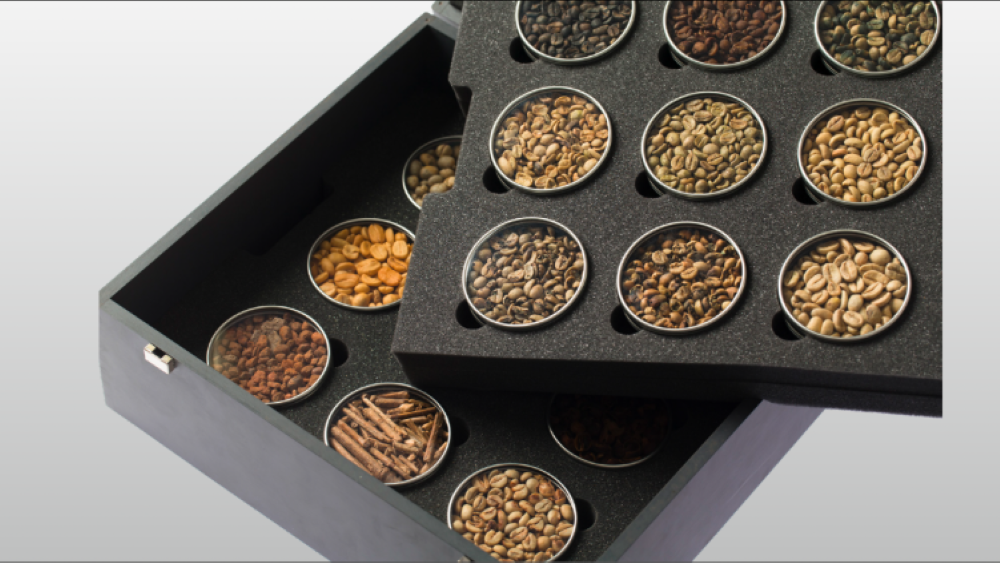
Some defects are extrinsic: stones, sticks, husks, parchment, pods, and foreign matter. They tell us about harvesting, separation, hulling, cleaning, and dry mill discipline. Their danger is often physical before it is sensory, because they damage machinery. Others are intrinsic: full black, partial black, full sour, partial sour, immature, withered, floater, insect damaged, fungus damaged, broken, shell, chipped, crushed, faded, and aged beans. These belong to the seed itself and have far greater potential to change the cup.

An immature bean can bring astringency, grassy bitterness, and harshness because its biochemical reserves have not reached balance. A sour bean can bring vinegar, ferment, rotten fruit, or sharp lactic acetic notes because microbial metabolism has moved into uncontrolled transformation. A black bean often carries the memory of overripeness, fallen fruit, soil contact, or severe stress. A floater, light and porous, is often underdeveloped, and its low density changes heat transfer in roasting. A broken bean is a high surface area wound, vulnerable to oxidation and contamination.

Harvest, Processing, and the Cultural Layer

At farm level, many defects begin with uneven ripeness. Coffee is not a factory product that arrives at maturity in one moment. On the same tree, green, half ripe, ripe, overripe, and dried fruit may coexist. Selective picking is chemical sorting before chemistry becomes irreversible. Processing then becomes decisive. Fermentation is not the enemy. Uncontrolled fermentation is.

The Rio defect is the perfect case study. In classical descriptions, Rio appears as medicinal, phenolic, iodine like, harsh, musty, or cellar like. It is associated with 2,4,6 trichloroanisole (TCA). A Rio note may be rejected by many specialty buyers yet expected or even loved in certain traditional markets. Science can say what is there. Culture decides what it means.

Storage Defects and Six Layers of Recognition

Storage defects are quieter and more dangerous. A coffee can pass visual inspection but still move chemically in the wrong direction. Moisture, oxygen, temperature, and time determine whether the seed preserves its aromatic potential. Good storage is not passive warehousing. It is slow chemistry management.

Recognition requires six layers: physical grading, density and moisture, green bean olfaction, sample roasting, blind cupping, and chemical analysis. The final layer remains human interpretation. Instruments detect compounds. Professionals decide risk, suitability, and value.

Frequently Asked Questions (FAQ)

1. What is a green coffee defect?

A trace of an invisible process ending in colour, density, smell, and chemistry changes.

2. What are extrinsic vs intrinsic defects?

Extrinsic are foreign materials (stones, sticks). Intrinsic are seed defects (black, sour, immature).

3. Can roasting remove defects?

No. Roasting translates defects into different sensory notes but cannot erase them.

4. What is the Rio defect?

A medicinal, phenolic off flavour linked to TCA. It is rejected by some markets but traditional in others.

5. Why are storage defects dangerous?

They are latent. Coffee can pass visual inspection but later develop papery, woody, or flat notes.

6. What is the most dangerous sentence in coffee quality?

“I like it, therefore it is good” and “I dislike it, therefore it is defective.”

Dr. Steffen Schwarz – Coffee Consulate
Published on Qahwa World: May 21, 2026

Shanghai Overtakes New York as Global Coffee Capital as Ethiopia and Vietnam Compete in China

Author: Sahl Maryam Jabra Madhin
Source: ECTA, GACC, ICO
Date: May 21, 2026

Executive Summary:

  • Shanghai now hosts over 9,115 cafes, making it the world’s leading coffee city, double New York and five times Paris.
  • China’s coffee consumption has grown 15 percent annually over the past three years.
  • Ethiopia ranks second as a coffee supplier to China after Brazil, with premium specialty coffee at $6,310 per ton.
  • Vietnam ranks third, offering robusta at $4,176 per ton, benefiting from geographic proximity (4-6 days shipping).
  • China’s zero tariff policy for Ethiopian products has boosted Ethiopian coffee exports, moving Ethiopia from 33rd to 3rd place in five years.
  • In the first ten months of the 2018 budget year, Ethiopia exported 37,711 tons of coffee to China worth $270.73 million.

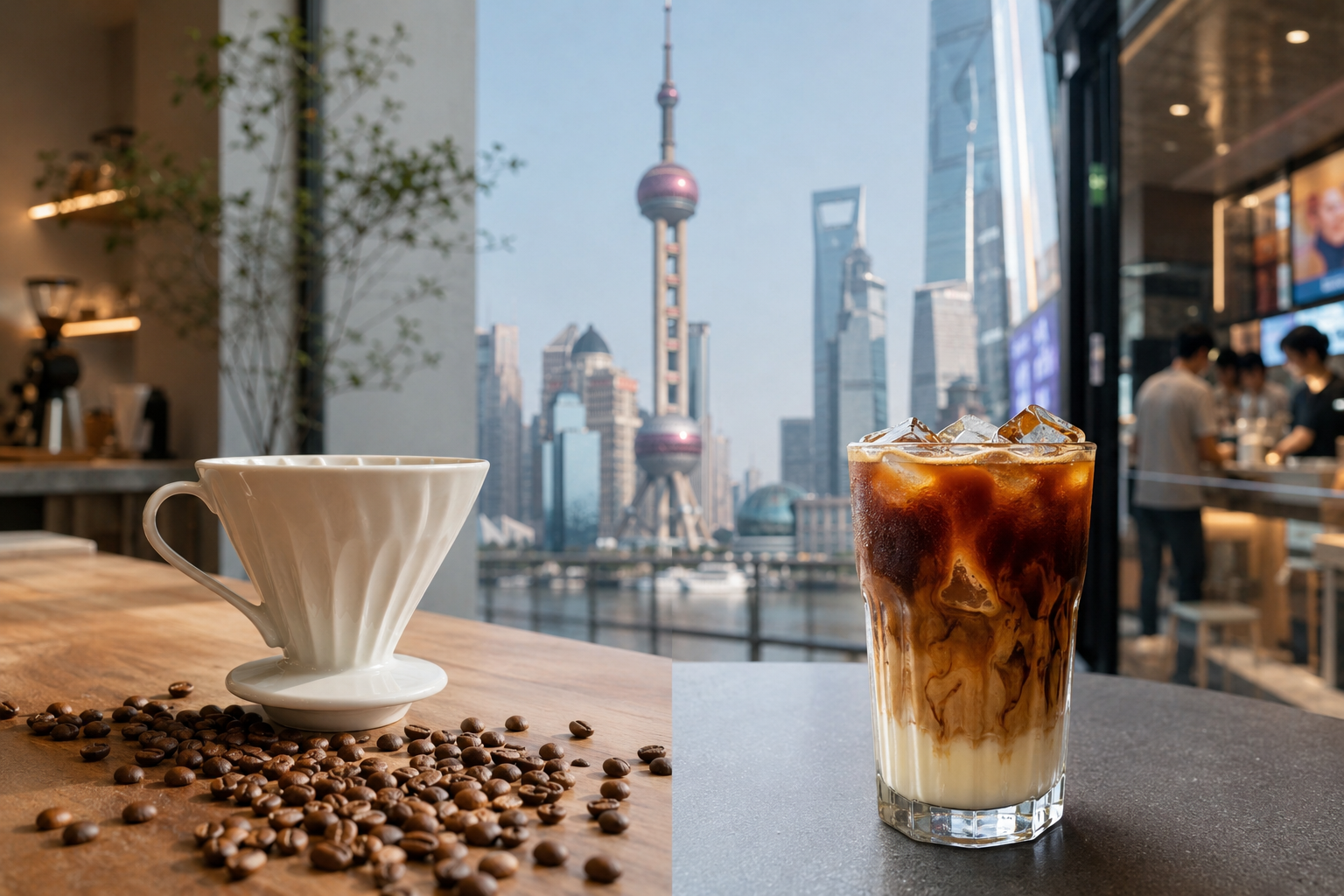
For many years, the global coffee industry had its eyes fixed on New York, Milan, and Paris. Today, the new growth center of the coffee industry has shifted to Asia. Shanghai now hosts over 9,115 cafes, making it the world’s leading coffee city. This is double the number in New York and approximately five times that of Paris.

Beyond the numbers, the key story is that China’s coffee consumption has grown 15 percent annually over the past three years. This has created a major shift in the global coffee supply chain. While many businesses still focus only on Western markets, China is quietly becoming a major destination and opportunity gateway for Ethiopian and Vietnamese coffee.

Ethiopia vs Vietnam in Shanghai (2025-2026)

Indicator Ethiopia Vietnam
Import rank in China 2nd (after Brazil) 3rd
Supply volume ~50,000 tons ~36,000 tons
Price per ton $6,310 (premium) $4,176 (mid-range)
Growth rate +79.1% revenue +65.8% supply
Key advantage Zero tariff, natural varieties, specialty quality Proximity (4-6 days), lower price

How Each Coffee is Perceived in Shanghai

Ethiopia: The Quality Standard
In Shanghai’s 9,000 cafes, Ethiopian coffee is viewed like fine wine. It is mostly found in specialty coffee shops and premium chains like Blue Bottle. It is preferred for pour-over black coffee. Young Shanghai coffee enthusiasts see Ethiopian coffee as the peak of complexity, with notes of wine, chocolate, spice, fruit, or citrus. Despite its higher price, it remains highly sought after.

Vietnam: The Reliable Workhorse
Once known only for instant coffee, Vietnam has rebranded itself by producing high quality robusta. Vietnamese coffee is commonly found in large chains like Luckin or Cotti, as well as popular cafes in the Jing’an district. It is known for its strong, nutty, chocolatey flavor and is seen as a reliable, affordable option, often mixed with milk.

Zero Tariff Policy and Ethiopia’s Rise

In 2025, a major change occurred: China’s zero tariff policy for Ethiopian products. This duty free access, along with growing strategic cooperation in agriculture, technology transfer, e-commerce links, and Shanghai’s role as a trading hub, has made Ethiopian coffee more price competitive in China.

Five years ago, China was the 33rd destination for Ethiopian coffee exports. By 2017, it rose to 4th place. In the first ten months of the 2018 budget year, Ethiopia exported 37,711 tons of coffee to China, worth $270.73 million, moving up to 3rd place. This demonstrates the rapid growth of Ethiopia’s presence in the Chinese market.

Frequently Asked Questions (FAQ)

1. How many cafes does Shanghai have?

Shanghai has over 9,115 cafes, more than double New York and about five times Paris.

2. How fast is China’s coffee consumption growing?

China’s coffee consumption has grown 15 percent annually over the past three years.

3. Which countries are the top coffee suppliers to China?

Brazil ranks first, followed by Ethiopia (second) and Vietnam (third).

4. What is the price difference between Ethiopian and Vietnamese coffee?

Ethiopian coffee averages $6,310 per ton, while Vietnamese coffee averages $4,176 per ton.

5. What is the zero tariff policy?

China granted duty free access to Ethiopian products in 2025, boosting Ethiopian coffee’s price competitiveness.

6. How much coffee did Ethiopia export to China in 2018?

In the first ten months of the 2018 budget year, Ethiopia exported 37,711 tons of coffee to China, worth $270.73 million.

Sahl Maryam Jabra Madhin – Based on reports from ECTA, GACC, ICO, and Allegra World Coffee Portal.
Published: May 21, 2026

Carolina Gutierrez: In Specialty Coffee, Hospitality Matters More Than Complexity

Author: Carolina Gutierrez
Source: LinkedIn
Date: May 20, 2026

Executive Summary:

  • The best coffee experiences are built on hospitality, connection, simplicity, and humility, not on ego.
  • Consumers rarely build loyalty to a brand simply because they were educated. They return because of how the experience made them feel.
  • People remember experiences far more emotionally than they remember technical details, according to consumer behavior research.
  • Most consumers seek comfort, trust, familiarity, and connection, not complexity.
  • The most successful industries evolved by becoming more accessible, not more intimidating. Wine and craft beer are examples.
  • Specialty coffee sometimes confuses passion with correction, making people feel unwelcome for not knowing enough.
  • The future of specialty coffee belongs to brands that make people feel included first and educated second.

Carolina Gutierrez, a specialty coffee leader focused on coffee quality and education across the Middle East and Africa, recently shared a reflective post on LinkedIn about the state of specialty coffee culture. Her message centered on a simple but often overlooked truth: the best coffee experiences are not built on ego. They are built on hospitality, connection, simplicity, and humility.

Gutierrez observed that while the specialty coffee industry says it wants more people to appreciate high quality coffee, it sometimes makes people feel unwelcome for not knowing enough. She argued that this matters more than many professionals realize. Consumers rarely build loyalty to a brand simply because they were educated. They return because of how the experience made them feel.

The Gap Between Expertise and Accessibility

Gutierrez pointed out that consumer behavior research has shown for years that people remember experiences far more emotionally than they remember technical details. Yet in coffee, professionals sometimes overcomplicate the experience in an attempt to communicate expertise. Processing methods, extraction theory, total dissolved solids, and flavor notes all matter. But most consumers are not searching for complexity. They are searching for comfort, trust, familiarity, and connection.

She emphasized that this is not a weakness in consumer behavior. It is simply human behavior. The most successful industries evolved when they became more accessible, not more intimidating. Wine evolved. Craft beer evolved. The strongest hospitality brands learned how to simplify experiences instead of overcomplicating them. Even companies like Apple built global loyalty by making complex things feel intuitive. Gutierrez believes coffee should learn from that example.

Passion Versus Correction

Gutierrez offered a critical observation about specialty coffee culture. She wrote that specialty coffee sometimes confuses passion with correction. A consumer enjoying sugar, flavored drinks, dark roast, or commercial coffee does not mean they have bad taste. It simply means that is where they are in their journey. People should not feel pressured to understand coffee before they feel welcome in it.

She concluded that complexity may impress professionals, but simplicity is what grows industries. The future of specialty coffee, in her view, will belong to the brands and professionals who make people feel included first and educated second.

Frequently Asked Questions (FAQ)

1. What is the main argument of Carolina Gutierrez’s post?

She argues that specialty coffee should prioritize hospitality, connection, simplicity, and humility over ego and technical expertise to make consumers feel welcome.

2. Why do consumers return to a coffee brand according to Gutierrez?

Consumers return because of how the experience made them feel, not simply because they were educated about coffee.

3. What does consumer behavior research say about memory and emotion?

Research shows that people remember experiences far more emotionally than they remember technical details.

4. What mistake does specialty coffee sometimes make?

Specialty coffee sometimes confuses passion with correction, making people feel unwelcome for not knowing enough about coffee.

5. What industries have successfully evolved by becoming more accessible?

Wine, craft beer, and strong hospitality brands have evolved by simplifying experiences instead of overcomplicating them. Apple also made complex technology feel intuitive.

6. What does Gutierrez believe is the future of specialty coffee?

The future belongs to brands and professionals who make people feel included first and educated second.

Carolina Gutierrez – Specialty Coffee Leader | Coffee Quality & Education Leadership | Driving Growth & Innovation across the Middle East & Africa.
Published on Qahwa World: May 20, 2026

Chinese Brands Like Luckin and Pop Mart Take on Starbucks and Nike in Global Push

Author: Qahwa World
Source: Business Insider
Date: May 20, 2026
Executive Summary:

  • Chinese brands are moving from being global manufacturers to competing directly for consumers in the US, Europe, and beyond.
  • Luckin Coffee is testing markets long dominated by Starbucks, including New York, with app based ordering and limited edition drinks.
  • Fashion labels Urban Revivo and Songmont are competing with Zara and Polène through stylish products at lower prices.
  • Pop Mart has evolved from a toy company into a global cultural force through collectible figures, especially Labubu.
  • Chinese brands face challenges including trade tensions, tariffs, and the need to build a clearly defined global identity.
  • Some brands downplay their Chinese origin, while others embrace Chinese aesthetics and cultural heritage as core identity.
  • Long term success depends on evolving from low cost alternatives into premium global names commanding lasting loyalty.

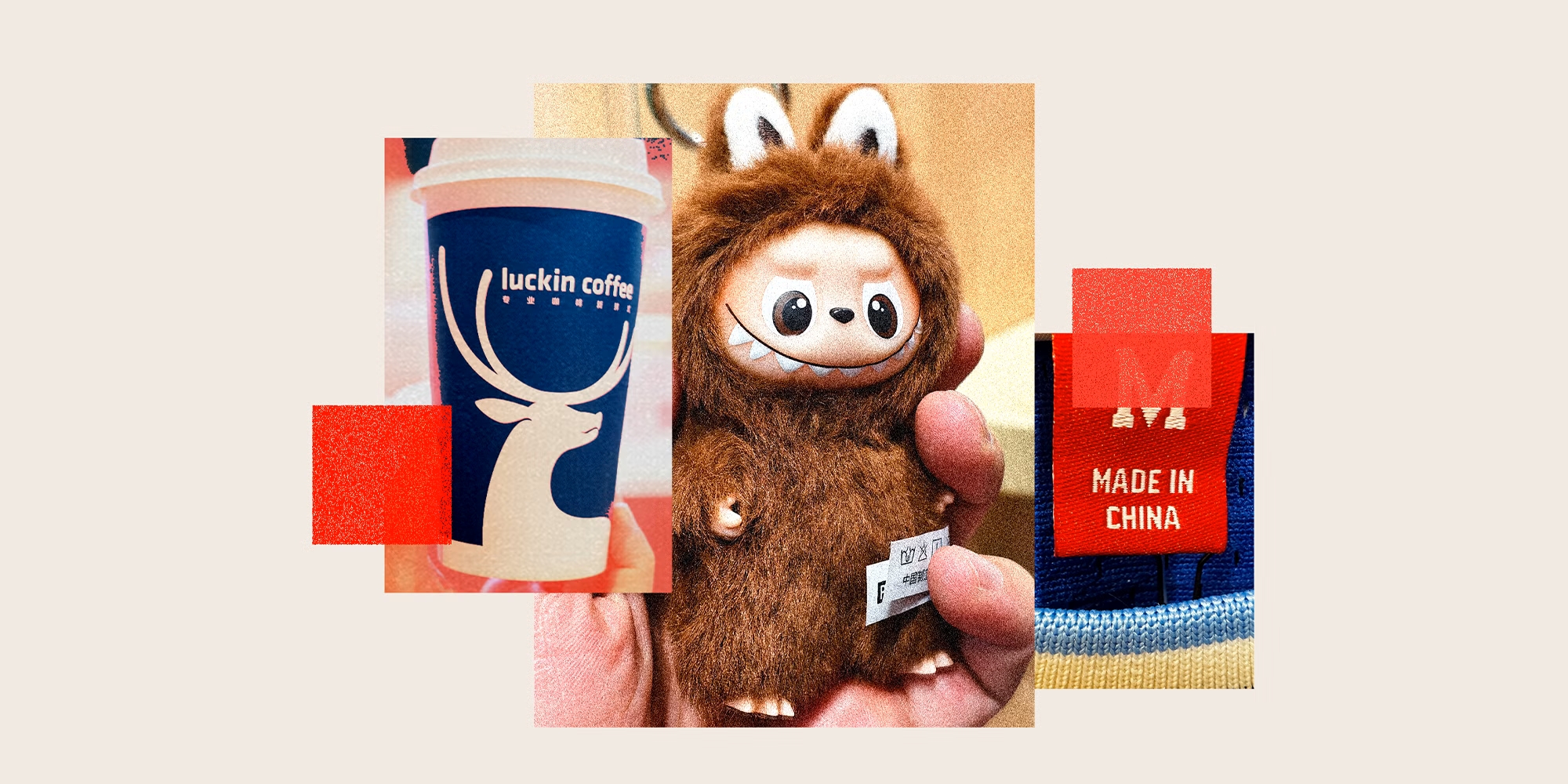
For nearly half a century, China has been the world’s factory floor, producing everything from smartphones to inexpensive clothing. While “Made in China” became common on consumer products, the companies behind those goods often remained unknown. Now, some of China’s fastest growing brands want consumers around the world to recognize their names. They are moving from the background of global commerce to the center, competing directly for customers in the United States, Europe, and beyond.

Fujian based Luckin Coffee is testing markets long dominated by Starbucks, including New York. The company uses app based ordering systems and offers limited edition drinks such as blood orange cold brew in the US and pandan coconut latte in Southeast Asia. Fashion labels including Urban Revivo and Songmont are competing with global mid market brands like Zara and Polène by offering stylish products at lower prices. Pop Mart has evolved from a toy company into a global cultural force through its collectible figures, particularly Labubu. Fast fashion giant Shein is reportedly considering acquiring the millennial favorite brand Everlane.

A New Generation of Chinese Brands

This is not the first time Chinese companies have attempted to reshape global business. In the 2000s, Beijing encouraged state backed industrial giants to expand overseas for resources and infrastructure projects. In the 2010s, Chinese firms embarked on a global acquisition spree, purchasing assets ranging from AMC Theatres to the Waldorf Astoria. More recently, companies such as electric vehicle maker BYD and drone manufacturer DJI demonstrated that Chinese firms could compete globally through advanced technology, not just lower prices.

Now, a new generation of Chinese brands is pursuing something even more challenging: becoming culturally influential and desirable. For many Chinese companies, international expansion is also becoming a necessity. China faces a prolonged economic slowdown, and its birthrate fell to a record low in 2025. Domestic competition has intensified, with aggressive price wars shrinking profit margins. As a result, overseas growth is increasingly essential.

Years of operating in one of the world’s most competitive consumer markets have given Chinese companies significant advantages in manufacturing, logistics, sales, and scaling operations. According to Eunkyu Lee, a marketing professor at Syracuse University, China is transforming itself from a low priced manufacturer into a producer of brands with unique personalities and storylines.

The Challenge of Building a Global Identity

Approach Examples Strategy
Downplaying Chinese identity Shein, TikTok Present as internet native global platforms
Embracing Chinese aesthetics Songmont, Laopu, Chagee Highlight Chinese symbolism, craftsmanship, traditions
Sports marketing Li-Ning Sponsor NBA players to enter mainstream sports culture

Becoming a globally recognized brand where image, identity, and perception matter remains difficult. National identity often helps transform products into symbols of aspiration and lifestyle. European luxury brands traditionally emphasize heritage, craftsmanship, and exclusivity, while American companies promote innovation and optimism. Japan and South Korea successfully made similar transitions during the late 20th century. Brands such as Sony, Samsung, Nintendo, and Uniqlo became globally associated with precision, minimalism, technology, and pop culture. China is now attempting a similar transformation, but at a much faster pace and without a clearly defined global identity.

Some Chinese brands are downplaying their Chinese identity altogether. Global successes such as Shein and TikTok gained popularity not by emphasizing their origins, but by presenting themselves as internet native global platforms. That strategy fits naturally within online culture, where trends spread quickly and consumers prioritize novelty over geography. As Lee noted, younger consumers are looking for something new, cool, and fresh. In that context, the country of origin is not very important.

Sportswear brand Li-Ning has increased its international visibility by sponsoring NBA players including Jimmy Butler and CJ McCollum, bringing Chinese designed footwear into mainstream sports culture. Pop Mart has also partnered with Disney and Sanrio’s Hello Kitty, placing its characters alongside some of the world’s most recognizable entertainment brands.

Embracing Chinese Heritage and Luxury Attention

At the same time, other Chinese brands are leaning heavily into Chinese aesthetics and cultural heritage. Songmont, Laopu, and tea chain Chagee are embracing Chinese symbolism, craftsmanship, and traditions as central parts of their brand identity. A growing online fascination with Chinese lifestyle and aesthetics, sometimes referred to as China-maxxing, suggests global consumers may be increasingly open to brands that highlight rather than soften their origins.

There are signs that global luxury leaders are paying attention. Songmont, whose minimalist leather handbags retail for up to around 800 dollars, has drawn attention from LVMH CEO Bernard Arnault. He reportedly visited a Songmont store and purchased two bags during a trip to Shanghai last September. Arnault also visited Laopu Gold, a jewelry brand known for handcrafted 24K gold pieces inspired by Chinese symbolism including dragons and gourds. In April, Gucci owner Kering announced plans to acquire a minority stake in Shanghai based fashion label Icicle, a premium brand often compared to Max Mara.

Political Challenges and Long Term Prospects

Politics may present another obstacle for Chinese brands seeking overseas growth. Trade tensions have disrupted supply chains and increased scrutiny of Chinese technology companies such as TikTok. BYD has expanded rapidly across Europe and South America but remains largely shut out of the US market because of high tariffs. Tariffs have also affected companies such as Shein and Temu, though neither has slowed its expansion efforts significantly. Instead, many firms are adapting by localizing operations and refining their international strategies.

This new generation of Chinese brands may be better positioned than previous waves because they are increasingly selling products as desirable lifestyle goods rather than simply low cost alternatives. Governments may find it difficult to prevent consumers from embracing brands they see as fashionable, useful, or culturally relevant. According to Lee, these brands are largely detached from political issues.

Ultimately, long term success will depend on whether Chinese brands can evolve from being viewed as inexpensive or trendy alternatives into premium global names capable of commanding lasting loyalty and higher prices. Success would mean some of these brands achieving premium brand recognition among global consumers and being able to command a price premium. That transformation will take time. But the broader direction is becoming increasingly clear: China has already reshaped how the world manufactures products. Now, it is trying to shape what the world wants.

Frequently Asked Questions (FAQ)

1. Which Chinese brands are expanding globally?

Luckin Coffee, Pop Mart, Songmont, Urban Revivo, Shein, Li-Ning, BYD, and DJI are among the Chinese brands competing in international markets.

2. How is Luckin Coffee competing with Starbucks?

Luckin is testing markets including New York with app based ordering systems and limited edition drinks such as blood orange cold brew and pandan coconut latte.

3. What strategies are Chinese brands using to go global?

Some brands downplay their Chinese identity and present as global platforms. Others embrace Chinese aesthetics and cultural heritage. Some use sports marketing and partnerships with global entertainment brands.

4. What challenges do Chinese brands face overseas?

Trade tensions, tariffs, political scrutiny, and the difficulty of building a clearly defined global identity are major challenges.

5. Are global luxury brands paying attention to Chinese brands?

Yes. LVMH CEO Bernard Arnault visited Songmont and Laopu stores. Kering announced plans to acquire a stake in Shanghai based brand Icicle.

6. What would success look like for Chinese brands?

Success means achieving premium brand recognition among global consumers and being able to command higher prices and lasting loyalty.

Qahwa World – Based on reporting from Business Insider.
Published: May 20, 2026

Coffee Farming in Hong Kong: A Bold Experiment in the Shadow of a Metropolis

Author: Coffee World
Source: CNN/ctvnews
Date: May 17, 2026
Executive Summary:

  • Hong Kong, a city of 7.5 million people, has begun growing coffee on Lantau Island despite urban conditions.
  • Ringo Lam, a former tech entrepreneur, started the project after bringing 100 coffee seeds from Panama six years ago.
  • About 80 of the 100 seeds sprouted, and now 25 farmers nurture approximately 400 coffee trees on Lantau.
  • The 2026 harvest yielded 10 kilograms of coffee cherries, nearly ten times the first harvest in 2023.
  • Hong Kong sits at 22 degrees north of the equator, within the global coffee belt, but lacks altitude for complex flavors.
  • Local coffee tastes smooth but less complex than specialty brews from traditional growing regions.
  • Farmers aim to raise awareness about sustainable farming and fair pay rather than compete with major producers.

A coffee roaster hums like an idling train in the attic of LCC Roastery on Hong Kong‘s Lantau Island. Owner Ringo Lam proudly displays a jar labeled “Lantau Bean,” which represents a daring dream: growing coffee in the shadow of a metropolis. For decades, Hong Kong has imported nearly all its food and beverages. But a small group of farmers and enthusiasts is proving that coffee can indeed thrive on this densely populated island.

Ringo Lam, 55, previously worked as a tech entrepreneur. He now collaborates closely with farmers on Lantau, an island known for its greenery and relaxed lifestyle. The island sits just a 30 minute ferry ride from Hong Kong’s bustling city center. Lam’s goal is to cultivate the city’s own coffee beans and change public perception about what is possible in urban agriculture.

The Coffee Belt and Hong Kong’s Position

Asia produces some of the world’s finest coffee, mainly in the southeastern part of the continent. Countries like Vietnam and Indonesia benefit from tropical climates. In East Asia, coffee consumption has grown rapidly over the past decade. However, less favorable conditions, including annual periods of extreme cold, have limited crop development in countries such as Japan and China. Only a few high-altitude areas like Yunnan in mainland China or the Alishan Mountain Range in Taiwan can grow premium Arabica coffee.

Hong Kong, a Chinese city with 7.5 million residents, has more than 700 cafes. Yet it has never been seen as an ideal location for coffee cultivation. The city has a stronger cultural attachment to tea. Exorbitant land prices make it more logical to import almost all food rather than grow it. Despite these challenges, Lam’s project has succeeded.

Katie Chick, an arboriculture instructor involved in running a coffee farm linked to the University of Hong Kong, explains that coffee trees thrive within the so called “coffee belt,” approximately 25 degrees north and south of the equator. Hong Kong sits at 22 degrees north, placing it just inside that band. “Geographically speaking, Hong Kong is fit to grow. We just lack a bit of altitude,” Chick said.

From Panama Seeds to Lantau Harvest

Lam’s journey began six years ago during a trip to Panama. He visited farmers to study the coffee industry and received 100 coffee seeds to take home. Not every seed will sprout, and coffee plants often take two to three years to bear fruit. “Out of all those 100 seeds, about 80 something came out,” Lam said. He called every farmer he knew on Lantau Island, asking them to take in the seedlings.

Initially, five farmers agreed. More joined later through trial and error. Today, 25 farmers nurture about 400 coffee trees on Lantau Island. Earlier this year, they harvested their largest batch of coffee cherries yet, measuring 10 kilograms. That amount is nearly ten times their first yield in 2023. An annual gathering now brings together local coffee farmers to brainstorm ways to refine their techniques.

Limited Yields and Commercial Viability

Despite this success, these farmers are not seeking to compete with Latin America or Southeast Asia. The high costs of production make large scale coffee farming hardly commercially viable in Hong Kong. The record 10 kilogram harvest would not fill a single 60 kilogram bag, which is the industry’s basic unit of trade. By comparison, farmers in Brazil, the world’s largest coffee grower, produced 63 million of those bags last year according to the United States Department of Agriculture.

CNN sampled two separate Hong Kong grown coffees. The taste was smooth and easy to drink, though lacking the complexity of specialty coffee from traditional regions. This forces local producers to innovate. They experiment with different wash processes and hold workshops to build awareness, hoping to maximize the value and impact of their home grown crops.

Key Data: Hong Kong Coffee Farming

Indicator Value
Coffee trees on Lantau Island 400
Number of farmers involved 25
2026 harvest (cherries) 10 kg
First harvest (2023) 1 kg (approx)
Hong Kong latitude 22 degrees north
Coffee belt range 25 degrees north to 25 degrees south
Farmer income per kg of beans 2 to 3 US dollars

Building Awareness and Fair Pay

Mike Sim, founder of Seed to Cup, a group that promotes local coffee, has rented a farm in Fanling, northern Hong Kong. He works to perfect his beans while running educational workshops. Last year, he partnered with a barista in a coffee making contest to showcase a batch he grew, mixed with Colombian varietal. They did not win, but Sim called it a big step forward. “We showed people that there are farms in Hong Kong now working with baristas,” he said.

Chan Fung-ming, one of Lam’s Lantau farmers, quit her job as a social worker to take over her family’s farm. Specializing in horticultural therapy, she advocates using gardening to improve well being. She hopes to use coffee to introduce farming to young people. “I think it’s a medium to bring people into the world of planting,” she said.

Lam runs a workshop that lets participants pick coffee cherries and process them from scratch. He says this offers visitors a taste of the hard work that farm workers in distant regions endure every day. For every kilogram of beans, which can produce about 44 cups of coffee, farmers receive only 2 to 3 US dollars. Lam believes that after attending his workshop, people become more willing to pay a fair price for coffee.

Frequently Asked Questions (FAQ)

1. Can coffee really grow in Hong Kong?

Yes. Hong Kong sits at 22 degrees north, within the global coffee belt. Farmers on Lantau Island have successfully grown coffee trees, with a harvest of 10 kilograms of cherries in 2026.

2. How did the Hong Kong coffee project start?

Ringo Lam brought 100 coffee seeds from Panama six years ago. About 80 sprouted, and he distributed them to farmers on Lantau Island. Today, 25 farmers grow about 400 trees.

3. How does Hong Kong grown coffee taste?

According to CNN samples, Hong Kong coffee is smooth and easy to drink, but less complex than specialty coffee from traditional high altitude regions.

4. Why doesn’t Hong Kong produce coffee commercially?

Land is extremely expensive, production costs are high, and yields are very small. The entire 2026 harvest was only 10 kilograms, far below commercial scale.

5. What is the goal of these coffee farmers?

They aim to raise awareness about sustainable farming, fair pay for workers, and reconnect city dwellers with the origins of their coffee, not to compete with major producers.

6. How much do coffee farmers earn per kilogram?

Farmers typically receive about 2 to 3 US dollars per kilogram of beans. One kilogram produces approximately 44 cups of coffee.

Coffee World – Report based on CNN/ctvnews coverage of Hong Kong coffee farming.
Published: May 17, 2026

Iran’s café culture buckles as everyday life contracts

Source: Iran International
Author: Maryam Sinaiee
Date: May 16, 2026, 08:37 GMT+1The Iran café crisis economic collapse has been making headlines in recent months.

Executive Summary

  • Café operating costs in Tehran have more than doubled, while customer numbers have fallen by up to 50 percent in recent months.
  • The head of Tehran’s coffee shop union says up to 40 percent of cafés have shut down.
  • Tehran alone had around 6,000 cafés before the crisis, but many can no longer survive.
  • Coffee bean prices in Iran have nearly doubled compared to pre-war levels, while a cup of coffee costs up to four times more in some cafés.
  • Many young people and women have lost their jobs due to closures and downsizing, with hiring frozen even at surviving cafés.
  • Advertising companies have stopped buying coffee for office kitchens for the first time in 20 years, as work freezes and projects get canceled.

Rising costs and widespread café closures

Iran’s deepening economic crisis is pushing cafés and coffee culture toward collapse. Soaring prices and falling incomes force both businesses and customers to cut back. Mohsen Mobarra, head of the union overseeing coffee shops in Tehran, told economic daily Donya-e-Eqtesad that café operating costs have more than doubled. Meanwhile, customer numbers have dropped by as much as 50 percent in recent months, with up to 40 percent of cafés shutting down.

Mobarra explained that continuing operations does not mean profitability. The profits of these businesses are steadily shrinking. As a result, cafés that rent their locations or lack strong financial backing are heading toward closure.

From social spaces to memories

Over the past two decades, cafés became an important part of urban life in Iran. They took root in Tehran before spreading across the country. With affordable entertainment options limited, they emerged as some of the few accessible spaces where young Iranians could socialize, work and spend time outside the home.

Many cafés evolved into more than places to drink coffee or eat light meals. They hosted poetry nights, small music performances, photography exhibitions and informal gatherings. They became rare spaces for social interaction at a time when few other public spaces remained accessible. Until a few months ago, Tehran alone had around 6,000 cafés of different sizes in operation. But the collapse in consumers’ purchasing power has hit the industry hard.

Real stories: Young workers losing hope

Sanaz, a 28-year-old receptionist at a private company, said she and her friends used to visit cafés several times a week. But now, with sharp increases in the costs of food, transportation and housing, even such small pleasures require careful calculation. She added: “I have to calculate every expense, even this simple form of entertainment, just to make it to the end of the month — assuming I don’t lose my job. If I lose my job, after years of financial independence, I’ll have to move back to my parents’ home in my hometown.”

The closures and downsizing have also eliminated jobs for many workers, most of them young people and women. Shana, 26, completed professional barista training before finding work at one of the branches of the well-known Saedi Nia café chain. In January, the chain’s branches were abruptly shut down after the owner voiced support for opposition protesters. Shortly afterward, war broke out. She says: “Even cafés that have survived the economic downturn are not hiring new staff anymore. Many are actually laying off existing employees. I have no hope that even by learning new skills like cooking or other work, I’ll be able to find a job. The economy keeps getting worse every day, and the job market is shrinking.”

Indicator Previous Level Current Level Change
Operating cafés in Tehran About 6,000 40% drop ~2,400 closed
Café operating costs Baseline More than double Increase >100%
Customer numbers Normal level Up to 50% drop Sharp decline
Coffee bean price Pre-war level Nearly double Increase ~100%
Price per coffee cup Regular price Up to 4 times higher Increase up to 300%

Coffee itself becomes a luxury

Tea remains Iran’s dominant traditional drink, but coffee consumption expanded rapidly in recent years. Now, however, the sharp rise in foreign currency prices and disruptions to imports have pushed coffee prices so high that many households are cutting consumption or abandoning it altogether. Although global coffee prices have declined, the cost of coffee beans in Iran — largely imported through the United Arab Emirates before the war — has nearly doubled compared to pre-war levels.

The increase has directly affected café prices. With rents and other expenses also rising, the price of a cup of coffee in some cafés has climbed by as much as four times. One café owner told Donya-e-Eqtesad that even cafés specializing in basic coffee drinks are seeing falling demand because many people can no longer justify going out even for coffee.

Impact on other sectors: Offices and companies

Tara, the manager of an advertising company with ten employees, said coffee has become so expensive that even buying it for office use is increasingly difficult. She adds: “For the first time in the past twenty years, I’ve had to stop buying coffee for the office kitchen, where it was always available for employees alongside tea. It’s not just about coffee prices. Since last summer’s war, work has effectively been frozen. Clients have even canceled half-finished projects, and everyone knows the company is taking its last breaths. If this situation continues, we’ll have no choice but to shut down.”

Frequently Asked Questions (FAQ)

1. What percentage of cafés have closed in Tehran due to the economic crisis?

According to the head of Tehran’s coffee shop union, up to 40 percent of cafés have shut down in recent months.

2. How much have customer numbers dropped at Iranian cafés?

Customer numbers have fallen by as much as 50 percent compared to previous periods, severely impacting revenues.

3. How have coffee prices changed in Iran?

Coffee bean prices have nearly doubled compared to pre-war levels, while a cup of coffee costs up to four times more in some cafés.

4. Why did the Saedi Nia café chain close?

The chain’s branches were abruptly shut down in January after the owner voiced support for opposition protesters, and war broke out shortly afterward.

5. Is there hope for improvement in the café job market?

Reports indicate that even cafés that have survived the downturn are not hiring new staff, and many are laying off existing workers as the crisis worsens daily.

6. How has the crisis affected coffee availability in workplaces?

Some companies, including advertising firms, have stopped buying coffee for their office kitchens for the first time in 20 years due to rising prices and frozen work.

Author: Maryam Sinaiee  |
Source: Iran International  |
Publication date: May 16, 2026

Russia Transforms from Tea Country to Coffee Country

Author: Qahwa World
Source: Industry reports and TASS news agency
Date: May 17, 2026

Executive Summary:

  • Economist Svetlana Ilyashenko announces that Russia has completely transformed from a tea country to a coffee country.
  • The turning point was 2016, when coffee imports exceeded tea imports for the first time in history by 4 percent.
  • Russian per capita coffee consumption rose from 200 grams per year to 2.1 kilograms by 2021.
  • Ready-made coffee sales in retail stores increased by 50 percent in 2025 alone.
  • The share of large supermarket chains in the hot beverage market jumped from 17 percent in 2023 to 35 percent in 2026.
  • Coffee history in Russia dates back 360 years to 1665 when it was prescribed as medicine to Tsar Alexis I.
  • Peter the Great introduced coffee to the Russian court after his trip to Holland and ordered the first cafes to open in 1724.
  • The Russian “Raf” coffee drink has become a globally recognized achievement within specialty coffee culture.

Economist Svetlana Ilyashenko, Associate Professor in the Trade Policy Department at Plekhanov Russian University of Economics, announced that Russia has completed its historic transformation to become a coffee country in every sense. This transformation comes after Russia remained a traditional tea country for centuries. Ilyashenko confirmed to TASS that statistics prove this fact beyond dispute. The decisive turning point came in 2016, when coffee import volumes exceeded tea imports for the first time in history by 4 percent.

The numbers tell the story of a silent but rapid revolution. At the beginning of the millennium, Russian per capita coffee consumption did not exceed 200 grams per year. Today, that figure has increased more than tenfold. By 2021, consumption reached 2.1 kilograms per person, and growth remained strong in recent years. In 2025 alone, ready-made coffee sales in retail stores increased by 50 percent. The share of large supermarket chains in the hot beverage market jumped from 17 percent in 2023 to 35 percent in 2026.

What is more striking is that coffee is no longer an additional drink. It has replaced tea in its traditional position as the daily morning drink, as well as a drink for business and professional meetings. This transformation is not just a change in numbers. It is a deep cultural shift.

A Long Historical Journey Spanning More Than 360 Years

The beginnings of coffee in Russia go back more than 360 years. In 1665, the English doctor Samuel Collins prescribed coffee to Tsar Alexis I as an effective remedy against headaches, colds, and bloating. Coffee at that time was imported from Persia and the Ottomans. It was very rare and expensive. People did not view it as a daily drink, but rather as a rare medicine.

The pivotal moment came with Tsar Peter the Great. During his grand tour of Europe between 1697 and 1698, and during his stay in Holland, he came to love coffee very much. He returned to Russia determined to spread it. He introduced coffee to the court and to official assemblies known as assemblées. He ordered it to be served for free to visitors in the Kunstkamera, Russia’s first museum. In 1724, he issued an order to open simple coffee houses in Saint Petersburg.

The elite continued to monopolize coffee throughout the 18th century. Empress Anna Ivanovna opened the first real coffee house in 1740. Catherine the Great was one of coffee’s biggest fans. She drank 4 to 6 cups per day, and often prepared them herself.

The 19th Century: Coffee Houses Become Cultural Centers

In the 19th century, coffee houses transformed into important cultural centers in Moscow and Saint Petersburg. People gathered at famous places like the Wolf and Beranger coffee house in Petersburg. It is said that the poet Alexander Pushkin visited this coffee house before his final duel. Coffee’s popularity increased after the War of 1812, when Russian soldiers returned from Europe loving this drink. Despite that, tea remained the most popular drink. This was due to its extensive trade with China and its low price compared to coffee.

During the Soviet era, coffee became a luxury and rare commodity. It was sometimes viewed as a bourgeois drink. Tea, however, remained the daily drink for all people due to its availability and low price.

The Real Revolution After 1991

After the collapse of the Soviet Union, doors opened wide. 1996 saw the opening of the first modern coffee chain called Coffee Bean. Then major Russian chains emerged such as Coffee House, Shokoladnitsa, and Kofemania. In 2007, Starbucks entered the Russian market.

Since 2010, the second and third waves of coffee culture have spread across Russia. Specialty coffee spread, along with high-quality beans and alternative brewing methods. The Russian “Raf” drink became a globally recognized achievement. In 2016, the historic turning point that Ilyashenko spoke about occurred, with coffee imports exceeding tea imports for the first time.

Coffee to Go: The New Lifestyle

Today, the “coffee to go” style rules in Russia. In Moscow, the number of fast coffee points increased by 5 percent in 2025. In contrast, traditional coffee houses declined by 12 percent. Large supermarket chains such as Pyaterochka, Magnit, Lenta, and others have entered the coffee market strongly. These stores use coffee to attract customers and increase the average check. They also benefit from their massive scale to offer competitive prices.

A Deep Cultural Shift, Not Just Numbers

This is no longer just an increase in consumption. It is a change in lifestyle and daily rituals. Coffee has become a symbol of the new generation, specifically the age group from 25 to 45 years. Coffee has become the drink of productivity, work, quick meetings, and fast-paced urban life. Tea, meanwhile, remains associated with family warmth and classical traditions.

Russia has not only imported coffee culture. It has developed its own version of coffee culture. This unique blend combines American speed, European quality, and traditional Russian hospitality.

Key Data: Russia’s Transformation into a Coffee Country

Indicator Value
Per capita consumption in 2000 200 grams per year
Per capita consumption in 2021 2.1 kg per year
Ready-made coffee sales increase 2025 50 percent
Supermarket chain share of hot beverages 2023 17 percent
Supermarket chain share 2026 35 percent
Turning point for coffee vs tea imports 2016
Fast coffee point increase in Moscow 2025 5 percent
Traditional coffee house decline in Moscow 2025 12 percent

Future Forecast for the Russian Coffee Market

Svetlana Ilyashenko expects continued strong growth in the coming years. Growth will be noticeable especially in several areas. First is cold coffee, which is growing in popularity during summer. Second is specialty coffee, which attracts lovers of unique flavors. Third is home coffee subscriptions, which offer convenience to consumers. Fourth is luxury coffee machines, which have become a symbol of upscale homes and offices.

The conclusion that can be drawn from the expert’s statements is that coffee has won in Russia. The transformation has become an irreversible reality. The only remaining question now is: what will the Russian coffee culture look like in the next two or three decades?

Frequently Asked Questions (FAQ)

1. When did coffee imports exceed tea imports in Russia for the first time?

That happened in 2016, when coffee import volumes exceeded tea imports by 4 percent, according to expert Svetlana Ilyashenko.

2. What was Russian per capita coffee consumption in 2021?

Russian per capita coffee consumption reached 2.1 kilograms per year by 2021, compared to just 200 grams at the beginning of the millennium.

3. Who first introduced coffee to Russia?

Tsar Peter the Great introduced coffee to Russia after his trip to Europe and Holland, where he loved the drink and ordered it to be served at court and in coffee houses.

4. What is the Russian “Raf” coffee drink?

The “Raf” drink is a Russian innovation in the coffee world that has become globally recognized. It falls within specialty coffee culture.

5. How has coffee consumption style changed recently in Russia?

The “coffee to go” style has spread significantly. Fast coffee points in Moscow increased by 5 percent in 2025, while traditional coffee houses declined by 12 percent.

6. What areas does the expert expect to grow in the Russian coffee market?

Svetlana Ilyashenko expects strong growth in cold coffee, specialty coffee, home subscriptions, and luxury coffee machines.

Qahwa World – Report based on statements by economist Svetlana Ilyashenko to the TASS news agency, with data from Plekhanov Russian University of Economics.
Published: May 17, 2026. Figures subject to updates based on latest official releases.

How Switzerland Became the World’s Second Largest Coffee Exporter?

Author: Coffee World
Source: Swissinfo
Date: May 16, 2026

Executive Summary:

  • Switzerland ranks second globally in coffee exports, with an annual value of 3.3 billion Swiss francs ($4.2 billion).
  • Green coffee enters Switzerland at $5 per kilogram, and after roasting, its value jumps to $26.80 per kilo.
  • Coffee accounts for 33% of Swiss agricultural exports, surpassing cheese and chocolate.
  • A legal concept called “substantial transformation” allows Switzerland to label roasted coffee as Swiss-made.
  • Swiss companies produce about 70% of all fully automatic coffee machines sold worldwide.
  • An estimated 60–70% of the global green coffee trade passes through Swiss trading desks.
  • The success of capsule coffee systems, especially Nespresso, boosted Swiss exports sharply from the early 2000s.

Switzerland has achieved an economic miracle that defies logic. Despite being a small country with a climate unsuitable for growing coffee, it has become the world’s second largest coffee exporter. Only Brazil exports more. According to recent figures, Switzerland ships coffee worth about 3.3 billion Swiss francs ($4.2 billion) annually, outpacing giants like Colombia, Ethiopia, and Vietnam all of which actually grow coffee.

The secret lies in processing, not farming. Switzerland imports green (unroasted) coffee beans from producing nations, then roasts and packages them locally. International trade rules consider roasting a “substantial transformation.” This legal nuance allows Swiss companies to label the final product as Swiss-made, even though the beans came from elsewhere.

From $5 to $26.80: The Value-Add of Roasting

According to the Swiss Trade Monitor from the University of St. Gallen, green coffee enters Switzerland at an average price of $5 per kilogram. After local roasting plants process the beans, their export value reaches $26.80 per kilo. This massive increase makes coffee Switzerland’s most important agricultural export today. With a share of around 33%, coffee even surpasses traditional exports such as cheese and chocolate.

In terms of pure export volume, Switzerland lags slightly behind Italy and Germany. However, its specialization in high-priced, portioned products such as capsules explains why it leads these countries in total export value.

‘Substantial Transformation’: The Legal Trick Behind the Success

Why is coffee that is only roasted in Switzerland allowed to carry a Swiss cross on its packaging? The answer is a legal finesse called “substantial transformation.” Under international trade law, a product’s country of origin is the nation where the product underwent its last substantial transformation. For coffee, customs authorities worldwide have ruled that roasting green beans qualifies as such a transformation. This subtlety has turned Switzerland into one of the world’s largest coffee-producing countries—without a single coffee plantation on its soil.

Nearly all green coffee arrives via the Rhine River. Beans first reach seaports such as Antwerp, Rotterdam, or Hamburg. Barges then transport them up the Rhine to Basel, where many large green coffee trading companies have set up their headquarters.

‘Coffee Valley’ and Global Leadership in Coffee Machines

Around Lake Geneva and in eastern Switzerland, entire ecosystems have developed. Experts often call this region “Coffee Valley.” It hosts not only giants like Nestlé (with Nescafé and Nespresso) but also the industry’s technology leaders.

Switzerland is the undisputed leader in the market for fully automatic coffee machines. About 70% of all such machines sold worldwide come from Switzerland. Leading manufacturers include Jura, Schaerer, and Thermoplan. Thermoplan, for example, supplies all coffee machines for Starbucks branches worldwide. Swiss suppliers of highly specialized precision components also drive this success. These plastic parts must withstand extreme pressures of up to 20 bar and temperatures of 100°C—essential for brewing fine espresso.

Switzerland as a Global Green Coffee Trading Hub

Switzerland’s role as a commodity trading center also explains its coffee dominance. According to the Swiss Trade Monitor, an estimated 60% to 70% of the global green coffee trade passes through Swiss desks. In addition, more than 40 members of the Swiss Coffee Trade Association control over half of all green coffee traded worldwide.

Export figures jumped sharply from the early 2000s onward, largely due to the success of capsule systems. Market leader Nespresso produces its capsules for the global market exclusively in three Swiss factories. Switzerland is also a major exporter of instant coffee and other highly processed specialties positioned in premium segments worldwide.

Key Data: Switzerland and the Global Coffee Trade

Indicator Value
Switzerland’s global coffee export rank Second (after Brazil)
Annual coffee export value 3.3 billion CHF ($4.2 billion)
Green coffee import price (per kg) $5.00
Roasted coffee export price (per kg) $26.80
Coffee’s share of Swiss agricultural exports 33%
Global market share of Swiss automatic coffee machines 70%
Estimated global green coffee trade via Swiss desks 60–70%

The Dark Side: Colonial Roots and Ethical Challenges

Any celebration of Switzerland’s coffee success must acknowledge the industry’s colonial origins. Although Switzerland never had its own colonies, prominent Swiss families owned coffee plantations. The Escher family, for example, owned a coffee plantation in Cuba. According to historical records, slaves guarded by dogs worked there for 14 hours a day. Some Swiss families were also deeply involved in transporting slaves and coffee—a practice researchers call “triangular business.”

Today, the industry still struggles with its image. Ecological and social problems persist in coffee-growing countries. After the European Union enacted a regulation on deforestation-free products, Switzerland launched the Swiss Platform for Sustainable Coffee. Targeted projects aim to improve living conditions for small farmers and make supply chains more transparent. However, critics doubt the platform’s success. They note that the model relies on voluntary action rather than binding legal obligations.

Therefore, the final chapter of the Swiss coffee saga remains unwritten. Global interdependencies continue to draw criticism, and sustainability challenges await stricter, more effective solutions.

Frequently Asked Questions (FAQ)

1. How does Switzerland export coffee without growing it?

Switzerland imports green coffee beans from producing countries, then roasts and processes them locally. Under international trade law, roasting counts as “substantial transformation,” allowing Swiss origin labeling.

2. What is the annual value of Swiss coffee exports?

Switzerland exports coffee worth about 3.3 billion Swiss francs ($4.2 billion) per year, making it the world’s second largest exporter after Brazil.

3. What share of the global coffee machine market does Switzerland hold?

Swiss companies produce approximately 70% of all fully automatic coffee machines sold worldwide, led by Jura, Schaerer, and Thermoplan.

4. What is “Coffee Valley” in Switzerland?

“Coffee Valley” refers to the ecosystem around Lake Geneva and eastern Switzerland, where major companies like Nestlé (Nespresso, Nescafé) and coffee machine technology leaders are based.

5. What criticisms does the Swiss coffee industry face?

Critics point to colonial-era roots (Swiss-owned plantations using slave labor) and ongoing environmental and social issues in producing countries. They also argue that Switzerland’s sustainability model is voluntary, not legally binding.

6. How did capsule coffee boost Swiss exports?

Nespresso produces all its capsules exclusively in three Swiss factories. The success of capsule systems from the early 2000s sharply increased Swiss coffee exports, especially in high-value product categories.

Coffee World – Report based on data from Swissinfo.ch, University of St. Gallen’s Swiss Trade Monitor, and the Swiss Coffee Trade Association.
Published: May 16, 2026 | Figures subject to updates based on latest official releases.

Between Poison and Coffee… The Art of the Perfect Reply

By: Rached Dabdob

Between poison and coffee lies the brilliance of a well-crafted reply. Coffee has always occupied a place in the history of political sparring, where great conflicts are often distilled into a single sentence. Perhaps the famous exchange between Winston Churchill and Nancy Astor remains the finest example of what Arabs describe as “effortless mastery”; words that appear simple, yet are impossible to imitate.

Although historians largely agree that the dialogue was merely an old anecdote that gained popularity over time, its enduring association with politicians reveals much about the nature of human conversation. When Lady Astor reportedly said, “If I were your wife, I would put poison in your coffee,” she was not expressing literal violence as much as what might be called “desperation in expression.” Churchill’s wit emerged in his ability to embrace the premise and reverse it instantly: “If you were my wife, I would drink it.” In a single stroke, he made death seem preferable to her companionship.

Yet such moments also remind us of a deeper lesson rooted in our values: true victory does not lie in silencing an opponent, but in rising above them. In the arena some describe as “reflective intelligence,” Muawiya ibn Abi Sufyan stands as a timeless example. He once said, “I would be ashamed if any sin were greater than my capacity to forgive.”

It is said that a man once insulted him publicly in his own gathering, relentlessly attacking him before the people, while Muawiya remained smiling and unmoved. When the man finally finished, Muawiya turned to those around him and asked, “What do you think should be done with him?” They advised punishment, but he replied, “No. Rather, we shall give him money, for he insulted us only because of the hardship of his condition.” In that moment, overlooking the insult became an act of political wisdom, transforming an enemy into a grateful man with a single gesture of generosity.

In the same spirit, Al-Ahnaf ibn Qays became known as “the Forbearing Sage of the Arabs.” One of the most eloquent stories told about him recounts how a man followed him, hurling vulgar insults without pause, while Al-Ahnaf neither answered nor turned around. But as they approached the neighborhood of his tribe, Al-Ahnaf stopped and calmly said, “If there is anything left in you to say, then say it now. I fear the young men of my people may hear you and harm you.” Here we understand that his silence was not born of fear, but of dignity; a refusal to descend into the mire of abuse, and even a protection of the fool from the recklessness of youth.

Today, we continue to witness many examples of such restraint, especially across social media platforms. Many insist that those driven by insults and vulgarity possess a spirit foreign to authentic Arab culture, for the Arab character was shaped by noble virtues that remain a cornerstone of its upbringing. How beautiful it is when a person combines the sharpness of intellect with the elegance of morality; through this balance, nations rise and civilizations mature.

And so, one cannot help but ask: will outsiders learn the etiquette of forbearance and dignity, just as they once learned from the Arabs how to drink coffee?