Ethiopia Coffee Revenue Tops 3 Billion

Source: Official government reports & Daily Coffee News analysis
Author: Qahwa World
Date: July 8, 2026

Ethiopia Coffee Revenue Tops 3 Billion

  • Ethiopia earned 3.1 billion dollars from coffee exports in a single year.
  • This represents a 719.6% increase compared to 20 years ago.
  • The country ranks third globally and first in Africa for coffee exports.
  • One year’s income exceeded the total of the previous 17 years combined.
  • Rising global demand for organic coffee opens new opportunities for Ethiopia.
  • A comparison with Brazil reveals Ethiopia’s competitive edge in sustainable farming.
  • The analysis recommends increased technical and financial support for farmers.

Ethiopia announced a historic achievement in its coffee sector. Export revenues surpassed the 3 billion dollar mark. This reflects a strategic transformation in farming and marketing policies.

Annual revenues reached 3.1 billion dollars. This surpasses the total earned over the previous 17 years. That total stood at only 3.3 billion dollars.

Historical Numbers Confirm Accelerated Growth

Official data compared current performance with past periods. The results showed enormous revenue growth. For example, 20 years ago, revenues were only 366 million dollars. Today, they stand at 3.1 billion dollars.

In addition, the net increase over 20 years exceeded 2.6 billion dollars. This translates to a growth rate of 719.6%. In contrast, income more than doubled within the last 5 years alone.

Ethiopian Coffee Export Revenue Comparison (in billions USD)
Period Revenue Net Increase Growth Rate
20 years ago 0.366 +2.634 719.6%
10 years ago 0.722 +2.278 315.5%
5 years ago 0.907 +2.093 230.7%
Current year 3.100

Strategic Opportunities Amid Brazil’s Crisis

Brazil, the world’s largest coffee producer, faces severe climate challenges. Production in Minas Gerais state has been heavily damaged. As a result, Brazil’s export capacity has declined.

In contrast, Ethiopia possesses unique natural advantages. It is the birthplace of Arabica coffee. Moreover, its farming relies on organic and forest-based systems. Therefore, it can fill the gap in European and Asian markets.

Organic Coffee and the Competitive Edge

Brazilian farmers are shifting to chemical fertilizers. They aim to quickly compensate for lost production. However, this reduces the quality of organic coffee.

Meanwhile, Ethiopian coffee remains natural and chemical-free. Furthermore, Ethiopia’s agroforestry system complies with new EU regulations. This strengthens its position in the global market. Consequently, the value of its exports continues to rise.

Required Steps to Maximize Gains

The report urged immediate action. First, increase productivity through technical support for farmers. Second, improve quality control to maintain global reputation. Third, provide affordable financing for sustainable agricultural projects.

In addition, leverage strong diplomatic ties with Asia. Especially China, which is a vast emerging market. Ultimately, this will enable Ethiopia to turn its origin advantage into true market dominance.

Frequently Asked Questions

What is Ethiopia’s current coffee export value?Ethiopia’s coffee exports reached 3.1 billion dollars last year, setting a new record.

What was the export value 20 years ago?The value was only 366 million dollars, which means a massive growth of over 700%.

What is Ethiopia’s global ranking in coffee exports?Ethiopia ranks third globally after Brazil and Colombia, and first in Africa.

How does Ethiopia benefit from Brazil’s crisis?It can compensate for the global supply shortage, especially in Europe and Asia, thanks to the quality of its organic and natural beans.

What are the main challenges for the sector?The sector needs more farmer support, better infrastructure, and increased funding to meet new market requirements.

Is Ethiopian coffee completely organic?Yes, the vast majority is grown naturally on small farms or in forests, without any chemical inputs.

Shanghai Overtakes New York as Global Coffee Capital as Ethiopia and Vietnam Compete in China

Author: Sahl Maryam Jabra Madhin
Source: ECTA, GACC, ICO
Date: May 21, 2026

Executive Summary:

  • Shanghai now hosts over 9,115 cafes, making it the world’s leading coffee city, double New York and five times Paris.
  • China’s coffee consumption has grown 15 percent annually over the past three years.
  • Ethiopia ranks second as a coffee supplier to China after Brazil, with premium specialty coffee at $6,310 per ton.
  • Vietnam ranks third, offering robusta at $4,176 per ton, benefiting from geographic proximity (4-6 days shipping).
  • China’s zero tariff policy for Ethiopian products has boosted Ethiopian coffee exports, moving Ethiopia from 33rd to 3rd place in five years.
  • In the first ten months of the 2018 budget year, Ethiopia exported 37,711 tons of coffee to China worth $270.73 million.

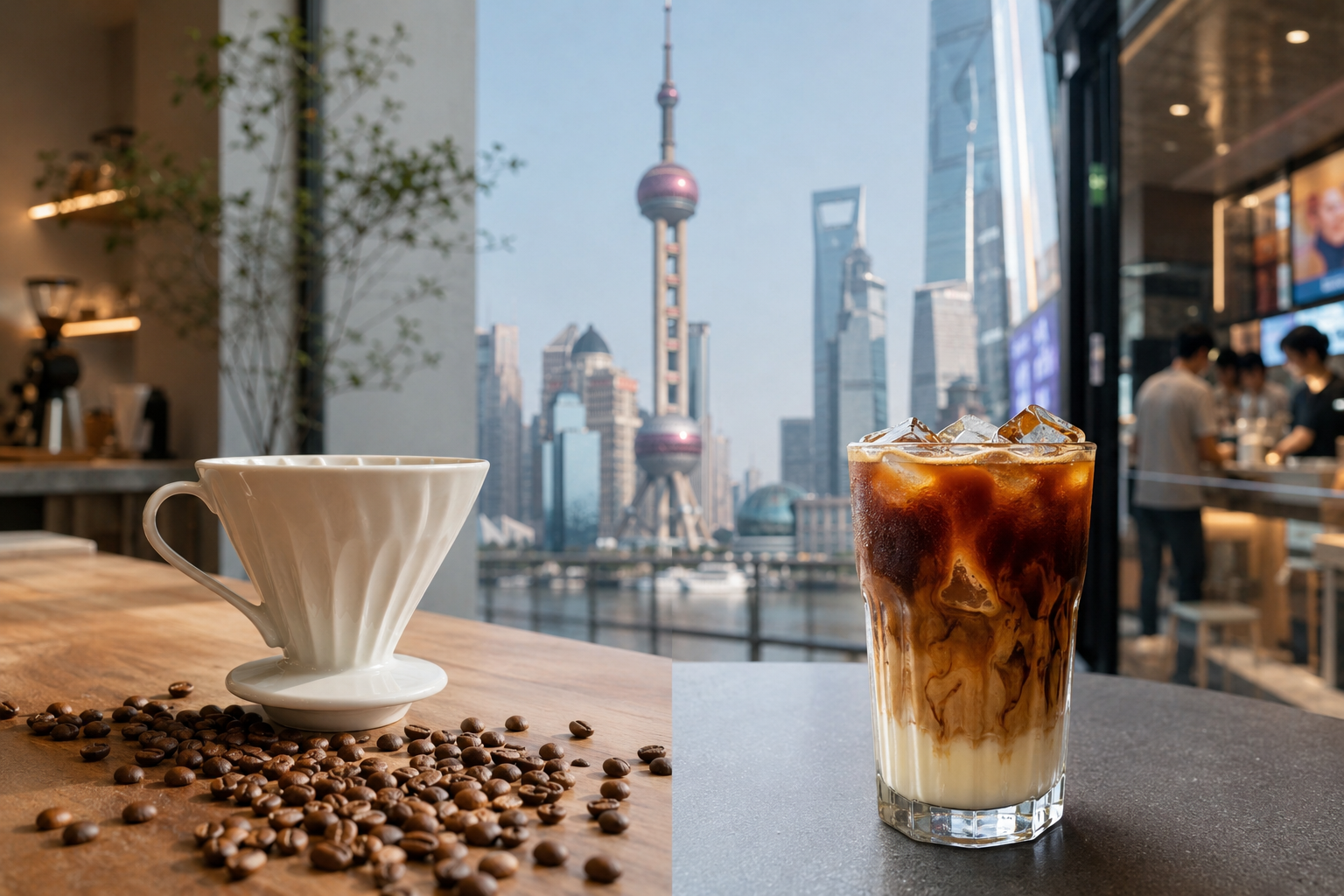
For many years, the global coffee industry had its eyes fixed on New York, Milan, and Paris. Today, the new growth center of the coffee industry has shifted to Asia. Shanghai now hosts over 9,115 cafes, making it the world’s leading coffee city. This is double the number in New York and approximately five times that of Paris.

Beyond the numbers, the key story is that China’s coffee consumption has grown 15 percent annually over the past three years. This has created a major shift in the global coffee supply chain. While many businesses still focus only on Western markets, China is quietly becoming a major destination and opportunity gateway for Ethiopian and Vietnamese coffee.

Ethiopia vs Vietnam in Shanghai (2025-2026)

Indicator Ethiopia Vietnam
Import rank in China 2nd (after Brazil) 3rd
Supply volume ~50,000 tons ~36,000 tons
Price per ton $6,310 (premium) $4,176 (mid-range)
Growth rate +79.1% revenue +65.8% supply
Key advantage Zero tariff, natural varieties, specialty quality Proximity (4-6 days), lower price

How Each Coffee is Perceived in Shanghai

Ethiopia: The Quality Standard
In Shanghai’s 9,000 cafes, Ethiopian coffee is viewed like fine wine. It is mostly found in specialty coffee shops and premium chains like Blue Bottle. It is preferred for pour-over black coffee. Young Shanghai coffee enthusiasts see Ethiopian coffee as the peak of complexity, with notes of wine, chocolate, spice, fruit, or citrus. Despite its higher price, it remains highly sought after.

Vietnam: The Reliable Workhorse
Once known only for instant coffee, Vietnam has rebranded itself by producing high quality robusta. Vietnamese coffee is commonly found in large chains like Luckin or Cotti, as well as popular cafes in the Jing’an district. It is known for its strong, nutty, chocolatey flavor and is seen as a reliable, affordable option, often mixed with milk.

Zero Tariff Policy and Ethiopia’s Rise

In 2025, a major change occurred: China’s zero tariff policy for Ethiopian products. This duty free access, along with growing strategic cooperation in agriculture, technology transfer, e-commerce links, and Shanghai’s role as a trading hub, has made Ethiopian coffee more price competitive in China.

Five years ago, China was the 33rd destination for Ethiopian coffee exports. By 2017, it rose to 4th place. In the first ten months of the 2018 budget year, Ethiopia exported 37,711 tons of coffee to China, worth $270.73 million, moving up to 3rd place. This demonstrates the rapid growth of Ethiopia’s presence in the Chinese market.

Frequently Asked Questions (FAQ)

1. How many cafes does Shanghai have?

Shanghai has over 9,115 cafes, more than double New York and about five times Paris.

2. How fast is China’s coffee consumption growing?

China’s coffee consumption has grown 15 percent annually over the past three years.

3. Which countries are the top coffee suppliers to China?

Brazil ranks first, followed by Ethiopia (second) and Vietnam (third).

4. What is the price difference between Ethiopian and Vietnamese coffee?

Ethiopian coffee averages $6,310 per ton, while Vietnamese coffee averages $4,176 per ton.

5. What is the zero tariff policy?

China granted duty free access to Ethiopian products in 2025, boosting Ethiopian coffee’s price competitiveness.

6. How much coffee did Ethiopia export to China in 2018?

In the first ten months of the 2018 budget year, Ethiopia exported 37,711 tons of coffee to China, worth $270.73 million.

Sahl Maryam Jabra Madhin – Based on reports from ECTA, GACC, ICO, and Allegra World Coffee Portal.
Published: May 21, 2026

Top Coffee Producers 2026

Dubai Qahwa World

As of April 2026, the global coffee market is undergoing a pivotal shift. Data from the International Coffee Organization (ICO) and the USDA show that the 2025/26 coffee year (October 2025–September 2026) has delivered record global supply, easing the extreme price pressures seen in 2024 and early 2025. World production is forecast at 178.8 million 60-kg bags (up 2% or +3.5 million bags year-on-year), while consumption reaches a record 173.9 million bags (+1.3%). Ending stocks remain tight at approximately 20.1 million bags, marking the fifth consecutive decline. Nevertheless, improved supply has caused ICO Composite Indicator Prices to drop sharply in early 2026 (February average: 267.57 US cents/lb, -9.9% month-on-month).

This supply surplus is driven by strong recoveries in Vietnam and Indonesia, record Ethiopian output, and steady performance in Brazil, despite drought impacts on key Arabica regions. National updates, including Brazil’s Conab first survey in February 2026, indicate an even stronger 2026 harvest, which could push global supply higher for 2026/27.

Top 10 Coffee-Producing Countries (2025/26 Forecast)

Data primarily from USDA December 2025 report, cross-verified with national sources and market analyses. Figures are green coffee equivalents. Percentages approximate global share.

Rank Country Production (M bags) % Global Main Variety YoY Change Key Notes
1 Brazil 63.0 ~35% Arabica (60%), Robusta/Conilon (40%) -2.0M (drought offset by Robusta gains) Record Robusta; Arabica hit by weather
2 Vietnam 30.8 ~17% Robusta (~95%) Recovery (+ higher yields) Fertilizer investment boosted output
3 Colombia 13.8 ~8% Arabica (100%, washed) -1.0M (excess rain/rust risk) Disease-resistant varieties helped
4 Indonesia ~12.5 ~7% Robusta (dominant) +1.7M (Robusta) Smallholder-dominated; favorable weather
5 Ethiopia 11.6 ~6.5% Arabica (specialty) Record (+0.5M) New varieties and pruning
6 Uganda ~6.9 ~3.9% Robusta Steady growth African Robusta leader
7 Honduras ~5.5–6.0 ~3% Arabica Part of Central America rebound Strong regional contributor
8 India ~5–6 ~3% Robusta (65%), Arabica (35%) Stable Specialty and organic focus
9 Peru ~4.2–5 ~2.5% Arabica (specialty/organic) Steady Premium export growth
10 Mexico / Guatemala ~3.8 each ~2% each Arabica Modest Central America/Mexico rebound

Total top 5: ~131.7M bags (~74% of world production). Latin America dominates Arabica; Asia leads Robusta.

Country Profiles: Drivers, Challenges, and 2026 Outlook

Brazil – World Leader (~35% of Global Supply)

Brazil remains the top producer. The 2025/26 crop saw Arabica decline to ~38M bags due to drought and high temperatures in Minas Gerais and São Paulo. Robusta surged to a record ~25M bags in Espírito Santo and Bahia thanks to better rainfall. Exports are forecast at ~37M bags.

  • Trends: Biennial cycle plus large-scale production with technology and irrigation. Funcafé funding supports the sector.
  • Challenges: Climate volatility, water stress, and EU Deforestation Regulation (EUDR) compliance.
  • 2026 Outlook: Conab’s February 2026 survey projects a record 66.2M bags (+17.1% YoY): Arabica +23.3% to 44.1M, Robusta +6.4% to 22.1M. This would surpass the 2020/21 record harvest.

Vietnam – Robusta Powerhouse

Nearly all output is Robusta, used in instant coffee and blends. Production rebounded due to favorable weather and higher input spending. Exports projected at 24.6M bags (+2.3M).

  • Trends: Export-oriented, rapid post-1990s expansion.
  • Challenges: Climate vulnerability in highlands; past dry spells.
  • 2026 Outlook: Continued recovery expected; early 2026 data shows strong export growth.

Colombia – Premium Arabica Specialist

100% washed Arabica. 2025/26 saw a modest decline due to excessive rains and cloud cover affecting flowering and rust risk. Disease-resistant varieties, such as Castillo, mitigated losses. Exports ~11.5M bags.

  • Trends: Focus on quality; yield improvements ongoing.
  • Challenges: Weather cycles, labor costs, altitude sensitivity.
  • 2026 Outlook: Rebound likely under normal conditions; key supplier to specialty markets.

Indonesia – Diverse Robusta and Specialty

Robusta dominates Sumatra and Java; small Arabica areas in the north. Production rose due to favorable weather and labor availability. Smallholder plots average 1 ha. Exports: green coffee +1.7M to 7.8M bags.

  • Trends: Stable land area (~1.2M ha), significant soluble coffee exports.
  • Challenges: Minimal fertilizer use, climate extremes.
  • 2026 Outlook: Stable supply to EU, US, and emerging markets expected.

Ethiopia – Africa’s Specialty Arabica Leader

Record 11.6M bags driven by adoption of higher-yielding varieties and pruning. Exports ~7.8M bags.

  • Trends: Natural and semi-washed processing; heirloom varieties remain globally sought.
  • Challenges: Smallholder fragmentation, highland climate variability, infrastructure limits.
  • 2026 Outlook: Growth likely if variety upgrades continue; specialty segment driver.

Emerging/Other Notable Producers

Uganda, Honduras, India, Peru, Mexico, and Guatemala produce the remaining ~25%. They are critical for Robusta (Uganda) and specialty/organic Arabica (Peru, India, Honduras). Central America/Mexico region rebounded +1.1M bags. India emphasizes premium niches (Monsoon Malabar, organic). All face smallholder and climate challenges but benefit from growing specialty demand.

Broader Trends Shaping 2026 and Beyond

  • Climate Change & Resilience: Droughts and excessive rains highlight vulnerability. By 2050, suitable coffee land may shrink significantly without adaptation.
  • Sustainability & Regulation: EUDR deadlines pressure exporters on traceability. Certifications (Fairtrade, organic, Rainforest Alliance) are growing, especially in Ethiopia, Colombia, and Peru.
  • Market Dynamics: High prices in 2024–25 spurred investment and supply recovery. Robusta exports surged in early 2025/26. Specialty demand remains robust.
  • Economic Impact: Coffee supports ~12.5 million farming households. Brazil and Vietnam dominate exports. Smallholders remain most vulnerable to volatility.
  • 2026/27 Outlook: Early forecasts indicate potential production above 180M bags if Brazil’s record harvest occurs and recoveries hold. Emerging markets will continue driving consumption growth.

Summary

2026 marks a transition from shortage-driven high prices to a more balanced, though still tight-stocks, market. Brazil’s dominance is set to strengthen, while Vietnam, Indonesia, and Ethiopia solidify their positions in Robusta and specialty segments. Long-term success depends on climate adaptation, sustainability, and innovation in varieties and processing. Opportunities abound in premium positioning and supply-chain resilience amid record availability.

This report draws on official forecasts as of early 2026. Data may be refined with subsequent national surveys, including Conab updates. Customized analysis, including by variety, export flows, or price scenarios, can be provided upon request.


Ethiopia Strengthens Coffee Ties with China

Addis Ababa – Qahwa World

A high-level Chinese delegation of 21 investors met with H.E.  Dr. Adugna Debela, Director General of the Ethiopian Coffee and Tea Authority (ECTA), to boost trade and promote Ethiopian coffee in China.

Led by Madam Betty, Chairperson of the Ethiopia-China Friendship and Cooperation Committee, the delegation visited ECTA’s headquarters to discuss strategic frameworks for expanding Ethiopian coffee in the Chinese market.

You may read: Chinese Firm Huichuan to Invest in Ethiopia Coffee Processing

Key Points:

Strategic Promotion: The delegation helps introduce Ethiopian coffee to Chinese consumers via innovative marketing channels.
Rapid Market Growth: China rose from the 33rd largest buyer to the 3rd largest in just eight months.
Investor Interest: Multiple Chinese companies seek premium Ethiopian coffee directly from its origin, signaling a new phase of “Coffee Diplomacy.”

Read also: Ethiopia and China Strengthen Coffee Sector Cooperation

“China’s emergence as a top destination for our coffee is remarkable.  We value the delegation’s commitment and will provide full support for this partnership,” said Dr. Adugna.

The meeting ended with a shared commitment to deepen Ethiopia-China relations, ensuring every cup in Beijing and Shanghai carries the authentic flavor of the Ethiopian highlands.

Chinese Firm Huichuan to Invest in Ethiopia Coffee Processing

Addis Ababa — Qahwa World

Chinese industrial leader Huichuan Freeze-Dried Health Food has announced plans for a major investment in Ethiopia’s coffee processing sector, aiming to boost value-added production in the world’s birthplace of coffee.

The announcement was made during a high-level meeting held today at the headquarters of the Ethiopian Coffee and Tea Authority (ECTA). A senior delegation from Huichuan, led by Chairman Mr. Wang Shuiyong, met with ECTA Director General Dr. Adugna Debela to discuss strategic cooperation.

Mr. Wang highlighted his company’s expertise in advanced freeze-drying technology, which produces premium instant coffee powder while preserving the rich aroma and flavor of Ethiopian Arabica beans. He noted that Huichuan’s products, already sourced from Ethiopian coffee, have gained strong international recognition and market share. The company is now preparing to establish a large-scale processing facility in Ethiopia to strengthen its global supply chain.

You may read: Ethiopia and China Strengthen Coffee Sector Cooperation

Dr. Adugna Debela welcomed the initiative, describing it as a timely and strategic partnership that supports Ethiopia’s efforts to enhance value addition in its coffee industry. He pointed to the country’s investor-friendly policies, including the development of specialized industrial parks for high-tech agro-processing.

“We are witnessing a transformative trend, with numerous Chinese investors showing keen interest in Ethiopia’s coffee sector,” Dr. Adugna stated. He assured the Huichuan delegation that the Ethiopian government is committed to providing full administrative and technical support to ensure the project’s success for both export and domestic markets.

  • Strengthening Ethiopia’s Coffee Value Chain

Ethiopia, known globally for its premium specialty coffees such as Yirgacheffe and Sidama, has been actively encouraging downstream processing to increase export revenues and generate employment. This latest investment by Huichuan reflects growing Chinese engagement in the sector, as China continues to emerge as a key destination for Ethiopian coffee.

The planned facility is expected to introduce state-of-the-art freeze-drying capabilities locally, helping Ethiopia move beyond raw bean exports toward higher-value, shelf-stable processed products that meet strong international demand.

The development is seen as part of broader China-Ethiopia cooperation in agriculture and trade. Further details regarding the project’s scale, timeline, and location are expected in the coming months.

AFCA 2026 Officially Opens in Addis Ababa

Brewing Africa’s Next Generation

Addis Ababa – Qahwa World x Buna Kurs

The 22nd African Fine Coffees Conference & Exhibition (AFCC&E) officially opened today at the Addis International Convention Center (AICC), marking a major milestone for Africa’s coffee sector. Following yesterday’s pre-conference Sustainability Day workshops, the event welcomed over 2,000 delegates from more than 25 countries, including government officials, private sector leaders, international buyers, and coffee experts.

A Vision for the Future This year’s theme, “Brewing Africa’s Next Generation,” underscores a commitment to modernizing the value chain, integrating youth into the sector, and building climate resilience. AFCA Chairperson Amir Hamza described the event as a “homecoming for coffee,” adding: “Africa will no longer just supply fine coffees to the world—we will define the future of coffee.”

Breaking Trade Barriers A highlight of the opening was the high-level panel discussion, “Why Do Roasters Find It Harder to Buy Directly from Africa?” presented by Algrano. Strategic partner Algrano brought a delegation of over 20 international buyers from the US and Europe to engage directly with African producers. Panelists focused on solutions to logistics bottlenecks, financing gaps, and late contracting that often hinder smallholder farmers from accessing global markets.

Exhibition Floor Highlights The trade floor is now fully buzzing with booths showcasing innovations in coffee technology, logistics, and premium green coffee. Cupping sessions are underway, featuring the winners from AFCA’s flagship competition, the Taste of Harvest, in addition to fresh Ethiopian harvests.

Delegates also explored value-addition technologies aimed at moving beyond raw bean exports to roasting and branding at origin. Policy initiatives introduced today include a gender-responsive framework designed to increase women’s participation in agricultural extension and decision-making, developed in partnership with the Ethiopian government and GIZ.

Economic and Sectoral Momentum The conference is already shaping critical discussions on coffee strategy, and analysts note that initiatives highlighted at AFCA are being seen as a platform to position Africa as a proactive player in global coffee pricing and innovation. The conference continues tomorrow and will feature the finals of the Africa Barista Championship and the Regional Taste of Harvest Competition, in addition to AFCA’s Burundi Taste of Harvest Auction.

Puyang Launches Integrated Coffee Production Chain in China

Dubai – Qahwa World

Coffee in China is no longer just an imported commodity or a growing consumer trend. It has become a strategic industrial and trade opportunity, with value chains extending from African production regions to Chinese processing hubs and global export markets. The Puyang County project in Henan Province stands out as a leading example of this transformation.

  • From Import to Deep Processing

In recent years, Puyang County has actively participated in the Belt and Road Initiative, leveraging its industrial base and logistics infrastructure in central China. Within this framework, the China-Ethiopia Coffee Industrial Demonstration Park was established, relying primarily on coffee beans imported from Ethiopia and Uganda, two of the world’s most prominent coffee origin countries.

What sets Puyang apart is not merely the import of raw beans but the transition to advanced processing within China, which increases the value of the final product and strengthens the competitiveness of Chinese manufacturers in global coffee supply chains.

A Fully Integrated Production Facility

The demonstration park in Puyang features a fully integrated production system, including:

A factory producing freeze-dried instant coffee;

Three roasting lines for coffee beans;

Ten cold brew production lines;

Eight freeze-drying lines.

This integration allows complete control over all processing stages—from roasting and extraction to drying and packaging—ensuring consistent quality, product variety, and the capacity to meet diverse international standards.

  • Puyang at the Heart of China’s Emerging Coffee Value Chains

Puyang’s initiative reflects a broader shift in China: moving from being a final importer of coffee to becoming a regional hub for processing and re-exporting coffee. With growing domestic consumption and the expanding specialty coffee market, models like Puyang’s are increasingly relevant, combining industrial efficiency with trade flexibility.

Exports from Puyang now reach Singapore, the United States, and other countries, demonstrating that integrated production chains can effectively serve both domestic and international markets.

  • Coffee as a Belt and Road Cooperation Tool

On a larger scale, Puyang exemplifies how the Belt and Road Initiative can support agro-industrial value chain development, not only infrastructure and energy projects. By importing beans from African origins and processing them domestically, China creates a shared-value model: raw material sourcing in Africa, industrial processing in China, and global market distribution. This strengthens China’s role in global coffee trade while providing African producers with more stable export channels.

  • Implications for the Specialty Coffee Sector

For the specialty coffee industry, Puyang highlights several key trends:

Increased focus on advanced processing techniques such as freeze-drying and cold brew extraction;

Building industrial capacity capable of handling a wide range of African coffee origins;

A growing orientation toward export-ready, value-added products, not just the domestic market.

These elements make Puyang a case study for China’s evolving coffee value chains, particularly as Belt and Road initiatives continue to expand.

The Puyang project illustrates how coffee can evolve from a simple imported commodity into a high-value industrial product within fully integrated value chains. With ongoing investment and strategic partnerships, coffee is poised to become a new axis of industrial and trade collaboration between China and producing countries, reaching beyond domestic consumption into global markets.

Ethiopia Hosts First Cup Tasters Challenge, Marking a New Chapter for Its Coffee Community

Addis Ababa – world×Buna Kura

Galani Coffee made history on December 1 by hosting Ethiopia’s first Cup Tasters Challenge, an event organized in partnership with the Iran Coffee Society and celebrated as a defining milestone for the country’s fast-growing specialty coffee scene.

The competition brought two global champions to Addis Ababa:
• Young Baek, World Cup Tasters Champion
• Taufan Mokoginta, World Roasting Champion

Their presence transformed the event into an intensive learning platform, where Ethiopia’s rising sensory talents received coaching, cupped side-by-side with champions, and gained exposure to world-class tasting standards.

Beyond the excitement of competition, the day symbolized something far greater — a meaningful connection between Ethiopia’s legacy as the birthplace of coffee and the expanding global culture of specialty coffee. The challenge underscored Ethiopia’s growing ambition to elevate its sensory professionals and strengthen its role at the forefront of the international coffee industry.

Ethiopia launches Specialty Coffee Association (SCAE) to elevate global profile

Addis Ababa – Qahwa World×Buna Kurs Media

Ethiopia has officially inaugurated the Specialty Coffee Association of Ethiopia (SCAE), a national platform aimed at strengthening the global presence and competitiveness of its specialty coffee sector. The launch took place on Tuesday, November 25, 2025, at the Skylight Hotel in Addis Ababa, attended by prominent coffee industry stakeholders, including H.E. Dr. Efa Muleta, State Minister of the Ministry of Agriculture, H.E. Dr. Adugna Debela, Director of the Ethiopian Coffee and Tea Authority, and leading specialty coffee exporters.

Leadership and Mission

SCAE is led by President Ashenafi Argaw and a board of industry experts. The association’s mission is to promote Ethiopian specialty coffee internationally, uphold high quality standards, support sustainability, and create opportunities for producers, exporters, and cooperatives. The launch event also recognized the legends who have shaped Ethiopia’s specialty coffee journey and highlighted the strategic pillars that will guide the sector’s future.

Key Initiatives

A central program under SCAE is the “Best of Ethiopia” national specialty coffee auction, designed to showcase the country’s top coffees to international buyers. Inspired by successful auctions in Panama and Colombia, this initiative aims to strengthen Ethiopia’s visibility in the premium coffee segment while ensuring quality, traceability, and direct market access for producers.

SCAE will also serve as a hub for training, research, professional development, and market expansion, offering resources to strengthen Ethiopia’s coffee sector while protecting its unique varietals and biodiversity.

Global Significance

Specialty coffee associations worldwide play a vital role in connecting producers to high-value markets, professionalizing the sector, and sharing knowledge. With SCAE, Ethiopia now has a dedicated platform to ensure its story of origin, quality, and sustainability reaches the international specialty coffee community.


Ethiopia Raises Capital Requirements for Coffee Exporters

Addis Ababa – September 14, 2025 – (Qahwa World) – The Ethiopian Coffee and Tea Authority (ECTA) has announced sweeping changes to the country’s coffee export regulations, significantly increasing the minimum capital required for exporters. The move, introduced under Directive 1106/2025, aims to professionalize the sector, reduce malpractice, and ensure higher quality standards in Ethiopia’s leading export industry.

Private coffee exporters must now hold a starting capital of 15 million birr, up from just 1 million birr — a 15-fold increase. Trade associations and corporate entities such as joint stock and limited liability companies face an even steeper jump, from 1.5 million birr to 20 million birr, more than 13 times the previous threshold. ECTA stated that previous rules were inadequate to monitor exporters and prevent the misuse of certificates of competence.

In addition to higher financial requirements, all exporters — except farmer exporters — are now obligated to establish an ECTA-certified coffee laboratory for basic quality testing. They must also employ a qualified coffee taster with at least a diploma and a renewed proficiency certificate, with each taster restricted to serving only one dispatcher.

The decision has divided stakeholders. Veteran exporter Semachew Ababu welcomed the directive, saying it would “refine the market” by filtering out under-funded players and ensuring greater consistency in quality for international buyers.

But smaller businesses voiced concerns. Entrepreneur Sosena Desalegin criticized the sudden hike, calling it “impossible to raise that much money overnight for a new business,” warning that it could stifle new entrants and competition.

Independent experts acknowledged the directive’s goal of curbing illegal practices but cautioned against the unintended consequences. “It may limit the sector to a few large players, which is not healthy for long-term growth and diversification,” one expert observed.

The new guidelines came into effect this week and are expected to reshape Ethiopia’s coffee export market, potentially concentrating power in the hands of larger companies while tightening quality controls across the sector.

The Ultimate Guide to Coffee Processing Methods Around the World: From Cherry to Cup

Dubai, 23 August 2025 (Qahwa World) – In the world of coffee, the journey from a ripe cherry on a tropical tree to the steaming brew in your mug is a tale of art, science, and global tradition. The coffee processing stage—where the fruit is transformed into green beans ready for roasting—is the crucible where flavors are shaped. This comprehensive guide explores coffee processing methods, diving into their histories, techniques, regional strongholds, and sensory impacts. Whether you’re a researcher seeking types of coffee processing, a barista curious about wet vs dry coffee processing, or an enthusiast exploring anaerobic coffee processing trends, this reference covers it all. Spanning over 70 coffee-producing countries, we’ll journey through time-honored methods like natural, washed, and honey processing, alongside cutting-edge innovations like anaerobic fermentation, which is gaining traction worldwide, including in Yemen.

With climate change reshaping coffee production, processing methods are evolving to balance sustainability and flavor innovation. By 2025, the rise of anaerobic processing in countries like Yemen highlights its growing appeal. Let’s uncover the full story.

The Origins of Coffee Processing: A Historical Perspective

Coffee’s story begins in Ethiopia around the 9th century, where wild Coffea arabica plants were first harvested. Early farmers dried whole cherries under the sun, birthing natural coffee processing. As coffee spread through Yemen and the Middle East to the Americas by the 18th century, diverse climates and resources spurred new techniques. Processing significantly influences a coffee’s flavor profile—many experts estimate it can account for around 30%—shaping acids, sugars, and volatile compounds through microbial activity and fermentation time. For researchers studying coffee biochemistry or sustainability, this guide offers a foundation for understanding these dynamics.

Natural (Dry) Processing: The Timeless Tradition

Natural coffee processing, or dry processing, is the oldest method, requiring minimal water and relying on sunlight. Whole cherries are spread on patios, raised beds, or rooftops and dried for 2–4 weeks, turned regularly to prevent mold. The bean absorbs sugars from the fruit, and the dried husk is hulled at 11% moisture.

Key Regions and History

  • Ethiopia: The origin, producing Yirgacheffe naturals with wild strawberry notes.

  • Brazil: The world’s top producer, using mechanized farms for consistency.

  • Yemen and Indonesia: Ancient terraces yield complex, winey profiles.

Flavor Profile and Science
Natural processing creates full-bodied, low-acidity cups with sweet, fruity notes like blueberry or chocolate. The bean ferments inside the fruit, boosting ethyl butyrate esters for fruity aromas. Risks include mold in humid conditions, requiring careful management. Variations include African raised-bed drying for airflow and Brazilian mechanical dryers for rainy seasons.

Washed (Wet) Processing: Precision and Clarity

Pioneered in Central America in the 19th century, washed coffee processing suits wet climates. Cherries are depulped, fermented in water tanks for 12–48 hours to remove mucilage, washed, and dried to 10–12% moisture.

Key Regions and History

  • Colombia and Kenya: Abundant rivers produce bright, citrusy coffees.

  • Guatemala, Nicaragua, Rwanda: High-altitude farms emphasize acidity.

Flavor Profile and Science
Washed coffees are clean and vibrant, with high acidity and notes like green apple or jasmine. Fermentation breaks down pectins via yeast and bacteria, clarifying terroir. Though water-intensive (20–40 liters per kilo), it reduces defects. Innovations include Kenyan double-washing for brightness and mechanical aquapulping to save water.

Honey (Pulped Natural) Processing: The Sweet Hybrid

Originating in Costa Rica in the mid-20th century, this hybrid method conserves water. Cherries are depulped, leaving varying mucilage (the “honey”) during drying for 8–30 days.

Key Regions and History

  • Costa Rica: Classifies as Yellow (minimal mucilage, grainy acidity), Red (balanced sweetness), or Black Honey (floral, syrupy).

  • Brazil (Pulped Natural), El Salvador, Panama: Used for premium lots.

Flavor Profile and Science
Sweeter than washed, cleaner than natural, with caramel, stone fruit, and honey notes. Mucilage caramelization enhances sucrose absorption. It’s eco-friendly but needs monitoring to avoid over-fermentation.

Wet Hulled (Giling Basah): Indonesia’s Earthy Signature

For humid climates, wet hulled coffee processing (semi-washed or Giling Basah) emerged in 19th-century Indonesia. Cherries are depulped, briefly fermented, hulled at 30–35% moisture, and dried further.

Key Regions and History

  • Indonesia (Sumatra, Java): Suits rainy climates, producing bold Mandheling coffees.

  • Papua New Guinea: Similar adaptations.

Flavor Profile and Science
Low acidity, heavy body, with earthy tobacco and dark chocolate notes. Rapid microbial activity in humid conditions risks defects but creates unique profiles.

Emerging Innovations: The Rise of Anaerobic and Fermentation-Driven Methods

The specialty coffee boom has sparked fermentation innovations, with anaerobic coffee processing leading the charge. Inspired by winemaking, it involves sealing beans in oxygen-free tanks for 12–72 hours, enhancing exotic flavors. By 2025, anaerobic processing is surging globally, including in Yemen, where farmers are adopting it to boost quality and demand.

Key Regions and History

  • Colombia and Costa Rica: Pioneers of anaerobic, yielding peach or yogurt notes.

  • Yemen: Recent adoption (post-2020) enhances Mocha coffee’s complex flavors, with airtight bags or barrels used for up to 120 hours, compared to traditional 10–20 hour wet fermentation. Professional tasters note increased recognition for Yemeni coffee globally.

  • Ethiopia, Brazil, Panama: Experimenting for premium lots.

  • Vietnam: Applying to robusta for bold, innovative profiles.

Flavor Profile and Science
Anaerobic fermentation produces intense, fruit-forward, or winey flavors (lactic acids create cheesy or yogurt-like notes). Yemen’s anaerobic coffees highlight natural aromas, balancing acidity. Variations include:

  • Carbonic Maceration: CO₂-infused tanks (Panama, Kenya) yield banana or whisky notes, starting in 2015.

  • Lactic Processing: Emphasizes creamy textures via milk-like bacteria.

  • Frozen Natural: Chilling cherries preserves brightness.

These methods enhance volatiles but may reduce bioactives like caffeine. They’re costly but fetch high prices in specialty markets.

Coffee Processing Methods Comparison: Insert Table Here

COFFEE PROCESSING METHODS COMPARISON
Method Key Regions Water Use Drying Time Flavor Profile Pros / Cons
Natural (Dry) Ethiopia, Brazil, Yemen Low 2–4 weeks Fruity, sweet, full-bodied Eco-friendly; risk of mold
Washed (Wet) Colombia, Kenya, Guatemala High 1–2 weeks Clean, bright acidity Consistent quality; water-intensive
Honey (Pulped) Costa Rica, Brazil, Panama Medium 1–4 weeks Sweet, caramel, balanced Sustainable; requires monitoring
Wet Hulled Indonesia (Sumatra) Medium ~1 week Earthy, heavy body, low acid Fast process; higher risk of defects
Anaerobic Colombia, Costa Rica, Yemen Varies Varies Exotic, winey, lactic, fruity Innovative; costly; experimental
Carbonic Maceration Panama, Kenya Low Varies Wine-like, banana, whisky Premium lots; inspired by winemaking

The Future of Coffee Processing: Sustainability and Global Trends

As climate change threatens yields, low-water methods like honey and anaerobic are gaining ground. Yemen’s shift to anaerobic processing, reported in 2025, reflects a broader trend toward flavor innovation and market competitiveness. AI-monitored fermentations and thermal shock (quick freezing) are emerging, with researchers predicting wider adoption by 2030. The Specialty Coffee Association offers resources for studying these trends.

FAQ: Common Questions on Coffee Processing

What is anaerobic coffee processing?
A fermentation in oxygen-free tanks, producing exotic flavors, increasingly used in Yemen and Colombia.

Why is anaerobic processing popular in 2025?
It enhances flavor complexity, boosting demand in specialty markets.

How does processing affect coffee quality?
It shapes acidity, body, and defects through microbial and chemical changes.

What are the best coffee processing methods?
Natural for sweetness, washed for clarity, anaerobic for innovation.


This ultimate guide to coffee processing methods is a definitive resource for researchers, baristas, and enthusiasts searching for anaerobic coffee processing Yemen or global coffee processing techniques. Each method tells a story of tradition, innovation, and environment, ensuring every sip is a chapter in coffee’s global legacy.