Harar: Where Coffee, Faith and Footsteps Meet

Harar blends centuries of coffee heritage, Islamic history and warm hospitality. The inaugural Great Harar Run offers visitors a new way to discover one of Ethiopia’s most remarkable cities.

By Tewodros Balcha | Exclusive for Qahwa World

Thousands of runners passed through the ancient gates of Harar today, transforming one of Africa’s oldest living cities into the newest stage of Ethiopia’s celebrated running culture.

The inaugural Ethio Telecom Great Harar Run was more than a sporting event. It was an invitation to experience a city where coffee, faith and hospitality have shaped everyday life for centuries.

Long before the starter’s whistle echoed through the narrow streets of Harar Jugol, generations of traders, scholars and pilgrims had followed these same paths. Today, athletes from Ethiopia and abroad joined that long procession, discovering a city whose history is inseparable from the story of coffee itself.

A City Built on Faith and Exchange

Perched in the eastern highlands of Ethiopia, Harar has been a crossroads between Africa and the Arabian Peninsula for centuries. According to local tradition, the city traces its origins to the 10th century and the arrival of Sheikh Abadir Umar ar-Rida, whose legacy remains deeply woven into Harar’s religious identity.

Known as Madinat al-Awliya, or the City of Saints, Harar is home to an extraordinary concentration of historic mosques, shrines and Islamic schools within its centuries-old walls. In 2006, Harar Jugol was inscribed as a UNESCO World Heritage Site, recognized for its unique urban heritage and cultural significance.

For generations, merchants crossed these gates carrying coffee, spices, textiles and ideas, linking Ethiopia with the Red Sea, Arabia and beyond.

Where Coffee Became a Tradition

Coffee’s wild origins lie in Ethiopia’s forests, but Harar played a defining role in transforming coffee from a native plant into one of the world’s earliest traded agricultural products.

For centuries, the region became one of Ethiopia’s most important coffee-growing and trading centers. Caravans carried Harar’s beans across ancient trade routes to the ports of the Red Sea, where Arab merchants introduced Ethiopian coffee to markets throughout the Middle East before it eventually reached Europe.

Today, Harar remains one of Ethiopia’s most celebrated coffee origins. Its naturally processed coffees are prized for their distinctive character, often revealing notes of blueberry, dried fruit, spice, chocolate and floral aromas. Long before the term “specialty coffee” existed, generations of farmers in Harar had already developed traditions of careful cultivation, harvesting and natural drying that continue to define the region’s reputation.

More Than a Cup

In Harar, coffee is not simply served.

It is prepared.

Guests are welcomed with freshly roasted beans, their aroma filling the room before the coffee is carefully brewed and shared. The ceremony unfolds without haste, turning every cup into an expression of hospitality rather than a simple refreshment.

Visitors from across the Arab world often find something familiar in this ritual. While traditions differ from one region to another, the values are instantly recognizable: generosity, conversation and the belief that welcoming a guest begins with coffee.

A Living Heritage

Walking through Harar Jugol is unlike visiting an open-air museum.

Its narrow alleyways remain full of daily life. Children play beneath centuries-old walls. Markets continue to trade much as they have for generations. Historic houses, colorful courtyards and neighborhood mosques remain part of a living city rather than preserved exhibits.

Arabic manuscripts copied by generations of scholars helped establish Harar as an important center of Islamic learning in the Horn of Africa. The city’s traditions continue to be passed from one generation to the next, making Harar a place where history is experienced rather than observed.

Running Through History

The Ethio Telecom Great Harar Run added a new chapter to that living history.

As the final stop of this year’s Discover Ethiopia Classics series, the event attracted thousands of participants, including elite athletes, local residents and visitors from nine countries.

Organized by the internationally respected Great Ethiopian Run, the event brought one of Africa’s leading road-racing organizations to one of Ethiopia’s oldest cities. Known globally for staging the annual Great Ethiopian Run in Addis Ababa, the organization has helped establish Ethiopia as one of the world’s premier destinations for distance running.

Yet in Harar, the route itself became part of the experience.

Runners passed through the ancient gates of Jugol, wound through historic neighborhoods and emerged into streets where coffee ceremonies welcomed visitors at every turn. As evening approached, the city’s famous hyena feeders prepared for another night of a tradition that has fascinated visitors for generations.

In Harar, even a road race becomes an encounter with history.

More Than a Destination

Every generation believes it has discovered authentic travel.

Harar has never needed to reinvent itself.

Visitors who arrive a day before the race can wander through the old city at their own pace, explore nearby coffee farms, watch naturally processed coffee drying beneath the Ethiopian sun and experience ceremonies that remain central to everyday life.

The race offers a reason to come.

The city offers every reason to stay.

Some places are remembered for their monuments.

Harar is remembered for its people, its coffee and the quiet generosity with which it welcomes every visitor.

Some cities you visit.

Harar is one you carry with you.
Ethiopica Coffee Show Takes Center Stage as Ethiopia’s Largest Agrofood Industry Gathering Opens in Addis Ababa

Source: Qahwa World – Special coverage from Addis Ababa |
Author: Qahwa World × Buna Kurs – ADDIS ABABA |
Date: June 26, 2026

Ethiopica Coffee Show Takes Center Stage as Ethiopia’s Largest Agrofood Industry Gathering Opens in Addis Ababa

Key Takeaways:

  • The second edition of the Ethiopica Coffee Show opened at the Addis International Convention Center, alongside Agrofood Ethiopia, Ethiopia Food Show, and Plastprintpack Ethiopia.
  • Over 150 exhibitors from 18 countries are participating, covering the entire value chain from production to packaging.
  • The Ethiopica Coffee Show represents a growing platform for Ethiopia’s coffee sector, with producers, exporters, roasters, and equipment manufacturers from around the world.
  • Growing global interest in Ethiopia’s coffee industry is driving greater emphasis on value addition, specialty coffee development, and branding.
  • The exhibitions highlight the interconnected nature of Ethiopia’s agro-industrial economy, including innovations in food processing, packaging, and manufacturing technologies.
  • The event is expected to strengthen Ethiopia’s position as a regional hub for agrofood trade and as the birthplace of Arabica coffee.

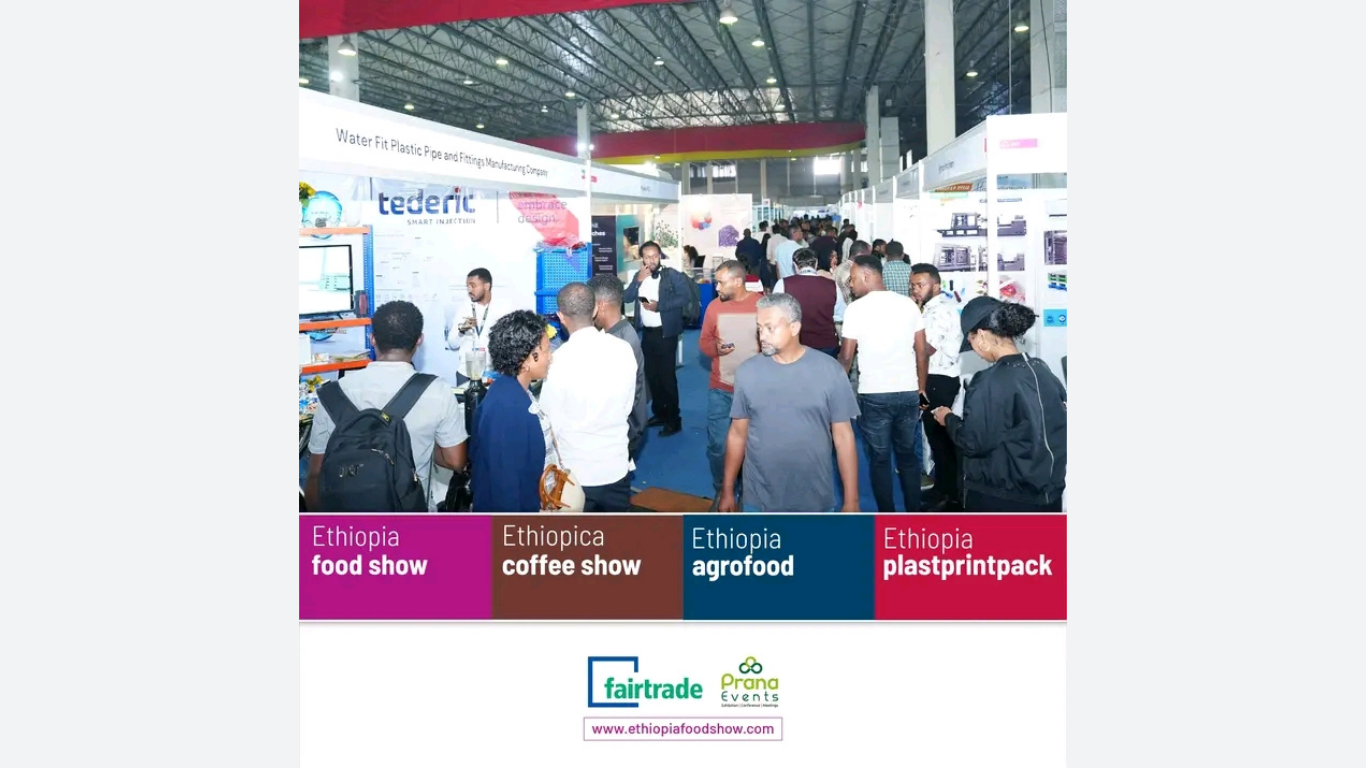
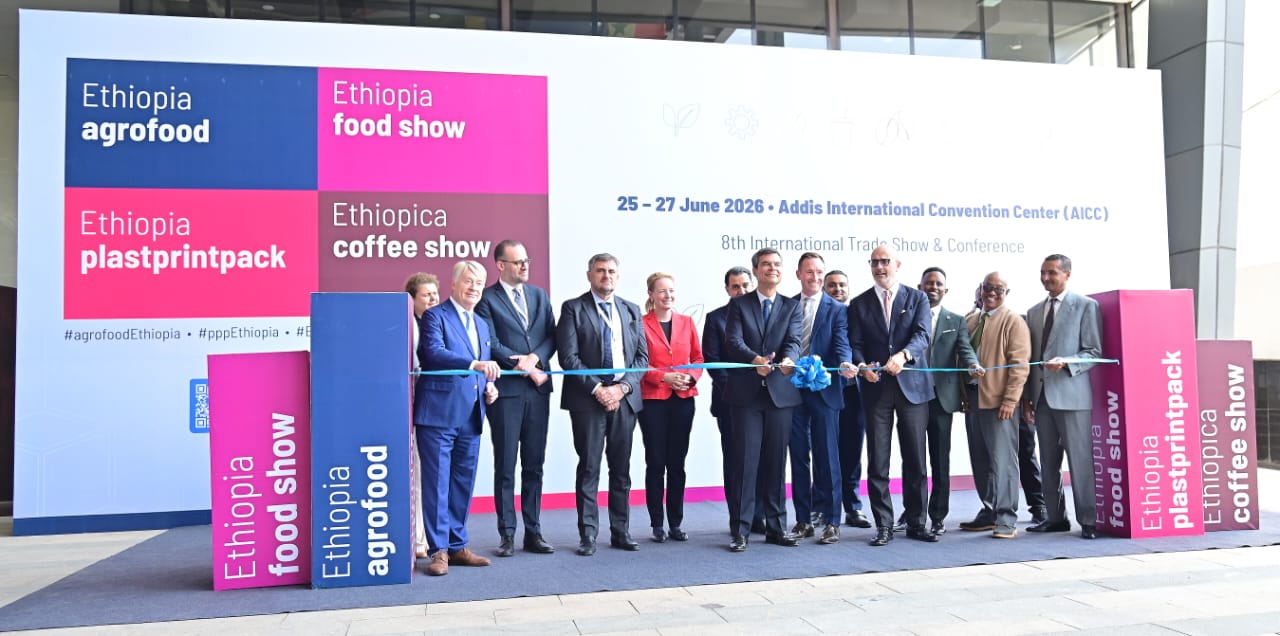
Ethiopia’s coffee sector took a prominent place in the spotlight on Thursday as the second edition of the Ethiopica Coffee Show opened at the Addis International Convention Center (AICC), alongside Agrofood Ethiopia, Ethiopia Food Show, and Plastprintpack Ethiopia, bringing together producers, exporters, technology suppliers, and industry stakeholders from around the world.

The combined exhibition, running from June 25 to 27, has transformed the AICC into a meeting point for the coffee, food processing, agriculture, packaging, and printing industries. More than 150 exhibitors from 18 countries are participating, showcasing products and technologies that span the entire value chain, from agricultural production and coffee processing to food manufacturing, packaging, and international trade.

Ethiopica Coffee Show: A Growing Platform for Ethiopia’s Export Sector

For coffee professionals, the Ethiopica Coffee Show represents a growing platform dedicated to one of Ethiopia’s most important export sectors. Exhibitors include coffee producers, exporters, roasters, equipment manufacturers, packaging companies, and service providers seeking to strengthen commercial relationships across domestic, regional, and international markets. The exhibition reflects increasing global interest in Ethiopia’s coffee industry at a time when stakeholders are placing greater emphasis on value addition, specialty coffee development, branding, and direct market engagement. Companies from Africa, Europe, Asia, Latin America, and the Middle East are participating in the event, creating opportunities for business networking, technology transfer, and investment discussions.

Indicator Value
Total Exhibitors Over 150
Participating Countries 18
Event Duration June 25-27, 2026
Location Addis International Convention Center
Participating Regions Africa, Europe, Asia, Latin America, Middle East

Beyond Coffee: The Interconnected Nature of Ethiopia’s Agro-Industrial Economy

Beyond coffee, the broader exhibition highlights the interconnected nature of Ethiopia’s agro-industrial economy. Visitors can explore innovations in food processing, beverage production, agricultural inputs, packaging solutions, printing technologies, and manufacturing equipment, sectors that increasingly support the country’s ambitions for industrial growth and export expansion. This integration reflects Ethiopia’s strategic shift toward a more diverse and interconnected economy.

Building Momentum and Strengthening Regional Standing

The scale of the event builds on momentum generated by previous editions, which attracted record participation from exhibitors and trade visitors. Organizers expect this year’s gathering to further strengthen Ethiopia’s position as a regional hub for agrofood trade while reinforcing the country’s reputation as the birthplace of Arabica coffee and one of the world’s most significant coffee-producing nations. Over the next three days, exhibitors and visitors will engage in product demonstrations, business meetings, and market discussions aimed at expanding trade opportunities and fostering new partnerships across the coffee and agrofood industries.

Integrated Exhibitions Reflecting the Real Value Chain

The organization of these four exhibitions in one location reflects the real-world integration of the value chain in the agro-industrial sector. The Ethiopica Coffee Show focuses on production and processing, while Agrofood Ethiopia covers the broader agricultural side, the Ethiopia Food Show addresses the food industry, and Plastprintpack Ethiopia meets packaging and printing needs. This integration creates an ideal environment for networking across different value chain actors and facilitates knowledge exchange and technology transfer between sectors.

Frequently Asked Questions About the Ethiopica Coffee Show and Associated Events

Q: When are the Ethiopica Coffee Show and associated events taking place?

A: From June 25 to 27, 2026.

Q: Where is the exhibition being held?

A: At the Addis International Convention Center in Addis Ababa, Ethiopia.

Q: How many exhibitors are participating?

A: Over 150 exhibitors from 18 countries.

Q: Which exhibitions are being held alongside the Ethiopica Coffee Show?

A: Agrofood Ethiopia, the Ethiopia Food Show, and Plastprintpack Ethiopia.

Q: Which geographic regions are participating in the event?

A: Africa, Europe, Asia, Latin America, and the Middle East.

The Ethiopica Coffee Show and associated events represent a strategic platform to strengthen Ethiopia’s position as the birthplace of coffee and as an emerging industrial hub in Africa. By bringing together key players across the value chain, from farm to packaging, these events help drive economic growth and foster innovation in Ethiopia’s agro-industrial sector. Follow our special coverage for the highlights of this global event.

Coverage by: Qahwa World × Buna Kurs – ADDIS ABABA.

All rights reserved. Republication with attribution permitted.

Publication date: June 26, 2026

Ethiopia at the Center of Global Coffee and Agro-Industry Convergence as Ethiopica Coffee Show Returns to Addis Ababa

The Ethiopica Coffee Show Addis Ababa is a highly anticipated event for coffee enthusiasts and industry professionals alike.

Source: Qahwa World – Special coverage from Addis Ababa |
Author: Qahwa World × Buna Kurs – ADDIS ABABA |
Date: June 21, 2026

Ethiopia at the Center of Global Coffee and Agro-Industry Convergence as Ethiopica Coffee Show Returns to Addis Ababa

Key Takeaways:

  • Addis Ababa hosts the Ethiopica Coffee Show alongside agrofood, plastprintpack, and the Ethiopia Food Show from June 25–27, 2026.
  • Over 150 exhibitors from 19 countries, with national pavilions from Brazil, China, and Italy.
  • The Ethiopica Coffee Show offers a dual lens: Ethiopia as coffee origin and as an evolving industrial ecosystem across the full value chain.
  • The IMF projects Ethiopia as one of Africa’s fastest-growing economies in 2026.
  • The exhibitions are held at the new world-class AICC Addis International Convention Center.
  • The integrated structure mirrors the real-world value chain from agricultural production to processing and packaging.

Addis Ababa is set to host one of the most significant global events in the coffee and agro-industry sector, as the Ethiopica Coffee Show returns to the Ethiopian capital from June 25–27, 2026. The event coincides with the agrofood, plastprintpack, and Ethiopia Food Show exhibitions, forming an integrated platform that brings together agricultural production, processing, packaging, and distribution under one roof.

Ethiopia, as the birthplace of coffee, continues to strengthen its position not only as a coffee-producing country but as an evolving industrial ecosystem encompassing the full coffee value chain – from cultivation and raw bean handling to processing technologies, packaging innovation, and export-ready market systems.

Integrated Exhibitions Reflect Industrial Transformation

Now in its 8th edition, the combined exhibitions arrive at a moment of strong economic momentum, with the IMF projecting Ethiopia as one of Africa’s fastest-growing economies in 2026. That growth is reflected in expanding industrial participation, with more than 150 exhibitors expected from over 19 countries across Africa, Europe, Asia, and the Middle East.

National pavilions from Brazil, China, and Italy further underline the event’s global relevance, bringing together players spanning agricultural production systems, food processing technologies, packaging solutions, and industrial machinery.

Organised by fairtrade Messe in cooperation with Prana Events, the exhibitions bring together thousands of trade visitors, policymakers, and industry stakeholders, positioning Addis Ababa as a temporary global meeting point for agrofood and coffee value chain innovation.

Exhibition Location Focus
Ethiopica Coffee Show Hall 1 Coffee from farm to export
agrofood Ethiopia Hall 1 Agriculture & food processing
Ethiopia Food Show Hall 1 Food industry
plastprintpack Ethiopia Hall 2 Packaging & printing

AICC Addis International Convention Center: A World-Class Venue

The 2026 edition will be held at the AICC Addis International Convention Center, a newly developed world-class venue designed to host large-scale international exhibitions. The layout reflects real-world integration: Hall 1 hosts agrofood Ethiopia, the Ethiopia Food Show, and the Ethiopica Coffee Show, while Hall 2 focuses on plastprintpack Ethiopia – mirroring the value chain from agricultural production to processing and packaging.

This deliberate structure is particularly visible in the coffee segment, where Ethiopia’s traditional production systems are now increasingly interfacing with modern processing, quality control, and packaging technologies aimed at global markets.

Ethiopian Millers’ Association Conference: Strengthening the Industry

Alongside the exhibition, the Ethiopian Millers’ Association will host a high-level conference focused on strengthening the milling industry through policy dialogue and market linkages. This reinforces the event’s role as both a commercial and policy platform, bringing together decision-makers and experts to discuss challenges and opportunities in the milling sector and related food industries.

Institutional Participation Strengthens the Event’s Standing

Institutional participation from Ethiopian authorities and international partners – including development agencies, embassies, and global industry associations – further strengthens the event’s position as a strategic convergence point for agro-industrial dialogue and investment. This reflects growing recognition of Ethiopia’s emergence as an industrial hub in Africa.

Ethiopica Coffee Show: A Snapshot of Ethiopia’s Coffee Future

Against this backdrop, the Ethiopica Coffee Show stands out as more than an exhibition feature. It is a snapshot of Ethiopia’s evolving role in the global coffee economy, where origin, processing, and export systems are increasingly being shaped within a unified industrial framework. For global coffee professionals, the show offers a rare dual lens: Ethiopia not only as origin, but as an evolving industrial ecosystem where coffee is shaped across a full value chain – from cultivation and raw bean handling to processing technologies, packaging innovation, and export-ready market systems.

Frequently Asked Questions About the Ethiopia Coffee and Agro-Industry Exhibitions

Q: When will the Ethiopia coffee and agro-industry exhibitions take place?

A: From June 25–27, 2026, in Addis Ababa, Ethiopia.

Q: Which exhibitions are being held concurrently?

A: The Ethiopica Coffee Show, agrofood Ethiopia, the Ethiopia Food Show, and plastprintpack Ethiopia.

Q: How many exhibitors are expected?

A: Over 150 exhibitors from more than 19 countries.

Q: Where will the exhibitions be held?

A: At the AICC Addis International Convention Center, Addis Ababa.

Q: Which countries have national pavilions?

A: Brazil, China, and Italy.

Q: What is the purpose of hosting these exhibitions together?

A: To reflect the real-world value chain from agricultural production to processing and packaging, and to strengthen Ethiopia’s position as an emerging industrial hub.

The Ethiopica Coffee Show is more than a trade event – it is a window into the future of Ethiopia’s coffee industry. It brings together a rich heritage and modern industry, affirming that Ethiopia is not only the birthplace of coffee but also its industrial future. Follow our special coverage from Addis Ababa to discover the highlights of this global event.

Coverage by: Qahwa World × Buna Kurs – ADDIS ABABA.

All rights reserved. Republication with attribution permitted.

Publication date: June 21, 2026

The Mountain Knows: Running and Coffee at 2,400 Metres Above Addis Ababa

Source: Qahwa World – Special coverage from Addis Ababa |
Author: Tewodros Balcha |
Photographer: Buna Kurs & Inter American Coffee |
Date: June 7, 2026

The Mountain Knows: Running and Coffee at 2,400 Metres Above Addis Ababa

Key Takeaways:

  • Ethiopia gave the world both coffee and legendary distance runners. Both thrive at altitude.
  • The Entoto Park CBE Run happens on the first Saturday of every month – 5km, free, no prizes.
  • Haile Gebreselassie, the greatest distance runner, now grows coffee in the Sheka forest under his own name.
  • The Ethiopian coffee ceremony and long-distance running share the same wisdom: patience, surrender, respect for time.
  • At 2,400 metres, the air asks something of you. Runners and coffee cherries both mature slower – and better – at altitude.
  • This is not a race. It is a monthly community ritual: coffee, eucalyptus, and a mountain that knows what it means to show up.

On a Saturday morning in Addis Ababa, at 2,400 metres above sea level, somewhere between a cup of coffee and a finish line, I think I understood something about Ethiopia that no guidebook had managed to explain.

The bus from 6 Kilo area leaves at 6:30 in the morning and it is already full. Not full in the polite, managed way of a shuttle service — full in the way Addis Ababa is full of things: pressing, warm, alive with conversation in three languages at once. Someone has brought a thermos. The eucalyptus smell hits before the park gates do, that particular green-grey sharpness that belongs to Entoto and nowhere else. By the time we are winding up the hillside road in the half-dark, I notice that nobody on this bus is anxious. There is no pre-race tension of the kind I know from European starting pens. People are laughing. An older woman in a white compression sock and a bright yellow headband is asleep against the window. A teenager is filming a reel of the trees. It is June 6th, the first Saturday of the month, and we are going to run.

What Entoto Asks of You

Entoto Natural Park sits on the northern rim of Addis Ababa at somewhere between 2,400 and 3,000 metres. The city sprawls below it; the sky above it feels closer than it should. The air is genuinely different up here — not thin in the gasping, dramatic way of high-altitude mountaineering literature, but thin in a way you only notice a few minutes into exertion, when your lungs quietly inform you that the usual arrangement is not going to apply today.

The Entoto Park CBE Run has been going since late 2024, organized under the Great Ethiopian Run umbrella, supported by the Commercial Bank of Ethiopia’s CBE Birr Plus platform, and held on the first Saturday of every month. Five kilometres. Free entrance. Capped at 700 runners. Registration opens at 6 AM on the last Monday of the month and fills, reliably, fast.

The course is a masterpiece of honest cruelty. The organizers have named each kilometre after a bird — a decision that sounds whimsical until you are running it and realize the names are doing real descriptive work. Uphill, then descent, then a flat middle, then the steepest climb, then a final swoop to the finish. Five kilometres. Five birds. Five completely different conversations between your body and the road. Running the fourth kilometre this morning — steep asphalt between tall eucalyptus, the city somewhere invisible below — I found myself thinking about what it means to be built for something difficult. About whether the difficulty is the point.

A Crowd That Does Not Perform

There is a photograph I keep coming back to from this morning. Hundreds of people, hands raised, Ethiopian flags threading through the crowd, the Addis Ababa Tourism Commission banner marking the edge of the frame. The eucalyptus trees are tall and pale behind them. Everyone is mid-motion, mid-joy. What strikes me is that nobody is performing for the camera. This is not a branded moment — or rather, it is branded, the purple of the Commercial Bank’s CBE Run signage is everywhere — but the joy inside the frame is not manufactured. These are people who woke up early and got on a bus and came to a mountain to run five kilometres together, and they are visibly, plainly happy about it.

At Entoto this morning, the DJ was already playing when we arrived. Someone handed me a coffee — I will come back to the coffee — and I stood at the start area and thought: this is what running looks like when it has not been turned into content yet.

The Man Who Built This

Haile Gebreselassie is 51 years old and was at Entoto this morning. Two Olympic gold medals, four World Championship titles, 27 world records across distances from 1,500 metres to the marathon. He held the marathon world record for years. The Amharic messages circulating in the lead-up to today’s run included the line: ሀይሌ በእንጦጦ አብሮን አለ — Haile is with us at Entoto. Not WILL BE. IS. Present tense. As if his presence is already a fact of the mountain.

But what I find more interesting than the records is what Haile has done with the decades since them. He founded the Great Ethiopian Run in 2001, which has grown into the largest road race in Africa, with over 40,000 participants annually. He runs an annual Girls Run race in Addis, specifically to create space for young women. And he has built the Entoto Park CBE Run into something that functions as a monthly community ritual rather than a competitive event — there are no prizes for winners. No prizes for winners. Think about what that signals, especially under the banner of a man who spent his career winning things. It says: this run is not about hierarchy. It is about showing up.

The Cup Before the Gun

The Entoto Park CBE Run offers complimentary coffee before and after the race. This is listed in the race day services alongside the baggage area and the DJ set. It is not an afterthought or a sponsor activation. It is infrastructure. I drank mine standing at the edge of the starting area, in that specific quality of early Addis light — not yet warm, the eucalyptus still holding onto the night’s cold — and I thought about something I had been turning over for weeks. Ethiopia is the country that gave the world coffee. Coffea arabica is indigenous to the highlands of Ethiopia. Ethiopia also, with some consistency, gives the world its fastest distance runners. Two things — coffee and running — that the rest of the world imports from Ethiopia. Both growing at altitude. Both demanding patience and the willingness to suffer usefully. And now, on a mountain above Addis Ababa, being served one alongside the other, before 700 people go out into the eucalyptus together.

Haile’s Other Harvest

In 2014, Haile Gebreselassie became a coffee farmer. The Ethiopian government gave him 1,500 hectares of land in Yeppo Village, in the Sheka forests of southwestern Ethiopia. He transformed it into a coffee estate. The Sheka forest sits at 1,600 to 1,800 metres, within a zone recognized by UNESCO as a biosphere reserve. The farm is divided into more than 50 identifiable plots, each with specific varieties and processing methods. Washed and natural, and this year for the first time, honey processed. The coffee is called Haile Coffee. What I find moving about the enterprise is what Haile has said about it: “Coffee is such a big part of the culture in Ethiopia. We Ethiopians have a unique opportunity to share our culture with people around the world.” And then, characteristically, he reached for the language of athletics: “You need three things to win. Discipline, hard work and commitment. No one will make it without those three.” He is describing coffee farming the way he describes marathon training. The patience required to tend a coffee estate is the same patience required to run a 2:03 marathon. You cannot shortcut either.

What the Ceremony Knows That the Race Does Not

The Ethiopian coffee ceremony — bunna maflat — takes the better part of an hour. The green beans are washed and roasted over charcoal, slowly, until the smoke carries their particular smell. They are ground by hand. The coffee is brewed in a clay jebena and served in small handle-less cups. Three rounds: abol, tona, baraka. The third, baraka, means blessing. You cannot rush this. Long-distance running, done properly, operates on the same principle. Runners who go out too fast in the first kilometre pay for it in the fourth and fifth. The body has its own timeline and it will be respected. Both traditions encode this wisdom in ritual. The ceremony says: sit down, the coffee will take as long as it takes. The race says: start slow, find your rhythm, let the road come to you. These are the same instruction in different forms.

The Mountain This Morning

The first kilometre was uphill, lungs adjusting, the city falling away behind you faster than you would expect. The eucalyptus are planted in long rows and the light comes through them in columns. There is no sound except breathing and footfall. The second kilometre, descending, was where I remembered why I run. The fourth kilometre nearly broke me. At 2,400 metres, steep uphill deep into a run that already has climbing in its legs, is a genuine negotiation between your will and your physiology. And then the final descent. The finish line. Afterward I had another coffee.

Why This Matters – For Both Worlds

If you are a coffee person: Ethiopia is not just an origin. It is the place where coffee is understood as a practice, a social technology, a form of time kept together. The bunna ceremony is not a tourist experience — it is how Ethiopians structure hospitality and community. If you are a runner: the Entoto Park CBE Run is what community running looks like when it is not organized primarily as content. No prizes. A DJ. Complimentary coffee. 700 people on a mountain. And if you belong to both worlds simultaneously: there is something almost embarrassingly perfect about standing at a starting line at altitude in the country that invented coffee, holding a cup of coffee, about to run through a forest, before a legend who decided that the same discipline, hard work, and commitment that made him a champion could grow a great cup of coffee in a UNESCO biosphere reserve.

Baraka

The third cup in the Ethiopian coffee ceremony is the blessing. By the time I drank mine today — standing near the finish line, the race over, the crowd dispersing slowly into the eucalyptus morning — the Entoto light had changed completely. I thought about Haile on his farm in Sheka, applying to coffee the same three things he applied to running: discipline, hard work, commitment. I thought about altitude — how it shapes coffee cherries by slowing their maturation, concentrating their sugars and acids into something more complex. How it shapes runners’ bodies by demanding more of their cardiovascular systems. How Entoto, right now, on the first Saturday of every month, is doing both things simultaneously — maturing runners slowly, in the thin air, at 2,400 metres, into something more than they were at the start line. The coffee was good. The run was hard. Neither needed to be anything else.


Event information: The Entoto Park CBE Run takes place on the first Saturday of every month in Entoto Natural Park, Addis Ababa. Registration opens at 6:00 AM on the last Monday of the month via CBE Birr Plus. Transport from 6 Kilo from 6:30 AM. Free entrance. Complimentary coffee included. Haile Coffee is available internationally at haile.coffee.

Coverage by Qahwa World × Buna Kurs – Addis Ababa. Photography by Buna Kurs and Inter American Coffee.

All rights reserved. Republication with attribution permitted.

Publication date: June 7, 2026

Ethiopian Coffee Arrives in Shetland via Honesty Box

Author: Qahwa World
Source: Based on reporting by Iona Nicol, BBC Scotland News
Date: May 31, 2026

Ethiopian Coffee Arrives in Shetland via Honesty Box

Executive Summary:

  • The BBC published this story about Netsanet Sori, who moved from Ethiopia to Shetland and brought her coffee tradition with her.
  • She now sells hand roasted Ethiopian coffee beans through an honesty box on the island of Whalsay.
  • Netsi was raised on a family coffee farm in rural Ethiopia after her mother died young.
  • She lived in Orkney for nine years before moving to Shetland in October 2025.
  • Traditional Ethiopian coffee ceremonies involve community gatherings, sharing news, and building belonging.
  • Netsi roasts the beans in a pot, constantly shaking them for even roasting, and then uses a small electric grinder.
  • Locals appreciate having a local source of real coffee instead of instant, and the honesty box adds to Shetland’s tradition of trust based sales.

The BBC published this story about a woman who moved from Ethiopia to Shetland and brought her coffee culture with her. Shetland is known for its honesty boxes.

These boxes usually contain fresh eggs, home baked goods, or pies.

However, the island of Whalsay recently received something different. A new honesty box now offers hand roasted Ethiopian coffee beans.

The coffee comes from Netsanet Sori, also known as Netsi. She moved to Whalsay in October 2025. Before that, she lived in Orkney for nine years. Netsi was raised on a family coffee farm in rural Ethiopia. Her mother died when she was young.

Therefore, her grandmother and great grandmother raised her on the farm. She says she had to grow up fast.

Staying Connected Through Coffee

Since moving to Scotland, Netsi has used coffee to stay connected to her home country. She imports coffee beans from the farm where she grew up. The BBC reported that she considers this tradition very important. She also plans to teach her children about it.

In Ethiopia, preparing and drinking coffee is a daily ritual. Community members, mainly women, gather for a traditional ceremony. Netsi told the BBC that neighbours and villagers meet once or twice a day.

They share information, good news, bad news, and love. She added that coffee is also about community belonging. “If you make a coffee, you can’t drink it alone,” she said. “You have to share what you have and help others.”

From Farm to Honesty Box

Hand roasting coffee beans is a slow and careful process. When the beans arrive in Whalsay, they are light green and have a subtle, earthy aroma. Netsi cleans them and roasts them in a pot. She constantly shakes the beans to ensure even roasting. As they cook, the beans darken to a rich brown. They also begin to release oil. Netsi says this is a sign of good quality coffee.

Traditionally, Ethiopians grind the beans with a tool that resembles a mortar and pestle. However, Netsi now uses a small electric grinder for speed.

While living in Orkney, she roasted coffee only for herself, friends, and charity events. After moving to Whalsay, she decided to turn her passion into a business. She told the BBC that after some research, she realized nobody else was roasting coffee like this in Shetland. She thought she could do it, and it has worked brilliantly. People seem to really like it.

Local Appreciation for Real Coffee

Ingrid Sutherland lives on Whalsay and has been buying the coffee. She first discovered it at a Christmas fair. She told the BBC that she is a coffee drinker who loves a good cup in the morning. She prefers real coffee, not instant. She was blown away by how cool it is. She added that the coffee is local, so she can just go along the road and get a bag instead of leaving the island. Shetland already has plenty of egg boxes and cake fridges, she said, but did not have a coffee box. She thinks it is fantastic to have one now.

Frequently Asked Questions (FAQ)

1. Who is Netsanet Sori?

She is an Ethiopian woman who moved to Shetland after living in Orkney for nine years. She was raised on a coffee farm in Ethiopia and now sells hand roasted coffee beans on Whalsay island.

2. What is an honesty box?

An honesty box is a trust based sales system common in Shetland. Customers take products and leave payment in a box. They are typically used for eggs, baked goods, and now coffee.

3. How does Netsi roast her coffee?

She roasts the beans in a pot, constantly shaking them for even roasting. The beans turn from light green to rich brown and release oil, which indicates good quality.

4. What is the traditional Ethiopian coffee ceremony?

It is a daily ritual where community members, mainly women, gather to share coffee, news, and love. It emphasizes community belonging and sharing.

5. Why did Netsi start selling coffee in Shetland?

After moving to Whalsay, she realized nobody else was roasting Ethiopian style coffee in Shetland. She turned her passion into a business, and local residents appreciate having real coffee available locally.

6. What do locals think of the coffee box?

Ingrid Sutherland, a local resident, said it is fantastic. She enjoys having a local source of real coffee instead of relying on instant coffee or leaving the island to buy beans.

Qahwa World – The BBC published this story. Reporting by Iona Nicol, BBC Scotland News.
Published: May 31, 2026

Stella: The Coffee Passport Menu Under Addis Ababa’s Guiding Star

Author: Tewodros Balcha
Source: Qahwa World×Buna Kurs – Addis Ababa
Date: May 22, 2026

Stella: The Coffee Passport Menu Under Addis Ababa’s Guiding Star

Executive Summary

  • Stella is an intimate coffee destination in Addis Ababa’s Wollo Sefer neighborhood, named after the Italian word for “star.”
  • The café offers a “coffee passport menu” featuring Ethiopian jebena, Turkish coffee, V60 pour-overs, Japanese-style iced brews, and Arabic qahwa.
  • Stella’s founder, a mother of three, grew up watching her father in Yirgacheffe and her grandmother’s ceremonial coffee rituals in Asmara.
  • Each brewing method receives its own distinct preparation and ritual, including individual jebenas and precise pour-over techniques.
  • The space includes a functioning roastery, allowing customers to experience coffee as a living craft.
  • Clients range from diplomats and expatriates to Gulf visitors, who often say Stella reminds them of Dubai or Jeddah.
  • Stella herself refuses to drink coffee when angry or exhausted, believing coffee deserves a better emotional environment.

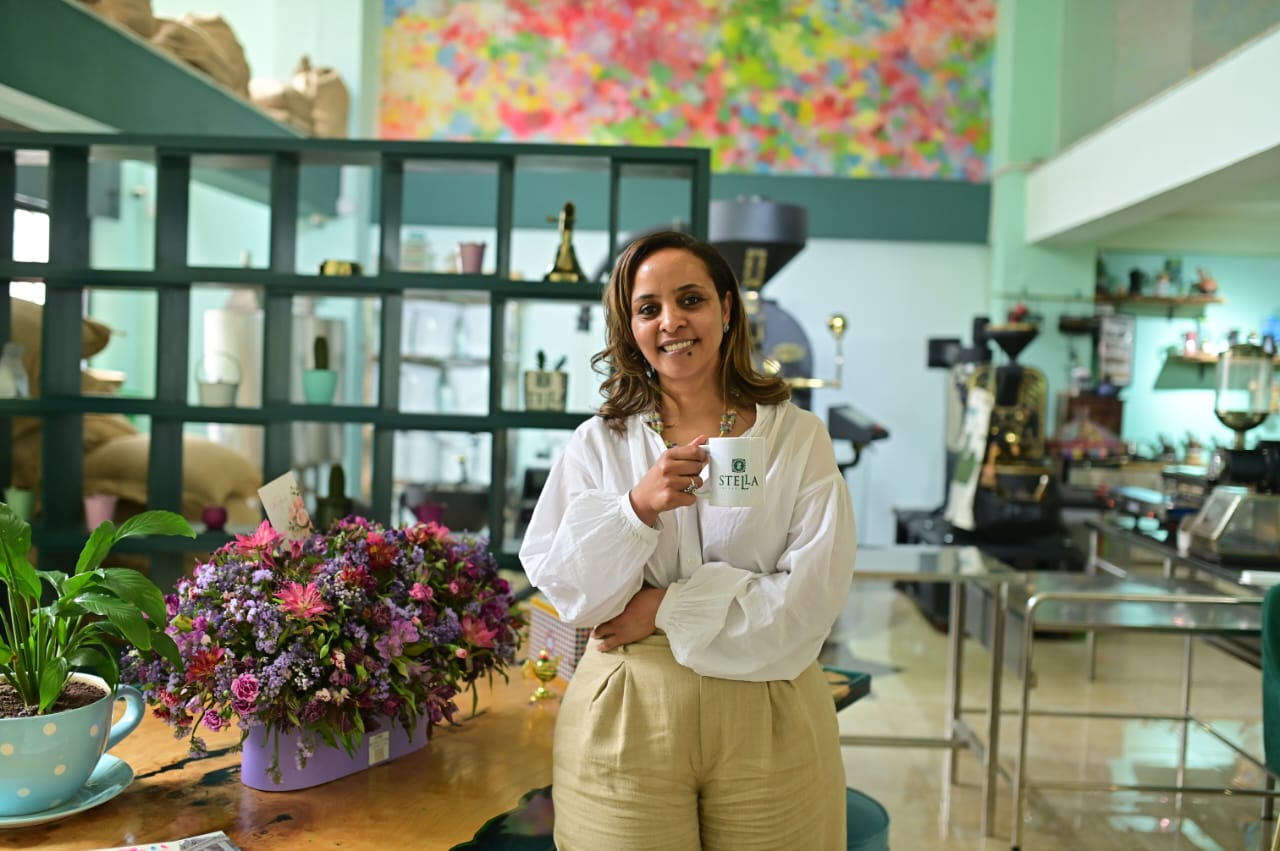
A few kilometers from Addis Ababa Bole International Airport, tucked quietly into the constantly moving neighborhood of Wollo Sefer, there is a coffee space that feels strangely detached from the city around it.

The transition begins almost immediately upon entering. Before the coffee arrives, before the brewing equipment catches your attention, there is scent — oud, deep and woody, the kind more commonly associated with Gulf hospitality and luxury hotels in Dubai or Jeddah than with cafés in Addis Ababa. For a brief moment, the city outside seems to dissolve.

Inside, Stella unfolds slowly. The space is spacious without feeling cold, elegant without becoming performative. Warm wood dominates the interior while plants and flowers soften nearly every corner. The furniture carries a classic sensibility — colorful, though never loud — and the seating feels intentionally cozy, designed less for quick turnover and more for lingering conversations. Nothing about the atmosphere feels accidental.

In specialty coffee language, places like this are increasingly called destination cafés: spaces people visit not simply to drink coffee, but to experience hospitality, ambiance, and ritual together. Stella belongs naturally in that category.

A Coffee Philosophy Rooted in Memory

At the center of it all is Stella herself, a mother of three whose relationship with coffee began long before she ever became a coffee drinker. Her father was a green coffee exporter and supplier, and some of her earliest memories were formed during school holidays spent with him in Yirgacheffe, one of Ethiopia’s most celebrated coffee-growing regions.

While many children return from vacations remembering games or family trips, Stella remembers coffee landscapes, processing stations, farmers, and long days observing people whose lives revolved around coffee. She learned quietly, simply by watching.

When she speaks about her father, her admiration is immediate and unmistakable. “He is my superstar,” she says with a smile.

Yet the roots of Stella’s coffee philosophy stretch back even further, to Asmara, where her grandmother’s coffee held an almost legendary status within the family. Stella remembers how devoted her father was to it. Despite spending his professional life around coffee, he drank only his mother’s preparation. Somewhere within those childhood observations, a deep impression formed. Coffee, Stella realized early, could carry emotion, reverence, and memory.

Interestingly, she did not begin drinking coffee seriously until much later in life. What fascinated her first was not the beverage itself, but everything surrounding it. As a child, she helped prepare ceremonial spaces around her grandmother’s coffee gatherings, learning instinctively that ambiance mattered as much as taste. The arrangement of the room, the rhythm of serving, the atmosphere of hospitality — all of it became inseparable from coffee itself.

A Coffee Passport Menu

Three years ago, those memories evolved into Stella. Calling it simply a café, however, feels insufficient. Boutique coffee house comes closer. Coffee atelier perhaps comes closer still. Because what Stella has created feels less like a conventional menu and more like a coffee passport.

Traditional Ethiopian jebena coffee shares space with Turkish coffee, V60 pour-overs, Japanese-style iced brews, Arabic qahwa, and brewing traditions from several other corners of the world. Yet the café’s defining quality is not variety alone. It is fidelity to ritual.

In many modern cafés, brewing tools have become visual symbols more than functional traditions. A V60 cone becomes decoration. A jebena becomes aesthetic identity. At Stella, however, the ritual itself remains intact. Order traditional jebena coffee and an individual jebena is prepared specifically for you rather than poured from a shared batch. Your coffee receives its own ceremony, its own pacing, its own attention.

The same philosophy extends across every brewing method on the menu. Turkish coffee is treated with its own distinct preparation. Japanese-style iced pour-overs are brewed with precision. Arabic qahwa receives the same careful attention Gulf guests expect back home.

During my visit, I ordered an iced V60 — a Japanese-style iced pour-over brewed directly over ice to preserve aromatic clarity and brightness. The preparation reflected the larger philosophy of the space itself: deliberate, patient, and deeply attentive to detail. Nothing felt rushed. Nothing felt industrialized.

A Living Roastery and Diverse Clientele

Inside the café, a functioning roastery further deepens the experience. Customers are not separated from coffee’s transformation. Roasting aromas drift naturally through the room while conversations continue nearby, allowing visitors to experience coffee not merely as a finished beverage, but as a living craft unfolding around them in real time.

That immersive atmosphere has attracted a remarkably diverse clientele ranging from diplomats and expatriates to high-profile Ethiopian figures and a growing number of visitors from Gulf countries. According to Stella, GCC guests often react most emotionally to the experience. Many tell her they briefly forget they are in Addis Ababa altogether. Instead, the atmosphere reminds them of Dubai, Jeddah, or other familiar spaces across the Gulf.

The reaction is hardly surprising. Stella speaks about Arabic coffee culture with something close to reverence. Not only the coffee itself, but the patience, hospitality, generosity, and ritual surrounding it. Her qahwa has become especially sought after, with Arab customers frequently purchasing her roasts in bulk after discovering the level of precision and authenticity she brings to the preparation.

Coffee Deserves a Better Emotional Environment

For Stella, coffee was never meant to become a hurried grab-and-go drink swallowed between appointments. She laughs while explaining one of her personal rules: she refuses to drink coffee when angry, emotionally unsettled, or exhausted. Most people use coffee to survive stressful days. Stella prefers water instead. Coffee, in her view, deserves a better emotional environment.

Spend enough time inside Stella and it becomes clear that this place was never built around caffeine alone. It was built around feeling. Around memory. Around slowing down.

Perhaps that is why the name feels unexpectedly perfect. Stella — “star” in Italian — suits the café in more ways than one. Because somewhere in Wollo Sefer, beneath the scent of oud and freshly roasted coffee, Stella has quietly created a guiding star of her own: a world of coffee traditions gathered together under one roof, where ritual still matters and hospitality still feels sacred.

Frequently Asked Questions

Where is Stella located?

Stella is located in the Wollo Sefer neighborhood of Addis Ababa, a few kilometers from Bole International Airport.

What makes Stella unique?

Stella offers a coffee passport menu with multiple brewing traditions including Ethiopian jebena, Turkish, V60, Japanese-style iced, and Arabic qahwa, each prepared with its own distinct ritual.

Who is Stella’s founder?

Stella is a mother of three whose father was a green coffee exporter and whose grandmother’s coffee ceremonies in Asmara deeply influenced her philosophy.

What is the signature coffee at Stella?

There is no single signature; the café is known for its variety and fidelity to ritual. Her Arabic qahwa has become especially popular with Gulf visitors.

Does Stella roast its own coffee?

Yes, the café includes a functioning roastery, allowing customers to experience coffee as a living craft.

What is Stella’s personal coffee rule?

She refuses to drink coffee when angry, emotionally unsettled, or exhausted, believing coffee deserves a better emotional environment.


Author: Tewodros Balcha | Source: Qahwa World – Addis Ababa | Date: May 22, 2026

Ethiopian Coffee Output Rises 4.7% in 2026

Author: Qahwa World – Addis Ababa

Source: USDA Foreign Agricultural Service – Report ET2026-0005
Date: May 20, 2026

Executive Summary

  • Ethiopian coffee production for marketing year 2026/2027 is forecast at 12.10 million 60 kg bags, up 4.7%.
  • Harvested area is forecast at 800,000 hectares, a 1.3% increase from the previous year.
  • Exports are forecast at 7.13 million bags, up 2.4%, supported by growing demand for Ethiopian Arabica.
  • China emerged as the third largest market in 2024/2025, with exports surging 264% to 670,000 bags.
  • Red cherry prices hit record highs of 220‑250 Birr per kg in Yirgacheffe, nearly four times the previous season.
  • About 5.9 million farmers are engaged in coffee production; smallholders account for 90% of national output.
  • The government allocated 100,000 hectares for private mechanized coffee farms to transform the sector.

The USDA Foreign Agricultural Service office in Addis Ababa forecasts Ethiopian coffee production for marketing year 2026/2027 at 12.10 million 60 kg bags, a 4.7% increase from the previous season. T

he growth is driven by improved yields under normal weather conditions. Harvested area is forecast at 800,000 hectares, up 1.3% from the estimated area for 2025/2026.

Exports are forecast at 7.13 million bags, supported by growing demand for Ethiopian Arabica beans. Marketing year 2025/2026 constitutes an exceptional period for Ethiopia’s coffee export sector, as record high fresh cherry prices and rising operating costs continue to place significant financial pressure on traders and exporters. China is rapidly emerging as one of the top coffee buyers, driven by its tariff free market access.

Production Gains Supported by Improved Yields and Area Expansion

The forecast assumes favorable weather conditions, particularly regular rainfall. In April 2026, farmers reported healthier flowering and more uniform cherry development across key producing regions. The southern regions are expected to experience a positive year after reporting a reduced harvest during the 2025/2026 season. The Ethiopian Coffee and Tea Authority reports that 5.9 million farmers are engaged in coffee production across the country. Smallholder farmers dominate Ethiopia’s coffee sector, accounting for 90% of total national production. These farmers typically cultivate coffee on small plots averaging less than half a hectare, often integrating coffee trees into mixed farming systems alongside food crops.

At the farm level, growing adoption of improved agronomic practices such as pruning and stumping of aging trees, along with increased use of recommended extension packages including composting and soil management techniques, is supporting productivity gains. Farmers are also becoming more aware of the benefits of stumping old coffee trees and intercropping. The gradual uptake of improved seedlings that are both higher yielding and more disease resistant is beginning to contribute to enhanced productivity.

Table 1: Ethiopia Coffee Production Estimate and Forecast

Marketing Year 2024/2025 (Estimate) 2025/2026 (Estimate) 2026/2027 (Forecast)
Area Harvested (hectares) 760,000 790,000 800,000
Production (million bags) 11.46 11.56 12.10
Yield (MT/ha) 0.90 0.90 0.91

National Stumping Campaign Boosts Yields

According to industry sources, nearly 70% of Ethiopia’s coffee trees are old, with some estimated to be more than 100 years old. Following the launch of a national stumping campaign four years ago, the Ethiopian Coffee and Tea Authority reports that stumped trees have already begun producing yields. Stumped trees cover 15% of the total coffee harvested area in 2025/2026. The Oromia region recorded the highest stumping rate at 19% of total harvested area, followed by South Ethiopia region at 14% and Sidama at 13%. Studies in Sidama and South Ethiopia regions have demonstrated that stumped coffee trees can increase yields by up to threefold within four years after stumping.

The Ethiopian Agricultural Research Institute reports that over 50 improved varieties offering higher yields and stronger disease resistance have been distributed to coffee growers across the country. These improved hybrid varieties yield around 2.8 tons per hectare under better management conditions, compared with current national average yields of less than 1.0 ton per hectare.

Ethiopia Pushes for Mechanized and Commercial Farms

The Government of Ethiopia is interested in large scale modern coffee production and has allocated 100,000 hectares of land for private sector coffee development. This marks the first time the government has allocated large tracts of land exclusively for modern coffee production. This represents a 70% increase compared to the country’s current 143,000 hectares of commercial coffee farms. Local officials describe the initiative as a strategic national project designed to transform Ethiopia’s coffee sector from its current reliance on traditional smallholder farming into a hybrid model that combines established practices with large scale technology driven production. Reports from May 2026 show that 110 private investors received new farmland for coffee cultivation. Planting has not yet begun, and authorities are urging investors to start developing the farmlands quickly.

Record Cherry Prices and Tightening Washed Coffee Supply

Farmers anticipated that the previous year’s record high coffee prices would maintain momentum, driving local cherry prices to unprecedented levels. At the start of 2025/2026, cherry prices tripled in some areas and quadrupled in others compared to the previous season. Several farmer cooperatives in Yirgacheffe district reported that red cherry prices peaked at 220‑250 Birr ($1.42‑$1.62) per kilogram in December 2025, nearly four times higher than the previous season. This sharp price hike, combined with rising production costs including labor expenses, created significant challenges for wet mills.

As a result, a notable shift in coffee processing practices occurred. Several farmers opted to process coffee at home rather than sell red cherries to washing stations, capturing higher returns by drying and selling natural coffee themselves. Simultaneously, wet mills became less inclined to purchase fresh cherries due to price increases and elevated working capital requirements. Farmers retaining cherries and wet mills reducing purchases significantly decreased the volume of red cherries reaching washing stations, leading to tighter availability of washed coffee during 2025/2026, alongside a growing share of natural processed coffee beans.

China Emerges as Third Largest Market

In 2024/2025, Ethiopia exported around 670,000 bags to China, generating more than $274 million in revenue. This positioned China as the third largest destination for Ethiopian coffee, a sharp rise from a decade ago when China ranked 17th with exports of approximately 22,000 bags. The pace of this growth highlights how quickly China has moved from a marginal buyer to a major player. Chinese imports have been driven by targeted trade promotion, improved market access, and strengthening commercial linkages. Since December 1, 2024, Ethiopian exports to China have enjoyed tariff free access, and China expanded its zero tariff policy to cover all tariff lines for products from 53 African countries effective May 1, 2026.

According to a USDA report, China’s domestic coffee market was estimated at approximately $42 billion in 2024, as coffee consumption rises rapidly among younger urban consumers. China’s coffee consumption reached 6.3 million bags by the end of 2024, but per capita consumption remains low at 22 cups annually, indicating substantial room for future expansion. Large chains such as Luckin Coffee (over 26,000 stores) and Cotti Coffee (around 15,000 outlets) continue to scale aggressively, shaping consumer habits and fueling demand for high quality beans.

Table 2: Top 10 Export Destinations for Ethiopian Coffee (MY 2024/2025)

Rank Country Volume (1,000 bags) Share
1 Saudi Arabia 1,182 15.9%
2 Germany 1,126 15.2%
3 China 670 9.0%
4 Belgium 651 8.8%
5 United States 614 8.3%
6 UAE 444 6.0%
7 South Korea 381 5.1%
8 Italy 259 3.5%
9 Russia 171 2.3%
10 Sudan 117 1.6%

Domestic Consumption Expands Despite High Prices

Domestic coffee consumption for 2026/2027 is forecast at 5.0 million bags. Post revised the 2025/2026 domestic consumption estimate upward from 3.70 million bags to 4.50 million bags, reflecting current market dynamics where falling global coffee prices are anticipated to redirect more supply domestically. Burgeoning demand in both rural and urban centers, as well as the increasingly emerging coffee culture among youth, is driving domestic consumption. Ethiopia ranks among the largest coffee consuming countries globally within the group of major producers. Per capita consumption is estimated at around 2.0 kilograms per year.

EUDR Compliance and Organic Certification Challenges

Ethiopia is making progress toward compliance with the EU Deforestation Regulation, which takes effect on December 30, 2026 for large businesses and June 30, 2027 for smaller enterprises. The Ethiopian Coffee and Tea Authority is working with international development partners and private sector stakeholders to operationalize a national traceability platform. Hundreds of thousands of smallholder plots have already been mapped and registered. However, challenges remain due to Ethiopia’s fragmented smallholder production system, limited digital infrastructure, and remoteness of many producing areas.

The EU’s updated organic regulation (Regulation 2018/848) became fully binding for non EU exporters on January 1, 2025, ending the previous equivalence system. The minimum annual on site inspection sampling rate has risen from approximately 2% to 5% of farmers, while at least 2% must now undergo residue sampling. The regulation also caps group certifications at roughly 2,000 smallholders and mandates annual audits for all certified operators. These stricter requirements are causing longer field inspection times, rising compliance costs, and increasing administrative burdens, making EU organic certification increasingly difficult for Ethiopian smallholder coffee farmers to maintain.

Frequently Asked Questions

How much coffee will Ethiopia produce in 2026/2027?

Production is forecast at 12.10 million 60 kg bags, a 4.7% increase from the previous year.

How many farmers are engaged in coffee production in Ethiopia?

About 5.9 million farmers, with smallholders accounting for 90% of national output.

What are the main export destinations for Ethiopian coffee?

Saudi Arabia and Germany are the largest with 15.9% and 15.2% shares, followed by China, Belgium, and the United States.

How much coffee did Ethiopia export to China in 2024/2025?

Around 670,000 bags worth $274 million, a 264% increase from the previous year, making China the third largest market.

Why are red cherry prices so high in 2025/2026?

Farmers anticipated continued momentum from record prices the previous year, driving local cherry prices to unprecedented levels, reaching 220‑250 Birr per kg in Yirgacheffe.

How is Ethiopia preparing for the EU Deforestation Regulation?

The Ethiopian Coffee and Tea Authority is developing a national traceability platform with international partners; hundreds of thousands of smallholder plots have already been mapped and registered.


Author: Qahwa World – Addis Ababa | Source: USDA Foreign Agricultural Service – Report ET2026-0005 | Date: May 20, 2026

Ethiopian Coffee Lifts Russia Trade to $435m in 2025 Surge

DUBAI – QAHWA WORLD

Trade between Russia and Ethiopia climbed to more than $435 million in 2025, nearly tripling from the previous year, reflecting a rapidly strengthening economic relationship anchored by commodities, agriculture, and expanding technology ties.

The figures were disclosed by Russia’s Ambassador to Ethiopia, Evgeny Terekhin, in comments to Russian state media. He attributed the growth to rising Russian exports of fertilisers, agricultural machinery, and energy equipment, alongside increased Ethiopian exports of coffee, flowers, and textiles.

Coffee has emerged as the standout driver of the trade surge. Ethiopian beans—particularly the Sidamo and Harar varieties—have seen growing demand among Russian consumers.

According to the ambassador, Ethiopia’s coffee exports to Russia rose from about $46 million in 2024 to an inflation-adjusted $123 million in 2025. Import volumes more than doubled over the same period, increasing from 8,300 tonnes to approximately 18,300 tonnes.

“Traditional export items are acting as growth drivers,” Terekhin said, pointing to sustained demand on both sides.

Beyond agricultural trade, cooperation is expanding into digital commerce. Ethiopian authorities have granted Russian online marketplaces a regulatory “green corridor,” easing market entry requirements. Wildberries and Russ—now operating under the merged entity RWB—are preparing to begin operations in Ethiopia after adapting their platforms to local market conditions.

“The entry of Russian tech companies into the Ethiopian market is no longer theoretical,” Terekhin said, noting that technical integration and product localisation are already underway.

The strengthening trade relationship also includes industrial ambitions. At a bilateral intergovernmental commission meeting in November 2025, Russian aluminium producer Rusal signed agreements with Ethiopian Investment Holdings to explore the construction of an aluminium plant in Ethiopia.

If realised, the project could deepen industrial cooperation and expand Russia’s footprint in East Africa, further broadening a partnership that is increasingly being shaped by coffee-led trade growth.

Ethiopian Women Lead Coffee Sustainability via Cascara

Addis Ababa – Qahwa World x Buna Kurs

As the AFCA conference continues, a focused side event at Creative Hub Ethiopia turned attention to an often-overlooked part of the coffee cherry: cascara. Sip, Savor, Sustain: Ethiopian Cascara Tasting brought together industry professionals, creatives, coffee producers, and coffee enthusiasts to explore how circular economy practices can create new opportunities—particularly for women in coffee.

The event was organized by the Center for Circular Economy in Coffee (C4CEC) in collaboration with Women in Coffee Ethiopia (WiCE) and Muna Mohammed, Founder and CEO of Eight50 Coffee in Canada, with support from the Italian Agency for Development Cooperation (AICS) and UNIDO, and in partnership with Ethiopia’s Ministry of Labor and Skills. Spanish Cooperation supported research on women in coffee and facilitated the participation of a woman coffee farmer to share firsthand experience from the field. The initiative builds on a research and pilot capacity-building program focused on coffee by-product valorization, implemented with women producers.

While cascara is gaining international attention, Ethiopian communities—especially women—have long brewed the dried coffee cherry as hashara tea, embedding sustainability into daily life long before it became a global concept.

During the event, cascara was served as tea, offering participants a sensory introduction to how coffee by-products can be transformed into market-ready products with export potential.

A key highlight of the evening was the emphasis on women’s participation in value addition across the coffee value chain. Women in Coffee Ethiopia (WiCE) emphasized that cascara represents a practical pathway for women producers to diversify income while reducing environmental waste from coffee processing.

The human impact of this approach was reflected in a presentation by a woman coffee producer representing a women-led cooperative from a major coffee-growing region of Ethiopia. Sharing her experience, she noted that cascara production and related training have improved household income, strengthened technical skills, and expanded economic opportunities for women in her community.

By turning what was once considered waste into a high-value product, cascara creates a second income stream that can directly benefit women-led cooperatives without requiring additional land or resources. At the same time, it supports environmental sustainability by reducing by-product disposal and promoting circular economy models within Ethiopia’s coffee sector.

The event drew a diverse audience of development partners, cooperatives, entrepreneurs, and industry representatives, reinforcing growing interest in inclusive, women-centered coffee innovations.

As Ethiopia continues to position itself as a global leader in specialty coffee, initiatives like Sip, Savor, Sustain demonstrate that the future of the sector lies not only in the bean, but in the full coffee fruit—and in empowering the women who have long been at the heart of its journey.

Gizat Worku Kebede: Ethiopia’s Harvest This Year is Excellent, and We Aim to Expand in the Middle East and Asia

Dubai – Ali Alzakary and Tewodros Balcha

Ethiopia, the birthplace of coffee, is once again taking the spotlight at the World of Coffee exhibition in Dubai, showcasing its unparalleled quality and diversity. With more than 10,000 coffee varieties, including rare wild coffee grown naturally in Ethiopia’s highlands, the country continues to set global standards for premium coffee.

From Dubai, Gizat Worku Kebede, Executive Director of the Ethiopian Coffee Association and Ethiopia’s chapter head in the African Coffee Association, highlighted the excellent current harvest and rising production levels, along with rapid expansion into markets in the Middle East and Far East. He emphasized Ethiopia’s mission to connect smallholder farmers with international buyers, support sustainability, and strengthen African coffee’s presence globally.

  • What is your mission and objective in participating in the World of Coffee Dubai exhibition?

Our mission in Dubai is to promote Ethiopian coffee to international markets, focusing on the Middle East and Far East. We aim to reach coffee lovers and buyers because Ethiopian coffee is naturally organic and unique. Ethiopia is the only country producing wild coffee—coffee that grows naturally in forests, cared for by no one, and harvested once a year by local farmers. With more than 10,000 coffee varieties, Ethiopia truly is the birthplace of coffee.

  • Could you share the latest updates on the current harvest season in Ethiopia?

We are here to showcase this year’s harvest, which is excellent. Total production has increased by around 1.2 million tons, and the new crop is already being exported. It’s a very positive year for Ethiopian coffee farmers and exporters.

  • Which markets are you currently targeting?

“The Middle East is a fast-growing market, particularly Saudi Arabia, which is Ethiopia’s largest coffee buyer. Dubai is also a key trade hub. We are expanding into emerging Far Eastern markets, including China, South Korea, and Japan, which have shown increasing interest in high-quality Ethiopian coffee.”

  • Can you tell us about the African Coffee Association and its role in supporting and developing the coffee sector?

“The African Coffee Association is the largest coffee association in Africa, representing East and Southern African countries. We also work with the African Coffee Union and the Coffee Development Agency to support West African nations. Together, we are preparing the largest coffee exhibition in Africa, scheduled in Addis Ababa from February 4–6, to promote African coffee both as a product and as a growing consumer market. Countries such as Morocco, Algeria, Egypt, South Africa, and Nigeria are consuming more coffee, and we encourage local consumption alongside exports.”

  • How do you support the coffee industry in Ethiopia?

Three years ago, we launched African Coffee Week in collaboration with the African Coffee Association, the African Coffee Union, and the Coffee Development Agency, dedicating a week entirely to celebrating coffee in Africa. At the same time, we run the Harvest Season competition for coffee quality, where winning farmers gain recognition and promotion for their coffee. These initiatives provide significant opportunities for African farmers, support sustainability, and help small-scale producers connect with coffee consumers worldwide.


View this post on Instagram


A post shared by Coffee Qahwa (@qahwaworld)

  • Key Quotes:

“Ethiopia is the only country producing wild coffee—coffee that grows naturally in forests and is harvested once a year by local farmers.”

“This year’s harvest is excellent, with total production increasing by around 1.2 million tons.”

“African Coffee Week and the Harvest Season competition give farmers recognition, support sustainability, and connect them with global coffee consumers.”

  • Conclusion:

Ethiopia continues to solidify its position as a global coffee powerhouse. Through initiatives such as African Coffee Week, the Harvest Season competition, and participation in international exhibitions like World of Coffee Dubai, Ethiopia not only showcases its premium coffee but also empowers smallholder farmers, promotes sustainability, and strengthens Africa’s presence in global markets. With its rich heritage, unique coffee varieties, and ongoing international expansion, Ethiopia remains at the forefront of innovation and excellence in the coffee world.


Ethiopia and China Strengthen Coffee Sector Cooperation

Addis Ababa – Qahwa World

Ethiopia is strengthening its coffee sector by expanding value-added exports and deepening strategic cooperation with China, particularly in agriculture and coffee, according to senior government officials.

Ethiopia and China are elevating their agricultural cooperation beyond trade into a strategic partnership, with coffee emerging as a central pillar of collaboration. China has rapidly become one of the top destinations for Ethiopian coffee, rising from 33rd to 4th place among export markets within the past five years.

A trade and economic cooperation forum aimed at promoting Ethiopian coffee in the Chinese and global markets was recently held in Jujiao City, China. The forum brought together government officials, buyers, and private-sector stakeholders and resulted in new market linkage agreements.

Officials said the strengthening of cooperation is driven by several factors, including China’s expanding role as a coffee destination, duty-free tariff privileges for African exports, technology and knowledge transfer, growing e-commerce linkages, and Hunan Province’s position as a key trade hub.

State Minister of Agriculture Dr. Efrem Mulleta said Ethiopia is implementing wide-ranging reforms to make its agricultural products competitive in international markets. These reforms focus on increasing production quality and quantity through modern technologies, innovation, and improved agricultural inputs.

He added that the conference in China is part of broader efforts to boost export earnings not only from coffee but also from livestock products, fisheries, and other agricultural outputs.

Ethiopian Coffee and Tea Authority Director General Dr. Adugna Debela said Ethiopia’s strong focus on coffee productivity, quality, and value addition has brought significant improvements in export performance.

In the last fiscal year alone, Ethiopia exported 470,000 tons of coffee, generating USD 2.6 billion in revenue. To further enhance earnings, the country is prioritizing the export of value-added coffee rather than raw beans.

Dr. Adugna noted that a 15-year coffee sector strategy has been developed and implemented to address structural challenges, improve productivity, and expand market access. Old, low-yield coffee trees have been replaced, while millions of new seedlings have been planted under the Green Legacy Initiative.

He emphasized that quality is critical for global competitiveness and said strict monitoring systems are in place to ensure high standards. Policy reforms have also streamlined the coffee marketing system, reduced losses, and minimized quality deterioration.

A newly approved directive now allows domestically roasted and ground coffee to be sold in foreign currency, creating new opportunities for exporters. As a result, several Ethiopian coffee companies have begun selling value-added products through Ethiopian Airlines, major hotels, and tourist destinations.

Dr. Adugna added that Ethiopian specialty coffee is gaining popularity among Chinese consumers, driven by rising demand and China’s duty-free market access for African countries.

State Minister of Government Communication Services Tesfahun Gobezay said China’s large population and rapidly growing coffee consumption make it a reliable and expanding market for Ethiopian coffee.

He also noted that the recent forum introduced Ethiopian coffee culture—from production to consumption—to Chinese audiences and opened a new chapter for expanding bilateral coffee trade and cooperation.

Officials stressed that Ethiopia’s combined focus on value addition, quality improvement, and strategic partnerships—particularly with China—is expected to further strengthen foreign exchange earnings and create sustainable growth in the coffee sector.

COT 2 Returns with Leading Coffee Professionals

Kerchanshe Leads a Deep Dive into Ethiopia’s Coffee Cradle

Addis Ababa – Qahwa World

The Coffee Origins Trip (COT), the high-impact expedition that redefined origin transparency, is set to return for its second edition from December 7–12.

Hosted by the Kerchanshe Group —Ethiopia’s largest coffee exporter and a revolutionary force in value chain modernization—this year’s journey is positioned as a critical field study into the future resilience of Arabica coffee.

The six-day immersion is specifically designed for international buyers, roasters, and researchers tasked with navigating the global specialty sector’s most pressing challenges: climate volatility, increasing traceability demands, and sustaining genetic diversity. The expedition will move across the famed highlands of Arsi, Bale, West Arsi, Sidama, Guji, and Gedeo —terroirs that are the literal birthplace of the Coffea arabica species.

The Research Mission: From Forest Genetics to Global Cup

Unlike typical origin trips, the COT agenda is built around an intensive research and development framework. The first days will focus on ecological vulnerability and resilience, with participants engaging with forest experts in the Arsi and Bale highlands—areas essential to understanding Arabica’s ancestral ecology and the genetic resources needed to combat climate change.

Israel Degefa, Kerchanshe Group CEO and the mastermind behind the trip commented: “The goal is to connect the sensory experience in the cup directly to the environmental reality on the ground. This is about moving beyond transaction; it’s about co-investing in the stability of our most precious commodity.”

The itinerary then pivots to innovation, with on-site access to best-practice operations, offered by the host, including the modern processing standards at Worka and Debeka farms. A dedicated cupping session at a state-of-the-art coffee lab in Bule Hora will feature unreleased micro-lots and experimental processing profiles, giving buyers an early glimpse into Ethiopia’s evolving flavor portfolio ahead of the 2025 shipping cycle.

Traceability, Transparency, and Cultural Value

A major focus of COT is demonstrating the feasibility of end-to-end traceability in Ethiopia’s complex smallholder system. Walkthroughs of the Tore Washing Stations will showcase the latest advancements in drying systems and export preparation protocols, addressing the critical industry need for verifiable, farm-level transparency.

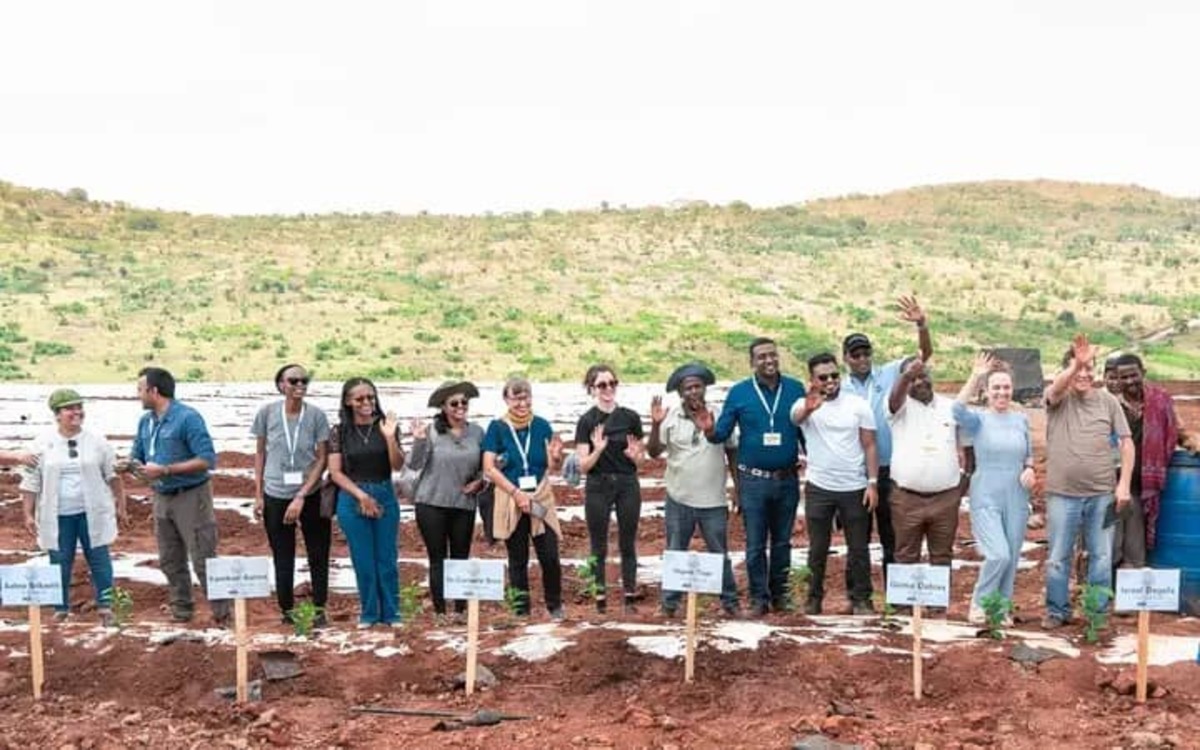
Crucially, the cultural component—highlighted by the traditional Buna Qalaa ceremony—is integrated to emphasize that cultural heritage is a non-negotiable value add for Ethiopia’s coffee. By weaving in community dialogue and storytelling, the host organization underscores that sustainability must encompass the social and historical narrative of the land and its people.

COT’s final session in Addis Ababa on December 12 is expected to transition into a closed-door discussion on potential collaborations, setting the tone for how international partners and the host organization, which supports millions of farmer livelihoods, can co-design a more resilient and rewarding specialty coffee supply chain.