USDA Report: Record World Coffee Production in 2026/27

Source: USDA Foreign Agricultural Service (FAS) – Coffee: World Markets and Trade
Author: Qahwa World
Date: July 23, 2026This article covers important findings from the world coffee market report 2026.

USDA Report: Record World Coffee Production in 2026/27

  • World coffee production forecast at a record 189.7 million bags in 2026/27, up 10.8 million from the previous year.
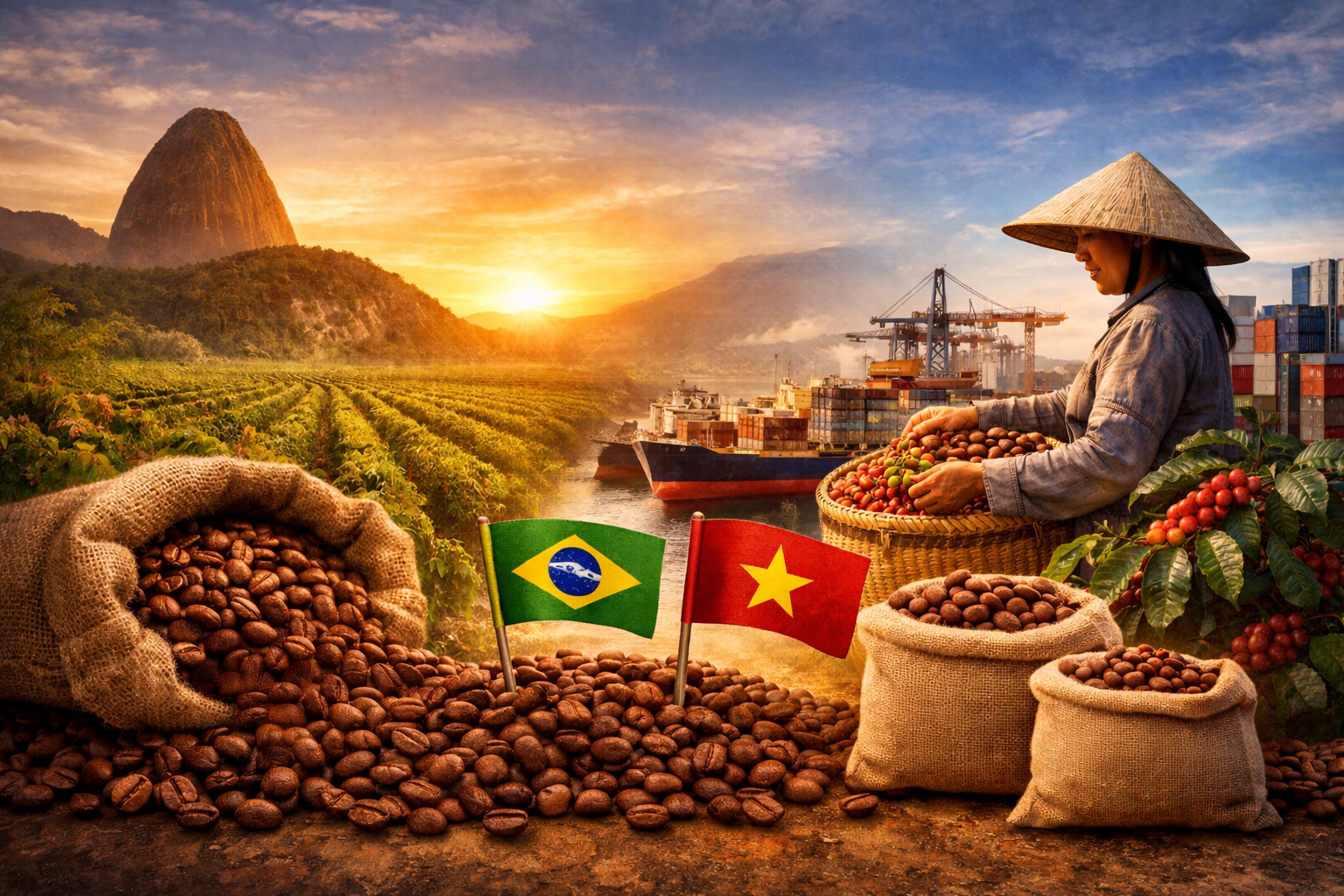
  • Brazil leads the surge with a record 71.9 million bags, driven by a 9.5 million bag Arabica rebound.
  • Global consumption rises to a record 179.7 million bags, with the European Union and United States leading gains.
  • World bean exports forecast at a record 131.4 million bags, up 11.9 million from 2025/26.
  • Ending stocks rise for a second consecutive year to 26.3 million bags.
  • Coffee prices have fallen 25% over the last seven months as additional supplies become available.
  • Vietnam, Colombia, Ethiopia, and Uganda all post production increases, while Indonesia declines.

The USDA Foreign Agricultural Service released its latest Coffee: World Markets and Trade report. Global coffee production for 2026/27 is forecast at a record 189.7 million bags. This represents an increase of 10.8 million bags from the previous year.

Record output in Brazil, Ethiopia, Uganda, and Vietnam drives this growth. These gains more than compensate for losses in India and Indonesia. World coffee bean exports are expected to reach a record 131.4 million bags. Global consumption is forecast to rise to a record 179.7 million bags.

World Production at Record High

World coffee production for 2026/27 is forecast 10.8 million bags higher than the previous year. Production is expected to reach a record 189.7 million bags. Brazil accounts for the largest share with a record 71.9 million bags. The rebound in Arabica production is particularly notable after five years of underperformance.

World Coffee Production 2026/27 (Million 60-kg Bags)
Category 2025/26 2026/27 Forecast Change
Total Production 178.8 189.7 +10.8
Arabica Production 94.4 105.9 +11.4
Robusta Production 84.4 83.8 -0.6

Brazil: Record Production and Arabica Rebound

Brazil’s combined Arabica and Robusta harvest is forecast at a record 71.9 million bags in 2026/27. This represents an increase of 8.9 million bags from the previous year. Arabica output is expected to rebound 9.5 million bags to 47.5 million, ending a five-year period of underperformance due to adverse weather conditions.

Timely rainfall during flowering in September and October ensured favorable fruit development. Near-record yields were achieved in Minas Gerais, where over 70% of Arabica coffee is grown. Robusta production is forecast to retreat 600,000 bags to 24.4 million following last year’s record harvest. Cooler temperatures combined with elevated rainfall lowered yields in Espirito Santo, where approximately 70% of Robusta is grown.

Brazil accounts for nearly 40% of world production and exerts significant influence on global supplies and prices. Brazil’s role in Arabica markets is even more pronounced, typically supplying between 40% and 50% depending on the biennial crop production cycle.

Brazil Coffee Production Outlook 2026/27
Category 2025/26 2026/27 Forecast Change
Arabica Production 38.0 million bags 47.5 million bags +9.5 million
Robusta Production 25.0 million bags 24.4 million bags -0.6 million
Total Production 63.0 million bags 71.9 million bags +8.9 million
Bean Exports 34.0 million bags 45.0 million bags +11.0 million
Ending Stocks 3.9 million bags 4.4 million bags +0.5 million

Global Consumption and Trade

World coffee bean exports are forecast 11.9 million bags higher to a record 131.4 million bags. This is driven by higher output in major producing countries. Global consumption is expected to rise to a record 179.7 million bags. The largest gains are occurring in the European Union and the United States.

Ending stocks are expected to rise for a second consecutive year to 26.3 million bags. This follows a significant drawdown between 2020/21 and 2024/25, when global ending stocks fell 15.5 million bags. While stocks are recovering, they remain below the long-term average.

World Coffee Summary 2026/27 (Million 60-kg Bags)
Category 2025/26 2026/27 Forecast Change
World Production 178.8 189.7 +10.8
World Bean Exports 119.5 131.4 +11.9
World Consumption 173.5 179.7 +6.3
Ending Stocks 24.4 26.3 +1.9

Country-by-Country Production Highlights

Vietnam production is forecast to increase 800,000 bags to a record 32.5 million. Expanding area and higher yields drive this growth. Recent high prices allowed growers to increase expenditures on fertilizers. Bean exports are forecast up 300,000 bags to 25.4 million. Domestic consumption is expected to reach a record 5.0 million bags.

Colombia output is expected to rise 900,000 bags to 13.4 million. Adequate soil moisture from last year’s excessive rains supports this growth. Increased utilization of fertilizers and pesticides also contributes. Bean exports, mostly to the United States and European Union, are forecast up 500,000 bags to 12.2 million.

Ethiopia is forecast to increase output by more than 500,000 bags to a record 12.1 million. Higher area and yield drive this growth. Over the last four years, growth has been driven by replacement of over half of the cultivated area with higher-yielding varieties. Bean exports are forecast up nearly 200,000 bags to 7.1 million.

Central America and Mexico production is forecast to rise nearly 600,000 bags to 17.7 million. Rebounding output in Costa Rica, Guatemala, Honduras, Mexico, and Panama contribute to this growth. Honduras is expected to account for nearly all the region’s growth, rebounding 500,000 bags to 6.0 million.

Indonesia production is forecast to drop 1.0 million bags to 11.4 million. Robusta output is expected to decrease 1.0 million bags to 10.0 million due to lower yields. Excessive rainfall disrupted flowering and cherry formation in Southern Sumatra and Java. Reduced output is expected to cut bean exports by over 800,000 bags to 7.0 million.

Key Country Production 2026/27 (Million 60-kg Bags)
Country 2025/26 2026/27 Forecast Change
Brazil 63.0 71.9 +8.9
Vietnam 31.7 32.5 +0.8
Colombia 12.5 13.4 +0.9
Ethiopia 11.6 12.1 +0.5
Indonesia 12.4 11.4 -1.0
Honduras 5.5 6.0 +0.5
Uganda 7.1 7.2 +0.1

Price Impact of Rising Supplies

Coffee prices have dropped 25% over the last seven months as additional supplies became available. This is measured by the International Coffee Organization monthly composite price index. The improving supply situation reflects record production and rising ending stocks.

However, ending stocks remain below the long-term average. Weather developments in key producing regions, particularly Minas Gerais in Brazil, remain the primary indicator for world market conditions. The biennial production cycle in Brazil continues to shape global supply and price expectations.

Revisions to 2025/26 Estimates

World production is unchanged from the December 2025 estimate of 178.8 million bags. Vietnam is raised 900,000 bags to 31.7 million on higher yields. Peru is up nearly 600,000 bags to 4.8 million. Colombia is lowered 1.3 million bags to 12.5 million due to excessive rain and cloud cover. Guatemala is reduced nearly 400,000 bags to 3.2 million due to coffee cherry borer and coffee rust.

World bean exports are revised down 4.3 million bags to 119.5 million. Brazil is lowered 3.0 million bags to 34.0 million due to lower shipments to the EU and United States. Ethiopia is reduced over 800,000 bags to 6.9 million on higher-than-anticipated domestic consumption. Vietnam is up 500,000 bags to 25.1 million on higher output.

Key Takeaways for the Coffee Industry

Record global production is expected to boost supplies significantly. Brazil’s Arabica rebound after five years of underperformance is particularly notable. This could help replenish global inventories that were drawn down in previous years.

Ending stocks are forecast to rise for a second consecutive year. However, they remain below the long-term average. Weather developments in Minas Gerais remain the primary indicator for world market conditions. Coffee prices have fallen 25% in seven months, reflecting improved supply. Producers and traders should monitor Brazil’s production cycle closely, as it heavily influences global market conditions.

Frequently Asked Questions

What is the forecast for global coffee production in 2026/27?World production is forecast at a record 189.7 million bags, up 10.8 million from the previous year.

What is Brazil’s production forecast?Brazil is forecast at a record 71.9 million bags, driven by a 9.5 million bag Arabica rebound.

What is the global consumption forecast?Global consumption is expected to rise to a record 179.7 million bags, with the largest gains in the EU and US.

What are ending stocks expected to be?Ending stocks are expected to rise for a second consecutive year to 26.3 million bags.

How have coffee prices responded to increased supply?Coffee prices have dropped 25% over the last seven months as additional supplies became available.

Which countries are driving production growth?Brazil, Vietnam, Colombia, Ethiopia, and Uganda are all posting production increases, while Indonesia declines.

Colombian Coffee Output Rises 7.2% in 2026

Author: Qahwa World – Bogota

Source: USDA Foreign Agricultural Service – Report CO2026-0008
Date: May 20, 2026

Colombia Coffee Output Rises 7.2% in 2026

Executive Summary

  • Colombian coffee production for marketing year 2026/2027 is forecast to rise 7.2% to 13.4 million 60 kg bags.
  • The increase is driven by favorable dry conditions and the transition from La Niña to a strong El Niño, as coffee plants tolerate water stress well.
  • Lower coffee prices encourage replanting and renovation, supporting future growth.
  • Exports are forecast at 13.4 million bags, with the United States remaining the top destination with over 40% market share.
  • Domestic consumption remains stable at 2.2 million bags despite promotional campaigns and a new law declaring coffee the national beverage.
  • Ending stocks fall 22.6% to 670,000 bags due to higher exports and lower imports.
  • Nearly 90% of Colombian coffee shipments already comply with the EU Deforestation Regulation (EUDR).

The USDA Foreign Agricultural Service office in Bogota forecasts Colombian coffee production for marketing year 2026/2027 to reach 13.4 million 60 kg bags, an increase of 7.2% from the previous year. This growth is mainly attributed to favorable dry conditions after years of heavy rainfall.

Colombia is transitioning from La Niña, which caused excessive precipitation, to a strong El Niño expected after mid 2026.

Despite concerns about El Niño affecting crops, coffee plants tolerate water stress and high temperatures, especially when grown in soils with good moisture retention. Historically, coffee production performs better during El Niño events than during La Niña. To achieve this production level, the Colombian Coffee Growers Federation (Fedecafe) recommended proper fertilization, weed management to conserve soil moisture, efficient harvesting, and establishing temporary shade cover using appropriate plant species.

Production Drop in 2025/2026 Due to Heavy Rains

For marketing year 2025/2026, USDA estimates a 9.4% decline in production to 12.5 million bags compared to the previous estimate. This drop is due to excessive rainfall in coffee growing regions, which negatively affected flowering and bean development. Continuous rainfall prevents the water deficit necessary for flower induction, causes premature flower fall, and increases the incidence of coffee leaf rust due to high humidity.

The phytosanitary survey conducted by Cenicafe in January 2026 showed that the national average incidence of coffee leaf rust reached 4.5%, up from 3.9% in October 2025, but it remains within phytosanitary control levels. Coffee berry borer infestation reached 1.6% nationally, below the economic damage threshold of 2%. Notably, 87% of Colombia’s coffee area is planted with rust resistant varieties, up from only 35% in 2010.

Lower Prices Encourage Farm Renovation

Local coffee prices depend on the New York international price and the Colombian peso to US dollar exchange rate. Since late 2025, prices have decreased due to global optimism about coffee production and a lower exchange rate. As of February 2026, coffee prices stood at 2,174,143 Colombian pesos per 125 kg bag, 30% lower than the same period a year earlier.

Labor costs account for about 70% of coffee production expenses. These costs have risen due to a minimum wage increase of more than 20%, plus higher fertilizer costs resulting from the Middle East conflict. The sector also suffers from labor shortages as workers move to urban areas for more profitable employment.

However, lower prices create a strategic window for farm renovation. When prices are high, producers maximize harvest from existing trees. When prices fall, the opportunity cost of renovation declines, and long term returns from rejuvenated trees become more attractive.

Exports, Imports and Stocks

USDA forecasts exports for 2026/2027 at 13.4 million bags, an increase of 4.6% from the previous year. Colombia exports coffee to more than 40 countries. The United States remains the top destination with over 40% market share, followed by the European Union, Canada, and Japan. From October 2025 to February 2026, exports to the United States, Japan, and South Korea increased more than 6% year on year.

In contrast, imports for 2026/2027 are forecast to fall 18% to 2.0 million bags as domestic production recovers. For 2025/2026, imports were estimated at 2.4 million bags due to lower domestic production and higher demand for lower quality coffee from Brazil, Peru, and Ecuador to fulfill soluble coffee export commitments. Colombia mainly imports green coffee (84.1%), followed by soluble coffee (15.7%), and roasted coffee (0.2%).

Ending stocks are forecast to fall 22.6% to 670,000 bags in 2026/2027, due to higher exports and lower imports despite improved production.

Table 1: Colombia Coffee Production, Supply and Distribution (1,000 60 kg bags)

Item 2024/2025 Official 2025/2026 Estimate 2026/2027 Forecast
Total Production 14,800 12,500 13,400
Total Imports 980 2,404 2,004
Total Exports 13,380 12,810 13,400
Domestic Consumption 2,150 2,200 2,200
Ending Stocks 918 866 670

Domestic Consumption and Government Policies

Domestic coffee consumption is forecast to remain stable at 2.2 million bags in 2026/2027. Despite expected moderate improvements in economic activity, high inflation (6.3% in 2026) and high coffee prices limit growth. Per capita coffee consumption in Colombia is about 3.08 kg per year, which is relatively low compared to more than 6 kg in most producing countries.

Fedecafe continues to promote domestic consumption through its campaign “Look for the Colombian Coffee Quality Triangle”. The triangular “Cafe de Colombia” logo guarantees 100% Colombian origin coffee, and about 850 brands use it. The government also enacted Law 2504 of 2025, which declares coffee the national beverage, promotes its consumption, and allows public entities to purchase national coffee and include it in food programs.

In April 2024, the Coffee Price Stabilization Fund Committee established the Coffee Income Compensation Mechanism (MECIC 2024). This mechanism provides direct financial support to growers when the rolling average domestic price falls below the average production cost. It has not been activated yet because prices have remained above the reference cost.

EU Deforestation Regulation Compliance

Colombian coffee producers are actively implementing traceability measures to comply with the European Union Deforestation Regulation (EUDR) 2023/1115. Colombia exports more than 20% of its coffee production to the EU. The compliance deadline is December 30, 2025 for medium and large companies, and June 30, 2026 for micro and small enterprises.

According to Fedecafe, nearly 90% of Colombian coffee lots already comply with the EU regulation. The federation has trained producers on the new legal requirements and created a geospatial platform that allows users to map their farm coordinates.

Frequently Asked Questions

How much coffee will Colombia produce in 2026/2027?

Production is forecast to reach 13.4 million 60 kg bags, an increase of 7.2% from the previous year.

Why did production drop in 2025/2026?

Production fell 9.4% to 12.5 million bags due to excessive rainfall that affected flowering and bean development.

How does El Niño affect Colombian coffee production?

Historically, coffee production performs better during El Niño because coffee plants tolerate water stress well, especially in soils with good moisture retention.

What are the main export destinations for Colombian coffee?

The United States is the top destination with over 40% market share, followed by the European Union, Canada, and Japan.

What percentage of Colombian coffee complies with the EUDR?

Nearly 90% of Colombian coffee lots already comply with the EU Deforestation Regulation.

How do lower coffee prices affect farmer decisions?

Lower prices reduce the opportunity cost of renovation, encouraging farmers to replant old trees for higher long term productivity.


Author: Qahwa World – Bogota | Source: USDA Foreign Agricultural Service – Report CO2026-0008 | Date: May 20, 2026

Colombia Mitaca Harvest: Quality Up, Volume Slightly Down

BOGOTÁ – Qahwa World

According to an update published today on the Sucafina website, Colombia’s mid-year Mitaca (fly crop) harvest is showing strong quality expectations despite a forecasted volume decline of roughly 4.5% compared to last year’s Mitaca. There is considerable industry interest in the Colombia Mitaca harvest 2026 due to these changes in projected volumes and expected quality.

The report, based on field observations from Oscar Fernando Hurtado, Global Head of Production Research, and Sara Ocampo, Sustainability Manager for CAMP & Colombia, indicates that harvesting began in mid-April following normal seasonal patterns. Interestingly, the Colombia 2026 Mitaca harvest will have its peak at lower-altitude farms between May and June, while higher zones follow in June and July. The harvest is expected to wrap up by mid-September.

Quality a Bright Spot

Favorable weather through Q1 2026 supported even cherry development, and coffee borer attacks remain below average. As for the Colombia Mitaca harvest in 2026, improved fertilization practices and farmer investments have also contributed to healthier field conditions. The main constraint is volume, as off‑cycle conditions and a wetter‑than‑usual main flowering period reduced production expectations.

Sustainability Progress

Sucafina also reported that two new Huila-based suppliers – Comercializadora de Café D&Y Coffee and Comercializadora de Café Mora – will begin IMPACT verification in July. Currently, 20,266 farmers across Colombia hold active IMPACT Verification. This process is slated to align closely with best environmental practices during the Mitaca harvest season in 2026.

On deforestation, 36,268 farm polygons have been submitted for assessment, supporting EUDR compliance. Initial carbon footprint measurements across transport, milling, and warehousing have been completed, and pilots on biochar production with partner Cotierra are in early stages. Notably, these initiatives support sustainability throughout the Colombia Mitaca harvest of 2026.

  • Related stories :

Historic Colombian Coffee Harvests Face Labour Shortages

Colombia Records Its Best Coffee Harvest in Over 30 Years

Top Coffee Producers 2026

Dubai Qahwa World

As of April 2026, the global coffee market is undergoing a pivotal shift. Data from the International Coffee Organization (ICO) and the USDA show that the 2025/26 coffee year (October 2025–September 2026) has delivered record global supply, easing the extreme price pressures seen in 2024 and early 2025. World production is forecast at 178.8 million 60-kg bags (up 2% or +3.5 million bags year-on-year), while consumption reaches a record 173.9 million bags (+1.3%). Ending stocks remain tight at approximately 20.1 million bags, marking the fifth consecutive decline. Nevertheless, improved supply has caused ICO Composite Indicator Prices to drop sharply in early 2026 (February average: 267.57 US cents/lb, -9.9% month-on-month).

This supply surplus is driven by strong recoveries in Vietnam and Indonesia, record Ethiopian output, and steady performance in Brazil, despite drought impacts on key Arabica regions. National updates, including Brazil’s Conab first survey in February 2026, indicate an even stronger 2026 harvest, which could push global supply higher for 2026/27.

Top 10 Coffee-Producing Countries (2025/26 Forecast)

Data primarily from USDA December 2025 report, cross-verified with national sources and market analyses. Figures are green coffee equivalents. Percentages approximate global share.

Rank Country Production (M bags) % Global Main Variety YoY Change Key Notes
1 Brazil 63.0 ~35% Arabica (60%), Robusta/Conilon (40%) -2.0M (drought offset by Robusta gains) Record Robusta; Arabica hit by weather
2 Vietnam 30.8 ~17% Robusta (~95%) Recovery (+ higher yields) Fertilizer investment boosted output
3 Colombia 13.8 ~8% Arabica (100%, washed) -1.0M (excess rain/rust risk) Disease-resistant varieties helped
4 Indonesia ~12.5 ~7% Robusta (dominant) +1.7M (Robusta) Smallholder-dominated; favorable weather
5 Ethiopia 11.6 ~6.5% Arabica (specialty) Record (+0.5M) New varieties and pruning
6 Uganda ~6.9 ~3.9% Robusta Steady growth African Robusta leader
7 Honduras ~5.5–6.0 ~3% Arabica Part of Central America rebound Strong regional contributor
8 India ~5–6 ~3% Robusta (65%), Arabica (35%) Stable Specialty and organic focus
9 Peru ~4.2–5 ~2.5% Arabica (specialty/organic) Steady Premium export growth
10 Mexico / Guatemala ~3.8 each ~2% each Arabica Modest Central America/Mexico rebound

Total top 5: ~131.7M bags (~74% of world production). Latin America dominates Arabica; Asia leads Robusta.

Country Profiles: Drivers, Challenges, and 2026 Outlook

Brazil – World Leader (~35% of Global Supply)

Brazil remains the top producer. The 2025/26 crop saw Arabica decline to ~38M bags due to drought and high temperatures in Minas Gerais and São Paulo. Robusta surged to a record ~25M bags in Espírito Santo and Bahia thanks to better rainfall. Exports are forecast at ~37M bags.

  • Trends: Biennial cycle plus large-scale production with technology and irrigation. Funcafé funding supports the sector.
  • Challenges: Climate volatility, water stress, and EU Deforestation Regulation (EUDR) compliance.
  • 2026 Outlook: Conab’s February 2026 survey projects a record 66.2M bags (+17.1% YoY): Arabica +23.3% to 44.1M, Robusta +6.4% to 22.1M. This would surpass the 2020/21 record harvest.

Vietnam – Robusta Powerhouse

Nearly all output is Robusta, used in instant coffee and blends. Production rebounded due to favorable weather and higher input spending. Exports projected at 24.6M bags (+2.3M).

  • Trends: Export-oriented, rapid post-1990s expansion.
  • Challenges: Climate vulnerability in highlands; past dry spells.
  • 2026 Outlook: Continued recovery expected; early 2026 data shows strong export growth.

Colombia – Premium Arabica Specialist

100% washed Arabica. 2025/26 saw a modest decline due to excessive rains and cloud cover affecting flowering and rust risk. Disease-resistant varieties, such as Castillo, mitigated losses. Exports ~11.5M bags.

  • Trends: Focus on quality; yield improvements ongoing.
  • Challenges: Weather cycles, labor costs, altitude sensitivity.
  • 2026 Outlook: Rebound likely under normal conditions; key supplier to specialty markets.

Indonesia – Diverse Robusta and Specialty

Robusta dominates Sumatra and Java; small Arabica areas in the north. Production rose due to favorable weather and labor availability. Smallholder plots average 1 ha. Exports: green coffee +1.7M to 7.8M bags.

  • Trends: Stable land area (~1.2M ha), significant soluble coffee exports.
  • Challenges: Minimal fertilizer use, climate extremes.
  • 2026 Outlook: Stable supply to EU, US, and emerging markets expected.

Ethiopia – Africa’s Specialty Arabica Leader

Record 11.6M bags driven by adoption of higher-yielding varieties and pruning. Exports ~7.8M bags.

  • Trends: Natural and semi-washed processing; heirloom varieties remain globally sought.
  • Challenges: Smallholder fragmentation, highland climate variability, infrastructure limits.
  • 2026 Outlook: Growth likely if variety upgrades continue; specialty segment driver.

Emerging/Other Notable Producers

Uganda, Honduras, India, Peru, Mexico, and Guatemala produce the remaining ~25%. They are critical for Robusta (Uganda) and specialty/organic Arabica (Peru, India, Honduras). Central America/Mexico region rebounded +1.1M bags. India emphasizes premium niches (Monsoon Malabar, organic). All face smallholder and climate challenges but benefit from growing specialty demand.

Broader Trends Shaping 2026 and Beyond

  • Climate Change & Resilience: Droughts and excessive rains highlight vulnerability. By 2050, suitable coffee land may shrink significantly without adaptation.
  • Sustainability & Regulation: EUDR deadlines pressure exporters on traceability. Certifications (Fairtrade, organic, Rainforest Alliance) are growing, especially in Ethiopia, Colombia, and Peru.
  • Market Dynamics: High prices in 2024–25 spurred investment and supply recovery. Robusta exports surged in early 2025/26. Specialty demand remains robust.
  • Economic Impact: Coffee supports ~12.5 million farming households. Brazil and Vietnam dominate exports. Smallholders remain most vulnerable to volatility.
  • 2026/27 Outlook: Early forecasts indicate potential production above 180M bags if Brazil’s record harvest occurs and recoveries hold. Emerging markets will continue driving consumption growth.

Summary

2026 marks a transition from shortage-driven high prices to a more balanced, though still tight-stocks, market. Brazil’s dominance is set to strengthen, while Vietnam, Indonesia, and Ethiopia solidify their positions in Robusta and specialty segments. Long-term success depends on climate adaptation, sustainability, and innovation in varieties and processing. Opportunities abound in premium positioning and supply-chain resilience amid record availability.

This report draws on official forecasts as of early 2026. Data may be refined with subsequent national surveys, including Conab updates. Customized analysis, including by variety, export flows, or price scenarios, can be provided upon request.


Coffee Markets Rise Amid Middle East Shipping Disruptions

Dubai – Qahwa World

Global coffee markets moved higher last week as escalating tensions in the Middle East disrupted key shipping routes and increased freight costs, while supply developments in major producing countries also influenced market sentiment.

Arabica coffee futures began the week at 279.90 US cents per pound and briefly approached the 290-cent level before easing slightly. The market maintained upward momentum through the week, posting marginally higher closes on Wednesday and Thursday. By Friday, prices opened 5.45 cents per pound higher than the previous day’s close, supported in part by reports that Brazil’s coffee exports fell 17.4% year-on-year in February.

You may like:Shock in the Coffee Market: Colombia’s Production Drops 36%

  • Shipping routes under pressure

Market activity during the period from March 2 to March 5 was shaped largely by geopolitical developments rather than major supply news from coffee-producing regions.

Military strikes involving the United States and Israel against Iran, followed by retaliatory actions, disrupted shipping activity through the Strait of Hormuz, a critical route for global trade. At the same time, shipping companies remain cautious about passing through the Red Sea amid concerns over possible attacks by Yemeni Houthi rebels.

These risks have forced some vessels to take longer routes around the Cape of Good Hope, significantly increasing transportation times as well as freight and insurance costs. The situation has added new uncertainty to global supply chains, including agricultural commodities such as coffee.

Read also: Kim Thompson: Coffee on the Edge of Disruption

  • Weather challenges in Colombia

At origin, coffee production conditions in Colombia remain difficult due to excessive rainfall. Persistent wet weather has affected flowering, maturation, and bean development in several regions, particularly in southern areas where limited sunshine has compounded the problem.

Producers and exporters are also facing economic pressure. The stronger Colombian peso, combined with the recent decline in the C-market price, is expected to reduce revenues compared with the previous year.

As a result, exporters have slowed sales, leading to lower export volumes and rising inventories while waiting for more favorable market conditions when possible.

  • Honduras harvest nearing completion

In Honduras, the harvest season has moved well beyond its peak, with more than 75% of the crop already collected. Harvesting has largely finished in lower-altitude regions, leaving mainly higher-elevation farms still gathering the remaining coffee.

Purchasing activity remains mixed. Exporters who secured contracts earlier at higher market prices are continuing to buy coffee cherries and parchment, while others with fewer forward commitments are delaying purchases.

Read this also; Oil Surge Could Brew Higher Coffee Prices

  • Currency markets react

Currency markets were also influenced by developments in the Middle East, with the US dollar strengthening following the weekend’s military strikes.

The GBP/USD and EUR/USD currency pairs initially dropped to 1.327 and 1.155, respectively, before recovering slightly to around 1.332 and 1.160 by Tuesday afternoon.

For the remainder of the week, both pairs traded mostly within a lower range compared with previous weeks as investors monitored geopolitical developments and their potential impact on global trade and energy markets.

  • Market outlook

While major supply-side news from coffee-producing countries remained limited during the week, traders continue to monitor shipping disruptions, weather conditions at origin, export flows, and currency movements. These factors are expected to remain key drivers of short-term price movements in global coffee markets.

Shock in the Coffee Market: Colombia’s Production Drops 36%

Dubai – Qahwa World

Coffee production in Colombia, the world’s largest producer of washed Arabica coffee, recorded a sharp drop in February 2026. Production reached 869,000 bags, with each bag weighing 60 kilograms, marking a decline of 36% compared with the same month last year. This decrease reflects a continuing negative trend that is putting pressure on the global coffee supply.

  • Noticeable Drop in Annual Production

When looking at the total production over the last 12 months, from March 2025 to February 2026, the total reached 12.72 million bags. This represents a decline of 14% compared with the previous cycle.

German Bahamon Jaramillo, the general manager of the National Coffee Federation (FNC), said that the current situation requires urgent action to protect the stability of the sector and maintain farm productivity, according to the Argentine newspaper Infobae.

You may like: Colombian Coffee Day Celebrated at Dubai Coffee Museum

The main recommendations include improving fertilization to restore plant strength and renewing coffee farms to ensure sustainable production in the medium term. There are also calls for direct support measures for farmers to help them deal with lower profits caused by reduced production.

  • Exports Also Decline

The drop in production has also affected exports. Coffee exports in February fell by 32%, reaching 807,000 bags.

During the beginning of the agricultural season, from October to February, total exports reached 5.06 million bags. This is a decline of 14% compared with the same period in the previous cycle.

  • Production Under Pressure

Experts say this decline shows how vulnerable coffee production is to climate changes and farm management problems. It also puts pressure on global prices and may increase the cost of coffee for consumers. At the same time, it makes it more difficult for small farmers to maintain sustainable businesses.

  • Main Reasons for the Decline

Several factors are behind the drop in production.

Climate changes:
Continuous heavy rain and thick cloud cover affected flowering and plant growth. This also led to the spread of diseases such as coffee leaf rust, although detection rates remain low thanks to resistant coffee varieties.

Read Also: Historic Colombian Coffee Harvests Face Labour Shortages

Farm management challenges:
Coffee plants are showing signs of exhaustion after several years of strong production. The 2024/2025 season recorded the highest production level in 30 years. In addition, higher costs for inputs such as fertilizers and labor have increased pressure on farmers.

Weak start to 2026:
The decline follows a 34% drop in January 2026, when production reached 893,000 bags, making the start of the year one of the weakest in recent years.

  • Suggested Actions

Experts suggest several steps to address the situation.

Short term:
Improve fertilization to strengthen plants and provide direct financial support for small farmers, who produce about 70% of the country’s coffee, to help offset income losses.

Medium term:
Renew coffee farms to ensure long-term sustainability and adopt varieties that are more resistant to climate conditions. Price-stabilization mechanisms are also recommended to reduce market volatility.

Long term:
Address climate change through global strategies. A report from the International Coffee Organization (ICO) and other groups expects that global coffee production could be affected by up to 50% by 2050 if adaptation measures are not taken.

  • Impact on Global Supply

Colombia represents about 10% to 12% of global Arabica production. Because of this, any decline in its output puts pressure on the global supply, especially when production also drops in countries like Vietnam or Indonesia during some periods.

However, some of this pressure may be eased by expectations of a record Brazilian crop in the 2026/2027 season, estimated at 66.2 million bags, an increase of 17.2%. This could push global production to around 180 million bags.

Still, climate volatility keeps supply fragile. As a result, major international buyers, including the United States and Europe, may look for temporary alternatives.

  • Price Movements

Arabica prices recently fell from record levels above $4 per pound in November 2025 to about $2.80 to $3.00 per pound today, mainly because of strong crop expectations in Brazil.

However, the decline in Colombian production has helped push prices up by about 2% to 5% in recent weeks. This increase is linked to concerns about global supply and geopolitical tensions, including shipping disruptions in the Strait of Hormuz.

The World Bank expects Arabica prices to fall by 13% to 15% during 2026 overall. But this outlook could change if production in Colombia continues to decline.

For consumers, coffee prices in the market may rise by about 5% to 10% in the short term, especially in Europe and the United States.

Coffee Prices Consolidate Amid Mixed Signals in Global Market

DUBAI – QAHWA WORLD

Coffee prices settled mixed on Wednesday, consolidating recent losses after a period of significant pressure. May Arabica coffee (KCK26) closed slightly lower at -0.65 (-0.23%), while May Robusta coffee (RMK26) rose +63 (+1.73%).

Arabica and robusta prices had tumbled earlier this month, with arabica reaching a 15-month low on Tuesday and robusta falling to a 6.5-month low on Monday, driven by expectations of a record Brazilian crop. Brazil’s crop forecasting agency, Conab, projected on February 5 that 2026 coffee production will rise +17.2% year-on-year to 66.2 million bags. Arabica production is expected to increase +23.2% to 44.1 million bags, while robusta will climb +6.3% to 22.1 million bags.

Wednesday’s losses were limited due to a stronger Brazilian real, which rose to a 1.75-year high against the U.S. dollar, discouraging export sales. Additionally, adequate rainfall in Brazil is supporting crop prospects. Somar Meteorologia reported that Minas Gerais, the country’s largest arabica-growing region, received 62.8 mm of rain during the week ending February 13, or 138% of the historical average.

Vietnam, the world’s largest robusta producer, is also influencing the market. January coffee exports surged 38.3% year-on-year to 198,000 metric tonnes, while total 2025 exports increased 17.5% to 1.58 million metric tonnes. Vietnam’s 2025/26 production is projected to rise 6% to a four-year high of 1.76 million metric tonnes (29.4 million bags).

ICE coffee inventories have shown signs of recovery, adding pressure to prices. Arabica stocks monitored by ICE rose to a 3.75-month high of 461,829 bags on January 7 after falling to a 1.75-year low in November. Similarly, ICE robusta inventories recovered to a 2.75-month high of 4,662 lots on January 26.

On the positive side, Brazil’s Trade Ministry reported that January exports fell -42.4% year-on-year to 141,000 metric tonnes, while lower supplies from Colombia, the world’s second-largest arabica producer, supported prices after January production dropped -34% to 893,000 bags.

Globally, the International Coffee Organization reported that total coffee exports for the current marketing year (October–September) declined slightly by -0.3% to 138.658 million bags. The USDA Foreign Agriculture Service projected in December that world coffee production in 2025/26 will reach a record 178.848 million bags, with arabica falling -4.7% to 95.515 million bags and robusta rising +10.9% to 83.333 million bags. Brazil’s production is expected to decline by 3.1% to 63 million bags, while Vietnam’s output will increase by 6.2% to 30.8 million bags. Ending stocks for 2025/26 are forecast to fall -5.4% to 20.148 million bags.

Overall, the coffee market faces mixed signals, with strong Brazilian supply forecasts and Vietnamese robusta exports exerting downward pressure, while lower production in Colombia and supply constraints in certain markets provide support for prices.

Coffee Prices Rise as Demand Returns After Sharp Decline

DUBAI – QAHWA WORLD

Coffee prices rose for a second consecutive day at the end of the week, following recent declines that prompted roasting companies to return to the market and rebuild their low inventories.

March arabica contracts recorded a slight increase, while robusta contracts rose to a one-week high, signaling strong renewed demand.

  • Sharp Declines Trigger Buying

Over the past two weeks, coffee faced significant pressure. Robusta prices fell to a six-month low, while arabica prices reached the same level, amid expectations of a plentiful Brazilian crop.

YOU MAY LIKE: Top 20 Most Powerful Coffee Companies in the World 2026 

Brazil’s National Supply Agency Conab announced that the country’s coffee production in 2026 is expected to rise by 17.2 percent compared to last year, reaching a record 66.2 million bags. Arabica production is projected to increase by 23.2 percent to 44.1 million bags, while robusta output is expected to rise by 6.3 percent to 22.1 million bags.

  • Rainfall Improves Crop Outlook

Heavy rainfall has eased drought concerns and improved expectations for Brazil’s coffee harvest. Minas Gerais, the country’s largest arabica-growing region, received 72.6 millimeters of rain for the week ending February 6, or 113 percent of the historical average, according to Somar Meteorologia.

  • Vietnam Increases Supply

Meanwhile, rising exports from Vietnam have added pressure on robusta prices. Vietnam’s January exports rose 38.3 percent year-on-year to 198,000 metric tons, while full-year 2025 exports increased 17.5 percent to 1.58 million metric tons.

READ THIS INTERVIEW: Hind Shaia: The Entrepreneur Renewing the Heritage of Yemeni Coffee from the Heart of Sana’a 

Vietnam’s coffee production for the 2025/2026 season is expected to rise six percent to 1.76 million metric tons, the highest level in four years, further boosting global robusta supply.

  • Inventory Recovery Limits Gains

Coffee inventories monitored by international exchanges have recovered from previous lows, moderating price gains. Arabica stocks rose from a one-and-a-half-year low, and robusta inventories recovered from a thirteen-month low to reach a two-month high.

  • Price Support Factors

Despite abundant supply in some regions, supportive factors remain. Brazil’s trade data showed January exports fell 42.4 percent year-on-year.

Colombia’s coffee production fell 34 percent in January to 893,000 bags, supporting arabica prices, as Colombia is the world’s second-largest producer of arabica coffee.

READ THIS RELATED STORY: Coffee Prices Rise as Brazilian Real Strength Sparks Short Covering 

Globally, the International Coffee Organization reported that world coffee exports during the marketing year from October to September declined 0.3 percent to 138.658 million bags, reflecting a slight tightening of global supply.

  • Global Production Forecast

The United States Department of Agriculture’s biannual report projects that world coffee production in the 2025/2026 season will rise two percent to a record 178.848 million bags. Arabica production is expected to decrease 4.7 percent to 95.515 million bags, while robusta output will rise 10.9 percent to 83.333 million bags.

Global ending stocks are projected to fall 5.4 percent to 20.148 million bags from 21.307 million bags in the previous season.

This data shows that the coffee market is balancing between ample supply in some countries and declining production and exports in others, alongside renewed demand at low price levels, keeping prices volatile and closely watched in the coming weeks.


Coffee Processing Methods in the Americas

Dubai – Qahwa World

Understanding how coffee is processed at origin is essential for buyers, roasters, and importers. While traditional classifications—washed, natural, and honey—still dominate the conversation, the reality is far more nuanced. From mechanized harvesting in Brazil to cooperative-led processing in Peru, each producing country has developed its own post-harvest practices.

This guide breaks down the dominant coffee processing methods across key producing countries in the Americas, drawing on insights from our producer network.

Coffee processing directly affects flavor profile, cup quality, shelf life, pricing, sustainability, and water usage. For green coffee buyers, understanding origin-specific practices is crucial for sourcing the right profiles, managing risk, and building transparent supply chains.

  • Brazil: Mechanized Natural Processing at Scale

Brazil leads the world in natural coffee processing due to its scale and mechanization. Harvesting is largely mechanized, using either large machines that shake entire trees or pole-mounted vibrating devices that target individual branches—sometimes still referred to as manual despite their mechanical nature.

A notable feature is the use of “floaters,” cherries that have partially or fully dried on the tree. These often contribute to desirable cup profiles rather than reflecting poor maturation.

After harvest, coffee is initially dried on patios. Once moisture falls below ~20%, mechanical dryers complete the process efficiently. Dry milling is often done on-farm, with a final cleaning stage handled by exporters. Green coffee is typically rested in wooden silos before shipment.

Dominant Process: Natural (60–70%)
Harvesting: Mechanized (machines or vibrating poles)
Drying: Patios + mechanical dryers
Post-Harvest: Dry milling on-farm; beans rested in wooden silos

  • Colombia: Washed Coffee with Infrastructure Support

Over 95% of Colombian coffee is processed using the washed method, despite a reputation for experimental naturals. Cherries are handpicked selectively, often requiring multiple passes. After pulping, beans are fermented in tanks and dried on patios, raised beds, or mechanical dryers.

Centralized collection centers help maintain quality, receiving coffee in wet, semi-wet, or dried states, each priced accordingly. When drying space is limited, submerging parchment in water preserves quality. These systems, guided by the Colombian Coffee Growers Federation (FNC), ensure consistent, high-quality washed coffees.

Dominant Process: Washed
Harvesting: Manual, selective picking
Drying: Patios, raised beds, vertical dryers (guardiolas)

  • Costa Rica: Washed with Innovation

Approximately 94% of Costa Rican coffee is washed. Cherries are manually picked and delivered to roadside collection points, where wet and dry processing occurs.

Many cooperatives use centrifugal demucilagers, reducing water usage and fermentation defects. Drying occurs on patios, raised beds, or mechanical dryers. Costa Rica also experiments with eco-efficient honey processes (white, yellow, red, and black).

Dominant Process: Washed
Innovation: Centrifugal demucilagers reduce water use
Drying: Patios, raised beds, mechanical dryers
Collection: Cherries delivered to collection centers

  • El Salvador: Traditional Washed with Growing Diversity

Washed processing accounts for ~80% of production, with cherries pulped, fermented, and dried on patios or guardiolas. Natural and honey methods each represent ~10%, catering to specialty buyers seeking unique profiles.

Dominant Process: Washed
Drying: Patios and increasing use of guardiolas
Other Methods: 10% natural, 10% honey

  • Guatemala: High-Altitude Washed Coffees

Guatemala primarily produces washed coffee (85–99%). Cherries are pulped, fermented, and dried on patios or rooftops to maximize sun exposure. Honey and natural processes are growing among specialty producers. Mechanical drying is increasingly used in regions with unpredictable weather.

Dominant Process: Washed
Drying: Patios, rooftops
Other Methods: 5–15% honey, 0.5–5% natural

  • Honduras: Cooperative-Driven Washed Production

Honduras favors washed processing, with most coffee handled on-farm and parchment delivered to cooperatives. Some mills experiment with cherry color sorting and centralized reception, but traditional methods prevail. Cooperatives play a key role in quality and market access for smallholders.

Dominant Process: Washed
Processing: On-farm; parchment sent to cooperatives
Innovation: Emerging cherry color sorting
Other Methods: 3% natural, 10–15% honey

  • Mexico: Washed Simplicity

Mexico relies on washed processing, with manual harvesting and patio drying. Practices vary by region, and isolated approaches could benefit from collaborative methods. Increasing Canephora cultivation may impact processing norms.

Dominant Process: Washed
Processing: Mostly on-farm, inherited practices
Drying: Patios

  • Nicaragua: Washed

Washed processing dominates (~97%), with cherries processed on-farm and parchment delivered to central mills. Water channels are used for density sorting, cleaning, and transport. Drying occurs on patios, raised beds, or guardiolas. Honey and natural processes exist but are marginal.

Dominant Process: Washed
Drying: Patios, raised beds, guardiolas
Operations: Water channels for cleaning and sorting

  • Peru: Cooperative-Led Washed Processing

Peru is overwhelmingly washed, with tank fermentation and sun-drying. Drying occurs on patios, lofts, raised beds, or parabolic dryers at cooperative stations. Natural and honey methods are rare but emerging.

Dominant Process: Washed
Fermentation: Tank-based
Drying: Patios, lofts, raised beds, parabolic dryers

  • Key Takeaways for Coffee Buyers
  • Washed processing dominates Latin America; Brazil is the main exception with natural processing.

  • Infrastructure and cooperatives play a crucial role in maintaining quality and consistency.

  • Innovation is rising, particularly in Costa Rica and Colombia, with eco-friendly and hybrid methods.

  • Understanding local practices is key for sourcing, pricing, and building traceable supply chains.

World of Coffee and World Brewers Cup Head to Bogotá, Colombia in 2027

Dubai – Qahwa World

The Specialty Coffee Association (SCA) has officially announced that World of Coffee Bogotá 2027 will take place in Colombia’s vibrant capital city from September 30 to October 2, 2027, hosting the prestigious World Brewers Cup competition.

The announcement was made during the first round of the 2025 World Barista Championship at HostMilano, where SCA CEO Yannis Apostolopoulos and Federación Nacional de Cafeteros de Colombia (FNC) CEO Germán Alberto Bahamón Jaramillo jointly revealed the exciting news.

Strengthening the SCA–FNC Partnership

This milestone event marks a new chapter in the collaboration between the SCA and FNC. Both organizations are joining forces to bring together the world’s top coffee professionals and competitors in one of the globe’s most dynamic coffee-producing nations. Their partnership recently deepened through a Memorandum of Understanding (MoU) focused on integrating the SCA’s Coffee Value Assessment methodology into the FNC’s national coffee quality processes.

A Return to Latin America’s Coffee Heartland

World of Coffee Bogotá 2027 follows World of Coffee Panama 2026, which will feature the World Barista Championship. Bogotá’s selection continues the SCA’s commitment to hosting world-class coffee events in producing countries, strengthening ties between origin and the global specialty coffee community.

The 2027 edition will also celebrate the return of a World Coffee Championship to Colombia after sixteen years — the last being the 2011 World Barista Championship held in Bogotá. This return underscores Colombia’s enduring importance to the global coffee industry and its role as a leader in quality, innovation, and sustainability.

A Global Gathering for Coffee Professionals

World of Coffee Bogotá 2027 will welcome exhibitors, sponsors, and attendees from every segment of the specialty coffee value chain. Visitors will be able to experience live World Brewers Cup performances, attend professional sessions, and engage with leading experts in coffee innovation and trade.

World of Coffee and World Brewers Cup to Take Place in Bogotá, Colombia in 2027

Additional details regarding exhibitor registration, speaking opportunities, and program highlights will be released in the coming months on the official SCA and World Coffee Championships platforms.

The Ultimate Guide to Coffee Processing Methods Around the World: From Cherry to Cup

Dubai, 23 August 2025 (Qahwa World) – In the world of coffee, the journey from a ripe cherry on a tropical tree to the steaming brew in your mug is a tale of art, science, and global tradition. The coffee processing stage—where the fruit is transformed into green beans ready for roasting—is the crucible where flavors are shaped. This comprehensive guide explores coffee processing methods, diving into their histories, techniques, regional strongholds, and sensory impacts. Whether you’re a researcher seeking types of coffee processing, a barista curious about wet vs dry coffee processing, or an enthusiast exploring anaerobic coffee processing trends, this reference covers it all. Spanning over 70 coffee-producing countries, we’ll journey through time-honored methods like natural, washed, and honey processing, alongside cutting-edge innovations like anaerobic fermentation, which is gaining traction worldwide, including in Yemen.

With climate change reshaping coffee production, processing methods are evolving to balance sustainability and flavor innovation. By 2025, the rise of anaerobic processing in countries like Yemen highlights its growing appeal. Let’s uncover the full story.

The Origins of Coffee Processing: A Historical Perspective

Coffee’s story begins in Ethiopia around the 9th century, where wild Coffea arabica plants were first harvested. Early farmers dried whole cherries under the sun, birthing natural coffee processing. As coffee spread through Yemen and the Middle East to the Americas by the 18th century, diverse climates and resources spurred new techniques. Processing significantly influences a coffee’s flavor profile—many experts estimate it can account for around 30%—shaping acids, sugars, and volatile compounds through microbial activity and fermentation time. For researchers studying coffee biochemistry or sustainability, this guide offers a foundation for understanding these dynamics.

Natural (Dry) Processing: The Timeless Tradition

Natural coffee processing, or dry processing, is the oldest method, requiring minimal water and relying on sunlight. Whole cherries are spread on patios, raised beds, or rooftops and dried for 2–4 weeks, turned regularly to prevent mold. The bean absorbs sugars from the fruit, and the dried husk is hulled at 11% moisture.

Key Regions and History

  • Ethiopia: The origin, producing Yirgacheffe naturals with wild strawberry notes.

  • Brazil: The world’s top producer, using mechanized farms for consistency.

  • Yemen and Indonesia: Ancient terraces yield complex, winey profiles.

Flavor Profile and Science
Natural processing creates full-bodied, low-acidity cups with sweet, fruity notes like blueberry or chocolate. The bean ferments inside the fruit, boosting ethyl butyrate esters for fruity aromas. Risks include mold in humid conditions, requiring careful management. Variations include African raised-bed drying for airflow and Brazilian mechanical dryers for rainy seasons.

Washed (Wet) Processing: Precision and Clarity

Pioneered in Central America in the 19th century, washed coffee processing suits wet climates. Cherries are depulped, fermented in water tanks for 12–48 hours to remove mucilage, washed, and dried to 10–12% moisture.

Key Regions and History

  • Colombia and Kenya: Abundant rivers produce bright, citrusy coffees.

  • Guatemala, Nicaragua, Rwanda: High-altitude farms emphasize acidity.

Flavor Profile and Science
Washed coffees are clean and vibrant, with high acidity and notes like green apple or jasmine. Fermentation breaks down pectins via yeast and bacteria, clarifying terroir. Though water-intensive (20–40 liters per kilo), it reduces defects. Innovations include Kenyan double-washing for brightness and mechanical aquapulping to save water.

Honey (Pulped Natural) Processing: The Sweet Hybrid

Originating in Costa Rica in the mid-20th century, this hybrid method conserves water. Cherries are depulped, leaving varying mucilage (the “honey”) during drying for 8–30 days.

Key Regions and History

  • Costa Rica: Classifies as Yellow (minimal mucilage, grainy acidity), Red (balanced sweetness), or Black Honey (floral, syrupy).

  • Brazil (Pulped Natural), El Salvador, Panama: Used for premium lots.

Flavor Profile and Science
Sweeter than washed, cleaner than natural, with caramel, stone fruit, and honey notes. Mucilage caramelization enhances sucrose absorption. It’s eco-friendly but needs monitoring to avoid over-fermentation.

Wet Hulled (Giling Basah): Indonesia’s Earthy Signature

For humid climates, wet hulled coffee processing (semi-washed or Giling Basah) emerged in 19th-century Indonesia. Cherries are depulped, briefly fermented, hulled at 30–35% moisture, and dried further.

Key Regions and History

  • Indonesia (Sumatra, Java): Suits rainy climates, producing bold Mandheling coffees.

  • Papua New Guinea: Similar adaptations.

Flavor Profile and Science
Low acidity, heavy body, with earthy tobacco and dark chocolate notes. Rapid microbial activity in humid conditions risks defects but creates unique profiles.

Emerging Innovations: The Rise of Anaerobic and Fermentation-Driven Methods

The specialty coffee boom has sparked fermentation innovations, with anaerobic coffee processing leading the charge. Inspired by winemaking, it involves sealing beans in oxygen-free tanks for 12–72 hours, enhancing exotic flavors. By 2025, anaerobic processing is surging globally, including in Yemen, where farmers are adopting it to boost quality and demand.

Key Regions and History

  • Colombia and Costa Rica: Pioneers of anaerobic, yielding peach or yogurt notes.

  • Yemen: Recent adoption (post-2020) enhances Mocha coffee’s complex flavors, with airtight bags or barrels used for up to 120 hours, compared to traditional 10–20 hour wet fermentation. Professional tasters note increased recognition for Yemeni coffee globally.

  • Ethiopia, Brazil, Panama: Experimenting for premium lots.

  • Vietnam: Applying to robusta for bold, innovative profiles.

Flavor Profile and Science
Anaerobic fermentation produces intense, fruit-forward, or winey flavors (lactic acids create cheesy or yogurt-like notes). Yemen’s anaerobic coffees highlight natural aromas, balancing acidity. Variations include:

  • Carbonic Maceration: CO₂-infused tanks (Panama, Kenya) yield banana or whisky notes, starting in 2015.

  • Lactic Processing: Emphasizes creamy textures via milk-like bacteria.

  • Frozen Natural: Chilling cherries preserves brightness.

These methods enhance volatiles but may reduce bioactives like caffeine. They’re costly but fetch high prices in specialty markets.

Coffee Processing Methods Comparison: Insert Table Here

COFFEE PROCESSING METHODS COMPARISON
Method Key Regions Water Use Drying Time Flavor Profile Pros / Cons
Natural (Dry) Ethiopia, Brazil, Yemen Low 2–4 weeks Fruity, sweet, full-bodied Eco-friendly; risk of mold
Washed (Wet) Colombia, Kenya, Guatemala High 1–2 weeks Clean, bright acidity Consistent quality; water-intensive
Honey (Pulped) Costa Rica, Brazil, Panama Medium 1–4 weeks Sweet, caramel, balanced Sustainable; requires monitoring
Wet Hulled Indonesia (Sumatra) Medium ~1 week Earthy, heavy body, low acid Fast process; higher risk of defects
Anaerobic Colombia, Costa Rica, Yemen Varies Varies Exotic, winey, lactic, fruity Innovative; costly; experimental
Carbonic Maceration Panama, Kenya Low Varies Wine-like, banana, whisky Premium lots; inspired by winemaking

The Future of Coffee Processing: Sustainability and Global Trends

As climate change threatens yields, low-water methods like honey and anaerobic are gaining ground. Yemen’s shift to anaerobic processing, reported in 2025, reflects a broader trend toward flavor innovation and market competitiveness. AI-monitored fermentations and thermal shock (quick freezing) are emerging, with researchers predicting wider adoption by 2030. The Specialty Coffee Association offers resources for studying these trends.

FAQ: Common Questions on Coffee Processing

What is anaerobic coffee processing?
A fermentation in oxygen-free tanks, producing exotic flavors, increasingly used in Yemen and Colombia.

Why is anaerobic processing popular in 2025?
It enhances flavor complexity, boosting demand in specialty markets.

How does processing affect coffee quality?
It shapes acidity, body, and defects through microbial and chemical changes.

What are the best coffee processing methods?
Natural for sweetness, washed for clarity, anaerobic for innovation.


This ultimate guide to coffee processing methods is a definitive resource for researchers, baristas, and enthusiasts searching for anaerobic coffee processing Yemen or global coffee processing techniques. Each method tells a story of tradition, innovation, and environment, ensuring every sip is a chapter in coffee’s global legacy.