Mexican Coffee Must Not Disappear Behind Intermediaries: A Conversation with José Manuel Hernández García

Author: Ali Alzakary
Source: Qahwa World
Date: May 20, 2026This article features a José Manuel Hernández García interview.

Executive Summary:

  • José Manuel Hernández García, a mechatronics engineer from Coatepec, Mexico, is building digital traceability systems and opening new trade routes for Mexican coffee to the Middle East and Eurasia.
  • Severe drought in 2024/2025 affected Mexican coffee production, pushing prices higher and forcing farms to adopt new water management strategies.
  • EUDR regulations pose a risk of excluding small farmers. The response is to help producers meet traceability requirements without being left behind.
  • Dubai serves as a strategic hub for roasting and distributing Mexican coffee across the Middle East, adapting to local consumption styles including espresso and Turkish coffee.
  • Armenia was chosen as a gateway to Russia and Eurasia because of its trade framework, avoiding the complexities of direct business with Russia and the limitations of Turkey.
  • The “Todos Somos Mexico” movement turned coffee into a tool for economic diplomacy, uniting producers, governments, embassies, and consulates to present Mexico internationally.
  • A new Latin American platform is being developed to connect producers directly with buyers in the Middle East and Eurasia, supporting transparency, fair trade, and direct negotiation.

José Manuel Hernández García grew up in Coatepec, Veracruz, one of Mexico’s most recognized coffee producing regions. He was surrounded by coffee farms and the people who work them. But instead of staying on the farm, he became a mechatronics engineer.

Instead of exporting coffee the traditional way, he built digital traceability systems, opened new trade routes to the Middle East and Eurasia, and founded “Todos Somos México,” a movement that uses coffee as a tool for economic diplomacy. At only 29 years old, he is now developing a Latin American platform to connect producers from Mexico and beyond with strategic markets in Dubai, Armenia, Russia, and the GCC.

In this interview, he speaks openly about drought, EUDR regulations, fair returns for small farmers, and why he chose Armenia over Turkey as a gateway to Eurasia. Do not just drink your coffee. Know the story behind it.

Here is the full interview.

As a mechatronics engineer who grew up in Coatepec, one of Mexico’s most recognized coffee producing regions, how has your technical background influenced the production systems and digital traceability processes at Casa Tostadora Briones?

Growing up in Coatepec gave me a direct connection to coffee culture from an early age, while my background in mechatronics engineering helped me approach the coffee industry from a systems, technology, and process perspective.

At Casa Tostadora Briones, we focus heavily on organization, traceability, quality control, and long term scalability. My technical background has influenced how we structure information, manage producer relationships, monitor quality standards, and develop more efficient commercial and export processes.

One of the projects we are currently developing focuses on improving traceability directly at the farm level. Our goal is to build systems that allow buyers to follow the coffee journey more closely, from the moment harvesting begins to the movement and processing of each coffee lot.

We are also exploring the implementation of AI assisted technologies for coffee quality analysis, including colorimetry and density evaluation systems, to help improve consistency, transparency, and quality control throughout the supply chain.

I believe technology can help create stronger connections between producers and international markets while bringing more transparency and value to Mexican coffee.

Mexican coffee producers are facing major climate related challenges, including droughts, along with ongoing instability in global coffee prices. How are these factors affecting the consistency and quality of your specialty coffee, and how do you balance fair returns for producers while staying competitive in international markets?

The 2024 2025 coffee harvest in Mexico was heavily affected by severe drought conditions, which significantly impacted production volumes and contributed to a major increase in coffee prices across the market.

In many coffee producing regions, farmers faced water shortages, irregular rainfall, and higher stress on coffee plants, directly affecting consistency, cherry development, and overall production planning.

One of the biggest challenges today is not only maintaining coffee quality, but also adapting farms to increasingly unstable climate conditions.

In response to this, some coffee farms in Mexico are beginning to implement new water management strategies, including the construction of water reservoirs, the development of water wells, and more efficient irrigation systems to help secure water access during critical periods.

At the same time, technology is becoming increasingly important. We are working toward implementing monitoring systems that help analyze water needs at the farm level, allowing producers to make more informed decisions based on environmental and production conditions.

Regarding fair returns for producers, our approach is to avoid competing only through low prices. If the international market demands specialty coffee, traceability, consistency, and origin, then the producer must also receive a fair value for that work.

We balance this by building relationships with markets that understand quality and origin, especially in regions such as the Middle East and Eurasia. Instead of reducing the value paid to producers, we work on improving market positioning, logistics, traceability, and commercial strategy so Mexican coffee can remain competitive internationally without weakening the producer’s income.

For us, competitiveness does not mean paying less at origin. It means creating a stronger value chain where the producer, the exporter, and the international buyer can all participate in a sustainable and transparent way.

With the European Union Deforestation Regulation (EUDR) introducing strict geolocation and traceability requirements, how are you preparing to meet these standards while ensuring that small coffee farmers are not left out of global trade opportunities?

The EUDR represents a major turning point for the coffee industry. Traceability is no longer only a commercial advantage. It is becoming a requirement for access to some of the most important international markets.

At Casa Tostadora Briones, we are preparing by strengthening traceability directly from the farm level. This includes producer identification, farm and plot geolocation, documentation of coffee lots, and better digital organization of information throughout the supply chain.

One of the most important elements of our work is that we already have producer groups in different coffee growing regions of Mexico. For example, in one region of Veracruz, specifically in Cordoba, we work with a group of around 200 small producers. They have the quality, the knowledge of the land, and the potential to produce excellent coffee, but many of them are not familiar with the international rules, documentation, certifications, and traceability requirements that global markets increasingly demand.

This is where our role becomes very important. We do not only act as an exporter. We also work as a bridge between producers and international markets, helping them understand what each market requires and supporting them in the process of improving coffee quality, organizing information, and moving toward standardization according to buyer expectations.

We are also working toward integrating technology that allows us to follow the movement of coffee from the moment the harvest begins, through processing, commercialization, and export. The goal is to give international buyers more transparency while helping producers become better prepared for new global requirements.

One of the biggest risks of regulations like EUDR is that small producers could be left behind simply because they do not always have access to digital tools, technical support, or administrative systems. We believe companies like ours must help prevent that.

For us, compliance should not become an exclusion filter. It should become a path toward better organization, stronger traceability, and greater participation for small producers in global trade.

The future of Mexican coffee depends on combining origin, technology, traceability, and inclusion.

You are currently leading expansion efforts from Dubai to strengthen the presence of Mexican coffee in the Middle East. What makes this region strategically important for you, and how do you plan to position Mexican coffee in such a highly competitive specialty coffee market?

Dubai, and the United Arab Emirates in general, are strategically important for us because coffee is one of the most important beverages not only in the UAE, but across the Middle East. Coffee is deeply connected to hospitality, business, family, and daily life in the region.

We are also seeing important changes in nearby markets. For example, Russia has traditionally been a tea consuming market, but coffee consumption has been growing significantly, creating new opportunities for coffee producers and brands.

The UAE is also one of the most important logistics and commercial hubs in the world. From Dubai, we can import green coffee, roast it locally to preserve freshness, and distribute it across different channels. This gives us a major advantage because freshness is essential for positioning high quality coffee in a competitive market.

Our current focus is to enter and develop the HORECA sector by adapting Mexican coffee to the local culture of consumption. In the Middle East, every country has its own way of drinking coffee, and if you do not adapt, you are out of the market.

That is why our strategy is not only to sell Mexican coffee as an origin, but to understand how it can perform in espresso, specialty brewing, Turkish style preparations, and other local preferences.

From Dubai, we also see the opportunity to re export Mexican coffee to the GCC and other strategic markets. This allows us to use Dubai as a platform to build a long term presence for Mexican coffee across the Middle East and beyond.

The goal is to position Mexico as a serious, consistent, and adaptable coffee origin in one of the most dynamic coffee regions in the world.

Your expansion strategy has also included Armenia as a gateway to Russia and the wider Eurasian market. Why did you choose Armenia for this role, and what were the biggest challenges in opening these new commercial routes?

Armenia became part of our expansion strategy because we saw an opportunity to build a new bridge between Mexico, the Middle East, Russia, and the wider Eurasian market.

Russia is a large and important market, but because of the current restrictions and sanctions environment, doing business directly with Russia is not simple. At the same time, this has created a market where many international players have stepped back, leaving space for new routes and alternative commercial structures.

At the beginning, we considered Istanbul as a possible hub for Eurasia. However, when you analyze the geopolitical and logistical situation, Turkey presents certain limitations for this specific strategy. Doing business with Russia can be complex, and there is also no open land border between Turkey and Armenia, which makes regional coverage more difficult.

Armenia, on the other hand, has strong commercial ties with Russia and is part of a trade framework that allows access to Russia and other Eurasian markets under more favorable conditions. This gives us the possibility to receive payments, work with regional partners, and explore re export opportunities to countries within that framework.

For us, Armenia can become a strategic platform. Our vision is to import Mexican green coffee, evaluate where it is most efficient to roast or process it, and then re export it to Russia and other Eurasian destinations.

One of the biggest challenges we have faced in Armenia is the high import tax, which can reach around 20 percent. That is where the strategy becomes important: understanding where the coffee should be imported, where it should be roasted or processed, and from where it should be re exported in order to remain competitive.

Opening this type of route requires solving logistics, customs, payments, documentation, local partnerships, and market adaptation at the same time.

Another important challenge is education. Mexican coffee is not yet strongly positioned in Armenia or Russia, so we have to explain the origin, the quality, the regions, and the value behind the product.

For us, Armenia represents a strategic door into Eurasia and a way to continue opening international routes for Mexican and Latin American coffee beyond traditional markets.

Through your leadership in the “Todos Somos Mexico” initiative, how were you able to turn coffee from an agricultural product into a tool for economic diplomacy and international representation for Mexico?

“Todos Somos Mexico (We are all Mexico)” was born when we decided to take Mexican coffee to new horizons, especially to the Middle East.

When we began exploring these markets, we realized that Mexican coffee was not strongly positioned internationally. But we also realized something deeper: in many cases, there was limited knowledge about Mexico itself, its coffee regions, its producers, its culture, and its capacity to participate in high value global markets.

We also saw that Mexican coffee often does not go far beyond the United States. Many small producers remain disconnected from international opportunities because they do not have access to the right networks, market information, export structures, or institutional support.

That is why we decided that our mission could not be only to sell coffee. We needed to position Mexican coffee and Mexico at the same time.

We began visiting farms, listening directly to the needs of coffee growers, and understanding the reality behind each region. From there, we started bringing together small producers, civil associations, state governments, and institutions under one shared vision.

The Ministry of Tourism of Mexico also joined this effort, allowing us to present not only coffee, but also Mexico’s culture, identity, and regional diversity at World of Coffee Dubai 2026. Mexican embassies in the Middle East and consulates also became part of this representation.

That is how “Todos Somos Mexico” was born: as a movement to unite coffee producing regions, producers, institutions, governments, embassies, and consulates under one international message.

For me, coffee became a tool for economic diplomacy because it allowed us to speak about Mexico through its people, its land, its culture, and its productive capacity.

The message is simple: no one should be left out of this great representation. Mexican coffee must become a bridge that opens doors for more producers, strengthens Mexico’s image abroad, and creates long term opportunities in strategic markets.

After bringing together producers, organizations, and diplomatic representatives under one shared vision, what real impact did local Mexican coffee farmers experience on the ground?

The first real impact was visibility.

For many years, many small coffee farmers in Mexico produced high quality coffee, but once their coffee entered the commercial chain, their identity often disappeared. Exporters or intermediaries would buy the coffee, but the final presentation usually focused only on the exporting company or the final brand, without mentioning the farm, the producer, the region, or the story behind that coffee.

From the beginning, we decided to change that.

For us, origin and traceability are not only technical concepts. They are also a way to give recognition back to the people who produce the coffee. That is why one of the first steps was to document the farm, the region, the producer, and the story behind each coffee lot, so the final buyer can understand where the coffee comes from and who is behind it.

Through “Todos Somos Mexico”, producers began to see that their coffee could be represented internationally with their own identity, not only as an anonymous product inside a supply chain.

On the ground, this created more awareness about what global markets require: traceability, quality consistency, documentation, standardization, and storytelling. Producers started to understand that international positioning requires more than a good cup. It requires organization, information, and long term preparation.

Another important impact is that this work also encourages other exporters and companies to become more conscious about how small producers are treated. When the market begins to value the farm, the region, and the producer behind the coffee, the entire supply chain is pushed toward more transparency and responsibility.

In our case, the objective is also to generate more resources and reinvest part of that value back into coffee growing communities. This reinvestment is essential because coffee production in Mexico has not been growing as it should. In many regions, instead of increasing, production has been decreasing.

Mexico has excellent coffee, diverse microclimates, rich soil, altitude, and strong producing communities. The potential is there. But without reinvestment, technical support, infrastructure, and long term planning, it is very difficult for producers to increase production and improve consistency.

That is also part of our objective: to use international positioning to create a stronger cycle where better markets can generate more value, and that value can return to the communities to help increase production, improve quality, and strengthen the future of Mexican coffee.

Of course, this is a long term process. The impact is not immediate for every producer, and there is still a lot of work to do. But the first step was to return visibility to the producer and open a door that did not exist before.

For us, the real impact is creating a path where more producers can access better markets, better information, better recognition, reinvestment, and better opportunities without losing their identity along the way.

You are now developing a Latin American platform aimed at connecting producers and coffee brands with strategic markets in the Middle East and Eurasia. What are the main operational and technological features of this platform, and how will it support transparency and fair trade?

The Latin American platform we are developing is designed to connect producers and coffee brands from Mexico and Latin America with strategic markets in the Middle East and Eurasia.

The idea is not to create a simple buy and sell marketplace. We want to build a commercial, technological, and marketing arm for producers, allowing them to reach international buyers without leaving behind their farms or losing control of their origin.

When I first arrived in Dubai, this is exactly the kind of support I would have wanted to find. I would have wanted a structure, guidance, market access, local support, and a platform that could help me understand how to enter such a competitive and complex market.

That experience became part of the vision. What we had to learn by ourselves, we now want to make possible for producers across Mexico and Latin America.

Through the platform, producers will be able to present their coffee directly to buyers, including information about the farm, region, process, quality profile, available volume, and traceability. The goal is to bring the final buyer closer to the producer, instead of hiding the producer behind layers of intermediaries.

Operationally, the platform will support direct negotiation, local roasting, local distribution, storage, HORECA opportunities, retail access, and market positioning in strategic locations such as Dubai. This means a producer in Mexico or Latin America could access the Middle East market without having to immediately open a company, travel constantly, or build an entire local operation from zero.

The technology behind this platform is already developed. We are currently refining the final details before announcing the official launch. The same visibility work that we started with Mexican coffee, documenting producers, farms, regions, stories, and origin, will now be expanded to Latin America.

This technology will allow buyers to receive information when harvesting begins, follow the movement of coffee lots from the farm, and access more transparent information throughout the supply chain.

But the platform is not only about sending one container to the Middle East and considering the work finished. In many cases, sending a container can be the easy part. The real challenge is creating a market for each producer or coffee brand, with its own narrative, identity, and story.

This is extremely important because if a buyer changes suppliers, the producer should not disappear from the market completely. If the farm, the region, and the story have already been positioned, the producer has a stronger foundation to continue building commercial opportunities beyond one single buyer.

In terms of fair trade, the platform supports transparency by giving producers visibility and a more active role in the commercial process. When the producer can be seen, contacted, and recognized, the value of the coffee is less likely to disappear inside the supply chain.

For buyers, the platform creates direct access to origin, better information, stronger traceability, and a more human connection with the people behind the coffee.

For producers, it becomes a way to negotiate, position their brand, access local roasting and distribution, and enter strategic international markets while continuing to focus on what they do best: producing coffee.

Our long term vision is to help Mexican and Latin American coffee compete globally with stronger organization, better technology, and a more direct connection between origin and demand.

As a 29 year old entrepreneur who has built international trade networks and commercial infrastructure across multiple regions, what vision is guiding your efforts to shape the future of Latin American coffee in emerging global markets?

My vision is to help Mexican and Latin American coffee move from being seen only as a raw material to becoming a stronger global value proposition with origin, identity, traceability, and direct market presence.

Mexico and Latin America have some of the best coffee producing regions in the world. We have altitude, soil, microclimates, producers, culture, and quality. But there is still so much to explore, to learn, and to implement. In many cases, producers still do not have enough access to international markets, commercial infrastructure, technology, or the right positioning.

Since I left Mexico, my main objective has been very clear: to continue being a bridge for producers, to keep opening routes, and to create new paths for Mexican and Latin American coffee in markets where our origins are still not fully recognized.

At 29, I understand that this is only the beginning. Building international routes takes time, patience, trust, and a lot of work. But I also believe this is the right moment. Emerging markets such as the Middle East and Eurasia are looking for quality, origin, consistency, and new stories. Mexico and Latin America have all of that, but we need to present it with better organization, stronger strategy, and greater unity.

What we started with Mexican coffee, we now want to expand to Latin America. The goal is to create more visibility, more transparency, and more commercial opportunities for producers, while helping buyers access coffee with real origin and a human story behind it.

For me, the future of Mexican and Latin American coffee is about exporting better, with more value, more recognition, and more participation from the people who actually produce the coffee.

If we can combine technology, traceability, logistics, local roasting, market adaptation, and international partnerships, Mexican and Latin American coffee can become much stronger in emerging global markets.

That is the vision guiding my work: to keep building bridges, opening routes, and creating opportunities so producers from Mexico and Latin America can participate in the world with more dignity, more visibility, and more future.

Ali Alzakary – Conducted this interview for Qahwa World.
Published: May 20, 2026
Carolina Gutierrez: In Specialty Coffee, Hospitality Matters More Than Complexity

Author: Carolina Gutierrez
Source: LinkedIn
Date: May 20, 2026

Executive Summary:

  • The best coffee experiences are built on hospitality, connection, simplicity, and humility, not on ego.
  • Consumers rarely build loyalty to a brand simply because they were educated. They return because of how the experience made them feel.
  • People remember experiences far more emotionally than they remember technical details, according to consumer behavior research.
  • Most consumers seek comfort, trust, familiarity, and connection, not complexity.
  • The most successful industries evolved by becoming more accessible, not more intimidating. Wine and craft beer are examples.
  • Specialty coffee sometimes confuses passion with correction, making people feel unwelcome for not knowing enough.
  • The future of specialty coffee belongs to brands that make people feel included first and educated second.

Carolina Gutierrez, a specialty coffee leader focused on coffee quality and education across the Middle East and Africa, recently shared a reflective post on LinkedIn about the state of specialty coffee culture. Her message centered on a simple but often overlooked truth: the best coffee experiences are not built on ego. They are built on hospitality, connection, simplicity, and humility.

Gutierrez observed that while the specialty coffee industry says it wants more people to appreciate high quality coffee, it sometimes makes people feel unwelcome for not knowing enough. She argued that this matters more than many professionals realize. Consumers rarely build loyalty to a brand simply because they were educated. They return because of how the experience made them feel.

The Gap Between Expertise and Accessibility

Gutierrez pointed out that consumer behavior research has shown for years that people remember experiences far more emotionally than they remember technical details. Yet in coffee, professionals sometimes overcomplicate the experience in an attempt to communicate expertise. Processing methods, extraction theory, total dissolved solids, and flavor notes all matter. But most consumers are not searching for complexity. They are searching for comfort, trust, familiarity, and connection.

She emphasized that this is not a weakness in consumer behavior. It is simply human behavior. The most successful industries evolved when they became more accessible, not more intimidating. Wine evolved. Craft beer evolved. The strongest hospitality brands learned how to simplify experiences instead of overcomplicating them. Even companies like Apple built global loyalty by making complex things feel intuitive. Gutierrez believes coffee should learn from that example.

Passion Versus Correction

Gutierrez offered a critical observation about specialty coffee culture. She wrote that specialty coffee sometimes confuses passion with correction. A consumer enjoying sugar, flavored drinks, dark roast, or commercial coffee does not mean they have bad taste. It simply means that is where they are in their journey. People should not feel pressured to understand coffee before they feel welcome in it.

She concluded that complexity may impress professionals, but simplicity is what grows industries. The future of specialty coffee, in her view, will belong to the brands and professionals who make people feel included first and educated second.

Frequently Asked Questions (FAQ)

1. What is the main argument of Carolina Gutierrez’s post?

She argues that specialty coffee should prioritize hospitality, connection, simplicity, and humility over ego and technical expertise to make consumers feel welcome.

2. Why do consumers return to a coffee brand according to Gutierrez?

Consumers return because of how the experience made them feel, not simply because they were educated about coffee.

3. What does consumer behavior research say about memory and emotion?

Research shows that people remember experiences far more emotionally than they remember technical details.

4. What mistake does specialty coffee sometimes make?

Specialty coffee sometimes confuses passion with correction, making people feel unwelcome for not knowing enough about coffee.

5. What industries have successfully evolved by becoming more accessible?

Wine, craft beer, and strong hospitality brands have evolved by simplifying experiences instead of overcomplicating them. Apple also made complex technology feel intuitive.

6. What does Gutierrez believe is the future of specialty coffee?

The future belongs to brands and professionals who make people feel included first and educated second.

Carolina Gutierrez – Specialty Coffee Leader | Coffee Quality & Education Leadership | Driving Growth & Innovation across the Middle East & Africa.
Published on Qahwa World: May 20, 2026

Coffee Farming in Hong Kong: A Bold Experiment in the Shadow of a Metropolis

Author: Coffee World
Source: CNN/ctvnews
Date: May 17, 2026
Executive Summary:

  • Hong Kong, a city of 7.5 million people, has begun growing coffee on Lantau Island despite urban conditions.
  • Ringo Lam, a former tech entrepreneur, started the project after bringing 100 coffee seeds from Panama six years ago.
  • About 80 of the 100 seeds sprouted, and now 25 farmers nurture approximately 400 coffee trees on Lantau.
  • The 2026 harvest yielded 10 kilograms of coffee cherries, nearly ten times the first harvest in 2023.
  • Hong Kong sits at 22 degrees north of the equator, within the global coffee belt, but lacks altitude for complex flavors.
  • Local coffee tastes smooth but less complex than specialty brews from traditional growing regions.
  • Farmers aim to raise awareness about sustainable farming and fair pay rather than compete with major producers.

A coffee roaster hums like an idling train in the attic of LCC Roastery on Hong Kong‘s Lantau Island. Owner Ringo Lam proudly displays a jar labeled “Lantau Bean,” which represents a daring dream: growing coffee in the shadow of a metropolis. For decades, Hong Kong has imported nearly all its food and beverages. But a small group of farmers and enthusiasts is proving that coffee can indeed thrive on this densely populated island.

Ringo Lam, 55, previously worked as a tech entrepreneur. He now collaborates closely with farmers on Lantau, an island known for its greenery and relaxed lifestyle. The island sits just a 30 minute ferry ride from Hong Kong’s bustling city center. Lam’s goal is to cultivate the city’s own coffee beans and change public perception about what is possible in urban agriculture.

The Coffee Belt and Hong Kong’s Position

Asia produces some of the world’s finest coffee, mainly in the southeastern part of the continent. Countries like Vietnam and Indonesia benefit from tropical climates. In East Asia, coffee consumption has grown rapidly over the past decade. However, less favorable conditions, including annual periods of extreme cold, have limited crop development in countries such as Japan and China. Only a few high-altitude areas like Yunnan in mainland China or the Alishan Mountain Range in Taiwan can grow premium Arabica coffee.

Hong Kong, a Chinese city with 7.5 million residents, has more than 700 cafes. Yet it has never been seen as an ideal location for coffee cultivation. The city has a stronger cultural attachment to tea. Exorbitant land prices make it more logical to import almost all food rather than grow it. Despite these challenges, Lam’s project has succeeded.

Katie Chick, an arboriculture instructor involved in running a coffee farm linked to the University of Hong Kong, explains that coffee trees thrive within the so called “coffee belt,” approximately 25 degrees north and south of the equator. Hong Kong sits at 22 degrees north, placing it just inside that band. “Geographically speaking, Hong Kong is fit to grow. We just lack a bit of altitude,” Chick said.

From Panama Seeds to Lantau Harvest

Lam’s journey began six years ago during a trip to Panama. He visited farmers to study the coffee industry and received 100 coffee seeds to take home. Not every seed will sprout, and coffee plants often take two to three years to bear fruit. “Out of all those 100 seeds, about 80 something came out,” Lam said. He called every farmer he knew on Lantau Island, asking them to take in the seedlings.

Initially, five farmers agreed. More joined later through trial and error. Today, 25 farmers nurture about 400 coffee trees on Lantau Island. Earlier this year, they harvested their largest batch of coffee cherries yet, measuring 10 kilograms. That amount is nearly ten times their first yield in 2023. An annual gathering now brings together local coffee farmers to brainstorm ways to refine their techniques.

Limited Yields and Commercial Viability

Despite this success, these farmers are not seeking to compete with Latin America or Southeast Asia. The high costs of production make large scale coffee farming hardly commercially viable in Hong Kong. The record 10 kilogram harvest would not fill a single 60 kilogram bag, which is the industry’s basic unit of trade. By comparison, farmers in Brazil, the world’s largest coffee grower, produced 63 million of those bags last year according to the United States Department of Agriculture.

CNN sampled two separate Hong Kong grown coffees. The taste was smooth and easy to drink, though lacking the complexity of specialty coffee from traditional regions. This forces local producers to innovate. They experiment with different wash processes and hold workshops to build awareness, hoping to maximize the value and impact of their home grown crops.

Key Data: Hong Kong Coffee Farming

Indicator Value
Coffee trees on Lantau Island 400
Number of farmers involved 25
2026 harvest (cherries) 10 kg
First harvest (2023) 1 kg (approx)
Hong Kong latitude 22 degrees north
Coffee belt range 25 degrees north to 25 degrees south
Farmer income per kg of beans 2 to 3 US dollars

Building Awareness and Fair Pay

Mike Sim, founder of Seed to Cup, a group that promotes local coffee, has rented a farm in Fanling, northern Hong Kong. He works to perfect his beans while running educational workshops. Last year, he partnered with a barista in a coffee making contest to showcase a batch he grew, mixed with Colombian varietal. They did not win, but Sim called it a big step forward. “We showed people that there are farms in Hong Kong now working with baristas,” he said.

Chan Fung-ming, one of Lam’s Lantau farmers, quit her job as a social worker to take over her family’s farm. Specializing in horticultural therapy, she advocates using gardening to improve well being. She hopes to use coffee to introduce farming to young people. “I think it’s a medium to bring people into the world of planting,” she said.

Lam runs a workshop that lets participants pick coffee cherries and process them from scratch. He says this offers visitors a taste of the hard work that farm workers in distant regions endure every day. For every kilogram of beans, which can produce about 44 cups of coffee, farmers receive only 2 to 3 US dollars. Lam believes that after attending his workshop, people become more willing to pay a fair price for coffee.

Frequently Asked Questions (FAQ)

1. Can coffee really grow in Hong Kong?

Yes. Hong Kong sits at 22 degrees north, within the global coffee belt. Farmers on Lantau Island have successfully grown coffee trees, with a harvest of 10 kilograms of cherries in 2026.

2. How did the Hong Kong coffee project start?

Ringo Lam brought 100 coffee seeds from Panama six years ago. About 80 sprouted, and he distributed them to farmers on Lantau Island. Today, 25 farmers grow about 400 trees.

3. How does Hong Kong grown coffee taste?

According to CNN samples, Hong Kong coffee is smooth and easy to drink, but less complex than specialty coffee from traditional high altitude regions.

4. Why doesn’t Hong Kong produce coffee commercially?

Land is extremely expensive, production costs are high, and yields are very small. The entire 2026 harvest was only 10 kilograms, far below commercial scale.

5. What is the goal of these coffee farmers?

They aim to raise awareness about sustainable farming, fair pay for workers, and reconnect city dwellers with the origins of their coffee, not to compete with major producers.

6. How much do coffee farmers earn per kilogram?

Farmers typically receive about 2 to 3 US dollars per kilogram of beans. One kilogram produces approximately 44 cups of coffee.

Coffee World – Report based on CNN/ctvnews coverage of Hong Kong coffee farming.
Published: May 17, 2026

SCA Announces World Barista Championship Rules and Regulations Changes for 2026

Source: Specialty Coffee Association (SCA)
Author: Qahwa World – Dubai
Date: May 18, 2026

Executive Summary

  • The Specialty Coffee Association (SCA) released updated rules for the 2026 World Barista Championship (WBC) in Panama from October 22 to 25.
  • Changes include adjustments to water served to judges and clarified language on espresso shot quantities for the signature beverage.
  • A new option allows competitors to override the drink evaluation protocol for espresso and milk courses by not serving spoons.
  • Grinder regulations updated: Ceado provides standardized equipment with two approved models: REV Zero and E37Z-Naked.
  • Competitors may use up to two grinders, either provided or personal, as long as personal grinders match approved models with original parts only.
  • All grinders will be inspected and sealed by Ceado prior to competition.

Event Date and Location

The Specialty Coffee Association (SCA) has released updated rules and regulations for the 2026 World Barista Championship (WBC). The championship will take place from October 22 to 25, 2026, at World of Coffee Panama.

These updates aim to improve competition fairness and keep pace with specialty coffee industry developments. The new rules clarify several technical points raised in previous editions and enhance transparency in the judging process.

Key Changes to Judging Rules

The latest round of updates introduces three main changes. First, changes have been made to the water served to judges. Water is a critical element in coffee quality evaluation, and this adjustment aims to standardize tasting conditions for all competitors. Second, the language around the number of espresso shots competitors must prepare for the signature beverage has been clarified, removing any previous ambiguity in rule interpretation.

Third, the new rules allow competitors to override the drink evaluation protocol for the espresso and milk beverage courses by not serving spoons to judges. This change gives competitors greater flexibility in how they present their drinks, leaving them the choice between traditional spoon-based evaluation or alternative presentation.

New Grinder Regulations and Ceado’s Role

The grinder regulations for this year’s championship have seen important updates. Qualified sponsor Ceado will provide all competitors with standardized equipment, offering two approved grinder models: the REV Zero and the E37Z-Naked. Competitors may use up to two grinders and may choose between provided equipment or their personal grinders, as long as personal grinders are the same approved models with original parts only.

All grinders – both provided by the sponsor and personal ones – will be inspected and sealed by Ceado prior to competition. This procedure ensures a level playing field and prevents unauthorized modifications that could give an unfair advantage. Competitors can review full details on grinder selection, inspection procedures, modification rules, and equipment specifications in the supplemental Grinder Procedures document.

Item Details
Qualified Espresso Machine STORM “Barista Attitude”, Tempesta Espresso Machine
Qualified Espresso Grinder Ceado REV Zero and E37Z-Naked Grinders
Qualified Water Filtration Sponsor BWT water+more

Available Documents and Sponsors

The SCA announced that rules documents, summaries of changes, and scoresheets are now available on the World Coffee Championships website: wcc.coffee/rules-regulations. Competitors, coaches, and judges can download these documents and review full details before October.

The 2026 World Barista Championship features major sponsors for essential equipment. The qualified espresso machine is the STORM “Barista Attitude” and Tempesta Espresso Machine. The qualified espresso grinder is provided by Ceado as mentioned. The qualified water filtration sponsor is BWT water+more. The World Coffee Championships team looks forward to welcoming competitors, judges, and coffee professionals to Panama this October.

Frequently Asked Questions (FAQ)

1. When and where will the 2026 World Barista Championship take place?

The championship will take place from October 22 to 25, 2026, at World of Coffee Panama.

2. What are the main changes to the judging rules?

Changes include adjustments to water served to judges, clarified language on espresso shot quantities for the signature beverage, and the option to override the evaluation protocol by not serving spoons.

3. What grinder models are approved by Ceado?

The two approved models are the REV Zero and the E37Z-Naked. Competitors may use up to two grinders.

4. Can competitors use their own personal grinders?

Yes, provided they are the same approved models with original parts only. All grinders will be inspected and sealed by Ceado before competition.

5. Where can I find the complete rules documents?

On the official World Coffee Championships website: wcc.coffee/rules-regulations

6. Who are the main sponsors of the championship?

Espresso machines by STORM and Tempesta, grinders by Ceado, and water filtration by BWT water+more.

Author: Qahwa World – Dubai  |
Source: Specialty Coffee Association (SCA)  |
Publication date: May 18, 2026

Professional Barista Skills: How the Role Transformed from Drink Maker to Experience Manager

Author: Qahwa World – Dubai
Date: May 17, 2026

Executive Summary

  • The barista role has shifted from a simple drink maker to a quality controller, hospitality professional, and skilled storyteller.
  • Automation does not reduce difficulty; it changes the nature of work, turning baristas into technical monitors and calibrators.
  • Today’s customers are more knowledgeable than ever, raising the stakes for every interaction behind the bar.
  • Staff turnover in hospitality exceeds 70% in the US and reaches 6% monthly in the UK, driven by treating barista roles as temporary.
  • Successful coffee shops invest in clear career paths, treating barista as a long-term craft rather than a stopgap job.
  • Hospitality and emotional intelligence now outweigh technical skills in building customer loyalty and justifying premium pricing.

The Evolution of the Barista Role

Over the past decade, the specialty coffee industry has witnessed a deep transformation in the nature of barista work. The scene no longer revolves solely around leveling a portafilter or pouring a symmetrical tulip. Today, baristas face multiple pressures: customers who follow coffee experts on social media, machines with complex technology, and coffee shops that demand multiple roles simultaneously.

Industry observers compare today’s barista to a chef in a fine dining restaurant. Both require technical mastery, the ability to handle pressure, and a talent for reading customer needs before they are expressed. This shift reflects positive progress in how the profession is valued, but it also places new burdens on those working behind the bar.

Advanced Technical Mastery: Extraction Science and Dynamic Calibration

Technical skills remain the foundation, but they have evolved significantly. It is no longer enough to know how to pull a good espresso shot. A barista must understand why it behaves that way under specific weather conditions or with a particular coffee origin.

Core technical skills include: understanding extraction science and the impact of grind size, temperature, and pressure; mastering latte art as a way to stabilize milk texture rather than just decoration; adjusting recipes for alternative brewing methods (pour-over, filter) based on processing method (natural, washed, honey); and maintaining equipment while troubleshooting issues. In the age of automation, the barista’s role shifts from “machine operator” to “quality assurance manager” who monitors performance and intervenes when necessary.

Dynamic calibration is what separates the professional barista from the beginner. Fixed recipes are the enemy of quality. A successful barista adjusts grind size and dose based on humidity and temperature changes inside the café throughout the day. This requires a trained palate to detect extraction defects (such as channeling or uneven extraction) before the customer complains.

Operational Variable Smart Standard Professional Goal
Water temperature 93°C (199°F) Avoid bitter burning or sharp acidity
Pre-infusion time 4 seconds Ensure even flow and prevent channeling
Grind size adjustment Minimum twice daily Counteract fluctuating indoor humidity

Managing Automation: From Operator to Quality Controller

Many coffee shops, especially in high-volume settings, are turning to automated equipment such as automatic pour-over brewers and milk foamers. Some see this as a threat to barista skill. The reality is different. Automation does not reduce difficulty; it changes the nature of the work. Today’s barista needs to understand machine algorithms, adjust pressure and flow profiles, and maintain equipment precisely to ensure consistent results.

When a machine manages extraction variables or milk steaming automatically, the barista’s role shifts toward monitoring, maintenance, and quality control. Identifying when something is off, understanding why, and fixing the problem requires attention to detail and forward-thinking. The smart barista harnesses technology to reduce waste and raise operational efficiency without compromising the sensory soul of the craft.

Emotional Intelligence and Interactive Hospitality

Research suggests that up to 78% of millennials prefer spending money on memorable experiences over material goods. This reality makes hospitality a critical success factor for specialty coffee shops. The Institute of Customer Service found that most consumers cite service quality as the main factor in whether they return to a business, ranking above price and product.

Emotional intelligence sits at the heart of excellent hospitality. The ability to read a customer’s body language in seconds — are they in a hurry, looking for conversation, or seeking a quiet experience? — handling a stressed customer during rush hour without escalating tension, and maintaining composure during a long queue are professional skills that take time and experience to develop. Additionally, explaining a complex menu in simple language, offering personalized suggestions without condescension, and turning a routine order into an engaging conversation about the customer’s preferences are all essential.

Brands like WatchHouse exemplify the success of a hospitality-first model. After record revenues, the chain aims to reach 100 global locations, where baristas greet guests at the door, seat them, walk them through the menu, and serve drinks tableside. This transforms a routine café visit into something closer to a fine dining experience.

Deep Coffee Knowledge and Storytelling

Today’s customers follow roasters on Instagram and know the difference between Ethiopian heirloom and Colombian pink bourbon. This level of knowledge reduces the burden of “educating” consumers, but it raises the stakes for every interaction. The barista’s role is no longer just providing information but enriching the drinking experience by connecting coffee to its story: the farm, the farmer, the processing method, the altitude, and how each affects the flavor.

The ability to make personalized suggestions with scientific confidence: “This natural Ethiopian will give you bold wild berry notes, while this Colombian offers a beautiful balance of caramel and green apple-like acidity.” Also handling special requests (plant-based milks, decaf, low-acid) with confidence rather than just “yes we can.”

Operational Efficiency and Economic Vision

Professional sustainability means the barista understands how their movements behind the bar affect the café’s profitability. Global coffee shops are not only looking for someone who pours beautiful latte art, but also someone who manages resources intelligently. Workflow optimization — organizing tools and moving smoothly to reduce customer wait time while maintaining the highest quality standards — is an art.

Waste reduction includes precisely adjusting milk quantities and controlling coffee bean waste during morning calibration. These practices directly reduce operational costs. Understanding the basics of drink costing and natural upselling that serves the customer makes the barista a partner in business success, not just an executive employee.

Continuous Learning and Career Paths: Tackling High Turnover

The hospitality sector suffers from high employee turnover. The US Bureau of Labor Statistics reports that the sector has the highest turnover rate in the country, at over 70%. A separate study found that nearly 3 million US hospitality workers left their jobs in early 2024, a figure 204% above the national average quit rate. Meanwhile, in the UK, recent data shows that around 6% of hospitality workers leave their jobs every month.

Most of these problems stem from how roles like barista are perceived. When treated as temporary rather than a long-term, professional position, employers invest less in training and development. This limits career progression, pushing baristas to find other work. The solution lies in creating clear career paths: junior barista, senior barista, head barista, roaster, café manager. Coffee shops that invest in continuous training, positive culture, and competitive pay retain the skilled, passionate people who help their businesses succeed.

Frequently Asked Questions (FAQ)

1. What is the single most important skill for a barista in 2026?

There is no single skill. The professional barista combines technical mastery (extraction science, dynamic calibration) with emotional intelligence (interactive hospitality, pressure management).

2. How has automation changed the barista’s role?

It shifted baristas from machine operators to quality controllers. They now need to understand machine algorithms, perform calibration and maintenance, while focusing on human elements that machines cannot replace.

3. Why are communication and hospitality skills so important today?

Customers are more knowledgeable than ever, and expectations are higher. Excellent service is the number one factor in customer return and justifies premium pricing in specialty coffee shops.

4. What causes high barista turnover in the industry?

The main reason is treating the profession as temporary rather than a career path. This leads to underinvestment in training, development, and competitive pay, pushing talent to seek more stable opportunities.

5. How can a coffee shop retain talented baristas?

By investing in continuous training, creating clear career paths, offering competitive pay, and building a positive workplace culture where baristas feel valued and respected.

6. What separates a professional barista from an average one today?

The professional combines technical excellence (dynamic calibration, extraction science, automation management) with soft skills (hospitality, emotional intelligence, storytelling, and economic awareness).

Author: Coffee Industry Analysis Unit  |
Source: Synthesis of three expert reports (field experience, PDG Jobs analysis, industry research)  |
Publication date: May 17, 2026

Mexico Coffee Production Forecast to Reach 4.1 Million Bags in 2026/2027

Author: Qahwa World – Dubai
Source: USDA Foreign Agricultural Service – Mexico City Office
Report Number: MX2026-0026
Date: May 14, 2026
Executive Summary

  • Mexico coffee production forecast at 4.1 million green bean equivalent bags for MY 2026/2027
  • Production expected to increase 1 percent year-over-year driven by robusta expansion
  • Mexican coffee consists of 85 percent arabica and 15 percent robusta
  • Chiapas, Veracruz, and Puebla account for more than 80 percent of national production
  • Domestic consumption projected to rise 1 percent to 3.2 million bags
  • United States remains primary destination for Mexican coffee exports
  • Soluble coffee covers approximately 60 percent of domestic consumption

The USDA Foreign Agricultural Service forecasts Mexico coffee production for marketing year 2026/2027 at 4.1 million green bean equivalent bags, a 1 percent increase from the previous year. This marginal growth is driven by sustained investment following two years of favorable market prices and the continued expansion of robusta production.

Mexican coffee production consists of 85 percent arabica and 15 percent robusta. The three main producing states are Chiapas, Veracruz, and Puebla, which together account for more than 80 percent of national output.

Production outlook by region

Chiapas is forecast to remain the top coffee-producing state by volume in MY 2026/2027. Puebla is expected to have the highest yields at 13 green bean equivalent bags per hectare, more than double the national average. This exceptional performance is due to favorable soil conditions, investments in leaf-rust resistant plants, and infrastructure near major cities. Veracruz ranks as the second highest yielding state.

Despite a decline from 2025 peaks, coffee prices in early 2026 continue to trend well above historical averages. According to the International Coffee Organization, arabica prices averaged 331 US cents per pound as of March 2026, which is 40 percent above the ten-year average.

This extended period of profitability has enabled producers in Chiapas, Veracruz, and Puebla to reinvest in farm management. Growers have increased plant density, input application, and quality control measures. The adoption of new varieties resistant to coffee leaf rust is forecast to continue growing the sector without expanding planted area.

Key insight: Following years of widespread coffee leaf rust outbreaks, Mexican producers have gradually transitioned toward replanting arabica rust-resistant varieties. These plants are currently in their early growth stages and have yet to fruit, but they are expected to lay the foundation for a more resilient and productive sector in the coming years.

Robusta expansion

Mexico is expanding robusta production due to its resilience against disease, ability to thrive in lower-altitude climates, and demand from large soluble coffee processors. According to industry contacts, large-scale processors have prioritized local sourcing. They provide robusta farmers with contract agreements and price stability. The main producer of robusta is Chiapas, followed by Veracruz, Puebla, and Oaxaca.

For MY 2025/2026, production is estimated at 4 million green bean equivalent bags, a 4 percent increase over the previous year. This growth is driven by recovery from heat waves that affected robusta fields in MY 2024/2025. Increased investment in both robusta and arabica management, enhanced pre- and post-harvest practices, and selective harvesting to secure higher quality and market premiums have also contributed.

Domestic consumption trends

Coffee consumption is forecast at 3.2 million green bean equivalent bags for MY 2026/2027, an increase of 1 percent from the previous year. This slight growth is attributed to expansion in retail coffee shops and chains, as well as changing consumption habits favoring premium coffee.

Convenience stores are increasing the availability of ready-to-drink coffee. Caffeine, a coffee company in northern Mexico, has entered a partnership with OXXO, the largest convenience store chain in Mexico. Caffeine produces, roasts, and supplies coffee for nearly all OXXO stores in Mexico and Colombia, ensuring high quality and fast coffee service across the chain network.

Mexico is also Starbucks’ largest market in Latin America and the Caribbean, and its seventh largest globally. With an expansion of approximately 70 new stores annually, the company plans to reach 1,000 stores in the country during 2026.

Major urban areas in Mexico are showing higher demand for high-quality, single-origin coffee. This has created new markets for premium coffee products such as capsules, cold brew, and specialty offerings. Microlots are growing in popularity to meet demand for unique sensory profiles and limited editions.

Online platforms in Mexico are increasing access to specialty coffee brands, single-origin beans, and subscription programs. This online channel enables small roasters to reach customers throughout the country, allowing customers to discover artisanal and responsibly sourced coffee products.

Despite growth in the premium sector, soluble coffee remains more practical and economical, covering approximately 60 percent of domestic consumption. Coffee tricycles, common in Mexico City and other cities, offer café de olla (roasted coffee prepared with cinnamon and sweetened), soluble coffee, and hot chocolate as an affordable and traditional alternative to coffee shops.

Export and import trends

Coffee exports for MY 2026/2027 are forecast at 3.4 million green bean equivalent bags, a decrease of 1 percent from the previous year. Gains in production are expected to satisfy domestic consumption, slightly reducing export volumes.

The United States remains the primary destination market for Mexican coffee in all forms. Exports to the United States reached 2.6 million green bean equivalent bags in 2025. Mexico primarily exports green bean and soluble coffee to the US market.

Coffee imports are forecast at 2.4 million green bean equivalent bags for MY 2026/2027, a decrease of 4 percent. This trend is driven by a forecasted rise in local robusta production, reducing the need for imported green beans. In 2025, the private sector announced various investment programs aimed at increasing coffee production capacity. As a result, Mexico is substituting soluble coffee imports with domestically manufactured products.

Government support programs

Mexico’s Secretariat of Agriculture and Rural Development operates several coffee-specific producer support programs. Production for Wellbeing provides direct financial support of 388 US dollars per producer per year. In 2026, a total of 181,364 producers participated, covering an area of 216,306 hectares.

Fertilizers for Wellbeing delivered 53,542 tons of fertilizer to 151,253 producers in 2026, benefiting an area of 165,984 hectares. This initiative seeks to enhance soil fertility and boost productivity among coffee growers and is expected to expand in scope for 2026.

Café Bienestar, managed by the Secretariat of Wellbeing, aims to distribute affordable coffee through the country network of Bienestar stores. The program buys coffee from producers in Chiapas, Oaxaca, Puebla, Veracruz, and Guerrero and processes it. This program is estimated to represent 3 to 4 percent of the total soluble coffee market.

Frequently Asked Questions

How much coffee will Mexico produce in 2026/2027?
The USDA forecasts Mexico coffee production at 4.1 million green bean equivalent bags for MY 2026/2027, a 1 percent increase from the previous year.

Which states produce the most coffee in Mexico?
Chiapas, Veracruz, and Puebla are the three main coffee-producing states, together accounting for more than 80 percent of national production. Chiapas remains the top producer by volume.

What is the breakdown between arabica and robusta in Mexico?
Mexican coffee production consists of 85 percent arabica and 15 percent robusta. Robusta production is expanding due to its disease resistance and demand from soluble coffee processors.

How is coffee leaf rust affecting Mexican production?
Following years of widespread coffee leaf rust outbreaks, producers have gradually transitioned to replanting arabica rust-resistant varieties. These plants are in early growth stages and are expected to create a more resilient sector.

What is the coffee consumption trend in Mexico?
Domestic consumption is forecast at 3.2 million bags, a 1 percent increase. Soluble coffee covers approximately 60 percent of consumption, while premium and specialty coffee segments are growing rapidly.

Who is the primary buyer of Mexican coffee?
The United States remains the primary destination market for Mexican coffee exports, receiving 2.6 million green bean equivalent bags in 2025.


Author: Qahwa World – Dubai
Source: USDA Foreign Agricultural Service – Mexico City Office
Report Number: MX2026-0026
Date: May 14, 2026

South Korea Tightens Regulations on Decaffeinated Coffee

Dubai – Qahwa World

South Korea’s Ministry of Food and Drug Safety has announced stricter regulations for decaffeinated coffee products, stating that products will only be allowed to carry the “decaffeinated” label if they contain no more than 0.1% residual caffeine in the coffee beans.

The new labeling standards are set to take effect on January 1, 2028.

Under the current rules, at least 90% of the caffeine must be removed from coffee for it to be classified as decaffeinated. However, existing regulations do not specify the final amount of caffeine that may remain in the product. The term “decaffeinated” also does not necessarily mean that the coffee is completely caffeine-free, which can lead to consumer misunderstanding.

The ministry explained that some decaffeinated coffee products may still contain relatively high levels of residual caffeine, especially when made from naturally high-caffeine coffee beans. This, officials said, conflicts with consumer expectations that decaffeinated coffee should contain little to no caffeine.

To reduce confusion, the updated standards will focus on the amount of caffeine remaining in the beans, aligning South Korea’s regulations more closely with international standards, including those used in the United States.

In a related move, the ministry also strengthened labeling requirements for alcoholic beverages amid a rise in collaborative products featuring alcohol brands packaged in designs resembling ordinary food products.

Al Jazeera Spotlights Yemeni Coffee at Kuala Lumpur Exhibition

Yemeni coffee competes globally with exceptional quality and production not exceeding 40 tons in 2025

Author: Qahwa World – Dubai | Source: Al Jazeera | Date: May 12, 2026 This article discusses the story of Al Jazeera Yemen coffee above the clouds and its journey to Kuala Lumpur. In fact, the story of Al Jazeera Yemen coffee above the clouds Kuala Lumpur highlights a unique cross-cultural journey.

Al Jazeera published a report on Yemeni coffee titled “Have You Tried Above the Clouds Coffee? The Secret of the Yemeni Bean That Caught Eyes in Malaysia,” prepared by its correspondent in Malaysia covering the International Coffee and Beverages Exhibition 2026 in Kuala Lumpur, held from May 7 to 9, 2026. Notably, the Al Jazeera Yemen coffee above the clouds Kuala Lumpur phenomenon was a main attraction at the exhibition.

The report opens by noting that those seeking an authentic flavor, rich taste, and captivating aroma from an exceptional cup of coffee might begin their journey in the Yemeni highlands, where coffee trees grow at altitudes exceeding 2,200 meters above sea level, in conditions unique to the mountains of Yafi and Abyan. The appeal of Al Jazeera Yemen coffee above the clouds Kuala Lumpur continues to grow among coffee lovers in Malaysia.

Yemeni Coffee.. Globally Recognized Quality

According to Yemeni coffee expert Ahmed Al Shoubli, Yemeni beans produce complex flavors tending toward chocolate, particularly in Al Yafei coffee, with ratings exceeding 85 points on the global quality scale, placing Yemeni coffee among the world specialty coffee elite.

However, Qaddafi Hamza, representative of the Chinese company Golden Choice in Malaysia, notes that Arabica coffee is no longer exclusive to Yemen, as his company also imports this variety from Guatemala, Mexico, Argentina, Indonesia, and elsewhere.

The Malaysian food exhibition in Kuala Lumpur brought together Al Shoubli and Hamza, with coffee companies occupying nearly half the exhibition space, a clear indicator of the rapidly growing global coffee industry. Al Jazeera Yemen coffee above the clouds Kuala Lumpur stands as a symbol of the region’s growing international presence.

Marketing Challenges and Limited Production

Coffee experts largely agree that Yemeni coffee possesses exceptional quality, but the greatest challenge lies in marketing and building a global brand capable of competing.

Rifat Al Ariqi, head of the coffee sector at the Small and Micro Enterprise Development Agency in Yemen, believes that enhancing the global presence of Yemeni coffee requires expanding Yemeni company participation in international coffee exhibitions, developing worker skills across various coffee production stages, establishing a specialized quality control authority, and strict adherence to global standards in farming, sorting, storage, roasting, packaging, and export.

Al Ariqi points out that officially exported Yemeni coffee does not exceed 10 percent of production volume, while a large portion leaves through unofficial channels, limiting its ability to compete in global markets.

Yemeni coffee farming also faces challenges related to high production costs due to farmers reliance on manual labor and the difficulty of using agricultural machinery in rugged mountainous areas, making quality and flavor distinction the most important competitive weapon.

From Qat to Coffee

Coffee cultivation is spread across 17 Yemeni governorates. According to Al Ariqi, production reached approximately 40 tons during 2025, with a notable expansion in cultivated areas at the expense of qat farms.

He confirms that Yemen witnessed the planting of more than 100,000 coffee trees over the past year, including 1,000 trees planted within just one month this year, indicating growing youth awareness of the importance of shifting toward coffee as a more sustainable and profitable economic crop.

This trend receives support from development organizations, including the Saudi Fund for the Reconstruction of Yemen and the Islamic Development Bank.

Nevertheless, the challenges facing Yemeni coffee are no different from global challenges related to climate and rising temperatures, which directly affect production volume and quality.

Accelerated Growth of Malaysia Coffee Market

Data from the World Coffee Portal indicates that Malaysia coffee sector recorded 28 percent growth over the past year, with the number of coffee shops and outlets reaching approximately 3,330 stores, with a market size estimated at $210 million.

Coffee is now present in nearly every corner of Malaysian shopping centers, alongside the spread of refrigerators dedicated to ready-made coffee in public places.

Shafiq Amin, an official at one coffee equipment company, says demand for coffee preparation machines has seen unprecedented growth over the past ten years, explaining that his company sales rose 15 percent this year compared to the previous year. He added that approximately 60 percent of machines sold go to homes, followed by offices and workplaces, amid increasing reliance on coffee as a daily source of energy and focus.

Boycotts and the Rise of Local and Asian Brands

Qaddafi Hamza believes that recent years have witnessed the rapid rise of local and Asian brands, particularly Chinese, at the expense of some traditional global brands.

He adds that boycott campaigns against companies accused of supporting Israel have contributed to accelerating the spread of these new brands, noting that building a brand in the coffee sector previously required many years, while startups today achieve wide reach within a short period.

He also pointed to the closure of some Starbucks branches in Malaysia amid boycott campaigns and accusations against the company regarding its positions on the Gaza war.

Hamza believes that some global cafes reliance on serving alcoholic beverages or mixing coffee with alcohol has pushed a segment of consumers toward local and Asian brands that offer products closer to consumer culture and values, while maintaining competitive quality levels.

Frequently Asked Questions

What is Above the Clouds coffee mentioned in the Al Jazeera report?
It is Yemeni coffee grown in highlands exceeding 2,200 meters above sea level, particularly in the Yafi and Abyan regions, known for complex chocolate-like flavors.

How much coffee did Yemen produce in 2025?
Production reached approximately 40 tons, with notable expansion in cultivated areas at the expense of qat farms, and more than 100,000 coffee trees planted over the past year.

What are the main challenges facing Yemeni coffee?
Key challenges include marketing and building a global brand, high production costs due to manual labor in mountainous areas, and a large portion of production leaving through unofficial channels.

How has the Malaysia coffee market grown?
The coffee sector in Malaysia recorded 28 percent growth, with approximately 3,330 coffee shops and a market size estimated at $210 million.

What is the relationship between boycott campaigns and the rise of local brands in Malaysia?
Boycott campaigns against companies accused of supporting Israel, including Starbucks, have accelerated the spread of local and Asian brands in the Malaysian market.


Author: Qahwa World – Dubai | Source: Al Jazeera | Date: May 12, 2026

Yemeni Coffee Steals the Show at ICBS 2026 in Malaysia

Author: Dubai – Qahwa World | Source: Yemen Monitor

Executive Summary

  • Event: International Coffee and Beverages Exhibition 2026 (ICBS 2026)
  • Venue: Kuala Lumpur Convention Centre (KLCC), Malaysia
  • Dates: May 7 to 9, 2026
  • Yemeni participation: Dedicated pavilion featuring 7 Yemeni companies specializing in coffee production and export
  • Participating companies: Ammar Al-Omari Trading Establishment, Al-Yafiea Coffee Company, Golden Yafa Coffee, Al-Shobly Export Company, Drip Darb, Star Mocha Coffee
  • Organizers and supporters: Small and Micro Enterprise Development Agency, Saudi Program for the Development and Reconstruction of Yemen, Islamic Development Bank
  • Support program: Market Access Promotion (MARKETS)
  • Supervising authority: Malaysian Ministry of Agriculture
  • Key activities: Live coffee brewing demonstrations, tasting sessions, distribution of cultural publications
  • Cultural publications: “Fingan Haysi” book and “Clouds Wine” trilogy
  • Media recognition: Malaysian press described the Yemeni pavilion as one of the exhibition’s highlights

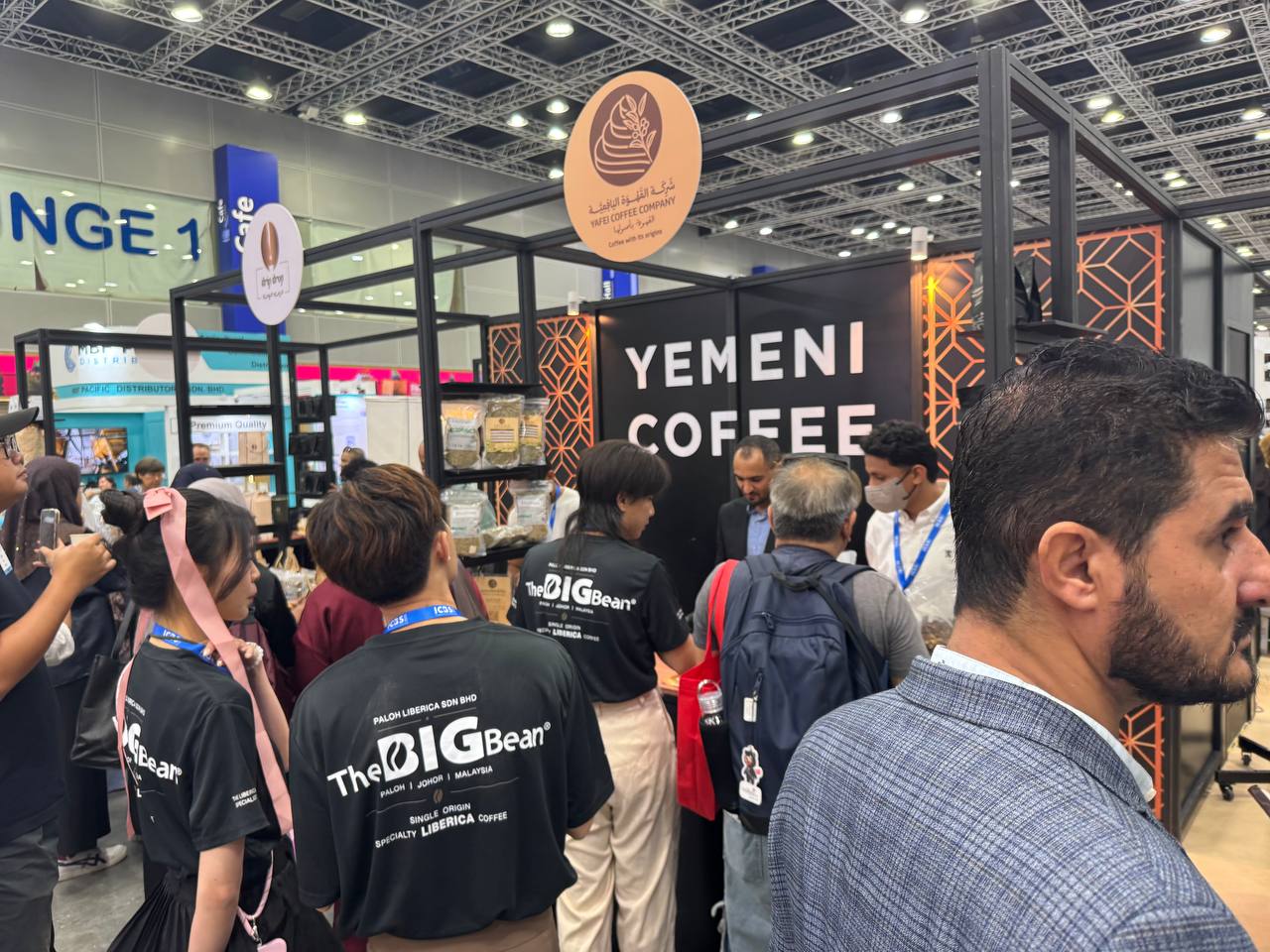
Yemeni coffee drew significant attention at the International Café and Beverage Show 2026 (ICBS 2026), as visitors gathered around the Yemeni pavilion to experience live brewing sessions, coffee tastings, and conversations about one of the world’s oldest coffee origins.

Held from May 7 to 9 at the Kuala Lumpur Convention Centre (KLCC), the exhibition brought together companies specializing in coffee, tea, matcha, café equipment, and beverage innovation, reflecting the continued rise of specialty coffee culture across Asia.

Among the busiest sections of the exhibition was the Yemeni pavilion, where producers and exporters introduced visitors to coffees cultivated in Yemen’s mountainous regions using traditional farming methods that have shaped the country’s coffee heritage for centuries.

Participating companies included Ammar Al-Omari Trading Foundation, Al-Yafae Coffee Company, Golden Yafea Coffee, Al-Shobli Export Company, Drip Drab, and Star Mocha Coffee. Throughout the event, exhibitors hosted cupping sessions and manual brewing demonstrations aimed at highlighting the distinct flavor profiles and historical identity of Yemeni coffee.

The participation was organized by the Small and Micro Enterprise Promotion Service (SMEPS) with support from the Saudi Development and Reconstruction Program for Yemen and the Islamic Development Bank through the “MARKETS” program, an initiative focused on improving access to international markets for Yemeni products.

Visitors and industry professionals showed particular interest in the connection between Yemeni coffee and the early history of global coffee trade. For many attendees, the pavilion offered more than a tasting experience — it provided a cultural introduction to coffee’s origins and the traditions that continue to shape production in Yemen today.

During his visit to the exhibition, Dr. Faisal Ali, President of the Yemenis Cultural Foundation, stressed the importance of presenting Yemeni coffee through a stronger cultural and media narrative capable of reaching modern specialty coffee audiences worldwide.

The pavilion also featured cultural publications linked to Yemen’s coffee history, including A Cup of Haysi and the Wine of the Clouds trilogy, adding a literary and historical dimension to the presentation.

Malaysian media covering the event described the Yemeni pavilion as one of the exhibition’s memorable highlights, noting the growing international interest in coffees tied to origin, heritage, and traditional agriculture.

Industry observers say the renewed attention toward Yemeni coffee reflects wider shifts in specialty coffee markets, particularly across Southeast Asia, where consumers are increasingly seeking coffees with traceable identity, regional character, and authentic production stories.

In addition to coffee showcases, ICBS 2026 featured brewing competitions, tea and matcha presentations, and live demonstrations of new beverage technologies as the region’s café and specialty beverage sectors continue to expand rapidly.


Author: Dubai – Qahwa World World | Source: Yemen Monitor

South Africa’s Rarest Coffee Thrives Along the KwaZulu-Natal Coast

Ali Alzakary – Dubai | Source: BusinessTech

Executive Summary

  • Coffee species: Coffea racemosa – one of the rarest in the world
  • Location: KwaZulu-Natal North Coast, South Africa (Ballito and Hluhluwe)
  • Key grower: Charles Dennison, founder of Cultivar Coffee and Racemosa Coffee
  • Current cultivation: ~15,000 trees propagated over 10 years
  • Annual output (2025): ~350 kg (equal to one small café’s consumption)
  • Export markets: 15 countries (high-end specialty roasters)
  • Unique flavor: Blackcurrant, herbs, camphor, mint (some detect cannabis-like aroma)
  • Climate resilience: Survives low rainfall, drought, cold; needs no spraying or irrigation
  • Conservation status: Protected on IUCN Red Lists (like black rhino)
  • South Africa farms: Hold approximately 90% of what exists in Africa

Coffea racemosa – considered by many coffee experts as the rarest coffee species on Earth – is being cultivated along South Africa’s KwaZulu-Natal North Coast. The coastal town of Ballito, best known for luxury estates and rapid property growth, is now gaining international recognition for preserving and producing this exclusive coffee. This species is native to Southern Africa. It remains exceptionally scarce due to very slow growth, difficult propagation, and highly specific climate requirements.

Rediscovering a Forgotten Coffee Species

Charles Dennison, founder of Cultivar Coffee and Racemosa Coffee, began researching this species during his Master’s degree in coffee studies. While traveling across Africa, Dennison found references to an unknown coffee species. He and his family then searched for surviving plants.

“They’re super rare. They are protected on the International Union for Conservation of Nature red lists, like the black rhino.” – Charles Dennison, 702 Drive interview

After locating seedlings, the family began cultivating the plants and has since propagated around 15,000 trees over the past decade. The regions around Ballito and Hluhluwe are now considered among the primary areas where the species survives naturally and is cultivated commercially. Dennison said farms in northern KwaZulu-Natal currently account for most of the species under cultivation in Africa.

“At the moment, we have probably about 90% of what exists in Africa,” he said.

A Coffee Unlike Any Other

Production of Coffea racemosa remains extremely limited because the trees grow slowly and are difficult to reproduce.

“It’s a very slow-growing tree. It’s very hard to propagate, which is why it’s so rare in the wild,” Dennison explained.

The coffee’s flavor profile is equally unusual and completely different from traditional Arabica or Robusta coffees.

“It’s completely different to any coffee I think anybody really would have tasted,” he said.

Dennison described tasting notes that include blackcurrant, herbs, camphor, and mint, while some tasters reportedly identify aromas reminiscent of cannabis. He admitted the coffee is highly polarising among consumers.

“When people taste it, they either love it or they hate it,” he said.

Production and Export

Because of its rarity and premium pricing, most of the production is exported to specialty coffee roasters overseas. Dennison said beans from the farms were sold to high-end roasters in 15 countries last year. Production volumes remain exceptionally small. According to Dennison, total output in 2025 reached only around 350 kilograms – roughly the annual consumption of a small café.

Metric Value
Trees propagated 15,000
Total output (2025) 350 kg
Export countries 15
Percentage of Coffea racemosa in Africa (KZN farms) 90%

A Climate-Resilient Coffee for the Future

Beyond its exclusivity, researchers are increasingly interested in Coffea racemosa because of its resilience to harsh environmental conditions. Dennison explained that the species can survive with very low rainfall, withstand drought conditions, and tolerate colder temperatures better than many commercial coffee varieties.

As climate change continues to threaten coffee production globally, breeding programmes are exploring the species for its potential role in developing more resilient coffee cultivars.

“It doesn’t need to be sprayed, and it doesn’t need irrigation,” Dennison said. “So there’s good potential to earn forex income.”

For South Africa’s emerging specialty coffee sector, the rare species could represent both a conservation success story and a future opportunity for sustainable coffee farming.

Frequently Asked Questions

What is Coffea racemosa and why is it so rare?

Coffea racemosa is regarded by many coffee experts as the rarest coffee species in the world. It is indigenous to Southern Africa and remains exceptionally scarce due to its slow growth, difficult propagation, and highly specific climate requirements. The species is protected on the International Union for Conservation of Nature red lists, similar to the black rhino.

Where is this rare coffee being grown?

The rare coffee is being cultivated along South Africa’s KwaZulu-Natal North Coast, with the regions around Ballito and Hluhluwe emerging as the primary areas where the species survives naturally and is cultivated commercially. According to Charles Dennison, farms in northern KwaZulu-Natal currently account for about 90% of what exists in Africa.

What does Coffea racemosa taste like?

The flavor profile is completely different from traditional Arabica or Robusta coffees. Tasting notes include blackcurrant, herbs, camphor, and mint. Some tasters reportedly identify aromas reminiscent of cannabis. The coffee is highly polarising – when people taste it, they either love it or hate it.

How much of this coffee is produced?

Production volumes remain exceptionally small. Total output in 2025 reached only around 350 kilograms – roughly the annual consumption of a single small café. The family behind its cultivation has propagated approximately 15,000 trees over the past decade.

Why is Coffea racemosa important for climate change research?

Researchers are increasingly interested in this species because of its resilience to harsh environmental conditions. It can survive with very low rainfall, withstand drought, and tolerate colder temperatures better than many commercial coffee varieties. It doesn’t need to be sprayed or irrigated, making it a potential source for developing more resilient coffee cultivars as climate change threatens global coffee production.


Ali Alzakary – Dubai | Source: BusinessTech

Michael Trung: After 50, I Became a Beginner in Coffee

An interview with Michael Trung,  Authorized SCA Trainer, coffee consultant, and founder of iO Coffee

Dubai – Ali Alzakary

Most coffee conversations start with a tasting note: chocolate, jasmine, dried fruit. But what if we started instead with a shipping container stuck at customs? Or a farmer watching months of work split open in a single rainstorm?

Michael Trung spent 25+ years in international logistics , moving goods, solving port crises, chasing paperwork. Then, after 50, he did something unexpected: he became a student of coffee. Today, he’s an Authorized SCA Trainer, a Specialty Coffee consultant, and the founder of iO Coffee, where he roasts in Vietnam to keep value with the people who grow the beans.

In this candid interview, Michael shares why COVID forced him to restart, what “the coffee smile” really means, and how logistics taught him to respect not just the bean, but every pair of hands that touches it.

If you care about where your coffee actually comes from not just the origin story, but the real supply chain.. read on.

  • You spent over 25 years in logistics, then suddenly moved into specialty coffee. How did that happen? And did logistics help you see coffee differently?

I come from the service industry. I spent more than 25 years in international freight forwarding—handling customs problems, shipment delays, port congestion, and phone calls at all hours just to keep cargo moving. That was my life for a long time.

Then COVID came and everything slowed down. For the first time in many years, I had time to sit quietly and think. I realized I knew how to move coffee around the world, but I knew nothing about the people growing it. I didn’t know the farming, the soil, or the hard work that happens before a bean even reaches a warehouse or café.

This became my startup life after 50. At an age when many people think about slowing down, I became a beginner again. Coming from logistics, I did not enter coffee as an expert, I entered as a student. In logistics, you learn to respect the journey from point A to point B. In coffee, I learned to respect the people standing at the beginning of that journey. Honestly, coffee taught me one thing: the more I know, the more I know I don’t know.

  • You founded iO Coffee after a long logistics career. How do you use that experience to improve the coffee chain? Have you changed how coffee is shipped because of the mistakes you saw?

Yes, very much. In logistics, one small mistake early on becomes a giant problem later. I’ve lived through the real-world headaches: the “HS code trap” at customs, missing certificates, or your cargo getting “rolled” at the port because of congestion. Coffee is very sensitive to all of this. If it sits in a hot container during a port delay or near something smelly because of a bad equipment choice, the flavor is gone.

Because of my background, I naturally pay attention to airflow, moisture control, packaging, and container cleanliness to protect the bean from farm to cup. But the biggest thing was seeing how little value stays with the farmers. That is why we roast in Vietnam at iO Coffee. I believe the origin should keep more of the reward, not just export the raw material.

For me, sustainability isn’t just a marketing word; it’s about protecting the hard work behind the coffee. That is why we always say: ‘Respect the Bean. Respect the hands.’

  • What pushed you to become an SCA Authorized Trainer and start “Michael Barista” on YouTube?

I used to think coffee was simple. But once you go deep, you see it’s a whole university inside a small bean—chemistry, farming, roasting, and sensory science all connected. I didn’t want to just be a guy with an opinion; I wanted to learn the professional international standards. That led me to become an SCA Authorized Trainer.

YouTube happened naturally. I started ‘Michael Barista’ to document my journey honestly, including my mistakes. I’m not a professor. I’m just an outsider sharing what I discover so that the younger generation feels coffee is something they can approach. I’ve also learned that today, good coffee alone is not enough—you need storytelling and a real connection with people.

  • Uring your many trips to coffee farms, what are three things you never expected to see?

The Sacrifice: I never expected the sheer level of labor. Seeing farmers picking cherries in the heat—that’s a man’s life, not just a product.

The Fragility (The ‘Coffee Smile’): In logistics, timing is important. In coffee, it’s everything. I learned a sad story on the farms: if it rains unexpectedly during harvest, the ripe cherries burst open. We call it the ‘coffee smile,’ but when the coffee smiles, the farmer cries. In just a few hours of rain, months of hard work are destroyed. It made me realize how sensitive this journey really is.

The Hope: I see younger farmers returning to the farms with new ideas while still respecting the older generation. They are bringing science and sustainability to the dirt, and that gives me hope for the future of Vietnamese coffee.

  • Vietnam is a top producer of Robusta. How do we move toward “value” instead of only “volume”?

For many years, Vietnam was known mostly for volume. But now I see more people focusing on quality, transparency, and Fine Robusta. People around the world now want more than just flavor notes; they want to know who produced the coffee and how it was handled.

I’m still learning how to balance my operational ‘logistics’ brain with the storytelling side. In logistics, we just moved cargo. In coffee, we have to share the heart behind the work. I don’t think we need too much noise. Good coffee speaks slowly. The best we can do is keep improving—little by little, season by season, cup by cup.


Michael Trung is an Authorized SCA Trainer and founder of iO Coffee in Vietnam. Find his educational content on YouTube as “Michael Barista.”

Drinkit and Victoria Arduino to Host Beverage Innovation Workshop in Dubai

Dubai — Qahwa World

DrinkIt, the digital coffee shop chain, has announced a partnership with Victoria Arduino to host a professional workshop in Dubai on May 20, 2026, focused on beverage innovation, product development, and the commercial strategy behind bestselling drinks.

The three-hour workshop will take place at the Victoria Arduino headquarters in Dubai and is designed for professionals across the food and beverage industry seeking practical insight into how successful beverage concepts are developed and launched within real operating businesses.

Drawing on its experience operating 10 digital coffee shops across Dubai, DrinkIt’s R&D team will share the framework the company uses to evaluate new drink ideas, balancing taste, operational efficiency, pricing, scalability, and profitability before products are introduced to the menu.

According to the organizers, the workshop will focus on the idea that successful beverages are not built on recipes alone, but through product thinking that integrates customer experience, cost management, workflow efficiency, and operational consistency.

Key topics will include beverage development for real-world café operations, pricing strategy, cost of goods sold (COGS), unit economics, and the challenges of scaling beverage programs while maintaining quality and speed of service.

Participants will also take part in hands-on exercises designed to simulate the beverage development process, from concept creation and evaluation to launch decision-making.

The workshop is aimed at head baristas, café owners, F&B managers, product developers, and entrepreneurs involved in beverage innovation and café concepts.

The event will be held on May 20, 2026, from 3:00 PM to 7:00 PM at the Victoria Arduino HQ in Dubai. Organizers noted that seats are limited and advance registration is required.

Registration is available here: Workshop Registration