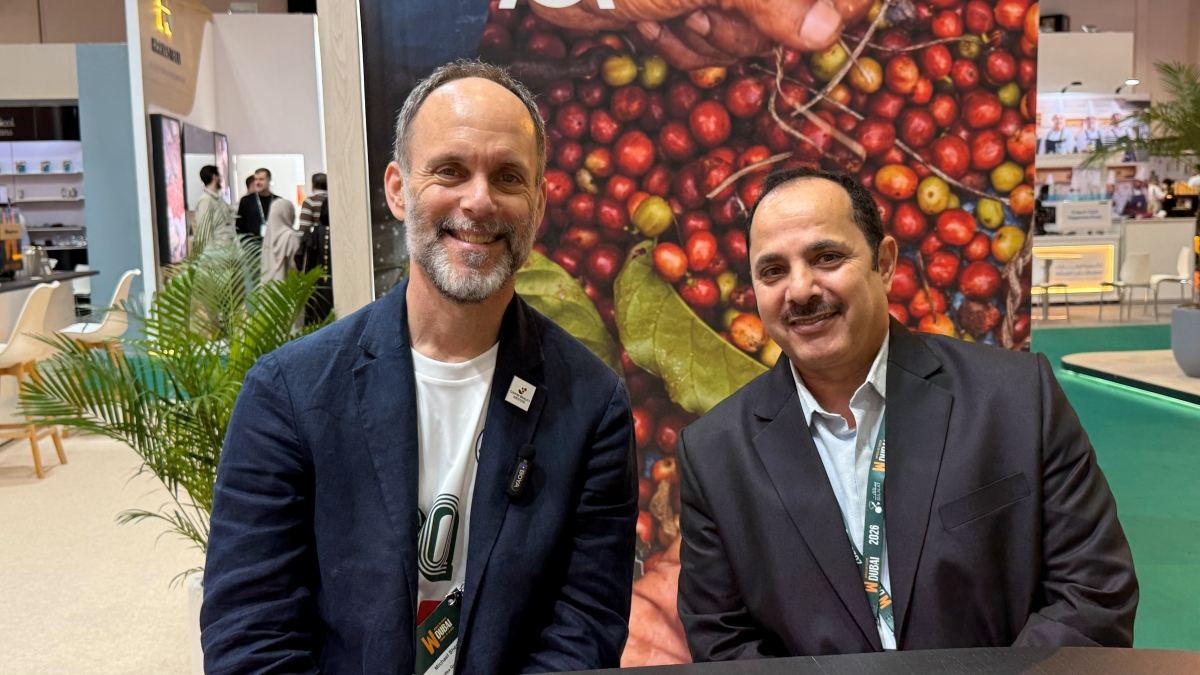
Mexican Coffee Must Not Disappear Behind Intermediaries: A Conversation with José Manuel Hernández García

Author: Ali Alzakary
Source: Qahwa World
Date: May 20, 2026This article features a José Manuel Hernández García interview.

Executive Summary:

  • José Manuel Hernández García, a mechatronics engineer from Coatepec, Mexico, is building digital traceability systems and opening new trade routes for Mexican coffee to the Middle East and Eurasia.
  • Severe drought in 2024/2025 affected Mexican coffee production, pushing prices higher and forcing farms to adopt new water management strategies.
  • EUDR regulations pose a risk of excluding small farmers. The response is to help producers meet traceability requirements without being left behind.
  • Dubai serves as a strategic hub for roasting and distributing Mexican coffee across the Middle East, adapting to local consumption styles including espresso and Turkish coffee.
  • Armenia was chosen as a gateway to Russia and Eurasia because of its trade framework, avoiding the complexities of direct business with Russia and the limitations of Turkey.
  • The “Todos Somos Mexico” movement turned coffee into a tool for economic diplomacy, uniting producers, governments, embassies, and consulates to present Mexico internationally.
  • A new Latin American platform is being developed to connect producers directly with buyers in the Middle East and Eurasia, supporting transparency, fair trade, and direct negotiation.

José Manuel Hernández García grew up in Coatepec, Veracruz, one of Mexico’s most recognized coffee producing regions. He was surrounded by coffee farms and the people who work them. But instead of staying on the farm, he became a mechatronics engineer.

Instead of exporting coffee the traditional way, he built digital traceability systems, opened new trade routes to the Middle East and Eurasia, and founded “Todos Somos México,” a movement that uses coffee as a tool for economic diplomacy. At only 29 years old, he is now developing a Latin American platform to connect producers from Mexico and beyond with strategic markets in Dubai, Armenia, Russia, and the GCC.

In this interview, he speaks openly about drought, EUDR regulations, fair returns for small farmers, and why he chose Armenia over Turkey as a gateway to Eurasia. Do not just drink your coffee. Know the story behind it.

Here is the full interview.

As a mechatronics engineer who grew up in Coatepec, one of Mexico’s most recognized coffee producing regions, how has your technical background influenced the production systems and digital traceability processes at Casa Tostadora Briones?

Growing up in Coatepec gave me a direct connection to coffee culture from an early age, while my background in mechatronics engineering helped me approach the coffee industry from a systems, technology, and process perspective.

At Casa Tostadora Briones, we focus heavily on organization, traceability, quality control, and long term scalability. My technical background has influenced how we structure information, manage producer relationships, monitor quality standards, and develop more efficient commercial and export processes.

One of the projects we are currently developing focuses on improving traceability directly at the farm level. Our goal is to build systems that allow buyers to follow the coffee journey more closely, from the moment harvesting begins to the movement and processing of each coffee lot.

We are also exploring the implementation of AI assisted technologies for coffee quality analysis, including colorimetry and density evaluation systems, to help improve consistency, transparency, and quality control throughout the supply chain.

I believe technology can help create stronger connections between producers and international markets while bringing more transparency and value to Mexican coffee.

Mexican coffee producers are facing major climate related challenges, including droughts, along with ongoing instability in global coffee prices. How are these factors affecting the consistency and quality of your specialty coffee, and how do you balance fair returns for producers while staying competitive in international markets?

The 2024 2025 coffee harvest in Mexico was heavily affected by severe drought conditions, which significantly impacted production volumes and contributed to a major increase in coffee prices across the market.

In many coffee producing regions, farmers faced water shortages, irregular rainfall, and higher stress on coffee plants, directly affecting consistency, cherry development, and overall production planning.

One of the biggest challenges today is not only maintaining coffee quality, but also adapting farms to increasingly unstable climate conditions.

In response to this, some coffee farms in Mexico are beginning to implement new water management strategies, including the construction of water reservoirs, the development of water wells, and more efficient irrigation systems to help secure water access during critical periods.

At the same time, technology is becoming increasingly important. We are working toward implementing monitoring systems that help analyze water needs at the farm level, allowing producers to make more informed decisions based on environmental and production conditions.

Regarding fair returns for producers, our approach is to avoid competing only through low prices. If the international market demands specialty coffee, traceability, consistency, and origin, then the producer must also receive a fair value for that work.

We balance this by building relationships with markets that understand quality and origin, especially in regions such as the Middle East and Eurasia. Instead of reducing the value paid to producers, we work on improving market positioning, logistics, traceability, and commercial strategy so Mexican coffee can remain competitive internationally without weakening the producer’s income.

For us, competitiveness does not mean paying less at origin. It means creating a stronger value chain where the producer, the exporter, and the international buyer can all participate in a sustainable and transparent way.

With the European Union Deforestation Regulation (EUDR) introducing strict geolocation and traceability requirements, how are you preparing to meet these standards while ensuring that small coffee farmers are not left out of global trade opportunities?

The EUDR represents a major turning point for the coffee industry. Traceability is no longer only a commercial advantage. It is becoming a requirement for access to some of the most important international markets.

At Casa Tostadora Briones, we are preparing by strengthening traceability directly from the farm level. This includes producer identification, farm and plot geolocation, documentation of coffee lots, and better digital organization of information throughout the supply chain.

One of the most important elements of our work is that we already have producer groups in different coffee growing regions of Mexico. For example, in one region of Veracruz, specifically in Cordoba, we work with a group of around 200 small producers. They have the quality, the knowledge of the land, and the potential to produce excellent coffee, but many of them are not familiar with the international rules, documentation, certifications, and traceability requirements that global markets increasingly demand.

This is where our role becomes very important. We do not only act as an exporter. We also work as a bridge between producers and international markets, helping them understand what each market requires and supporting them in the process of improving coffee quality, organizing information, and moving toward standardization according to buyer expectations.

We are also working toward integrating technology that allows us to follow the movement of coffee from the moment the harvest begins, through processing, commercialization, and export. The goal is to give international buyers more transparency while helping producers become better prepared for new global requirements.

One of the biggest risks of regulations like EUDR is that small producers could be left behind simply because they do not always have access to digital tools, technical support, or administrative systems. We believe companies like ours must help prevent that.

For us, compliance should not become an exclusion filter. It should become a path toward better organization, stronger traceability, and greater participation for small producers in global trade.

The future of Mexican coffee depends on combining origin, technology, traceability, and inclusion.

You are currently leading expansion efforts from Dubai to strengthen the presence of Mexican coffee in the Middle East. What makes this region strategically important for you, and how do you plan to position Mexican coffee in such a highly competitive specialty coffee market?

Dubai, and the United Arab Emirates in general, are strategically important for us because coffee is one of the most important beverages not only in the UAE, but across the Middle East. Coffee is deeply connected to hospitality, business, family, and daily life in the region.

We are also seeing important changes in nearby markets. For example, Russia has traditionally been a tea consuming market, but coffee consumption has been growing significantly, creating new opportunities for coffee producers and brands.

The UAE is also one of the most important logistics and commercial hubs in the world. From Dubai, we can import green coffee, roast it locally to preserve freshness, and distribute it across different channels. This gives us a major advantage because freshness is essential for positioning high quality coffee in a competitive market.

Our current focus is to enter and develop the HORECA sector by adapting Mexican coffee to the local culture of consumption. In the Middle East, every country has its own way of drinking coffee, and if you do not adapt, you are out of the market.

That is why our strategy is not only to sell Mexican coffee as an origin, but to understand how it can perform in espresso, specialty brewing, Turkish style preparations, and other local preferences.

From Dubai, we also see the opportunity to re export Mexican coffee to the GCC and other strategic markets. This allows us to use Dubai as a platform to build a long term presence for Mexican coffee across the Middle East and beyond.

The goal is to position Mexico as a serious, consistent, and adaptable coffee origin in one of the most dynamic coffee regions in the world.

Your expansion strategy has also included Armenia as a gateway to Russia and the wider Eurasian market. Why did you choose Armenia for this role, and what were the biggest challenges in opening these new commercial routes?

Armenia became part of our expansion strategy because we saw an opportunity to build a new bridge between Mexico, the Middle East, Russia, and the wider Eurasian market.

Russia is a large and important market, but because of the current restrictions and sanctions environment, doing business directly with Russia is not simple. At the same time, this has created a market where many international players have stepped back, leaving space for new routes and alternative commercial structures.

At the beginning, we considered Istanbul as a possible hub for Eurasia. However, when you analyze the geopolitical and logistical situation, Turkey presents certain limitations for this specific strategy. Doing business with Russia can be complex, and there is also no open land border between Turkey and Armenia, which makes regional coverage more difficult.

Armenia, on the other hand, has strong commercial ties with Russia and is part of a trade framework that allows access to Russia and other Eurasian markets under more favorable conditions. This gives us the possibility to receive payments, work with regional partners, and explore re export opportunities to countries within that framework.

For us, Armenia can become a strategic platform. Our vision is to import Mexican green coffee, evaluate where it is most efficient to roast or process it, and then re export it to Russia and other Eurasian destinations.

One of the biggest challenges we have faced in Armenia is the high import tax, which can reach around 20 percent. That is where the strategy becomes important: understanding where the coffee should be imported, where it should be roasted or processed, and from where it should be re exported in order to remain competitive.

Opening this type of route requires solving logistics, customs, payments, documentation, local partnerships, and market adaptation at the same time.

Another important challenge is education. Mexican coffee is not yet strongly positioned in Armenia or Russia, so we have to explain the origin, the quality, the regions, and the value behind the product.

For us, Armenia represents a strategic door into Eurasia and a way to continue opening international routes for Mexican and Latin American coffee beyond traditional markets.

Through your leadership in the “Todos Somos Mexico” initiative, how were you able to turn coffee from an agricultural product into a tool for economic diplomacy and international representation for Mexico?

“Todos Somos Mexico (We are all Mexico)” was born when we decided to take Mexican coffee to new horizons, especially to the Middle East.

When we began exploring these markets, we realized that Mexican coffee was not strongly positioned internationally. But we also realized something deeper: in many cases, there was limited knowledge about Mexico itself, its coffee regions, its producers, its culture, and its capacity to participate in high value global markets.

We also saw that Mexican coffee often does not go far beyond the United States. Many small producers remain disconnected from international opportunities because they do not have access to the right networks, market information, export structures, or institutional support.

That is why we decided that our mission could not be only to sell coffee. We needed to position Mexican coffee and Mexico at the same time.

We began visiting farms, listening directly to the needs of coffee growers, and understanding the reality behind each region. From there, we started bringing together small producers, civil associations, state governments, and institutions under one shared vision.

The Ministry of Tourism of Mexico also joined this effort, allowing us to present not only coffee, but also Mexico’s culture, identity, and regional diversity at World of Coffee Dubai 2026. Mexican embassies in the Middle East and consulates also became part of this representation.

That is how “Todos Somos Mexico” was born: as a movement to unite coffee producing regions, producers, institutions, governments, embassies, and consulates under one international message.

For me, coffee became a tool for economic diplomacy because it allowed us to speak about Mexico through its people, its land, its culture, and its productive capacity.

The message is simple: no one should be left out of this great representation. Mexican coffee must become a bridge that opens doors for more producers, strengthens Mexico’s image abroad, and creates long term opportunities in strategic markets.

After bringing together producers, organizations, and diplomatic representatives under one shared vision, what real impact did local Mexican coffee farmers experience on the ground?

The first real impact was visibility.

For many years, many small coffee farmers in Mexico produced high quality coffee, but once their coffee entered the commercial chain, their identity often disappeared. Exporters or intermediaries would buy the coffee, but the final presentation usually focused only on the exporting company or the final brand, without mentioning the farm, the producer, the region, or the story behind that coffee.

From the beginning, we decided to change that.

For us, origin and traceability are not only technical concepts. They are also a way to give recognition back to the people who produce the coffee. That is why one of the first steps was to document the farm, the region, the producer, and the story behind each coffee lot, so the final buyer can understand where the coffee comes from and who is behind it.

Through “Todos Somos Mexico”, producers began to see that their coffee could be represented internationally with their own identity, not only as an anonymous product inside a supply chain.

On the ground, this created more awareness about what global markets require: traceability, quality consistency, documentation, standardization, and storytelling. Producers started to understand that international positioning requires more than a good cup. It requires organization, information, and long term preparation.

Another important impact is that this work also encourages other exporters and companies to become more conscious about how small producers are treated. When the market begins to value the farm, the region, and the producer behind the coffee, the entire supply chain is pushed toward more transparency and responsibility.

In our case, the objective is also to generate more resources and reinvest part of that value back into coffee growing communities. This reinvestment is essential because coffee production in Mexico has not been growing as it should. In many regions, instead of increasing, production has been decreasing.

Mexico has excellent coffee, diverse microclimates, rich soil, altitude, and strong producing communities. The potential is there. But without reinvestment, technical support, infrastructure, and long term planning, it is very difficult for producers to increase production and improve consistency.

That is also part of our objective: to use international positioning to create a stronger cycle where better markets can generate more value, and that value can return to the communities to help increase production, improve quality, and strengthen the future of Mexican coffee.

Of course, this is a long term process. The impact is not immediate for every producer, and there is still a lot of work to do. But the first step was to return visibility to the producer and open a door that did not exist before.

For us, the real impact is creating a path where more producers can access better markets, better information, better recognition, reinvestment, and better opportunities without losing their identity along the way.

You are now developing a Latin American platform aimed at connecting producers and coffee brands with strategic markets in the Middle East and Eurasia. What are the main operational and technological features of this platform, and how will it support transparency and fair trade?

The Latin American platform we are developing is designed to connect producers and coffee brands from Mexico and Latin America with strategic markets in the Middle East and Eurasia.

The idea is not to create a simple buy and sell marketplace. We want to build a commercial, technological, and marketing arm for producers, allowing them to reach international buyers without leaving behind their farms or losing control of their origin.

When I first arrived in Dubai, this is exactly the kind of support I would have wanted to find. I would have wanted a structure, guidance, market access, local support, and a platform that could help me understand how to enter such a competitive and complex market.

That experience became part of the vision. What we had to learn by ourselves, we now want to make possible for producers across Mexico and Latin America.

Through the platform, producers will be able to present their coffee directly to buyers, including information about the farm, region, process, quality profile, available volume, and traceability. The goal is to bring the final buyer closer to the producer, instead of hiding the producer behind layers of intermediaries.

Operationally, the platform will support direct negotiation, local roasting, local distribution, storage, HORECA opportunities, retail access, and market positioning in strategic locations such as Dubai. This means a producer in Mexico or Latin America could access the Middle East market without having to immediately open a company, travel constantly, or build an entire local operation from zero.

The technology behind this platform is already developed. We are currently refining the final details before announcing the official launch. The same visibility work that we started with Mexican coffee, documenting producers, farms, regions, stories, and origin, will now be expanded to Latin America.

This technology will allow buyers to receive information when harvesting begins, follow the movement of coffee lots from the farm, and access more transparent information throughout the supply chain.

But the platform is not only about sending one container to the Middle East and considering the work finished. In many cases, sending a container can be the easy part. The real challenge is creating a market for each producer or coffee brand, with its own narrative, identity, and story.

This is extremely important because if a buyer changes suppliers, the producer should not disappear from the market completely. If the farm, the region, and the story have already been positioned, the producer has a stronger foundation to continue building commercial opportunities beyond one single buyer.

In terms of fair trade, the platform supports transparency by giving producers visibility and a more active role in the commercial process. When the producer can be seen, contacted, and recognized, the value of the coffee is less likely to disappear inside the supply chain.

For buyers, the platform creates direct access to origin, better information, stronger traceability, and a more human connection with the people behind the coffee.

For producers, it becomes a way to negotiate, position their brand, access local roasting and distribution, and enter strategic international markets while continuing to focus on what they do best: producing coffee.

Our long term vision is to help Mexican and Latin American coffee compete globally with stronger organization, better technology, and a more direct connection between origin and demand.

As a 29 year old entrepreneur who has built international trade networks and commercial infrastructure across multiple regions, what vision is guiding your efforts to shape the future of Latin American coffee in emerging global markets?

My vision is to help Mexican and Latin American coffee move from being seen only as a raw material to becoming a stronger global value proposition with origin, identity, traceability, and direct market presence.

Mexico and Latin America have some of the best coffee producing regions in the world. We have altitude, soil, microclimates, producers, culture, and quality. But there is still so much to explore, to learn, and to implement. In many cases, producers still do not have enough access to international markets, commercial infrastructure, technology, or the right positioning.

Since I left Mexico, my main objective has been very clear: to continue being a bridge for producers, to keep opening routes, and to create new paths for Mexican and Latin American coffee in markets where our origins are still not fully recognized.

At 29, I understand that this is only the beginning. Building international routes takes time, patience, trust, and a lot of work. But I also believe this is the right moment. Emerging markets such as the Middle East and Eurasia are looking for quality, origin, consistency, and new stories. Mexico and Latin America have all of that, but we need to present it with better organization, stronger strategy, and greater unity.

What we started with Mexican coffee, we now want to expand to Latin America. The goal is to create more visibility, more transparency, and more commercial opportunities for producers, while helping buyers access coffee with real origin and a human story behind it.

For me, the future of Mexican and Latin American coffee is about exporting better, with more value, more recognition, and more participation from the people who actually produce the coffee.

If we can combine technology, traceability, logistics, local roasting, market adaptation, and international partnerships, Mexican and Latin American coffee can become much stronger in emerging global markets.

That is the vision guiding my work: to keep building bridges, opening routes, and creating opportunities so producers from Mexico and Latin America can participate in the world with more dignity, more visibility, and more future.

Ali Alzakary – Conducted this interview for Qahwa World.
Published: May 20, 2026

From Vilnius to the World: The Story Behind Huracán Coffee’s Historic Win

An exclusive interview with Vytautas Kratulis, founder of the World’s Best Coffee Roaster 2026

Dubai – Ali Alzakary

When Huracán Coffee was crowned World’s Best Coffee Roaster 2026 at the Global Coffee Awards in San Salvador, it was more than a victory. It marked a defining moment for the global coffee industry. For the first time, a roaster from the Baltic region reached the top, standing alongside and above long-established coffee markets in Europe and North America.

This achievement reflects years of work, consistency, and a deep understanding of coffee that goes far beyond roasting alone. Behind it is Vytautas Kratulis, a figure whose journey is closely tied to the transformation of Lithuania itself. From the uncertainty that followed independence in the early 1990s to building one of the most respected specialty coffee companies in the world, his path mirrors the rise of a new coffee culture in an emerging region.

In this exclusive conversation with Qahwa World, Kratulis shares his story, his philosophy, and his perspective on what it truly means to produce great coffee today.

Read the full interview below.

  • To start, could you briefly introduce yourself and share the story behind Huracán Coffee?

When the Soviet Union collapsed, everything changed. Lithuania became independent in 1991, just as I turned seventeen. It was a complete reset. There were no clear rules, no stable systems, only a strong sense that we had to build a country from the ground up, including its economy, institutions, and businesses.

There was chaos, many crises, very little money, and almost no legal framework. But for a young person, it also meant freedom and possibility. Many of us wanted to travel, to see the world, and at the same time take part in building something new in a country that was just taking shape.

I started working in a distribution company handling commercial coffee brands from Sweden, Austria, Poland, and Germany. My job was simple, placing products on shelves. But the deeper I got into it, the more questions I had. I began to notice that people cared about good coffee. They were looking for it.

It also connected to my personal experience. In my family, coffee had meaning. My mother suffered from migraines, and coffee helped her. At that time, truly good coffee was rare, and because of that, its value felt higher than it does today. When something good appeared, people noticed. I kept seeing this pattern. People appreciated quality, even if they did not always have the words to describe it.

Then one day I tasted freshly roasted coffee for the first time. It was presented by a Polish entrepreneur selling drum roasting machines. That moment changed everything for me. I bought a roaster.

At that time, there was no concept of specialty coffee as we understand it today. There was no internet as we know it, no structured information, and I had no awareness of the specialty coffee movement until 2004.

In 2004, I attended an exhibition in Athens, where I met key figures from what was then the Specialty Coffee Association of Europe. That experience gave me a completely new perspective.

After returning to Vilnius, I opened the first dedicated specialty coffee shop in Lithuania, established a local SCA chapter, and organized the first national championship under international rules. We also sent our first national champion to the World Barista Championship in Seattle. That was how the Baltic region began connecting with the global specialty coffee community.

A major turning point in my career came in 2005, when I was invited to judge at the Cup of Excellence in Nicaragua. That was my first visit to a coffee origin. There, I met many of the people who shaped the specialty coffee movement. It was also my first time sitting at a Cup of Excellence cupping table. Since then, I have served as a judge in competitions in nearly every producing country that participates in the program.

  • How did you feel when you heard you had won World’s Best Coffee Roaster?

It is hard to put into words. Even if we had received silver or bronze, the feeling would have been very strong. But when you are ranked number one, you begin to reflect and look for the reasons behind it.

Looking back now, it is clear that this did not happen by chance. The result follows the work. But in that moment, the only thought was that you are simply lucky to be there.

When we received a bronze medal in the filter category in Europe and qualified for the final, we already celebrated it as the highest point in our journey. Going into the world final, we did not expect this kind of recognition, especially considering the level of markets like the United States, Canada, the United Kingdom, and Scandinavia.

Today, access to great coffee is relatively equal. Roasters can find and buy exceptional lots, visit producers, and operate within well-established logistics. We all see each other’s work.

The difference lies in the market itself. In more developed markets, demand for quality is stronger and more consistent. People can pursue quality without compromise, and good coffee becomes part of everyday life.

In my local market, I am still shaped by a less mature consumer. Expectations are different, and that naturally defines certain limits.

  • What do you think made the biggest difference in this competition?

We received a strong number of medals across different categories and subcategories, close to a fifth of all awards. That range made a difference.

Beyond filter coffee, which we understand well, we also have long experience preparing roasts for milk-based drinks. We have had six national barista champions come through our team.

In areas like omni roasting, which is not something we do every day, it was a new challenge. Still, we performed well and received recognition.

Timing also played a role. It was a moment when many of our carefully sourced lots had just arrived. Every year, we make a point of buying something special, competition-level coffees. This allowed us to present strong coffees across many categories.

We prepared seriously. We had a plan for what to present, when to roast, and how to approach the competition.

We did not expect to win. But we knew how to present ourselves with respect at the highest level.

  • How would you describe your approach to roasting in simple terms?

We believe roasting should be adapted to purpose.

For milk-based drinks, we adjust the coffee to work well with milk. For filter coffee, we roast light so the coffee can express its natural character, including origin and variety.

Espresso is different. We prefer sweetness and balance, with more roundness in the cup, not just strong acidity. Our style sits somewhere between Italian and Scandinavian approaches.

Acidity is important, but we do not push it to the front. We value origin, freshness, precision, and preparation. At the same time, we do not follow trends blindly.

  • How important are your relationships with coffee farmers?

They are very important.

It is always a special feeling to know that a farmer is waiting for your order, expecting your visit, and welcoming you.

These relationships take years to build. It is about understanding each other. In the end, what a farmer chooses to sell you becomes how that country is experienced in your market.

For example, we have worked with the Pacas family in El Salvador since 2008. It is not only about rare varieties, but also about everyday coffees that truly represent a country.

I try to visit producing countries regularly to see progress and changes.

  • What is your view on blind tasting competitions?

From my perspective, they can reflect quality if the system is well structured.

Consistency, standardized preparation, and experienced judges are essential. These factors allow for objective evaluation.

I still consider Cup of Excellence the most advanced system. At the same time, Global Coffee Awards offers something valuable by comparing coffees from different countries without bias.

  • What does this win mean for the Baltic region?

It is a significant result for our region.

Our customers are part of this achievement. They trusted us for many years. I hope it gives confidence to other roasters.

At the same time, the market is still developing. Awareness and consistency are improving, but there is still a gap compared to more mature markets.

  • What are your plans after this win?

This result confirmed that what we do resonates globally.

We will continue focusing on coffee. We have expanded into products like cold brew concentrate and specialty instant coffee, as well as collaborations with other industries.

Looking ahead, I would like to be more present in the Arab coffee scene. I believe we have something meaningful to contribute there.

  • What advice would you give to roasters who want to reach this level?

Do not focus too much on others. Follow your own path.

Take part and do not let fear of losing stop you. Many strong players never even try.

This interview reflects a journey built over decades, shaped by curiosity, persistence, and a deep respect for coffee at every stage of its value chain. Huracán Coffee’s achievement is not only a win, but a signal that the global coffee map continues to evolve, opening space for new regions and new voices.

From Café Culture to Home Precision: How GCC Consumers Are Redefining Coffee with Sage

Dubai – Ali Alzakary

Across the GCC, coffee is no longer confined to cafés or social outings—it is rapidly becoming a refined, deeply personal experience crafted at home. Driven by a sophisticated café culture and global exposure, consumers in markets like the UAE and Saudi Arabia are developing a sharper appreciation for quality, consistency, and the finer details behind every cup.

This shift is giving rise to a new kind of coffee enthusiast: the home barista who seeks professional-grade results without leaving the kitchen. Expectations are evolving beyond convenience toward precision, control, and a deeper understanding of the brewing process. At the same time, coffee remains closely tied to hospitality in the region, turning home preparation into an expression of taste and identity.

In this conversation, Elie Abou Khalil shares insights into this transformation, the technology enabling it, and how innovation is shaping the future of coffee at home. From engineering challenges to smart connectivity and consumer behavior, this interview offers a closer look at a fast-evolving landscape.

Read on to explore how the GCC’s coffee culture is entering a new era—one defined by knowledge, craftsmanship, and elevated expectations.

How do you see the GCC consumer evolving from just being a café regular to a dedicated “home barista” who demands professional-grade precision?

From a Sage perspective, what we’re seeing across the GCC is a sustained and very clear growth of specialty coffee at home. Over the past years, consumers in markets like the UAE and Saudi Arabia have developed a strong appreciation for high-quality coffee, driven by a very advanced café culture and global exposure through travel. What’s changing now is that this expectation is no longer limited to coffee shops. More and more people want to recreate that same level of quality at home.

With that comes a shift in behaviour. Consumers are not just looking for a machine, they’re looking for consistency, precision, and the ability to understand and refine their coffee. That’s where we see a real step-change in the market. At the same time, coffee is deeply connected to hospitality in the region. Preparing coffee at home – whether it’s a classic espresso or more personalised drinks – has become part of how people host and express quality. What we also see increasingly are more personalised or “house-style” drinks being created at home, which further drives the need for control and repeatability.

For us at Sage, this is exactly the space we operate in. Our focus is on bringing professional-level performance into the home in a way that is intuitive and consistent. For us, it’s not about turning every consumer into a professional barista, it’s about giving them the tools and confidence to achieve café-quality results, every day, in their own kitchen.

With your SCA background, how does Sage strike that balance between automation for the everyday user and the manual control that coffee purists want?

From our perspective, it’s not about choosing between automation and control, but about delivering the right solution for every type of coffee user.

In the GCC, we see a wide spectrum of needs, from consumers seeking speed and consistency to those looking for a more hands-on experience. At Sage, we address this through a portfolio that spans automatic, manual, and assisted preparation, always anchored in the same commitment to in-cup quality.

Across the range, our focus is on precision and performance, ensuring reliable results from the first cup.

At the same time, milk-based drinks are central to coffee culture in the Gulf. Features like automated milk texturing and steaming play a key role here, delivering consistent results while still allowing users to refine and personalise their coffee over time.

Ultimately, we aim to empower consumers with the right tools for their preferred coffee experience, with the flexibility to grow without compromising on quality.

What were the actual engineering hurdles in bringing lab-level standards, like thermal stability and pressure profiling, into a home kitchen appliance?

The real challenge is not introducing advanced features, but making them perform consistently in a home environment. Commercial machines are designed for scale and trained users, whereas at home the expectation is compact design, intuitive use, and reliable results in an everyday setting. At Sage, our approach is built on the four keys: dose, brew temperature, pressure, and steam. These principles originate from commercial machines and are integrated across our entire range.

The complexity lies in translating these into a home format. This means delivering precise dose and weight, maintaining brew temperature within a tight range, ensuring stable pressure throughout extraction, and providing consistent steam performance for milk texturing. These elements only matter if they deliver consistent in-cup results. That’s why the focus is on precision, repeatability, and ease of use rather than added complexity.

Ultimately, it’s about bringing professional-level performance into the home in a way that feels seamless and reliable.

With global supply chains under pressure and the climate affecting bean prices, how can home technology help consumers get the most out of their coffee and reduce waste?

For me, a lot comes down to consistency in preparation. With Sage, the focus is on helping users get to a high-quality result more quickly and with greater confidence. When key elements like dose, temperature, and extraction are stable and repeatable, it becomes much easier to unlock the full potential of the coffee.

What I often see is that once people can rely on their setup, they start to better understand their coffee and naturally refine their process over time. In the end, it’s about achieving consistently better results at home and making sure every coffee delivers the experience people expect.

Is the surge in premium appliances across the UAE and Saudi a long-term structural shift, or just a post-pandemic trend that might cool off?

This is clearly a long-term structural shift. In the UAE and Saudi Arabia, coffee is deeply embedded in daily routines and plays a key role in hosting, which naturally raises expectations for quality at home. Consumers are no longer satisfied with basic solutions – they are looking for consistency, performance, and a more refined coffee experience.

At the same time, the market is becoming more educated. There is a stronger focus on long-term value, performance, and reliability, rather than short-term trends.

This is exactly where Sage is positioned. As a brand, we focus on bringing professional-level performance into the home in a way that is intuitive and consistent. As expectations continue to rise, the demand for premium home coffee solutions will remain strong and continue to evolve.

How is Sage helping bridge the “education gap” for home brewers? Do you think hobbyists should actually pursue formal coffee certifications to get the best out of their gear?

A big part of our approach at Sage is designing machines that guide the user towards a good result from the start. A clear workflow and consistent performance make it easier to build confidence and improve over time. At the same time, our range supports different types of users, whether they prefer a more automatic, assisted, or manual approach, always without compromising on precision and in-cup quality.

Education is very much part of our DNA. We work closely with coffee professionals and roasters, because ultimately the machine is only as good as the coffee beans you use. Our machines are developed with experts at our design and innovation centre at our Australian headquarters, bringing real café standards into the home. We also support that learning beyond the product through in-store experiences and practical content built around real at-home brewing.

Having gone through formal certifications myself, I can see the value they bring. That said, they’re not essential for everyone. Coffee should remain accessible, but for those who want to go deeper, structured learning can accelerate that journey. Ultimately, it’s about combining performance, precision, and consistency to give people the confidence to create great coffee at home.

Where does the Middle East sit on Sage’s global innovation map? Are there specific features you’re developing just for our regional tastes and needs?

The Middle East has become a highly important region in terms of consumer insight and engagement.

What stands out is how informed and quality-driven consumers are. There is a strong focus on performance, design, and the overall experience at home, which makes the feedback from this region particularly valuable. Rather than developing isolated features for one market, the focus is on identifying global patterns. In the Middle East, that clearly includes a strong preference for milk-based drinks, a high frequency of home entertaining, and the need for consistent performance across multiple drinks.

As I often see, making one good coffee is one thing, but delivering that same quality consistently when hosting is just as important. These insights feed directly into how features are prioritised at Sage, ensuring that innovation reflects real usage and delivers value across different markets.

How can we use better tech to improve transparency and traceability, making sure the farmers at the origin are actually getting a fair deal?

In specialty coffee, roasters often work very closely with farms, building direct, long-term relationships and focusing on quality from origin through to the final cup. That connection is a key part of what defines specialty coffee. It’s not just about the end result, but about how the coffee is sourced, processed, and handled along the way.

At Sage, our role is on the preparation side. We design machines that allow users to fully express that quality at home. We work closely with some of the world’s leading baristas and coffee professionals to ensure our machines reflect real café standards and are optimised for specialty coffee.

Technology can support transparency, but our focus is on delivering the precision and consistency needed to bring out the best in every coffee.

Looking five years ahead, how do you see the “Smart Home” and AI changing our morning coffee routines?

Connectivity will play an increasingly important role in how people experience coffee at home. We already see this with machines like the Oracle Jet, which is WiFi-enabled. This allows for ongoing software updates and the ability to introduce new recipes over time, ensuring the machine stays up to date and continues to evolve with the user.

With the Oracle Dual Boiler, connectivity goes a step further. It is also WiFi-enabled and works in combination with the Sage Coffee App, enabling a more connected experience, from guided support to remote interaction. At the same time, it’s important to note that the app is currently only available in selected regions.

For me, the real value of this technology is not about adding complexity, but about continuous improvement. It allows us to support users beyond the initial purchase and make the experience more intuitive over time. At the same time, coffee remains a very personal and social ritual. So the role of smart technology is to support that experience, not replace it. Ultimately, it’s about creating a connected ecosystem that evolves with the user, while keeping the process simple, consistent, and enjoyable.


A Quiet Craft: Kaffa Oslo’s Discipline, Cupping, and Roasting

Dubai – Ali Alzakary
In the quiet precision of Nordic coffee culture, Kaffa Oslo has built a reputation shaped by patience, sensory discipline, and a deep respect for detail. From its roastery in Ryen, Oslo, the team continues to refine how coffee is selected, roasted, and experienced.After a standout year marked by recognition at “Nordics Best Roaster 2026,” we speak with head roaster Trude Skjold Løken about the journey behind the achievement, the realities of global coffee logistics, and the philosophy that guides Kaffa Oslo’s approach to roasting.

What follows is a conversation about craft, competition, and connection across the world of specialty coffee.

We invite you to read the full interview below.

Introduction to Kaffa Oslo

Could you introduce yourself and the story behind Kaffa Oslo to our audience? What are the core values that define the roastery’s identity in the Norwegian coffee scene?

Hello there! My name is Trude and I`ve worked with specialty coffee since 2012, starting of as a barista before getting a job as a production roaster in 2016. Worked my way up to a position as head roaster with quality control some years down the line. Learned with time, stubbornness and patience how to be a good cupper for roasting purposes and this is what made me who I am today. If I could give everyone that`s considering becoming a roaster just one tip: learn how to cup for roasting purposes and never stop cupping!

KAFFA is a small specialty roastery based in Ryen, Oslo. Born from the legacy of the iconic Oslo coffee bars JAVA and MOCCA. Founded by Robert W. Thoresen, the first World Barista Champion, our mission has always been to create meaningful experiences through exceptional coffee.

We work directly with dedicated producers around the world to source the finest green coffee through our owner and his sourcing company Collaborative Coffee Source. This work allows us to ensure sustainability and quality at every step of the journey. We use a light roasting style developed to highlight the unique character of each coffee while ensuring it remains easy to brew.

Since 2005, we have focused on making specialty coffee approachable and inclusive. Whether for home brewing or professional brewing, our goal is to provide a touch of everyday luxury through traceable, high quality coffee.

The Winning Moment

Congratulations again on winning “Nordics Best Roaster 2026.” Looking back at the competition, what do you think was the defining element in your roasting profile that set Kaffa Oslo apart this year?

Answer: There were many amazing coffees on the competition table, but maybe the florality and sparkling acidity of our sourced coffee made it stand out. We were extremely lucky to source a geisha like that. One of the best geishas I`ve ever tasted and I`ve had quite a few! The mandatory coffee had quite a similar approach/profile as the sourced, I approached it like a geisha. Roasted in a nordic light style but with enough development to give them body to make them both stand out.

The Competition Experience

In the “Mandatory Coffee” category, everyone roasts the same beans. How did you manage to imprint your signature style on those beans to impress the judges?

Answer: My first sampleroast (on a ROEST sample roaster) reminded me of a geisha-I found the coffee to be very light, sweet and delicate, so I took that approach when roasting the first batch on our smallest production roaster (a Probat UG15). Trying my best to bring forward the notes the coffee was inhabiting: red berries, the florality of black tea, sweet and elegant.

Global Supply Chains

With the current tensions in the Middle East affecting global shipping routes, how do you see these logistics challenges impacting the arrival and cost of green coffee in Norway?

Answer: The current challenge the last few years is that our East African coffee can`t take the shortcut through the Suez Canal, so it`s detouring all the way around the Cape of Good Hope. This adds about two to three weeks to our wait times and significantly increases freight costs. On top of that, the jump in global fuel prices means it`s costing more to power the ships and the trucks delivering to us here in Norway. It`s not always easy logistically to be located so far up in the northern hemisphere, but we`re doing our best to keep everything moving.

Adaptability

Have these regional disruptions prompted Kaffa Oslo to reconsider shipping methods or explore different sourcing strategies to ensure consistency?

Answer: We won`t change any of our buying strategies or move coffee in a different way. We will just have to wait a bit longer for the coffee to arrive in Norway.

Future Ambitions

After reaching the top in the Nordics for 2026, what is the next milestone for you? Are there plans for more international competitions or new projects within the roastery?

Answer: We will continue to compete in Nordics Best Roaster in the coming years as it`s a very fun, challenging, teambuilding and educational competition. On a personal note I will continue to compete in national cupping- and roasting championships as I am a very competitive person and I learn so much from it.

A Message to the Arab World

What message would you like to share with the specialty coffee community in the Arab world who are following your success?

Answer: I would really like to visit one day-never been to your side of the world. If I plan a visit; please invite me to your roastery and lets exchange coffees and set up a cupping!

Source: Dubai – Ali Alzakary


Michael Sheridan in an Exclusive Interview with Qahwa World

CQI CEO Speaks Candidly About Coffee, Community, and 2026 Goals

Dubai – Ali Alzakary

2025 was a year of transformation and challenge for the Coffee Quality Institute (CQI). From transitioning its flagship program, the Q, to SCA, to navigating the sudden loss of USAID funding—the largest donor in CQI’s history—CEO Michael Sheridan reflects on how these shifts shaped the organization’s mission and approach. Amid historic market volatility, Sheridan discusses the importance of recommitting to CQI’s goal of supporting coffee producers, promoting measurable impact for farmers—especially women—and evolving coffee education to meet the demands of a rapidly changing industry. He also shares insights from global conversations on the biggest concerns in the coffee community, including risk reduction, community engagement, and strategies to create meaningful impact.

Join us in this valuable interview to hear directly from Michael Sheridan about CQI’s vision for 2026 and beyond.

  • What did 2025 teach you, and how is that changing your approach for 2026?

Last year was a really consequential one for CQI. We transitioned our biggest program, the Q, to SCA against the backdrop of the shuttering of USAID, which was the biggest source of public funding for development work in coffee communities and the largest donor in CQI’s history. At the same time, the coffee market was experiencing the largest and most sustained rally anyone has ever seen, which caused lots of disruption in the market and undid years of work on trading relationships based on mutual commitment to quality.

We understood in 2025 that we were entering a new phase in CQI’s work, and that effectively advancing our mission in this new context would require thinking carefully about CQI’s role in the coffee ecosystem and listening carefully to members of the community. We are still in this process of reflection and consultation, but two things are clear.

First, we are recommitting to our mission: we are focused on market-based support for coffee producers. Second, we know we can’t get there alone. We know that the changes we introduced last year were disruptive in our community, and we know we need to build that community to be successful. We are working to create new approaches for collaboration with individuals and coffee companies, and expect to be in a position to talk more about those in the coming weeks.

  • How do you know you’re truly making a difference for farmers, especially women?

One of the things I love about this work is how measurable it can be. I got my start in coffee working for an international development agency where many of my peers were working on programs that measured change over very long time horizons. Their work in peacebuilding, gender equity, and social change was as hard to measure as it was important. In contrast, I was always grateful that my work to support coffee producers had annual metrics tied to the coffee cycle: production, average price, gross coffee income, etc.

While some of the structural changes we want to be part of at CQI related to equitable value distribution may require long-term commitment, every year brings an opportunity to check in on how well we are advancing our mission to improve the quality of coffee and the lives of the people who produce it. The mechanism that links those two elements of our mission (one, the improvement of quality, and the other, improvement of lives) is the market. Buyers can convert improvements in quality into improvements in seller livelihoods every coffee cycle by increasing rewards (e.g., premium prices, increased purchase volume, etc.), reducing risks (e.g., longer-term commitments, multi-grade purchases, etc.), or both. This is part of the reason we will be more intentional about engagment with industry parters in 2026 and beyond — to try to ensure quality improvements translate into improvements in the lived realities of the people who grow our coffee.

Women play a prominent role in our thinking about impact. As you may know, CQI has a long history of promoting women’s participation in the benefits generated by coffee. Long before my time, visionary leaders at CQI created the Partnership for Gender Equity, which evolved into an independent organization called Equal Origins that is doing groundbreaking work in this space. We have consistently supported women’s participation over the years, and investment in educational activities by and for women has been a throughline in our project investments over the past two years. I expect more of the same in 2026, which has been designated the International Year of the Woman Farmer by the UN’s Food and Agriculture Organization.

  • How must coffee education evolve to stay relevant right now?

I think coffee education has never been more necessary. There has been so much disruption in recent years — accelerated climate change, historic market volatility, rapidly changing market preferences, sharp changes in policy, and public disinvestment in coffee communities have all created the need for recalibrating traditional approaches, and in many cases that means education to meet new challenges and seize new opportunities.

At CQI, we are thinking hard about the what, how, and who of our educational work. I think the “what” is the relevance question you ask: what are the specific topics that will position producers and other supply stream actors to respond effectively to changes in the operating environment? In a global marketplace in which processing is as important as it has been in our lifetimes, we see lots of opportunities to deliver new and improved content through our Post-Harvest Processing Program that is timely and relevant. We are also eyeing new tools and content relevant to coffee quality beyond post-harvest processing that aim to address pain points that have surfaced in our conversations over the past few months.

Additionally, we are exploring the “how,” seeking ways to deliver educational content that are efficient and accessible. In some cases, that will likely mean creating new content for digital delivery or digitalizing existing analog content. In other cases, it will mean delivering in-person education in shorter-form classes that are not designed to lead to certification but directly to field-level impact through the adoption of good practices.

Finally, we are acutely aware that we need to evolve the “who” and certify more instructors who live and work in the places where coffee is grown. Localising coffee education will be a key to unlocking access.

  • From your global talks, what’s the no. 1 concern you’re hearing from the community?

We have spent the last few months conferring with leaders from the coffee sector to inform the next phase of CQI’s work — producers, processors, traders, roasters, educators, and others. The one thing that seemed to be on everyone’s mind was risk — market risk, price risk, production risk, risk related to quality, etc. As we think about how we can best support coffee producers and the entire coffee community in 2026 and beyond, we find ourselves thinking a lot about how we can partner with actors all along the supply stream to help reduce risk, most especially the smallholder producers who are generally least equipped to bear it. In a market where there is a lot of attention paid to way quality improvement can increase the rewards and premiums growers earn, there may be less appreciation for a focus on risk reduction, but it can help us deliver on our mission to improve the lives of producers every bit as much as increased rewards.

  • At the end of 2026 — what does a “win” look like for CQI?
Well, I think part of the answer is related to your question above about measuring our impact — the outcomes of the work will speak for themselves. But I think an important part of the answer is also related to the process — how effective we are at building community engagement in our work will go a long way to defining how successful we can be. I know that if we can manage to enlist the best of the CQI community in this effort with us, we are going to create real opportunity for producers while addressing pain points in the industry. That sounds like success to me!


View this post on Instagram


A post shared by Coffee Qahwa (@qahwaworld)