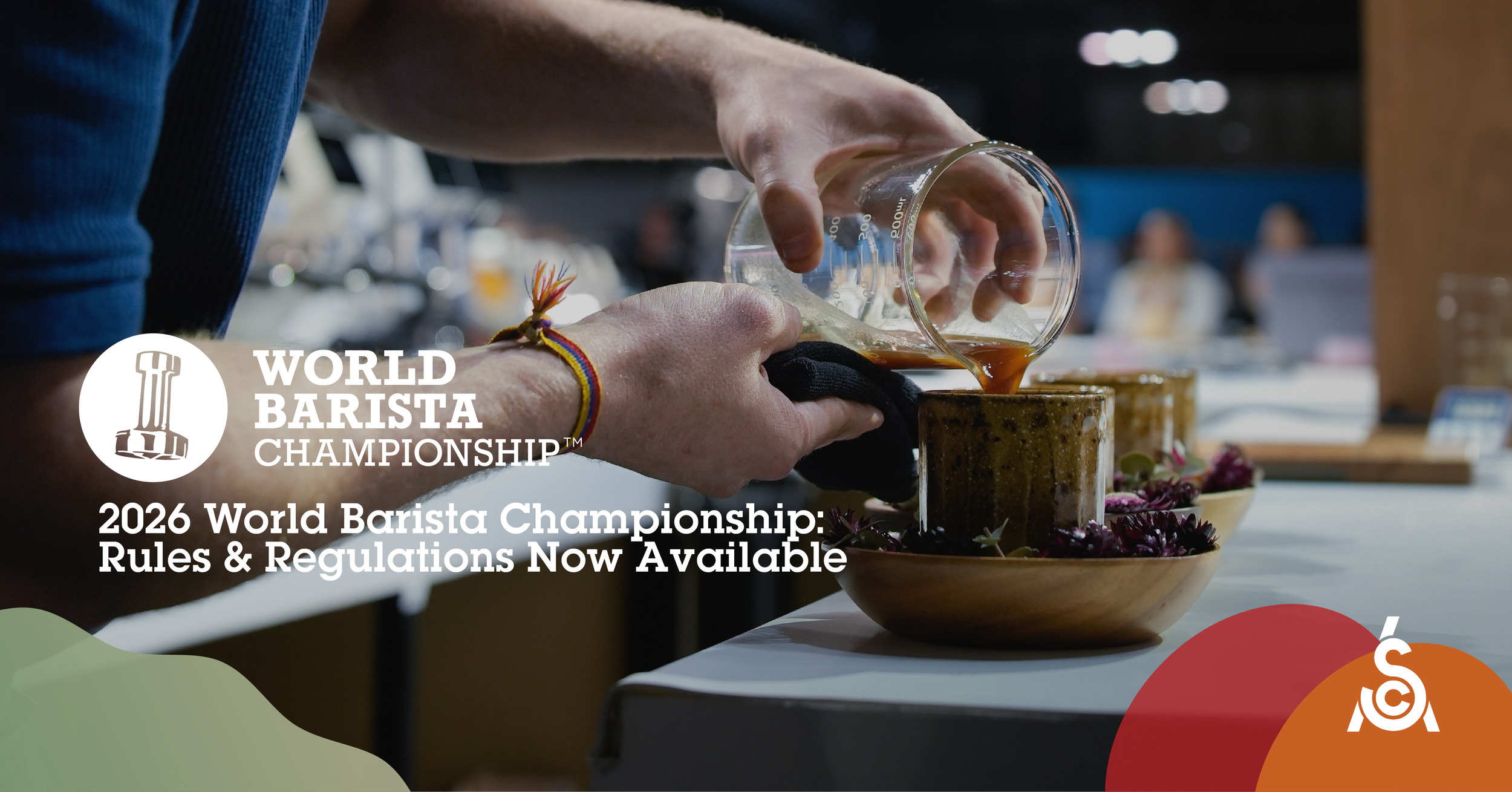
SCA Announces World Barista Championship Rules and Regulations Changes for 2026

Source: Specialty Coffee Association (SCA)
Author: Qahwa World – Dubai
Date: May 18, 2026

Executive Summary

  • The Specialty Coffee Association (SCA) released updated rules for the 2026 World Barista Championship (WBC) in Panama from October 22 to 25.
  • Changes include adjustments to water served to judges and clarified language on espresso shot quantities for the signature beverage.
  • A new option allows competitors to override the drink evaluation protocol for espresso and milk courses by not serving spoons.
  • Grinder regulations updated: Ceado provides standardized equipment with two approved models: REV Zero and E37Z-Naked.
  • Competitors may use up to two grinders, either provided or personal, as long as personal grinders match approved models with original parts only.
  • All grinders will be inspected and sealed by Ceado prior to competition.

Event Date and Location

The Specialty Coffee Association (SCA) has released updated rules and regulations for the 2026 World Barista Championship (WBC). The championship will take place from October 22 to 25, 2026, at World of Coffee Panama.

These updates aim to improve competition fairness and keep pace with specialty coffee industry developments. The new rules clarify several technical points raised in previous editions and enhance transparency in the judging process.

Key Changes to Judging Rules

The latest round of updates introduces three main changes. First, changes have been made to the water served to judges. Water is a critical element in coffee quality evaluation, and this adjustment aims to standardize tasting conditions for all competitors. Second, the language around the number of espresso shots competitors must prepare for the signature beverage has been clarified, removing any previous ambiguity in rule interpretation.

Third, the new rules allow competitors to override the drink evaluation protocol for the espresso and milk beverage courses by not serving spoons to judges. This change gives competitors greater flexibility in how they present their drinks, leaving them the choice between traditional spoon-based evaluation or alternative presentation.

New Grinder Regulations and Ceado’s Role

The grinder regulations for this year’s championship have seen important updates. Qualified sponsor Ceado will provide all competitors with standardized equipment, offering two approved grinder models: the REV Zero and the E37Z-Naked. Competitors may use up to two grinders and may choose between provided equipment or their personal grinders, as long as personal grinders are the same approved models with original parts only.

All grinders – both provided by the sponsor and personal ones – will be inspected and sealed by Ceado prior to competition. This procedure ensures a level playing field and prevents unauthorized modifications that could give an unfair advantage. Competitors can review full details on grinder selection, inspection procedures, modification rules, and equipment specifications in the supplemental Grinder Procedures document.

Item Details
Qualified Espresso Machine STORM “Barista Attitude”, Tempesta Espresso Machine
Qualified Espresso Grinder Ceado REV Zero and E37Z-Naked Grinders
Qualified Water Filtration Sponsor BWT water+more

Available Documents and Sponsors

The SCA announced that rules documents, summaries of changes, and scoresheets are now available on the World Coffee Championships website: wcc.coffee/rules-regulations. Competitors, coaches, and judges can download these documents and review full details before October.

The 2026 World Barista Championship features major sponsors for essential equipment. The qualified espresso machine is the STORM “Barista Attitude” and Tempesta Espresso Machine. The qualified espresso grinder is provided by Ceado as mentioned. The qualified water filtration sponsor is BWT water+more. The World Coffee Championships team looks forward to welcoming competitors, judges, and coffee professionals to Panama this October.

Frequently Asked Questions (FAQ)

1. When and where will the 2026 World Barista Championship take place?

The championship will take place from October 22 to 25, 2026, at World of Coffee Panama.

2. What are the main changes to the judging rules?

Changes include adjustments to water served to judges, clarified language on espresso shot quantities for the signature beverage, and the option to override the evaluation protocol by not serving spoons.

3. What grinder models are approved by Ceado?

The two approved models are the REV Zero and the E37Z-Naked. Competitors may use up to two grinders.

4. Can competitors use their own personal grinders?

Yes, provided they are the same approved models with original parts only. All grinders will be inspected and sealed by Ceado before competition.

5. Where can I find the complete rules documents?

On the official World Coffee Championships website: wcc.coffee/rules-regulations

6. Who are the main sponsors of the championship?

Espresso machines by STORM and Tempesta, grinders by Ceado, and water filtration by BWT water+more.

Author: Qahwa World – Dubai  |
Source: Specialty Coffee Association (SCA)  |
Publication date: May 18, 2026

Global Buzz After Italian Chef Declares: “Cappuccino Ends at 11 a.m.”

Dubai – Qahwa World

Italian celebrity chef Gino D’Acampo has stirred a wave of debate after posting a video on his social platforms in which he revealed a strict cultural rule about cappuccino. According to D’Acampo, the drink should never be consumed after 11 a.m., a tradition deeply ingrained in Italian coffee culture, while espresso remains the drink of choice throughout the day.

In the video titled “How to be a Proper Italian with Gino: When should you drink Cappuccino or Espresso?” he explained that there is a time for cappuccino and a time for espresso, and it is not as flexible as people outside Italy may assume. Espresso, he said, can be enjoyed any time, especially after lunch or dinner, because it helps stimulate blood circulation and aids digestion. Cappuccino, however, is an entirely different story.

Based on milk, the drink becomes heavy when consumed after meals, slowing down the digestive process rather than helping it. “Once it’s 11 o’clock, I’m done with cappuccino,” D’Acampo insisted. “I won’t drink it after that.

It’s not something Italians do. Milk after a meal is the last thing your body needs, while caffeine does the opposite and speeds up your system.”

His comments sparked a strong reaction online. The video quickly gained millions of views and triggered wide discussions among coffee lovers worldwide.

Some saw his declaration as a glimpse into the unique Italian approach to food and lifestyle, emphasizing balance, moderation, and cultural identity.

Others mocked the rule with comments like, “So milk after dinner is forbidden, but tiramisu with cream is allowed,” while many insisted that they would continue drinking whatever coffee they wanted, whenever they wanted.

Still, a significant number of viewers acknowledged that these traditions are what make Italy’s coffee culture distinctive and that experiencing coffee in Italy is as much about respecting these unwritten rules as it is about taste itself. D’Acampo, who was born in Naples and is now based in London, is well known for his humorous style and his efforts to share Italian culinary secrets with a global audience.

His remarks this time went beyond nutrition to highlight how Italians view coffee not only as a beverage but as a way of life, with strict rituals and timing that connect to health and social customs.

He reminded his audience that while cappuccino is perfect in the morning alongside a pastry, the rest of the day belongs to espresso, which Italians consume quickly at the bar, often standing, in a tradition that values efficiency and rhythm over size and variety.

The debate also underscores the tension between Italian authenticity and globalization. In places like the United States or the United Kingdom, coffee culture embraces oversized lattes, frappuccinos, and cappuccinos at any time of day.

In Italy, by contrast, the rules are precise: cappuccino before noon, espresso afterward, and rarely anything else. These rules may appear restrictive to outsiders, but for Italians they are a reflection of food wisdom passed down over generations. D’Acampo’s firm stance reflects this heritage.

While announcing that he will soon return with a new television program titled “Italian in Malta” and a separate acting project in Ireland, he reminded viewers that his greatest passion will always remain food.

For him, coffee etiquette is inseparable from Italian culinary identity, and ignoring it is to miss the essence of what it means to drink coffee like an Italian. His viral statement has reignited a timeless conversation about coffee: is it about following traditions and respecting cultural norms, or is it about personal freedom and preference? For Italians, the answer remains clear—cappuccino belongs to the morning, and once the clock strikes 11, it is espresso’s turn to reign.

10 Rules for Making Great Coffee: Everything You Didn’t Know About Moka Pots, Pods, and Ground Coffee

Dubai – Qahwa World

Making an excellent cup of coffee is an art and a science. Whether you prefer using a moka pot, coffee pods, or pre-ground coffee, these ten tips will help you perfect your brew and enhance your coffee experience.

  1. Choosing Between Moka, Pods, and Capsules
    Your preference matters. Moka coffee tends to have a stronger flavor, capsules offer consistency, and pods are the more sustainable choice.
  2. Checking Your Moka Pot’s Condition
    Run your finger along the inside rim of the moka pot’s boiler. If it feels rough instead of smooth, it’s time for a replacement.
  3. Espresso vs. Hyper-espresso Capsules
    Hyper-espresso capsules include a special chamber to prevent water leakage, mimicking barista-quality coffee at home. However, they are less environmentally friendly than standard capsules.
  4. Storing Ground Coffee
    After opening, consume ground coffee within six days for peak freshness. Storing it in the fridge can extend the flavor and aroma for up to 21 days.
  5. The Moka Pot Technique
    For moka lovers, ensure the water level in the boiler stays below the safety valve. Turn off the heat just before the coffee starts to sputter.
  6. Coffee Crema: A Quality Indicator
    The crema—the frothy layer on top—dissipates within 3-4 minutes. The longer it lasts, the better the coffee quality. Ideally, it should be a hazelnut shade with hints of dark brown.
  7. Barista Timing for Espresso
    At a café, espresso extraction should take 20 to 27 seconds, with a shot volume of 13 to 26 grams in the cup.
  8. Caffeine Content: Long vs. Short Shots
    Contrary to popular belief, the caffeine content in a long shot and a ristretto is the same. The difference lies in extraction time, not quantity.
  9. Grinding and Storing Coffee Beans
    Grind beans in 7-9 gram portions for immediate use. Ground coffee loses 65% of its aroma within 15 minutes. To preserve whole beans, store them in airtight containers to prevent the oils from oxidizing.
  10. Sugar or Sweeteners? Go Natural
    To fully appreciate the coffee’s flavor, skip sugar and sweeteners. Drinking it plain allows the true aroma and taste to shine.

By following these simple yet essential rules, you can elevate your coffee-making skills and enjoy a superior cup every time. Whether you’re a moka enthusiast or a pod aficionado, small adjustments can make a big difference.

Coffee Terminology Explained: Pods, Capsules, and Moka Pots
Understanding the key differences between coffee-making methods and tools can enhance your brewing experience. Here’s a quick guide:

  • Moka Pots: A classic stovetop method that produces strong, espresso-like coffee. Best for those who enjoy bold flavors and hands-on brewing techniques.
  • Coffee Pods: Compact, paper-based packages compatible with multiple machines. They are eco-friendlier than capsules but less effective in preserving coffee freshness.
  • Coffee Capsules: Vacuum-sealed, single-use containers made of aluminum or plastic. Known for maintaining freshness and delivering consistent results, though typically compatible with specific machines like Nespresso or Keurig.

These distinctions serve as a foundation for choosing the method that suits your taste and lifestyle, whether you’re a moka enthusiast, a sustainability advocate, or someone who values convenience and precision.