US Imports of Soluble Coffee from Russia More Than Tripled in Q1 202

By Ali Al Zakary – Moscow & Dubai | May 9, 2026 | 4 min read

Imports from Russia reached $641,900 in first quarter, while chicory purchases fell 15%

📋 Executive Summary – Key Data from US Statistics Service

  • 🇺🇸 Soluble coffee imports from Russia (Q1 2026): $641,900 (3.5x higher than Q1 2025)
  • 📉 Soluble coffee imports (March 2026 only): $191,400 (25% drop from February 2026)
  • 🇺🇸 Roasted chicory imports from Russia (Q1 2026): $13,800 (15% decrease year-over-year)
  • 📈 Roasted chicory imports (March 2026 only): $3,400 (41% increase month-over-month, 20% increase year-over-year)

1. Soluble Coffee Imports from Russia Surge

The United States, in the first quarter of 2026, more than tripled its imports of soluble coffee from the Russian Federation, according to a RIA Novosti report citing data from the US statistical service (Bureau of Labor Statistics).

Detailed breakdown:

  • During the first three months of 2026, the US imported soluble coffee from Russia worth $641,900.
  • This is 3.5 times higher than the same period in 2025 (Q1 2025).
  • However, in March 2026 alone, shipment volumes fell by nearly a quarter — to $191,400.

2. Chicory Imports from Russia Decline

At the same time, the United States reduced its purchases of roasted chicory from Russia — an alternative to coffee — during the first quarter of 2026.

Detailed breakdown:

  • For Q1 2026, chicory imports from Russia totaled $13,800.
  • This represents a 15% decrease compared to Q1 2025.
  • However, in March 2026, chicory purchases saw a 41% increase compared to February 2026, and a 20% increase compared to March 2025 — reaching $3,400.

3. Largest Suppliers to the US Market

Soluble Coffee:

The largest suppliers of soluble coffee to the United States were:

  • 🇲🇽 Mexico
  • 🇨🇴 Colombia
  • 🇧🇷 Brazil

Chicory:

The largest suppliers of chicory to the United States were:

  • 🇫🇷 France
  • 🇮🇳 India
  • 🇵🇱 Poland

4. Summary Table: US Imports from Russia, Q1 2026

Product Q1 2025 (estimated) Q1 2026 YoY Change March 2026 MoM Change
Soluble Coffee ~$183,400 $641,900 ▲ 250% $191,400 ▼ 25%
Roasted Chicory ~$16,200 $13,800 ▼ 15% $3,400 ▲ 41%

❓ Frequently Asked Questions (FAQ)

Q: Where does this data come from?
A: The data was obtained by the RIA Novosti news agency from the US statistical service (Bureau of Labor Statistics) for the first quarter of 2026.

Q: How significant is the growth in soluble coffee imports from Russia?
A: Imports grew 3.5 times year-over-year — from approximately $183,400 in Q1 2025 to $642,000 in Q1 2026.

Q: What happened to chicory imports?
A: Quarterly chicory imports decreased by 15% compared to last year, but March saw a 41% month-over-month increase and a 20% year-over-year increase.

Q: Which countries are the largest suppliers of these products to the US?
A: For soluble coffee — Mexico, Colombia, and Brazil. For chicory — France, India, and Poland.

📌 Disclaimer

This information is provided for informational purposes only and does not constitute individual investment advice.


✍️ About the author: Ali Al Zakary – Journalist based in Moscow and Dubai, specializing in foreign trade statistics analysis and economic relations between Russia and the Americas. Has been tracking US Bureau of Labor Statistics data since 2020.

Source: RIA Novosti, citing US statistical service (Bureau of Labor Statistics) data, May 2026.

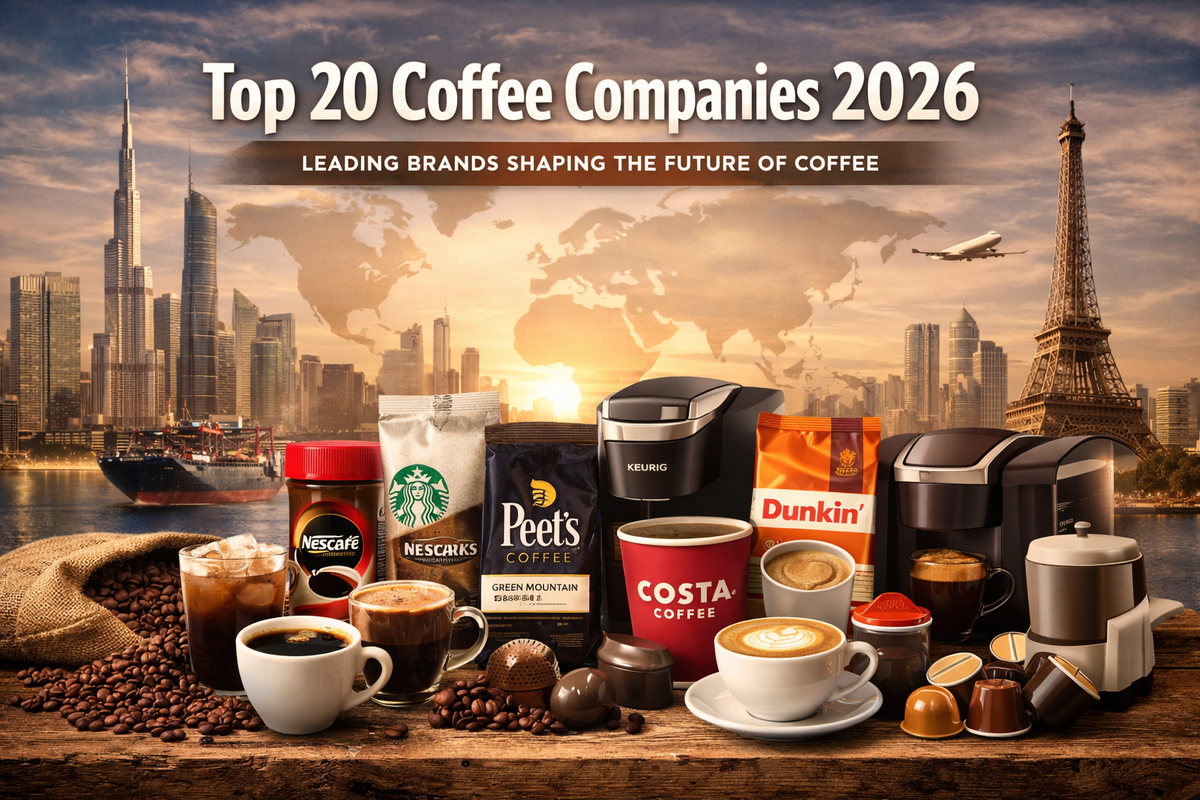
Top 20 Coffee Companies 2026

Dubai – Qahwa World

The global coffee market in 2026 is valued at around USD 145–176 billion, with projections reaching USD 227–275 billion by 2032–2034 at a CAGR of 5.1–6.6%. Growth is driven by premiumization, ready-to-drink (RTD) formats, single-serve pods, at-home brewing innovations, and sustainability-focused sourcing. Asia-Pacific is the fastest-growing region, while North America and Europe dominate in value through high-margin specialty products.

This report provides an independent ranking of the Top 20 Coffee Market Players for 2026, based on 2025–early 2026 industry data, including revenue analyses, packaged/at-home segment performance, and competitive landscape assessments. The ranking covers estimated global market share across packaged, at-home, and branded coffee products.

Key 2026 Developments

  • Nestlé leads in instant coffee and premium capsules.
  • JDE Peet’s and Keurig Dr Pepper remain separate; their $18 billion merger is expected to close in Q2 2026.
  • U.S. packaged giants like J.M. Smucker and Kraft Heinz maintain strong at-home segment presence.
  • Market fragmentation continues below the top tier, with specialty and regional players driving innovation.

Global Coffee Market Context (2026)

  • Market Value: USD 150–180 billion (estimated)
  • Key Formats: Packaged/at-home (dominant), ready-to-drink, single-serve, out-of-home retail
  • Growth Drivers: Premium/specialty demand, convenience, sustainability certifications, Asia-Pacific expansion
  • Challenges: Climate volatility affecting Brazil and Vietnam, traceability costs, ethical/direct-trade consumer preferences

Top 20 Coffee Companies (2026 Estimates)

Rank Company Name Key Coffee Brands Origin Country Estimated Market Share (%)
1 Nestlé S.A. Nescafé, Nespresso, Starbucks (at-home license) Switzerland 22.0
2 JDE Peet’s Jacobs, Douwe Egberts, Peet’s Coffee, Senseo, L’OR Netherlands 13.5
3 Keurig Dr Pepper Keurig pods, Green Mountain Coffee USA 9.8
4 Starbucks Corporation Starbucks pods, ground, RTD at-home USA 9.2
5 The J.M. Smucker Company Folgers, Dunkin’ (packaged/at-home) USA 5.5
6 The Kraft Heinz Company Maxwell House, other mass-market blends USA 4.8
7 Lavazza (Luigi Lavazza S.p.A.) Lavazza, Carte Noire Italy 4.5
8 Melitta Group Melitta (filter/pods), brewing products Germany 4.0
9 Tchibo GmbH Tchibo, European blends Germany 3.2
10 Strauss Group / UCC Strauss Coffee, UCC Coffee Israel / Japan 2.8
11 illycaffè (Illy) Illy, Segafredo Zanetti Italy 2.4
12 Tata Consumer Products Tata Coffee, Coffee Bean & Tea Leaf (at-home) India 2.1
13 Massimo Zanetti Beverage Group Segafredo, foodservice brands Italy 1.9
14 UCC Ueshima Coffee Co. UCC (canned/RTD) Japan 1.6
15 Farmer Bros. Co. Caribou Coffee (at-home) USA 1.3
16 JAB Holding Company (select assets) Peet’s, other premium holdings Belgium 1.1
17 The Coca-Cola Company (Costa) Costa Coffee (RTD/packaged) UK / USA 0.9
18 Intelligentsia Coffee / Blue Bottle Blue Bottle (premium) USA 0.7
19 Stumptown Coffee Roasters Stumptown (specialty) USA 0.6
20 Dutch Bros. Coffee Dutch Bros (packaged/RTD) USA 0.5

Total share of Top 20: Approximately 85–88%, with the remainder split among hundreds of independent and specialty roasters.

Strategic Positioning of Top Players

Global Giants (Ranks 1–4)

Nestlé dominates instant coffee and premium capsules while managing the Starbucks at-home license. JDE Peet’s and Keurig Dr Pepper lead in pods and convenience segments. Starbucks leverages its brand for strong at-home and ready-to-drink presence.

U.S. Packaged Leaders (Ranks 5–6)

J.M. Smucker (Folgers) and Kraft Heinz (Maxwell House) maintain significant U.S. market share with affordable, widely distributed coffee products.

European & Premium Specialists (Ranks 7–11)

Lavazza, Melitta, Tchibo, Strauss/UCC, and illycaffè focus on espresso and filter traditions, emphasizing quality-driven growth in Europe and emerging markets.

Niche & Emerging Players (Ranks 12–20)

Tata leverages Indian origin strength, Massimo Zanetti and UCC focus on RTD and foodservice, and specialty brands like Intelligentsia and Stumptown capture premium niches. Dutch Bros. and Caribou expand into packaged products.

Market Outlook 2026 and Beyond

The top 6–8 players control over 60% of the packaged and at-home market. Innovation flows from independent and specialty players. The pending Keurig Dr Pepper–JDE Peet’s merger could create a new global competitor rivaling Nestlé.

Critical success factors:

  • Investments in sustainability and traceability
  • Innovation in recyclable pods, functional RTD, and premium single-origin products
  • Adaptation to climate-driven supply risks and rising Robusta demand

This ranking is based on cross-verified industry data as of April 2026. The coffee market remains dynamic, culturally vital, and full of opportunity for players balancing scale with quality and consumer trust.

Data sourced from Coffeeness, Global Growth Insights, Expert Market Research, and other industry analyses for the packaged and at-home coffee segment.


Top Coffee Producers 2026

Dubai Qahwa World

As of April 2026, the global coffee market is undergoing a pivotal shift. Data from the International Coffee Organization (ICO) and the USDA show that the 2025/26 coffee year (October 2025–September 2026) has delivered record global supply, easing the extreme price pressures seen in 2024 and early 2025. World production is forecast at 178.8 million 60-kg bags (up 2% or +3.5 million bags year-on-year), while consumption reaches a record 173.9 million bags (+1.3%). Ending stocks remain tight at approximately 20.1 million bags, marking the fifth consecutive decline. Nevertheless, improved supply has caused ICO Composite Indicator Prices to drop sharply in early 2026 (February average: 267.57 US cents/lb, -9.9% month-on-month).

This supply surplus is driven by strong recoveries in Vietnam and Indonesia, record Ethiopian output, and steady performance in Brazil, despite drought impacts on key Arabica regions. National updates, including Brazil’s Conab first survey in February 2026, indicate an even stronger 2026 harvest, which could push global supply higher for 2026/27.

Top 10 Coffee-Producing Countries (2025/26 Forecast)

Data primarily from USDA December 2025 report, cross-verified with national sources and market analyses. Figures are green coffee equivalents. Percentages approximate global share.

Rank Country Production (M bags) % Global Main Variety YoY Change Key Notes
1 Brazil 63.0 ~35% Arabica (60%), Robusta/Conilon (40%) -2.0M (drought offset by Robusta gains) Record Robusta; Arabica hit by weather
2 Vietnam 30.8 ~17% Robusta (~95%) Recovery (+ higher yields) Fertilizer investment boosted output
3 Colombia 13.8 ~8% Arabica (100%, washed) -1.0M (excess rain/rust risk) Disease-resistant varieties helped
4 Indonesia ~12.5 ~7% Robusta (dominant) +1.7M (Robusta) Smallholder-dominated; favorable weather
5 Ethiopia 11.6 ~6.5% Arabica (specialty) Record (+0.5M) New varieties and pruning
6 Uganda ~6.9 ~3.9% Robusta Steady growth African Robusta leader
7 Honduras ~5.5–6.0 ~3% Arabica Part of Central America rebound Strong regional contributor
8 India ~5–6 ~3% Robusta (65%), Arabica (35%) Stable Specialty and organic focus
9 Peru ~4.2–5 ~2.5% Arabica (specialty/organic) Steady Premium export growth
10 Mexico / Guatemala ~3.8 each ~2% each Arabica Modest Central America/Mexico rebound

Total top 5: ~131.7M bags (~74% of world production). Latin America dominates Arabica; Asia leads Robusta.

Country Profiles: Drivers, Challenges, and 2026 Outlook

Brazil – World Leader (~35% of Global Supply)

Brazil remains the top producer. The 2025/26 crop saw Arabica decline to ~38M bags due to drought and high temperatures in Minas Gerais and São Paulo. Robusta surged to a record ~25M bags in Espírito Santo and Bahia thanks to better rainfall. Exports are forecast at ~37M bags.

  • Trends: Biennial cycle plus large-scale production with technology and irrigation. Funcafé funding supports the sector.
  • Challenges: Climate volatility, water stress, and EU Deforestation Regulation (EUDR) compliance.
  • 2026 Outlook: Conab’s February 2026 survey projects a record 66.2M bags (+17.1% YoY): Arabica +23.3% to 44.1M, Robusta +6.4% to 22.1M. This would surpass the 2020/21 record harvest.

Vietnam – Robusta Powerhouse

Nearly all output is Robusta, used in instant coffee and blends. Production rebounded due to favorable weather and higher input spending. Exports projected at 24.6M bags (+2.3M).

  • Trends: Export-oriented, rapid post-1990s expansion.
  • Challenges: Climate vulnerability in highlands; past dry spells.
  • 2026 Outlook: Continued recovery expected; early 2026 data shows strong export growth.

Colombia – Premium Arabica Specialist

100% washed Arabica. 2025/26 saw a modest decline due to excessive rains and cloud cover affecting flowering and rust risk. Disease-resistant varieties, such as Castillo, mitigated losses. Exports ~11.5M bags.

  • Trends: Focus on quality; yield improvements ongoing.
  • Challenges: Weather cycles, labor costs, altitude sensitivity.
  • 2026 Outlook: Rebound likely under normal conditions; key supplier to specialty markets.

Indonesia – Diverse Robusta and Specialty

Robusta dominates Sumatra and Java; small Arabica areas in the north. Production rose due to favorable weather and labor availability. Smallholder plots average 1 ha. Exports: green coffee +1.7M to 7.8M bags.

  • Trends: Stable land area (~1.2M ha), significant soluble coffee exports.
  • Challenges: Minimal fertilizer use, climate extremes.
  • 2026 Outlook: Stable supply to EU, US, and emerging markets expected.

Ethiopia – Africa’s Specialty Arabica Leader

Record 11.6M bags driven by adoption of higher-yielding varieties and pruning. Exports ~7.8M bags.

  • Trends: Natural and semi-washed processing; heirloom varieties remain globally sought.
  • Challenges: Smallholder fragmentation, highland climate variability, infrastructure limits.
  • 2026 Outlook: Growth likely if variety upgrades continue; specialty segment driver.

Emerging/Other Notable Producers

Uganda, Honduras, India, Peru, Mexico, and Guatemala produce the remaining ~25%. They are critical for Robusta (Uganda) and specialty/organic Arabica (Peru, India, Honduras). Central America/Mexico region rebounded +1.1M bags. India emphasizes premium niches (Monsoon Malabar, organic). All face smallholder and climate challenges but benefit from growing specialty demand.

Broader Trends Shaping 2026 and Beyond

  • Climate Change & Resilience: Droughts and excessive rains highlight vulnerability. By 2050, suitable coffee land may shrink significantly without adaptation.
  • Sustainability & Regulation: EUDR deadlines pressure exporters on traceability. Certifications (Fairtrade, organic, Rainforest Alliance) are growing, especially in Ethiopia, Colombia, and Peru.
  • Market Dynamics: High prices in 2024–25 spurred investment and supply recovery. Robusta exports surged in early 2025/26. Specialty demand remains robust.
  • Economic Impact: Coffee supports ~12.5 million farming households. Brazil and Vietnam dominate exports. Smallholders remain most vulnerable to volatility.
  • 2026/27 Outlook: Early forecasts indicate potential production above 180M bags if Brazil’s record harvest occurs and recoveries hold. Emerging markets will continue driving consumption growth.

Summary

2026 marks a transition from shortage-driven high prices to a more balanced, though still tight-stocks, market. Brazil’s dominance is set to strengthen, while Vietnam, Indonesia, and Ethiopia solidify their positions in Robusta and specialty segments. Long-term success depends on climate adaptation, sustainability, and innovation in varieties and processing. Opportunities abound in premium positioning and supply-chain resilience amid record availability.

This report draws on official forecasts as of early 2026. Data may be refined with subsequent national surveys, including Conab updates. Customized analysis, including by variety, export flows, or price scenarios, can be provided upon request.

 

Global Coffee Production Is Rising; Prices Are Falling

An Industry Perspective from Ethiopia

By Gizat Worku Kebede, General Manager of the Ethiopian Coffee Exporters Association.

Global coffee production is increasing; its price, meanwhile, is decreasing.

According to the new global coffee production forecast released on February 25, 2026, the world is set to produce a volume it has never seen before. Rabobank forecasts production of 180 million 60-kg bags global consumption, signaling continued supply expansion and potential downward pressure on prices.

Additional analyses highlight speculative fund liquidation and surplus conditions as contributing factors to price volatility. HedgePoint Global Markets forecasts Brazil’s 2026/27 exports at 47 million bags — a historical high — reinforcing expectations of softer price conditions.

The average price of Brazilian Natural coffee in the New York market declined from USD 3.43 per pound in January to USD 3.09 in February. This movement reflects prevailing market dynamics and broader supply-demand conditions.

The World Bank projects an average 13% price adjustment in 2026 compared to 2025 levels.

For Ethiopian exporters and suppliers, alignment between domestic pricing and global market trends remains essential for competitiveness and sustainable market participation. Price structures that reflect international benchmarks help safeguard export flows and foreign currency earnings in a volatile market environment.

This perspective is offered as an industry contribution to informed discussion on global coffee market developments.