The Ultimate Guide to Coffee Processing Methods Around the World: From Cherry to Cup

Dubai, 23 August 2025 (Qahwa World) – In the world of coffee, the journey from a ripe cherry on a tropical tree to the steaming brew in your mug is a tale of art, science, and global tradition. The coffee processing stage—where the fruit is transformed into green beans ready for roasting—is the crucible where flavors are shaped. This comprehensive guide explores coffee processing methods, diving into their histories, techniques, regional strongholds, and sensory impacts. Whether you’re a researcher seeking types of coffee processing, a barista curious about wet vs dry coffee processing, or an enthusiast exploring anaerobic coffee processing trends, this reference covers it all. Spanning over 70 coffee-producing countries, we’ll journey through time-honored methods like natural, washed, and honey processing, alongside cutting-edge innovations like anaerobic fermentation, which is gaining traction worldwide, including in Yemen.

With climate change reshaping coffee production, processing methods are evolving to balance sustainability and flavor innovation. By 2025, the rise of anaerobic processing in countries like Yemen highlights its growing appeal. Let’s uncover the full story.

The Origins of Coffee Processing: A Historical Perspective

Coffee’s story begins in Ethiopia around the 9th century, where wild Coffea arabica plants were first harvested. Early farmers dried whole cherries under the sun, birthing natural coffee processing. As coffee spread through Yemen and the Middle East to the Americas by the 18th century, diverse climates and resources spurred new techniques. Processing significantly influences a coffee’s flavor profile—many experts estimate it can account for around 30%—shaping acids, sugars, and volatile compounds through microbial activity and fermentation time. For researchers studying coffee biochemistry or sustainability, this guide offers a foundation for understanding these dynamics.

Natural (Dry) Processing: The Timeless Tradition

Natural coffee processing, or dry processing, is the oldest method, requiring minimal water and relying on sunlight. Whole cherries are spread on patios, raised beds, or rooftops and dried for 2–4 weeks, turned regularly to prevent mold. The bean absorbs sugars from the fruit, and the dried husk is hulled at 11% moisture.

Key Regions and History

  • Ethiopia: The origin, producing Yirgacheffe naturals with wild strawberry notes.

  • Brazil: The world’s top producer, using mechanized farms for consistency.

  • Yemen and Indonesia: Ancient terraces yield complex, winey profiles.

Flavor Profile and Science
Natural processing creates full-bodied, low-acidity cups with sweet, fruity notes like blueberry or chocolate. The bean ferments inside the fruit, boosting ethyl butyrate esters for fruity aromas. Risks include mold in humid conditions, requiring careful management. Variations include African raised-bed drying for airflow and Brazilian mechanical dryers for rainy seasons.

Washed (Wet) Processing: Precision and Clarity

Pioneered in Central America in the 19th century, washed coffee processing suits wet climates. Cherries are depulped, fermented in water tanks for 12–48 hours to remove mucilage, washed, and dried to 10–12% moisture.

Key Regions and History

  • Colombia and Kenya: Abundant rivers produce bright, citrusy coffees.

  • Guatemala, Nicaragua, Rwanda: High-altitude farms emphasize acidity.

Flavor Profile and Science
Washed coffees are clean and vibrant, with high acidity and notes like green apple or jasmine. Fermentation breaks down pectins via yeast and bacteria, clarifying terroir. Though water-intensive (20–40 liters per kilo), it reduces defects. Innovations include Kenyan double-washing for brightness and mechanical aquapulping to save water.

Honey (Pulped Natural) Processing: The Sweet Hybrid

Originating in Costa Rica in the mid-20th century, this hybrid method conserves water. Cherries are depulped, leaving varying mucilage (the “honey”) during drying for 8–30 days.

Key Regions and History

  • Costa Rica: Classifies as Yellow (minimal mucilage, grainy acidity), Red (balanced sweetness), or Black Honey (floral, syrupy).

  • Brazil (Pulped Natural), El Salvador, Panama: Used for premium lots.

Flavor Profile and Science
Sweeter than washed, cleaner than natural, with caramel, stone fruit, and honey notes. Mucilage caramelization enhances sucrose absorption. It’s eco-friendly but needs monitoring to avoid over-fermentation.

Wet Hulled (Giling Basah): Indonesia’s Earthy Signature

For humid climates, wet hulled coffee processing (semi-washed or Giling Basah) emerged in 19th-century Indonesia. Cherries are depulped, briefly fermented, hulled at 30–35% moisture, and dried further.

Key Regions and History

  • Indonesia (Sumatra, Java): Suits rainy climates, producing bold Mandheling coffees.

  • Papua New Guinea: Similar adaptations.

Flavor Profile and Science
Low acidity, heavy body, with earthy tobacco and dark chocolate notes. Rapid microbial activity in humid conditions risks defects but creates unique profiles.

Emerging Innovations: The Rise of Anaerobic and Fermentation-Driven Methods

The specialty coffee boom has sparked fermentation innovations, with anaerobic coffee processing leading the charge. Inspired by winemaking, it involves sealing beans in oxygen-free tanks for 12–72 hours, enhancing exotic flavors. By 2025, anaerobic processing is surging globally, including in Yemen, where farmers are adopting it to boost quality and demand.

Key Regions and History

  • Colombia and Costa Rica: Pioneers of anaerobic, yielding peach or yogurt notes.

  • Yemen: Recent adoption (post-2020) enhances Mocha coffee’s complex flavors, with airtight bags or barrels used for up to 120 hours, compared to traditional 10–20 hour wet fermentation. Professional tasters note increased recognition for Yemeni coffee globally.

  • Ethiopia, Brazil, Panama: Experimenting for premium lots.

  • Vietnam: Applying to robusta for bold, innovative profiles.

Flavor Profile and Science
Anaerobic fermentation produces intense, fruit-forward, or winey flavors (lactic acids create cheesy or yogurt-like notes). Yemen’s anaerobic coffees highlight natural aromas, balancing acidity. Variations include:

  • Carbonic Maceration: CO₂-infused tanks (Panama, Kenya) yield banana or whisky notes, starting in 2015.

  • Lactic Processing: Emphasizes creamy textures via milk-like bacteria.

  • Frozen Natural: Chilling cherries preserves brightness.

These methods enhance volatiles but may reduce bioactives like caffeine. They’re costly but fetch high prices in specialty markets.

Coffee Processing Methods Comparison: Insert Table Here

COFFEE PROCESSING METHODS COMPARISON
Method Key Regions Water Use Drying Time Flavor Profile Pros / Cons
Natural (Dry) Ethiopia, Brazil, Yemen Low 2–4 weeks Fruity, sweet, full-bodied Eco-friendly; risk of mold
Washed (Wet) Colombia, Kenya, Guatemala High 1–2 weeks Clean, bright acidity Consistent quality; water-intensive
Honey (Pulped) Costa Rica, Brazil, Panama Medium 1–4 weeks Sweet, caramel, balanced Sustainable; requires monitoring
Wet Hulled Indonesia (Sumatra) Medium ~1 week Earthy, heavy body, low acid Fast process; higher risk of defects
Anaerobic Colombia, Costa Rica, Yemen Varies Varies Exotic, winey, lactic, fruity Innovative; costly; experimental
Carbonic Maceration Panama, Kenya Low Varies Wine-like, banana, whisky Premium lots; inspired by winemaking

The Future of Coffee Processing: Sustainability and Global Trends

As climate change threatens yields, low-water methods like honey and anaerobic are gaining ground. Yemen’s shift to anaerobic processing, reported in 2025, reflects a broader trend toward flavor innovation and market competitiveness. AI-monitored fermentations and thermal shock (quick freezing) are emerging, with researchers predicting wider adoption by 2030. The Specialty Coffee Association offers resources for studying these trends.

FAQ: Common Questions on Coffee Processing

What is anaerobic coffee processing?
A fermentation in oxygen-free tanks, producing exotic flavors, increasingly used in Yemen and Colombia.

Why is anaerobic processing popular in 2025?
It enhances flavor complexity, boosting demand in specialty markets.

How does processing affect coffee quality?
It shapes acidity, body, and defects through microbial and chemical changes.

What are the best coffee processing methods?
Natural for sweetness, washed for clarity, anaerobic for innovation.


This ultimate guide to coffee processing methods is a definitive resource for researchers, baristas, and enthusiasts searching for anaerobic coffee processing Yemen or global coffee processing techniques. Each method tells a story of tradition, innovation, and environment, ensuring every sip is a chapter in coffee’s global legacy.
The Rise of Coffee Chains

By: Serkan Oral

The 21st century is the age of coffee chains more than any other. Coffee beans are becoming as valuable as gold. The sector continues its upward trend, driven by the rapid expansion of coffee chains worldwide.

Let’s talk numbers.
Between 2015 and 2024, global coffee imports reached a total of $370.3 billion. The United States accounted for $69.2 billion of this total, followed by Germany with $41.9 billion and France with $28.9 billion. Other major importers included Italy, Canada, Belgium, Spain, Japan, the Netherlands, and Switzerland, with their combined imports amounting to $238.5 billion. Altogether, the top 10 coffee importers represented 64.4% of the global market during the past decade.

There are also emerging markets on the rise.

Meanwhile, Brazil stood as the world’s largest coffee exporter, with exports over the past decade totaling $360.3 billion, followed by Switzerland with $28.7 billion and Colombia with $28.6 billion. Other significant exporters were Germany, Vietnam, Italy, Honduras, France, Belgium, and Indonesia.

Türkiye carries a dual identity in the global coffee story — as both the heir to the Ottoman coffee legacy and as a modern hub for new-generation coffee culture.

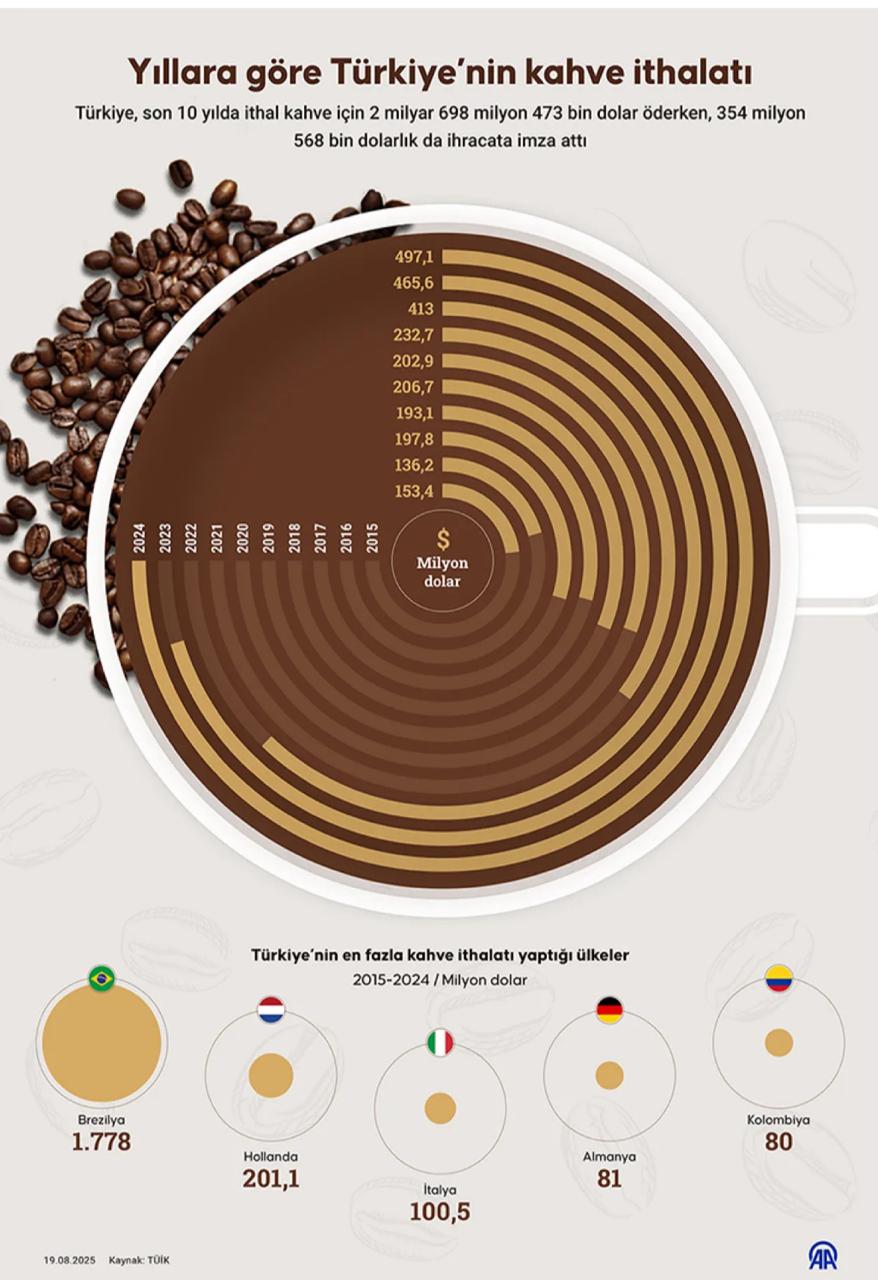
Türkiye’s coffee imports between 2015 and 2024 reached $2.7 billion, with prices for imported coffee rising from $153.4 million in 2015 to $497.1 million in 2024, marking an increase of 224%, according to the national statistical bureau TurkStat.

On the export side, Türkiye recorded $354.5 million worth of coffee exports over the last decade, including $55.6 million in the first half of this year alone.

Türkiye imported most of its coffee from Brazil, totaling $1.7 billion, followed by the Netherlands with $201.1 million, Italy with $100.5 million, Germany with $80.9 million, and Colombia with $79.9 million. The country’s imports stood at $472.5 million as of June, with Brazil remaining its top supplier.

The world’s coffee consumption — both hot and iced — over the past decade totaled $370.3 billion, according to data from the International Trade Center (ITC). The United States was the largest importer, while Brazil dominated exports.

Personally, I prefer iced coffee on summer afternoons, but I always start my day with a hot Turkish coffee. For Turks, the tradition of the 11 a.m. coffee break continues as a nationwide ritual. Around the world, specialty coffee is also gaining momentum, and habits are evolving quickly.

The golden era of coffee and coffee shops has already begun, spreading across continents. More lovely qahwa days are on the horizon.

Brazil Weather and U.S. Tariffs Drive Coffee Prices to Multi-Month Highs

Dubai, August 19, 2025 (Qahwa World) – Coffee prices surged on Tuesday, with arabica futures climbing to a 2.25-month high and robusta reaching a two-month high, supported by dry conditions in Brazil’s key growing regions and tightening U.S. supplies following new tariffs on Brazilian coffee.

September arabica coffee (KCU25) rose 1.85% (+6.35¢/lb), while September ICE robusta (RMU25) gained 4.04% (+$168). The rise reflects mounting concern over Brazil’s weather, particularly in Minas Gerais, the country’s largest arabica-producing state, where Somar Meteorologia reported no rainfall during the week ending August 16.

Market support is also coming from the United States, where buyers are avoiding new contracts for Brazilian coffee due to a 50% tariff imposed on imports. Brazil typically supplies about one-third of U.S. unroasted coffee, making the tariff impact significant for roasters and traders.

Brazil’s July export figures further underscored supply concerns. According to the Trade Ministry, unroasted coffee exports fell 20.4% year-on-year to 161,000 metric tons. Exporter group Cecafé reported that green coffee shipments dropped 28% y/y to 2.4 million bags, while total coffee exports fell to 2.7 million bags. From January to July, Brazil’s overall exports declined 21% to 22.2 million bags.

Certified exchange inventories remain tight. ICE arabica stocks fell to a 1.25-year low of 726,661 bags on August 14 before recovering slightly to 733,105 bags this week. ICE robusta stocks dropped to a three-week low of 6,749 lots, down from late-July’s two-year high of 7,029 lots.

On the supply side, Brazil’s 2025/26 coffee harvest is advancing. Research firm Safras & Mercado estimates the crop was 94% complete as of August 6, with robusta nearly finished (99%) and arabica at 91%. Cooxupé, Brazil’s largest coffee cooperative, reported its members had completed 80.4% of their harvest by August 8.

Beyond Brazil, Vietnam’s coffee industry continues to influence robusta prices. Drought reduced 2023/24 production by 20% y/y to 1.47 million metric tons, the lowest in four years, while 2024 exports fell 17.1% to 1.35 million metric tons. However, recovery signs emerged with January–July 2025 exports up 6.9% y/y to 1.05 million metric tons.

The International Coffee Organization (ICO) reported that global coffee exports in June rose 7.3% y/y to 11.69 million bags, though October–June totals slipped 0.2% to 104.14 million bags.

Looking ahead, the USDA’s Foreign Agricultural Service (FAS) projects 2025/26 world coffee production at a record 178.7 million bags, up 2.5% year-on-year. Arabica output is expected to fall 1.7% to 97 million bags, while robusta is forecast to rise 7.9% to nearly 82 million bags. Ending stocks are projected to grow 4.9% to 22.8 million bags.

However, trader Volcafe sees a very different balance: a global arabica deficit of 8.5 million bags in 2025/26, the fifth consecutive year of shortages and larger than the 5.5 million bag deficit recorded in 2024/25. This highlights continued market tightness despite record overall supply projections.

Geadas atingem cafezais no Cerrado Mineiro e preocupam produtores

São Paulo, 18 de agosto de 2025 (Qahwa World) – Cafezais da região de Patrocínio, considerado o maior município produtor de café do mundo, foram atingidos por geadas na madrugada de segunda-feira, segundo informou à Reuters o presidente da Federação dos Cafeicultores do Cerrado, Gláucio de Castro. O fenômeno climático pode ter afetado os botões florais destinados à próxima safra.

Além de Patrocínio, municípios vizinhos como Araxá e Indianópolis, também localizados no Cerrado Mineiro – região estratégica para a produção de café arábica do Brasil – registraram geadas. Contudo, Castro ressaltou que a real dimensão dos danos só poderá ser confirmada após o período de floradas.

Impacto preliminar

De acordo com a avaliação inicial, as geadas foram classificadas como “de capote”, atingindo principalmente a parte superior das plantas. Embora menos intensas e abrangentes que as ocorridas em 2021, quando a safra seguinte foi severamente comprometida, elas ainda podem reduzir o potencial produtivo.

“As geadas dessa vez foram mais de capote, pegaram mais o lado superior da planta. Mas, de qualquer forma, afeta”, afirmou Castro.

O dirigente destacou que os botões florais atingidos são sensíveis e poderiam florescer entre setembro e outubro, com a chegada das chuvas. No entanto, os efeitos do frio podem se revelar apenas mais adiante. “Essa queima dos botões florais é meio silenciosa, só vamos ver para frente se vai abrir flor”, explicou.

Levantamentos em andamento

As cooperativas do Cerrado Mineiro estão realizando levantamentos sobre eventuais perdas. Segundo relatos preliminares de produtores, os danos representariam cerca de um terço do impacto causado em 2021. Entretanto, Castro alertou que é cedo para estimar números com precisão.

Em casos de geadas mais intensas, quando ambos os lados da planta são comprometidos, os agricultores recorrem ao “esqueletamento” – poda drástica que implica na perda total da produção da safra seguinte.

Reflexo no mercado

Na segunda-feira, o café arábica negociado na bolsa ICE encerrou em alta de quase 4%, impulsionado pelos relatos de geadas no Brasil, maior produtor e exportador global da commodity. Porém, nesta terça-feira, os preços recuaram, devolvendo parte dos ganhos.

Situação em outras regiões

Cooperativas do Sul de Minas, como a Cooxupé (Guaxupé) e a Minasul (Varginha), informaram que as geadas se concentraram em áreas de baixada, sem maiores danos às lavouras.

Segundo a consultoria StoneX, o Sul de Minas deverá produzir pouco mais de 15 milhões de sacas de 60 kg em 2025, enquanto o Cerrado Mineiro deve registrar 6,2 milhões de sacas.

Coffee Prices Rise on Light Frost in Brazil and Sharp Decline in Robusta Exports

Dubai, 13 August 2025 (Qahwa World) – Coffee futures gained on Wednesday, supported by reports of light frost in Brazil’s Cerrado Mineiro region and a significant drop in the country’s robusta exports.

September arabica coffee (KCU25) closed up +4.45 cents (+1.41%), while September ICE robusta coffee (RMU25) surged +206 points (+5.53%) to reach a two-month high.

Weather Impact

Light frost earlier this week in Cerrado Mineiro, one of Brazil’s key arabica-producing areas, prompted concerns in the market, although initial assessments suggest damage is minimal. Above-average rainfall in Minas Gerais last week (4.8 mm, or 109% of the historical average) eased dryness concerns, potentially limiting upward price pressure.

Exports Driving the Rally

According to exporter group Cecafe, Brazil’s July green coffee exports fell -28% year-on-year to 2.4 million bags. Arabica exports declined -21%, while robusta exports plunged -49%. Total July coffee exports dropped -28% to 2.7 million bags, with January–July shipments down -21% to 22.2 million bags.

The sharp decline in robusta exports, combined with short-covering after previous market losses, was a major factor behind robusta’s price surge. Brazil’s July unroasted coffee exports also fell -20.4% y/y to 161,000 metric tons.

Falling Inventories

ICE-monitored arabica inventories fell to a 1.25-year low of 736,411 bags on Wednesday. Robusta inventories dropped to a two-week low of 6,928 lots, slightly below the one-year high recorded at the end of July.

Harvest Progress

Safras & Mercado reported that Brazil’s 2025/26 coffee harvest was 94% complete as of August 6, ahead of last year’s 92% at the same time. Robusta harvest is 99% finished, while arabica is 91% complete. Cooxupé, Brazil’s largest coffee cooperative and exporter, said its members had harvested 80.4% of their crop by August 8.

Trade Policy Concerns

Market attention is also on U.S. trade policy, as President Trump has yet to exempt coffee from a proposed 50% tariff on Brazilian exports, a move that could impact sales to the U.S. and increase domestic inventories in Brazil.

Global Supply Picture

The International Coffee Organization (ICO) reported global coffee exports in June rose +7.3% y/y to 11.69 million bags, though cumulative October–June exports slipped -0.2% to 104.14 million bags.

The USDA’s June forecast projects global 2025/26 coffee production will rise +2.5% y/y to a record 178.68 million bags, with arabica output down -1.7% to 97.02 million bags and robusta production up +7.9% to 81.66 million bags. Ending stocks are expected to increase +4.9% to 22.82 million bags.

Vietnam’s Role in Robusta Supply

Vietnam’s 2023/24 coffee production fell -20% y/y to 1.472 million metric tons due to drought—the smallest crop in four years. The Vietnam Coffee and Cocoa Association has lowered its 2024/25 production forecast to 26.5 million bags, down from December’s estimate of 28 million bags. However, Vietnam’s Jan–July 2025 exports rose +6.9% y/y to 1.05 million metric tons.

Deficit Outlook

Despite higher overall global production, Volcafe forecasts a -8.5 million bag global arabica deficit in 2025/26—wider than the -5.5 million bag shortfall in 2024/25—marking the fifth consecutive year of deficits.

Cold Snap Threatens Brazil’s 2026 Coffee Crop During Early Flowering

Dubai, 13 August 2025- (Qahwa World) – As Brazil’s 2025 harvest concludes, attention is already turning to the next season — and early signs show potential trouble ahead. Early flowering has begun in several major coffee-growing regions, a stage when trees are especially vulnerable to weather changes. Recent cold temperatures in Minas Gerais and São Paulo have sparked frost concerns, prompting urgent on-the-ground assessments.

Flowering is underway in:

  • South of Minas – a high-altitude sub-region in Minas Gerais with dense specialty Arabica plantings, currently slightly behind in development.

  • Cerrado Mineiro – a designated coffee-producing area recognized for its dry harvest season and consistent quality.

  • São Paulo – including Mogiana, known for its fertile volcanic soils.

Over the past 24 hours, temperatures have fallen sharply. Patrocínio, in Cerrado Mineiro, recorded an early morning low of 1.9°C, with light frost confirmed in parts of the region. Initial reports point to minor visible damage so far. Weather forecasts indicate lows below 10°C across much of Minas Gerais through August 15, with frost risk at 50–70% in higher-altitude zones.

Potential Impact on Brazil’s Supply
While current assessments suggest limited frost damage, agricultural analysts caution that even without visible frost, low temperatures during flowering can reduce fruit set and lower yields. This could tighten Brazil’s 2026 coffee supply — a concern magnified by the recently imposed 50% U.S. tariff on Brazilian green coffee. Any further cold fronts in the coming days could escalate risks and push global coffee prices higher.

The next week will be critical in determining how weather conditions will shape Brazil’s production outlook for the year ahead.

Tight Supplies Push Coffee Prices to Multi-Week Highs in September 2025

Dubai, 12 August 2025 (Qahwa World) – The global coffee market saw a sharp rally at the start of August, with September Arabica futures (KCU25) rising by 14.00 cents (+4.53%) to hit a seven-week high, while September Robusta futures (RMU25) climbed 188 points (+5.28%) to a four-week high. The surge was fueled by clear signs of tightening supply in the world’s largest producing countries, driven by lower exports and falling inventories.

Brazil’s Trade Ministry reported that the country’s exports of unroasted coffee in July dropped 20.4% year-on-year to 161,000 metric tons. At the same time, ICE-monitored Arabica inventories fell to a 14.5-month low of 738,095 bags, while Robusta stocks declined to a two-week low of 6,981 lots.

Markets are closely watching the United States’ stance on import tariffs, as President Trump has yet to announce an exemption for coffee from the 50% import duty on Brazilian exports — a move that could impact U.S. sales and boost domestic inventories in Brazil.

In weather developments, Minas Gerais, Brazil’s largest Arabica-growing region, recorded 4.8 mm of rainfall during the week ending 9 August, amounting to 109% of the historical average, easing drought concerns. Harvest progress remains swift, with Safras & Mercado estimating that 94% of the 2025/2026 crop had been completed as of 6 August (99% for Robusta and 91% for Arabica). Cooxupé, the country’s largest coffee cooperative and exporter, reported its members had harvested 74% of their crop by 1 August.

Globally, the International Coffee Organization’s monthly report showed that June exports rose 7.3% year-on-year to 11.69 million bags, while cumulative exports from October to June slipped 0.2%.

In recent months, prices have faced downward pressure from expectations of abundant supply. In June, the U.S. Department of Agriculture forecast Brazil’s 2025/2026 coffee production at 65 million bags (+0.5%), and Vietnam’s output at 31 million bags (+6.9%, the highest in four years). The USDA also projected record global output of 178.68 million bags (+2.5%), with Arabica production down 1.7% and Robusta production up 7.9%. Ending stocks are expected to rise 4.9% to 22.82 million bags.

Brazil’s Coffee Exporters Council (Cecafe) reported that June green coffee exports fell 31% year-on-year to 2.3 million bags, with Arabica shipments down 27% and Robusta down 42%. In Vietnam, 2023/2024 production dropped 20% year-on-year due to drought, hitting a four-year low, while exports from January to July 2025 rose 6.9% to 1.05 million metric tons.

Volcafe projects that the global Arabica market will post a deficit of 8.5 million bags in 2025/2026, compared to a 5.5 million-bag deficit in 2024/2025, marking the fifth consecutive year of shortfall.