ICO: Coffee Prices Hit Historic Surge as Exports Decline

Dubai, September 3, 2025 (Qahwa World) – The International Coffee Organization (ICO) in its August 2025 report revealed unprecedented shifts in the global coffee market, with the ICO Composite Indicator Price (I-CIP) rising by 14.6% to 297.05 US cents per pound – its highest level since 2024 and 24.3% higher year-on-year. At the same time, the report highlighted that global green coffee exports continued to contract for the sixth consecutive month, underscoring the dual pressure of soaring prices and shrinking supplies.

Historic Price Surge
According to the ICO, all coffee groups recorded strong gains. Robusta led the surge with a 19.1% increase to 199.13 US cents per pound, while Colombian Milds, Brazilian Naturals, and Other Milds rose between 12% and 14%. Futures prices also jumped sharply, with New York contracts up 13.6% and London contracts up 18.2%, signaling broad-based upward momentum.

Market Drivers
The report identified multiple factors fueling the rally:

  • The United States’ 50% tariff on Brazilian coffee, slowing down commercialization.

  • Brazil’s government support through the Funcafé fund, allocating BRL 6.8 billion (USD 1.29 billion) to finance the 2025/26 harvest.

  • Reports of lower bean density in Brazil despite large screen size, reducing crop estimates.

  • European roasters stockpiling ahead of the EU’s Deforestation Regulation (EUDR) deadline in December 2025.

  • A minor frost in Brazil damaging up to half a million bags.

  • Roasters increasing long positions in futures markets to hedge against further price hikes.

Export Downturn
The ICO report also showed global green coffee exports reaching 10.3 million bags in July 2025, down 0.7% from July 2024. South America posted the steepest decline (-18.5%), driven by Brazil’s 28.6% fall in shipments.

Regional Contrasts

  • Asia & Oceania exports surged by 22.7%, led by Vietnam (+29.4%) and Indonesia (+20.4%).

  • Africa’s exports rose 4.4%, with Uganda (+51.4%) and Ethiopia (+12.5%) as key contributors.

  • Mexico & Central America posted a moderate increase of 7.2%.

Looking Ahead
The ICO emphasized that the combination of rising prices and falling exports places the global coffee market in a volatile phase. With the EUDR coming into effect by year-end and climate-related risks looming over major producers, coffee is set to remain one of the most vulnerable agricultural commodities to both economic and environmental shocks.

Brazil Estimates Coffee Export Losses at $196.5 Million

Cecafé: Brazilian coffee exporters lost nearly $200 million in July 2025

Dubai, September 3, 2025 (Qahwa World) – Brazil, the world’s largest coffee producer and exporter, has faced severe challenges due to disruptions in its port infrastructure. According to the Brazilian Coffee Exporters Council (Cecafé), total exporter losses in July 2025 amounted to $196.5 million.

Cecafé reported that overloaded and strained port facilities caused massive delays and forced changes in shipping routes. As a result, more than 598.7 thousand 60-kg bags of coffee could not be shipped in July. The average value of a bag was $385.4, while the longest idle period reached 35 days. In total, exporters lost the equivalent of 1.1 billion reals ($196.5 million), and shipments to the global market fell by 27%, dropping to 164 thousand tons.

Beyond logistical problems, Brazilian farmers also faced prolonged frosts. Experts warned that these unfavorable weather conditions triggered stress flowering, which could negatively impact not only the 2025 harvest but also next year’s production.

The disruptions in Brazil and Vietnam have already intensified pressure on the global coffee market. In New York, arabica prices rose to a two-month high in July, while in London, on November 27, the January futures price for robusta reached $5,547.5 per ton (+7.55%), setting a record since at least January 2008, according to ICE Futures.

Luza Baiguzina, Associate Professor at IMES, previously warned that difficulties with exports from Brazil and Vietnam could push coffee prices in Russia up by as much as 20% in 2026.

The Coffee Race: From Corporate Giants to Startups… Who Will Shape the Future?

Dubai – Ali Alzakry

The sale of Geisha coffee from the famed “Hacienda La Esmeralda” at the “Best of Panama 2025” auction was no ordinary event. A historic record was set when the washed Geisha fetched an unprecedented $30,204 per kilogram. Yet the bigger surprise was not the price itself, but the buyer: a Dubai-based startup, just one week old at the time, that stunned the industry by purchasing the entire 20-kilogram lot for a staggering $604,000. A dramatic scene that shook the markets and ignited debates among experts, investors, and coffee leaders worldwide.

And the shocks did not stop there. The sector was soon rattled by a string of announcements: “Coca-Cola” revealed it is considering the sale of “Costa Coffee”; “Burgerizzr” announced its acquisition of 60% of the café chain “Shuffle”; and a historic milestone was recorded with “Keurig Dr Pepper” acquiring “JDE Peet’s” for €15.7 billion. A whirlwind of events that disrupted the landscape and raised big questions about the future of coffee in Dubai and across the globe.

These developments prompted us at Qahwa World to open this file seriously, guided by the voices of seasoned leaders and pioneers in the coffee sector — people who combine boldness with credibility, and who know the market intimately. With them, we explored critical questions:

  • Are these events just a passing wave of headlines, or the signs of a long-term transformation?

  • How will Dubai and the region be impacted?

  • And what do these deals mean for producers, independent roasters, and young entrepreneurs?

Diverging Views: From Showmanship to the Core of Coffee

When we asked coffee experts about these developments, their views revealed striking contrasts — an intellectual confrontation that highlights the complexity of the challenges ahead.

“Kim Thompson” sees the sale of “Costa Coffee” as simply corporate repositioning that does not affect the fundamentals of specialty coffee, emphasizing that true value lies in farmer relationships. “Matt Toogood,” however, warns that extravagant moves — such as buying an entire lot of Geisha at a record price — risk harming the industry more than helping it. In contrast, “Katerina Borodich” argues that coffee has now become a strategic sector in its own right, while “Federico Ortile” views these changes as a signal of the industry’s shift toward innovation and partnerships. “Robert Jones,” meanwhile, believes we are at the dawn of a new era in coffee, with the global map being redrawn.

Kim Thompson: “Big Deals Don’t Change the Core of Specialty Coffee”

“Kim Thompson,” co-founder of “RAW Coffee Company,” describes Coca-Cola’s potential sale of “Costa Coffee” as interesting but unsurprising. She stresses that such moves do not alter the essence of what companies like RAW Coffee do: sourcing directly from trusted producers, ensuring fair trade, and serving customers who value quality and transparency.

According to Thompson, multinational repositioning reflects shareholder priorities, but the real work happens at origin and in independent roasteries. Corporate headlines may ripple across markets, but they do not affect the heart of the sector: ensuring farmers are fairly paid and consumers are served authentic coffee.

She notes that the industry’s deeper transformation lies in changing consumer tastes, rising interest in specialty coffee, and recognition of coffee as both culture and commodity.

On Panama, she believes that a Dubai startup purchasing the entire Geisha lot was headline-grabbing but not a true measure of sustainability or impact. For her, the real benchmark lies in how investments support farmers, knowledge-sharing, and meaningful consumer experiences.

Thompson warns that the sector must not be distracted by dramatic headlines and forget the daily challenges faced by producers — rising costs, volatile markets, and climate change. The future of coffee, she insists, will not be determined by billion-dollar deals but by empowering producers and supporting sustainable farming.

Matt Toogood: “Showmanship Harms Coffee More Than It Helps”

Matt Toogood,” CEO“RAW Coffee Company,

“Matt Toogood,” CEO “RAW Coffee Company,” describes Dubai as a unique laboratory for specialty coffee, where consumer tastes shifted over 15 years from bitter, traditional espresso to balanced, flavorful profiles. He emphasizes that this shift was driven not by big chains but by independent cafés that dared to serve coffee that was sweet, balanced, and not bitter.

He recalls that initial reactions ranged from confusion to excitement, but eventually consumers embraced the change.

In contrast, large chains, he says, adopted the language of quality without improving their products — masking poor coffee with milk and sugar. The true transformation, Toogood argues, was led by independent operators who adapted to consumer behavior.

Regarding Panama, he calls the record-breaking Geisha purchase “a theatrical stunt” with no commercial logic. He warns that such actions mislead farmers into thinking value lies in inflated prices, when in fact auctions are often choreographed months in advance for marketing purposes.

Katerina Borodich: “Coffee Is No Longer a Side Product… It’s a Strategic Sector”

Katerina Borodich,” CEO of “Drinkit UAE

“Katerina Borodich,” CEO of “Drinkit UAE,” sees “Burgerizzr’s” 60% acquisition of “Shuffle” as proof of a clear trend: coffee is no longer a complementary product in food and beverage — it is a strategic industry on its own.

She notes that regional demand is driven by fast-paced lifestyles and strong hospitality culture, with consumers seeking convenience, flavor, personalization, and speed. Drinkit’s tech-enabled platform, she says, delivers exactly that.

Borodich emphasizes that Dubai is more than a consumer market — it is a gateway and a global platform. The city rewards speed and innovation, and what succeeds there can succeed anywhere.

She acknowledges that competition will intensify, but insists this also creates more opportunities for startups. Success, she argues, comes not from “serving coffee” alone but from understanding consumers and delivering complete experiences.

For her, these deals reflect investor confidence in coffee’s future in the region, grounded in stable demand and strong government support.

Federico Ortile: “Dubai Is Not a Market… It’s a Global Laboratory”

Federico Ortile,” Managing Director of the “Simonelli Group Middle East

“Federico Ortile,” Managing Director of the “Simonelli Group Middle East,” sees Coca-Cola’s potential exit from “Costa Coffee” as part of a larger corporate trend — moving from owning retail brands to focusing on innovation and partnerships.

He views Burgerizzr’s investment in “Shuffle” as a landmark move, bringing regional capital into a space long dominated by international players. This, he argues, strengthens the region’s food and beverage ecosystem.

On “Keurig Dr Pepper’s” €15.7 billion acquisition of “JDE Peet’s,” Ortile calls it transformative, consolidating two global powerhouses. He notes that it will intensify competition but also open access to greater resources and platforms.

As for Dubai, Ortile describes it not as a mere consumer market but as a global laboratory — where international trends meet regional innovation. He believes its role as a hub for luxury coffee will only grow as local capital merges with global technology.

Robert Jones: “We Are on the Cusp of a New Era in Coffee”

Robert Jones,” Managing Director of “Coffee Planet

“Robert Jones,” Managing Director of Family First Cafe | GEMS Global,” interprets Coca-Cola’s reconsideration of “Costa Coffee” as a clear sign that even the biggest players are reassessing their bets in a changing market. Consumers, he says, no longer seek scale alone but quality and experience — and legacy brands risk irrelevance if they fail to evolve.

He views Burgerizzr’s acquisition of “Shuffle” as an investor move to control consumer dwell time and data — proof that coffee is now a lifestyle and emotional connection rather than just a beverage.

On the “Keurig Dr Pepper” deal for “JDE Peet’s,” Jones calls it a reshaping of the global value chain, with ripple effects on sourcing, pricing, and pressure on smaller brands to stand out through authenticity.

For him, Dubai is no longer peripheral but a central player in specialty coffee worldwide. The record Geisha purchase, he argues, was a strategic message that placed Dubai at the center of the global coffee stage.

“We are not witnessing a passing wave,” Jones concludes. “This is a complete redrawing of the coffee map. It is a new era for coffee — but success will go to those who build with vision and purpose, not those chasing spectacle.”

Conclusion

From Panama to Dubai, from auction halls to billion-euro deals, coffee has broken free of its role as a daily beverage or traditional trade. It has become a global investment arena — where corporate giants collide with ambitious startups, and visions clash between spectacle and substance, between quick profit and long-term sustainability.

This investigation revealed that there is no single answer to the question: What is happening in the coffee market?

  • “Kim Thompson” believes the core of specialty coffee remains unchanged.

  • “Matt Toogood” warns that theatrical excess could damage the industry.

  • “Katerina Borodich” stresses the future belongs to agile, innovative startups.

  • “Federico Ortile” sees Dubai as a global laboratory where capital meets innovation.

  • And “Robert Jones” insists the world is entering a new era where the coffee map itself is being redrawn.

One thing is certain: coffee is no longer in the shadows. It has taken center stage in the global economic and cultural landscape — and today’s developments will shape its future for decades to come.

Coffee Prices Surge as ICE Inventories Hit Multi-Year Lows

Dubai, August 27, 2025 (Qahwa World) – Coffee markets staged a sharp turnaround by Wednesday’s close, with both arabica and robusta futures rallying strongly as dwindling ICE inventories and tightening export flows outweighed harvest pressure from Brazil. The rebound highlights the volatility gripping global coffee trade, where supply constraints and policy shifts continue to drive rapid intraday price swings.

On the ICE exchange, December arabica coffee (KCZ25) jumped +13.00 (+3.49%), while November robusta (RMX25) surged +188 (+4.01%), with robusta touching a three-month high. The rally came just hours after arabica futures had slipped on harvest pressure, underscoring how quickly sentiment is shifting.

ICE-monitored stocks remain a key bullish driver. Arabica inventories fell to a 1.25-year low of 716,578 bags, while robusta dropped to a one-month low of 6,611 lots. Traders say the tightening certified stockpiles are providing strong underlying support, particularly for robusta. At the same time, Brazil’s harvest is almost complete. Cooxupé, the country’s largest cooperative, reported members were 91.3% finished by August 22, while Safras & Mercado estimated 99% of the crop complete, with robusta fully harvested and arabica at 98%. This progress has been weighing on prices, yet the bullish impact of falling inventories and weaker exports is increasingly dominant.

July export figures underline this trend. Brazil’s Trade Ministry reported a 20.4% year-on-year decline in unroasted coffee exports, totaling 161,000 metric tons. Cecafé confirmed a broader contraction, citing a 28% fall in green coffee exports to 2.4 million bags. Arabica exports dropped 21%, while robusta plunged 49%. Shipments for the first seven months of 2025 are down 21% at 22.2 million bags.

Outside Brazil, fundamentals remain tight. Vietnam’s 2023/24 crop fell 20% year-on-year to 1.47 million metric tons due to drought, the smallest in four years. Exports in 2024 declined 17%, though shipments this year have rebounded, rising 6.9% between January and July. At the global level, the International Coffee Organization (ICO) reported June exports up 7.3% year-on-year to 11.69 million bags, though cumulative shipments since October are slightly lower at -0.2%.

Looking ahead, the USDA’s Foreign Agricultural Service (FAS) projects record global production of 178.68 million bags in 2025/26, driven by robusta’s 7.9% expansion. Arabica output is expected to contract by 1.7% to 97 million bags. Despite this, Volcafé forecasts a deepening arabica deficit of 8.5 million bags, widening from this year’s 5.5 million, marking the fifth consecutive annual shortfall.

The market’s day-to-day volatility highlights the tension between short-term harvest pressure and long-term structural supply constraints. With U.S. buyers canceling contracts following 50% tariffs on Brazilian coffee, and inventories at multi-year lows, analysts warn the coming months could bring continued turbulence for global coffee prices.

Global Coffee Prices Surge as Brazil Faces Weather Woes and US Tariffs

São Paulo, August 25, 2025 (Qahwa World) – Coffee markets remain under heavy pressure from climate shocks in Brazil and trade tensions with the United States, pushing prices sharply higher in recent weeks, even as a stronger U.S. dollar triggered modest profit-taking on Monday.

Arabica futures in New York had surged to a 3.5-month high earlier in the day but ended lower, with December contracts closing down 0.15% after investors booked profits. September robusta contracts were idle due to a UK holiday. Analysts said the dollar’s strength spurred liquidation, though underlying supply concerns continue to dominate the market.

In Brazil, retail coffee prices that had fallen an average of 12% earlier in August are now expected to reverse course. According to the Brazilian Coffee Industry Association (ABIC), raw coffee prices rose almost 25% between July and August, reaching 2,191 reais ($395) per 60-kilogram bag. Despite this surge, supermarket prices in August averaged 58.99 reais (around $10) per kilogram, still below May’s peak of 70 reais/kg. ABIC’s executive director, Celirio Inacio, warned that if futures remain elevated, higher shelf prices are “inevitable.”

The main external factor driving the rally remains the 50% tariff imposed by the U.S. government on Brazilian goods, including coffee. Brazil normally supplies about one-third of U.S. unroasted coffee imports, and American buyers have already begun canceling contracts. Marcio Ferreira, president of Brazil’s Coffee Exporters Council (Cecafé), called the tariffs “the main driver” of the sharp price increases in New York.

Weather concerns add another layer of pressure. Somar Meteorologia reported that Minas Gerais, Brazil’s largest arabica-producing state, received no rainfall in the week ending August 23. Frost damage earlier in the month has also raised fears of reduced yields. Despite this, Brazil’s 2025/26 harvest is almost complete: Safras & Mercado estimated 99% of the crop had been gathered by August 20, with robusta fully harvested and arabica at 98%. Cooxupé, the country’s largest cooperative, reported its members’ harvest at 86.1% by mid-August.

Exports are slowing dramatically. Brazil’s July shipments of unroasted coffee dropped 20.4% year-on-year to 161,000 metric tons, while Cecafé data showed green coffee exports fell 28% to 2.4 million bags. Arabica exports fell 21%, robusta plunged 49%, and total shipments from January through July were down 21% from last year at 22.2 million bags. Meanwhile, inventories tracked by ICE remain at multi-year lows: arabica stocks hit a 15-month low of 726,661 bags in mid-August, while robusta fell to its lowest in four weeks.

Global dynamics reflect the same strain. The USDA’s Foreign Agriculture Service (FAS) projects world coffee production in 2025/26 will rise 2.5% year-on-year to a record 178.7 million bags, with robusta up nearly 8% but arabica slightly down. Brazil’s production is forecast to rise only 0.5% to 65 million bags, while Vietnam could rebound 6.9% to 31 million bags, its largest in four years. Yet despite the higher output, trading house Volcafe predicts an arabica deficit of 8.5 million bags for 2025/26 — the fifth consecutive year of shortfalls.

Brazil, as the world’s top coffee producer and exporter and the second-largest consumer after the United States, stands at the center of these global shifts. With tariffs restricting trade, exports slowing, inventories tightening, and weather threats mounting, analysts warn that consumers should brace for rising retail coffee prices both domestically and worldwide — even if day-to-day trading sometimes pulls prices lower.

The Rise of Coffee Chains

By: Serkan Oral

The 21st century is the age of coffee chains more than any other. Coffee beans are becoming as valuable as gold. The sector continues its upward trend, driven by the rapid expansion of coffee chains worldwide.

Let’s talk numbers.
Between 2015 and 2024, global coffee imports reached a total of $370.3 billion. The United States accounted for $69.2 billion of this total, followed by Germany with $41.9 billion and France with $28.9 billion. Other major importers included Italy, Canada, Belgium, Spain, Japan, the Netherlands, and Switzerland, with their combined imports amounting to $238.5 billion. Altogether, the top 10 coffee importers represented 64.4% of the global market during the past decade.

There are also emerging markets on the rise.

Meanwhile, Brazil stood as the world’s largest coffee exporter, with exports over the past decade totaling $360.3 billion, followed by Switzerland with $28.7 billion and Colombia with $28.6 billion. Other significant exporters were Germany, Vietnam, Italy, Honduras, France, Belgium, and Indonesia.

Türkiye carries a dual identity in the global coffee story — as both the heir to the Ottoman coffee legacy and as a modern hub for new-generation coffee culture.

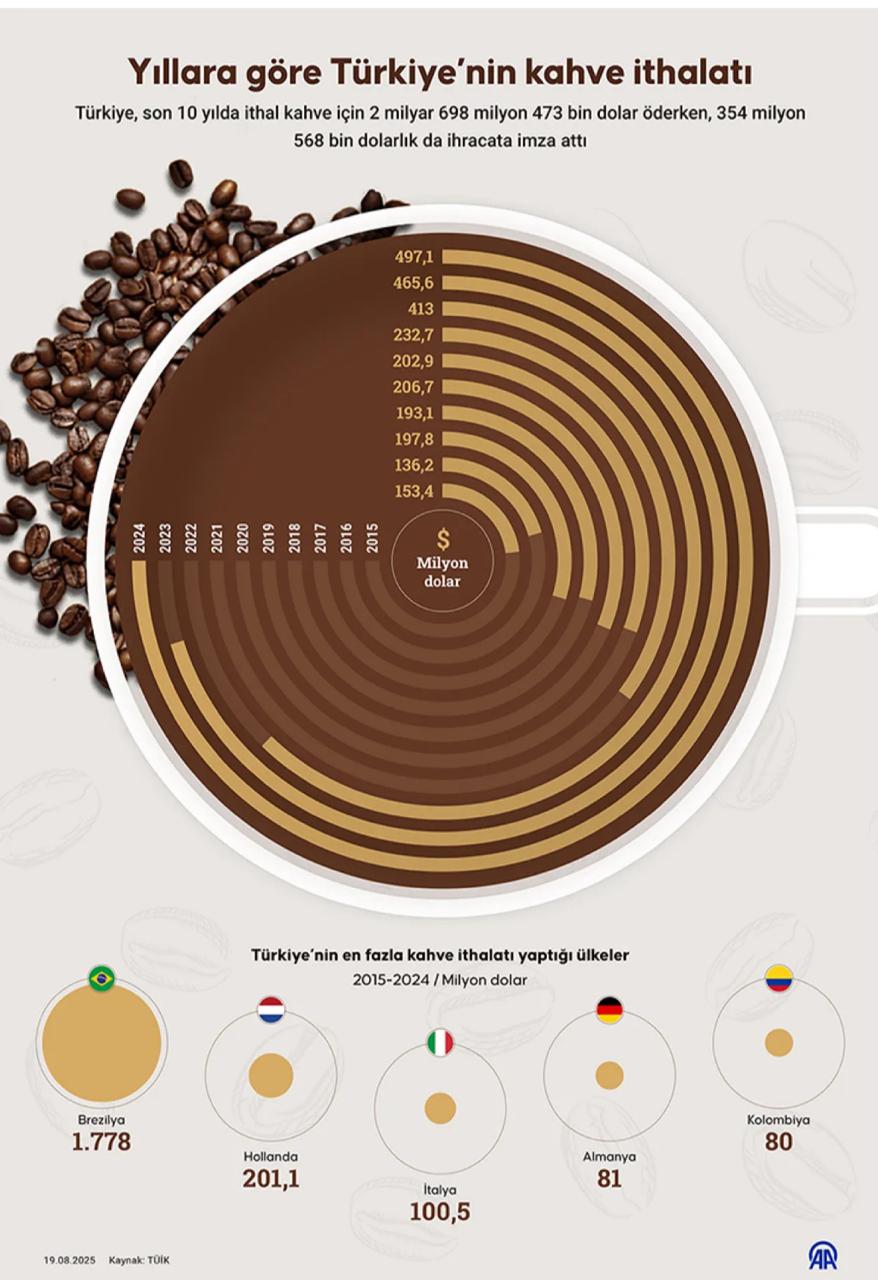
Türkiye’s coffee imports between 2015 and 2024 reached $2.7 billion, with prices for imported coffee rising from $153.4 million in 2015 to $497.1 million in 2024, marking an increase of 224%, according to the national statistical bureau TurkStat.

On the export side, Türkiye recorded $354.5 million worth of coffee exports over the last decade, including $55.6 million in the first half of this year alone.

Türkiye imported most of its coffee from Brazil, totaling $1.7 billion, followed by the Netherlands with $201.1 million, Italy with $100.5 million, Germany with $80.9 million, and Colombia with $79.9 million. The country’s imports stood at $472.5 million as of June, with Brazil remaining its top supplier.

The world’s coffee consumption — both hot and iced — over the past decade totaled $370.3 billion, according to data from the International Trade Center (ITC). The United States was the largest importer, while Brazil dominated exports.

Personally, I prefer iced coffee on summer afternoons, but I always start my day with a hot Turkish coffee. For Turks, the tradition of the 11 a.m. coffee break continues as a nationwide ritual. Around the world, specialty coffee is also gaining momentum, and habits are evolving quickly.

The golden era of coffee and coffee shops has already begun, spreading across continents. More lovely qahwa days are on the horizon.

Brazil Weather and U.S. Tariffs Drive Coffee Prices to Multi-Month Highs

Dubai, August 19, 2025 (Qahwa World) – Coffee prices surged on Tuesday, with arabica futures climbing to a 2.25-month high and robusta reaching a two-month high, supported by dry conditions in Brazil’s key growing regions and tightening U.S. supplies following new tariffs on Brazilian coffee.

September arabica coffee (KCU25) rose 1.85% (+6.35¢/lb), while September ICE robusta (RMU25) gained 4.04% (+$168). The rise reflects mounting concern over Brazil’s weather, particularly in Minas Gerais, the country’s largest arabica-producing state, where Somar Meteorologia reported no rainfall during the week ending August 16.

Market support is also coming from the United States, where buyers are avoiding new contracts for Brazilian coffee due to a 50% tariff imposed on imports. Brazil typically supplies about one-third of U.S. unroasted coffee, making the tariff impact significant for roasters and traders.

Brazil’s July export figures further underscored supply concerns. According to the Trade Ministry, unroasted coffee exports fell 20.4% year-on-year to 161,000 metric tons. Exporter group Cecafé reported that green coffee shipments dropped 28% y/y to 2.4 million bags, while total coffee exports fell to 2.7 million bags. From January to July, Brazil’s overall exports declined 21% to 22.2 million bags.

Certified exchange inventories remain tight. ICE arabica stocks fell to a 1.25-year low of 726,661 bags on August 14 before recovering slightly to 733,105 bags this week. ICE robusta stocks dropped to a three-week low of 6,749 lots, down from late-July’s two-year high of 7,029 lots.

On the supply side, Brazil’s 2025/26 coffee harvest is advancing. Research firm Safras & Mercado estimates the crop was 94% complete as of August 6, with robusta nearly finished (99%) and arabica at 91%. Cooxupé, Brazil’s largest coffee cooperative, reported its members had completed 80.4% of their harvest by August 8.

Beyond Brazil, Vietnam’s coffee industry continues to influence robusta prices. Drought reduced 2023/24 production by 20% y/y to 1.47 million metric tons, the lowest in four years, while 2024 exports fell 17.1% to 1.35 million metric tons. However, recovery signs emerged with January–July 2025 exports up 6.9% y/y to 1.05 million metric tons.

The International Coffee Organization (ICO) reported that global coffee exports in June rose 7.3% y/y to 11.69 million bags, though October–June totals slipped 0.2% to 104.14 million bags.

Looking ahead, the USDA’s Foreign Agricultural Service (FAS) projects 2025/26 world coffee production at a record 178.7 million bags, up 2.5% year-on-year. Arabica output is expected to fall 1.7% to 97 million bags, while robusta is forecast to rise 7.9% to nearly 82 million bags. Ending stocks are projected to grow 4.9% to 22.8 million bags.

However, trader Volcafe sees a very different balance: a global arabica deficit of 8.5 million bags in 2025/26, the fifth consecutive year of shortages and larger than the 5.5 million bag deficit recorded in 2024/25. This highlights continued market tightness despite record overall supply projections.

Coffee Prices Soar to New 2-Month Highs Amid Brazil Frost and Falling Exports

Dubai, August 16, 2025 (Qahwa World) – Coffee prices surged to their highest levels in two months on Friday, driven by frost concerns in Brazil, declining exports, and tightening global inventories. The rally pushed September Arabica coffee (KCU25) up 4.64% to close at +15.15, while September Robusta coffee (RMU25) gained 2.86% at +117. Over the week, Arabica rose +10.4% and Robusta +18%, marking one of the strongest weekly rallies of the year.

Brazil Frost Sparks Market Tensions

Early this week, a light frost was reported in Cerrado Mineiro, one of Brazil’s key Arabica-producing regions. While crop damage was limited, the event renewed market fears over frost risks during Brazil’s winter season. Weather events in Brazil remain a critical factor in global coffee price volatility.

Sharp Decline in Brazilian Exports

Brazil, the world’s largest coffee exporter, reported a 20.4% year-on-year drop in July unroasted coffee exports to 161,000 MT, according to its Trade Ministry. Exporter group Cecafe confirmed a steep decline, with green coffee exports down 28% y/y to 2.4 million bags. Within this, Arabica exports fell -21%, while Robusta exports plunged -49%.
From January to July, Brazil shipped 22.2 million bags, down -21% compared with last year.

Inventories at Multi-Year Lows

Declining ICE warehouse stocks further fueled bullish momentum. Arabica inventories hit a 1.25-year low of 726,661 bags on Thursday before rebounding slightly to 731,739 on Friday. Robusta inventories fell to a three-week low of 6,907 lots, below the recent two-year high of 7,029 lots reached in late July.

U.S. Tariffs Add Uncertainty

The market is awaiting clarity on U.S. trade policy, as President Trump has yet to exempt coffee from the proposed 50% tariff on Brazilian exports. Such a move could raise domestic inventories in Brazil while reshaping global trade flows.

Weather and Harvest Update

Above-average rainfall in Minas Gerais, Brazil’s largest Arabica region, brought 4.8 mm of precipitation last week, or 109% of the historical average, easing dryness concerns but weighing slightly on prices.
Meanwhile, Brazil’s 2025/26 harvest is nearing completion. Safras & Mercado reported 94% progress as of August 6, ahead of last year’s 92%. Cooxupe, Brazil’s largest cooperative, said its members had completed 80.4% of the harvest by August 8.

Global Coffee Exports and Vietnam Outlook

On the supply side, the International Coffee Organization (ICO) noted that global coffee exports rose +7.3% y/y in June to 11.69 million bags. However, cumulative exports from October to June dipped slightly by -0.2% y/y at 104.14 million bags.

Vietnam, the world’s second-largest producer, continues to face challenges. The country’s 2023/24 output fell 20% y/y to 1.472 million MT, the lowest in four years, due to drought. Exports in 2024 dropped -17.1% to 1.35 million MT. However, from January to July 2025, Vietnam’s shipments rose 6.9% y/y to 1.05 million MT, offering partial recovery.

USDA and Volcafe Projections

The USDA’s Foreign Agriculture Service (FAS) expects world coffee production to hit a record 178.68 million bags in 2025/26, up 2.5% year-on-year. Robusta output is forecast to surge by +7.9% to 81.65 million bags, while Arabica is projected to decline -1.7% to 97.02 million bags.
Despite this, Volcafe projects a widening global Arabica deficit of -8.5 million bags for 2025/26 – the fifth straight year of supply shortfalls – compared with a -5.5 million bag deficit last season.

Jollibee’s Coffee & Tea Chains Boost Record Q2 Sales to ₱114.5 Billion

Dubai, 14 August 2025 – (Qahwa World) – The Jollibee Group has posted its strongest second-quarter results on record, driven by surging sales in its coffee and tea portfolio, which now accounts for more than half of the company’s global outlets.

For the quarter ending 30 June 2025, the Filipino foodservice giant reported system-wide sales (SWS) of ₱114.5 billion ($2 billion), marking a 19.6% increase year-on-year. Net income attributable to the group rose 5.6% to ₱3.21 billion ($54.4 million), while total net income grew 7.2% to ₱3.42 billion. Operating income reached ₱6.04 billion, a 19.1% rise, with margins improving to 7.8%.

Coffee & Tea: The Growth Engine

International sales were the standout performer, climbing 32.6% year-on-year, largely fuelled by a 68.8% surge in the Coffee & Tea segment. The group’s store network grew by 45–46% compared to the same period last year, reaching 10,119 outlets worldwide, 69% of which are franchised. Of these, 5,312 stores are coffee or tea chains, underscoring the category’s central role in Jollibee’s expansion strategy.

Key brands in the portfolio delivered solid mid-single-digit sales growth:

  • Compose Coffee – Acquired 70% in July 2024 for $238 million, the South Korean chain now operates 2,809 stores and is on track to surpass 3,000 locations in 2025. It is projected to deliver a 36% return on invested capital (ROIC) this year and accounted for 56.6% of Coffee & Tea segment growth.

  • The Coffee Bean & Tea Leaf (CBTL) – Bought in 2019 for $350 million, the Singapore-headquartered brand runs 1,261 outlets in more than 20 countries, including 200 in the US and strong representation in Indonesia, Malaysia, and India.

  • Highlands Coffee – With 896 stores in Vietnam, the chain is targeting 1,000 outlets by year-end, expanding through kiosks, drive-thru, and hotel partnerships.

  • Milksha – The Taiwan-based bubble tea and ice cream brand operates 346 stores locally and in markets such as Australia, Canada, Hong Kong, the Philippines, and the UK.

Strategic Strengths and Gaps

CEO Ernesto Tanmantiong credited the quarter’s momentum to the combined strength of the Coffee & Tea segment, sustained contributions from the Philippine business, and the performance of international operations. He highlighted the company’s multi-brand, multi-market approach as a key factor in its growth trajectory.

However, China remains a critical market to conquer. Jollibee currently operates 547 restaurants there under the Tim Ho Wan, Yonghe King, and Hong Zhuang Yuan brands but has lacked a branded coffee chain presence since CBTL exited in 2018.

Outlook

With coffee and tea brands now at the heart of Jollibee’s expansion strategy, the company is positioned to strengthen its foothold in high-growth beverage markets worldwide. The challenge ahead will be translating its success in South Korea, Vietnam, and Taiwan into competitive advantage in China, the world’s second-largest economy.