Coffee Prices Drop on Brazil Weather and Rising Stocks

Dubai – Qahwa World

Coffee markets fell on Wednesday amid favorable weather forecasts in Brazil and rising inventories monitored by the Intercontinental Exchange (ICE).

May arabica futures (KCK26) were down 8.70 points (-2.94%), while May ICE robusta (RMK26) declined 137 points (-3.71%). Showers expected in key Brazilian coffee-growing regions supported the recent price drop.

ICE data shows that arabica inventories, which fell to a 1.75-year low of 396,513 bags in November, recovered to a five-month high of 564,626 bags on Tuesday. Robusta inventories also rose to a 3.5-month peak before falling slightly to 4,563 lots as of Wednesday.

You may like:Brazil’s Specialty Coffee Sector Gains Global Momentum

Coffee prices had partially retraced last week’s rally triggered by the Iran conflict and the closure of the Strait of Hormuz, which increased global shipping rates, fuel, and insurance costs.

Brazil’s exports also influenced the market. According to Cecafe, February green coffee shipments fell by 27% year-on-year, while the Trade Ministry reported a 17.4% decline to 142,000 metric tons. Conversely, recent rains in Minas Gerais—the country’s largest arabica-producing state—amounted to 14.9 mm last week, about 35% of the historical average, offering some support to crop expectations.

Earlier in February, coffee prices hit multi-month lows amid forecasts of a record Brazilian crop. Conab projected Brazil’s 2026 coffee output at 66.2 million bags, with arabica rising 23.2% to 44.1 million bags and robusta up 6.3% to 22.1 million bags. Global production for 2026/27 is expected to reach 180 million bags, according to Rabobank.

You may like:Coffee Markets Rise Amid Middle East Shipping Disruptions

Vietnam’s coffee exports further pressured robusta prices. The National Statistics Office reported a 14% year-on-year rise to 366,000 MT for January–February 2026, while 2025 exports jumped 17.5% to 1.58 million MT. Production in 2025/26 is forecast to reach 1.76 million MT, a four-year high.

Despite these factors, the International Coffee Organization (ICO) noted a slight 0.3% year-on-year decline in global coffee exports for the current marketing year. The USDA’s Foreign Agriculture Service projects 2025/26 global production at 178.848 million bags, with arabica down 4.7% to 95.515 million bags and robusta up 10.9% to 83.333 million bags. Brazil’s production is expected to fall 3.1% to 63 million bags, while Vietnam rises 6.2% to 30.8 million bags. Ending stocks are forecast to decline 5.4% to 20.148 million bags.

Analysts say the combination of Brazilian rainfall, rising ICE inventories, and record production in Vietnam is likely to maintain downward pressure on coffee prices in the near term.

Coffee Prices Rise Amid Surging Shipping Costs

Dubai – Qahwa World

Coffee markets saw gains on Wednesday, with May arabica (KCK26) climbing +3.10 (+1.09%) and May robusta (RMK26) rising +29 (+1.78%).

Analysts attribute the rebound to supply-side concerns. The ongoing conflict in Iran has disrupted shipping through the Strait of Hormuz, driving up global freight rates, insurance costs, and fuel expenses—factors that are expected to push costs higher for coffee importers and roasters.

Meanwhile, favorable weather in Brazil is supporting the country’s coffee crop but is acting as a bearish influence on prices. Somar Meteorologia reported that Minas Gerais, Brazil’s largest arabica-growing region, received 78 mm of rainfall in the week ending February 20, 131% of the historical average.

You may read: War Redraws Global Shipping Map and Pressures Coffee Supply Chains

Despite this, coffee prices had sharply declined over the past five weeks, with arabica hitting a 15-month low last Tuesday and robusta dropping to a 6.75-month low last Monday. Brazil’s crop forecasts show strong production ahead: the national agency Conab predicts 2026 coffee output will reach a record 66.2 million bags, up +17.2% year-on-year. Arabica production is expected at 44.1 million bags (+23.2% y/y), and robusta at 22.1 million bags (+6.3% y/y).

On a global scale, Rabobank projects coffee production in 2026/27 to hit 180 million bags, an increase of 8 million bags from the previous year.

Vietnam, the largest robusta producer, is also contributing to market pressure. January coffee exports surged +38.3% y/y to 198,000 metric tons, while total 2025 exports jumped +17.5% y/y to 1.58 MMT. Vietnam’s 2025/26 production is projected to reach 1.76 MMT (29.4 million bags), a four-year high.

Inventory dynamics are mixed. ICE-monitored arabica stocks, which fell to a 1.75-year low of 396,513 bags on November 18, have rebounded to a four-and-three-quarter-month high of 528,028 bags. Robusta inventories also recovered to a 3.25-month high of 4,721 lots after hitting a 14-month low in December.

Brazilian exports, however, fell sharply in January, with 141,000 MT shipped (-42.4% y/y), while Colombia’s smaller output supports price levels. The National Federation of Coffee Growers reported that January arabica production fell -34% y/y to 893,000 bags.

The International Coffee Organization noted a slight global export decline for the marketing year (Oct-Sep) of -0.3% y/y to 138.658 million bags. USDA forecasts for 2025/26 show total world coffee production rising +2.0% y/y to a record 178.848 million bags. Arabica output is expected to fall -4.7% to 95.515 million bags, while robusta climbs +10.9% to 83.333 million bags. Brazil’s production is projected at 63 million bags (-3.1%), and Vietnam’s at 30.8 million bags (+6.2%). Ending stocks are forecast to decline -5.4% to 20.148 million bags.

High Coffee Costs Force Americans to Change Their Daily Habits

DUBAI – QAHWA WORLD

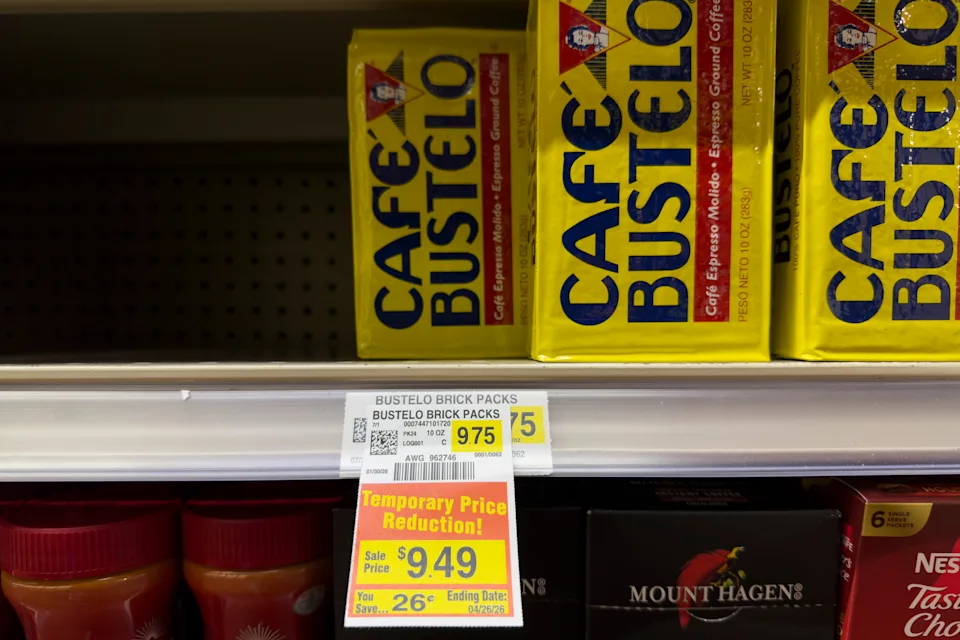
A grocery store in Chicago displayed coffee for sale on February 9, 2026, as rising prices continue to impact consumers nationwide.

For a long time, Chandra Donelson’s morning started with a trip to McDonald’s for a coffee with five creams and ten sugars, later evolving into Starbucks caramel macchiatos. The 35-year-old from Washington, D.C., has treated coffee as a vital ritual since her youth. However, the surge in prices eventually led her to an unexpected decision: quitting her daily habit. “I did that daily for years. I loved it. That was just my routine,” she explained. “And now it’s not.”

Across the United States, coffee enthusiasts are being forced to modify their behaviors—either by skipping the café, opting for cheaper alternatives, or stopping altogether. In January 2026, the Consumer Price Index revealed that coffee prices jumped 18.3% compared to the previous year. Looking back over five years, the government reported a staggering 47% increase.

YOU MAY LIKE: Coffee Prices Rise as Brazilian Real Strength Sparks Short Covering

These financial pressures have led people like Liz Sweeney, 50, of Boise, Idaho, to take drastic steps. Once a self-described “coffee addict,” Sweeney used to drink three cups at home and visit a café whenever she went out. Now, she has limited herself to a single cup at home and occasionally grabs a Diet Coke for a cheaper caffeine fix.

Similarly, 34-year-old Dan DeBaun from Minnesota has reduced his café visits to save money for a new home. He noted that what once cost $2 has now become a $5 or $6 expense. He now prepares ground coffee from Trader Joe’s and carries it in a travel mug. Data from the payment platform Toast indicates that the median price for a hot coffee reached $3.61 in December, while cold brew climbed to $5.55.

The vast majority of coffee in the U.S. is imported. Although some tariffs briefly impacted the market in 2025 before being revoked, the primary culprits for the price surge are environmental. Severe droughts in Vietnam, excessive rainfall in Indonesia, and harsh weather in Brazil have devastated crop yields and pushed global market prices higher.

Despite the financial strain, the National Coffee Association notes that two-thirds of Americans still consume coffee every day, and overall consumption has remained relatively stable. However, for those feeling the pinch of rising rent and food costs, the habit is becoming harder to maintain.

Sharon Cooksey, 55, of North Carolina, used to visit Starbucks every morning but eventually switched to brewing at home. After discovering that a bag of Lavazza coffee was significantly cheaper, she realized that an entire bag—which lasts for weeks—costs the same as one latte at a shop. “I’ll be damned if it didn’t taste so good,” she said, surprised to find she preferred her own brew.

For Chandra Donelson, the final straw came during a government shutdown that paused her paycheck. She traded her $8 coffee for a tea blend that costs about twenty cents per cup. As she puts it, “The math just makes sense.”

Why There Are Fewer Places to Sit Down for Coffee in Moscow

Moscow – Qahwa World

Over the past year, Moscow’s coffee market has undergone a noticeable shift. Grab-and-go coffee outlets continue to expand, while traditional cafés with seating areas are gradually losing ground.

From January 2025 to January 2026, the number of coffee-to-go locations in the city grew by about 5%, rising from roughly 3,900 to 4,100 outlets. These formats typically include small kiosks or compact spaces with little or no seating.

At the same time, the number of classic cafés declined much more sharply. Over the same period, their total fell by 12%, from around 2,900 to 2,500. Earlier reports also pointed to closures by major chains: in 2025, one of Moscow’s largest café operators shut down more than 10% of its locations.

Similar trends are visible outside the capital. In other Russian cities with populations over one million, the number of coffee-to-go outlets increased by an average of 3.5% year on year, while the number of traditional cafés dropped by about 13%.

The highest concentration of cafés and grab-and-go coffee points remains in central districts. Presnensky, Tverskoy and Basmanny lead the way. As of January 2026, Tverskoy district had about 120 cafés and 188 coffee-to-go outlets; Presnensky counted 126 cafés and 183 to-go points; Basmanny had 114 cafés and 159 grab-and-go locations.

The rise of coffee to go comes amid higher prices in traditional cafés. In January 2026, the average bill in Moscow cafés reached 501 rubles. The most expensive coffee is found in Vnukovo and the Obruchevsky district, where a cup can cost more than 800 rubles. The lowest prices are typically seen in residential areas such as Pechatniki, Bibirevo, Vostochnoye Degunino, Altufyevsky district and Veshnyaki.

Market experts note that while the number of cafés had been growing steadily in previous years, consumer demand has recently started to weaken. Rising prices have made it harder for cafés to attract new customers. Higher costs are driven by several factors, including more expensive coffee beans and milk, rising wages, increasing rent, and higher electricity costs.

At the same time, competition from retailers is intensifying. Automated coffee machines in grocery stores are gaining popularity. During the first nine months of 2025, sales of ready-to-drink coffee in retail chains surged both in volume and in value, adding further pressure on traditional café formats.

If you’d like, I can also optimize this version for SEO, adapt it for an international media outlet, or shorten it into a brief news piece.

Sucafina Releases Key Update on Vietnam’s 2025/26 Coffee Harvest

Vietnam Harvest Update 2025/26: Delayed Start, Strong Outlook

Dubai – Qahwa World

With global markets closely monitoring Vietnam, recent heavy rains from Storm 15 have attracted significant attention among those keen to understand the weather’s impact on supply. We caught up with Khoi Nguyen, Trading Manager at Sucafina Vietnam, for an update. Khoi tells us that despite rain-driven delays and labor tightness, the outlook remains positive, with production increases expected and quality indicators trending upward.

  • Production on the rise: Vietnam’s combined Robusta & Arabica 2025/26 Coffee crop is forecast at 31.2 million bags, up 12% year on year.
  • Heavy rains delaying progress: Excessive rainfall has slowed harvesting (14% of Robusta completed vs. ~25% historical average), compounded by labor shortages.
  • Strong quality prospects: Favorable cherry development and solid farm investment support expectations for improved overall quality.

Harvest Status: Delayed but Resilient

Despite the weather challenges making headlines, Vietnam’s coffee harvest is showing remarkable resilience. Khoi and the team project a total production of 31.2 million bags a 12% increase over last year. This includes 29.9 million bags of Robusta (up 11.5%) and 1.3 million bags of Arabica (up 19%). These numbers exceed our earlier forecasts (+6%) and sit well above the five-year average. Early-season agronomic conditions were favorable, and ongoing investment in farming helped set a strong foundation.

Recent weeks of intense rainfall have slowed harvesting across key Robusta regions. As of 25 November, only 14% of the crop had been harvested, compared with 17% at the same time last season. Labor availability is also lower this year, adding pressure to farm operations. However, sustained high coffee prices over two consecutive years provide farmers resources and incentives to manage these difficulties. If weather stabilizes, quality is expected to improve over last year.

2025/26 Harvest Timing

Robusta harvest is expected to peak in mid-December, with farmers busy harvesting, drying, and husking across Vietnam’s major producing areas.

Arabica harvest has reached its peak in the North (accounting for around 70% of the total Arabica crop). Central Arabica regions will peak early-December.

Both Robusta and Arabica harvests should be expected to complete in late January.

Regulatory & Supplier Landscape

Two key regulatory themes affect the supply chain: a 5% VAT on green coffee was introduced in July 2025, and the evolving European Union Deforestation Regulation (EUDR). Neither has an immediate impact at the farm level.

A 5% VAT on green coffee trading has been in place since July 2025 (previously only applied to roasted). The VAT has no impact on farmers’ harvesting behavior, but it may influence how exporters manage their supplier base. While it will not impact overall pricing (as VAT is refunded at export), it adds complexity to reporting administration and reduces cash flow somewhat.

Though EUDR details and enforcement timelines remain unclear, Vietnam’s supply chain is proactive. Supplier collaboration on geodata analysis and completion of macro risk assessment data collection position shipments well for 2025 due-diligence requirements.

IMPACT Supply Chains & Sustainability

Our IMPACT verified supply chains in Gia Lai and Lâm Đng are each progressing through audit cycles. IMPACT-verified coffees will be available starting December 2025.

In Arabica regions, we have successfully registered and audited over 1,500 new farmers in Son La and Lâm Đng for Rainforest Alliance (RA), 4C, and C.A.F.E. Practices certifications. These farmers have also completed training on RA and other agricultural standards. Other sustainability initiatives, including composting, tree planting, GAP training, and soil sampling, continue per earlier updates.

Outlook

While heavy rains understandably raise concerns, the broader view is optimistic. Vietnam is positioned to deliver a larger coffee crop with strong quality potential, grounded in sustained farmer investment and solid production forecasts. Weather stability in December and January remains critical. If conditions normalize, the 2025/26 season could mark one of Vietnam’s strongest performances in recent years.

Farmers’ gains from two years of high prices bolster reinvestment but also elevate their pricing expectations. For roasters and traders, this underscores the importance of early engagement on volumes and quality to secure desired lots.

Despite the media spotlight on weather-related challenges, the reality is nuanced: delays and risks require careful monitoring, but strong production volumes, sound quality fundamentals, and a mature, sustainability-focused supply chain provide confidence. If you are interested in learning more about our Vietnam supply chain or booking coffee from Vietnam, reach out to your trader!

U.S.-Made Coffee Remains More Expensive Than Imports Despite Tariffs

Dubai – Qahwa World

Throughout 2025, U.S. consumers have witnessed a steady rise in prices across nearly all goods following the administration’s decision to impose tariffs on imported products from global trade partners. Coffee has been no exception, even though the United States relies almost entirely on imported beans to satisfy domestic demand.

Data shows that coffee prices rose by 14.5% between July 2024 and July 2025, while roasted and packaged coffee in supermarkets increased by 21.7% between August 2024 and August 2025. These price hikes are largely attributed to tariffs affecting major coffee-producing nations such as Brazil, which supplies around 40% of the world’s coffee, and Vietnam, the second-largest global exporter.

Despite rising international prices, coffee produced within the United States remains significantly more expensive — a trend unlikely to change. Coffee cultivation requires specific geographical and climatic conditions found only in limited areas of the country, most notably Hawaii, where the right soil and altitude allow for small-scale production of high-quality beans. Even so, the total domestic yield accounts for barely 1% of what Americans consume annually.

Experts in both agriculture and finance agree that the United States lacks the natural and environmental capacity to achieve self-sufficiency in coffee production, even if domestic and imported prices were equal. Consumption far exceeds what local producers can supply, and expanding cultivation faces both economic and ecological constraints. The country’s main coffee-growing regions — Hawaii and Puerto Rico — can only cover a fraction of nationwide demand.

While tariff policies are intended to strengthen local industries and reduce reliance on imports, coffee remains a clear exception. Natural limitations make large-scale domestic production unfeasible, and imported coffee continues to be more affordable and abundant despite higher tariffs. Analysts conclude that the American coffee market will remain deeply tied to global supply chains — particularly to producers in Brazil, Vietnam, and Ethiopia — regardless of future policy changes or tariff increases.