SCA Opens 2026 Sustainability Awards Nominations

Dubai – Qahwa World

The Specialty Coffee Association (SCA) has officially opened nominations for the 2026 Sustainability Awards. Since 2004, this program has recognized outstanding work in the field of sustainability, honoring the projects, business models, and individuals dedicated to confronting the coffee industry’s greatest challenges—from climate change to gender equality.

These awards reflect collaborations that span geographies, cultures, and supply-chain roles, aiming to share vital lessons for the benefit of the entire coffee sector. With each passing year, the SCA continues to see greater diversity in how the global community approaches these critical issues.

Award Categories and Eligibility

Nominations are open through January 31, 2026, for the following categories:

  • For-Profit Award: Recognizes for-profit companies that play a pivotal role in industry sustainability. Eligible businesses must have been operating for at least three years. (Note: This is for businesses; individual products or ideas do not qualify).

  • Non-Profit Award: Celebrates non-profit organizations or specific projects advancing sustainability. Eligible organizations or projects must have been operating for at least three years.

A Note on the Individual Award: The SCA is currently reevaluating how to best celebrate individuals across the value chain and has paused the Individual Award until further notice.

A Legacy of Impact: Past Winners (2004–2025)

The 2026 nominees will join an esteemed lineage of pioneers who have shaped the industry:

  • 2025: Fair Trade International (Non-Profit) | Black Baza Coffee Co. (For-Profit)

  • 2024: Root Capital (Non-Profit) | Sancoffee (For-Profit)

  • 2023: José Rivera & David Griswold (Individual) | Root Capital (Non-Profit) | Primavera Green Coffee (For-Profit)

  • 2022: David Browning (Individual) | Jimma Agro-Biodiversity Project (Project) | Caravela Coffee (Business Model)

  • 2021: Michael Sheridan (Individual) | Alto Mayo Landscape Peru REDD+ Project (Project) | Pachamama Coffee Cooperative (Business Model)

  • 2020: Dr. Timothy Schilling (Sustainability Champion) | Las Manos del Café by RGC Coffee (Project) | Cooperative Coffees (Business Model)

  • 2019: Esperanza Dionisio Castillo (Sustainability Champion) | Union Hand-Roasted Coffee (Project) | Agricafe (Business Model)

  • 2015–2018: Notable winners include World Coffee Research, the Guatemalan Coffee Foundation (Funcafé), and the Bukonzo Joint Cooperative Union for their “Gender Action Learning System.”

  • 2004–2014: Early pioneers include Thanksgiving Coffee Company, Twin Trading for “Congo Coffee Revival,” Pueblo a Pueblo, Grounds for Health, Starbucks Coffee Company (C.A.F.E. Practices), and Dean’s Beans.

Submission Details

Potential nominees can find full details on judging criteria, eligibility, and the 2026 prize on the official SCA website. For questions regarding submissions, please contact [email protected].

An Easy Way to Boost Protein in Your Daily Coffee

Dubai – Qahwa Word

Protein is essential for maintaining the body’s structure, supporting muscles, tissues, and overall health. As protein-focused eating habits continue to gain attention, many people are searching for simple ways to increase their intake without overhauling their diets. One surprisingly effective option may already be part of a daily ritual: coffee.

Milk is a common addition to coffee, but the small amount typically used limits its nutritional contribution. For those looking to turn their coffee into a more protein-rich drink, ultra-filtered milk offers a practical alternative. This type of milk is processed in a way that concentrates protein while reducing lactose, resulting in a more nutrient-dense option than standard milk.

Even a modest splash of ultra-filtered milk can noticeably increase the protein content of a cup of coffee. In addition to its nutritional advantages, it also improves texture. The higher protein level gives coffee a fuller body, smoother consistency, and a richer, creamier taste that pairs well with a wide range of roasts.

Expanding beyond basic coffee

Ultra-filtered milk is especially useful in drinks that rely heavily on milk. Beverages such as lattes, cappuccinos, and other espresso-based drinks allow for a larger quantity of milk, making them an ideal vehicle for added protein. Its ability to foam well also makes it suitable for milk foam and cold foam toppings.

It can be used in whipped coffee preparations, blended iced drinks, and flavored foams, offering versatility without sacrificing creaminess. In many cases, it can replace heavier dairy ingredients, simplifying recipes while maintaining a smooth finish.

Outside of coffee, the same milk can be incorporated into smoothies alongside yogurt and fruit, providing another easy way to increase protein intake during the day.

Dairy-free options

For those following a plant-based diet, soy milk stands out as a reliable protein-rich alternative. While other plant-based milks are popular for flavor, soy milk offers a balance of creaminess and protein that works well in both hot and cold coffee drinks.

With the right milk choice, coffee can serve not only as an energy boost but also as a convenient addition to a protein-conscious routine.

How to Add More Protein to Your Coffee with the Right Milk

The 2026 Cup of Excellence Calendar Unveiled

A New Season of Global Coffee Distinction

PORTLAND – QAHWA WORLD

The Alliance for Coffee Excellence (ACE) has officially released the highly anticipated 2026 Cup of Excellence (COE) and National Winner (NW) competition calendar. This upcoming season marks another year of dedication to discovering the finest coffees across the globe, bringing together producers, buyers, and the specialty coffee community to celebrate unparalleled quality and transparency.

Whether you are a roaster planning your bidding strategy, a cupper preparing to join an International Jury, or a coffee enthusiast following the journey of exceptional micro-lots, this calendar serves as your essential guide for the 2026 season.

2026 Competition & Auction Schedule

The 2026 circuit covers key origins from Central America to Asia. Below is the comprehensive schedule of International Jury weeks and their corresponding auction dates:

Country International Jury Week COE Auction Date National Winner Auction
Nicaragua May 11 – 15 June 25
El Salvador May 11 – 15 July 2
Honduras May 19 – 23 July 16
Costa Rica May 25 – 30 July 9
Guatemala June 1 – 4 July 23 July 20 – 24
Mexico June 8 – 12 July 28 July 27 – 31
Thailand June 8 – 12 July 30 July 27 – 31
Taiwan June 15 – 19 August 13 August 10 – 14
Indonesia October 13 – 17 November 26
Brazil (Main) October 19 – 24 December 1 November 23 – 27
Brazil (Naturals) October 26 – 31 December 8 December 1 – 4

Key Opportunities for Professionals

In addition to the auctions, ACE has announced that International Jury applications will officially open on January 1st, 2026. This is a unique opportunity for qualified sensory experts to evaluate the world’s highest-scoring coffees at their origin.

The organization reminds participants that the calendar is subject to continuous updates to align with harvest conditions. For registrations, sample sets, and the latest updates, please visit: AllianceForCoffeeExcellence.org.

Official 2026 Cup of Excellence Calendar: Competition & Auction Dates

Dubai Becomes Regional Hub for Coffee Re-exports, Valued at AED 3.5 Billion

Dubai – Qahwa World

Dubai has successfully solidified its position as a leading regional hub for coffee re-exports, with the value of its operations in this sector exceeding AED 3.5 billion in 2024. This robust performance is driven by strategic investments across the value chain, including advanced storage warehouses, cupping labs, quality control centers, and specialized trading platforms that have streamlined the flow of green coffee throughout the region.

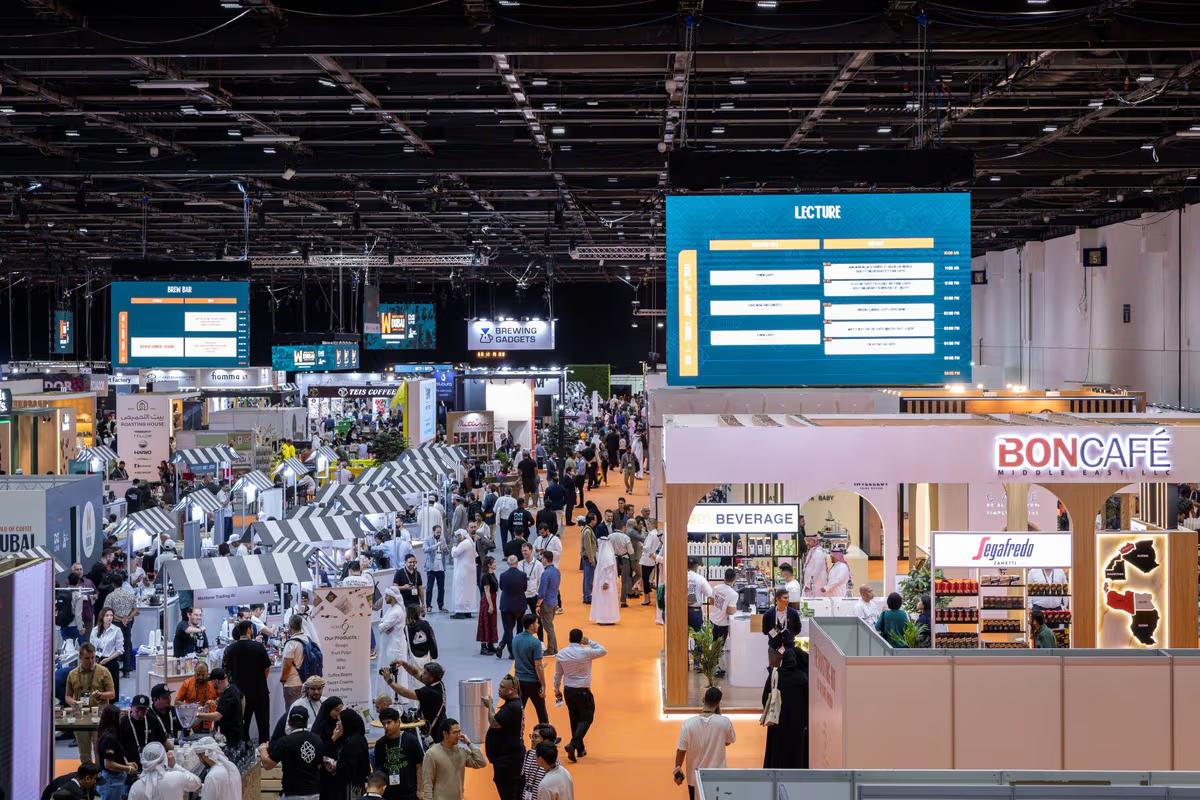
Simultaneously, the UAE continues to lead the sector’s transformation, with the national coffee market value surpassing AED 12 billion (approximately $3.2 billion). Reinforcing this role, the Dubai World Trade Centre is preparing to host the fifth edition of the “World of Coffee Dubai” exhibition from January 18 to 20, 2026, amid the city’s growing status as one of the world’s most diverse and coffee-dense urban hubs.

Regionally, North Africa and Levant markets have seen remarkable growth; coffee consumption in Egypt has doubled over the past five years, while Morocco’s coffee imports rose by 23% in 2024. A youthful demographic, with those under 35 representing over 60% of the population, has fueled an 11% growth in the branded coffee shop sector, where coffee is embraced as a modern lifestyle and cultural experience.

Khalid Al Mulla, Chairman of the Specialty Coffee Association (SCA) UAE Chapter, emphasized that this growth reflects infrastructure development across the entire value chain, beyond just consumption. Furthermore, Shouq Bin Redha, Exhibition Director of World of Coffee Dubai, noted that a new generation of entrepreneurs and producers is driving innovation and sustainability, ensuring long-term growth for the industry.

Global Coffee Market: Record Production Amid Supply Challenges

Dubai – Qahwa World

The United States Department of Agriculture (USDA) has released its semi-annual report, “Coffee: World Markets and Trade,” revealing a historic milestone for the industry. While global production is projected to reach an all-time high for the 2025/26 season, the market remains under significant structural pressure. A relentless growth in consumption continues to outpace supply recovery, driving global ending stocks to their lowest levels in years and keeping prices near record peaks.

A Milestone in Global Production

World coffee production for the 2025/26 season is forecast to reach a historic high of 178.8 million bags (60 kilograms each), an increase of 3.5 million bags from the previous year. This surge is primarily driven by a remarkable recovery in Southeast Asia and Africa, which has managed to offset the climate-related losses in traditional Arabica hubs like Brazil and Colombia.

Divergent Fortunes: The Rise of Robusta and Arabica’s Struggle

The report highlights a significant shift in the production landscape:

  • Indonesia’s Rebound: Robusta production is set to surge by 1.7 million bags to reach 11.0 million, thanks to favorable weather and improved labor utilization.

  • Ethiopia’s Transformation: Following a massive three-year initiative to plant higher-yielding varieties, Ethiopia is poised for a record output of 11.6 million bags.

  • Brazil’s Climate Battle: The world’s largest producer faces a split reality. While its Robusta harvest hit a record 25 million bags, its Arabica crop was slashed by 6 million bags due to severe drought and extreme heat in Minas Gerais and São Paulo, bringing total output down to 63 million bags.

  • Vietnam’s Recovery: Production is expected to rebound to 30.8 million bags as high market prices encouraged farmers to invest more in fertilizers and infrastructure.

Consumption Growth and the “Stock Crisis”

Global coffee consumption continues its unrelenting upward trajectory, reaching a projected record of 173.9 million bags. This persistent demand—driven by the European Union, the United States, and emerging markets like China—is outstripping the pace of production.

Consequently, global ending stocks are forecast to decline for the fifth consecutive year, dropping to just 20.1 million bags. This “tight” supply situation explains why the International Coffee Organization’s (ICO) composite price index has nearly tripled during this period. The market currently has very little “cushion” to absorb any future weather shocks.


Top 20 Coffee Producing Countries (2025/2026 Forecast)

(Data in 1,000s of 60kg bags)

Rank Country Total Production (Arabica + Robusta)
1 Brazil 63,000
2 Vietnam 30,800
3 Colombia 13,800
4 Indonesia 12,450
5 Ethiopia 11,560
6 Uganda 6,875
7 India 6,050
8 Honduras 5,800
9 Peru 4,200
10 Mexico 3,903
11 Guatemala 3,540
12 Nicaragua 2,580
13 China 1,900
14 Malaysia 1,500
15 Tanzania 1,450
16 Cote d’Ivoire 1,300
17 Costa Rica 1,170
18 Papua New Guinea 950
19 Thailand 900
20 Kenya 850

Top 10 Global Coffee Consumers (2025/2026 Forecast)

(Data in 1,000s of 60kg bags)

Rank Country / Statistical Entity Domestic Consumption
1 European Union 41,870
2 United States 26,550
3 Brazil 22,162
4 Japan 7,550
5 Philippines 6,780
6 China 5,500
7 Indonesia 4,900
8 Canada 4,800
9 Vietnam 3,750
10 Russia 3,610

Meals On Me Launches First Permanent Café at Padel Pro Dubai

DUBAI, UAE — Qahwa World

Meals On Me, a prominent UAE-based meal plan provider, has officially entered the physical retail market with the opening of its first permanent café located at Padel Pro in the Dubai World Trade Centre.

The new facility marks a strategic expansion for the brand, moving beyond its traditional subscription-based delivery model to offer on-the-go nutritional options. The café’s menu features a selection of the brand’s “Protein+” dishes, alongside healthy breakfast options, salads, sandwiches, and protein-enriched smoothies.

As part of the launch, Meals On Me has partnered with Nyala Coffee, a community-driven organization that sources coffee from African farmers and reinvests profits into vocational training for marginalized youth. This partnership integrates a social impact element into the café’s beverage offerings.

The official opening on November 27 was preceded by an exclusive community event featuring friendly padel matches and product tastings. To encourage engagement with its broader services, the company is offering a 15% discount on its long-term meal plans for customers who book a court at Padel Pro through December 31.

The café operates daily from 6:00 AM to midnight, catering to athletes, local professionals, and commuters looking for health-conscious dining options in the World Trade Centre area.

Arabica Coffee Drives Economic Development in Tiengan Ward

Vietnam—Qahwa World

Ward in Son La Province, northern Vietnam, is gradually becoming a center for high-quality Arabica coffee production. Coffee plantations are helping local residents increase their incomes and escape poverty. In 2025, the area is focusing on high-yield varieties, modern technologies, and cooperative farming models.

Just a few minutes from the provincial center, the green and productive Arabica coffee plantations of Tiengan Ward thrive. Thanks to an elevation of over 900 meters above sea level and a mild climate, the local coffee is known for its rich aroma and light acidity, making it suitable for specialty coffee production.

As of 2025, coffee plantations in Tiengan cover more than 350 hectares, with over 80% planted with high-yield Arabica. Yields reach 1518 tons per hectare, 1012% higher than during 20202023, reflecting changes in approaches to rural economic development.

Nguyen Van Tuan, Chairman of the People’s Committee of Tiengan Ward, Son La Province, stated: “Arabica is regarded as a key crop, with a focus on organic production and the renewal of varieties to improve both quality and local incomes.”

Ka Thi Thuong, the head of Tam Quynh Village in Tiengan Ward, was among the first to successfully switch to high-yield Arabica. She said: “The village covers 772 hectares. On average, about 8 tons of Arabica are harvested per hectare. This year’s yield was particularly high: the majority of families earned more than USD 3,800, while some earned over USD 38,000.”

Beyond Thuong’s family, more than 700 households in Tiengan rely on coffee for income, earning 120150 million VND annually, contributing significantly to the local economy.

Today, Son La Province is the largest center for Arabica coffee in Vietnam, with over 20,000 hectares of plantations, representing nearly 60% of all Arabica-growing areas in the country. The “Son La Arabica” brand is gradually gaining national recognition, from coffee competitions to exports.

Vuong Van Hai, chairman of the provincial tea association, said:

“Son La focuses on producing high-quality specialty coffee and developing the sector according to geographical indications, while strictly adhering to quality standards and environmental requirements.”

Coffee not only generates income but also drives the development of primary and advanced processing, trade, and agrotourism, creating stable jobs for local residents.

Tiengan Ward aims to build a closed-loop “coffee economy” that combines environmental protection with sustainable development. One of the key initiatives in 2025 is the adoption of modern technologies in coffee cultivation: smart drip irrigation systems, the use of organic biofertilizers, and selective harvesting. These measures help achieve more uniform bean quality, higher sugar content, and consistent flavor.

From the first coffee trees planted on hillside slopes to today, Tiengan Ward is steadily moving toward a more prosperous economic future. Coffee beans have become a symbol of renewed thinking and confidence in modern agricultural development. As local farmers continue to tie their future to Arabica, the story of “prosperity from the mountains” is increasingly visible in the lush greenery of Tiengan’s coffee plantations.

Russia Sets Record for Brazilian Coffee Imports

Moscow – Qahwa World

Russia significantly increased its imports of coffee from Brazil between January and November, with the total value reaching nearly $390 million — the highest level recorded to date, according to official Brazilian statistics.

Since the beginning of the year, Brazilian coffee shipments to Russia amounted to approximately $392.6 million, compared with about $232.3 million over the same period last year, highlighting a sharp expansion in bilateral trade within this segment.

Import volumes also rose in physical terms, totaling 62.3 thousand tonnes, which represents a 13% year-on-year increase.

As a result of the higher purchases, Russia ranked 11th among the world’s largest importers of Brazilian coffee. Germany remained the leading destination with imports worth around $2.1 billion, followed by the United States at $1.8 billion and Italy at approximately $1.2 billion.

Other major markets for Brazilian coffee during the period included Japan and Belgium, as well as the Netherlands, Türkiye, and Spain, while China also featured among the top ten importing countries.

Luckin Coffee Explores Potential Acquisition of Blue Bottle Coffee

Dubai – Qahwa World

Chinese coffee chain Luckin Coffee is reportedly evaluating a potential acquisition of Blue Bottle Coffee, the specialty coffee brand majority-owned by Nestlé, as part of its strategy to strengthen its presence in the premium coffee segment.

Sources indicate that Luckin and its main investor, Centurium Capital, are pursuing moves to build a portfolio of premium coffee brands and expand their global footprint. This potential bid follows reports that Nestlé was considering selling its stake in the California-based Blue Bottle, which it acquired in 2017 for $425 million, valuing the company at roughly $700 million. Current estimates suggest the brand could now be sold at a lower price.

Blue Bottle Coffee operates over 100 boutique cafés in the United States and East Asia, including 12 locations in mainland China and four in Hong Kong.

In addition to Blue Bottle, Luckin and Centurium are said to be exploring a bid for Lucky Ace International Ltd., the holder of master franchise rights for Japanese specialty chain % Arabica in China and Hong Kong. % Arabica currently runs 84 outlets in mainland China and 15 in Hong Kong.

Centurium Capital, which had previously shown interest in Coca-Cola’s Costa Coffee, appears to have shifted focus toward the Luckin expansion strategy.

Luckin Coffee, China’s largest coffee chain with more than 29,000 stores nationwide, significantly outpaces its nearest competitor, Cotti Coffee. Centurium became Luckin’s controlling shareholder in January 2022, holding over 50% of voting rights, following previous investments that helped the company recover from accounting issues and restructure debt.

Beyond China, Luckin has expanded internationally with 68 stores in Singapore, 45 in Malaysia, and five in the United States. CEO Jinyi Guo announced in November 2025 that the company is preparing for a new public listing in the United States.

Historic Sale at Cerrado Mineiro: Coffee Bag Fetches $38,500

Patrocínio, Brazil – Qahwa World

A bag of specialty coffee from Brazil’s Cerrado Mineiro region has reached a record price of US$38,500 at the 13th Cerrado Mineiro Regional Award in Uberlândia, Minas Gerais. The lot, winning the Pulped Cherry category, was cultivated by Eduardo Pinheiro Campos of Fazenda Dona Nenem in Presidente Olegário and purchased by a consortium led by Expocacer, in collaboration with Veloso Green Coffee, Marex, and Nucoffee.

The runner-up bid of US$19,250 went to Louis Dreyfus Company for the champion of the Natural category. The strong competition reflects growing worldwide interest in Cerrado Mineiro coffees.

The Cerrado Mineiro Coffee Growers Federation confirmed that this is the highest amount ever paid for a coffee bag at an auction in Brazil. The auction raised a total of US$108,500 across nine lots, averaging US$12,000 per bag.

Eduardo Pinheiro Campos commented: “This achievement honors our hardworking team. It reflects years of dedication, awards, and excellence. Over the thirteen editions of this competition, we have reached the podium eleven times, showing consistent quality and commitment.”

Simão Pedro, President of Expocacer, added: “When buyers compete at this level, it demonstrates the global recognition of our quality, sustainability, and innovation. Expocacer is proud to lead Brazil’s coffee sector, proving that our specialty coffee sets benchmarks internationally.”

The 13th Cerrado Mineiro Regional Award showcased the best coffees of the 2025–2026 harvest in four categories: Natural, Pulped Cherry, Fermented, and Sweet Cerrado Mineiro. Expocacer members won first place in Pulped Cherry and shared first place in Sweet Cerrado Mineiro.

Forty percent of the auction proceeds (US$43,400) will benefit the Escola de Atitude project, which supports youth education and personal development in coffee-growing communities.

Highlights of Expocacer at the 13th Cerrado Mineiro Regional Award

Eduardo Pinheiro Campos – First place, Pulped Cherry (90.59 points)

Maria Soraia Guimarães – Third place, Pulped Cherry (89.18 points)

Guima Café – First place (shared), Sweet Cerrado Mineiro

About Expocacer
Founded in 1993 in Patrocínio, Minas Gerais, Expocacer is a cooperative of coffee producers supporting over 740 members. With modern facilities, including warehouses holding over one million coffee bags, the cooperative exports specialty coffee to more than 35 countries while promoting social and environmental initiatives.

UK Becomes Joe & The Juice’s Largest Global Market, Surpassing Denmark

Dubai – Qahwa World

Joe & The Juice has positioned the United Kingdom as its biggest market worldwide after an accelerated store rollout over the past year, overtaking its home market of Denmark.

The Copenhagen-founded brand added 16 new locations across the UK in 2025, bringing its total to 89 outlets nationwide. This places the UK ahead of Denmark, where the company operates 78 stores, and the United States with 74 locations.

The expansion includes a new flagship store in Manchester, along with first-time openings in cities such as Cambridge, Bath, and Bristol. Since entering the UK market in 2009 with a debut store on London’s Regent Street, the brand has steadily strengthened its presence across the country.

Jon James, Managing Director for the UK, said customer demand has exceeded expectations, with newly opened stores delivering strong performance. He noted that the positive response has reinforced confidence in further regional expansion across the UK.

Joe & The Juice now operates more than 460 stores in 23 international markets. In 2024, CEO Thomas Nørøxe stated that the UK could ultimately support up to 500 locations as part of the company’s broader ambition to reach 1,000 global outlets by 2029. Recent market entries include Turkey, Morocco, and Mexico.

The company has been majority-owned by New York–based investment firm General Atlantic since November 2023. Reports indicate that the firm is assessing the possibility of a US stock market listing for Joe & The Juice as early as 2026.

Coca-Cola Makes Last-Minute Effort to Revive Costa Coffee Sale Talks

London – Qahwa World

Coca-Cola is reportedly making a final attempt to keep negotiations alive over the potential sale of Costa Coffee, as discussions with its preferred buyer have slowed due to disagreements on valuation.

According to international media reports, talks between the US beverage group and London-based private equity firm TDR Capital have reached an impasse. TDR, the owner of UK supermarket chain Asda, was recently named the leading contender to acquire Costa Coffee. The proposed transaction would reportedly cover Costa’s UK and global operations, while excluding its approximately 300 stores in China.

Sources familiar with the matter indicate that Coca-Cola is seeking a valuation close to $2 billion for the 4,200-store coffee chain. This figure represents a significant reduction from the $4.9 billion the company paid when it acquired Costa Coffee in early 2019. A final decision on the future of the brand is expected before December 21, 2025.

In an effort to secure an agreement, Coca-Cola is said to be open to alternative deal structures, including the sale of a controlling stake rather than a complete exit.

The company began formally reviewing strategic options for Costa Coffee in August 2025. The move followed comments from outgoing Chief Executive James Quincey, who acknowledged to investors that the performance of the coffee business had fallen short of expectations and had not delivered the returns initially anticipated.

Several investment groups have previously expressed interest in Costa Coffee. These include US-based Bain Capital and China’s Centurium Capital, which owns Luckin Coffee. Other major private equity firms, including Apollo and KKR, are understood to have withdrawn from the process in recent months.