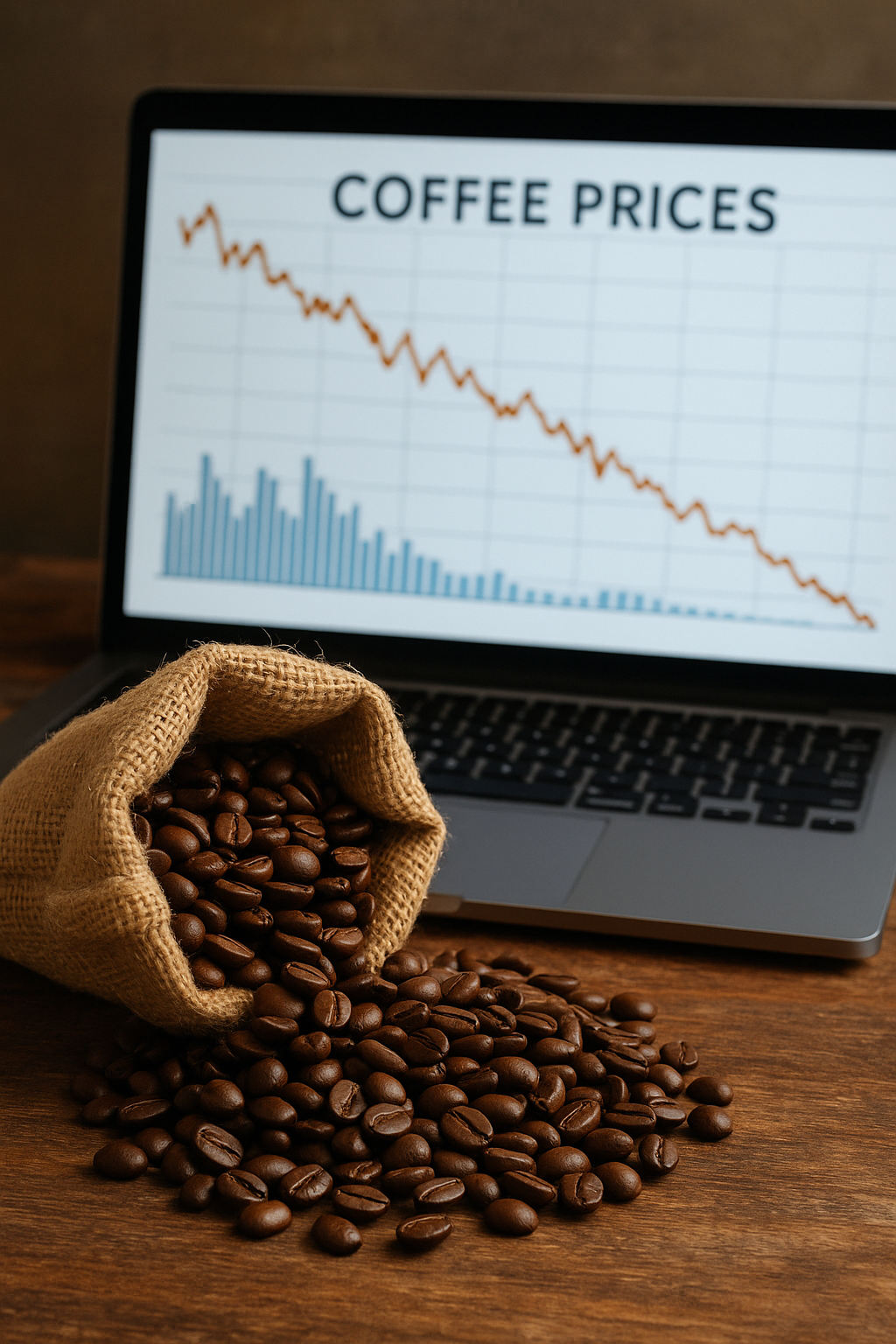
Global Coffee Prices Fall as U.S.–Brazil Trade Talks Raise Hopes for Tariff Relief

New York – Qahwa World

Coffee prices continued to decline on Monday as traders reacted to signs of a possible breakthrough in trade negotiations between the United States and Brazil. The downward movement follows a volatile week in which arabica and robusta futures hit multi-month highs before retreating sharply.

Market optimism grew after Brazil’s President Luiz Inácio Lula da Silva announced that his meeting with U.S. President Donald Trump, held on the sidelines of the ASEAN Summit in Malaysia, was “surprisingly good.” Lula hinted that both nations were close to finding a “definitive solution” on trade within days. This development has raised expectations that the heavy tariffs imposed on Brazilian exports, including coffee, could soon be eased.

Brazil, the world’s largest coffee exporter, has been significantly affected by the 50 % tariffs placed on its coffee shipments to the U.S. earlier this year. The duties have disrupted the normal flow of beans to American buyers, forcing many roasters to look for alternative suppliers. As a result, coffee inventories monitored by ICE have dropped to their lowest levels in over a year — arabica stocks fell to 447,773 bags and robusta holdings slipped to just over 6,000 lots. Since nearly one-third of the U.S. coffee supply comes from Brazil, any shift in trade policy could have immediate effects on American imports and retail prices.

Even as the diplomatic news eased some pressure, weather conditions in Brazil continue to concern the market. Somar Meteorologia reported that the main arabica-producing state of Minas Gerais received only 0.3 millimeters of rain in the week ending October 24 — about 1 % of its normal rainfall. The Bloomberg Brazil Weather Analysis confirmed that rainfall across the region has been about 30 % below average for the past month, fueling fears that prolonged dryness could reduce flowering and affect the 2026/27 crop yield.

Meanwhile, Vietnam’s coffee sector, the world’s largest producer of robusta, is showing the opposite trend. The Vietnam Coffee and Cocoa Association expects production in 2025/26 to increase by 10 % year-on-year if favorable weather continues. Official statistics show that the country exported 1.23 million metric tons between January and September 2025 — up 10.9 % from a year earlier — and total output for the upcoming season is projected to reach 1.76 million tons, equivalent to 29.4 million bags. This would mark Vietnam’s most productive season in four years and continue to weigh on robusta prices.

The International Coffee Organization also reported that global coffee exports from October to August rose slightly by 0.2 % to 127.9 million bags, suggesting that the overall supply remains sufficient despite regional challenges. In Brazil, crop forecasting agency Conab cut its 2025 arabica estimate in September by 4.9 % to 35.2 million bags, bringing total coffee production for the year to 55.2 million bags.

At the global level, the U.S. Department of Agriculture’s Foreign Agriculture Service (FAS) projects total coffee production for 2025/26 to reach 178.7 million bags — a 2.5 % increase year-on-year. Arabica output is expected to fall 1.7 % to 97 million bags, while robusta is forecast to grow 7.9 % to 81.6 million bags. Ending stocks are likely to rise nearly 5 % to 22.8 million bags, signaling more comfortable supply conditions heading into 2026.

However, climate factors may quickly change that outlook. The U.S. National Oceanic and Atmospheric Administration (NOAA) has raised the probability of a La Niña event to 71 % for the period between October and December. If it materializes, it could lead to drier-than-usual conditions across Brazil’s coffee-growing regions, threatening future yields.

For now, the coffee market remains pulled between political progress and environmental risk. The possibility of a U.S.–Brazil trade agreement could restore smoother coffee flows to the United States and ease supply constraints, but persistent drought conditions in South America and growing output in Southeast Asia continue to shape global price trends. Traders are watching both developments closely as the market searches for direction in the final quarter of 2025.

Rain Forecasts in Brazil Pressure Arabica Coffee Prices Despite Tight Global Supply

Dubai – Qahwa World

Arabica coffee prices fell sharply on Thursday as forecasts of much-needed rainfall in Brazil’s key coffee-growing regions eased concerns about prolonged dryness that had recently pushed prices higher. Meanwhile, robusta prices edged up, supported by steady demand and limited inventories.

On the Intercontinental Exchange (ICE), December arabica (KCZ25) closed down –7.85 cents (–2.04%) at 297.05 U.S. cents per pound, while November robusta (RMX25) gained +26 points (+0.57%), reaching a three-week high.

Brazil Weather Outlook

According to Brazilian meteorological agency Climatempo, parts of Minas Gerais — the country’s largest arabica-producing region — could receive up to 30 millimeters of rain this week, a “significant amount” expected to promote flowering for the 2026/27 crop cycle. The prospect of rainfall led to profit-taking after recent price gains fueled by drought concerns.

Earlier this week, Somar Meteorologia reported that Minas Gerais received only 0.9 millimeters of rain during the week ended October 4 — just 3% of the historical average — raising fears of poor flowering and lower yields before these latest forecasts.

Inventory and Trade Developments

While weather news weighed on prices, global supply signals remained tight. ICE-monitored arabica inventories fell to a 1.5-year low of 519,534 bags on Thursday, while robusta inventories hit a 2.5-month low of 6,237 lots. The sharp drawdown is partly linked to the 50% tariff on U.S. imports of Brazilian coffee, which has caused American buyers to void new contracts and tightened U.S. supplies. Brazil accounts for around one-third of America’s unroasted coffee imports.

At the same time, the International Coffee Organization (ICO) reported that global coffee exports for the current marketing year (Oct–Aug) rose by 0.2% year on year to 127.92 million bags, indicating adequate supply in the short term but little room for further tightening.

Production and Export Trends

Brazil’s crop forecaster Conab recently revised down its 2025 arabica crop estimate by 4.9% to 35.2 million bags (from 37 million in May) and cut total coffee output to 55.2 million bags (from 55.7 million). Meanwhile, Cecafé, the Brazilian exporters’ association, said coffee shipments fell 21% in the first seven months of the year to 22.2 million bags and plunged 28% in July alone.

In contrast, Vietnam — the world’s largest producer of robusta — is seeing strong growth. The Vietnam National Statistics Office reported that coffee exports from January to September 2025 rose 10.9% to 1.23 million metric tons, with the 2025/26 harvest expected to increase 6% to 1.76 million tons (29.4 million bags), a four-year high.

Global Outlook

The U.S. Department of Agriculture’s Foreign Agricultural Service (FAS) forecasts global coffee production in 2025/26 to reach a record 178.68 million bags, up 2.5% year on year. Within that total, arabica output is expected to decline 1.7% to 97.02 million bags, while robusta is projected to rise 7.9% to 81.65 million bags. Ending stocks are forecast to increase by 4.9% to 22.82 million bags.

However, trader Volcafe projects a global arabica deficit of 8.5 million bags for 2025/26 — wider than the 5.5 million bag deficit in 2024/25 — marking the fifth consecutive year of shortfall.

Adding to market uncertainty, the U.S. National Oceanic and Atmospheric Administration (NOAA) on September 16 raised the probability of a La Niña event between October and December to 71%. Such conditions can cause dry weather in South America and potentially damage Brazil’s next coffee crop, maintaining a tense balance between short-term relief and long-term risk.

Market Summary

For now, traders remain focused on Brazil’s rainfall patterns and their impact on flowering and yields. If forecasted rains fail to materialize, a renewed price rebound could follow as concerns about crop development resurface. Conversely, consistent rainfall in October could alleviate some supply pressures and bring temporary stability to arabica prices.

Coffee Prices Retreat on Rain Forecasts for Brazil

Dubai –  Qahwa World

Coffee prices fell for the second consecutive day on Tuesday as forecasts pointed to rain across key coffee-growing regions in Brazil, easing previous concerns over dry conditions.

December arabica coffee (KCZ25) closed down 1.56% at –5.95, while November ICE robusta (RMX25) slipped 1.27% to –57. According to Climatempo, rainfall is expected to spread from São Paulo to Minas Gerais this week, with some regions receiving over 30 mm of precipitation — a welcome relief for farmers during the critical flowering stage of the 2026/27 crop.

The decline follows Monday’s report from the International Coffee Organization (ICO) showing that global coffee exports between October 2024 and August 2025 rose 0.2% year-on-year to 127.92 million bags, signaling abundant global supply.

Robusta prices also faced pressure from Vietnam, where the National Statistics Office reported that coffee exports from January to September 2025 surged 10.9% to 1.23 million metric tons (MMT), reinforcing supply-driven headwinds.

Just days earlier, coffee prices had hit two-week highs on worries about dry weather in Brazil. Somar Meteorologia reported that Minas Gerais — the nation’s largest arabica region — received only 0.9 mm of rain in the week ending October 4, representing just 3% of the historical average.

Adding to the market’s complexity, U.S. tariffs on Brazilian imports have tightened supply in the American market. The 50% tariff, imposed earlier this year, has led to a sharp drawdown in ICE-monitored inventories, with arabica stocks dropping to a 1.5-year low of 534,665 bags, and robusta stocks to a 2.5-month low of 6,293 lots. Roughly one-third of unroasted coffee consumed in the U.S. originates from Brazil, intensifying the domestic supply strain.

Meanwhile, the National Oceanic and Atmospheric Administration (NOAA) raised the likelihood of a La Niña event in the southern hemisphere to 71% for October–December 2025, potentially signaling drier conditions in Brazil later this year.

Brazil’s national crop forecasting agency Conab recently trimmed its 2025 arabica estimate by 4.9%, down to 35.2 million bags, and revised its total coffee production forecast to 55.2 million bags — a modest decrease from 55.7 million in May.

Earlier, Cecafé, Brazil’s coffee exporters’ council, reported that the country’s July exports fell 28% to 2.7 million bags, bringing total shipments for January–July 2025 down 21% year-on-year to 22.2 million bags.

On the other hand, Vietnam — the world’s largest producer of robusta — is expected to harvest a 4-year-high crop of 1.76 MMT (29.4 million bags) in the 2025/26 season, up 6% year-on-year.

The U.S. Department of Agriculture’s Foreign Agricultural Service (FAS) projects global coffee production for 2025/26 to grow 2.5% year-on-year to a record 178.68 million bags, driven by a 7.9% increase in robusta output to 81.66 million bags, while arabica output is forecast to decline 1.7% to 97.02 million bags. FAS expects ending stocks to climb 4.9% to 22.82 million bags.

Despite these figures, Volcafe foresees a global arabica deficit of 8.5 million bags for 2025/26 — the fifth consecutive year of shortage — widening from 5.5 million bags last season.

Historic Drop in Certified Coffee Stocks Threatens Global Market Stability

Dubai Qahwa World

The global coffee market is entering a period of heightened uncertainty as certified coffee stocks fall to their lowest level in years, signaling tightening supply chains and growing pressure on prices. According to the International Coffee Organization’s (ICO) September 2025 Coffee Market Report, both Arabica and Robusta certified inventories saw steep declines, raising alarm among traders and producers about the sustainability of global coffee flows.

The ICO reported that certified Arabica stocks in the United States dropped by 19.3%, falling to 0.66 million 60-kg bags, while certified Robusta stocks in London declined by 4.3% to 1.08 million bags. The organization described these figures as a “clear indicator of tightening supply,” warning that if this trend continues, it could lead to further market volatility and stronger upward pressure on coffee prices into 2026.

The decline in certified stocks comes at a time when global coffee prices are already at a two-year high. The ICO Composite Indicator Price (I-CIP) averaged 324.62 US cents per pound in September up 9.3% from August and 25.4% year-on-year. This sustained rally reflects a combination of supply shortages, export delays, and speculative momentum, according to the report. Analysts also note that the depletion of certified stocks is a major driver behind the surge, as roasters and traders draw down existing inventories to meet ongoing demand.

In Brazil, the world’s largest coffee producer and exporter, the situation remains complex. Despite a healthy harvest, export performance continues to weaken, with the Brazilian Coffee Exporters Council (Cecafé) reporting a tenth consecutive monthly decline. Shipments have been slowed by logistical congestion at the Port of Santos and delayed customs procedures, resulting in slower replenishment of certified stocks. Much of the crop, although harvested, remains stored domestically awaiting transport a factor that continues to strain global availability.

Colombia, the world’s top producer of washed Arabica, is also struggling with weather disruptions in key coffee-growing regions and infrastructure setbacks that have limited its export capacity. Meanwhile, Vietnam, the largest Robusta supplier, has maintained stable production but faces supply chain bottlenecks that delay shipments to major consuming markets, particularly Europe and North America.

The ICO emphasized that these combined factors have created a fragile equilibrium in which global coffee demand remains resilient, but the flow of physical supply is insufficient to keep inventories stable. “The rate of certified stock depletion is now nearing levels not seen since 2021,” the report warned, adding that the balance between consumption and production is increasingly difficult to maintain amid logistical and policy-related challenges.

Trade policies are adding further complications. The United States’ 50% import tariff on coffee, still in place as of September 2025, continues to weigh heavily on trade volumes. Many importers have avoided purchasing new shipments at elevated costs, instead relying on existing certified reserves. This has accelerated the drawdown of available stock, pushing certified inventories closer to critical thresholds.

At the same time, monetary policy decisions have influenced speculative activity across commodity markets. The Federal Reserve’s recent 25-basis-point rate cut its first since 2024 triggered renewed investor interest in coffee futures, pushing prices even higher. The report noted that this speculative demand has intensified the pressure on physical stocks, as traders anticipate continued price gains and hedge against potential shortages.

The ICO also pointed to regulatory uncertainty in Europe as a factor contributing to the decline in certified inventories. Exporters are recalibrating their shipment schedules due to the forthcoming EU Deforestation Regulation (EUDR), which mandates traceability and geolocation data for coffee imports. While the European Commission has signaled a potential one-year delay in enforcement, many traders are opting to postpone shipments until compliance frameworks are clarified, further limiting short-term supply availability.

Market analysts caution that the combination of depleted stocks, policy delays, and persistent trade restrictions could lead to supply shortages in early 2026 if current trends persist. “The market is walking a fine line,” one analyst cited by the ICO noted. “With certified inventories at record lows, even minor disruptions whether from weather, logistics, or policy shifts could have an outsized impact on prices.”

This tightening supply scenario has already been reflected in the futures markets. ICE Arabica prices in New York rose by 11.5% in September, averaging 366.31 US cents per pound, while ICE Robusta prices in London climbed 8.9% to 197.56 US cents per pound. The price differential between the two markets widened by 14.7% to 168.75 US cents per pound, the highest level recorded in 2025. The ICO said the widening gap highlights uneven stock conditions and structural imbalances between Arabica and Robusta markets.

Furthermore, intra-day price volatility increased to 13.8%, compared to 10.6% in August, underscoring how thin inventories amplify market sensitivity to short-term developments. The report noted that low stock levels make the market more reactive to speculative trading, currency fluctuations, and export data releases.

Despite these challenges, some optimism remains tied to upcoming harvests in Central America and East Africa, which could provide temporary relief to global supplies. However, the ICO cautioned that recovery will likely be slow, as high fertilizer and labor costs continue to limit farm investment and productivity gains across several producing countries.

Ultimately, the ICO concluded that the historic decline in certified coffee stocks represents more than a temporary fluctuation it reflects a deep structural imbalance in the global coffee economy. Persistent trade barriers, logistical delays, and delayed regulatory decisions have combined to restrict availability at a time when global demand remains robust. The report warned that unless export performance and stock replenishment improve by early 2026, the market could face an extended period of high prices and intensified volatility.

As the global coffee sector navigates this critical juncture, the ICO urged stakeholders from producers to importers to focus on efficient supply chain management, sustainable farming practices, and regulatory coordination to restore stability to the market. Without such measures, the world’s coffee supply chain risks remaining on edge well into the coming year.

Global Coffee Market Reacts to Tariffs, Rate Cuts, and EU Regulation Uncertainty

Dubai Qahwa World

The global coffee market navigated a turbulent September as trade tensions, monetary policy shifts, and regulatory uncertainty reshaped investor sentiment and price dynamics. According to the International Coffee Organization’s (ICO) latest Coffee Market Report for September 2025, the sector was influenced by a combination of U.S. tariff policy, an interest rate cut by the Federal Reserve, and developments surrounding the European Union’s Deforestation Regulation (EUDR). Together, these factors created a complex environment of both optimism and caution across producing and consuming regions.

The month began with heightened uncertainty following the decision by the United States to maintain its 50% import tariff on coffee. This came despite a presidential executive order, issued on 8 September, that excluded several commodities from the existing tariff regime. Coffee, however, remained absent from the exemption list, as it is not considered a product that can be sufficiently produced within the U.S. to meet domestic demand. The policy stance kept traders and importers on edge, particularly in light of already tight global supplies and rising domestic roasting costs.

The ICO report noted that the continued imposition of tariffs has dampened export momentum from major producing countries, particularly Brazil, which remains the world’s largest coffee supplier. Exporters faced not only the direct cost of tariffs but also indirect consequences such as higher insurance premiums and delayed shipments. The United States, typically the second-largest destination for Brazilian coffee after Germany, saw imports fall sharply in August down 46% year-on-year and 26% month-on-month, according to data from Cecafé.

However, as the month progressed, a diplomatic thaw between Washington and Brasília offered a glimmer of optimism. Meetings between senior officials from both countries, held on the sidelines of the United Nations General Assembly in New York, were interpreted by market analysts as a potential first step toward resolving trade tensions. Though no formal changes were announced, the dialogue provided reassurance to traders that punitive tariffs might be reviewed later in the year, especially if inflationary pressure continues to ease in the United States.

Adding to the month’s market developments, the U.S. Federal Reserve cut its benchmark interest rate by 25 basis points on 17 September its first such move since early 2024. The decision aimed to support economic growth amid signs of slowing consumer spending and lower manufacturing output. For coffee traders, the rate cut brought mixed implications. On one hand, cheaper borrowing encouraged speculative activity in commodity markets, which helped lift prices. On the other, the stronger U.S. dollar that followed the announcement increased costs for buyers using other currencies, especially in emerging markets.

The ICO observed that the daily volatility of the ICO Composite Indicator Price (I-CIP) rose to 13.8% in September, up from 11% the previous month, partly driven by the interplay of monetary and trade factors. The organization emphasized that such fluctuations reflect not only speculation but also genuine uncertainty about the future of trade flows and regulatory frameworks that govern the industry.

In Europe, a different kind of uncertainty unfolded. The European Commissioner for Environment, Oceans, and Fisheries, responsible for overseeing the Deforestation Regulation (EUDR), expressed concern over the readiness of the EU’s technical system for tracing commodities such as coffee, cocoa, and palm oil. The Commissioner admitted that the digital platform designed to monitor compliance might not be fully operational in time for the regulation’s official start date in January 2026. As a result, Brussels is now considering a one-year postponement of the EUDR’s implementation.

This potential delay was met with relief from coffee-producing nations and exporters, many of whom have voiced apprehension over the costs and logistical burdens of compliance. The regulation, adopted in 2023, requires companies importing into the EU to prove that their products do not contribute to deforestation or forest degradation. For coffee, that means exporters must provide precise geolocation data for every farm and ensure traceability across the supply chain. While the regulation aims to promote sustainable trade, several producing countries, including Ethiopia, Uganda, and Honduras, have warned that smaller farmers could be excluded from the European market if compliance deadlines remain too strict.

Market participants see the proposed delay as a temporary reprieve. “It gives exporters and cooperatives valuable time to adjust and strengthen traceability systems,” the ICO noted. However, the organization also cautioned that postponement does not remove the long-term challenge of compliance. Producers who fail to invest in sustainable certification and farm-level data systems risk losing access to the world’s most regulated and high-value coffee market.

By the end of September, the combined effects of tariffs, monetary easing, and policy uncertainty continued to shape market sentiment. The ICO Composite Indicator Price averaged 324.62 US cents per pound, up 9.3% from August, marking the highest level in two years. Yet, behind the price surge lay diverging regional realities: while exporters in Vietnam and Colombia benefited from strong demand and competitive logistics, producers in Brazil and Central America faced rising export costs and political tension around trade access.

The report concluded that these intersecting economic and regulatory developments have pushed the coffee industry into a phase of structural adaptation. With monetary policy softening in the United States, trade negotiations cautiously reopening, and the EU potentially adjusting its sustainability timeline, the final quarter of 2025 is expected to test the industry’s resilience. Analysts agree that while prices may remain high in the short term, long-term stability will depend on how swiftly producers, traders, and regulators can align under a more predictable and sustainable framework.

As the ICO noted, the coffee market of late 2025 is no longer defined solely by supply and demand but by the policies, regulations, and economic instruments that govern it. The cup of coffee on the global stage has never been more entangled with diplomacy, finance, and environmental accountability.

Global Coffee Prices Surge to 2-Year High

Dubai – Qahwa World

The global coffee market witnessed a significant price surge in September 2025, marking one of the strongest monthly performances in recent years. According to the latest Coffee Market Report issued by the International Coffee Organization (ICO), the ICO Composite Indicator Price (I-CIP) averaged 324.62 US cents per pound, representing a 9.3% increase compared to August 2025 and a striking 25.4% rise year-on-year. The report reveals that while prices rose across all coffee groups, tightening certified stocks and persistent trade uncertainties continue to define the market’s volatile landscape.

The ICO noted that Arabica varieties led the monthly increase, with Colombian Milds climbing 10.1% to 403.77 US cents/lb, Other Milds advancing 9.3% to 400.21 US cents/lb, and Brazilian Naturals gaining 11.3% to 374.91 US cents/lb. Robusta, meanwhile, registered a more moderate yet notable 5.9% increase to 210.85 US cents/lb. The rise was mirrored on both major futures exchanges, with New York ICE prices up 11.5% to 366.31 US cents/lb, and London ICE prices increasing by 8.9% to 197.56 US cents/lb. The I-CIP fluctuated between 298.14 and 360.74 US cents/lb during the month, maintaining a median value of 323.44.

The report attributes much of September’s price escalation to several interconnected macroeconomic and policy-related developments that placed upward pressure on the market during the first half of the month. Among these, concerns over the long-term supply of coffee to the United States stood out, especially given the continued uncertainty surrounding import tariffs. Although on 8 September the U.S. administration issued an executive order revising tariffs for “aligned partners” with established trade agreements, coffee remained excluded from the list. The commodity continues to face a 50% import tariff imposed earlier in the year, as it is not yet categorized among products that the U.S. cannot sufficiently produce domestically. This policy has led to sustained apprehension among traders and exporters, particularly as U.S. certified Arabica stocks continue to decline.

The ICO underlined that certified stocksused as a short-term substitute for coffee importsare shrinking at an alarming rate, reinforcing market tightness. U.S. certified stocks of Arabica fell 19.3% in September to 0.66 million 60-kilogram bags, while London-certified Robusta stocks decreased 4.3% to 1.08 million bags. These drawdowns, the report states, indicate that the market is “starting to feel the squeeze,” signaling a bullish outlook for prices if replenishment remains weak.

However, the latter half of September brought developments that introduced downward pressure and tempered speculative enthusiasm. On 15 and 17 September, the ICE Futures U.S. exchange raised margin requirements for Arabica contracts twice in a single week. Higher margin requirements force investors to deposit more capital with brokers to cover increased credit risk, thus raising borrowing costs for both new and existing positions. The ICO explained that such moves can reduce liquidity and limit speculative demand, potentially stabilizing prices in overheated markets.

At the same time, discussions at the United Nations General Assembly between U.S. and Brazilian officials provided a momentary boost to market optimism. As the world’s largest coffee producer and the largest destination market sought to improve bilateral trade relations, investors interpreted the talks as a signal that tariff détente might eventually follow. Brazil’s exports have been under severe strain, declining for ten consecutive months due to both cyclical production factors and logistical issues at the port of Santos.

On the monetary front, the U.S. Federal Reserve’s 25-basis-point interest rate cut on 17 September had a nuanced impact. While the policy was intended to lower borrowing costs across the economy, it indirectly affected coffee prices by making speculative trading less expensive. The ICO noted that cheaper credit may have helped sustain trading volumes, adding volatility to a market already under pressure from tightening supplies.

The European Union also entered the spotlight in September after the EU Commissioner for Environment, Water Resilience and a Competitive Circular Economy raised concerns over the readiness of the EU Deforestation Regulation (EUDR) IT system. The Commissioner indicated that the system might not be able to handle the expected transaction volume, suggesting a possible one-year extension before enforcement begins. The EUDR, which aims to ensure that coffee and other commodities imported into the EU are deforestation-free, has been a major topic of concern among exporters since its adoption, and any delay could temporarily ease compliance-related pressures on coffee-producing nations.

Despite these counterbalancing developments, overall volatility continued to rise. The ICO reported that intra-day volatility of the I-CIP increased by 2.8 percentage points compared to August, averaging 13.8% in September. By category, Colombian Milds and Other Milds showed volatility of 14.0% and 13.7%, respectively, Brazilian Naturals 14.7%, and Robustas 15.0%. At the futures level, New York volatility stood at 15.2%, while London measured 16.2%, reflecting a minor uptick in speculative activity.

Price differentials also widened notably. The Colombian MildsOther Milds differential expanded from 0.41 to 3.56 US cents/lb, while the Colombian MildsRobustas differential rose 15.1% to 192.92 US cents/lb. The arbitrage between the London and New York markets, a key indicator of the spread between Arabica and Robusta, widened by 14.7% to 168.75 US cents/lb, the highest level of the year.

Overall, the ICO described September as a month defined by tightening supplies, speculative activity, and geopolitical uncertainty. The consistent decline in certified stocks, combined with unresolved tariff tensions and potential EUDR delays, continues to reinforce a bullish sentiment across the market. As the fourth quarter of 2025 begins, analysts expect coffee prices to remain elevated, with volatility likely to persist until structural issuessuch as logistics bottlenecks, regulatory clarity, and weather-related production concernsare addressed.

In summary, the ICO’s latest data depict a coffee market under strain but also opportunity. Prices are buoyed by constrained supply and investor sentiment, while trade policies and financial dynamics continue to influence short-term movements. With the I-CIP climbing above 320 US cents/lb for the first time in over two years and certified stocks hitting new lows, September 2025 may well be remembered as a turning point in the evolving balance between global coffee supply and demand.

International Coffee Organization Launches Comprehensive Guide to Celebrate International Coffee Day 2025

Dubai – Qahwa World

The International Coffee Organization (ICO) has released a comprehensive guide to help individuals and institutions celebrate International Coffee Day 2025, taking place on October 1st under the theme “More Than Ever: Embracing Collaboration for Collective Action.” The guide highlights that coffee is not just a beverage, but a symbol of cooperation and collective effort, from the farm to the consumer’s cup.

What Does the Guide Include?

The ICO has prepared a communications toolkit featuring:

Customizable campaign images

Social media graphics

Posters and banners

All materials are available in English, French, Spanish, and Portuguese, and can be downloaded directly from the ICO’s official website to help spread a unified global message.

Join the Campaign with #ICD2025

The ICO invites everyone to participate in the digital campaign by completing the phrase:

“Coffee is Collaboration because…”

and sharing it across social media platforms using the official hashtag #ICD2025.

The Message for 2025

In its statement, the ICO emphasized: “The true power of the coffee sector lies in the unity of all its actors – from producers to consumers. Collaboration is what makes coffee a vital part of solutions to economic and social development. In 2025, a year full of challenges, we reaffirm our commitment to walk side by side for the common good.”

A Global Call to Action

Through this guide, International Coffee Day becomes more than a symbolic celebration. It offers practical tools and opportunities for engagement, from sharing campaign visuals and organizing local events to telling personal coffee stories that reflect the spirit of collaboration.

With this guide, the ICO empowers everyone — from cafés and companies to individuals — to join the global movement of celebrating coffee and embracing collaboration more than ever.

International Coffee Day 2025: ICO Launches Global Campaign “Embracing Collaboration More Than Ever”

London – Qahwa World

The International Coffee Organization (ICO) has announced the theme for International Coffee Day 2025, celebrated worldwide on October 1: “Embracing Collaboration More Than Ever.”

The annual event brings together millions of people across the globe to celebrate coffee and recognize the farmers, cooperatives, traders, roasters, baristas, and consumers who contribute to making coffee the world’s most beloved beverage. This year’s campaign underscores that coffee is synonymous with collaboration and calls on all stakeholders to unite in a spirit of solidarity and shared purpose.

Collaboration at the Core

The ICO emphasizes that the 2025 theme highlights the essential role of collaboration across the coffee value chain in ensuring sustainable livelihoods and shared prosperity. By strengthening links from crop to cup, the campaign positions coffee as a driver of income generation, sustainable development, and resilient communities.

Vanúsia Nogueira, Executive Director of the ICO, stated:

“Coffee is a product of many hands and many hearts. When farmers, cooperatives, researchers, roasters, traders, baristas and consumers work together, we create opportunities for income, resilience and environmental stewardship. This year’s campaign calls for practical collaboration that delivers real benefits along the whole chain. Join us — take part in the challenges and show how, together, coffee can be a force for good.”

Digital Campaign and Global Participation

The 2025 initiative will feature a refreshed, interactive website and encourage digital participation through the hashtag #ICD2025. Among the activities, participants will be invited to complete the phrase “Coffee is collaboration because…” in posts or videos, showcasing the many ways coffee connects people across the globe.

The ICO invites governments, industry partners, civil society, cooperatives, and consumers to get involved by:

Registering events and activities on the official campaign website

Promoting the hashtag #ICD2025 through their communication channels

Recording short videos with the campaign phrase and tagging @icocoffeeorg

A full communications toolkit and multilingual resources are available at www.internationalcoffeeday.org

About the ICO

The International Coffee Organization is the only intergovernmental body focused on enhancing the sustainability of the global coffee sector. It provides official statistics on production, trade, and consumption, and develops public-private partnerships and technical cooperation projects to foster progress and resilience in the industry. More information is available at www.ico.org

Coffee Prices Plunge on Rain Forecasts for Brazil

Dubai, September 18, 2025 – (Qahwa World) – Global coffee markets faced a sharp downturn on Wednesday as prices tumbled amid forecasts of long-awaited rainfall in Brazil, the world’s largest coffee producer. December arabica futures (KCZ25) closed down -33.70 cents, a steep -8.23%, marking a one-week low. November ICE robusta futures (RMX25) also plunged by -331 points, or -6.92%.

The sudden reversal came just a day after arabica reached a contract high and robusta hit a three-week peak, driven by drought conditions. Forecasts now indicate showers in Brazil’s key coffee-growing regions beginning next week, triggering heavy long liquidation in the market.

Brazil’s Cooxupe cooperative, the largest in the country, announced that the harvest among its members was 98.9% complete as of September 12, adding further bearish pressure. The completion of the harvest, coupled with improved weather outlooks, weighed heavily on investor sentiment.

Yet underlying fundamentals remain tense. Earlier this month, Brazil’s crop forecasting agency Conab revised its 2025 arabica production estimate down by -4.9% to 35.2 million bags, while total coffee output was trimmed to 55.2 million bags. Global supply challenges also persist: the International Coffee Organization (ICO) reported that July exports fell -1.6% year-on-year, while cumulative exports from October to July slipped -0.3%.

On the demand side, U.S. buyers continue to face supply strain due to 50% tariffs on Brazilian coffee, effectively tightening the American market, where one-third of unroasted coffee imports come from Brazil. Meanwhile, ICE-monitored inventories continue to dwindle, with arabica stocks dropping to a 16.5-month low of 659,949 bags and robusta inventories falling to a 1.5-month low of 6,551 lots.

Vietnam, the world’s second-largest coffee producer, is also under scrutiny. Severe drought reduced the 2023/24 crop by -20% year-on-year to 1.472 million metric tons, the smallest harvest in four years. Exports in 2024 declined -17.1%, though shipments from January to August 2025 were up +7.8% year-on-year, showing signs of recovery.

Looking ahead, the USDA’s Foreign Agriculture Service projects global coffee production in 2025/26 will reach a record 178.68 million bags, up +2.5% year-on-year, supported by strong robusta output. However, research firm Volcafe warns that arabica will face a deficit of -8.5 million bags in 2025/26, the fifth consecutive year of shortage.

For now, rain forecasts in Brazil have calmed fears of immediate supply disruption, but the broader picture of tightening inventories, tariffs, and shifting climate risks ensures that volatility will remain a defining feature of the global coffee market.

Coffee Prices Surge on Brazil Weather Concerns and Supply Tightness

Dubai, 23 August, 2025 (Qahwa World) – Coffee futures surged sharply on Friday, reaching multi-month highs as weather concerns in Brazil and tightening global supplies continued to fuel bullish momentum. December arabica coffee (KCZ25) closed up +13.30 cents (+3.64%), marking a 3.5-month high, while September ICE robusta (RMU25) gained +108 points (+2.27%), its strongest level in three months. The rally extended a three-week upward trend, with traders reacting to reports of dry conditions and frost damage in Brazil, the world’s largest coffee producer.

According to Somar Meteorologia, Minas Gerais, Brazil’s leading arabica coffee-growing region, recorded no rainfall during the week ending August 16. This lack of precipitation, coupled with recent frost damage, raised concerns over crop yields and pushed prices higher. Additional upward pressure came from the United States, where coffee supplies are tightening as buyers void new Brazilian contracts in response to a 50% tariff on Brazilian exports. With nearly one-third of U.S. coffee imports traditionally sourced from Brazil, the restrictions have intensified market concerns over availability.

Brazil’s Trade Ministry reported that July unroasted coffee exports fell by 20.4% year-on-year to 161,000 metric tons. Exporter group Cecafe confirmed an even steeper decline in green coffee shipments, which dropped 28% in July to 2.4 million bags. Arabica exports fell 21%, robusta plunged 49%, and overall shipments for the January–July period slipped 21% to 22.2 million bags. Meanwhile, ICE-monitored arabica inventories fell to a 1.25-year low of 726,661 bags before recovering slightly to 729,606 bags on Friday. Robusta inventories also dropped to a four-week low of 6,642 lots, down from a two-year high of 7,029 lots at the end of July.

On the other hand, progress in Brazil’s harvest is adding a bearish element. Safras & Mercado reported that 99% of the 2025/26 crop was harvested as of August 20, with the robusta harvest completed and 98% of arabica finished. Brazil’s largest cooperative, Cooxupé, announced that its members had completed 86.1% of their harvest by August 15.

Global developments continue to influence sentiment. The International Coffee Organization reported that world coffee exports rose 7.3% in June to 11.69 million bags, although cumulative shipments from October through June were slightly lower at 104.14 million bags. In Vietnam, drought reduced 2023/24 production by 20% to 1.472 million metric tons, the smallest crop in four years, while 2024 exports dropped 17.1%. The Vietnam Coffee and Cocoa Association has since lowered its 2024/25 production forecast to 26.5 million bags. However, government data showed that exports from January to July 2025 rose 6.9% to 1.05 million metric tons.

The USDA’s Foreign Agriculture Service projects that global coffee production in 2025/26 will rise by 2.5% to a record 178.68 million bags, with robusta output increasing by 7.9% to 81.66 million bags and arabica output slipping 1.7% to 97.02 million bags. Ending stocks are forecast to climb 4.9% to 22.82 million bags. Despite these figures, trader Volcafe projects a widening arabica deficit of 8.5 million bags for 2025/26, compared with 5.5 million in 2024/25, marking the fifth consecutive year of shortages.

Coffee markets are now navigating the opposing forces of immediate weather-driven supply risks and harvest progress in Brazil against longer-term forecasts of record global output, leaving traders alert to further volatility in the weeks ahead.

Brazil Weather and U.S. Tariffs Drive Coffee Prices to Multi-Month Highs

Dubai, August 19, 2025 (Qahwa World) – Coffee prices surged on Tuesday, with arabica futures climbing to a 2.25-month high and robusta reaching a two-month high, supported by dry conditions in Brazil’s key growing regions and tightening U.S. supplies following new tariffs on Brazilian coffee.

September arabica coffee (KCU25) rose 1.85% (+6.35¢/lb), while September ICE robusta (RMU25) gained 4.04% (+$168). The rise reflects mounting concern over Brazil’s weather, particularly in Minas Gerais, the country’s largest arabica-producing state, where Somar Meteorologia reported no rainfall during the week ending August 16.

Market support is also coming from the United States, where buyers are avoiding new contracts for Brazilian coffee due to a 50% tariff imposed on imports. Brazil typically supplies about one-third of U.S. unroasted coffee, making the tariff impact significant for roasters and traders.

Brazil’s July export figures further underscored supply concerns. According to the Trade Ministry, unroasted coffee exports fell 20.4% year-on-year to 161,000 metric tons. Exporter group Cecafé reported that green coffee shipments dropped 28% y/y to 2.4 million bags, while total coffee exports fell to 2.7 million bags. From January to July, Brazil’s overall exports declined 21% to 22.2 million bags.

Certified exchange inventories remain tight. ICE arabica stocks fell to a 1.25-year low of 726,661 bags on August 14 before recovering slightly to 733,105 bags this week. ICE robusta stocks dropped to a three-week low of 6,749 lots, down from late-July’s two-year high of 7,029 lots.

On the supply side, Brazil’s 2025/26 coffee harvest is advancing. Research firm Safras & Mercado estimates the crop was 94% complete as of August 6, with robusta nearly finished (99%) and arabica at 91%. Cooxupé, Brazil’s largest coffee cooperative, reported its members had completed 80.4% of their harvest by August 8.

Beyond Brazil, Vietnam’s coffee industry continues to influence robusta prices. Drought reduced 2023/24 production by 20% y/y to 1.47 million metric tons, the lowest in four years, while 2024 exports fell 17.1% to 1.35 million metric tons. However, recovery signs emerged with January–July 2025 exports up 6.9% y/y to 1.05 million metric tons.

The International Coffee Organization (ICO) reported that global coffee exports in June rose 7.3% y/y to 11.69 million bags, though October–June totals slipped 0.2% to 104.14 million bags.

Looking ahead, the USDA’s Foreign Agricultural Service (FAS) projects 2025/26 world coffee production at a record 178.7 million bags, up 2.5% year-on-year. Arabica output is expected to fall 1.7% to 97 million bags, while robusta is forecast to rise 7.9% to nearly 82 million bags. Ending stocks are projected to grow 4.9% to 22.8 million bags.

However, trader Volcafe sees a very different balance: a global arabica deficit of 8.5 million bags in 2025/26, the fifth consecutive year of shortages and larger than the 5.5 million bag deficit recorded in 2024/25. This highlights continued market tightness despite record overall supply projections.

Côte d’Ivoire Coffee Week Showcases Africa’s Shift to Sustainable, Value-Added Coffee

The International Trade Centre (ITC) and the International Coffee Organization (ICO) reaffirmed their commitment to inclusivity and sustainability during Coffee Week in Abidjan, Côte d’Ivoire.

Historically, with the exception of Ethiopia, much of Africa has viewed coffee primarily as an export commodity rather than a drink enjoyed locally. Coffee culture has remained limited in many countries, with minimal value addition or internal trade. However, this is changing. A new movement is emerging across the continent, where African countries are reclaiming ownership of coffee—adding value at origin, trading regionally, and cultivating domestic appreciation and consumption.

Côte d’Ivoire’s Coffee Week symbolizes this transformation, signaling Africa’s rise as both a producer and a dynamic coffee market.

As part of their ongoing collaboration under the Alliances for Action initiative, ITC and ICO co-hosted activities to strengthen value chains, promote investment, and build technical capacity—particularly in robusta-producing regions. The event was organized in partnership with Côte d’Ivoire’s Conseil Café-Cacao, the Robusta Coffee Agency of Africa and Madagascar (ACRAM), the Specialty Coffee Association (SCA), and other partners.

Key activities included:

  • Barista and cupper training aligned with SCA standards, training 25 entrepreneurs in professional tasting and preparation techniques.

  • International seminar on coffee genetic resources with Crop Trust and the National Centre for Agronomic Research (CNRA), attended by 29 participants from 16 countries.

  • Press conference featuring leaders from ITC, ICO, Crop Trust, and Côte d’Ivoire’s Permanent Representative for Commodities, Ambassador Aly Touré.

  • Launch of ITC’s Agribusiness Investment Promotion Approach, with a workshop introducing 40 participants to ITC’s agro-investment methodology and providing targeted training to 15 attendees on investment readiness.

“This is about giving producing countries the tools, knowledge, and platforms to lead coffee transformation on their own terms,” said ICO Executive Director Vanusia Nogueira. “We’re here to make quality coffee education more accessible—especially in robusta-producing countries.”

Sahande Mamadou, Director of Elima Torréfaction, noted the value of the training: “This deepened my understanding of sensory analysis and specialty coffee cupping. We now see the importance of improving roasting techniques and sampling for our clients.”

ITC’s Côte d’Ivoire Coffee Coordinator, Mory Diawara, emphasized the importance of value addition and regional markets, saying it would bring greater returns to local producers and processors.

The week also reinforced the ICO–ITC–SCA partnership to professionalize African youth in the coffee sector, in line with the DACBA initiative (Drink African Coffee, Build Africa) led by the Inter-African Coffee Organization.

Côte d’Ivoire’s Minister of Agriculture, ICO’s Executive Director, and Ambassador Aly Touré participated in high-level discussions, highlighting the sector’s strategic importance. The event concluded with calls for expanded capacity building and equipment support to strengthen the sector further.

The investment readiness workshop, supported by ITC’s Alliances for Action, provided a platform for small businesses to engage with financial service providers, understand investor requirements, and explore opportunities—focusing on unlocking investments and increasing domestic value addition for long-term resilience.

Through inclusive partnerships, technical training, and investment facilitation, ITC and ICO aim to position producing countries not only as exporters but also as global leaders in shaping the future of sustainable coffee.

About the Project:
The ACP Business-Friendly Programme is funded by the European Union and the Organisation of African, Caribbean and Pacific States (OACPS) and jointly implemented by ITC’s Alliances for Action, the World Bank, and UNIDO. It supports agribusiness competitiveness in ACP countries, promoting inclusive and sustainable value chains that benefit all stakeholders.