Dunkin’ Gives Away Over 1 Million Free Coffees for April Fools’

Dubai – Qahwa World

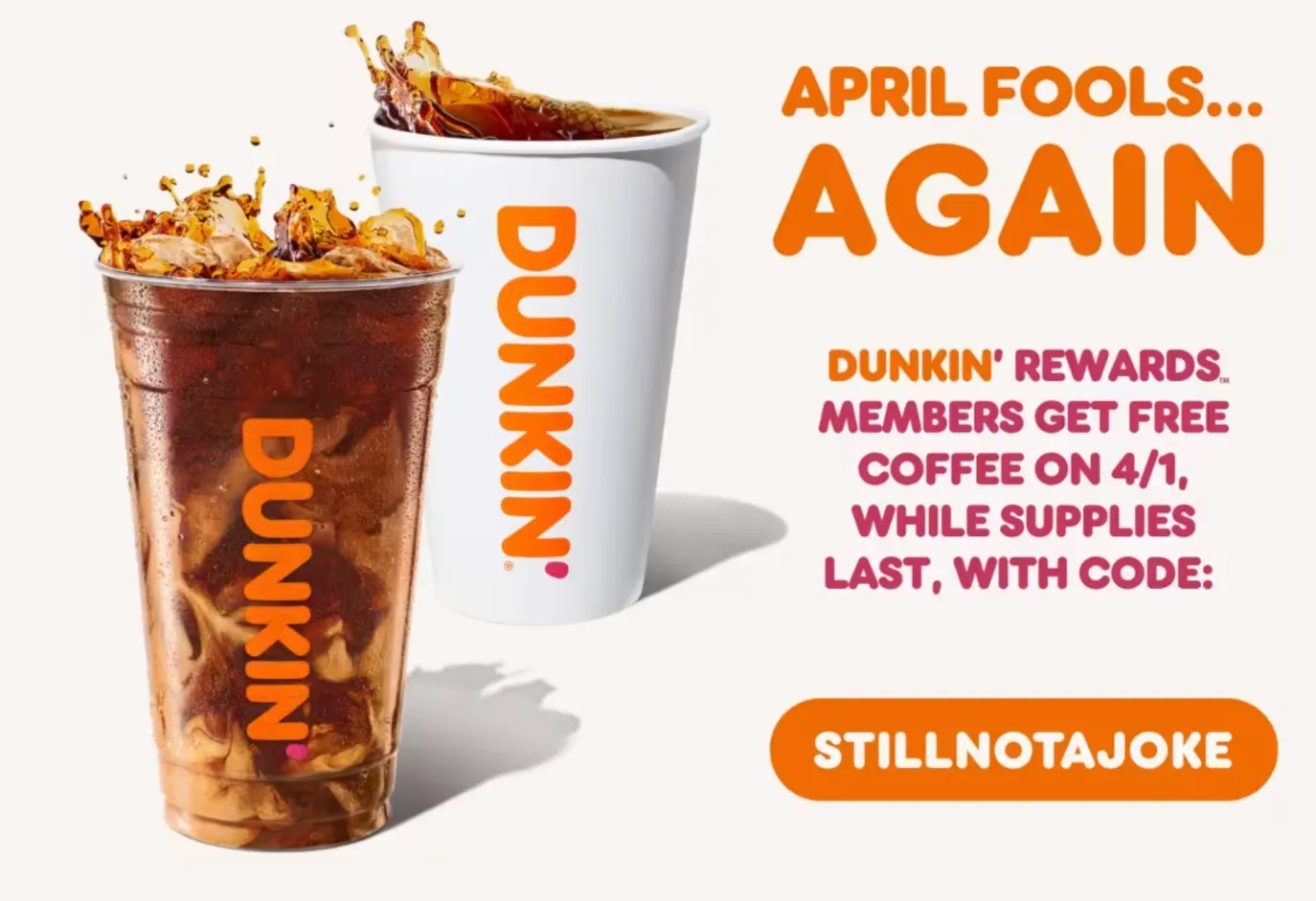
Dunkin’ launched its annual April Fools’ Day promotion on Wednesday, April 1, 2026, offering more than 1,000,001 free coffees to members of its Rewards program across the United States, one more than last year’s giveaway to prove that the promotion was not a prank.

According to the official announcement on Dunkin’s blog, last year the chain distributed one million free coffees, which some customers doubted. To address this, Dunkin’ increased the giveaway by one coffee this year to demonstrate the offer’s authenticity.

Rewards members could claim any size hot or iced brewed coffee (excluding cold brew and extra-large hot coffee in most descriptions) by entering the promo code StillNotAJoke in the Dunkin’ app on April 1 only. The offer was limited to the first 1,000,001 members to enter the code.

The free coffee certificate could be redeemed within seven days after entering the code, approximately until April 8. Each member could redeem one coffee only, and no purchase was required. The offer remained valid while supplies lasted.

The promotion received widespread media attention, as it returned after last year’s successful but heavily doubted giveaway. Marketing experts note that initiatives like this strengthen customer engagement and loyalty to the brand.

With this campaign, Dunkin’ turned April Fools’ Day into a real celebration for coffee lovers, proving that the promotion was genuine and not a joke for members of its Rewards program.

Top 16 Fall Coffee Drinks from Healthiest to Unhealthiest

Dubai Qahwa World

As autumn unfolds across the Northern Hemisphere, coffee chains are once again unveiling their most anticipated seasonal creations. While the iconic pumpkin spice latte continues to dominate menus, 2025’s fall offerings reveal a much broader spectrum of flavors from pecan and caramel to cereal-inspired blends and an even wider range of nutritional profiles.

A new analysis by Hers has compared 16 of the season’s most popular fall coffee drinks from major U.S. brands, ranking them from the healthiest to the least healthy based on four key nutrition indicators: calories, sugar, fat, and trans fat. The study included beverages from Starbucks, Dunkin’, McDonald’s, Krispy Kreme, and Einstein Bros., examining each drink’s standard recipe and medium serving size.

The findings highlight major differences between the drinks, reminding coffee lovers that not all cozy fall treats are created equal. Some beverages, particularly cold brews, can offer lower sugar and calorie counts, while others especially blended or cream-based options contain as much sugar and fat as a full meal.

According to the report, two of the five healthiest drinks are cold brews, confirming their reputation as lighter, smoother, and less sugary alternatives to lattes and frappes. Starbucks, unsurprisingly, dominates the list with a wide range of options spanning nearly every position on the ranking from top performers to indulgent desserts in disguise. Pumpkin spice lattes, the hallmark of the season, generally sit in the middle range, offering moderate calorie and sugar levels compared to other festive drinks.

Below is Hers’ full ranking of the Top 16 Fall Coffee Drinks in 2025 from Healthiest to Unhealthiest:

  1. Pecan Oatmilk Cortado Starbucks
  2. Caramel Cream Cold Brew Einstein Bros.
  3. Chai Latte Starbucks
  4. Pumpkin Spice Iced Coffee Krispy Kreme
  5. Pumpkin Cream Cold Brew Starbucks
  6. Pumpkin Spice Latte McCafé (McDonald’s)
  7. Pumpkin Spice Latte Krispy Kreme
  8. Pumpkin Spice Iced Signature Latte Dunkin’
  9. Cereal N’ Milk Iced Latte Dunkin’
  10. Iced Pecan Crunch Oatmilk Latte Starbucks
  11. Iced Pumpkin Spice Latte Starbucks
  12. Pumpkin Spice Crème Frappuccino Blended Beverage Starbucks
  13. Pumpkin Spice Latte Starbucks
  14. Pumpkin Spice Frappuccino Blended Beverage Starbucks
  15. Iced Pumpkin Cream Chai Starbucks
  16. Frozen Pumpkin Spice Latte Krispy Kreme

At the top of the list are the Pecan Oatmilk Cortado and the Caramel Cream Cold Brew, both praised for their balanced flavors and relatively light nutritional footprint. At the bottom sits the Frozen Pumpkin Spice Latte from Krispy Kreme, which packs a hefty 610 calories, 80 grams of sugar, and 25 grams of fat numbers closer to a dessert than a coffee. Similarly, Starbucks’ Iced Pumpkin Cream Chai and Pumpkin Spice Frappuccino also rank among the least healthy, with sugar levels exceeding 60 grams per serving.

In contrast, the cold brews show impressive restraint. Einstein Bros.’ Caramel Cream Cold Brew has just 210 calories and 33 grams of sugar, while Starbucks’ Pecan Oatmilk Cortado contains only 26 grams of sugar the lowest among all drinks reviewed. Even the much-loved Pumpkin Cream Cold Brew from Starbucks performs relatively well, landing in the top five with 250 calories and 31 grams of sugar.

To ensure accurate comparisons, Hers standardized the serving size to 16 ounces for each drink and analyzed them using nutritional data provided by each brand. The study gave trans fat a double weight in the scoring system due to its proven links to cardiovascular disease and inflammation.

Beyond the rankings, the report serves as a timely reminder to enjoy the season’s flavors mindfully. Coffee lovers are encouraged to stay hydrated, balance indulgent drinks with lighter choices, and incorporate fresh fall produce like apples, pumpkins, and squash into their diet for better nutrition and immunity. The study also notes that moderate physical activity even a simple walk with a pumpkin spice latte in hand can significantly reduce the risks of heart disease and diabetes.

Ultimately, the report captures an essential truth of modern coffee culture: fall drinks are as much about experience as flavor. From the first sip of pumpkin spice to the smooth chill of cold brew, the choice now lies not just in taste but in the balance between pleasure and well-being.

Worth $58.5 Billion: US Coffee Market Slows Under Cost Pressures

Dubai Qahwa World

The US branded coffee shop industry, one of the largest in the world, is showing signs of strain as growth slows amid rising costs and a tough economic climate. According to new industry research, the market is now worth around $58.5 billion, achieving 6.6% annual sales growth a dip from last year’s 7%.

Despite the cooling pace, the market continues to expand in size and scale. Net outlet growth reached 4.2% in 2025, bringing the total to more than 45,200 stores across 588 brands, although this marks a slowdown from the 5.1% growth recorded in 2024.

Expansion Meets Resistance

Big players are still adding stores. Starbucks, Dunkin’, Dutch Bros, and 7 Brew each expanded by more than 100 outlets over the past year. Yet, broader growth has been curbed by record-high green coffee costs, persistent inflation, and a 50% tariff on Brazilian imports, which together create unprecedented pressure on operators.

Drive-thru coffee chains are leading the charge. Dutch Bros surpassed 1,000 locations, while Arkansas-based 7 Brew posted the fastest expansion rate in the sector. Black Rock Coffee Bar, following its $294 million IPO in September 2025, is also preparing for nationwide growth.

Adding to the competitive landscape, China’s Luckin Coffee and Cotti Coffee have entered the US market. At the same time, more than 50 independent café businesses grew to five or more outlets, officially stepping into the branded chain category.

Consumers Pay More, Confidence Drops

Sales figures were propped up by higher menu prices. Over the last year, the average cost of a 16oz latte, cappuccino, or filter coffee rose by 3%, while iced coffee went up by nearly 5%.

Although more than half of US industry leaders reported positive sales, fewer than a third described overall trading conditions as favorable down sharply from 2024. Just 20% of executives expect conditions to improve in the coming year, and more than one-third now predict that coffee shop sales will lag behind US GDP growth.

Non-Dairy Options Go Mainstream

One of the most notable shifts in consumer trends has been the removal of surcharges for plant-based milks. Eighteen of the 20 largest coffee chains including Starbucks, Dunkin’, and Dutch Bros now serve oat, almond, and other dairy alternatives without extra charges.

Still, nearly two-thirds of industry leaders believe that surcharges remain justified due to higher costs, and more than half of customers indicated they would pay extra for their preferred alternative milk. Almond milk continues to dominate demand.

Outlook to 2030: Resilience and Adaptation

Even with mounting headwinds, the sector shows long-term resilience. Market forecasts project that the US branded coffee shop industry will exceed $63 billion within a year and reach $82.4 billion by 2030, supported by outlet growth to more than 57,700 stores nationwide.

Industry experts say growth will increasingly depend on portfolio adjustments and new strategies to meet evolving customer expectations in a challenging economy.

Saudi Arabia’s Coffee Shops: From “Al-Zuhour” to a Billion-Riyal Industry under Vision 2030

Dubai – August 22, 2025 (Qahwa World) – Coffee in Saudi Arabia is no longer just a morning ritual or a social beverage. It has transformed into a thriving industry aligned with Vision 2030, drawing local and international investment. According to figures reported by Al-Eqtisadiah, the Saudi coffee market was valued between SAR 5 and 7 billion in 2024, growing at an annual rate of more than 5%. Saudis consume around 80,000 tons of coffee beans annually, which translates to 36.5 million cups every day.

Saudi Arabia’s café culture dates back to the mid-20th century. One of the earliest modern cafés, “Al-Zuhour,” opened in Riyadh in 1954. At the time, Yemeni-style cafés, serving coffee alongside tea, shisha, and food, were more prominent. By the 1960s and 1970s, cafés became more widespread, only to face setbacks during the 1980s due to social restrictions.

With the dawn of the new millennium, internet cafés marked the beginning of a new chapter. These spaces quickly evolved into modern cafés, catering to a young population—70% of Saudis are under 35. This demographic shift laid the foundation for today’s café boom, where establishments are not only places for leisure but also venues for cultural and artistic events.

Coffee and Vision 2030

Vision 2030 treats coffee as more than a beverage. It is seen as part of Saudi Arabia’s cultural identity and as a driver of economic diversification. In 2022, the Ministry of Culture declared the “Year of Saudi Coffee,” while also adopting the official term “Saudi Coffee” instead of “Arabic Coffee” in restaurants, cafés, and retail outlets.

This move carried strong symbolic value, reaffirming coffee’s deep cultural roots in the Kingdom. It also boosted international recognition through festivals, exhibitions, and promotional campaigns, positioning Saudi coffee as both a cultural marker and an economic asset.

To build on this momentum, the Public Investment Fund (PIF) launched the Saudi Coffee Company in 2022, with a SAR 1.2 billion (USD 320 million) investment plan over ten years. The company’s mission is to develop a full value chain—from cultivating beans in the southern regions, particularly Jazan, Asir, and Al-Baha, to processing, roasting, marketing, and exporting.

The plan includes planting 5 million coffee trees by 2030, raising domestic production from 800 tons annually to over 10,000 tons. A major milestone is the construction of a factory in Jazan with a capacity of 27,000 tons per year, including 9,000 tons of roasted coffee, with scalability for future expansion. This facility is expected to be a cornerstone for local industry growth and international market entry.

Cafés now account for 16% of Saudi Arabia’s food service sector, which reached SAR 17 billion in 2024. The Ministry of Commerce reports that by mid-2025, there were 61,000 commercial licenses for cafés, including 27,000 for traditional coffee shops.

On the brand front, competition is fierce. Local chain Barn’s leads the market with more than 800 outlets, followed by Dunkin’ with over 600, and Starbucks with more than 450. Kyan Café has expanded to over 270 locations, Coffee Address to 234, while Dr. Café maintains a strong presence with more than 100 outlets. This mix of homegrown and global brands reflects the Kingdom’s dynamic market and consumer demand.

From History to Today’s Transformation

Historically, coffeehouses worldwide were intellectual and social hubs—whether in Istanbul in 1475, Cairo’s famed El Fishawy café that hosted writers like Naguib Mahfouz, or the European coffeehouses that played roles in politics and literature.

In Saudi Arabia, the transformation has been unique. From Al-Zuhour in the 1950s to today’s modern coffeehouses, these spaces now serve as cultural platforms as much as commercial ventures. They host poetry readings, art exhibitions, and social events, aligning with a broader national vision to diversify entertainment and cultural offerings.

Long considered a “drink for the mood,” coffee in Saudi Arabia is now firmly embedded in the economic landscape. It is part of a broader narrative that blends heritage and modernity. Between the millions of cups consumed daily, the government-backed Saudi Coffee Company’s ambitious investments, and the strong presence of global and local brands, coffee has become a pillar of both identity and growth.

From its modest beginnings in a small Riyadh café seven decades ago to today’s billion-riyal industry, Saudi coffee tells a story of transformation. It is no longer only about flavor and tradition, but also about culture, business, and the country’s ambition to position itself as a key player in the global coffee economy.