Top Espresso Drinks: Latte Up 31% in 2026

New York, NY – Qahwa World announces new insights on espresso-based beverages 2026 trends.

Americans aren’t just drinking more specialty coffee. They are going espresso first, which is especially evident in espresso-based beverages 2026 results.

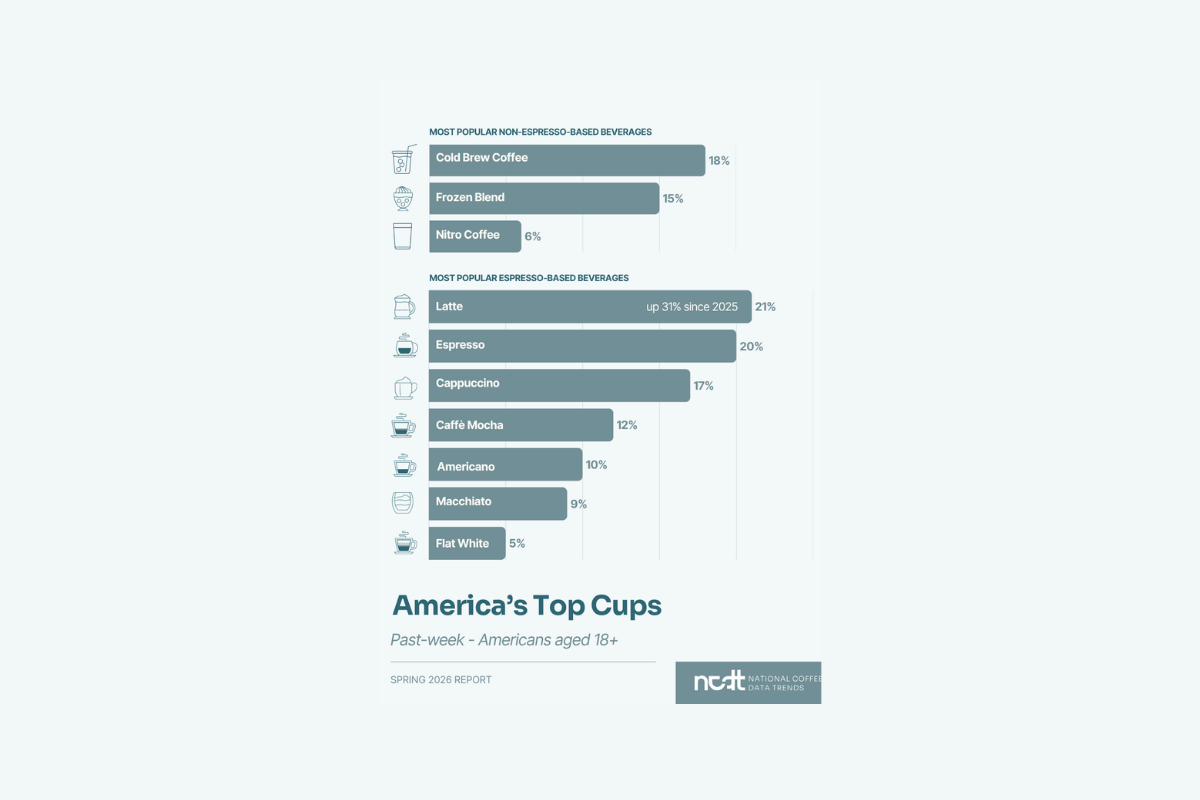
According to the Spring 2026 National Coffee Data Trends (NCDT) report from the National Coffee Association, 58% of American adults had a specialty coffee in the past week, up from 53% in 2022. But the real story lies inside the cup: Espresso-Based Beverages (EBBs) are driving the growth. Notably, espresso drinks based on espresso are shaping beverage preferences in 2026.

Overall, 45% of American adults consumed an EBB in the past week, up from 40% in 2022. The newly released “America’s Top Cups” ranking for Americans aged 18+ reveals the order of espresso favorites, highlighting how espresso-based drinks will continue evolving throughout 2026.

The Top Espresso-Based Beverages (Past Week)

Rank Beverage Past-week consumption Change since 2022
1 Latte 21% Up from 17%
2 Espresso 20% Up from 16%
3 Cappuccino 17% No change
4 Caffè Mocha 12% No change
5 Americano 10% No change
6 Macchiato 9% No change
7 Flat White 5% No change

📈 Latte surges 31% since 2025

The latte is accelerating. The report shows latte consumption is up 31% since 2025, making it the fastest growing espresso beverage. Straight espresso also climbed from 16% to 20% over the same period. A sign of growing appreciation for quality shots. In conclusion, we see espresso-based beverages 2026 influencing consumption patterns across the industry.

A Changing Coffee Landscape

Non-espresso options like cold brew (18% popularity) and frozen blends (15%) still have a place. But the espresso category is where the momentum lies. For retailers, these espresso-based beverages 2026 trends indicate that menu innovation is essential for staying ahead.

“The shift toward espresso-based beverages reflects a broader sophistication in American coffee tastes. Consumers know what they want, and they want it pulled fresh.”

The Spring 2026 NCDT Report was conducted in January 2026 by Dig Insights. It offers complete data on consumption trends, demographic breakdowns, and future forecasts, including projections for espresso-based beverages in 2026.
The Science Behind the Perfect Espresso

Dubai – Qahwa World

Coffee lovers often search for the ideal espresso, but scientists are now asking whether it can be understood—and even predicted—using mathematics and physics.

A group of international researchers from science and environmental fields recently explored how brewing behavior might be described through mathematical modeling, focusing on how water interacts with compacted coffee grounds inside an espresso machine.

The Role of the Coffee “Puck”

At the center of the study is the coffee puck—the tightly packed layer of ground coffee used during espresso extraction. When hot water passes through it under pressure, it extracts flavor compounds, oils, and caffeine.

The structure of this coffee puck plays a major role in how evenly water flows and how much flavor is extracted.

Many factors influence this process, including how fine the coffee is ground, how densely it is packed, and how long water interacts with it.

How the Research Was Conducted

To better understand the internal structure of coffee beds, researchers tested different grind sizes using beans from multiple origins. They examined how particles arranged themselves when compressed into espresso-like samples.

  • Multiple grind sizes ranging from fine to coarse were tested
  • Samples were packed under controlled conditions
  • Advanced 3D imaging was used to study internal pore spaces

Using high-resolution imaging technology, the team mapped tiny gaps between coffee particles. These spaces determine how easily water can move through the puck.

Simulating Water Flow Through Coffee

The researchers applied computer-based models inspired by percolation principles, which describe how fluids move through connected structures.

These simulations helped reveal how water distributes itself inside different coffee structures and how extraction efficiency changes with grind size and density.

What Affects Espresso Extraction?

According to the study, several physical properties influence the brewing process:

  • Particle size of ground coffee
  • Density of the packed puck
  • Connectivity of internal pore spaces
  • Surface area exposed to water

Together, these factors determine how long water remains in contact with the coffee and how much material is extracted.

Why This Research Matters

While the study is highly technical, its practical applications may include improving brewing equipment, optimizing grinder settings, and helping industrial coffee systems produce more consistent results.

However, researchers also emphasize that even with advanced models, personal taste still plays a major role in defining what makes the “perfect” espresso.

Conclusion

Science may be able to describe and predict how espresso extraction works, but the final judgment of quality still belongs to the drinker.


Italian-Style Coffee Linked to Lower Risk of Common Liver Disease

Dubai – Qahwa World

A recent Italian study published on 19 March 2026 in a scientific journal has found an association between traditional Italian-style coffee consumption and a reduced risk of metabolically dysfunctional-associated steatotic liver disease (MASLD).

The research was conducted by scientists at the National Institute of Gastroenterology in Bari, Italy, and focused specifically on coffee prepared using traditional Italian methods such as espresso and moka, which rely on pressure extraction.

MASLD is currently one of the most widespread chronic liver diseases globally, affecting more than 30% of adults. It is strongly associated with obesity, insulin resistance, type 2 diabetes, dyslipidemia, and hypertension, and can progress to more severe liver conditions, including cirrhosis and liver cancer.

The study analyzed data from a long-term research project in Southern Italy. A total of 1,079 coffee-drinking participants were included in the final analysis. Liver conditions were assessed using ultrasound examinations, while coffee consumption was evaluated through a validated dietary questionnaire.

The findings showed that, after adjusting for various health and lifestyle factors, higher coffee consumption was associated with a lower risk of MASLD. The risk was 52.1% lower among those who consumed one cup per day, 53.2% lower for two cups, and 55.1% lower for three cups. The greatest reduction, 59.3%, was observed among individuals who consumed four to six cups daily.

In addition, each extra cup of coffee per day was associated with an approximate 15.7% reduction in risk.

Researchers attributed these findings to the high levels of bioactive compounds retained in Italian-style coffee, particularly in unfiltered preparations. These include chlorogenic acids, diterpenes, trigonelline, and melanoidins, which are believed to play a role in reducing inflammation, improving insulin sensitivity, and limiting fat accumulation in the liver.

Despite the findings, the researchers emphasized that the study is observational and does not establish a direct cause-and-effect relationship. Coffee consumption was also self-reported by participants.

The study noted that coffee is a central part of daily life in Italy, with most consumers preferring espresso or moka preparation methods.

According to European health guidance, up to 400 mg of caffeine per day is considered safe for healthy adults, though certain groups such as pregnant women or individuals sensitive to caffeine are advised to limit intake.

The study concludes that moderate consumption of Italian-style coffee may be associated with potential liver health benefits, while further research is needed to confirm these findings.

Which Coffee Is Actually the Healthiest? Scientists Share an Unexpected Answer

Dubai – Qahwa World

For many people, mornings begin with coffee—and a familiar dilemma: espresso, cappuccino, or Americano. Yet research suggests that the most health-friendly option is often overlooked and far less trendy.

  • Brewing Method Matters More Than Strength

It turns out that how coffee is prepared can be more important than how strong it is. Long-term population studies conducted in Scandinavia found that people who regularly drank filtered coffee had a lower risk of cardiovascular problems compared to those who favored unfiltered varieties.

The reason lies in the filter itself. Paper filters trap certain natural compounds in coffee that can raise levels of LDL (“bad”) cholesterol. By removing these substances, filtered coffee becomes gentler on the heart. Moderate daily consumption has been associated with improved cardiovascular outcomes.

  • Espresso-Based Drinks and Brain Health

This doesn’t mean espresso is harmful. On the contrary, recent research suggests that compounds found in espresso may help protect the brain. These substances appear to interfere with processes linked to the buildup of abnormal proteins associated with neurodegenerative conditions.

Caffeine also has anti-inflammatory properties and can support alertness and cognitive performance. In this context, drinks like cappuccino or latte may offer more than just comfort—they could contribute to long-term brain health when consumed sensibly.

  • Instant Coffee: Not as Bad as Its Reputation

Instant coffee often gets a bad rap due to its higher levels of acrylamide, a compound formed during high-temperature processing. While large doses have shown harmful effects in laboratory studies, the amounts typically consumed in everyday life are far lower.

Health experts emphasize that moderate intake of instant coffee is unlikely to pose significant risks. In fact, it still contains antioxidants that can support gut health and overall well-being.

  • The Bottom Line

There is no single “perfect” cup of coffee.
Filtered coffee appears to be the best choice for heart health, espresso-based drinks may benefit the brain, and instant coffee is acceptable in moderation.

Ultimately, the best coffee is the one you enjoy and drink responsibly. Any health benefits should be seen as a welcome bonus—not the sole reason to pour another cup.

Espresso Prices in Ukraine: Regional Trends and Cost Changes

Kiev – Qahwa World

The price of a single cup of espresso in Ukraine continues to rise, reflecting broader shifts in the country’s coffee market. As espresso forms the base of most coffee drinks, changes in its cost directly influence café pricing nationwide.

Data published by Opendatabot shows that in December 2025, the average price of an espresso reached 41 hryvnias. This marks a 17% increase compared to the same period last year, while prices have almost doubled since the beginning of the full-scale war.

Price differences between regions remain noticeable. The Lviv region currently records the highest average price, with a cup of espresso costing 47 hryvnias, up 19% year on year. This is the first time in several years that the region has topped the national price ranking.

The Odesa region follows closely, where espresso is sold for an average of 45 hryvnias per cup.

At the opposite end of the scale, the Khmelnytskyi region offers the lowest prices, with espresso costing around 33 hryvnias, despite an 18% annual increase. Prices remain relatively moderate in the Zaporizhzhia and Kirovohrad regions, where a cup averages 35 hryvnias.

The sharpest annual rise was recorded in the Sumy region, located near the frontline. There, espresso prices increased by 26% over the year, bringing the average cost to approximately 36 hryvnias.

The Espresso Index is commonly used as an economic benchmark, tracking the price of a standard espresso to compare living costs, purchasing power, and inflation trends across different regions and countries.

In related commodity news, global cocoa prices previously hit a record high, with New York futures reaching USD 11,578 per metric ton. By the end of April, however, cocoa bean prices fell by 26% within just two days.

You Can’t Lead a Specialty Coffee Business Without Understanding Coffee

By: Estella Zuleta Carmona

Owning a specialty coffee shop without understanding coffee is like running a music studio without knowing what sound means. You can have the best equipment, the right people, and all the passion in the world but if you can’t hear when something is out of tune, you’re not leading the craft; you’re just managing noise.

In specialty coffee, leadership begins with understanding. Not just the numbers, not just the concept but the product itself. You don’t have to be the one pulling shots or roasting beans, but you need to recognize what balance in espresso feels like, what defines a clean extraction, and why variables like water, grind, and temperature are not technical details but expressions of consistency and care.

This isn’t about being a technician. It’s about responsibility understanding what your name represents in every cup that leaves your bar. A brand built on aesthetics or social media engagement can survive for a while, but a brand built on understanding lasts. Because when things go wrong and they always do knowledge is what helps you fix, adapt, and grow.

When you understand coffee, even at a foundational operational level, everything changes. Suddenly, conversations with your team become more meaningful. You can communicate in the same sensory and technical language. You can taste and identify what aligns with your concept instead of depending entirely on others to define your standard. You start making better decisions about workflow, equipment, and quality not based on trends or assumptions, but on clarity.

The owner who doesn’t understand coffee ends up chasing opinions changing direction based on whichever consultant or barista shouts the loudest. They spend money reacting to problems they don’t truly comprehend. Meanwhile, the owner who understands the craft builds direction. They don’t need to do everything themselves, but they lead with perspective. They can tell when something is off, and they know how to ask the right questions.

In specialty, knowledge isn’t about control; it’s about clarity. It creates alignment between the vision, the product, and the people behind it. It turns management into mentorship and transforms a business into a craft.

Because at the end of the day, you can’t represent a product you don’t understand. You don’t need to be the expert behind the bar but you do need to know what your bar stands for, and why every decision behind it should honor the coffee, the people, and the purpose that brought it to life.

Global Buzz After Italian Chef Declares: “Cappuccino Ends at 11 a.m.”

Dubai – Qahwa World

Italian celebrity chef Gino D’Acampo has stirred a wave of debate after posting a video on his social platforms in which he revealed a strict cultural rule about cappuccino. According to D’Acampo, the drink should never be consumed after 11 a.m., a tradition deeply ingrained in Italian coffee culture, while espresso remains the drink of choice throughout the day.

In the video titled “How to be a Proper Italian with Gino: When should you drink Cappuccino or Espresso?” he explained that there is a time for cappuccino and a time for espresso, and it is not as flexible as people outside Italy may assume. Espresso, he said, can be enjoyed any time, especially after lunch or dinner, because it helps stimulate blood circulation and aids digestion. Cappuccino, however, is an entirely different story.

Based on milk, the drink becomes heavy when consumed after meals, slowing down the digestive process rather than helping it. “Once it’s 11 o’clock, I’m done with cappuccino,” D’Acampo insisted. “I won’t drink it after that.

It’s not something Italians do. Milk after a meal is the last thing your body needs, while caffeine does the opposite and speeds up your system.”

His comments sparked a strong reaction online. The video quickly gained millions of views and triggered wide discussions among coffee lovers worldwide.

Some saw his declaration as a glimpse into the unique Italian approach to food and lifestyle, emphasizing balance, moderation, and cultural identity.

Others mocked the rule with comments like, “So milk after dinner is forbidden, but tiramisu with cream is allowed,” while many insisted that they would continue drinking whatever coffee they wanted, whenever they wanted.

Still, a significant number of viewers acknowledged that these traditions are what make Italy’s coffee culture distinctive and that experiencing coffee in Italy is as much about respecting these unwritten rules as it is about taste itself. D’Acampo, who was born in Naples and is now based in London, is well known for his humorous style and his efforts to share Italian culinary secrets with a global audience.

His remarks this time went beyond nutrition to highlight how Italians view coffee not only as a beverage but as a way of life, with strict rituals and timing that connect to health and social customs.

He reminded his audience that while cappuccino is perfect in the morning alongside a pastry, the rest of the day belongs to espresso, which Italians consume quickly at the bar, often standing, in a tradition that values efficiency and rhythm over size and variety.

The debate also underscores the tension between Italian authenticity and globalization. In places like the United States or the United Kingdom, coffee culture embraces oversized lattes, frappuccinos, and cappuccinos at any time of day.

In Italy, by contrast, the rules are precise: cappuccino before noon, espresso afterward, and rarely anything else. These rules may appear restrictive to outsiders, but for Italians they are a reflection of food wisdom passed down over generations. D’Acampo’s firm stance reflects this heritage.

While announcing that he will soon return with a new television program titled “Italian in Malta” and a separate acting project in Ireland, he reminded viewers that his greatest passion will always remain food.

For him, coffee etiquette is inseparable from Italian culinary identity, and ignoring it is to miss the essence of what it means to drink coffee like an Italian. His viral statement has reignited a timeless conversation about coffee: is it about following traditions and respecting cultural norms, or is it about personal freedom and preference? For Italians, the answer remains clear—cappuccino belongs to the morning, and once the clock strikes 11, it is espresso’s turn to reign.

The World’s Most Popular Coffee Varieties!

Coffee lovers, rejoice! Join us on a tantalizing journey through the world’s most beloved coffee concoctions. From the enchanting alleys of Europe to the bustling streets of Asia, coffee is more than a beverage; it’s a cultural phenomenon. Let’s dive into the realm of the five most popular coffee drinks, each with its own unique charm and widespread appeal.

  1. Cappuccino: Step into the world of sophistication with the illustrious cappuccino. Preferred by 24 countries, including the chic cafes of France, the vibrant streets of Kenya, and the picturesque landscapes of the Netherlands, cappuccino is a harmonious blend of espresso, velvety steamed milk, and ethereal foam. As you savor each sip, you’ll understand why it’s adored for its perfect balance and adorned with a delicate foam “hood,” reminiscent of the Capuchin friars.
  2. Espresso: Prepare to be captivated by the intense allure of espresso. Embraced by 14 countries, including the bustling cities of the United States and the ancient ruins of Egypt, espresso is a potent elixir crafted by the skilled hands of baristas. Derived from the Italian word “esprimere,” meaning to squeeze out, espresso tantalizes the palate with its robust flavor and high caffeine content, offering a quick burst of energy in every sip.
  3. Black Coffee: Experience the pure essence of coffee with the timeless classic, black coffee. Celebrated in 12 countries, including the vibrant markets of South Africa and the enchanting deserts of Jordan, black coffee embodies simplicity at its finest. With no added cream or sweeteners, it offers a guilt-free indulgence, believed to aid in weight loss and embraced as the cornerstone of coffee culture worldwide.
  4. Americano: Journey into the heart of coffee tradition with the beloved Americano. Cherished in 10 countries, including the passionate tango-filled streets of Argentina and the picturesque landscapes of Italy, the Americano offers a smooth and less intense alternative to espresso. Legend has it that it gained popularity during World War II, a testament to its enduring appeal and ability to bridge cultures with its comforting warmth.
  5. Mocha: Surrender to the irresistible allure of mocha, a decadent fusion of chocolate and coffee beloved in six countries, from the bustling streets of Japan to the tranquil shores of Mauritius. With its luscious blend of espresso, chocolate, and creamy milk, mocha is a delightful treat for the senses, offering a perfect harmony of sweetness and richness to elevate any moment.

But wait, there’s more! Explore a myriad of other popular coffee delights, from the creamy indulgence of lattes to the spirited warmth of Irish coffee, each offering a unique glimpse into the diverse tapestry of global coffee culture. Join us as we celebrate the artistry, tradition, and sheer delight of coffee in all its glorious forms. Cheers to the world’s favorite brews!

Ever Wondered What Espresso Is and How It All Began?

Espresso, the powerhouse behind your daily caffeine fix, is more than just a component of your morning latte or cappuccino—it’s a finely crafted brew with a rich history and unique characteristics.

What is Espresso?

Espresso is a concentrated form of coffee created by forcing hot water through finely ground, specially roasted coffee beans using an espresso machine. This process results in one- to two-ounce shots of thick, creamy espresso, packed with flavor and caffeine.

The journey of espresso dates back to the late 19th century when Luigi Bezzera revolutionized coffee brewing by inventing the single-serve espresso machine in 1903. Alongside Desiderio Pavoni, they refined the machine, making it commercially available after showcasing it at the 1906 Milan Fair.

Distinguishing Espresso from Coffee

Espresso differs from traditional coffee not only in its brewing method but also in its beans and roasting process. Darkly roasted espresso beans undergo a longer roasting period, releasing oils that contribute to its intense flavor and full-bodied texture.

Conversely, coffee beans for traditional brews are roasted for shorter periods, resulting in lighter roasts with different flavor profiles. Despite similarities in taste, brewing espresso involves high pressure and fine grounds, distinguishing it from slower, lower-pressure methods used for coffee.

Caffeine Content

A single shot of espresso contains approximately 64 milligrams of caffeine, less than an eight-ounce cup of coffee, which typically contains around 92 milligrams. However, espresso-based drinks often incorporate multiple shots, leading to varying caffeine levels depending on the beverage.

Blonde Espresso vs. Regular Espresso

Blonde espresso, a newer trend, refers to beans roasted on the lighter end of the scale, offering a milder flavor compared to traditional dark roasts. While regular espresso boasts a bold, bitter profile, blonde espresso provides a lighter, smoother alternative.

Savoring Espresso

Espresso aficionados often enjoy their brew straight—black and unadorned. However, it’s versatile enough to be transformed into a variety of delightful concoctions, from lattes and cappuccinos to inventive cocktails like the espresso martini.

Popular Espresso-Based Drinks

  • Espresso: The quintessential shot of concentrated coffee, best enjoyed unadorned.
  • Americano: A diluted espresso drink made by adding hot water, resembling drip coffee.
  • Latte: A shot of espresso combined with steamed milk, often flavored with syrups.
  • Cappuccino: Similar to a latte but with a higher foam content.
  • Macchiato: Espresso “stained” with a dollop of warm milk.
  • Affogato: A delightful dessert featuring espresso poured over gelato.
  • Espresso Martini: A sophisticated cocktail blending espresso with vodka and coffee liqueur.