
The Science Behind the Perfect Espresso

Dubai – Qahwa World

Coffee lovers often search for the ideal espresso, but scientists are now asking whether it can be understood—and even predicted—using mathematics and physics.

A group of international researchers from science and environmental fields recently explored how brewing behavior might be described through mathematical modeling, focusing on how water interacts with compacted coffee grounds inside an espresso machine.

The Role of the Coffee “Puck”

At the center of the study is the coffee puck—the tightly packed layer of ground coffee used during espresso extraction. When hot water passes through it under pressure, it extracts flavor compounds, oils, and caffeine.

The structure of this coffee puck plays a major role in how evenly water flows and how much flavor is extracted.

Many factors influence this process, including how fine the coffee is ground, how densely it is packed, and how long water interacts with it.

How the Research Was Conducted

To better understand the internal structure of coffee beds, researchers tested different grind sizes using beans from multiple origins. They examined how particles arranged themselves when compressed into espresso-like samples.

  • Multiple grind sizes ranging from fine to coarse were tested
  • Samples were packed under controlled conditions
  • Advanced 3D imaging was used to study internal pore spaces

Using high-resolution imaging technology, the team mapped tiny gaps between coffee particles. These spaces determine how easily water can move through the puck.

Simulating Water Flow Through Coffee

The researchers applied computer-based models inspired by percolation principles, which describe how fluids move through connected structures.

These simulations helped reveal how water distributes itself inside different coffee structures and how extraction efficiency changes with grind size and density.

What Affects Espresso Extraction?

According to the study, several physical properties influence the brewing process:

  • Particle size of ground coffee
  • Density of the packed puck
  • Connectivity of internal pore spaces
  • Surface area exposed to water

Together, these factors determine how long water remains in contact with the coffee and how much material is extracted.

Why This Research Matters

While the study is highly technical, its practical applications may include improving brewing equipment, optimizing grinder settings, and helping industrial coffee systems produce more consistent results.

However, researchers also emphasize that even with advanced models, personal taste still plays a major role in defining what makes the “perfect” espresso.

Conclusion

Science may be able to describe and predict how espresso extraction works, but the final judgment of quality still belongs to the drinker.
 

Temperature Doesn’t Increase Extraction It Redesigns the Cup

By: Estella Zuleta Carmona

When I talk about temperature in coffee extraction, I’m not simply referring to “more heat = more extraction.” Temperature is the energy we give to the system, and that energy defines both the extraction rate and which chemical compounds can be released from the coffee’s solid matrix. Higher temperatures facilitate the extraction of less soluble compounds, as they reduce the energy required for them to dissolve and diffuse into the beverage. At the same time, this increased energy accelerates both the release and the loss of volatile and non-volatile aromatic compounds.

Furthermore, temperature modifies the effective polarity of water, changing its ability to dissolve compounds of different polarities. Therefore, temperature not only determines how much is extracted, but also what is extracted and in what proportion, defining the final chemical and sensory profile of the coffee.

In this context, adjusting the temperature means adjusting the energy available in the extraction system. By doing so, you modify which chemical compounds can be extracted, at what rate, and in what proportion. In practice, changing the temperature is a direct way to “reconfigure” the cup, because it alters the balance between volatile and non-volatile compounds, influences the polarity of the water, and redefines the final chemical and sensory profile of the coffee.
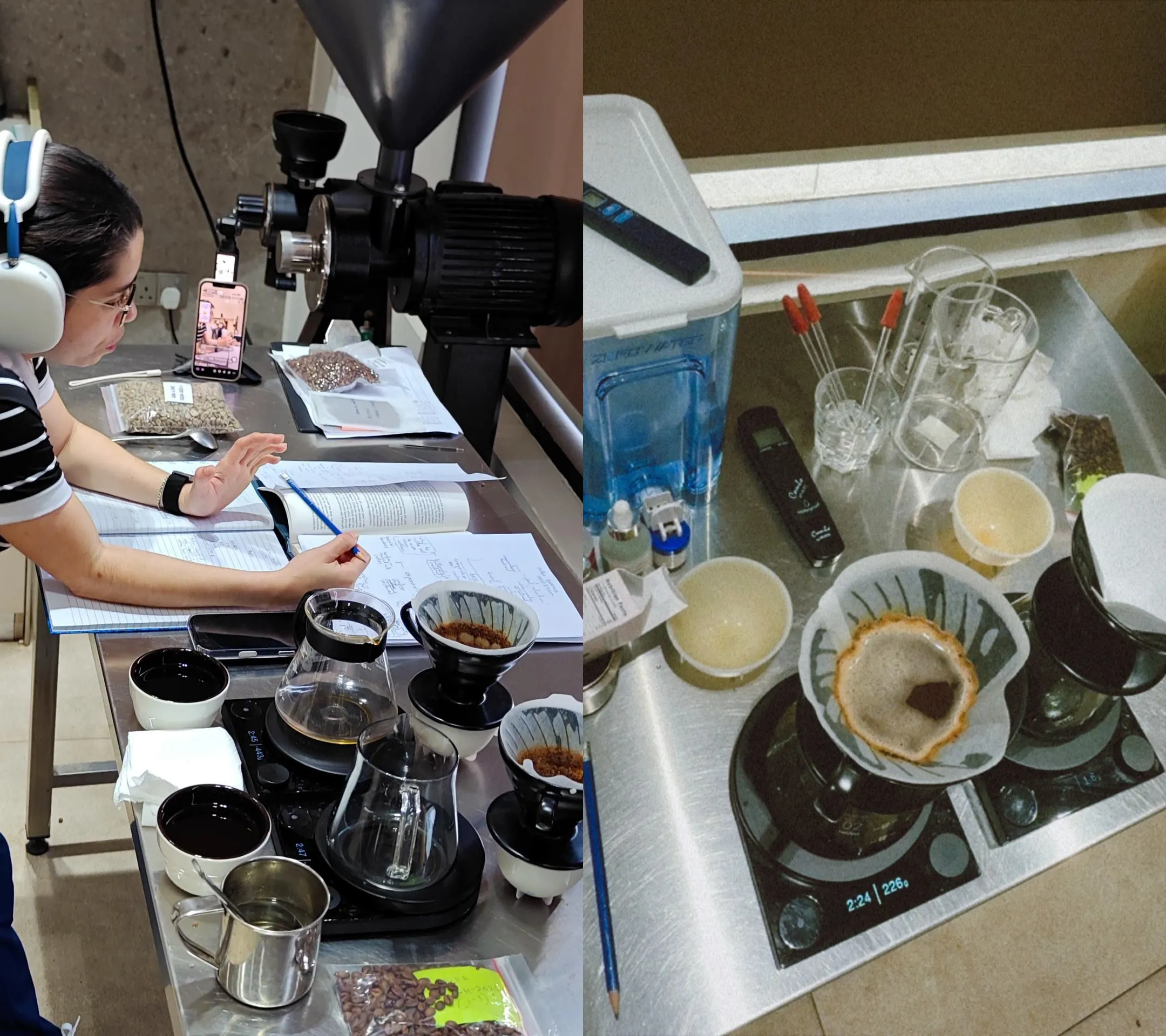
To explore this, I brewed two very different coffees at 85 °C and 95 °C: an Ethiopia natural–anaerobic and a China natural. Same coffees, same parameters. Only energy changed.
At 85 °C, the Ethiopia natural–anaerobic showed medium-high acidity, moderate sweetness, and low bitterness. The cup finished quickly, with a dry, dusty mouthfeel. As it cooled, acidity stayed dominant, sweetness remained low, and bitterness nearly disappeared. Lower energy preserved acidity, but limited structural development and aromatic persistence.
At 95 °C, the same coffee shifted completely. Acidity softened to medium, while sweetness and bitterness increased (bitterness still medium-low). Floral notes became clearer, and the mouthfeel turned juicy and syrupy. Hot, everything felt louder not because more was extracted, but because extraction and aromatic loss were happening faster at the same time.
The China natural behaved in the opposite way. Higher temperatures emphasized sweetness and body, not aromatic collapse. Around 89 °C, sweetness peaked, and with more heat the cup gained structure and weight without a proportional rise in bitterness. In this coffee, energy built the cup instead of compressing it.
This is why temperature has no universal “sweet spot.”
It doesn’t simply extract more it decides what survives in the cup.
Adjusting temperature is not correcting a recipe.
It’s choosing which version of the coffee you allow to exist.
This contrast highlights a critical point: temperature has no universal effect on extraction. Its impact is entirely dependent on the chemical composition of the coffee and the way energy interacts with that composition. Adjusting temperature is therefore not about optimizing a parameter, but about making a deliberate chemical and sensory choice deciding which compounds are prioritized, which are sacrificed, and how the final balance is constructed.