Top Espresso Drinks: Latte Up 31% in 2026

New York, NY – Qahwa World announces new insights on espresso-based beverages 2026 trends.

Americans aren’t just drinking more specialty coffee. They are going espresso first, which is especially evident in espresso-based beverages 2026 results.

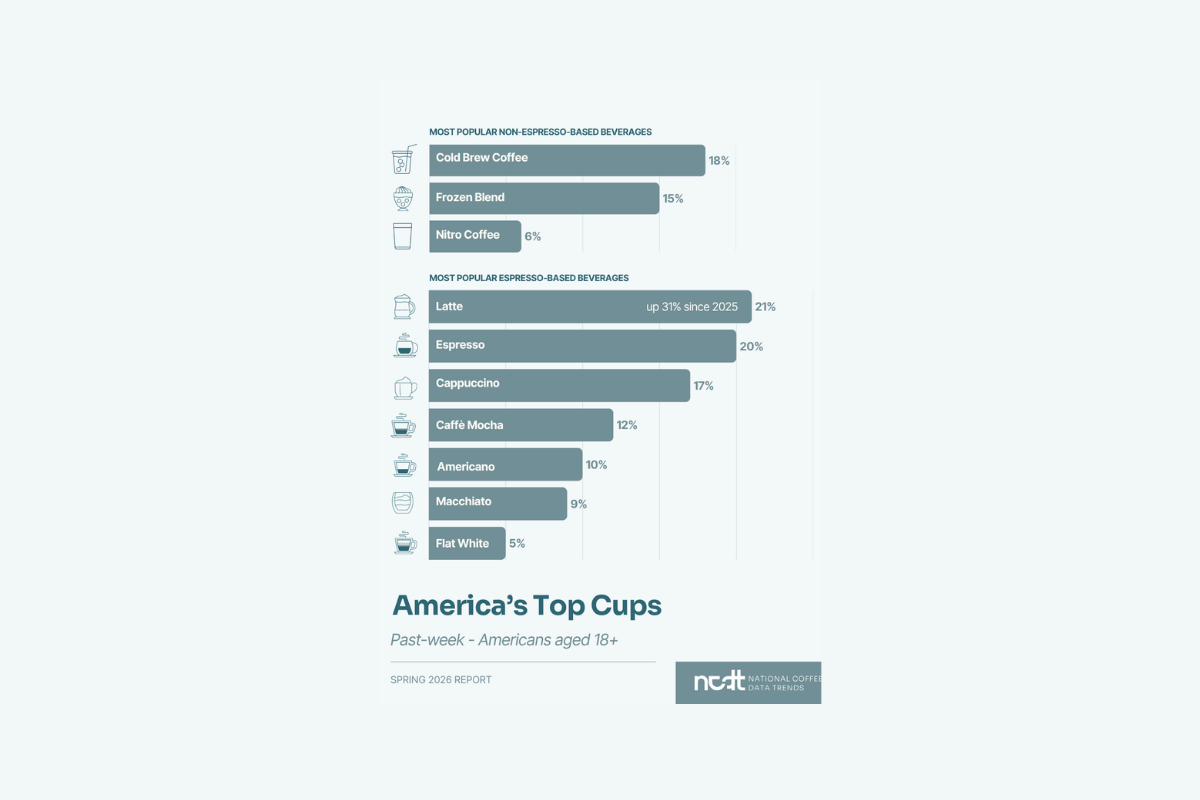
According to the Spring 2026 National Coffee Data Trends (NCDT) report from the National Coffee Association, 58% of American adults had a specialty coffee in the past week, up from 53% in 2022. But the real story lies inside the cup: Espresso-Based Beverages (EBBs) are driving the growth. Notably, espresso drinks based on espresso are shaping beverage preferences in 2026.

Overall, 45% of American adults consumed an EBB in the past week, up from 40% in 2022. The newly released “America’s Top Cups” ranking for Americans aged 18+ reveals the order of espresso favorites, highlighting how espresso-based drinks will continue evolving throughout 2026.

The Top Espresso-Based Beverages (Past Week)

Rank Beverage Past-week consumption Change since 2022
1 Latte 21% Up from 17%
2 Espresso 20% Up from 16%
3 Cappuccino 17% No change
4 Caffè Mocha 12% No change
5 Americano 10% No change
6 Macchiato 9% No change
7 Flat White 5% No change

📈 Latte surges 31% since 2025

The latte is accelerating. The report shows latte consumption is up 31% since 2025, making it the fastest growing espresso beverage. Straight espresso also climbed from 16% to 20% over the same period. A sign of growing appreciation for quality shots. In conclusion, we see espresso-based beverages 2026 influencing consumption patterns across the industry.

A Changing Coffee Landscape

Non-espresso options like cold brew (18% popularity) and frozen blends (15%) still have a place. But the espresso category is where the momentum lies. For retailers, these espresso-based beverages 2026 trends indicate that menu innovation is essential for staying ahead.

“The shift toward espresso-based beverages reflects a broader sophistication in American coffee tastes. Consumers know what they want, and they want it pulled fresh.”

The Spring 2026 NCDT Report was conducted in January 2026 by Dig Insights. It offers complete data on consumption trends, demographic breakdowns, and future forecasts, including projections for espresso-based beverages in 2026.

Mohammed Al-Hamdani: Guarding a Legacy of Over a Century

From 1918 to the Global Market—The Journey of a Legendary Coffee Dynasty

Dubai – Ali Alzakary

In the world of commodities, there are brands that sell “products”, and then there are rare entities that sell “history” distilled in a cup. To step into the world of “Al-Hamdani Mocha” is not merely to enter a commercial enterprise; it is to open the archives of a legacy that began in 1918. Back then, coffee caravans were defining global trade from the rugged peaks of Yemen.

From the narrow alleys of “Souq Bo’an” in Bani Matar, where the ancestors laid the foundation, to the skyscrapers of New York and the bustling markets of the Arabian Gulf, this family has transformed the “coffee cherry” into a civilizational message. Between century-old manuscripts and state-of-the-art European production lines stands Mr. Mohammed Al-Hamdani, CEO of Al-Hamdani Mocha, to tell us how such a profound “trust” is managed, and how the company has kept the pulse of Yemeni soil alive in the hearts of coffee aficionados worldwide.

We invite you, in this exclusive and deep-dive interview, to sail through a journey that began a century ago and never stopped, and to discover the secrets behind the authentic Mocha that connects the mountains of Haraaz and Al-Hayma to the entire world.

Mohammed Al-Hamdani: A Century of Yemeni Mocha Coffee Heritage | Interview

  • Mr. Mohammed, when we speak of a history dating back to 1918, we are looking at a legacy that predates the formation of many contemporary global markets. As the CEO of this venerable trading family, how do you describe the sense of responsibility in managing an institution that preserves manuscripts and documents over a century old?

Managing a company with this history is not just a commercial duty; it is a profound historical and cultural trust. We aren’t just running a profit-oriented entity; we are the guardians of a family legacy intertwined with the name of Yemeni coffee since the dawn of the last century. Al-Hamdani’s philosophy is built on a golden triangle: Authenticity, Quality, and Continuity. Successive generations have been keen to uphold the standards set by our grandfathers—from selecting the cherries in the farms to delivering a product worthy of the identity of Yemeni coffee. This is why Al-Hamdani has remained synonymous with quality and authentic Yemeni Mocha across decades.

  • The journey began in Souq Bo’an in Bani Matar, where your ancestors took their first steps. How have you and your team maintained that direct, soulful relationship with the farmers of Al-Hayma, Haraaz, and Bani Matar?

The farmer is our first and most vital partner. Our relationship with the farmers of Bani Matar, Haraaz, and Al-Hayma is not a dry supply-chain transaction; it is a lifelong partnership. We support them through agricultural training and awareness of scientific harvesting and drying methods, and we provide stable marketing channels that ensure their sustainability. This mutual trust is what has guaranteed our access to the finest coffee varieties and protected the quality of Yemeni coffee from fading despite all challenges.

Mohammed Al-Hamdani: A Century of Yemeni Mocha Coffee Heritage | Interview

  • In 2003, you made a significant leap by introducing modern European production lines. How do you balance the “soul” of traditional Yemeni farming with the “precision” of international standards?

Yemeni coffee derives its uniqueness from its traditional nature inherited through generations—this is a red line we cannot cross. However, to keep pace with the global market, it was essential to develop our sorting and packaging processes. We introduced European technologies to clean and protect the beans, ensuring they are defect-free according to international standards, without interfering with the essence of their natural cultivation and sun-drying. This equation between Authenticity and Technology is what has enabled our product to compete strongly in the most prestigious international arenas.

  • With over ten branches in Saudi Arabia and the Gulf, plus a branch in the United States, how do you read the varying tastes of coffee lovers globally?

Mohammed Al-Hamdani: Tastes vary by culture. In the Gulf, there remains a strong bond with traditional Arabic coffee based on Yemeni beans. In America and Europe, there is a growing passion for Specialty Coffee and modern preparation methods like Espresso and Filter. The beauty of Yemeni coffee is that it asserts its presence in all these styles; its complex flavor and history give it a special “charisma” that attracts professionals and hobbyists alike, regardless of the serving method.

Mohammed Al-Hamdani: A Century of Yemeni Mocha Coffee Heritage | Interview

  • The “Model Farm” project in Haraaz and Al-Hayma… What does this represent for your investment vision for the future of Yemeni coffee?

This project is the heart of our future vision. We seek to establish modern agricultural best practices that increase production efficiency and improve quality while maintaining the full authentic Yemeni character. The goal is not just to increase the harvest but to transform the farm into a training center that supports the Yemeni farmer and enhances the sector’s sustainability, proving to the world that Yemen is capable of offering world-class investment models in its historic lands.

  • Despite current logistical and economic challenges, Al-Hamdani continues to expand. What is the secret engine behind this resilience?

Mohammed Al-Hamdani: The secret lies in “Belief in Identity.” We believe that Yemeni coffee is the best in the world, and this belief drives our continuous work despite the odds. We rely on a strong network of relationships, accumulated trade experience, and a strict, non-negotiable commitment to international standards in packaging and export. We work to ensure that the coffee reaches the consumer’s hand anywhere in the world in the same perfect condition it was in the moment it was harvested.

Mohammed Al-Hamdani: A Century of Yemeni Mocha Coffee Heritage | Interview

  • Finally, Mr. Mohammed, how would you summarize a century of time in one message to everyone sipping a cup of Al-Hamdani coffee?

Our message is simple: Behind every sip is a story of a land. Every cup of Al-Hamdani coffee encapsulates the toil of a patient Yemeni farmer and a family legacy standing strong since 1918. We don’t just sell a drink; we export history, culture, and a Yemeni identity that reaches from Sana’a to Dubai and New York, telling the world: “This is the origin of Mocha.”

Amal Al-Ekadi: A Woman’s Voice Showcasing the Value of Yemeni Coffee

Dubai Ali Alzakary

At the heart of coffee’s long story, Yemeni coffee remains one of its most authentic and fascinating chapters. From the mountains of Yemen—where coffee first began its journey to the rest of the world—the beans still carry the aroma of history and the character of a land cultivated by generations of farmers. Yet such a rich legacy always needs voices capable of telling its story and bringing it back into the global spotlight.

Among those voices is Amal Al-Ekadi, a Yemeni coffee advocate and marketing specialist who has dedicated years to promoting Yemeni coffee and highlighting its place in the global market. In this conversation with Qahwa World, Al-Ekadi shares her personal journey, the challenges she has faced, and her hopes for the future of Yemeni coffee. Through the following lines, readers are invited to discover her story and vision.

  • A Journey into the World of Coffee

Amal Al-Ekadi describes herself as someone who has been deeply engaged in the world of Yemeni coffee for several years, particularly in promoting and introducing Yemeni beans to wider audiences. Her professional path began at a foreign company where she worked in the production department before gradually advancing into shipping and export operations.

Throughout this journey, she says her goal remained clear: to help the world recognise the true value and rich heritage of Yemeni coffee. Today she is based in Riyadh, but she still considers herself part of the ongoing effort to amplify the voice of Yemeni coffee internationally.

  • Passion Behind the Idea

Al-Ekadi explains that her decision to work in promoting Yemeni coffee grew from her deep love for it and her belief that it represents a true treasure. Yemen, she notes, is the birthplace of coffee, yet marketing efforts have not always reflected this historical importance. This realization motivated her to become part of a movement that introduces people to this remarkable product and restores its rightful place in the global coffee scene.

  • A Flavor That Tells a Story

What fascinates Amal Al-Ekadi most about Yemeni coffee is its unique flavor profile and the diversity that appears from one region to another. For her, Yemeni coffee is far more than a beverage—it is a story, a culture, and a way of life shaped by farmers who dedicate years of work and care to cultivating these beans before they reach a cup.

  • First Steps

Her beginnings in the field were modest. Amal Al-Ekadi started by communicating directly with farmers and learning about the different varieties of Yemeni coffee. She also acknowledges the support she received from her former manager, Shubair Ezi, whose guidance played an important role in her early career.

Through her work in shipping and export, she gained practical experience while also introducing Yemeni coffee to wider audiences through social media and professional connections with coffee enthusiasts both inside and outside Yemen.

  • Challenges Along the Way

The path, however, was not without obstacles. Al-Ekadi points to the difficult circumstances Yemen has experienced in recent years, including war and the logistical challenges of transportation and export.

Despite these difficulties, Yemeni coffee has continued to find its way to global markets, thanks to the efforts of people who believe deeply in its value and remain committed to sharing it with the world.

Amal Al-Ekadi: A Yemeni Voice Promoting Yemeni Coffee

  • Growing Global Interest

According to Amal Al-Ekadi, the past few years have brought a noticeable shift in how people perceive Yemeni coffee. With the rapid growth of the specialty coffee movement worldwide, more consumers and professionals have begun to recognize the exceptional quality and distinctive character of Yemeni beans.

This renewed interest has helped return Yemeni coffee to the international conversation about premium and specialty origins.

  • The Distinctive Flavors of Yemen’s Mountains

While she believes every Yemeni coffee origin has its own charm, Amal Al-Ekadi says she is particularly drawn to coffees from mountainous regions such as Haraz and Yafa. Beans from these areas often display complex and rich flavor profiles that appeal strongly to specialty coffee enthusiasts.

  • The Growing Role of Yemeni Women

Amal Al-Ekadi also highlights the important role Yemeni women play in the coffee sector, from farming and processing to marketing and promotion. She believes women’s presence in the industry has become increasingly visible and influential in recent years, a development she considers both encouraging and essential for the sector’s future.

  • A Dream for Yemeni Coffee

For Amal Al-Ekadi, the long-term dream is for Yemeni coffee to fully reclaim its global reputation. Equally important is ensuring that Yemeni farmers receive the recognition and fair prices they deserve for the tremendous effort they invest in cultivating this historic crop.

  • A Message to Farmers and Young Entrepreneurs

In closing, Amal Al-Ekadi offers a message to farmers and young people interested in entering the coffee sector. Farmers, she says, are the foundation of this precious heritage, while the younger generation holds the key to its future development.

With greater awareness, thoughtful work, and professional marketing, she believes Yemeni coffee can become not only a source of pride but also an important economic pillar for Yemen.

Amal Al-Ekadi also expressed her appreciation to Qahwa World and to Mr Ali for the opportunity to share her experience with Yemeni coffee, expressing hope that collective efforts will continue to highlight the value of this historic product and bring it the recognition it deserves.
 

The World’s Most Popular Coffee Varieties!

Coffee lovers, rejoice! Join us on a tantalizing journey through the world’s most beloved coffee concoctions. From the enchanting alleys of Europe to the bustling streets of Asia, coffee is more than a beverage; it’s a cultural phenomenon. Let’s dive into the realm of the five most popular coffee drinks, each with its own unique charm and widespread appeal.

  1. Cappuccino: Step into the world of sophistication with the illustrious cappuccino. Preferred by 24 countries, including the chic cafes of France, the vibrant streets of Kenya, and the picturesque landscapes of the Netherlands, cappuccino is a harmonious blend of espresso, velvety steamed milk, and ethereal foam. As you savor each sip, you’ll understand why it’s adored for its perfect balance and adorned with a delicate foam “hood,” reminiscent of the Capuchin friars.
  2. Espresso: Prepare to be captivated by the intense allure of espresso. Embraced by 14 countries, including the bustling cities of the United States and the ancient ruins of Egypt, espresso is a potent elixir crafted by the skilled hands of baristas. Derived from the Italian word “esprimere,” meaning to squeeze out, espresso tantalizes the palate with its robust flavor and high caffeine content, offering a quick burst of energy in every sip.
  3. Black Coffee: Experience the pure essence of coffee with the timeless classic, black coffee. Celebrated in 12 countries, including the vibrant markets of South Africa and the enchanting deserts of Jordan, black coffee embodies simplicity at its finest. With no added cream or sweeteners, it offers a guilt-free indulgence, believed to aid in weight loss and embraced as the cornerstone of coffee culture worldwide.
  4. Americano: Journey into the heart of coffee tradition with the beloved Americano. Cherished in 10 countries, including the passionate tango-filled streets of Argentina and the picturesque landscapes of Italy, the Americano offers a smooth and less intense alternative to espresso. Legend has it that it gained popularity during World War II, a testament to its enduring appeal and ability to bridge cultures with its comforting warmth.
  5. Mocha: Surrender to the irresistible allure of mocha, a decadent fusion of chocolate and coffee beloved in six countries, from the bustling streets of Japan to the tranquil shores of Mauritius. With its luscious blend of espresso, chocolate, and creamy milk, mocha is a delightful treat for the senses, offering a perfect harmony of sweetness and richness to elevate any moment.

But wait, there’s more! Explore a myriad of other popular coffee delights, from the creamy indulgence of lattes to the spirited warmth of Irish coffee, each offering a unique glimpse into the diverse tapestry of global coffee culture. Join us as we celebrate the artistry, tradition, and sheer delight of coffee in all its glorious forms. Cheers to the world’s favorite brews!