Top Espresso Drinks: Latte Up 31% in 2026

New York, NY – Qahwa World announces new insights on espresso-based beverages 2026 trends.

Americans aren’t just drinking more specialty coffee. They are going espresso first, which is especially evident in espresso-based beverages 2026 results.

According to the Spring 2026 National Coffee Data Trends (NCDT) report from the National Coffee Association, 58% of American adults had a specialty coffee in the past week, up from 53% in 2022. But the real story lies inside the cup: Espresso-Based Beverages (EBBs) are driving the growth. Notably, espresso drinks based on espresso are shaping beverage preferences in 2026.

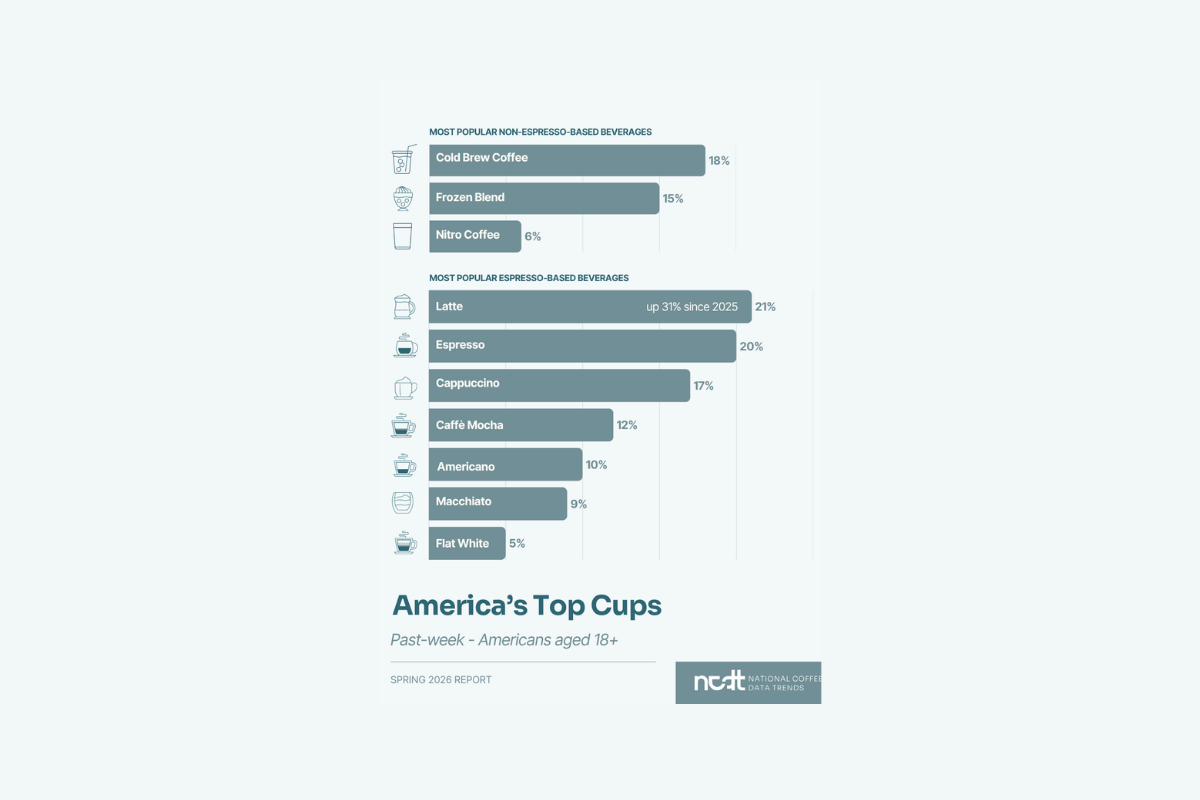
Overall, 45% of American adults consumed an EBB in the past week, up from 40% in 2022. The newly released “America’s Top Cups” ranking for Americans aged 18+ reveals the order of espresso favorites, highlighting how espresso-based drinks will continue evolving throughout 2026.

The Top Espresso-Based Beverages (Past Week)

Rank Beverage Past-week consumption Change since 2022
1 Latte 21% Up from 17%
2 Espresso 20% Up from 16%
3 Cappuccino 17% No change
4 Caffè Mocha 12% No change
5 Americano 10% No change
6 Macchiato 9% No change
7 Flat White 5% No change

📈 Latte surges 31% since 2025

The latte is accelerating. The report shows latte consumption is up 31% since 2025, making it the fastest growing espresso beverage. Straight espresso also climbed from 16% to 20% over the same period. A sign of growing appreciation for quality shots. In conclusion, we see espresso-based beverages 2026 influencing consumption patterns across the industry.

A Changing Coffee Landscape

Non-espresso options like cold brew (18% popularity) and frozen blends (15%) still have a place. But the espresso category is where the momentum lies. For retailers, these espresso-based beverages 2026 trends indicate that menu innovation is essential for staying ahead.

“The shift toward espresso-based beverages reflects a broader sophistication in American coffee tastes. Consumers know what they want, and they want it pulled fresh.”

The Spring 2026 NCDT Report was conducted in January 2026 by Dig Insights. It offers complete data on consumption trends, demographic breakdowns, and future forecasts, including projections for espresso-based beverages in 2026.

Kazakhstanis Are Drinking More Coffee Despite Rising Prices

Kazakhstan – Qahwa World

In 2025, people in Kazakhstan bought coffee 24% more often on average in the morning. Demand continued to grow despite higher prices. The average price of a cup increased by 8% to 1,310 tenge.

The data comes from Poster, a company that provides automation systems for cafes and restaurants.

Classic Drinks Still Lead

Cappuccino remains the most popular choice. Latte ranks second, followed by Americano.

At the same time, coffee culture in Kazakhstan continues to evolve. Alternative brewing methods and drinks such as bumble, an espresso-based drink with orange juice often served cold, are still less popular than classic options but are growing rapidly.

In 2025:

  • filter coffee sales increased by 65%
  • bumble sales tripled

These categories also show the fastest price growth, yet demand continues to rise.

According to Asylzhan Kazi, founder of the Espresso Day coffee chain, classic drinks account for the majority of sales, while seasonal offerings, especially cold drinks in summer, provide additional growth.

Average Coffee Prices in Kazakhstan

Drink Average Price (₸) Price Growth in 2025
Alternative (pour-over, Chemex, AeroPress, etc.) 2180 ₸ ↑ 5%
Filter coffee 1210 ₸ ↑ 14%
Latte 1200 ₸ ↑ 10.5%
Cappuccino 1160 ₸ ↑ 9.6%
Flat white 1050 ₸ ↑ 7.3%
Americano 880 ₸ ↑ 10.5%

Based on aggregated and anonymized sales data from Poster.

Cities with the Highest Coffee Consumption

Astana led in coffee consumption in 2025, with sales growing by about one third compared to the previous year.

Almaty also saw growth, though more moderate at around 16% with already strong demand.

A Morning Habit

Coffee is most often purchased before the start of the workday. About a quarter of daily revenue is generated between 8:00 and 10:00, with a peak at 9:00.

Around half of daily revenue is made before 13:00. This shows that starting the day with coffee is becoming an increasingly common habit.

The Economics of a Cup

Earlier reports showed that coffee shop profitability in Almaty does not exceed 16%, based on calculations by coffee shop owner Osmanzhan Iminzhanov, who analyzed the cost structure of a single cup.

Cappuccino Tops the List of Favorite Coffee Drinks in Moscow

Dubai – Qahwa World

Cappuccino is the most popular coffee choice among residents of Moscow, according to economist and global economy expert Khadzhimurad Belkharoiev.

Belkharoiev noted that after cappuccino, the most consumed coffee drinks are Americano and various types of latte. Overall, Muscovites consume coffee significantly more than residents of other major Russian cities—around 50% more than in St. Petersburg. Seasonal changes also affect beverage preferences: in winter, coffee and tea consumption rises, while in summer people tend to choose mineral water and soft drinks.

The economist added that the coffee market continues to grow, fueled by changing consumer habits and even medical advice recommending moderate coffee consumption to support vascular health.

Reflecting on history, Belkharoiev pointed out that tea was the dominant drink during the Soviet era due to trade ties with India, while high-quality coffee was scarce and considered a luxury.

Today, the situation is very different. Global coffee production reaches tens of millions of tons each year, with a large share exported internationally. The worldwide market is valued in the hundreds of billions of dollars, and billions of cups of coffee are consumed annually outside the home. Since the early 2020s, global coffee prices have steadily risen, a trend that is also reflected in Russia, where consumption is gradually shifting from tea to coffee.

Belkharoiev attributes this change to generational and market factors. Younger consumers tend to choose coffee when visiting cafes and restaurants, and the coffee sector remains highly profitable. The growing availability of home coffee machines has also boosted domestic coffee consumption.

Regarding prices, retail coffee costs have increased over the past year, and cafe prices have risen as well. However, expected increases in Robusta production globally could help stabilize prices. Nevertheless, according to Belkharoiev, the era of cheap coffee is effectively over.