Top Espresso Drinks: Latte Up 31% in 2026

New York, NY – Qahwa World announces new insights on espresso-based beverages 2026 trends.

Americans aren’t just drinking more specialty coffee. They are going espresso first, which is especially evident in espresso-based beverages 2026 results.

According to the Spring 2026 National Coffee Data Trends (NCDT) report from the National Coffee Association, 58% of American adults had a specialty coffee in the past week, up from 53% in 2022. But the real story lies inside the cup: Espresso-Based Beverages (EBBs) are driving the growth. Notably, espresso drinks based on espresso are shaping beverage preferences in 2026.

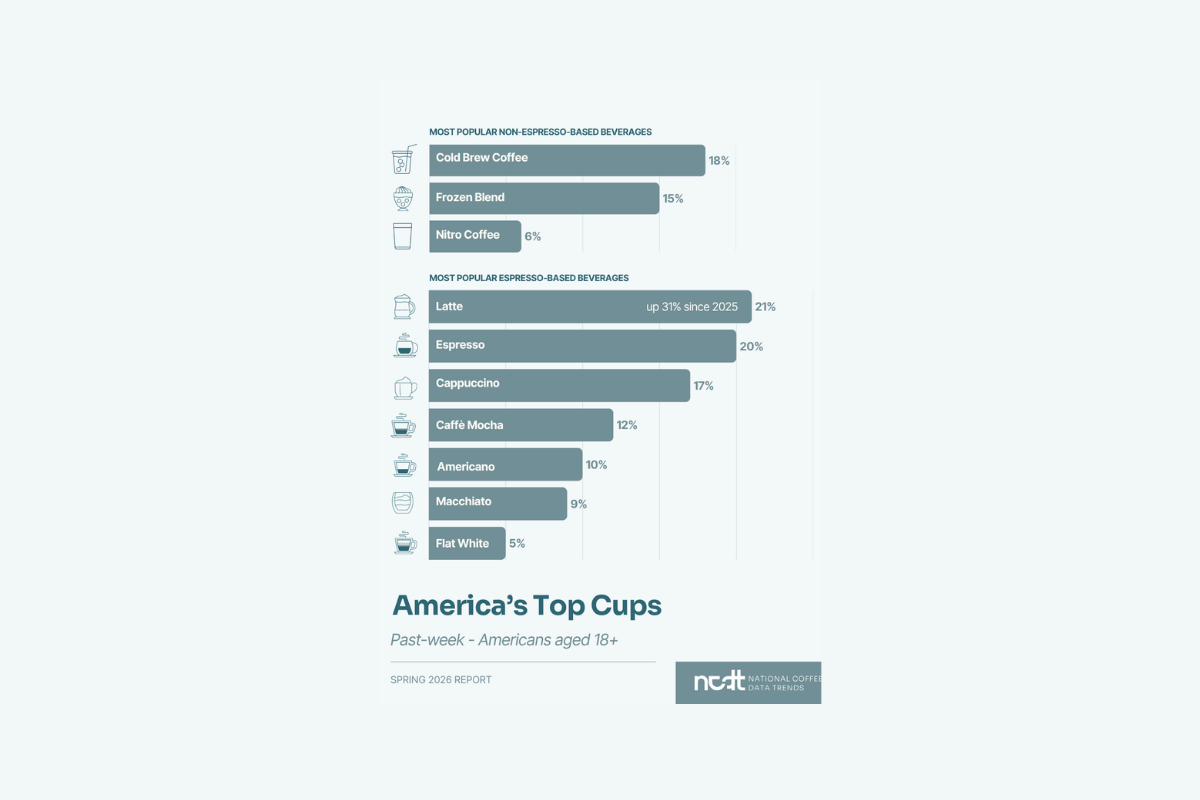
Overall, 45% of American adults consumed an EBB in the past week, up from 40% in 2022. The newly released “America’s Top Cups” ranking for Americans aged 18+ reveals the order of espresso favorites, highlighting how espresso-based drinks will continue evolving throughout 2026.

The Top Espresso-Based Beverages (Past Week)

Rank Beverage Past-week consumption Change since 2022
1 Latte 21% Up from 17%
2 Espresso 20% Up from 16%
3 Cappuccino 17% No change
4 Caffè Mocha 12% No change
5 Americano 10% No change
6 Macchiato 9% No change
7 Flat White 5% No change

📈 Latte surges 31% since 2025

The latte is accelerating. The report shows latte consumption is up 31% since 2025, making it the fastest growing espresso beverage. Straight espresso also climbed from 16% to 20% over the same period. A sign of growing appreciation for quality shots. In conclusion, we see espresso-based beverages 2026 influencing consumption patterns across the industry.

A Changing Coffee Landscape

Non-espresso options like cold brew (18% popularity) and frozen blends (15%) still have a place. But the espresso category is where the momentum lies. For retailers, these espresso-based beverages 2026 trends indicate that menu innovation is essential for staying ahead.

“The shift toward espresso-based beverages reflects a broader sophistication in American coffee tastes. Consumers know what they want, and they want it pulled fresh.”

The Spring 2026 NCDT Report was conducted in January 2026 by Dig Insights. It offers complete data on consumption trends, demographic breakdowns, and future forecasts, including projections for espresso-based beverages in 2026.

Kazakhstanis Are Drinking More Coffee Despite Rising Prices

Kazakhstan – Qahwa World

In 2025, people in Kazakhstan bought coffee 24% more often on average in the morning. Demand continued to grow despite higher prices. The average price of a cup increased by 8% to 1,310 tenge.

The data comes from Poster, a company that provides automation systems for cafes and restaurants.

Classic Drinks Still Lead

Cappuccino remains the most popular choice. Latte ranks second, followed by Americano.

At the same time, coffee culture in Kazakhstan continues to evolve. Alternative brewing methods and drinks such as bumble, an espresso-based drink with orange juice often served cold, are still less popular than classic options but are growing rapidly.

In 2025:

  • filter coffee sales increased by 65%
  • bumble sales tripled

These categories also show the fastest price growth, yet demand continues to rise.

According to Asylzhan Kazi, founder of the Espresso Day coffee chain, classic drinks account for the majority of sales, while seasonal offerings, especially cold drinks in summer, provide additional growth.

Average Coffee Prices in Kazakhstan

Drink Average Price (₸) Price Growth in 2025
Alternative (pour-over, Chemex, AeroPress, etc.) 2180 ₸ ↑ 5%
Filter coffee 1210 ₸ ↑ 14%
Latte 1200 ₸ ↑ 10.5%
Cappuccino 1160 ₸ ↑ 9.6%
Flat white 1050 ₸ ↑ 7.3%
Americano 880 ₸ ↑ 10.5%

Based on aggregated and anonymized sales data from Poster.

Cities with the Highest Coffee Consumption

Astana led in coffee consumption in 2025, with sales growing by about one third compared to the previous year.

Almaty also saw growth, though more moderate at around 16% with already strong demand.

A Morning Habit

Coffee is most often purchased before the start of the workday. About a quarter of daily revenue is generated between 8:00 and 10:00, with a peak at 9:00.

Around half of daily revenue is made before 13:00. This shows that starting the day with coffee is becoming an increasingly common habit.

The Economics of a Cup

Earlier reports showed that coffee shop profitability in Almaty does not exceed 16%, based on calculations by coffee shop owner Osmanzhan Iminzhanov, who analyzed the cost structure of a single cup.

The 10 Most Expensive Cappuccino Cities in 2025

Dubai – Qahwa World

A simple cup of cappuccino can tell a story much larger than just a morning indulgence. It reflects the cost of living, wages, rents, taxes, currency strength, and local purchasing power. What feels like a small daily treat in one city can quickly become a notable expense in another.

Top Cities for the Priciest Cappuccinos (2025 Data)

According to Deutsche Bank’s “Mapping the World’s Prices 2025” report, which uses crowd-sourced Numbeo data from 69 major cities and converts prices into USD, the most expensive cappuccinos can be found in the following cities:

Rank City Country Cappuccino Price (USD)
1 Zurich Switzerland $6.77
2 Copenhagen Denmark $6.77
3 New York United States $5.95
4 San Francisco United States $5.90
5 Geneva Switzerland $5.86
6 Abu Dhabi UAE $5.84
7 Los Angeles United States $5.78
8 Chicago United States $5.67
9 Boston United States $5.62
10 Dubai UAE $5.53

European cities, particularly Swiss and Nordic ones, dominate the top rankings. High wages, steep rents, strong currencies such as the Swiss franc and Danish krone, and elevated operating costs all contribute to these high prices. Switzerland stands out with multiple cities in the top ten due to its exceptional cost of living.

Notable Price Differences Within Countries

  • In the United States, prices vary widely: New York ($5.95), San Francisco ($5.90), and Los Angeles ($5.78) are at the top, while other cities remain more moderate.
  • In Switzerland, Zurich and Geneva reflect the country’s generally high cost environment.
  • In the United Kingdom, Edinburgh ($5.28) and London ($5.19) are expensive but not among the world’s highest.
  • UAE cities like Abu Dhabi and Dubai are expensive due to imported goods, high expatriate demand, and a culture of premium cafés.

The Affordable Side: Where Cappuccino Remains Cheap

At the other end of the spectrum, cappuccinos can cost less than $2 in several cities:

  • Cairo, Egypt: ~$1.57 (cheapest in the dataset)
  • Rome, Italy: ~$1.79
  • Milan, Italy: ~$2.15
  • Delhi, India: ~$2.07
  • Mumbai, India: ~$2.58

Lower prices often stem from local sourcing, lower labor and rent costs, and a cultural focus on daily coffee or tea rituals.

The gap between the most and least expensive cities exceeds fourfold, highlighting global economic disparities.

Why Cappuccino Prices Reflect Bigger Economic Trends

Daily items like coffee are sensitive to multiple factors:

  • Labor costs: Barista wages in Zurich or Copenhagen are significantly higher than in Cairo.
  • Rent and real estate: Prime café locations in major financial hubs increase overhead costs.
  • Dependence on imports: Many high-cost cities rely on imported coffee beans, milk, and equipment.
  • Taxes and regulations: VAT, minimum wage laws, and sustainability standards all contribute to the final price.
  • Local purchasing power: Higher prices are often paired with higher salaries, meaning a $6.77 cappuccino in Zurich may feel more affordable relative to income than a $2 cappuccino in a lower-wage city.

A daily coffee habit (five days a week) costs approximately:

  • $33.85/month in Zurich or Copenhagen
  • ~$29.75/month in New York
  • Under $8/month in Cairo

Over a year, these expenses can total hundreds or thousands of dollars in high-cost cities, serving as a tangible reminder of inflation and urban economics.

Small pleasures like coffee make abstract concepts such as “cost of living” tangible. Whether budgeting for your daily ritual or analyzing global markets, the humble cappuccino offers a clear lens into local and international economies.

Source: Deutsche Bank Research – Mapping the World’s Prices 2025 (via Numbeo data). Prices are averages and may vary by café type and location.

Cappuccino Tops the List of Favorite Coffee Drinks in Moscow

Dubai – Qahwa World

Cappuccino is the most popular coffee choice among residents of Moscow, according to economist and global economy expert Khadzhimurad Belkharoiev.

Belkharoiev noted that after cappuccino, the most consumed coffee drinks are Americano and various types of latte. Overall, Muscovites consume coffee significantly more than residents of other major Russian cities—around 50% more than in St. Petersburg. Seasonal changes also affect beverage preferences: in winter, coffee and tea consumption rises, while in summer people tend to choose mineral water and soft drinks.

The economist added that the coffee market continues to grow, fueled by changing consumer habits and even medical advice recommending moderate coffee consumption to support vascular health.

Reflecting on history, Belkharoiev pointed out that tea was the dominant drink during the Soviet era due to trade ties with India, while high-quality coffee was scarce and considered a luxury.

Today, the situation is very different. Global coffee production reaches tens of millions of tons each year, with a large share exported internationally. The worldwide market is valued in the hundreds of billions of dollars, and billions of cups of coffee are consumed annually outside the home. Since the early 2020s, global coffee prices have steadily risen, a trend that is also reflected in Russia, where consumption is gradually shifting from tea to coffee.

Belkharoiev attributes this change to generational and market factors. Younger consumers tend to choose coffee when visiting cafes and restaurants, and the coffee sector remains highly profitable. The growing availability of home coffee machines has also boosted domestic coffee consumption.

Regarding prices, retail coffee costs have increased over the past year, and cafe prices have risen as well. However, expected increases in Robusta production globally could help stabilize prices. Nevertheless, according to Belkharoiev, the era of cheap coffee is effectively over.

Global Buzz After Italian Chef Declares: “Cappuccino Ends at 11 a.m.”

Dubai – Qahwa World

Italian celebrity chef Gino D’Acampo has stirred a wave of debate after posting a video on his social platforms in which he revealed a strict cultural rule about cappuccino. According to D’Acampo, the drink should never be consumed after 11 a.m., a tradition deeply ingrained in Italian coffee culture, while espresso remains the drink of choice throughout the day.

In the video titled “How to be a Proper Italian with Gino: When should you drink Cappuccino or Espresso?” he explained that there is a time for cappuccino and a time for espresso, and it is not as flexible as people outside Italy may assume. Espresso, he said, can be enjoyed any time, especially after lunch or dinner, because it helps stimulate blood circulation and aids digestion. Cappuccino, however, is an entirely different story.

Based on milk, the drink becomes heavy when consumed after meals, slowing down the digestive process rather than helping it. “Once it’s 11 o’clock, I’m done with cappuccino,” D’Acampo insisted. “I won’t drink it after that.

It’s not something Italians do. Milk after a meal is the last thing your body needs, while caffeine does the opposite and speeds up your system.”

His comments sparked a strong reaction online. The video quickly gained millions of views and triggered wide discussions among coffee lovers worldwide.

Some saw his declaration as a glimpse into the unique Italian approach to food and lifestyle, emphasizing balance, moderation, and cultural identity.

Others mocked the rule with comments like, “So milk after dinner is forbidden, but tiramisu with cream is allowed,” while many insisted that they would continue drinking whatever coffee they wanted, whenever they wanted.

Still, a significant number of viewers acknowledged that these traditions are what make Italy’s coffee culture distinctive and that experiencing coffee in Italy is as much about respecting these unwritten rules as it is about taste itself. D’Acampo, who was born in Naples and is now based in London, is well known for his humorous style and his efforts to share Italian culinary secrets with a global audience.

His remarks this time went beyond nutrition to highlight how Italians view coffee not only as a beverage but as a way of life, with strict rituals and timing that connect to health and social customs.

He reminded his audience that while cappuccino is perfect in the morning alongside a pastry, the rest of the day belongs to espresso, which Italians consume quickly at the bar, often standing, in a tradition that values efficiency and rhythm over size and variety.

The debate also underscores the tension between Italian authenticity and globalization. In places like the United States or the United Kingdom, coffee culture embraces oversized lattes, frappuccinos, and cappuccinos at any time of day.

In Italy, by contrast, the rules are precise: cappuccino before noon, espresso afterward, and rarely anything else. These rules may appear restrictive to outsiders, but for Italians they are a reflection of food wisdom passed down over generations. D’Acampo’s firm stance reflects this heritage.

While announcing that he will soon return with a new television program titled “Italian in Malta” and a separate acting project in Ireland, he reminded viewers that his greatest passion will always remain food.

For him, coffee etiquette is inseparable from Italian culinary identity, and ignoring it is to miss the essence of what it means to drink coffee like an Italian. His viral statement has reignited a timeless conversation about coffee: is it about following traditions and respecting cultural norms, or is it about personal freedom and preference? For Italians, the answer remains clear—cappuccino belongs to the morning, and once the clock strikes 11, it is espresso’s turn to reign.

The World’s Most Popular Coffee Varieties!

Coffee lovers, rejoice! Join us on a tantalizing journey through the world’s most beloved coffee concoctions. From the enchanting alleys of Europe to the bustling streets of Asia, coffee is more than a beverage; it’s a cultural phenomenon. Let’s dive into the realm of the five most popular coffee drinks, each with its own unique charm and widespread appeal.

  1. Cappuccino: Step into the world of sophistication with the illustrious cappuccino. Preferred by 24 countries, including the chic cafes of France, the vibrant streets of Kenya, and the picturesque landscapes of the Netherlands, cappuccino is a harmonious blend of espresso, velvety steamed milk, and ethereal foam. As you savor each sip, you’ll understand why it’s adored for its perfect balance and adorned with a delicate foam “hood,” reminiscent of the Capuchin friars.
  2. Espresso: Prepare to be captivated by the intense allure of espresso. Embraced by 14 countries, including the bustling cities of the United States and the ancient ruins of Egypt, espresso is a potent elixir crafted by the skilled hands of baristas. Derived from the Italian word “esprimere,” meaning to squeeze out, espresso tantalizes the palate with its robust flavor and high caffeine content, offering a quick burst of energy in every sip.
  3. Black Coffee: Experience the pure essence of coffee with the timeless classic, black coffee. Celebrated in 12 countries, including the vibrant markets of South Africa and the enchanting deserts of Jordan, black coffee embodies simplicity at its finest. With no added cream or sweeteners, it offers a guilt-free indulgence, believed to aid in weight loss and embraced as the cornerstone of coffee culture worldwide.
  4. Americano: Journey into the heart of coffee tradition with the beloved Americano. Cherished in 10 countries, including the passionate tango-filled streets of Argentina and the picturesque landscapes of Italy, the Americano offers a smooth and less intense alternative to espresso. Legend has it that it gained popularity during World War II, a testament to its enduring appeal and ability to bridge cultures with its comforting warmth.
  5. Mocha: Surrender to the irresistible allure of mocha, a decadent fusion of chocolate and coffee beloved in six countries, from the bustling streets of Japan to the tranquil shores of Mauritius. With its luscious blend of espresso, chocolate, and creamy milk, mocha is a delightful treat for the senses, offering a perfect harmony of sweetness and richness to elevate any moment.

But wait, there’s more! Explore a myriad of other popular coffee delights, from the creamy indulgence of lattes to the spirited warmth of Irish coffee, each offering a unique glimpse into the diverse tapestry of global coffee culture. Join us as we celebrate the artistry, tradition, and sheer delight of coffee in all its glorious forms. Cheers to the world’s favorite brews!

What is a Cappuccino and what are its backgrounds ?

A cappuccino is a classic coffee beverage that originated in Italy. It is traditionally made with espresso, steamed milk, and milk foam, and has a ratio of 1:1:1 of each ingredient. The espresso provides the base of the drink, the steamed milk adds creaminess and body, and the milk foam creates a light and airy texture on top. Cappuccinos are often enjoyed for breakfast or as a mid-morning pick-me-up.

History of the Cappuccino

The exact origins of the cappuccino are unclear, but it is believed to have been developed in Italy sometime in the early 20th century. The name “cappuccino” is thought to be derived from the Capuchin friars, whose robes were a similar color to the coffee drink.

How to Make a Cappuccino

To make a cappuccino, you will need an espresso machine, a milk frother, and a cup. Here are the basic steps:

Pull one or two shots of espresso into your cup.
Steam milk until it is hot and frothy.
Pour the steamed milk into the cup, stopping halfway to create a layer of foam.
Spoon the remaining milk foam on top of the drink.
Variations of the Cappuccino

There are many variations of the cappuccino, such as:

Dry cappuccino: This cappuccino has less steamed milk and more milk foam, resulting in a stronger espresso flavor.
Wet cappuccino: This cappuccino has more steamed milk and less milk foam, resulting in a milder espresso flavor.
Iced cappuccino: This cappuccino is made with cold milk foam instead of hot milk foam.
Flavored cappuccino: This cappuccino is made with flavored syrup or powder, such as chocolate, vanilla, or caramel.

Cappuccino Tips

Use fresh, cold milk for the best results.
Don’t over-steam the milk, or it will become too hot and lose its froth.
If you don’t have an espresso machine, you can use strong brewed coffee instead.