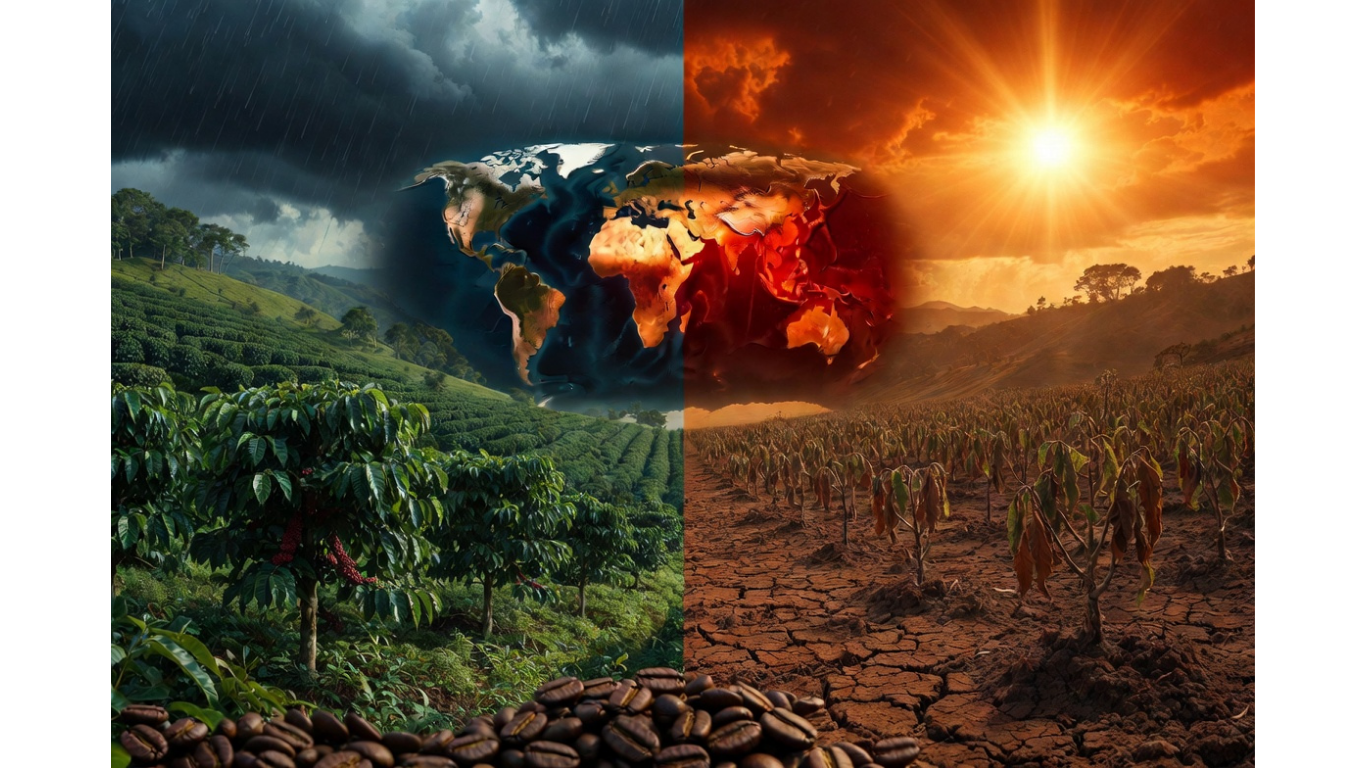
US Coffee Consumption 2026 by the Numbers

Source: National Coffee Association (NCA) |
Author: Qahwa World |
Date: June 6, 2026

US Coffee Consumption 2026 by the Numbers: The Rise of Specialty Coffee and What It Means for Global Markets

Key Numbers:

  • 66% of American adults drank coffee yesterday – more than any other beverage including water.
  • 47% drank specialty coffee daily, surpassing traditional coffee (42%).
  • 58% had specialty coffee in the past week, a 10-point increase since 2021.
  • 45% of Americans consumed espresso-based beverages weekly (lattes, cappuccinos, espressos).
  • Age group 25-39 leads consumption: 69% weekly for specialty coffee.
  • Hispanic Americans are the highest specialty coffee consumers (67% weekly).
  • Northeast and West regions have the highest consumption (64% and 61% weekly).
  • Medium roast is the most popular (58%), followed by dark (39%) and light (13%).

The 2026 National Coffee Data Trends report, released by the National Coffee Association (NCA), confirms that coffee remains America’s favorite beverage. 66% of adults drank coffee yesterday, ahead of tap or bottled water. However, the real story lies in a deep shift within the US market.

For the first time, specialty coffee is achieving sustainable growth over traditional coffee. This shift reflects changing consumer tastes and carries major implications for global production, arabica and robusta futures, roasting strategies, and distribution worldwide. In this report, we present the most revealing numbers and analyze what they mean for the global coffee market.

1. Daily and Weekly Consumption Basics

January 2026 data shows specialty coffee outpacing traditional coffee in daily consumption for the first time on a broad scale. Daily specialty coffee penetration reached 47%, versus 42% for traditional coffee. On a weekly basis, 58% of Americans drank specialty coffee, compared to 62% for traditional coffee – a very close gap.

Coffee Type Daily Penetration Weekly Penetration
Specialty Coffee 47% 58%
Traditional Coffee 42% 62%
Espresso Based Beverages (EBBs) 29% 45%
Cold Specialty Beverages (N-EBBs)* 17% 27%

* Includes cold brew, frozen blended coffee, and nitro coffee.

Since 2021, weekly specialty coffee consumption has increased by 10 percentage points (from 48% to 58%). Meanwhile, weekly traditional coffee consumption has remained stable at around 62%. This means nearly all growth in the US coffee market comes from the specialty segment.

2. Who Drinks Specialty Coffee? Demographic Profile

By age: The 25-39 age group is the strongest driver. 69% of them drank specialty coffee in the past week, versus only 46% of those aged 60+. Moreover, 60% of the 25-39 group consumed espresso beverages, and 40% drank cold specialty drinks. Young adults (18-24) prefer specialty (50%) over traditional (40%), signaling a lasting generational shift.

Age Group Specialty (Weekly) Espresso Beverages Cold Specialty
18-24 50% 38% 33%
25-39 69% 60% 40%
40-59 60% 47% 27%
60+ 46% 30% 13%

By ethnicity: Hispanic Americans are the highest specialty coffee consumers (67% weekly), followed by Asian Americans (64%). African Americans (57%) and Caucasian Americans (56%) follow. Hispanic Americans also lead in espresso beverages (57%) and cold specialty drinks (39%).

By region: The Northeast leads with 64% weekly specialty consumption, followed by the West (61%), then the South (57%), and finally the Midwest (49%).

3. How Do Americans Drink Their Specialty Coffee?

Temperature: 43% prefer hot specialty coffee, while 32% consume it cold. In contrast, traditional coffee is 54% hot and only 13% cold. Specialty coffee thus dominates the cold beverage market year-round, even in January.

Roast level: Medium roast is the most popular (58%), followed by dark roast (39%), then light roast (13%). This confirms a preference for balanced, classic flavors.

Additives (sweeteners and whiteners): 59% of specialty coffee drinkers use sweeteners or flavored syrup. 58% use whiteners (milk, cream, or milk alternatives). The 25-39 age group records the highest sweetener usage (70%). Hispanic Americans are more likely to add white sugar and honey.

Out-of-home preparation: 36% of specialty coffee drinkers buy their coffee away from home (cafés, restaurants, workplaces), compared to only 23% of traditional drinkers. This highlights the importance of the hospitality and café sector for specialty coffee growth.

4. What Do These Numbers Mean for the Global Coffee Market?

The US shift to specialty coffee is not just a local taste change; it is a strong signal for global markets.

1. Demand for high-quality arabica will increase: Specialty coffee’s heavy reliance on arabica puts pressure on producing countries to increase output while maintaining quality. However, a record Brazil 2026/27 crop (71.9 million bags) may create a temporary surplus, but strong US demand will absorb much of it.

2. Arabica prices may find support despite surplus: Prices usually fall when supply rises. Yet 58% of Americans drinking specialty coffee weekly means that any production increase may be met by rising consumption, limiting price collapse. Additionally, tight spot supplies (falling exchange inventories) support prices in the short term.

3. Robusta market faces pressure: As traditional coffee’s share declines, Vietnam increases its robusta exports. This could lead to a robusta surplus and downward pressure on prices. Roasters will need to find new uses for robusta.

4. Flavor innovation and new formats are essential: 35% of specialty coffee drinkers consider flavor part of the definition of “specialty coffee.” The strong preference for sweet flavors forces producers to develop blends that meet these tastes. Meanwhile, the popularity of cold drinks requires investment in chilled distribution channels.

5. Demographic shifts reshape global marketing: Specialty coffee’s concentration among 25-39 year olds and Hispanic Americans means brands must redirect their campaigns and sales channels. Higher out-of-home consumption (36%) benefits global café chains.

6. Supply chain and climate challenges remain: With El Niño and Strait of Hormuz disruptions persisting, specialty coffee supply chains become more fragile. Prices may experience sharp volatility despite a theoretical surplus.

5. What Does This Mean for the Arab World, Especially the Gulf?

The Gulf market is experiencing massive growth in specialty coffee. US data confirms this is a global trend. For coffee-importing Arab countries, this means:

  • Higher prices: If strong US demand continues, arabica prices may rise globally, increasing import costs for local roasters and cafés.
  • Opportunity for differentiation: Arab cafés can play on distinctive flavors (spice, floral, fruit) that US specialty drinkers are open to. This opens doors for collaboration with US roasters or exporting innovative Arab blends.
  • Need for investment in education and training: To meet global quality standards, the Gulf coffee sector must strengthen Q Grader and sensory analysis programs, just as labs like Kanamori Coffee Lab do in Japan.

Frequently Asked Questions About US Coffee Consumption 2026

Q: What percentage of Americans drink coffee daily compared to other beverages?

A: 66% drink coffee daily, making it the most consumed beverage ahead of tap or bottled water.

Q: Has specialty coffee truly overtaken traditional coffee?

A: In daily consumption, yes: 47% specialty vs. 42% traditional. Weekly, traditional still leads slightly (62% vs. 58%).

Q: Which age group consumes the most specialty coffee?

A: The 25-39 age group, at 69% weekly.

Q: What is the most popular roast in America?

A: Medium roast (58%), followed by dark (39%), then light (13%).

Q: How do these numbers affect global coffee prices?

A: Strong US demand for arabica supports prices, while Brazil’s record crop may create temporary surplus. Robusta prices trend downward due to Vietnam exports.

Q: Which flavors do US specialty coffee drinkers prefer most?

A: Sweet flavors: chocolate (85%), caramel and brown sugar (78%), vanilla (79%).

The 2026 data shows that specialty coffee is no longer a luxury but the backbone of the US coffee market. This sends clear messages to producers, roasters, and investors worldwide: quality, innovation, and understanding demographic shifts are the keys to success in the coming decade.

Prepared and edited by: Qahwa World – Based on the National Coffee Association’s 2026 National Coffee Data Trends Specialty Coffee Report.

All rights reserved. Republication with attribution permitted.

Publication date: June 6, 2026
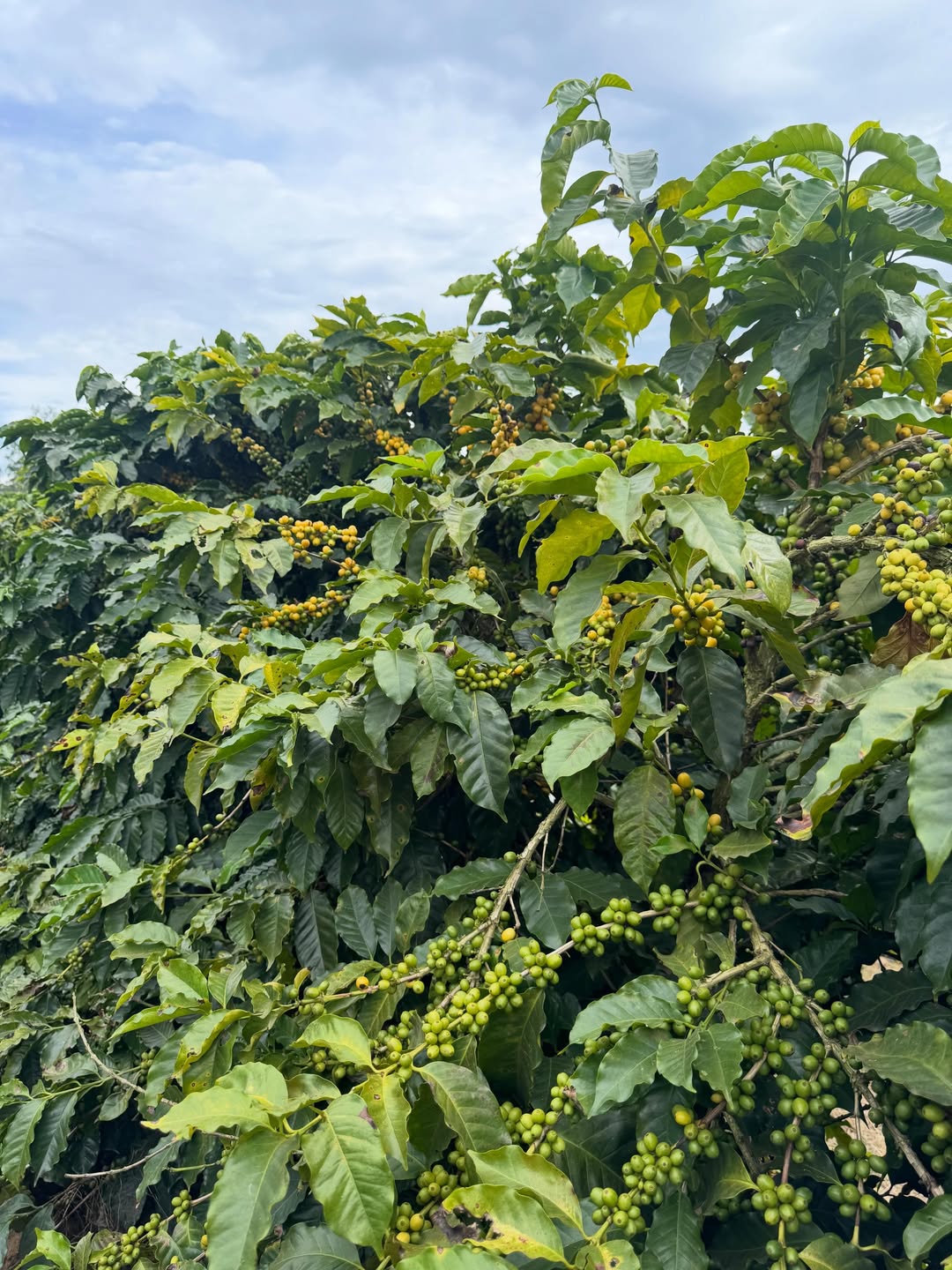
Arabica Coffee Rebounds Amid Tight Spot Market Supplies

Source: Barchart (adapted) |
Author: Qahwa World |
Date: June 5, 2026

Recent trends show that arabica coffee has experienced a rebound in the spot market, drawing attention from both traders and coffee enthusiasts. In this article, we will examine the key developments and analysis surrounding the arabica coffee rebound spot market and what it means for industry stakeholders. If you are following arabica coffee rebound spot market news, understanding arabica coffee rebound spot market conditions is important for those looking to make sense of price fluctuations and opportunities in the industry.

Arabica Coffee Rebounds Amid Tight Spot Market Supplies

Key Highlights:

  • July arabica coffee futures rose 0.34% after hitting a 19-month low.
  • ICE arabica coffee inventories fell to a 3.75-month low on Thursday.
  • A record Brazil 2026/27 crop forecast is weighing on prices.
  • Rabobank raised its global arabica surplus estimate to 9.5 million bags.
  • Vietnam’s coffee exports rose 7.9% in the first five months of 2026.
  • El Niño could delay rains in Brazil and hurt next year’s crop.
  • The ongoing closure of the Strait of Hormuz disrupts global coffee supplies.

Arabica coffee futures rebounded from a 19-month low today. July arabica rose 0.34%, while July robusta fell 1.34%. The rebound was driven by short covering amid persistent tightness in the spot market. ICE monitored arabica coffee inventories dropped to a 3.75-month low on Thursday.

Therefore, the market remains mixed. Improved global supply expectations have pushed prices lower over the past six weeks. However, near-term supply tightness and geopolitical risks provide support.

Record Brazil Crop Forecast Weighs on Prices

On Wednesday, the USDA Foreign Agricultural Service (FAS) forecast a record 2026/27 Brazil coffee crop of 71.9 million bags. This represents a 14% increase year on year. In addition, Rabobank raised its 2026/27 global arabica surplus estimate to 9.5 million bags, up from 7.0 million bags previously.

On May 7, the Coffee Trading Academy projected Brazil’s 2026/27 harvest would increase by 12% to 71.4 million bags. On March 19, Marex Group Plc projected a record 75.9 million bags, surpassing Sucafina‘s forecast of 75.4 million bags. StoneX raised its estimate to 75.3 million bags on March 12.

As a result, coffee prices have trended lower over the past six weeks. StoneX projects the 2026 global coffee surplus will expand to 10 million bags, up from 1.8 million bags in 2025. This would be the largest surplus in six years.

Source Brazil 2026/27 Crop Forecast (million bags)
USDA FAS 71.9
Coffee Trading Academy 71.4
Marex Group 75.9
Sucafina 75.4
StoneX 75.3

Strong Vietnam Exports Pressure Robusta; Inventories Fall

On Tuesday, Vietnam’s National Statistics Office reported that the country’s coffee exports from January to May 2026 rose 7.9% year on year to 922,000 metric tons. Moreover, Vietnam’s 2025 coffee exports jumped 17.5% to 1.58 million metric tons. Vietnam’s 2025/26 coffee production is projected to climb 6% to a four-year high of 1.76 million metric tons (29.4 million bags).

In contrast, ICE arabica coffee inventories fell to a 3.75-month low of 426,063 bags on Thursday. Meanwhile, ICE robusta inventories dropped to a two-year low of 3,631 lots on May 15. They are now slightly higher at 3,732 lots.

El Niño and Strait of Hormuz Threaten Supplies

Concerns are growing that an El Niño weather pattern could hurt Brazil’s coffee crop next year. Coffee trader Commercial stated that El Niño may delay rains in Brazil during September and October, when tree flowering normally occurs. This would damage the 2026/27 crop.

The US National Oceanic and Atmospheric Administration (NOAA) estimates an 82% probability that El Niño conditions will emerge between May and July and persist through the end of the year. There is a 67% chance of a “Super El Niño.”

Furthermore, the ongoing closure of the Strait of Hormuz has disrupted global coffee supplies and is bullish for prices. The closure has tightened supplies by increasing shipping rates, insurance, fertilizer, and fuel costs. This raises costs for coffee importers and roasters.

On the bearish side, the International Coffee Organization (ICO) reported on November 7 that global coffee exports for the current marketing year (October to September) fell 0.3% to 138.658 million bags. The USDA FAS bi-annual report on December 18 projected that 2025/26 world coffee production will increase 2.0% to a record 178.848 million bags. Arabica production is expected to fall 4.7% to 95.515 million bags, while robusta production rises 10.9% to 83.333 million bags.

Type 2025/26 Forecast (million bags) Year-over-Year Change
Arabica 95.52 -4.7%
Robusta 83.33 +10.9%
Global Total 178.85 +2.0%

Ending Stocks Continue to Decline

The USDA FAS forecasts that 2025/26 ending stocks will fall 5.4% to 20.148 million bags, down from 21.307 million bags in 2024/25. This decline comes despite higher production expectations. It reflects strong global demand and continued supply chain pressures.

However, prices may face additional pressure if large surplus forecasts materialize, especially with recovering production in Brazil and Vietnam. Investors remain watchful of weather developments in South America and geopolitical tensions in the Arabian Gulf region.

Frequently Asked Questions About Coffee Price Movements

Q: Why did arabica coffee prices rebound despite record Brazil crop forecasts?

A: Due to short covering and tight spot market supplies. ICE monitored inventories fell to a 3.75-month low.

Q: How do Vietnam’s exports affect robusta prices?

A: Rising Vietnamese exports increase global robusta supply, putting downward pressure on prices. July robusta futures fell 1.34% today.

Q: What is the impact of El Niño on coffee prices?

A: El Niño could delay rains in Brazil, harming tree flowering and reducing next year’s crop. This would support higher prices.

Q: How does the Strait of Hormuz closure affect the coffee market?

A: The closure disrupts shipping routes and raises transport, insurance, and fuel costs. This increases costs for importers and roasters.

Q: What is the global coffee surplus forecast for 2026?

A: StoneX expects the surplus to reach 10 million bags, the largest in six years, driven by higher production in Brazil and Vietnam.

The coffee market remains torn between large surplus expectations on one hand and tight spot supplies, weather risks, and geopolitical tensions on the other. Investors continue to monitor exchange inventories and weather developments in Brazil closely.

Prepared and edited by: Qahwa World – Based on a Barchart report by Rich Asplund (adapted).

All rights reserved. Republication with attribution permitted.

Publication date: June 5, 2026

Brazil Coffee Output to Reach Record 71.9M Bags

Author: Qahwa World – Brasília
Source: USDA Foreign Agricultural Service – Report BR2026-0025
Date: June 1, 2026

Brazil Coffee Output to Reach Record 71.9M Bags

Executive Summary

  • Brazil’s 2026/27 coffee production is forecast at 71.9 million 60‑kg bags, a 14% increase over the previous season.
  • Arabica output is expected to surge 25% to 47.5 million bags, ending five years of low harvests.
  • Robusta (conilon) production is forecast at 24.4 million bags, a slight decline from 25 million bags due to cooler weather and excess rain in some regions.
  • Exports for 2026/27 are projected to jump 30% to 49 million bags, supported by the record crop.
  • However, low stocks and fears of an El Niño event are making exporters cautious and holding back deals.
  • Domestic consumption remains stable at 22.39 million bags, with a 0.5% annual increase.
  • The “Zero Crop, 100% Crop” management technique is helping farmers optimize yields and reduce costs.

Brazil is set to produce a record 71.9 million 60‑kg bags of coffee in the 2026/27 season. This is a 14% increase over the previous cycle. The outlook is especially bright for arabica coffee.

Optimal weather in major growing regions has driven the recovery. The record crop follows five years of low arabica production caused by adverse conditions.

Exports are expected to surge 30% to 49 million bags. However, exporters remain cautious. They are holding back on deals because of low stocks and uncertainties about a possible El Niño event.

El Niño could affect the end of the current harvest and the 2027/28 cycle. These factors are strongly influencing coffee prices in the Brazilian market.

Production Outlook

The positive biennial cycle is a key driver. Arabica trees naturally produce more in alternating years. This year is a high‑yield year.

Favorable weather conditions and rising global prices have also encouraged farmers to expand their coffee areas. Technology has enabled higher planting density per hectare.

As a result, total coffee production is forecast at 71.9 million 60‑kg bags. This is a 14% increase from the 63 million bags estimated for 2025/26.

The National Supply Company (CONAB) projects a slightly lower figure of 66.7 million bags. The Brazilian Institute of Geography and Statistics (IBGE) projects 65.1 million bags.

Both official agencies use different methodologies. They have historically provided lower estimates than the USDA.

Arabica and Robusta Performance

Arabica production is forecast to reach 47.5 million bags. This is a 25% increase over the previous cycle. The growth is driven by the positive biennial cycle and expanded cultivated area.

Technological improvements in crop management also played a role. Milder temperatures before flowering supported good crop development.

In contrast, robusta (conilon) production is forecast at 24.4 million bags. This is a slight decline from the 25 million bags estimated for 2025/26.

Colder weather and periods of excessive rainfall reduced yields in some main producing regions. The strong growth of the 2025/26 harvest also made it difficult to sustain the same level of production.

Producers are increasingly worried about climate change. Many are adjusting their practices, seeking more shaded areas, and looking for resilient varieties.

Regional Performance

Minas Gerais remains Brazil’s largest coffee‑producing state. It is forecast to harvest 34.1 million bags in 2026/27, up from 26.7 million in 2025/26.

The increase is due to the positive biennial cycle and better rainfall distribution. Rainfall was especially good before flowering and through March.

Espírito Santo, the second‑largest producer, is forecast at 21.4 million bags. Arabica production there is expected at 4.4 million bags, while robusta accounts for 17 million bags.

São Paulo, which grows only arabica, saw growth of more than 15% over the previous cycle, despite varied weather conditions.

Bahia has now become the second‑largest robusta producer, surpassing Rondônia. Its growth comes from advanced technology and high‑performance irrigated areas.

Rondônia is expected to see a 19% increase in robusta production. Favorable weather and the renewal of crops with higher‑yielding clonal plants are the main reasons.

Table 1: Brazilian Coffee Production by State (million 60‑kg bags)

State 2025/26 2026/27 Change
Minas Gerais 26.7 34.1 +27.7%
Espírito Santo 20.9 21.4 +2.4%
São Paulo 4.8 5.5 +14.6%
Bahia 4.7 5.2 +10.6%
Rondônia 2.3 2.8 +21.7%

Prices and Production Costs

Arabica prices rose sharply at the end of 2025 due to limited supply. However, prices started to decrease with the forecast of a larger harvest.

In April 2026, arabica coffee averaged BRL 1,811.87 (USD 360.03) per 60‑kg bag. This was a 5% drop from March and a 28% drop from April 2024.

Robusta prices fell even more. In April 2026, robusta traded at BRL 917.05 (USD 182.26). That was a 10% monthly drop and a 46% drop from April 2025.

Fears of an El Niño event have dampened sales activity. Many producers who were liquidating their remaining stocks are now holding back.

Production costs remain high. Fertilizer prices have risen, and freight costs have increased due to higher diesel prices. Diesel climbed about 24% in March 2026.

To cope, many farmers are adopting the “Zero Crop, 100% Crop” technique. This method divides farms into two plots and alternates skeleton pruning.

As a result, farmers focus only on the plot in its high‑yield phase. The system also increases organic matter and reduces fertilizer needs.

Domestic Consumption and Exports

Brazil’s domestic coffee consumption is forecast at 22.39 million bags for 2026/27. This is a slight 0.5% increase over the previous year.

Consumption declined by more than 2% in 2025 due to high prices. However, it recovered in early 2026 as supermarket prices dropped.

In the first four months of 2026, consumption rose 2% compared to the same period in 2025. The average Brazilian drinks about 3.8 cups of coffee per day.

Exports for 2026/27 are forecast to jump 30% to 49 million bags. This is based on the record harvest. However, low stocks have prevented even higher volumes.

Between January and April 2026, Brazil exported 11.5 million bags, a 24% decrease from the same period in 2025. April exports increased 1.2%, signaling a gradual recovery.

Germany remains the top buyer of Brazilian coffee, followed by the United States, Italy, Japan, and Belgium. The United States holds over 30% of the market share for Brazilian coffee imports.

Specialty coffees accounted for almost 18% of total exports in early 2026, though that volume was 36% lower than the same period in 2025.

Policy and Minimum Prices

The government has allocated BRL 7.37 billion for the 2026/27 Coffee Economy Defense Fund (FUNCAFE). The fund supports crop management, marketing financing, and working capital.

Minimum guaranteed prices for the 2026/27 harvest have been increased. Arabica now has a minimum price of BRL 792.53 per 60‑kg bag, a 20% rise from the previous season.

Robusta’s minimum price was set at BRL 556.97 per bag, a 12% increase. These prices are valid from April 2026 through March 2027.

Frequently Asked Questions

How much coffee will Brazil produce in 2026/27?

Production is forecast at 71.9 million 60‑kg bags, a 14% increase over the previous season.

Why is arabica production expected to surge?

The positive biennial cycle, expanded planted area, technological advances, and favorable weather are the main drivers.

Which Brazilian state produces the most coffee?

Minas Gerais is the largest producer, forecast at 34.1 million bags in 2026/27.

How will El Niño affect Brazilian coffee?

There is a 60% chance of El Niño between May and July 2026. It could negatively impact the 2027/28 harvest through higher temperatures and altered rainfall.

What is the “Zero Crop, 100% Crop” technique?

It is a management method that divides a farm into two plots and alternates skeleton pruning, allowing farmers to focus on high‑yield areas and reduce costs.

What are the main export destinations for Brazilian coffee?

Germany, the United States, Italy, Japan, and Belgium are the top buyers.


Author: Qahwa World – Brasília | Source: USDA Foreign Agricultural Service – Report BR2026-0025 | Date: June 1, 2026

Climate Resilient Coffee: Excelsa and Liberica Offer Hope

Author: Qahwa World
Source: Mongabay (Meena Menon)
Date: June 1, 2026

Climate Resilient Coffee: Excelsa and Liberica Offer Hope

Executive Summary:

  • Mongabay published this story. Arabica and Robusta face growing threats from rising temperatures and erratic rainfall.
  • Lesser known coffee species like Excelsa and Liberica are gaining attention for their resilience and adaptability.
  • British planter Colonel Benson introduced Excelsa to India in the 1800s, but growers never commercialised it widely.
  • In 2025, the South India Coffee Company sold over four tonnes of Excelsa. Demand for saplings is now rising.
  • Researchers at Kew Gardens are studying underutilised species. They have proposed a new hybrid called Libex.
  • Ugandan farmers have grown hundreds of acres of Excelsa since the early 2000s as a climate adaptation.
  • For a sustainable future, the coffee industry must diversify by blending traditional and alternative species.

Mongabay published this story about climate resilient coffee. Rising temperatures and erratic rainfall increasingly threaten the two dominant coffee species, Arabica and Robusta. Pest pressures add to their vulnerability. Consequently, researchers and farmers are turning to lesser known species such as Excelsa and Liberica. These forgotten plants offer new hope for the industry.

Excelsa Gains New Relevance

Excelsa (Coffea dewevrei) grows naturally in parts of Tropical Africa and Southeast Asia. In India, farmers traditionally planted it as a boundary marker or for shade. However, they never commercialised it widely. According to an unpublished paper, a British planter named Colonel Benson introduced Excelsa to India in the late 1800s. He saw it as an alternative to Arabica after pest outbreaks. Nevertheless, its height, which can reach fifteen metres, made estate management impractical.

Today, climate change is prompting a revaluation. Akshay Dashrath, co founder of the South India Coffee Company, maintains 60 year old Excelsa trees on his estate in Karnataka. Interestingly, his grandfather used to drink only Excelsa at home. In 2024 and 2025, the company began revaluating Excelsa across five estates. As a result, they sold over four tonnes of green coffee in 2025. For 2026, they estimate sales will reach five tonnes.

Indian Growers Face Climate Instability

Across India’s coffee growing regions, farmers report increasing climate instability. Kerehaklu Estate in Karnataka has grown Excelsa and Liberica since 1953. Pranoy Thipaiah, the managing partner, told Mongabay that rainfall has become longer and more intense. He also noted that plants’ biological clocks have shifted. Pest pressure has increased as well. Excelsa and Liberica, he explained, handle climate variations better than traditional species. Their long gestation period means harvest occurs after the unseasonal rains pass. Thipaiah is now expanding his trials. He has seven different varieties from Vietnam growing in his nursery. Next year, he plans to transplant them into the main estate.

Global Research on Resilient Species

The search for climate resilient coffee extends far beyond India. Researchers have identified 133 different coffee species worldwide. Aaron Davis of the Royal Botanic Gardens, Kew, told Mongabay that Arabica and Robusta may soon lose their dominance. Arabica requires a cool tropical climate with distinct dry periods. Robusta needs warmth and moisture but cannot tolerate drought. Therefore, neither species can survive the coming changes. Davis advocates for diversification. “We need a portfolio of coffee crop species to adapt to altered climates,” he stated.

Excelsa is already scaling up in Uganda and Vietnam. Farmers there have grown hundreds of acres since the early 2000s. Kiwuka Catherine, a Ugandan research officer, explained that smallholders and large farmers are adopting Excelsa as a climate adaptation. At least 200 farms in Uganda and several in India, Vietnam, and South Sudan now produce Excelsa for export. This trend shows no signs of slowing.

New Hybrids and Future Possibilities

Species Climate Resilience Current Status
Arabica Low, heat sensitive Dominant but vulnerable
Robusta Moderate, not drought tolerant Widely grown, under pressure
Excelsa High, heat and drought tolerant Gaining commercial interest
Liberica High, adaptable Under research
Libex (hybrid) Very high, disease resistant Proposed new hybrid

Researchers have also investigated a hybrid between Liberica and Excelsa. They named it Coffea X libex, or Libex coffee. This hybrid resists heat, excess moisture, and disease effectively. According to Dashrath, this finding could prove crucial for the future of coffee. Hybrids offer a sustainable option for growers facing unpredictable weather. In India, Excelsa is slowly moving from obscurity into the mainstream. SICC has received requests for more than 4,000 saplings for 2026. Davis believes Ugandan Excelsa could appear in supermarkets within a decade. For a sustainable future, the coffee industry must embrace diversification, regenerative agriculture, and multiple alternative species.

Frequently Asked Questions (FAQ)

1. Why are Arabica and Robusta vulnerable to climate change?

Temperatures above 30°C reduce yields. Arabica cannot tolerate heat, while Robusta cannot handle drought. Changing rainfall patterns and pests add more stress.

2. What exactly is Excelsa coffee?

Excelsa (Coffea dewevrei) is a lesser known coffee species native to Africa and Southeast Asia. It grows tall and shows strong resistance to heat and drought.

3. Where can farmers grow Excelsa today?

Growers cultivate Excelsa in India, Uganda, and Vietnam. Ugandan farmers have grown hundreds of acres since the early 2000s as a climate adaptation.

4. What is Libex coffee?

Libex (Coffea X libex) is a hybrid between Liberica and Excelsa. It demonstrates strong resistance to heat, moisture stress, and disease.

5. Can consumers buy Excelsa coffee now?

Yes, but only in small quantities. In India, producers sold over four tonnes in 2025. Ugandan Excelsa may soon reach supermarket shelves.

6. What does the future of coffee look like?

Diversification. Growers will need a portfolio of species including Excelsa, Liberica, Stenophylla, and hybrids like Libex alongside improved Arabica and Robusta.

Qahwa World – Mongabay published this story. Reporting by Meena Menon.
Published: June 1, 2026

Coffee Prices Fall on Forecasts for Dry Weather in Brazil

Author: Qahwa World
Source: Barchart (Rich Asplund)
Date: May 29, 2026

Coffee Prices Fall on Forecasts for Dry Weather in Brazil

Executive Summary:

  • July arabica coffee futures closed down 2.70% on dry weather forecasts for Brazil, allowing the harvest to resume after rain delays.
  • July robusta coffee fell 2.14% amid improved global supply outlook and rising Vietnam exports.
  • Brazil’s 2026/27 coffee harvest is projected to increase 12% to 71.4 million bags, with some forecasts as high as 75.9 million bags.
  • StoneX expects the 2026 global coffee surplus to reach 10 million bags, the largest in six years.
  • Vietnam coffee exports rose 15.8% in January-April 2026 to 810,000 metric tons.
  • ICE arabica inventories fell to a 3.25-month low of 440,785 bags, supporting prices.
  • El Niño risks and dry conditions in Vietnam remain supportive for prices, while the US dollar weakness added support.

Coffee prices retreated sharply on Thursday after updated weather forecasts called for dry conditions next week in Brazil’s coffee growing regions.

The dry weather will allow the coffee harvest to resume after being delayed this week by heavy rains. July arabica coffee futures closed down 2.70%, while July robusta coffee fell 2.14%.

Brazil Crop Outlook and Global Surplus

Coffee prices have trended lower over the past month, with arabica falling to a one and a half year low last Tuesday amid an improved global supply outlook.

On May 7, the Coffee Trading Academy projected Brazil’s 2026/27 coffee harvest would increase 12% year on year to 71.4 million bags.

On March 19, Marex Group projected a record Brazilian crop of 75.9 million bags, surpassing Sucafina’s forecast of 75.4 million bags.

On March 12, StoneX raised its estimate to a record 75.3 million bags. StoneX also projected the 2026 global coffee surplus would expand to 10 million bags from 1.8 million bags in 2025, the largest surplus in six years.

Vietnam Exports and Inventory Trends

Soaring coffee exports from Vietnam, the world’s largest robusta producer, are bearish for robusta prices.

On May 9, Vietnam’s National Statistics Office reported that the country’s coffee exports in the first four months of 2026 rose 15.8% year on year to 810,000 metric tons.

Vietnam’s 2025 coffee exports jumped 17.5% to 1.58 million metric tons. Production for the 2025/26 season is projected to climb 6% to a four year high of 1.76 million metric tons, equivalent to 29.4 million bags.

ICE coffee inventories have trended lower over the past two months, which typically supports prices. ICE arabica coffee inventories fell to a 3.25-month low of 440,785 bags on Thursday.

ICE robusta inventories fell to a two year low of 3,631 lots on May 15, but recovered to a six week high of 3,968 lots last Friday.

Weather Risks and Other Factors

Global weather risks remain supportive for coffee prices. Excessive dryness in Vietnam is raising concerns about the robusta coffee crop.

Weather forecaster Vaisala said recent showers in Vietnam’s Central Highlands have been spotty, and more rain is needed to aid cherry growth.

Concerns that an El Niño weather pattern could hurt Brazil’s coffee crop next year are also supportive for prices.

Coffee trader Commercial said El Niño may delay rains in Brazil during September and October, when tree flowering normally occurs, potentially hurting the 2026/27 crop.

NOAA estimates an 82% probability of El Niño between May and July, with a 67% chance of a Super El Niño.

Smaller exports from Brazil are supportive of coffee prices.

On May 12, Cecafe reported that Brazil’s April green coffee exports fell 1.3% year on year to 2.76 million bags.

The ongoing closure of the Strait of Hormuz has disrupted global coffee supplies, increasing shipping rates, insurance, and fuel costs, which is bullish for prices.

USDA Production Forecasts

Indicator 2025/26 Forecast
World coffee production 178.848 million bags (+2.0% record)
Arabica production 95.515 million bags (-4.7%)
Robusta production 83.333 million bags (+10.9%)
Brazil production 63 million bags (-3.1%)
Vietnam production 30.8 million bags (+6.2%, 4-year high)
Ending stocks 20.148 million bags (-5.4%)

The USDA’s Foreign Agriculture Service bi-annual report of December 18 projected world coffee production in 2025/26 would increase 2.0% to a record 178.848 million bags.

Arabica production is expected to decrease 4.7% to 95.515 million bags, while robusta production is forecast to rise 10.9% to 83.333 million bags.

The USDA also forecast Brazil’s coffee production to decline 3.1% to 63 million bags, while Vietnam’s output would rise 6.2% to a four year high of 30.8 million bags.

Ending stocks are projected to fall 5.4% to 20.148 million bags.

Frequently Asked Questions (FAQ)

1. Why did coffee prices fall on Thursday?

Prices fell due to forecasts of dry weather in Brazil, allowing the coffee harvest to resume after being delayed by heavy rains.

2. How much did arabica and robusta drop?

July arabica fell 2.70%, and July robusta fell 2.14%.

3. What is the projected Brazilian coffee crop for 2026/27?

The Coffee Trading Academy projects 71.4 million bags, while Marex Group and StoneX project record crops above 75 million bags.

4. How much did Vietnam’s coffee exports increase?

Exports rose 15.8% in January-April 2026 to 810,000 metric tons.

5. What is the expected global coffee surplus for 2026?

StoneX projects a surplus of 10 million bags, the largest in six years.

6. How does El Niño affect coffee prices?

El Niño could delay rains in Brazil during the flowering season, potentially reducing the 2026/27 crop, which supports prices.

Qahwa World – Based on Barchart commodity bulletin by Rich Asplund.
Published: May 29, 2026

Coffee Prices Rise on Weather Concerns

Author: Qahwa World
Source: Barchart
Date: May 27, 2026

Coffee Prices Rise on Weather Concerns

Executive Summary:

  • July arabica coffee futures closed up 0.61 percent on Tuesday, while robusta gained 1.82 percent.
  • Dry and uneven rains in Vietnam’s Central Highlands raised concerns about robusta cherry development.
  • El Niño could delay Brazil’s September-October rains, threatening the 2026/27 flowering season.
  • NOAA estimates 82% chance of El Niño from May to July, with 67% chance of a Super El Niño.
  • Vietnam coffee exports rose 15.8% in Jan-Apr 2026 to 810,000 metric tons.
  • ICE robusta inventories fell to a two-year low before recovering slightly to 3,968 lots.
  • Brazil’s April green coffee exports declined 1.3% to 2.76 million bags.

Coffee prices moved higher on Tuesday, reaching one week highs as weather risks in key producing countries raised concerns about future supply.

July arabica coffee futures closed up 0.61 percent, while July ICE robusta coffee futures gained 1.82 percent.

Robusta prices climbed sharply due to continued dry conditions in Vietnam, the world’s largest robusta producer.

According to weather forecaster Vaisala, recent rainfall in Vietnam’s Central Highlands, the country’s main coffee growing region, has been uneven. Additional rain is needed to support cherry development.

El Niño Risks in Brazil

Concerns over a possible El Niño weather pattern in Brazil also supported prices. Coffee trader Commercial warned that El Niño could delay seasonal rains in Brazil during September and October, the critical flowering period for coffee trees, potentially affecting the country’s 2026/27 crop.

The US National Oceanic and Atmospheric Administration estimates an 82 percent probability that El Niño conditions will develop between May and July and continue through the end of the year, including a 67 percent chance of a Super El Niño.

Despite Tuesday’s gains, coffee prices have generally weakened over the past month as expectations for larger global supplies weighed on the market. Arabica futures fell to a one and a half year low last week following several optimistic crop forecasts for Brazil.

Supply Forecasts and Vietnam Exports

On May 7, the Coffee Trading Academy projected Brazil’s 2026/27 coffee harvest at 71.4 million bags, up 12 percent year on year.

Marex Group forecast a record crop of 75.9 million bags, while StoneX raised its estimate to 75.3 million bags. StoneX also projected the global coffee surplus could expand to 10 million bags in 2026, compared with 1.8 million bags in 2025.

Additional pressure on robusta prices has come from rising exports from Vietnam. On May 9, Vietnam’s National Statistics Office reported that coffee exports during January to April rose 15.8 percent year on year to 810,000 metric tons.

Full year exports for 2025 increased 17.5 percent to 1.58 million metric tons. Vietnam’s 2025/26 coffee production is also expected to rise 6 percent to 1.76 million metric tons, equivalent to 29.4 million bags, the highest level in four years.

Inventories and Other Factors

Indicator Value
July arabica close (Tuesday) Up 0.61% (KCN26)
July robusta close (Tuesday) Up 1.82% (RMN26)
Vietnam coffee exports (Jan-Apr 2026) 810,000 MT (+15.8% y/y)
ICE robusta inventories (May 22) 3,968 lots (6-week high)
ICE arabica inventories (Tuesday) 446,816 bags (3.25-month low)
Brazil April green coffee exports 2.76 million bags (-1.3% y/y)

ICE coffee inventories have generally declined over the past two months, offering some support to prices.

ICE robusta inventories fell to a two year low of 3,631 lots on May 15 before recovering slightly to 3,968 lots last Friday.

ICE arabica inventories dropped to a three and a quarter month low of 446,816 bags on Tuesday.

Brazilian export data also provided support. Cecafe reported on May 12 that Brazil’s April green coffee exports declined 1.3 percent year on year to 2.76 million bags.

Disruptions linked to the closure of the Strait of Hormuz have increased shipping costs, insurance premiums, fertilizer expenses, and fuel prices, tightening global coffee supply chains.

Global Production Outlook

The International Coffee Organization reported that global coffee exports for the current marketing year (October to September) fell 0.3 percent year on year to 138.658 million bags.

The USDA Foreign Agricultural Service projects global coffee production for 2025/26 will rise 2 percent to a record 178.848 million bags.

The report forecasts arabica production declining 4.7 percent to 95.515 million bags, while robusta production increases 10.9 percent to 83.333 million bags. FAS estimates Brazil’s 2025/26 coffee production at 63 million bags, down 3.1 percent, while Vietnam’s output is expected to rise 6.2 percent to a four year high of 30.8 million bags. Global ending stocks for 2025/26 are forecast to decline 5.4 percent to 20.148 million bags.

Frequently Asked Questions (FAQ)

1. Why did coffee prices rise on Tuesday?

Prices rose due to dry conditions in Vietnam threatening robusta cherry development and potential El Niño risks in Brazil that could delay flowering rains.

2. How much did robusta and arabica gain?

July robusta gained 1.82 percent, while July arabica rose 0.61 percent.

3. What is the El Niño risk for Brazil?

El Niño could delay September-October rains, the critical flowering period for coffee trees, potentially hurting the 2026/27 crop.

4. How much did Vietnam’s coffee exports increase?

Exports rose 15.8 percent in January-April 2026 to 810,000 metric tons.

5. What happened to ICE coffee inventories?

Robusta inventories recovered to 3,968 lots, while arabica inventories fell to a 3.25-month low of 446,816 bags.

6. What is the global production forecast for 2025/26?

USDA projects record production of 178.848 million bags, with arabica down 4.7% and robusta up 10.9%.

Qahwa World – Based on Barchart commodity data.
Published: May 27, 2026

Brazil Coffee Production to Hit Record 66.7 Million Bags in 2026

Author: Qahwa World – Brasília
Source: National Supply Company of Brazil (Conab), Cecafé, MDIC
Date: May 26, 2026This update covers expectations for a Brazil coffee production 2026 record, based on the latest reports and forecasts.

Brazil Coffee Output to Hit Record 66.7 Million Bags in 2026

Executive Summary

  • Brazil’s coffee production for the 2026 harvest is forecast at 66.7 million 60 kg bags, an 18% increase over 2025 and a new record, surpassing the 2020 harvest of 63.08 million bags.
  • Arabica production is expected to reach 45.8 million bags (+28%), while Robusta (Conilon) is forecast at 20.9 million bags (+0.8%).
  • Total planted area rises 3.9% to 2.34 million hectares, with national average productivity projected at 34.4 bags per hectare (+13%).
  • Minas Gerais, the largest producer, is forecast at 33.4 million bags (+29.8%). Espírito Santo follows with 18 million bags (+3%).
  • Brazil exported 11.5 million bags from January to April 2026, down 22.5% year-on-year due to low stocks, but April exports jumped 11.2% to 4.27 million bags, signaling recovery with the new harvest.
  • The USDA projects world production for 2025/26 at 178.8 million bags (+2%), with global demand rising 1.3% to 173.9 million bags, keeping prices elevated.

The National Supply Company of Brazil (Conab) released its second harvest survey on May 21, 2026, forecasting a record coffee production of 66.7 million 60 kg bags for the 2026 crop year, an 18% increase over the previous season.

If confirmed, this will be the largest harvest in Conab’s historical series, surpassing the 2020 record of 63.08 million bags.

The positive biennial cycle (higher production year for Arabica), the entry of new areas into production, and favorable weather conditions are the main drivers of this growth.

The total coffee area is expected to increase by 3.9% to 2.34 million hectares, comprising 1.94 million hectares of productive fields and 401,700 hectares of young plantations. National average productivity is projected to recover by 13% to 34.4 bags per hectare.

Arabica and Robusta Production

Arabica coffee production is forecast at 45.8 million bags, a 28% increase over 2025. This would be the third-highest Arabica harvest on record, behind only 2020 and 2018.

The expansion is driven by the positive biennial cycle, a larger area under production, and favorable weather conditions, particularly good rainfall distribution during the flowering period.

Robusta (Conilon) production is expected to reach 20.9 million bags, a modest 0.8% increase. While the harvested area is projected to grow to 388,220 hectares, average yields are estimated to drop 3.5% to 53.9 bags per hectare.

This decline reflects the high yields achieved in 2025 (a natural off-year for Robusta’s biennial cycle is less pronounced) and below-average temperatures in Espírito Santo during the production cycle, which affected plant physiology.

Production by State

Minas Gerais, the country’s largest coffee producer, is forecast to harvest 33.4 million bags (combining both species), a 29.8% increase over 2025.

This result is attributed to the positive biennial cycle combined with better rainfall distribution, especially in the months preceding flowering, as well as favorable weather through March, which provided good grain formation.

Espírito Santo, the second-largest producer, is expected to harvest 18 million bags, a 3% increase. Arabica production in the state is projected to rise 27.9% to 4.4 million bags, benefiting from the high biennial cycle.

However, Conilon production is forecast at 13.6 million bags, a 4.2% decrease due to the record-high performance in 2025 and below-average temperatures.

Bahia is expected to produce 4.7 million bags (+5.9%), supported by consistent weather, increased producer investment, and new areas entering production. São Paulo is forecast at 5.9 million bags (+24.6%), where only Arabica is grown. Rondônia is expected to produce 2.8 million bags (+19.4%), driven by the renewal of genetic material with more productive clonal plants and favorable weather.

Table 1: Brazil Coffee Production Forecast by State (2026, million 60 kg bags)

State 2026 Production (million bags) Change vs 2025 Main species
Minas Gerais 33.4 +29.8% Arabica
Espírito Santo 18.0 +3.0% Robusta (Conilon)
São Paulo 5.9 +24.6% Arabica
Bahia 4.7 +5.9% Both
Rondônia 2.8 +19.4% Robusta

Exports: April Recovery Signals New Harvest

According to the Brazilian Coffee Exporters Council (Cecafé), Brazil exported 4.27 million 60 kg bags in April 2026, an 11.2% increase compared to April 2025 (3.84 million bags). This was the first monthly increase in 2026, indicating the beginning of an export recovery as the new harvest enters the market.

“The rise in April reflects the start of the new harvest season in Brazil, which contributed to increased coffee availability for export,” said Horacio Miranda, analyst at hEDGEpoint. This upward trend supports Cecafé’s expectations of higher exports in the second half of the year.

In contrast, total exports from January to April 2026 reached 11.6 million bags, a 16.1% decrease compared to the same period in 2025. Export revenue for the first four months totaled $4.49 billion, down 14.4% year-on-year, according to MDIC data.

The decline in early 2026 reflects low domestic stocks resulting from limited production in previous years and strong export demand.

The main destinations in April were Germany, the United States, Italy, Belgium, and Japan.

Table 2: Brazil Monthly Coffee Exports (million 60 kg bags)

Month 2024 (million bags) 2025 (million bags) 2026 (million bags) Change (Apr 2026 vs Apr 2025)
January 3.2 3.1 2.9
February 2.8 2.9 2.4
March 3.0 3.2 2.6
April 3.4 3.84 4.27 +11.2%

Global Market Outlook

The United States Department of Agriculture (USDA) forecasts world coffee production for the 2025/26 cycle at 178.8 million 60 kg bags, a 2% increase over the previous cycle.

Despite the production increase, no significant price reductions are expected due to low carryover stocks from the previous cycle and a projected 1.3% increase in global demand to 173.9 million bags.

Brazil’s record harvest will play a major role in replenishing global stocks and meeting rising demand, particularly for high-quality Arabica beans.

Frequently Asked Questions

How much coffee will Brazil produce in 2026?

Brazil is forecast to produce 66.7 million 60 kg bags, an 18% increase over 2025, setting a new record.

What is driving the production increase?

The positive biennial cycle (high-yield year for Arabica), expansion of planted area (+3.9%), and favorable weather conditions, especially good rainfall distribution.

Which Brazilian state produces the most coffee?

Minas Gerais is the largest producer, forecast at 33.4 million bags, a 29.8% increase.

How are Brazil’s coffee exports performing?

April exports jumped 11.2% to 4.27 million bags, signaling recovery with the new harvest. However, January-April exports were down 16.1% due to low stocks.

What is the global coffee market outlook?

USDA projects world production at 178.8 million bags (+2%) and demand at 173.9 million bags (+1.3%), keeping prices elevated due to low stocks.


Author: Qahwa World – Brasília | Source: Conab, Cecafé, MDIC, USDA | Date: May 26, 2026

Vietnam Coffee Output Rises to 32.5 Million Bags in 2026

Author: Qahwa World – Ho Chi Minh City
Source: USDA Foreign Agricultural Service – Report VM2026-0016
Date: May 20, 2026

Vietnam Coffee Output Rises to 32.5 Million Bags in 2026

Executive Summary

  • Vietnam coffee production for 2026/2027 is forecast at 32.5 million 60 kg bags, comprising 31.4 million bags of Robusta and 1.1 million bags of Arabica.
  • Harvested area expands to 644,000 hectares, driven by replanting programs and price incentives from 2024-2025 peaks.
  • Exports are forecast at 28.95 million bags, up 2% from 2025/2026, with strong demand from Germany, Italy, the United States, and emerging Asian markets.
  • Domestic consumption continues to grow, reaching 5 million bags, supported by rising middle class and tourism.
  • Falling prices from recent peaks have prompted producers to release stocks, supporting strong export performance.
  • Fertilizer and fuel costs up 30%, labor costs up 33%, pressuring farmer income.
  • El Niño with 62% probability expected in mid-2026, threatening dry conditions in the Central Highlands.

The USDA Foreign Agricultural Service office in Ho Chi Minh City forecasts Vietnam coffee production for marketing year 2026/2027 at 32.5 million 60 kg bags, comprising 31.4 million bags of Robusta and 1.1 million bags of Arabica. This represents an increase from the revised 2025/2026 estimate of 31.7 million bags.

The increase is driven by production expansion following the price peaks of 2024-2025, replanting programs, and expansion by large private enterprises such as Hoang Anh Gia Lai Group and Vinh Hiep Co., Ltd.

Exports are forecast at 28.95 million bags in 2026/2027, up 2% from the revised 2025/2026 estimate of 28.5 million bags. The first half of 2025/2026 saw exports reach 15.7 million bags, a 27.5% increase year-on-year.

Domestic consumption continues to grow, forecast at 5 million bags in 2026/2027, up from 4.9 million bags. GDP grew above 8% in 2025, and tourism reached 21 million international visitors, boosting coffee demand.

According to the Ministry of Agriculture and Environment, Vietnam’s total coffee area has reached approximately 730,000 hectares. Harvested area for 2026/2027 is forecast at 644,000 hectares, up from 630,200 hectares in 2025/2026.

Improved productivity and climate-resilient varieties drive steady Robusta growth, while Arabica area remains stable. Replanted areas under the Coffee Replanting Program (2021-2023) will enter stable harvest phase with high-yield potential.

However, the Western Highland Agriculture and Forestry Science Institute warns that approximately 30% of current coffee area is 20 years or older and requires replanting or renewal to maintain productivity.

Rising Input Costs and Farmer Concerns

High coffee export prices in 2024-2025 created strong production incentives but also risks to long-term sustainability. Farmers increased input applications, often applying fertilizer beyond recommended levels, resulting in excess nitrogen, phosphorus, and potassium in some areas of the Central Highlands.

Early or excessive irrigation may increase coffee yield in the short term, but depletes groundwater and increases production costs over time. Local farmers report that production costs have increased significantly, with fertilizer and fuel rising approximately 30% and labor costs rising 33% compared to the previous year.

Farmers express concern about reduced rainfall and drought conditions in the Central Highlands. Precipitation fell below normal from January to March 2026 in major coffee-producing provinces including Dak Lak, Gia Lai, Kon Tum, Dak Nong, and Lam Dong.

NOAA forecasts a 62% probability that El Niño conditions will emerge during June to August 2026 and persist through at least the end of 2026. El Niño typically brings warmer and drier conditions to parts of Southeast Asia, which could reduce coffee productivity and production.

Sustainability and EUDR Compliance

Vietnam is steadily transforming from a quantity-focused coffee exporter into a globally competitive producer of high-quality, innovative, and sustainable coffee products. As of 2025, approximately 40% of Vietnam’s coffee area has achieved sustainability certification standards such as Rainforest Alliance, Fairtrade, 4C, and UTZ.

The Specialty Coffee Program, developed by MAE in 2021, continues to focus on improving bean quality through better farming practices, selective harvesting, and post-harvest processing techniques. This shift attracts attention from global buyers seeking distinctive flavor profiles and traceable origin stories.

MAE and coffee export companies are actively working to fulfill EU Deforestation Regulation (EUDR) requirements, which take effect in December 2026. However, challenges remain with more than 600,000 smallholder households involved in coffee production.

Intercropping and Crop Diversification

In recent years, many farmers in the Central Highlands converted portions of their coffee-growing areas to higher-value crops like durian, which can generate profits 2.5 to 3 times higher than coffee per unit area. However, the sharp rise in coffee export prices in 2024 reversed this trend, prompting farmers to return to coffee cultivation.

The traditional coffee monoculture model is gradually shifting toward intercropping systems, where farmers grow coffee alongside durian, avocado, macadamia, or pepper. While intercropping helps diversify farmer income, it reduces coffee tree density per unit area, complicating accurate acreage measurements.

Exports and Markets

Vietnam exported approximately 15.7 million bags in the first half of 2025/2026, a 27.5% increase compared to the same period in 2024/2025. Major markets demonstrated strong export growth, including Germany (up 46%), Italy (up 31%), the United States (up 37%), Spain (up 22%), Russia (up 35%), and Japan (up 19%).

Asian markets also recorded significant growth, including India (up 1,022%), Cambodia (up 473%), Thailand (up 56%), and China (up 50%). Soluble and roasted coffee exports account for approximately 13% of total exports, with forecast at 3.55 million bags in 2026/2027.

During the first half of 2025/2026, Laos was Vietnam’s largest coffee supplier, accounting for 45% of total imports, followed by Indonesia (19%), Brazil (16%), and Uganda (10%).

Prices and Stocks

The average export price reached $5,127 per ton in the first half of 2025/2026, down 9% compared to the same period of 2024/2025. In March 2026, the export price was $4,553 per ton, a 22% decrease compared to March 2025. However, coffee prices remain elevated compared to 2023/2024.

Domestic Robusta coffee prices in the Central Highlands averaged approximately VND 102,800 per kg in the first half of 2025/2026, a 16% decrease compared to the first half of 2024/2025.

Ending stocks for 2025/2026 are revised down to 689,000 bags based on stronger exports and higher domestic consumption. Stocks are forecast to continue declining to 489,000 bags in 2026/2027.

Table 1: Vietnam Coffee Production, Supply and Distribution (1,000 60 kg bags)

Item 2024/2025 2025/2026 2026/2027
Beginning Stocks 889 1,089 689
Arabica Production 1,000 1,200 1,100
Robusta Production 28,000 30,500 31,400
Total Production 29,000 31,700 32,500
Total Imports 1,200 1,300 1,250
Total Exports 25,200 28,500 28,950
Domestic Consumption 4,800 4,900 5,000
Ending Stocks 1,089 689 489

Frequently Asked Questions

How much coffee will Vietnam produce in 2026/2027?

Production is forecast at 32.5 million 60 kg bags, including 31.4 million bags of Robusta and 1.1 million bags of Arabica.

What is driving the increase in production?

Expansion in harvested area, replanting programs, and high price incentives from 2024-2025 peaks.

What are the main export destinations for Vietnamese coffee?

Major markets include Germany, Italy, the United States, Spain, Russia, Japan, and emerging Asian markets like India, Thailand, and China.

How are prices trending?

Export prices have declined 9% from the same period last year, and domestic Robusta prices are down 16%.

What is the El Niño risk for Vietnam’s coffee crop?

NOAA forecasts a 62% probability of El Niño emerging by mid-2026, which could bring drier conditions to the Central Highlands and reduce productivity.

How much of Vietnam’s coffee area is certified sustainable?

Approximately 40% of Vietnam’s coffee area has achieved sustainability certifications such as Rainforest Alliance, Fairtrade, 4C, and UTZ.


Author: Qahwa World – Ho Chi Minh City | Source: USDA Foreign Agricultural Service – Report VM2026-0016 | Date: May 20, 2026

Black Coffee Twig Borer: A Growing Threat to Robusta and Arabica

Author: Qahwa World – Agricultural Desk
Source: International Coffee Pest Monitor, USDA, and industry research (2025-2026)
Date: May 22, 2026In this article, we discuss Black Coffee Twig Borer pest control solutions and strategies for the coming seasons.

Executive Summary

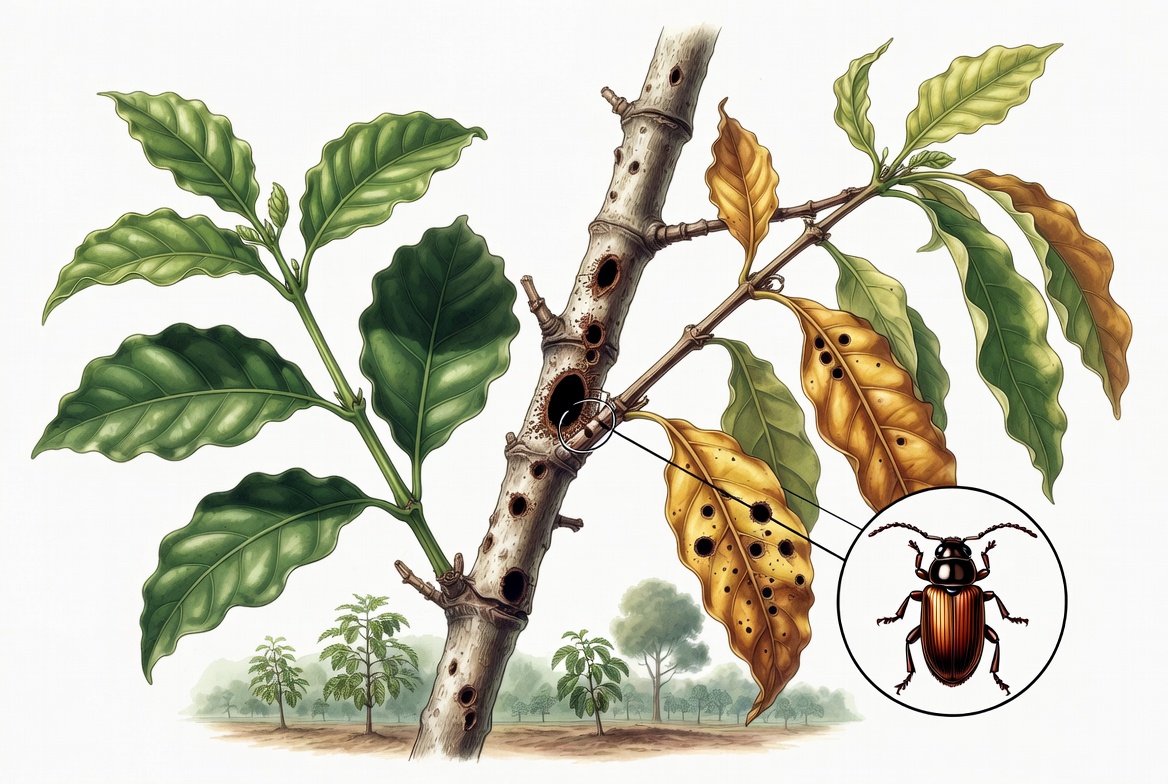
  • The Black Coffee Twig Borer (Xylosandrus compactus) is an invasive ambrosia beetle native to Southeast Asia, now damaging coffee in East Africa, Hawaii, and Latin America.
  • It primarily attacks Robusta but also infests Arabica and over 200 host plants. Yield losses can reach 20-50% in severe infestations.
  • Female beetles bore into small twigs, introduce ambrosia fungi, and cause branch dieback within 5-14 days.
  • Factors favoring infestation: high planting density, poor pruning, water stress, and unsuitable shade trees (e.g., Maesopsis eminii).
  • Integrated Pest Management (IPM) combines sanitation pruning, ethanol‑baited bottle traps, and maintaining tree health. Chemical control is a last resort.
  • In Uganda, annual losses are estimated in tens of millions of dollars. Community‑wide trapping and pruning are the most effective.
  • For growers in arid regions like the Gulf, prevention through certified pest‑free material and rigorous scouting is critical.

The Black Coffee Twig Borer (Xylosandrus compactus), also known as the shot‑hole borer, is a small ambrosia beetle native to Southeast Asia. It has become a significant invasive pest in many coffee‑growing regions, including East Africa (especially Uganda), Hawaii, parts of Latin America, and Southeast Asia.

It primarily affects Robusta coffee (Coffea canephora) but also attacks Arabica and over 200 other host plant species across 62 families. The beetle is considered one of the most economically damaging pests in affected areas, with reported losses reaching up to 20‑50% in severe infestations through branch dieback and reduced yields.

Biology and Life Cycle

Adult females are 1.4–1.7 mm long, dark brown to black and shiny. Males are smaller (0.9–1.3 mm), flightless, and rarely seen outside galleries.

Only females initiate attacks. They bore into small twigs and branches (usually less than 2 cm in diameter) and introduce symbiotic ambrosia fungi (Raffaelea spp. or similar) that grow inside the tunnels and serve as food for adults and larvae.

The full life cycle takes about 3–5 weeks depending on temperature. Females mate inside the gallery (or via parthenogenesis) and lay eggs. Larvae feed on the fungus. New females emerge to attack other branches.

The pest attacks stressed, weakened, or overcrowded plants more aggressively, especially during dry seasons. However, it can also infest apparently healthy trees.

Symptoms and Damage on Coffee Trees

External signs include tiny circular entry holes (about 1 mm) on twigs, often with frass (sawdust‑like material) or sap oozing. Sudden wilting and yellowing of leaves on affected branches (flagging) appears within days. Dieback of twigs and small branches occurs within 5–14 days.

Internal damage involves fungal growth that blocks the xylem (water‑conducting tissues), causing rapid desiccation. Infested branches often show dark staining inside.

Economic impact is severe: loss of fruit‑bearing branches reduces yield directly. Repeated attacks weaken trees, increase susceptibility to other diseases, and can kill young plants or seedlings. In Uganda, annual losses have been estimated in tens of millions of US dollars. In other regions, branch loss can reach 20–40%.

Factors Favoring Infestation

High planting density and poor pruning (bushy canopies) create favorable conditions. Excessive or unsuitable shade trees, such as Maesopsis eminii (musizi) and Markhamia platycalyx (musambya), also increase risk. Water stress during dry periods, poor soil nutrition, and low tree vigor are additional factors. The presence of alternate hosts nearby further exacerbates the problem.

Integrated Pest Management (IPM) – Current Best Practices (2025-2026)

The most effective and sustainable approach combines cultural, mechanical, and monitoring methods. Chemical use is generally discouraged as a primary strategy.

Cultural practices form the foundation of control. Sanitation pruning is highly effective: regularly inspect and prune infested twigs or branches, then immediately burn or bury them deeply to prevent re‑infestation. However, it is labor‑intensive.

Tree health management is critical: ensure optimal fertilization, irrigation during dry spells, proper spacing (e.g., 3 m x 3 m), and balanced shade. Healthy, vigorous trees are far less susceptible.

Shade management involves using suitable shade trees (e.g., papaya may reduce infestation) and avoiding known host shade trees. Older, taller shade systems often show lower infestation levels. Remove or avoid planting nearby susceptible species.

Monitoring and mass trapping are highly recommended. Ethanol‑baited bottle traps are low‑cost and effective. Use empty plastic bottles with soapy water plus ethanol (or local alcohol like waragi at ~75% concentration) as attractant. Place 7–15 traps per acre, preferably in the lower canopy. Community‑wide trapping is most successful.

Chemical control should be a last resort. Systemic insecticides like imidacloprid (e.g., after pruning) have shown efficacy in some studies, but resistance risks and negative effects on beneficial insects limit long‑term use.

Emerging approaches include push‑pull strategies using repellents (e.g., verbenone + methyl salicylate) combined with attractant traps (2024 studies). Biological enhancement through biodiversity and natural enemies is also being explored.

Recommendations for Farmers (Particularly in UAE/Gulf Region)

Although Xylosandrus compactus is not yet widely reported in the UAE, vigilance is important if importing coffee plants or growing in similar climates. Source certified, pest‑free planting material. Maintain excellent tree nutrition and irrigation (critical in arid conditions).

Implement routine scouting, especially in dry or hot seasons. Adopt area‑wide management by coordinating with neighboring farms. Combine pruning, sanitation, and mass trapping as the core strategy.

Key principle: prevention through plant health is more effective and economical than curative measures.

Frequently Asked Questions

What is the Black Coffee Twig Borer?
It is an invasive ambrosia beetle (Xylosandrus compactus) that attacks coffee twigs, causing branch dieback and yield losses of 20-50%.

Which coffee varieties are most affected?
Robusta is the primary host, but Arabica and over 200 other plant species are also attacked.

How can I identify an infestation?
Look for tiny entry holes (1 mm) on twigs, sawdust‑like frass, sudden wilting of branches (flagging), and dieback within 5-14 days.

What is the most effective control method?
Sanitation pruning (removing and destroying infested branches) combined with ethanol‑baited bottle traps and maintaining tree health.

Are chemical insecticides recommended?
Only as a last resort. Imidacloprid has some efficacy, but resistance and environmental risks limit its use.

Can I use traps for mass trapping?
Yes. Ethanol‑baited bottle traps are low‑cost, simple to make, and highly effective when used community‑wide (7‑15 traps per acre).


Author: Qahwa World – Agricultural Desk | Source: International Coffee Pest Monitor, USDA, and industry research (2025-2026) | Date: May 22, 2026

Ugandan Coffee Output Rises Slightly to 7.2 Million Bags in 2026

Author: Qahwa World – Nairobi
Source: USDA Foreign Agricultural Service – Report UG2026-0001
Date: May 20, 2026

Ugandan Coffee Output Rises to 7.2 Million Bags in 2026

Executive Summary

  • Ugandan coffee production for 2026/2027 is forecast at 7.2 million 60 kg bags, up from 7.1 million bags.
  • Planted area expands to 595,000 hectares, driven by land use shift from timber to coffee in Masaka region.
  • Robusta accounts for 80% of output (6.0 million bags); Arabica 20% (1.1 million bags).
  • Exports forecast at 6.8 million bags, up 1.9%, with the European Union taking 73% of total exports.
  • Domestic consumption rises slightly to 335,000 bags, supported by hospitality sector growth.
  • Fertilizer prices up 21% for a 50‑kg bag, limiting farmer uptake.
  • Government plans gradual shift from green bean exports to processed coffee (roasted and soluble) to boost value addition.

The USDA Foreign Agricultural Service office in Nairobi forecasts Ugandan coffee production for marketing year 2026/2027 at 7.2 million 60 kg bags, up from 7.1 million bags in the previous season.

The increase is driven by expansion in area under production, supported by sustained high prices in recent years.

Coffee exports in 2026/2027 are projected to rise from 6.7 million to 6.8 million bags.

Domestic consumption is forecast to increase slightly to 335,000 bags, supported by growth in the hospitality sector and a gradual rise in coffee consumption, particularly in urban areas.

FAS Nairobi forecasts planted area in 2026/2027 at 595,000 hectares, up from 590,000 hectares in 2025/2026.

This growth is driven by a gradual shift in land use from timber production to coffee, particularly in the Masaka region.

Uganda’s smallholder coffee farmers typically farm on 0.5 to 2.5 hectares of land.

Small farms dominate the sector and account for about 90% of total production, while medium and large-scale estates contribute the remaining 10%.

Robusta Dominates Production

For 2026/2027, post forecasts robusta production at 6.0 million 60 kg bags and arabica production at 1.1 million bags.

The increase reflects marginal expansion in area planted, driven by prevailing high prices.

Favorable weather conditions, increased adoption of improved agronomic practices, and the maturation of high-yielding trees planted earlier further support growth.

Robusta accounts for approximately 80% of total national production, with arabica making up the remaining 20%.

Uganda’s main coffee-growing regions are the central, eastern, and western zones, with emerging production areas in the north.

Robusta is mainly grown in the central region, although cultivation is increasingly expanding into the north due to increased investment and land availability.

Arabica is mainly cultivated in high-altitude areas of the eastern and western regions.

Table 1: Uganda Coffee Production, Supply and Distribution (1,000 60 kg bags)

Item 2024/2025 2025/2026 2026/2027
Planted Area (1,000 HA) 580 590 595
Harvested Area (1,000 HA) 570 575 580
Robusta (1,000 bags) 5,670 5,815 6,025
Arabica (1,000 bags) 1,030 1,060 1,135
Total Production (1,000 bags) 6,700 6,875 7,160
Exports (1,000 bags) 6,350 6,700 6,830
Domestic Consumption (1,000 bags) 325 330 335
Ending Stocks (1,000 bags) 269 334 329

Fertilizer Costs and Pest Challenges

Fertilizer use among Ugandan coffee farmers remains low, although farmers are starting to adopt its use.

Medium and large-scale farmers account for most fertilizer applications, while a growing number of smallholders are beginning to incorporate fertilizer into their agronomic practices.

However, high costs continue to constrain broader uptake.

Prices of commonly used nitrogen and phosphorus-based fertilizers have increased by approximately 21% for a 50‑kilogram bag, limiting affordability for farmers.

Most smallholder farmers continue to rely primarily on mechanical and traditional control methods to manage pests and diseases.

However, there is a gradual increase in the use of agrochemicals, particularly pesticides, driven by persistent and increasingly severe pest and disease pressures.

The twig borer is the most common pest, while coffee rust is the most recurrent disease.

These challenges continue to affect yields and increase production costs.

Coffee production is largely rain-fed, with rainfall generally sufficient.

Irrigation is more relevant in areas with less reliable rainfall, including parts of the north and east, but adoption remains limited due to high capital and operational costs.

Exports and Markets

Uganda exports over 98% of its coffee as green beans.

Exports in 2026/2027 are forecast at approximately 6.8 million bags, up 1.9%, driven by sustained strong global demand.

The European Union remains Uganda’s main export destination, accounting for about 73% of total exports in 2024/2025.

Morocco and the United States each account for about 6%.

The United Kingdom, Switzerland, Australia, Turkey, and Ukraine each take about 1%, while other destinations collectively account for about 6%.

Uganda is increasingly expanding its reach into non-traditional markets, with Morocco and China gaining importance.

Post revised the 2025/2026 export estimate upward by 2.8% from 6.52 to 6.70 million bags to reflect additional exports to non-reporting destinations, particularly Sudan.

Policy Shift Toward Value Addition

Uganda plans to gradually reduce exports of unprocessed coffee in line with the country’s focus on value addition to achieve its ambitious tenfold growth strategy.

The government aims to attract investment in coffee processing activities to expand industries, increase export earnings, and create jobs across the value chain.

This would prioritize exports of processed coffee products such as roasted and soluble coffee over green beans.

However, officials indicate that the transition will occur gradually rather than through an immediate ban, allowing green bean exports to continue in the short to medium term as local processing capacity and supporting infrastructure expand.

In 2025, the government restructured the Uganda Coffee Development Authority, integrating its functions into the Ministry of Agriculture, Animal Industry and Fisheries.

Initial implementation has yielded mixed feedback, with some stakeholders reporting continued access to services with minimal disruption, while others indicate delays in service delivery.

Frequently Asked Questions

How much coffee will Uganda produce in 2026/2027?
Production is forecast at 7.2 million 60 kg bags, up from 7.1 million bags.

What is the breakdown between Robusta and Arabica?
Robusta accounts for 6.0 million bags (80%), while Arabica accounts for 1.1 million bags (20%).

What are the main export destinations for Ugandan coffee?
The European Union takes 73% of exports, followed by Morocco (6%) and the United States (6%).

How much have fertilizer prices increased?
Fertilizer prices have risen by approximately 21% for a 50‑kg bag.

What is Uganda’s policy on coffee exports?
Uganda plans to gradually reduce green bean exports and shift toward processed coffee (roasted and soluble) to boost value addition.


Author: Qahwa World – Nairobi | Source: USDA Foreign Agricultural Service – Report UG2026-0001 | Date: May 20, 2026

El Niño: What It Is and How It Affects Coffee

Author: Qahwa World – Climate Desk

Source: NOAA, WMO, ICO, StoneX, industry sources
Date: May 22, 2026

Executive Summary

  • There is a 96% probability that El Niño will persist through the Northern Hemisphere winter of 2026‑2027.
  • Sea surface temperatures in the Niño 3.4 region have already exceeded the +0.5°C El Niño threshold.
  • Vietnam and Indonesia face drought and higher temperatures, threatening Robusta yields.
  • Brazil may see irregular rainfall during critical flowering (August‑October 2026), reducing Arabica quality.
  • Colombia and Central America face mixed risks: excess rain (leaf rust) or drought.
  • Analysts expect higher coffee price volatility in 2027, with Robusta supply risks pushing futures higher.
  • Smallholder farmers in vulnerable regions could face income losses, food insecurity, and migration pressure.

As of mid‑May 2026, the tropical Pacific is showing unmistakable signs of a rapid transition toward El Niño conditions.

According to the NOAA Climate Prediction Center’s ENSO Diagnostic Discussion released on May 14, there is an 82% probability that El Niño will emerge between May and July 2026, rising to a 96% chance that it will persist through the Northern Hemisphere winter of 2026‑2027.

Scientists are closely monitoring whether this event could evolve into a Super El Niño, potentially rivaling the record‑strength episodes of 1982‑83, 1997‑98, or 2015‑16. With sea surface temperatures in key Niño regions already warming sharply, the stage is set for significant disruptions to global weather patterns — from devastating floods in South America to severe droughts across Southeast Asia and parts of East Africa.

What Is El Niño?

El Niño (Spanish for “The Little Boy” or “Christ Child”) is the warm phase of the El Niño‑Southern Oscillation (ENSO), Earth’s most influential climate variability pattern. Under normal conditions, strong easterly trade winds push warm surface water westward across the equatorial Pacific toward Indonesia, allowing cold, nutrient‑rich water to upwell off the coasts of Peru and Ecuador. During El Niño, these trade winds weaken or reverse. Warm water spreads eastward, suppressing upwelling and altering atmospheric circulation patterns worldwide.

The counterpart, La Niña, brings cooler waters and opposite weather effects. ENSO events typically occur every 2‑7 years and last 9‑18 months.

Current Status – May 2026

The equatorial Pacific is currently in a transitional state following a weak La Niña. Sea surface temperatures in the Niño 3.4 region have risen rapidly, with recent weekly values exceeding the +0.5°C El Niño threshold.

Multiple international models, including those from NOAA, the ECMWF, and the WMO, show high confidence in El Niño development by mid‑to‑late 2026. While peak strength remains uncertain, some projections suggest anomalies could exceed +2.0°C, raising the possibility of a strong‑to‑very‑strong event.

Global Weather Impacts

El Niño redistributes heat and moisture across the planet:

  • South America (Peru, Ecuador, northern Brazil): Increased rainfall and flooding risks, potential damage to infrastructure and agriculture.
  • Southeast Asia, Indonesia, Australia: Significantly reduced rainfall, drought, higher wildfire risk, water shortages.
  • East Africa: Wetter‑than‑average conditions, increased flood and disease risks.
  • Southern United States: Wetter winters; Northern US and Canada often milder.
  • Global: Elevated average temperatures (El Niño typically adds ~0.1–0.3°C to global surface temperatures).

Impact on Global Coffee Production

Coffee is one of the most climate‑sensitive major commodities. With roughly 12.5 million farming families dependent on it worldwide, any major ENSO event sends ripples through prices, quality, and livelihoods. The 2026‑2027 El Niño is expected to affect both Arabica and Robusta differently across key origins.

1. Brazil – The World’s Largest Producer

Brazil faces a complex outlook. While the current 2026/27 harvest is projected to be strong, El Niño could disrupt the critical flowering period (August‑October 2026) through irregular rainfall or excessive heat. Historical patterns show El Niño often brings drier conditions to key Arabica regions in Minas Gerais and São Paulo, potentially reducing bean size, increasing defects, and lowering quality.

2. Vietnam and Indonesia – Robusta Heartlands

These two giants are highly vulnerable to El Niño‑induced drought and elevated temperatures. Reduced rainfall and prolonged dry seasons can stress Robusta trees, leading to smaller beans, lower yields, and higher production costs due to increased irrigation needs. The 2015‑16 El Niño caused notable declines in Robusta output in these regions.

3. Colombia, Central America, and East Africa

Colombia and Central America face mixed signals: potential for excessive rainfall in some areas (increasing fungal diseases like coffee leaf rust) or drought in others. Ethiopia and Kenya may see wetter conditions that boost yields in some highlands but heighten disease pressure and complicate harvesting.

Overall Market Outlook

Analysts anticipate higher price volatility in 2027 as the event peaks. While Brazil’s large crop may buffer total volume in the short term, quality concerns and Robusta supply risks could push Arabica and Robusta futures higher. The ICO and major traders are already factoring these risks into their forecasts.

Broader Economic and Humanitarian Implications

  • Price Spikes: Coffee futures have already shown sensitivity to El Niño headlines, with short covering observed.
  • Smallholder Farmers: Millions in vulnerable regions face income losses, food insecurity, and potential migration pressures.
  • Supply Chain: Roasters, traders, and consuming countries should prepare for tighter specialty‑grade supplies and elevated costs.
  • Compounding Factors: Persistent low stocks, high input costs (fertilizers, labor), and climate change amplify risks.

Recommendations and Preparedness

For Governments and International Organizations: Strengthen early warning systems, support farmers with drought‑resistant varieties, irrigation, shade management, and crop insurance. The WMO, FAO, and ICO should coordinate contingency planning.

For the Coffee Industry: Diversify sourcing strategies, invest in sustainable practices that build resilience, and monitor ENSO updates monthly.

For Consumers: Expect potential price increases in premium and everyday coffee blends throughout 2027. Supporting traceable, climate‑smart coffee can help mitigate long‑term risks.

Frequently Asked Questions

What is the probability that El Niño will persist through winter 2026/2027?

NOAA estimates a 96% probability that El Niño will persist through the Northern Hemisphere winter of 2026‑2027.

Which coffee origins are most at risk from this El Niño?

Vietnam and Indonesia (Robusta) face drought; Brazil (Arabica) may see irregular flowering; Colombia and Central America face mixed flood/drought risks.

How could El Niño affect coffee prices?

Analysts expect higher price volatility in 2027. Robusta supply risks could push futures higher, and specialty‑grade supplies may tighten.

What can smallholder farmers do to prepare?

Governments and organizations should provide drought‑resistant varieties, irrigation support, shade management, and crop insurance.

How does this El Niño compare to past events?

Models suggest it could become a strong‑to‑very‑strong event, potentially rivaling 1982‑83, 1997‑98, or 2015‑16, but final strength remains uncertain.

What are the broader economic risks beyond coffee?

Smallholder farmers face income losses and food insecurity; supply chains face tighter supplies and elevated costs; migration pressures may increase.


Author: Qahwa World – Climate Desk | Source: NOAA, WMO, ICO, StoneX, industry sources | Date: May 22, 2026

Shanghai Overtakes New York as Global Coffee Capital as Ethiopia and Vietnam Compete in China

Author: Sahl Maryam Jabra Madhin
Source: ECTA, GACC, ICO
Date: May 21, 2026

Executive Summary:

  • Shanghai now hosts over 9,115 cafes, making it the world’s leading coffee city, double New York and five times Paris.
  • China’s coffee consumption has grown 15 percent annually over the past three years.
  • Ethiopia ranks second as a coffee supplier to China after Brazil, with premium specialty coffee at $6,310 per ton.
  • Vietnam ranks third, offering robusta at $4,176 per ton, benefiting from geographic proximity (4-6 days shipping).
  • China’s zero tariff policy for Ethiopian products has boosted Ethiopian coffee exports, moving Ethiopia from 33rd to 3rd place in five years.
  • In the first ten months of the 2018 budget year, Ethiopia exported 37,711 tons of coffee to China worth $270.73 million.

For many years, the global coffee industry had its eyes fixed on New York, Milan, and Paris. Today, the new growth center of the coffee industry has shifted to Asia. Shanghai now hosts over 9,115 cafes, making it the world’s leading coffee city. This is double the number in New York and approximately five times that of Paris.

Beyond the numbers, the key story is that China’s coffee consumption has grown 15 percent annually over the past three years. This has created a major shift in the global coffee supply chain. While many businesses still focus only on Western markets, China is quietly becoming a major destination and opportunity gateway for Ethiopian and Vietnamese coffee.

Ethiopia vs Vietnam in Shanghai (2025-2026)

Indicator Ethiopia Vietnam
Import rank in China 2nd (after Brazil) 3rd
Supply volume ~50,000 tons ~36,000 tons
Price per ton $6,310 (premium) $4,176 (mid-range)
Growth rate +79.1% revenue +65.8% supply
Key advantage Zero tariff, natural varieties, specialty quality Proximity (4-6 days), lower price

How Each Coffee is Perceived in Shanghai

Ethiopia: The Quality Standard
In Shanghai’s 9,000 cafes, Ethiopian coffee is viewed like fine wine. It is mostly found in specialty coffee shops and premium chains like Blue Bottle. It is preferred for pour-over black coffee. Young Shanghai coffee enthusiasts see Ethiopian coffee as the peak of complexity, with notes of wine, chocolate, spice, fruit, or citrus. Despite its higher price, it remains highly sought after.

Vietnam: The Reliable Workhorse
Once known only for instant coffee, Vietnam has rebranded itself by producing high quality robusta. Vietnamese coffee is commonly found in large chains like Luckin or Cotti, as well as popular cafes in the Jing’an district. It is known for its strong, nutty, chocolatey flavor and is seen as a reliable, affordable option, often mixed with milk.

Zero Tariff Policy and Ethiopia’s Rise

In 2025, a major change occurred: China’s zero tariff policy for Ethiopian products. This duty free access, along with growing strategic cooperation in agriculture, technology transfer, e-commerce links, and Shanghai’s role as a trading hub, has made Ethiopian coffee more price competitive in China.

Five years ago, China was the 33rd destination for Ethiopian coffee exports. By 2017, it rose to 4th place. In the first ten months of the 2018 budget year, Ethiopia exported 37,711 tons of coffee to China, worth $270.73 million, moving up to 3rd place. This demonstrates the rapid growth of Ethiopia’s presence in the Chinese market.

Frequently Asked Questions (FAQ)

1. How many cafes does Shanghai have?

Shanghai has over 9,115 cafes, more than double New York and about five times Paris.

2. How fast is China’s coffee consumption growing?

China’s coffee consumption has grown 15 percent annually over the past three years.

3. Which countries are the top coffee suppliers to China?

Brazil ranks first, followed by Ethiopia (second) and Vietnam (third).

4. What is the price difference between Ethiopian and Vietnamese coffee?

Ethiopian coffee averages $6,310 per ton, while Vietnamese coffee averages $4,176 per ton.

5. What is the zero tariff policy?

China granted duty free access to Ethiopian products in 2025, boosting Ethiopian coffee’s price competitiveness.

6. How much coffee did Ethiopia export to China in 2018?

In the first ten months of the 2018 budget year, Ethiopia exported 37,711 tons of coffee to China, worth $270.73 million.

Sahl Maryam Jabra Madhin – Based on reports from ECTA, GACC, ICO, and Allegra World Coffee Portal.
Published: May 21, 2026