Starbucks Tests ChatGPT Integration to Help Customers Choose Drinks

Dubai – Qahwa World

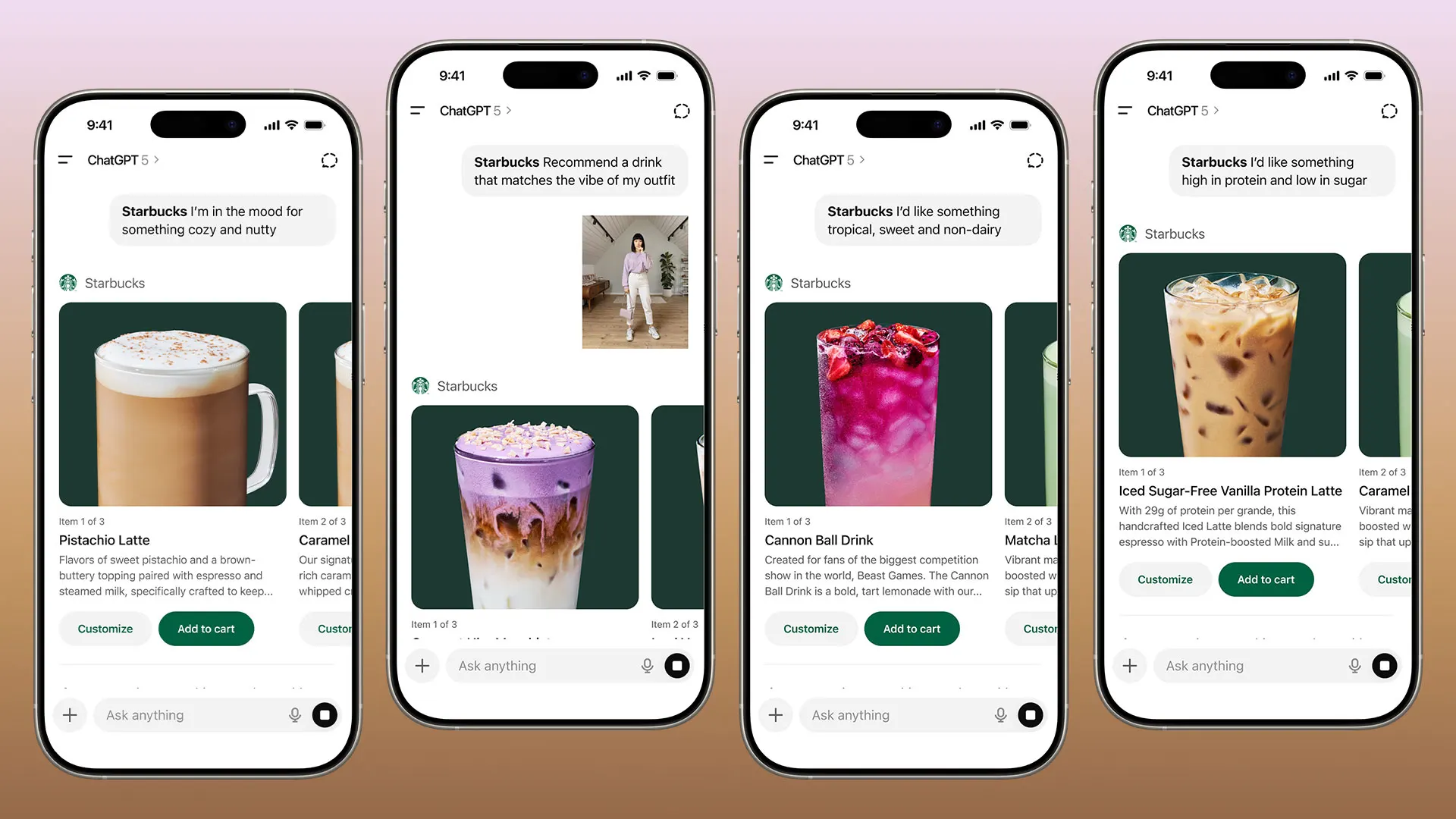
Starbucks is experimenting with a new ChatGPT integration designed to help customers decide what to order and customize their drinks before using the Starbucks app.

Starting April 15, users can tag @starbucks inside ChatGPT to activate a beta experience connected to the coffee chain. The feature allows people to describe what they’re in the mood for—such as cravings, feelings, or even images—and receive tailored drink suggestions.

For example, a prompt like “@starbucks, I’m looking for an iced pick-me-up” could return options such as an Iced Dragon Energy Drink along with other menu recommendations.

According to Paul Riedel, senior vice president of digital and loyalty at Starbucks, the idea reflects a shift in customer behavior. “Customers aren’t always starting with a menu. They’re starting with a feeling,” he said in a blog post announcing the feature.

The integration is designed not only to suggest drinks but also to encourage discovery of lesser-known menu items. Users can refine recommendations, customize their selections, and place orders through the Starbucks app.

Starbucks joins other retailers, including Etsy and Walmart, that are integrating ChatGPT into shopping and discovery experiences as consumers increasingly use AI tools for recommendations.

Riedel described the goal as meeting customers at the moment of inspiration, making it easier to find a drink that fits their preferences.

The rollout is part of Starbucks’ broader “Back to Starbucks” strategy aimed at improving sales and customer engagement. The company recently reported its first U.S. sales growth in two years, alongside continued investment in AI.

However, the announcement has also drawn criticism online. Some users questioned the need for AI assistance in choosing coffee, arguing that ChatGPT can already provide similar suggestions without direct integration into Starbucks systems.

The experiment highlights the growing role of AI in retail experiences—and ongoing debate about how far that integration should go.

Starbucks and Boyu Capital Finalize Joint Venture to Drive Growth in China

Dubai – Qahwa World

April 2, 2026 – Seattle – Starbucks Coffee Company has completed its joint venture agreement with investment firm Boyu Capital, marking a key step in its long-term strategy to expand in China.

The deal, first announced in November 2025, underscores Starbucks’ confidence in China as one of its most important growth markets. The partnership is designed to strengthen the company’s presence, improve local market adaptation, and enhance the customer experience while maintaining brand standards.

Under the agreement, funds managed by Boyu Capital now hold a 60 percent stake in Starbucks’ retail operations in China. Starbucks retains a 40 percent share and continues to own the brand and intellectual property, licensing them to the joint venture.

You may read: Starbucks Returns to Growth for the First Time in Two Years

The new entity currently oversees around 8,000 coffee shops, which will gradually transition to a licensed operating model. Over time, the partners aim to expand the network to as many as 20,000 locations.

Company leadership highlighted that combining Starbucks’ global brand strength with Boyu Capital’s local expertise is expected to support expansion into new cities, reach more customers, and reinforce the company’s position in a highly competitive market.

The strategy will place strong emphasis on local adaptation, including tailored beverage offerings, food options, digital engagement, and store formats designed to meet the needs of diverse communities across China.

The partnership is also expected to improve operational efficiency, support faster expansion, and strengthen long-term profitability.

With the transaction now complete, both parties are moving into the operational phase of the joint venture, focusing on growth, innovation, and delivering a consistent coffee experience across the Chinese market.

Why There Are Fewer Places to Sit Down for Coffee in Moscow

Moscow – Qahwa World

Over the past year, Moscow’s coffee market has undergone a noticeable shift. Grab-and-go coffee outlets continue to expand, while traditional cafés with seating areas are gradually losing ground.

From January 2025 to January 2026, the number of coffee-to-go locations in the city grew by about 5%, rising from roughly 3,900 to 4,100 outlets. These formats typically include small kiosks or compact spaces with little or no seating.

At the same time, the number of classic cafés declined much more sharply. Over the same period, their total fell by 12%, from around 2,900 to 2,500. Earlier reports also pointed to closures by major chains: in 2025, one of Moscow’s largest café operators shut down more than 10% of its locations.

Similar trends are visible outside the capital. In other Russian cities with populations over one million, the number of coffee-to-go outlets increased by an average of 3.5% year on year, while the number of traditional cafés dropped by about 13%.

The highest concentration of cafés and grab-and-go coffee points remains in central districts. Presnensky, Tverskoy and Basmanny lead the way. As of January 2026, Tverskoy district had about 120 cafés and 188 coffee-to-go outlets; Presnensky counted 126 cafés and 183 to-go points; Basmanny had 114 cafés and 159 grab-and-go locations.

The rise of coffee to go comes amid higher prices in traditional cafés. In January 2026, the average bill in Moscow cafés reached 501 rubles. The most expensive coffee is found in Vnukovo and the Obruchevsky district, where a cup can cost more than 800 rubles. The lowest prices are typically seen in residential areas such as Pechatniki, Bibirevo, Vostochnoye Degunino, Altufyevsky district and Veshnyaki.

Market experts note that while the number of cafés had been growing steadily in previous years, consumer demand has recently started to weaken. Rising prices have made it harder for cafés to attract new customers. Higher costs are driven by several factors, including more expensive coffee beans and milk, rising wages, increasing rent, and higher electricity costs.

At the same time, competition from retailers is intensifying. Automated coffee machines in grocery stores are gaining popularity. During the first nine months of 2025, sales of ready-to-drink coffee in retail chains surged both in volume and in value, adding further pressure on traditional café formats.

If you’d like, I can also optimize this version for SEO, adapt it for an international media outlet, or shorten it into a brief news piece.