Ethiopia Launches East Africa’s First Specialty Coffee Training Center

Sahel Maryam – Qahwa World

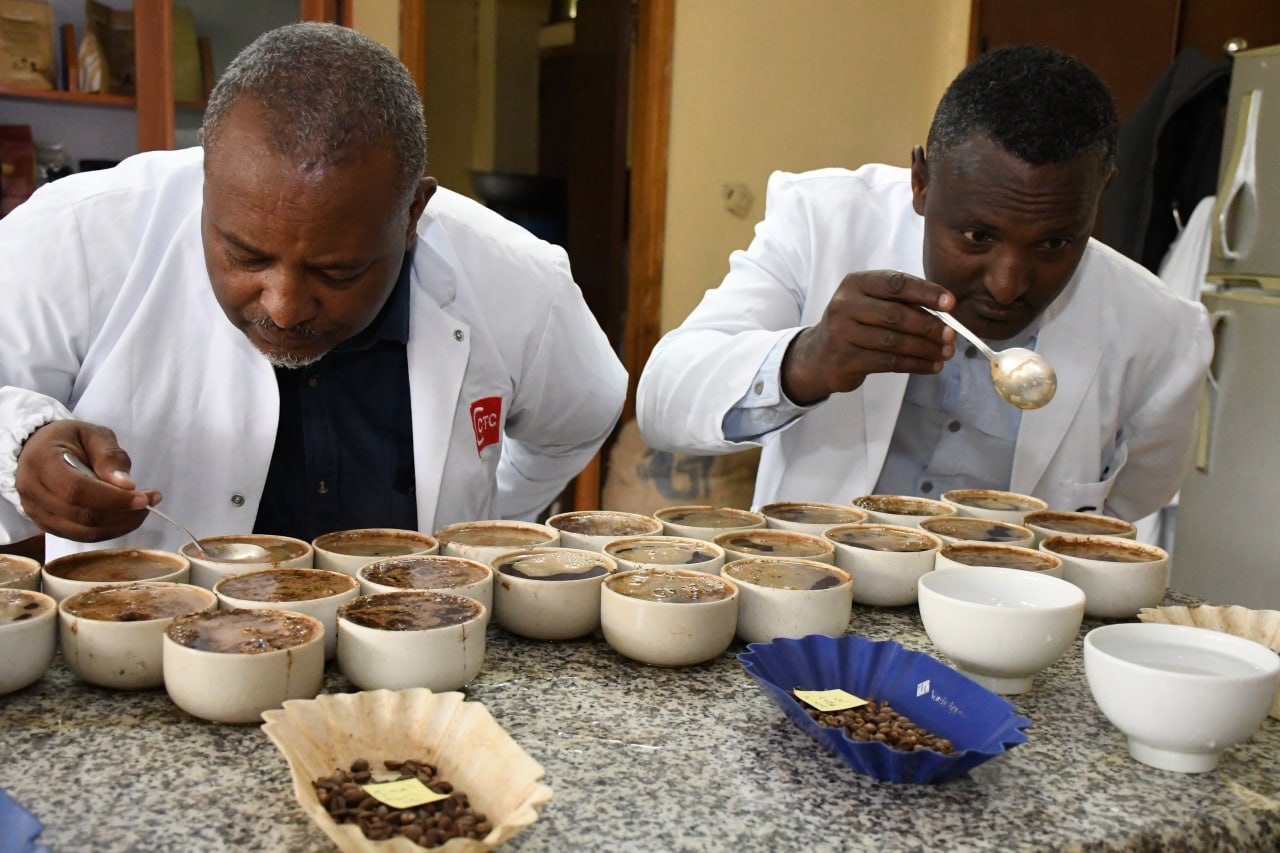
In a pioneering move for the region, a new coffee roasting and quality assessment center has opened in Sahel Maryam, Medhin, Ethiopia. The facility, the first of its kind in East Africa, combines state-of-the-art equipment with instruction from experienced coffee professionals.

The center aims to train participants in evaluating coffee quality to global standards, enabling them to independently assess beans and elevate industry practices. Trainees leave with the skills to analyze and improve coffee from the farm to the cup, applying internationally recognized Specialty Coffee Association (SCA) protocols.

The initiative has received recognition from Ethiopian coffee authorities, UNIDO, the Italian government, and the Italian Development Cooperation Agency for its contribution to developing the local and regional coffee sector.

Coffee Quality Evaluation Standards
The process of assessing coffee quality at the center is comprehensive:

Physical Quality of Beans – Inspecting defect count, bean size and uniformity, moisture content, and presence of foreign matter.
Sensory Evaluation (Cupping) – Scoring aroma, flavor, aftertaste, acidity, body, balance, and sweetness.
Defect Identification – Spotting spoiled, fermented, or overripe beans.
Organic Acid Analysis – Identifying natural acids such as citric, malic, acetic, and phosphoric to characterize flavor profiles.
Standardized Protocols – Applying precise roast levels, grind sizes, water quality, and brew ratios to ensure consistent and fair evaluation.

Coffee that scores 80 points or above under these criteria is classified as “Specialty Coffee.” Experts emphasize that proper evaluation relies on certified Q-Graders rather than subjective taste alone, ensuring adherence to international standards.

The new center marks a major step forward in Ethiopia’s ongoing mission to cement its position as a global leader in coffee quality and expertise.

Specialty Coffee Association Releases Its 2024 Annual Report

The Specialty Coffee Association (SCA) has released its 2024 Annual Report, signed by Chief Executive Officer Yannis Apostolopoulos, highlighting a transformative year marked by new quality standards, record membership growth, scientific advancements, and unprecedented global expansion in education and events — all with a strong focus on sustainability, research, and equitable value distribution across the coffee industry.

According to the report, 2024 represented a pivotal year for the SCA, as it officially adopted and published the new Coffee Value Assessment (CVA) standards, replacing the long-standing 2004 cupping form. This milestone positioned the CVA as the official protocol for global coffee quality evaluation. The association recorded more than 10,000 downloads of the CVA forms, over 1,500 learners enrolled in the “CVA for Cuppers” course, and more than 130,000 views on its CVA educational video series on YouTube. Additionally, the SCA waived course fees for over 500 coffee professionals in producing countries, ensuring broader and fairer access to professional education.

A major achievement highlighted in the report was the introduction of a new membership model offering free access to the SCA’s resources, educational programs, and events. This initiative led to exponential growth, bringing the association’s global community to over 100,000 companies and coffee professionals within just six months — a reflection of its ongoing mission to make knowledge and opportunities accessible to all who contribute to the specialty coffee industry.

The report also emphasized the strong research momentum driven by the Coffee Science Foundation (CSF), which supported six flagship projects in 2024. These included studies on physical defects in green coffee, developing a universal roast measurement system, exploring sweetness perception, analyzing the impact of packaging on consumer experience, and understanding how value is created and distributed throughout the coffee value chain. These efforts underscore the SCA’s commitment to fostering data-driven innovation and sustainability.

Globally, the SCA expanded its footprint through multiple major events. The “World of Coffee” trade shows took place in Dubai, Chicago, Busan, and Copenhagen, serving as platforms for knowledge exchange, business, and innovation. Notably, 2024 marked the first-ever World of Coffee held in Asia — in Busan, South Korea. The year also saw the launch of the Coffee Value Summit in Shenzhen, China, focusing on value creation and the implementation of the CVA. Other initiatives included “Green Coffee Connect,” fostering relationships between producers and importers, and the “Retail Buyer’s Lounge,” designed to enhance business networking during trade shows.

Following a period of financial stabilization from 2020 to 2023, the SCA strategically reinvested in 2024 to expand access to education, fund critical research, and strengthen partnerships. The association maintained a balance between program growth and fiscal responsibility, ensuring its ability to continue serving the global coffee community despite economic uncertainty.

In the area of education, the SCA organized five Educator Summits across Asia and the United States, providing platforms for trainers and educators to enhance their teaching and professional development. Comprehensive multilingual surveys were also conducted to gather feedback from trainers and learners, leading to further curriculum improvements and the development of new systems to support global education in coffee.

Looking ahead, the report outlined ambitious plans for 2025, including the launch of a comprehensive coffee evaluation program in partnership with the Coffee Quality Institute (CQI), expanded educational offerings for green coffee sellers and retailers, the creation of online forums to connect the global coffee community, and continued research into equitable value distribution and sustainability across the coffee value chain.

The 2024 Annual Report reaffirms the SCA’s role as a leading global organization uniting research, education, standards, and events to build a more sustainable, inclusive, and equitable future for the specialty coffee industry worldwide.
Evolved Q Grader Program Adopts Coffee Value Assessment, Reshaping Global Coffee Standards

Dubai, 13 August 2025 (Qahwa World) — The global coffee industry is set for a historic transformation as the Q Grader Program, the benchmark certification for coffee quality evaluation, adopts the Coffee Value Assessment (CVA) framework under the leadership of the Specialty Coffee Association (SCA).

From October 1, 2025, the SCA will take over program operations from the Coffee Quality Institute (CQI), retiring the 2004 cupping protocol that has defined quality standards for over two decades. The move marks a significant shift toward a more holistic approach to coffee evaluation, placing equal emphasis on physical, sensory, cultural, and personal perception attributes.

Why the Change Matters

The 2004 protocol—built on objective scoring for aroma, flavor, body, and other measurable traits—has long been a trusted tool. However, industry leaders argue it underrepresents extrinsic factors such as origin, processing method, certifications, and producer stories, which increasingly influence market value.

Introduced in 2023, the CVA integrates four dimensions of assessment:

  • Physical Attributes — Objective evaluation of green coffee quality.

  • Extrinsic Attributes — Market-relevant factors such as terroir, certifications, and narratives.

  • Affective Attributes — The cupper’s personal impression on a 100-point scale.

  • Descriptive Attributes — Detailed sensory profiling of flavor and aroma.

By including these dimensions, the CVA reflects a coffee’s complete market value—not just its chemical or physical characteristics.

Impact on Q Graders

All current and former Arabica and Robusta Q Graders must complete the CVA for Cuppers conversion course by December 31, 2025 to maintain certification. The course, lasting two days, is designed to help graders transition smoothly to the new framework.

From 2026 onward, only the six-day Evolved Q Course will lead to certification. Missing the conversion deadline means starting the process from scratch.

Industry Reactions

“The CVA acknowledges that coffee quality is more than chemistry—it’s culture, craftsmanship, and context,” said Thomas Haigh, Specialty Coffee Merchant and Arabica Q Grader since 2015.

Producers, particularly in origin countries, see the shift as an opportunity to highlight unique practices and secure better recognition for their efforts. Roasters and green buyers anticipate richer, more nuanced data for sourcing decisions.

Key Transition Dates

  • October 1, 2025 — SCA takes over Q Grader Program; CVA becomes standard.

  • December 31, 2025 — Last day for Q Graders to complete CVA for Cuppers conversion course.

  • From 2026 — Six-day Evolved Q Course becomes the only certification route.

Looking Ahead

The adoption of the CVA is more than an administrative change—it represents an industry-wide realignment toward recognizing both intrinsic and extrinsic value in coffee. While some professionals may resist altering a long-trusted system, others view this as an essential evolution to meet the demands of a more globalized and story-driven specialty market.