Coffee Market Between Today’s Tightness and Tomorrow’s Abundance: How May 2026 Numbers Reveal a Sharp Disconnect

Source: Qahwa World analysis – based on the International Coffee Organization (ICO) May 2026 report |
Author: Qahwa World |
Date: June 14, 2026

Coffee Market Between Today’s Tightness and Tomorrow’s Abundance: How May 2026 Numbers Reveal a Sharp Disconnect

What Is Happening in the Coffee Market Today?

  • The coffee market is living a stark contradiction: spot inventories are shrinking while record surplus expectations are rising.
  • NY‑certified arabica stocks plunged 13.5% to 0.48 million bags – a multi‑month low.
  • At the same time, Brazil raised its 2026/27 production forecast to a record 66.7 million bags, with arabica alone jumping 28% y/y.
  • The market is pricing based on “future abundance” expectations, ignoring current physical tightness.
  • This disconnect creates a highly volatile environment: any additional disruption could trigger a sharp price spike.
  • Importers and roasters face a strategic dilemma: how to balance immediate supply needs against the risk of a price collapse later.

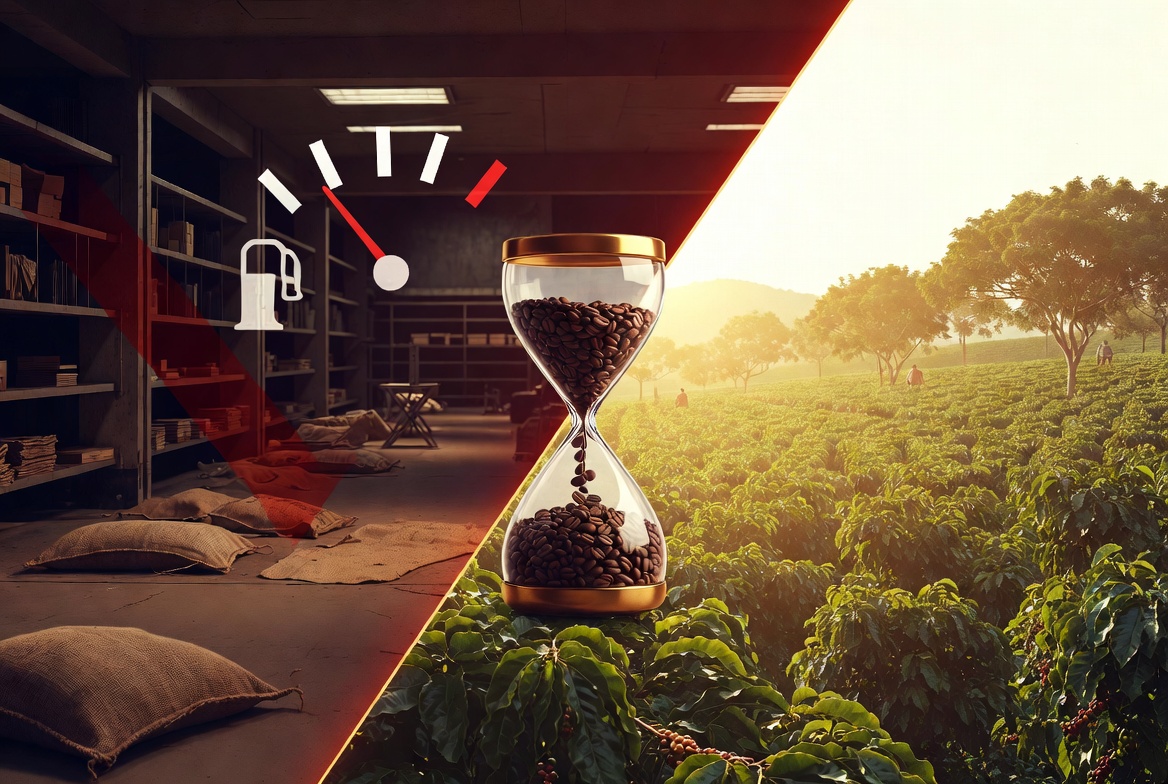
If you look at the May 2026 coffee market figures, you will find yourself facing two completely different markets inside one. The first market talks about shrinking inventories falling to multi‑month lows, about difficulties in securing immediate supplies. The second market promises a record surplus driven by an exceptional Brazilian crop that could reshape the global balance for years.

This contradiction is not just a statistical curiosity. It reflects a deep crisis of confidence between what exists today and what the market expects tomorrow. In this analysis, we examine the main features of this disconnect and explore its consequences for importers, roasters, and decision‑makers in the global coffee industry.

1. Inventories Are Crashing – A Warning Signal That Cannot Be Ignored

Despite all the talk about a surplus, the ICO numbers point to a very different reality on the ground. In May 2026, NY‑certified arabica stocks plunged 13.5% to just 0.48 million bags – the lowest level in months. Similarly, London‑certified robusta stocks remained near two‑year lows.

What this number means is simple: immediate physical supply of high‑grade coffee is running out. The market is currently suffering from genuine pressure on available stocks. This is not a reflection of weak production, but rather the result of several interacting factors: supply chain disruptions, slower deliveries, and possibly traders preferring to hold back inventory in anticipation of higher prices.

What is striking is that these shrinking stocks have not yet translated into a sharp price rally. That is exactly what deserves attention.

2. Brazil Announces a Historic Season – A Surplus That Could Rewrite the Rules

On the opposite side of the equation, CONAB raised its forecast for the 2026/27 Brazilian crop to a record 66.7 million bags. Beyond the headline number, the most striking figure is the huge jump expected in arabica production alone: up 28% year‑on‑year to 45.8 million bags.

This leap is not just a number on a table. It is the main factor feeding market expectations of a large surplus that could reach 10 million bags in coffee year 2026/27. Since the market is currently pricing based on “tomorrow’s expectations” rather than “today’s realities”, this massive number is the primary driver of the downward pressure we have seen on prices in recent months.

Indicator Trend Implication
Exchange stocks (NY arabica) ▼ 13.5% Acute spot tightness Brazil production forecast (arabica) ▲ 28% Expected future surplus ICO Composite Indicator (I‑CIP) ▼ 3.8% Pricing based on expectations, not reality

3. The Paradox – Why Are Prices Ignoring Current Physical Tightness?

Here lies the hardest question: why are prices not rising in response to falling spot inventories? The answer reflects a fundamental shift in how the market is pricing. It seems that traders are now basing their decisions on long‑term future expectations rather than current realities. The record Brazilian crop forecast appears so heavy that it overshadows all immediate scarcity signals.

This shift in market behavior is not necessarily healthy. It creates a condition of high fragility. If for any reason that record crop fails to materialise – drought, floods, logistical disruptions – the market will suddenly face two painful realities at once: already depleted spot inventories and a surplus that never arrived. The likely outcome would be a sharp price spike that could catch everyone off guard.

4. What This Means for Importers and Roasters – A Strategic Dilemma

For importers and roasters, this paradox creates one of the most difficult strategic dilemmas imaginable:

  • On one hand: Spot inventories are tight and prices remain historically high. The need to secure immediate supplies is urgent.
  • On the other hand: Any long‑term supply contract signed today could become a heavy burden if the record surplus materialises and prices collapse in the second half of the year.
  • The bottom line: Everyone is waiting. Buyers are waiting for a price collapse that may not come. Sellers are waiting for a rally that may not happen. The market is suspended in an uncomfortable grey zone.

The most prudent strategy at this time may be short‑term diversification rather than long‑term commitments. Flexible supply contracts, phased purchasing in small increments, and close monitoring of weather developments in Brazil may be the wisest approach in this uncertain phase.

5. The Market Is Pricing a Fiction, but Reality May Have Its Own Say

The disconnect we see today between falling spot inventories and record surplus expectations is not merely a statistical anomaly. It reflects a change in market psychology. Traders have heavily bet that the record Brazilian crop will satisfy all demand and more. But history teaches us that weather, logistics, and supply chains do not always follow optimistic scenarios.

If the surplus materialises as expected, prices may face further downward pressure. But if the Brazilian crop is negatively affected by weather or El Niño, the market could sharply refocus on the reality of tight spot inventories, generating an unexpected upward spike. In either case, caution remains the most important watchword.

Frequently Asked Questions About Coffee Market Contradictions

Q: How can inventories fall while the market expects a surplus at the same time?

A: Inventories reflect the immediate present. Surplus expectations are based on the future Brazilian crop. The time gap between present and future is the source of the contradiction.

Q: Why are tight inventories not pushing prices higher?

A: Because the market is currently focused on “future abundance” expectations. Those heavy expectations weigh on prices and prevent them from reacting to current tightness.

Q: What is the most likely scenario for the coming months?

A: High volatility will be the main theme. Any weather or logistical development could sharply change the price direction in either direction.

Q: What do you advise importers and roasters at this time?

A: Avoid long‑term commitments. Use short‑term, flexible contracts. Monitor weather developments in Brazil very closely.

Q: Could we see a price collapse soon?

A: Not necessarily. Low inventories provide a floor that could prevent a major collapse even if a surplus materialises.

The coffee market today tells a complex story that cannot be understood through a single number. It is a story of a market torn between a tight present and an abundant future. The true professionals are those who can read between the lines and see that the greatest risk may not be the surplus itself, but the surprises that might appear on the road to it.

Analysis by Qahwa World – Based on the International Coffee Organization (ICO) market report for May 2026.

All rights reserved. Republication with attribution permitted.

Publication date: June 14, 2026
Coffee Prices Fall on Improved Brazil Crop Prospects

Author: Qahwa World
Source: Barchart
Date: May 20, 2026
Executive Summary:

  • July arabica coffee closed down 0.68% on Wednesday, while July robusta fell 0.51% to a one month low.
  • Arabica hit a one and a half year low on Tuesday amid an improved global supply outlook.
  • The Coffee Trading Academy projects Brazil’s 2026/27 harvest will increase 12% year on year to 71.4 million bags.
  • Marex Group and StoneX both forecast record Brazilian crops above 75 million bags for 2026/27.
  • StoneX projects the 2026 global coffee surplus will expand to 10 million bags, the largest in six years.
  • Vietnam coffee exports rose 15.8% in the first four months of 2026, reaching 810,000 metric tons.
  • ICE robusta inventories hit a two year low last Friday but recovered slightly on Wednesday.

Coffee prices settled lower on Wednesday, May 20, 2026, with robusta falling to a one month low. Expectations of a larger Brazilian coffee crop continue to weigh on prices. July arabica coffee futures closed down 0.68%, and July ICE robusta coffee closed down 0.51%.

Prices have ratcheted lower over the past month, with arabica falling to a one and a half year near term low on Tuesday amid an improved global supply outlook. On May 7, the Coffee Trading Academy projected Brazil’s 2026/27 coffee harvest would increase 12 percent year on year to 71.4 million bags. On March 19, Marex Group projected a record Brazilian crop of 75.9 million bags, surpassing Sucafina’s forecast of 75.4 million bags. On March 12, StoneX raised its Brazil 2026/27 production estimate to a record 75.3 million bags, up from a November estimate of 70.7 million bags. StoneX also projected the 2026 global coffee surplus would expand to 10 million bags from 1.8 million bags in 2025, the largest surplus in six years.

Vietnam Exports and ICE Inventories

Soaring coffee exports from Vietnam, the world’s largest robusta producer, are bearish for robusta prices. On May 9, Vietnam’s National Statistics Office reported that the country’s coffee exports in the first four months of 2026 rose 15.8 percent year on year to 810,000 metric tons. Vietnam’s 2025 coffee exports jumped 17.5 percent to 1.58 million metric tons. Production for the 2025/26 season is projected to climb 6 percent to a four year high of 1.76 million metric tons, equivalent to 29.4 million bags.

ICE coffee inventories have trended lower over the past two months, which typically supports prices. ICE robusta inventories fell to a two year low of 3,631 lots last Friday, though they recovered to a two and a half week high of 3,845 lots on Wednesday. ICE arabica coffee inventories fell to a two and three quarter month low of 456,462 bags on Wednesday.

Brazil Exports and Supply Disruptions

Smaller exports from Brazil are supportive of coffee prices. Last Tuesday, Cecafe reported that Brazil’s April green coffee exports fell 1.3 percent year on year to 2.76 million bags. The ongoing closure of the Strait of Hormuz has disrupted global coffee supplies and is bullish for prices. The closure has tightened supplies by increasing shipping rates, insurance, fertilizer and fuel costs, raising costs for importers and roasters.

As a bearish factor, the International Coffee Organization reported on November 7 that global coffee exports for the current marketing year (October to September) fell 0.3 percent year on year to 138.658 million bags.

USDA Production Forecasts

Indicator 2025/26 Forecast
World coffee production 178.848 million bags (+2.0% y/y record)
Arabica production 95.515 million bags (-4.7% y/y)
Robusta production 83.333 million bags (+10.9% y/y)
Brazil production 63 million bags (-3.1% y/y)
Vietnam production 30.8 million bags (+6.2% y/y, 4 year high)
Ending stocks 20.148 million bags (-5.4% y/y)

The USDA’s Foreign Agriculture Service bi-annual report of December 18 projected that world coffee production in 2025/26 would increase 2.0 percent year on year to a record 178.848 million bags. Within that total, arabica production is expected to decrease 4.7 percent to 95.515 million bags, while robusta production is forecast to rise 10.9 percent to 83.333 million bags. The USDA also forecast Brazil’s 2025/26 coffee production would decline 3.1 percent to 63 million bags, while Vietnam’s output would rise 6.2 percent to a four year high of 30.8 million bags. Ending stocks for 2025/26 are projected to fall 5.4 percent to 20.148 million bags from 21.307 million bags in 2024/25.

Frequently Asked Questions (FAQ)

1. Why are coffee prices falling?

Coffee prices are under pressure mainly due to expectations of a larger Brazilian coffee crop for 2026/27 and surging exports from Vietnam, pointing to a global surplus.

2. How low did arabica coffee prices go?

July arabica coffee futures fell to a one and a half year low on May 19, 2026, closing down 0.68% on May 20.

3. What is the projected Brazilian coffee crop for 2026/27?

The Coffee Trading Academy projects 71.4 million bags, while Marex Group and StoneX project record crops above 75 million bags.

4. How much did Vietnam’s coffee exports increase?

Vietnam’s coffee exports rose 15.8 percent in the first four months of 2026 compared to the same period last year, reaching 810,000 metric tons.

5. What is the expected global coffee surplus for 2026?

StoneX projects the 2026 global coffee surplus will expand to 10 million bags, the largest surplus in six years.

6. How does the Strait of Hormuz closure affect coffee prices?

The closure disrupts global coffee supplies by increasing shipping rates, insurance, and fuel costs, which is a bullish factor supporting prices.

Qahwa World – Based on Barchart commodity bulletin.
Published: May 20, 2026

Coffee Prices Decline as Expectations of Ample Brazilian Crop Weigh on Market

Author: Qahwa World
Source: Barchart (Rich Asplund)
Date: May 18, 2026 Coffee prices decline ample supplies is the main story as the market experiences significant changes.
Executive Summary:

  • July arabica coffee fell to a 1.5 year low on Monday, closing down 1.01 percent. July robusta posted a 4 week low, closing down 1.75 percent.
  • The Coffee Trading Academy projects Brazil’s 2026/27 harvest will increase 12 percent year on year to 71.4 million bags.
  • Marex Group and StoneX both forecast record Brazilian crops exceeding 75 million bags for 2026/27.
  • StoneX projects the 2026 global coffee surplus will expand to 10 million bags, the largest in six years.
  • Vietnam coffee exports rose 15.8 percent in the first four months of 2026 compared to the same period last year.
  • ICE robusta inventories fell to a two year low last Friday, while arabica inventories dropped to a 2.75 month low.
  • The closure of the Strait of Hormuz continues to disrupt global coffee supplies, supporting prices.

Coffee prices extended their sharp losses from last Friday on May 18, 2026. July arabica coffee futures closed down 1.01 percent, reaching a one and a half year low. July robusta coffee fell 1.75 percent, hitting a four week low. The declines were driven largely by expectations of a larger Brazilian coffee crop and surging exports from Vietnam.

Market analysts are forecasting a record harvest in Brazil for the 2026/27 season. On May 7, the Coffee Trading Academy projected Brazil’s crop would increase 12 percent year on year to 71.4 million bags. Earlier forecasts from Marex Group and StoneX were even higher. Marex projected a record 75.9 million bags, while StoneX raised its estimate to 75.3 million bags. StoneX also predicted that the global coffee surplus would expand from 1.8 million bags in 2025 to 10 million bags in 2026, the largest surplus in six years.

Vietnam, the world’s largest robusta producer, is also adding to supply pressure. According to Vietnam’s National Statistics Office, coffee exports in the first four months of 2026 rose 15.8 percent year on year to 810,000 metric tons. For the full year 2025, Vietnam’s coffee exports jumped 17.5 percent to 1.58 million metric tons. Production for the 2025/26 season is projected to climb 6 percent to a four year high of 1.76 million metric tons, equivalent to 29.4 million bags.

Inventories and Supply Disruptions

ICE coffee inventories have trended lower over the past two months, which typically supports prices. ICE robusta inventories fell to a two year low of 3,631 lots last Friday. ICE arabica coffee inventories dropped to a 2.75 month low of 462,777 bags on Monday. Despite these declines, the broader supply outlook remains bearish.

Meanwhile, smaller exports from Brazil are providing some support. On May 12, Cecafe reported that Brazil’s April green coffee exports fell 1.3 percent year on year to 2.76 million bags. Additionally, the ongoing closure of the Strait of Hormuz has disrupted global coffee supplies. The closure has increased shipping rates, insurance costs, fertilizer and fuel prices, raising costs for coffee importers and roasters. This factor remains bullish for prices.

Key Market Data

Indicator Value
July arabica coffee close (May 18) Down 1.01% to 1.5 year low
July robusta coffee close (May 18) Down 1.75% to 4 week low
Brazil 2026/27 crop forecast (Coffee Trading Academy) 71.4 million bags (+12% y/y)
Brazil 2026/27 crop forecast (Marex Group) 75.9 million bags (record)
Brazil 2026/27 crop forecast (StoneX) 75.3 million bags (record)
Projected 2026 global coffee surplus 10 million bags (largest in 6 years)
Vietnam coffee exports (Jan-Apr 2026) 810,000 MT (+15.8% y/y)
ICE robusta inventories (May 15) 3,631 lots (2 year low)
ICE arabica inventories (May 18) 462,777 bags (2.75 month low)

Global Export and Production Outlook

On November 7, the International Coffee Organization reported that global coffee exports for the current marketing year (October to September) fell 0.3 percent year on year to 138.658 million bags. This decline is a bearish factor for prices.

The USDA Foreign Agriculture Service released a bi-annual report on December 18 projecting that world coffee production in 2025/26 would increase 2.0 percent year on year to a record 178.848 million bags. Within that total, arabica production is expected to decrease 4.7 percent to 95.515 million bags, while robusta production is forecast to rise 10.9 percent to 83.333 million bags. The USDA also forecast that Brazil’s 2025/26 coffee production would decline 3.1 percent to 63 million bags, while Vietnam’s output would rise 6.2 percent to a four year high of 30.8 million bags. Ending stocks for 2025/26 are projected to fall 5.4 percent to 20.148 million bags from 21.307 million bags in 2024/25.

Frequently Asked Questions (FAQ)

1. Why are coffee prices falling?

Coffee prices are under pressure mainly due to expectations of a larger Brazilian coffee crop for 2026/27 and surging exports from Vietnam, which point to a global surplus.

2. How low did arabica coffee prices go?

July arabica coffee futures fell to a one and a half year low on May 18, 2026, closing down 1.01 percent.

3. What is the projected Brazilian coffee crop for 2026/27?

Forecasts vary, but the Coffee Trading Academy projects 71.4 million bags, while Marex Group and StoneX project record crops above 75 million bags.

4. How much did Vietnam’s coffee exports increase?

Vietnam’s coffee exports rose 15.8 percent in the first four months of 2026 compared to the same period last year, reaching 810,000 metric tons.

5. What is the expected global coffee surplus for 2026?

StoneX projects the 2026 global coffee surplus will expand to 10 million bags, the largest surplus in six years.

6. How does the Strait of Hormuz closure affect coffee prices?

The closure disrupts global coffee supplies by increasing shipping rates, insurance, and fuel costs, which is a bullish factor supporting prices.

Qahwa World – Based on market reports from Barchart by Rich Asplund.
Published: May 18, 2026

Strong Dollar Weighs on Coffee Prices

Dubai – Qahwa World

Coffee futures closed lower on Tuesday as a stronger U.S. dollar pressured commodity markets. This is a clear example of how a Strong Dollar Weighs on Coffee Prices. July arabica coffee contracts (KCN26) fell 0.76%, while July robusta futures (RMN26) declined 0.63%.

Losses were limited by tightening certified coffee inventories. ICE arabica stocks dropped to a 2.5-month low of 471,831 bags, while robusta inventories fell to a two-year low of 3,664 lots.

The ongoing closure of the Strait of Hormuz continued to disrupt global coffee trade flows, increasing shipping, insurance, fuel, and fertilizer costs for importers and roasters.

Brazil’s weaker export performance also supported prices. Cecafe reported that Brazil’s March green coffee exports declined 10% year-on-year to 2.65 million bags, while the country’s Trade Ministry said total March coffee exports fell 31% to 151,000 metric tons.

Meanwhile, rising supplies from Vietnam weighed on robusta prices. Vietnam’s coffee exports during January–April 2026 increased 15.8% year-on-year to 810,000 metric tons, according to the National Statistics Office. The country’s 2025/26 coffee production is expected to rise 6% to a four-year high of 1.76 million metric tons.

Expectations of a larger Brazilian crop also added bearish pressure. Recent forecasts from the Coffee Trading Academy, Marex Group, Sucafina, and StoneX all point to strong production in Brazil’s 2026/27 season, with estimates ranging from 71.4 million to 75.9 million bags.

StoneX also expects the global coffee surplus to expand to 10 million bags in 2026, compared with 1.8 million bags in 2025.

The USDA’s Foreign Agricultural Service forecasts global coffee production in 2025/26 will reach a record 178.848 million bags, driven by stronger robusta output, while global ending stocks are projected to decline 5.4% to 20.148 million bags.

Global Coffee Prices Fall as Brazil Crop Outlook Signals Oversupply

Dubai – Qahwa World

Global coffee prices declined at the start of the week as expectations of strong supply weighed on market sentiment, particularly with Brazil’s harvest approaching.

Arabica coffee had already fallen to its lowest level in several weeks, pressured by forecasts pointing to a potentially record-breaking Brazilian crop for the 2026/27 season. Analysts from multiple firms have raised their production estimates, with projections suggesting output could exceed 75 million bags. If realized, this would mark a significant increase from the previous season and reinforce expectations of abundant supply.

The global balance is also shifting. Current estimates indicate that the coffee market could move into a much larger surplus in 2026, compared to a relatively modest surplus the year before. This outlook has contributed to the recent downward trend in prices.

Vietnam is adding further pressure to the market. As the world’s leading robusta producer, the country has reported rising export volumes in early 2026, continuing the strong performance seen last year. Production is also expected to increase, reaching a multi-year high and boosting global robusta availability.

Despite the broader bearish outlook, some factors are offering limited support to prices. Robusta inventories monitored by exchanges have recently dropped to their lowest level in over a year, indicating tighter short-term supply.

There are also ongoing concerns about global trade conditions. Higher shipping and logistics costs continue to affect the coffee sector, increasing expenses for exporters and roasters and adding uncertainty to supply chains.

Meanwhile, Brazil’s recent export data shows a decline compared to the same period last year, suggesting a temporary tightening in available shipments even as larger future harvests are anticipated.

Looking ahead, global coffee production for the 2025/26 season is still expected to reach a record level. While arabica output may see a slight decrease, robusta production is forecast to rise significantly, helping to balance overall supply. Ending stocks are projected to decline modestly, indicating that while supply is strong, stock levels may not increase dramatically.