FAO Welcomes UN Resolution Establishing International Coffee Day on October 1

Dubai – Qahwa World

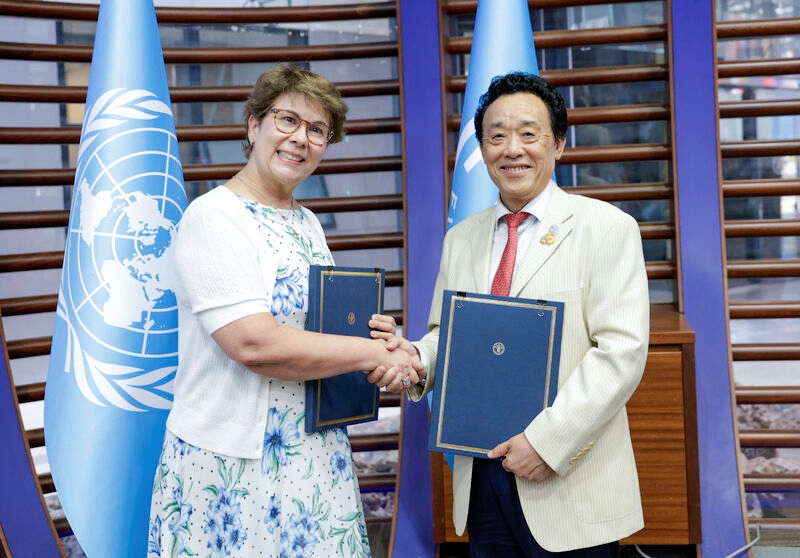
The Food and Agriculture Organization of the United Nations has welcomed a new resolution adopted by the United Nations General Assembly proclaiming October 1 as International Coffee Day, marking a significant step toward recognizing coffee’s global economic, social, and cultural importance.

The resolution, approved on 10 March 2026 in New York, highlights the historical and cultural role of coffee and its lasting influence on societies worldwide. It acknowledges that coffee has evolved from its origins into a globally traded agricultural commodity that sustains communities while also serving as a symbol of social interaction, cultural identity, and everyday tradition across generations.

You may Read: UN Officially Designates 1 October as International Coffee Day 

  • Coffee and global development

The United Nations resolution underscores the contribution of the coffee sector to several key global development priorities. Among them are ending hunger, reducing extreme poverty, empowering women, and promoting decent work and economic growth, all of which are central to the United Nations Sustainable Development Goals.

According to Qu Dongyu, coffee represents far more than a popular beverage.

“Coffee is more than a drink; it is a globally traded commodity—from beans to coffee service—that sustains the livelihoods of millions of farming households and connects rural communities to markets around the world,” he said. “Recognizing the value of the coffee sector will raise awareness of its socio-economic importance and strengthen its contribution to eradicating poverty.”

You may read: International Coffee Day: How It Started and Why the World Celebrates 

  • A sector supporting millions

Coffee remains one of the most widely consumed beverages worldwide. Global per-capita consumption has grown by about 1.2 percent annually over the past decade, reflecting steady demand across international markets.

The sector supports the livelihoods of around 25 million coffee farmers, while employment extends across the entire value chain—from cultivation and processing to trading, roasting, and retail. Altogether, the global coffee industry generates more than 200 billion dollars in annual revenue.

Coffee also ranks among the world’s most traded agricultural commodities. In 2024, global production surpassed 11 million tonnes, with approximately 8 million tonnes traded internationally. That same year, the estimated value of global coffee production reached nearly 25 billion dollars, while international trade in coffee beans totaled about 34 billion dollars.

Read also: International Coffee Day: A Beverage’s Journey from Yemen to the World 

  • Vital exports for developing economies

For many low-income countries, coffee exports remain a critical source of foreign currency earnings.

In 2024, coffee accounted for 27.9 percent of total merchandise exports in Ethiopia, 20.1 percent in Uganda, and 19.5 percent in Burundi. In both Ethiopia and Uganda, revenues from coffee exports exceeded national food import bills, while in Burundi they represented nearly one-fifth of the country’s food import costs.

During the same year, Brazil and Viet Nam were the world’s leading coffee exporters, while the European Union and the United States remained the largest import markets.

  • FAO’s role in strengthening the coffee sector

FAO works with coffee-producing countries through a range of initiatives designed to strengthen sustainability, productivity, and farmer livelihoods.

One of the organization’s priorities is helping producers adapt to the growing impacts of climate change. Through programs such as Farmer Field Schools, FAO supports pest management strategies and the conservation of traditional coffee systems, including projects in Panama. Additional initiatives promote agroforestry systems and climate-resilient coffee varieties in East Africa, while cooperative development programs are helping strengthen rural economies in countries such as Cuba.

You may like:Coffee Industry on International Coffee Day: Production, Consumption, and Future Challenges 

The organization is also assisting producers in responding to evolving market requirements. As international buyers increasingly demand traceability and compliance with sustainability standards, FAO is working with governments and producers in countries including Honduras, Guatemala, and Uganda to establish stronger traceability systems and align national policies with global frameworks. These efforts aim to mobilize investment benefiting more than 200,000 smallholder farmers.

Through its Investment Centre and initiatives such as the Hand-in-Hand Initiative, FAO is also supporting financing mechanisms that improve efficiency and increase farmer incomes. Projects in Brazil, Costa Rica, and Honduras, implemented with partners including the World Bank, are helping strengthen the long-term resilience of coffee farming systems. In El Salvador, FAO has supported the development of a comprehensive national coffee strategy.

  • A global platform for the coffee community

With the establishment of International Coffee Day under the UN system, FAO has been invited to coordinate the annual observance in collaboration with relevant organizations, particularly the International Coffee Organization.

The new international day is expected to serve as a global platform for dialogue, cooperation, and knowledge-sharing across the coffee value chain. By highlighting both the opportunities and the challenges facing producers, the initiative aims to strengthen international commitment to a sustainable, inclusive, and resilient coffee sector that contributes to rural development and global food security.


IAEA Announces Nuclear Science Initiative to Safeguard Costa Rica’s Tarrazú Coffee

Dubai, August 19, 2025 (Qahwa World) – The International Atomic Energy Agency (IAEA) ⚛️ has officially announced a new initiative to protect Costa Rica’s world-renowned Tarrazú coffee. In a post shared on its official X account (formerly Twitter), the IAEA released a video explaining how nuclear science is being applied to authenticate coffee origins and shield this premium product from fraud.

The video highlights the journey of a single coffee bean, from the rain and soil that shaped it to the laboratory techniques that reveal its unique “fingerprint.” Through these methods, scientists at the University of Costa Rica are building a geographic database that will certify the authenticity of Tarrazú coffee and help preserve its global prestige.

Backed by #Atoms4Food

The initiative forms part of #Atoms4Food, a joint program of the IAEA and the Food and Agriculture Organization of the United Nations (FAO). By applying nuclear and related techniques, laboratories worldwide will be able to verify the geographical origin of coffee beans with high precision. This provides coffee drinkers with the assurance that every cup of Tarrazú reflects the authenticity of its heritage.

Protecting Farmers and Consumers

For Costa Rican farmers, safeguarding authenticity means protecting livelihoods. Tarrazú coffee commands premium prices in international markets, and this project ensures that its reputation remains untarnished by fraud. At the same time, consumers benefit from greater confidence in the integrity of what they buy.

A Track Record in Coffee Authentication

This is not the first time the IAEA has engaged with coffee. Since 2019, the Agency, together with FAO, has led international research projects applying stable isotope techniques to combat fraud in high-value foods, including rice, honey, and coffee.

Earlier studies used nuclear methods to distinguish Jamaican Blue Mountain coffee from imitations, and IAEA-led radiocarbon intercomparison exercises demonstrated how laboratories across Europe and Latin America could reliably verify coffee origins. The Tarrazú project builds directly on this scientific foundation, making nuclear science an everyday guardian of authenticity.

Every Sip Tells a Story

“By assessing the fingerprint of coffee, we can prove its authenticity,” the IAEA video explains. With nuclear science now protecting Tarrazú, every sip carries more than flavor—it carries a story of tradition, science, and trust, safeguarded for future generations.

📌 Summary:
The IAEA announced on its official X account a new initiative to protect Costa Rica’s Tarrazú coffee through nuclear science. Backed by FAO under #Atoms4Food, the project authenticates coffee origins, strengthens consumer trust, safeguards farmers’ incomes, and builds on years of IAEA-led research into food fraud prevention.