Tight Supplies Push Coffee Prices to Multi-Week Highs in September 2025

Dubai, 12 August 2025 (Qahwa World) – The global coffee market saw a sharp rally at the start of August, with September Arabica futures (KCU25) rising by 14.00 cents (+4.53%) to hit a seven-week high, while September Robusta futures (RMU25) climbed 188 points (+5.28%) to a four-week high. The surge was fueled by clear signs of tightening supply in the world’s largest producing countries, driven by lower exports and falling inventories.

Brazil’s Trade Ministry reported that the country’s exports of unroasted coffee in July dropped 20.4% year-on-year to 161,000 metric tons. At the same time, ICE-monitored Arabica inventories fell to a 14.5-month low of 738,095 bags, while Robusta stocks declined to a two-week low of 6,981 lots.

Markets are closely watching the United States’ stance on import tariffs, as President Trump has yet to announce an exemption for coffee from the 50% import duty on Brazilian exports — a move that could impact U.S. sales and boost domestic inventories in Brazil.

In weather developments, Minas Gerais, Brazil’s largest Arabica-growing region, recorded 4.8 mm of rainfall during the week ending 9 August, amounting to 109% of the historical average, easing drought concerns. Harvest progress remains swift, with Safras & Mercado estimating that 94% of the 2025/2026 crop had been completed as of 6 August (99% for Robusta and 91% for Arabica). Cooxupé, the country’s largest coffee cooperative and exporter, reported its members had harvested 74% of their crop by 1 August.

Globally, the International Coffee Organization’s monthly report showed that June exports rose 7.3% year-on-year to 11.69 million bags, while cumulative exports from October to June slipped 0.2%.

In recent months, prices have faced downward pressure from expectations of abundant supply. In June, the U.S. Department of Agriculture forecast Brazil’s 2025/2026 coffee production at 65 million bags (+0.5%), and Vietnam’s output at 31 million bags (+6.9%, the highest in four years). The USDA also projected record global output of 178.68 million bags (+2.5%), with Arabica production down 1.7% and Robusta production up 7.9%. Ending stocks are expected to rise 4.9% to 22.82 million bags.

Brazil’s Coffee Exporters Council (Cecafe) reported that June green coffee exports fell 31% year-on-year to 2.3 million bags, with Arabica shipments down 27% and Robusta down 42%. In Vietnam, 2023/2024 production dropped 20% year-on-year due to drought, hitting a four-year low, while exports from January to July 2025 rose 6.9% to 1.05 million metric tons.

Volcafe projects that the global Arabica market will post a deficit of 8.5 million bags in 2025/2026, compared to a 5.5 million-bag deficit in 2024/2025, marking the fifth consecutive year of shortfall.
Rising Production and Exports Put Kenya Back on the Global Coffee Map

Dubai – Qahwa World

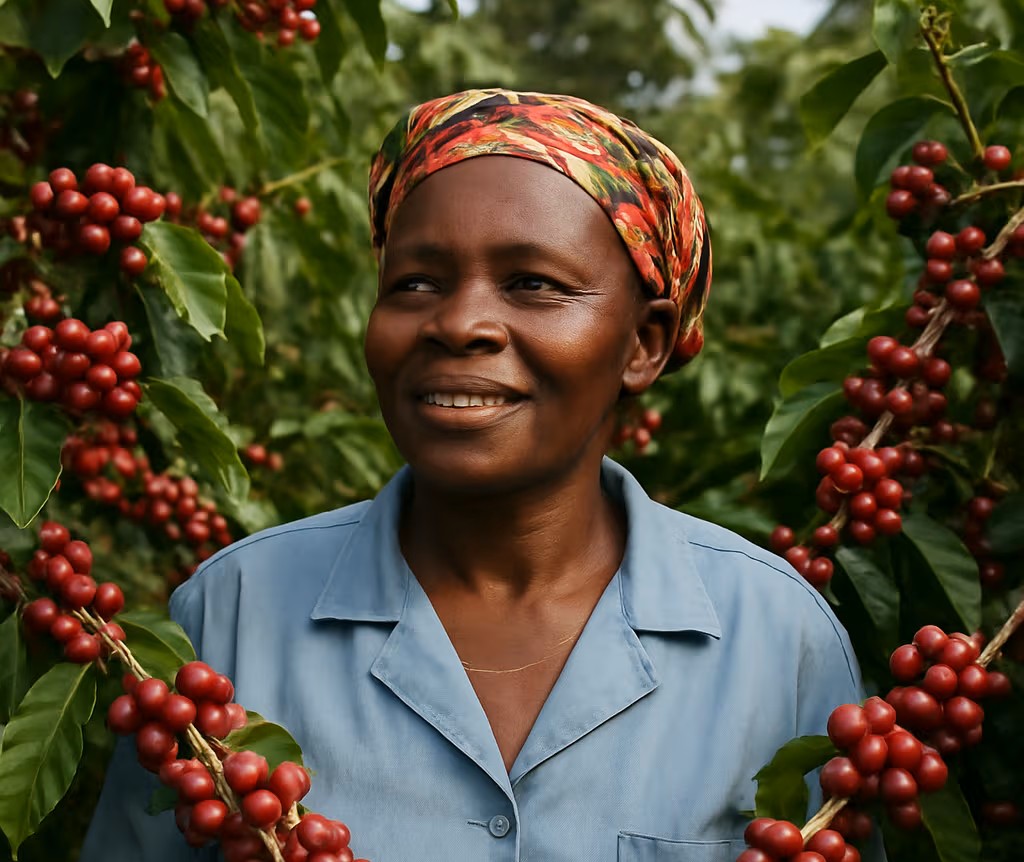
Kenya is witnessing a strong rebound in its coffee sector, with production forecast to grow by 13.3% in the 2025/26 marketing year, reaching 850,000 sixty-kilogram bags. This recovery is driven by high global prices, government reforms, and farmer support programs. Exports are also projected to rise by 10%, while domestic consumption is expected to increase by 6.9%. With these promising indicators, Kenya is reclaiming its place among the world’s top Arabica coffee producers.

According to the USDA’s Coffee Annual Report (May 2025), Kenya’s coffee production is forecast to increase from 750,000 bags in 2024/25 to 850,000 bags in 2025/26. Farmers have responded to favorable prices with improved agricultural practices—applying more fertilizer, controlling pests more effectively, and capitalizing on Arabica’s natural biennial production peak.

In February 2025, the Nairobi Coffee Exchange (NCE) recorded a historic high of $363 per 50-kg bag, up from $254 in October 2024. Although a slight price correction is expected in the second half of the year, prices remain favorable and have reinvigorated investment in farms.

Slight Expansion in Planted Area

While harvested area is expected to remain at 105,000 hectares, planted area will increase slightly as the Kenyan government rolls out its Coffee Expansion Program in both traditional and new growing regions across Central, Eastern, and Rift Valley Kenya. The program includes subsidized seedlings, supported by county-level grants and expanded production at the Coffee Research Institute to meet increased demand.

Urbanization Slows, Coffee Area Stabilizes

Between 2020 and 2024, coffee area declined from 112,000 to 105,000 hectares due to urban development, particularly around Nairobi, Kiambu, and Nyeri. However, this trend has slowed, thanks to a stagnating real estate market, offering the sector a chance to stabilize.

Marketing Reforms and Structural Overhaul

Roughly 80% of Kenya’s coffee is sold through producer cooperatives, while the remaining volume is marketed by private farms and estates. The Nairobi Coffee Exchange remains the country’s primary marketplace, handling over 90% of coffee sales.

Since 2023, Kenya has implemented significant reforms in marketing and regulation. The NCE is now under the Capital Markets Authority, which licenses brokers responsible for classification and auction procedures. There are currently 15 licensed brokers. Additionally, licensing of millers was decentralized to county governments.

A pending Coffee Bill in Parliament seeks to formalize these changes by creating a new Coffee Board of Kenya and an independent Coffee Research and Training Institute, to be funded through a coffee sales levy.

Exports Rising but Facing EU Deforestation Law

Coffee exports are expected to grow by 10% to 840,000 bags in 2025/26, up from 763,000 bags the previous year. Green beans dominate Kenya’s export portfolio, with major buyers including:

  • European Union: Over 57%

  • United States: 16.75%

  • South Korea: 5.16%

  • United Kingdom: 3.43%

  • Other emerging markets: China, Australia, India

However, the upcoming EU Deforestation Regulation, taking effect in January 2026, poses a potential challenge. In response, Kenya has formed a multi-agency committee to evaluate readiness and establish compliance mechanisms.

Domestic Consumption on the Rise

Domestic coffee consumption is projected to grow by 6.9%, reaching 62,000 bags in 2025/26. This growth is driven by the rapid expansion of coffee shops, particularly in Nairobi, and a 15% surge in tourism in 2024. Kenya’s coffee culture is evolving, with increasing demand for specialty brews and locally roasted varieties.

Despite this growth, soluble coffee consumption remains low due to the lack of local processing facilities. Kenya imports approximately 45,000 bags of instant coffee annually.

Stock Levels and Imports

Ending stocks are expected to increase to 86,000 bags in 2025/26, reflecting higher production. For 2024/25, stock estimates have been revised downward to 63,000 bags due to higher exports and tighter output.

Conclusion: Kenya’s Return to Coffee Leadership

With production, exports, and consumption all trending upward, Kenya is once again asserting itself on the global coffee stage. While challenges like EU environmental compliance lie ahead, the country’s proactive reforms and farmer-focused strategies signal a new era of growth and global relevance for Kenyan coffee.