Starbucks and Nestlé launch cold coffee concentrate for global markets

Dubai – Qahwa World

Nestlé and Starbucks are set to introduce a new ready-to-mix product aimed at the growing demand for cold coffee. The companies will roll out Starbucks Coffee Craft Concentrate in 2026 under their Global Coffee Alliance.

Made with Arabica coffee, the concentrate will be available in two flavors: Rich Black and Signature Caramel. The product is scheduled to debut in Japan, South Korea, and the United Kingdom, followed by expansion across Europe and Asia in 2027.

Ethel Touitou said the new product is designed to give consumers more control over how they prepare coffee at home. By simply adding water, milk, or plant-based alternatives, users can create a variety of iced drinks, including americanos and caramel-style beverages.

The Global Coffee Alliance, launched in 2018, combines Nestlé’s manufacturing and distribution capabilities with Starbucks’ brand presence. As a result, Starbucks-branded packaged products are now sold in nearly 80 markets worldwide.

Nik Dodi said the launch reflects the continued expansion of the partnership, bringing Starbucks-style coffee experiences into more homes and new consumption occasions.

Industry forecasts indicate continued growth in the cold coffee segment, with the global market expected to exceed $4 billion by 2030, driven by increasing consumer interest in convenient and customizable chilled beverages.

Global Coffee Market to Hit $380B by 2033

Dubai – Qahwa World

The global coffee market is advancing rapidly, driven by strong consumer demand that shows no signs of slowing. Around half a trillion cups of coffee are consumed worldwide each year—more than 2 billion cups every day—making coffee one of the world’s most popular daily beverages and a core pillar of the global beverage industry.

According to the latest data from Grand View Research (as of early 2026), the market was valued at approximately USD 249.34 billion in 2025 and is projected to reach USD 380.28 billion by 2033, reflecting a compound annual growth rate (CAGR) of 5.4% from 2026 to 2033. This growth continues despite economic pressures, climate-related challenges in key producing regions, and evolving consumer preferences. Other industry analyses present slightly more conservative estimates, ranging from $214 billion to $239 billion by 2031–2033, depending on methodology, but all projections indicate continued expansion.

Consumption Leaders: Volume vs. Per Capita

The United States remains the largest coffee-consuming country in total volume, supported by a large population and a deeply rooted coffee culture. On average, Americans drink around three cups per day, resulting in significant national consumption.

On a per-capita basis, Northern Europe leads global rankings. Recent data suggests Luxembourg ranks among the highest per-person consumers at over five cups daily, influenced in part by cross-border commuting. Finland also maintains a leading position, with approximately 3–4 cups per person per day and annual consumption of around 10–12 kg per capita, among the highest levels globally.

This strong Nordic consumption culture is deeply embedded in daily life. In Finland, coffee is a social staple, commonly consumed black and frequently enjoyed during regular coffee breaks known as “kahvihetki.”

Asia-Pacific: The Fastest Growing Region

While established markets are maturing, the Asia-Pacific region is emerging as a major growth engine for the global coffee industry. Rising incomes, rapid urbanization, and a young, digitally connected population are driving demand across China, Japan, India, and other markets.

China has surpassed the United States in terms of branded coffee shop presence, with more than 50,000 outlets and rapidly expanding chains such as Luckin Coffee. In India, café culture continues to develop and is expected to significantly expand market potential by 2030. Indonesia has also experienced strong growth, with domestic consumption reportedly tripling since pre-pandemic levels.

The Asia-Pacific coffee market is projected to grow faster than the global average, with estimated CAGR ranges of 6–8% in recent forecasts. Growth is being supported by premium café expansion, ready-to-drink coffee products, and shifting preferences in urban areas away from traditional tea consumption.

The Quality Shift: Specialty Coffee and Arabica Dominance

Global coffee consumption is not only increasing in volume but also shifting toward higher quality. Arabica beans continue to dominate due to their smoother flavor profile, while demand for specialty coffee is accelerating, particularly among younger consumers.

Millennials and Gen Z consumers are increasingly prioritizing single-origin sourcing, traceability, and distinctive flavor profiles over mass-market products. The global specialty coffee segment is expanding faster than the broader market, with projected CAGR near 10.8% through 2033.

Convenience and Changing Lifestyles

Modern consumption habits are driving demand for convenience-focused coffee products. Capsules, instant coffee, liquid concentrates, and ready-to-drink (RTD) beverages are increasingly popular, allowing consumers to access premium coffee experiences at home, in the workplace, or on the move.

Sustainability and Supply Chain Pressures

Sustainability has become a central requirement in the coffee industry. Ethical sourcing, organic certification, and transparent supply chains are increasingly important to consumers, particularly in premium segments.

Many consumers are willing to pay higher prices for coffee that supports farmers, reduces environmental impact, and carries certifications such as Fair Trade or Rainforest Alliance. At the same time, climate change continues to pose risks to major coffee-growing regions, prompting greater focus on resilient crop varieties and sustainable farming practices.

Challenges and Market Outlook

The coffee sector faces increasing competition from alternative beverages, including tea, herbal infusions, energy drinks, and functional beverages, as consumers diversify their preferences toward health-oriented options.

Supply chain volatility, driven by weather events and geopolitical factors, also remains a persistent challenge for producers and roasters.

Despite these pressures, the long-term outlook for the coffee industry remains positive. Strong cultural demand, combined with innovation in product formats, sustainability initiatives, and experiential retail, is expected to support continued growth through the next decade.

From specialty cafés in Tokyo to espresso bars in Dubai and traditional filter coffee in Helsinki, global coffee culture continues to expand. The coming years are expected to bring greater product diversity, improved sustainability practices, and new consumption experiences for one of the world’s most widely enjoyed beverages.

Keurig Dr Pepper Reports 97.75% of JDE Peet’s Shares Tendered

Keurig Dr Pepper says post-closing acceptance period lifts its holding to 97.75% of shares, paving the way for buy-out proceedings and delisting from Euronext Amsterdam.

BURLINGTON, Mass., FRISCO, Texas and AMSTERDAM – Qahwa World

Keurig Dr Pepper Inc. (“KDP”) (NASDAQ: KDP) and JDE Peet’s N.V. (“JDE Peet’s”) (EURONEXT: JDEP) jointly announced that the post-closing acceptance period relating to the Offer (the “Post-Closing Acceptance Period”) expired today at 17:40 CEST.

During the Post-Closing Acceptance Period, 7,821,867 shares were tendered under the Offer, representing approximately 1.61% of the shares and an aggregate value of approximately €249,126,463.95. Together with the 466,712,270 shares that were already acquired by the Offeror, the Offeror will hold a total of 474,534,137 shares, representing approximately 97.75% of the shares and an aggregate value of approximately €15,113,912,263.45.

With reference to the Offer Memorandum, shareholders who accepted the Offer during the Post-Closing Acceptance Period will receive the Offer Price for each tendered share transferred for acceptance pursuant to the Offer during the Post-Closing Acceptance Period, under the terms and conditions of the Offer and subject to its restrictions. Settlement of the shares tendered during the Post-Closing Acceptance Period will occur, and payment of the Offer Price for each such share will be made, on April 15, 2026. The Offeror cannot guarantee that shareholders who tendered their shares for acceptance will receive payment on this date.

As a result of the acquisition of more than 95% of the shares by the Offeror, the Offeror will initiate statutory buy-out proceedings in accordance with Section 5.13.2 (Buy-Out Proceedings) of the Offer Memorandum and will implement the post-closing demerger in accordance with Section 5.13.4 (Post-Closing Demerger) of the Offer Memorandum. As previously announced, it has been decided, in consultation with Euronext, that the last day of trading of the shares will be April 29, 2026, and that the shares will be delisted from Euronext Amsterdam on April 30, 2026.

Announcements

Any announcements contemplated by the Offer Memorandum will be made by press release. Any press release issued by the Offeror will be made available on KDP’s website. Any press release issued by JDE Peet’s will be made available on JDE Peet’s website.

Offer Memorandum; Position Statement

Digital copies of the Offer Memorandum are available on the websites of JDE Peet’s and KDP. Digital copies of the Position Statement are available on JDE Peet’s website. Copies of the Offer Memorandum will be made available, upon request, free of charge at the offices of JDE Peet’s. The websites of JDE Peet’s and KDP do not constitute a part of, and are not incorporated by reference into, the Offer Memorandum and the Position Statement.

Notice to shareholders of JDE Peet’s in the United States

The tender offer is being made for the ordinary shares of JDE Peet’s, a public limited liability company incorporated under the laws of the Netherlands with shares listed on Euronext Amsterdam. US shareholders should note that the tender and related documents are subject to Dutch disclosure and procedural requirements, which differ from those of the United States.

JDE Peet’s shares are not listed on a US securities exchange and the company is not subject to the reporting requirements of the US Securities Exchange Act of 1934, and does not file reports with the US Securities and Exchange Commission (SEC).

The tender offer is being made in the United States in compliance with, and in reliance on, the exemption provided by Rule 14d-1(d), known as the “Tier II” exemption, under the Exchange Act and otherwise in accordance with Dutch law.

Receipt of cash pursuant to the tender offer by a US holder of JDE Peet’s shares will be a taxable transaction under US federal income tax law and applicable state, local and foreign tax laws. Each holder is advised to consult an independent professional adviser regarding the tax consequences.

It may be difficult for US holders to enforce their rights under US securities laws, as JDE Peet’s is located outside the United States and some or all of its officers and directors may reside outside the United States.

To the extent permissible under applicable law, JDE Peet’s and its affiliates or brokers may purchase shares outside the tender offer in the open market or through private transactions at prevailing or negotiated prices. Such purchases will not exceed the tender offer price. No purchases will be made in the United States on behalf of KDP.

Neither the SEC nor any US state securities commission has approved or disapproved the tender offer or passed upon its merits. Any representation to the contrary is a criminal offence in the United States.

Restrictions

The distribution of this press release may be restricted in certain jurisdictions. Persons who receive this document should inform themselves of and observe any such restrictions. Failure to comply may constitute a violation of applicable securities laws. Neither KDP nor JDE Peet’s assumes responsibility for any such violations.

This announcement is for information purposes only and does not constitute an offer or invitation to acquire or dispose of any securities or investment advice.

Forward-looking statements

This press release contains forward-looking statements relating to the impact of the transaction, future financial performance, cost savings and synergies. These statements are subject to risks and uncertainties that could cause actual results to differ materially.

Neither KDP nor JDE Peet’s undertakes any obligation to update forward-looking statements except as required by law.

KDP Acquires JDE Peet’s, Names Oliveira Coffee CEO

BURLINGTON, Mass., FRISCO, Texas and AMSTERDAM  — Qahwa World

Keurig Dr Pepper Inc. (KDP) said it has acquired 96.22% of JDE Peet’s N.V., advancing its strategy to build a global coffee business alongside its North American beverage operations.

The deal combines JDE Peet’s global coffee platform with KDP’s Keurig system, bringing together established brands, distribution networks, and category expertise. The company said integration efforts are underway, focusing on operations, cost synergies, andorganisationall alignment.

KDP reiterated plans to split into two publicly traded U.S. companies after an interim period:

a North America-focused beverage business, and
a standalone global coffee company.

You may like: Keurig Dr Pepper Seals $15.7 Billion JDE Peet’s Deal as 96% of Shares Tendered

As part of the move, KDP appointed Rafael Oliveira as CEO of its coffee unit and future head of the planned Global Coffee Co. Oliveira, who has led JDE Peet’s since 2024, will join KDP’s executive leadership team and report to CEO Tim Cofer, who is expected to lead the beverage company post-separation.

KDP Chair Pam Patsley said Oliveira was selected following a comprehensive review process, citing his experience in global markets and recent performance at JDE Peet’s. Cofer said the combination and leadership structure position the company to scale its coffee operations globally.

Oliveira said the combined business aims to operate across all coffee segments and markets, leveraging global reach and local expertise.

The company said it is targeting operational readiness for the separation by the end of 2026, subject to market conditions and internal milestones.

A post-closing acceptance period for remaining shareholders runs through April 13, 2026. With KDP now holding more than 95% of shares, JDE Peet’s will be delisted from Euronext Amsterdam, with the last trading day set for April 29 and delisting expected on April 30.

Tim Cofer’s Strategy: Why Keurig Dr Pepper Is Building a Coffee Giant

New York – August 27, 2025 (Qahwa World) – When Keurig Dr Pepper (KDP) unveiled its $18.4 billion acquisition of JDE Peet’s, the headline alone turned heads. But the deeper story lies in the reasoning of CEO Tim Cofer, who is reshaping the company by building a coffee powerhouse—only to spin it off as an independent entity while KDP doubles down on its soda and refreshment empire.

The move marks a sharp departure from the vision set in 2018, when Keurig Green Mountain merged with Dr Pepper Snapple in a $19 billion deal. The idea was bold: unite hot and cold beverages under one roof, controlling every category of nonalcoholic drinks on consumers’ shopping lists. That concept thrived during the COVID-19 lockdown, when KDP used AI insights from home brewers to anticipate surging demand for K-Cups, while also stockpiling Dr Pepper and Canada Dry. Sales boomed as consumers hoarded both coffee pods and sodas.

Yet the promise of synergy has faded. In Q2 2025, KDP’s soft drink revenues surged 10.7% compared with the previous year, but U.S. coffee sales fell 1.9% and international hot beverages dropped 3.8%. Rising coffee bean prices forced K-Cup price hikes, pushing consumers toward cheaper ground and instant coffee. Instead of a perfect fit, coffee became a drag on the business, and management faced the distraction of running two very different operations.

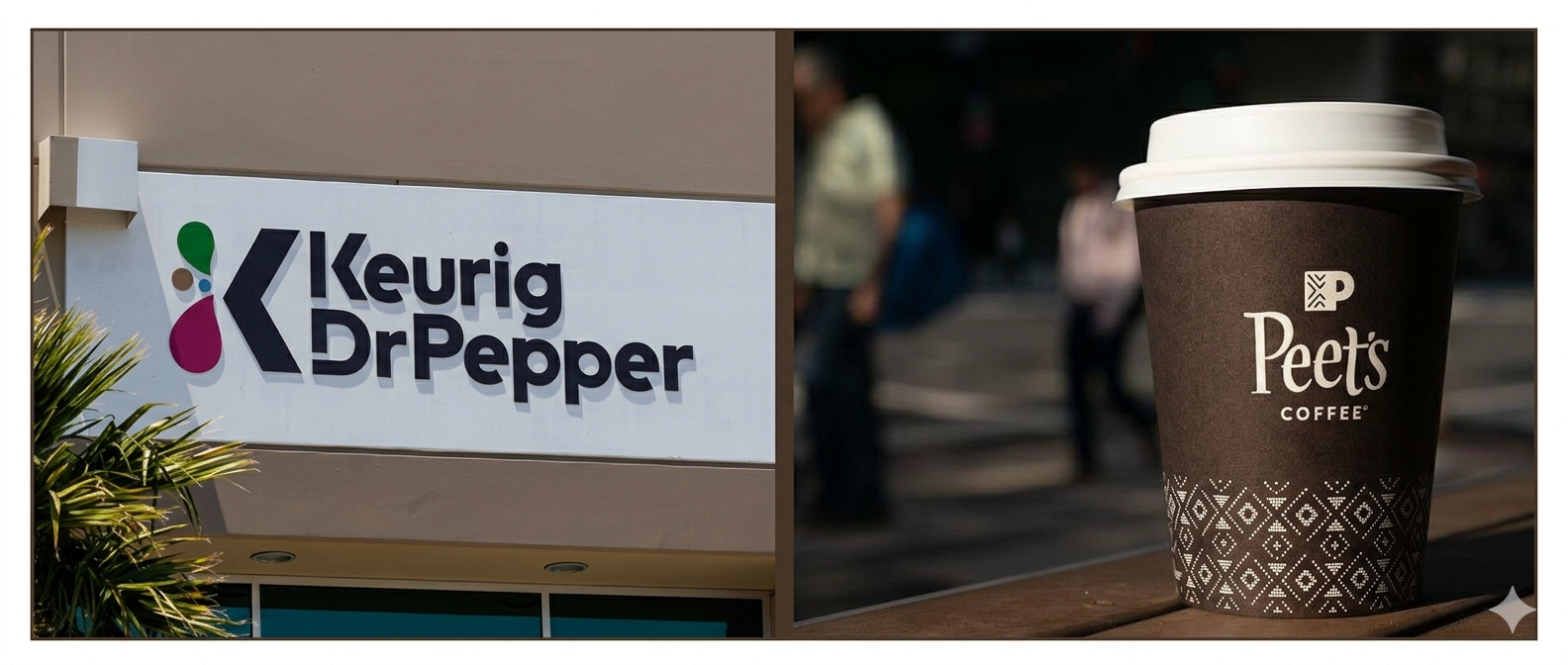
Cofer’s solution: scale and separation. By acquiring JDE Peet’s—home to brands like Jacobs, L’Or, and Peet’s Coffee retail stores—KDP will merge it with Keurig to create a transatlantic coffee giant generating nearly $16 billion in annual revenues split evenly between Europe and North America. Then KDP will spin off the coffee business to shareholders, giving it independence and sharper focus. The remaining KDP will center entirely on refreshment, managing more than 150 brands from Dr Pepper and 7Up to Snapple and Schweppes.

For Cofer, the decision is not about retreat but about unlocking potential. Coffee, he points out, is a $400 billion global market—one of the few products most people consider indispensable. But paired with sodas, it lacked the attention and resources it deserved. As a standalone company, it can pursue growth on its own terms. Meanwhile, KDP’s soda business can concentrate on taking market share from Coke and Pepsi, especially in restaurants, energy drinks, sports hydration, and trendy innovations like “dirty sodas,” which KDP introduced after spotting a viral TikTok craze.

The move reflects Cofer’s pedigree as a dealmaker. At Kraft and Mondelez, he mastered the art of integrating and separating global businesses, from the Kraft-Cadbury merger to snack acquisitions in Asia. At KDP, he has applied the same instincts, betting on bold moves like acquiring Ghost Energy and diversifying into premium categories. Now he is wagering that specialization, not diversification, will deliver long-term growth.

Investors are skeptical. KDP’s stock fell 11% on the day of the announcement, erasing billions in market value. But analysts note that coffee and sodas are fundamentally different businesses, with little overlap in distribution or strategy. Splitting them could, in fact, make both stronger.

If Cofer’s gamble pays off, KDP’s breakup will not just be remembered as a costly deal but as one of the defining strategic pivots in today’s beverage industry—creating two giants instead of one distracted hybrid.