Cautions Raised on Exploiting Coffee’s Health Benefits for Commercial Gain

In a recent study, alarming warnings have been sounded regarding the potential hazards linked to the commercialization of coffee’s health benefits. The study, featured in Coffee Intelligence, underscores the imperative to critically assess health claims associated with coffee products.

Over the past decade, extensive research has consistently linked moderate coffee consumption to a lower risk of type 2 diabetes, heart disease, certain cancers, and cognitive diseases like Alzheimer’s and Parkinson’s. A noteworthy revelation indicates that consuming one cup of coffee every six hours may even reduce the risk of contracting the coronavirus.

Coffee, recognized for its abundant bioactive compounds, antioxidants, and polyphenols, is increasingly hailed as a superfood renowned for fortifying and protecting the body. Cold brew has gained widespread popularity as a pre-workout drink, while black coffee has become a staple in the fitness community.

However, it is crucial to discern between the health benefits attributed to pure black coffee and the potential drawbacks introduced by additives. The surge in coffee’s popularity as a superfood has led to an influx of products containing artificial sweeteners, flavors, preservatives, emulsifiers, stabilizers, and artificial colors.

The study underscores previous findings revealing that 98% of 131 flavored hot drinks from major coffee chains exceeded three times the recommended daily sugar intake for adults, sparking concerns about the long-term health impact. With the global ready-to-drink coffee market poised to surpass $42 billion by 2027, there is a notable shift towards customizable beverages, significantly contributing to the industry’s growth.

This trend aligns with the broader discourse surrounding the infiltration of ultra-processed foods (UPFs) into global diets. In the UK, for example, 65% of the average diet consists of ultra-processed foods, a factor linked to obesity, cardiovascular disease, and various health-related issues.

The study affirms that leveraging the health benefits of coffee has become an effective marketing strategy for new products, especially given the heightened focus on health and wellness, particularly among Generation Z and younger millennials. Whether intentional or not, some new products are capitalizing on coffee’s well-established health reputation, potentially risking the tarnishing of coffee’s image as these products emerge as a new face of the industry.

Compounding concerns, health and wellness claims in the coffee sector remain entirely unregulated, providing brands ample latitude to make unverified assertions about their products without the need for research or studies to substantiate them. While acknowledging the need for comprehensive, well-funded research, it raises concerns about potential biases when research is funded by entities that stand to profit from promoting the health benefits of coffee.

This underscores the critical importance of exercising heightened scrutiny when confronted with health and wellness claims for new coffee products, especially until such claims are subject to more stringent regulation. Ultimately, the reputation of coffee itself is at stake, necessitating a cautious approach to protecting consumer confidence and well-being.

The Top 10 Coffee-Producing Countries of 2023

In a recent publication by the World Population Review, comprehensive statistics regarding global coffee production have been unveiled, spotlighting the ten leading nations in this vital industry. Strikingly, the roster of top coffee producers markedly differs from the list of nations that rank highest in coffee consumption.

Before delving into the specifics of the leading coffee-producing countries, it is pertinent to acquaint ourselves with some noteworthy aspects of coffee cultivation. Originating as a fruit from coffee trees, the growth of coffee mirrors the intricate journey from seed to plant, a process that is not universally conducive to sustainable cultivation. Tracing its roots to the Ethiopian region, coffee cultivation and consumption subsequently permeated Yemen before spreading globally.

Coffee cultivation predominantly thrives in regions proximate to the equator, constituting the “coffee belt” between 25 degrees north and 30 degrees south. Encompassing Central and South America, Africa, and parts of Asia, this belt signifies the optimal climate for coffee growth, situated between the Tropics of Cancer and Capricorn.

Distinguished by two primary types, Arabica and Robusta, coffee beans contribute substantially to global production. Arabica beans are renowned for their mild and smooth flavor, while Robusta beans exhibit a bolder, more robust taste and higher caffeine content. Together, these two varieties account for the majority of the world’s coffee output.

While approximately seventy countries engage in coffee production, not all nations with coffee cultivation facilities export their products. Focusing on those actively contributing to the global market, fifty countries partake in coffee production and export.

Presented below is a list of the ten foremost coffee-producing countries, along with their respective annual production quantities (tons), based on the latest data from the Food and Agriculture Organization of the United Nations (FAO):

  1. Brazil – 2,993,780 tons
  2. Vietnam – 1,845,033 tons
  3. Indonesia – 765,415 tons
  4. Colombia – 560,340 tons
  5. Ethiopia – 456,000 tons
  6. Honduras – 400,674 tons
  7. Uganda – 374,760 tons
  8. Peru – 365,582 tons
  9. India – 334,000 tons
  10. Guatemala – 226,700 tons

Further insights into three of the top ten coffee-producing nations offer a glimpse into their distinctive contributions to the global coffee industry:

Brazil: Undoubtedly, Brazil emerges as the foremost producer, both in quantity and pounds. Concentrated in São Paulo, Paraná, and Minas Gerais, Brazil’s coffee production primarily employs the dry process, emphasizing natural drying through exposure to sunlight.

Indonesia: Counted among the prolific Asian coffee producers, Indonesia boasts approximately one and a half million farmers engaged in coffee farming and production. Renowned for rarities such as kopi luwak, Indonesia’s coffee industry exhibits a dedication to quality, reflected in the premium status of its beans, including the expensive Kopi Luwak.

Honduras: Benefiting from geographical elevations exceeding the required altitude for coffee cultivation, Honduras stands out among coffee-producing nations. The country’s success in coffee production is attributed to strategic geographic advantages, with elevations reaching three thousand feet higher than necessary, contributing to its prominence in the global coffee market.

Top 10 Nations Leading Coffee Consumption in 2023

Coffee, celebrated for its captivating aroma and invigorating caffeine content, remains one of the globe’s most cherished beverages.More than 400 billion cups of coffee are consumed annually. Cultivated in over 70 tropical countries, its popularity knows no bounds.

Considered the world’s second-largest exported commodity, following oil, coffee production is spearheaded by Brazil, Vietnam, and Colombia. Surprisingly, the highest per capita consumption occurs in Scandinavian nations, where the dark and chilly winters elevate coffee to a prized beverage. In the United States, annual consumption hovers around 4.4 kilograms or 9.7 pounds per person, ranking the nation as the 25th largest consumer on a per capita basis, with an average of three cups consumed daily.

Recently, the World Population Review unveiled statistics on global coffee consumption for the year 2023. The list underscores the dominance of Scandinavian countries in the top positions, revealing a surprising absence of any Arab nations despite their historical connection with coffee production, notably in Yemen and the Arabian Peninsula.

Notably, none of the major coffee-producing countries, such as Brazil and Colombia, secured a spot on the list, highlighting a distinctive gap between production and consumption.

The Top 10 Coffee-Consuming Countries Per Capita

Analyzing the data reveals Finland as the undisputed leader, boasting a remarkable annual consumption of 12 kilograms (26 pounds) per person. The top 20 countries, each with a distinctive coffee culture, include:

Finland – 12 kg / 26 lbs: Leading the world, Finns savor approximately four cups daily, with a legally mandated 10-minute coffee break for workers.

Norway – 9.9 kg/22 lbs: Norwegians, consuming over three cups daily, view coffee shops as social hubs rather than workspaces.

Iceland – 9 kg / 20 lbs: In Iceland, where beer was illegal until 1987, coffee serves as a crucial social drink, offered customarily to visitors.

Denmark – 8.7 kg/19 lbs: “Kaffeslabberas” signifies informal gatherings where coffee and cake are served, a tradition extended to weddings.

Netherlands – 8.4 kg/19 lbs: Dutch traders introduced coffee to the West, a historical feat shaping the global coffee landscape.

Sweden – 8.2kg/18lbs: The Swedes embrace “Fika,” a term for a prolonged coffee break fostering social connections.

Switzerland – 7.9 kg / 17 lbs: Combining coffee and wine in “Luzerner Kafi,” the Swiss contribute to coffee innovation, exemplified by Nespresso.

Belgium – 6.8 kg / 15 lbs: Belgian cities boast numerous cafes, with Café Wittamer serving the distinctive brulote espresso.

Luxembourg – 6.5 kg / 14 lbs: Despite its size, Luxembourg houses numerous cafes, from elegant establishments to quaint coffee shops.

Canada – 6.5 kg / 14 lbs: Representing the sole non-European entry, Canada pioneers coffee chains, notably Tim Hortons, a dominant force in the nation’s coffee culture.

This data provides a snapshot of the dynamic interplay between culture and coffee consumption, revealing unexpected leaders and underscoring the global diversity in the appreciation of this beloved beverage.

Haraz: A Journey into the Heart of Yemeni Coffee

In the rich tapestry of coffee’s history, Yemen holds a special place. It was from Yemen that the world first tasted coffee, and the roots of the global coffee trade dig deep into its soil. While historians debate the origin of coffee—Ethiopia or Yemen—one fact remains indisputable: without Yemen, coffee would be an unknown entity.

Historical records point to Yemeni Sufis in the early fifteenth century as the first to elevate coffee from a mere beverage to a social ritual, using it to stimulate their minds during nightly worship. Yemeni coffee stands as the epitome of quality and commands a staggering price, with a pound fetching $240 and a kilo commanding around $500. Europe and the United States are the primary importers, despite dwindling production.

Coffee thrives across Yemen, but certain regions have etched their names in coffee history. Among them, Haraz, renowned for its towering mountains, some reaching 3000 meters above sea level,Coffee is grown there at altitudes, some of which reach 2,600 meters above sea level and terraced gardens crafted by Yemeni hands, transforming the landscape into lush coffee farms.

Haraz is synonymous with picturesque houses rising above the clouds, their roofs adorned with vibrant hues mirroring the splendor of drying coffee berries scattered around. Historical accounts trace coffee cultivation in Haraz back over 500 years.

Our guide into the heart of Haraz was Abdul Latif Al-Jaradi, a certified coffee expert from quality coffee institute   and founding shareholder of “Mocha Story” and “Coffee Story” companies exporting Yemeni coffee. Al-Jaradi has not only preserved endangered coffee varieties but also propagated them on a private farm with 300 thriving trees.

Haraz, according to Al-Jaradi, is divided into four distinct coffee-producing sections: eastern Haraz, western Haraz, Saafan, and Bani Ismail. Each region boasts its unique character and coffee profile, shaped by differences in terrain, environment, water, and soil.

Eastern Haraz coffee captivates with its unparalleled sweetness and fruitiness. In contrast, western Haraz coffee stands out with tropical fruity overtones, unique incense notes, intense sweetness, and exceptionally hard beans. Saafan coffee charms with its floral and sugary notes, while Bani Ismail coffee, often likened to chocolate, offers a blend of nuts, caramelization, and distinctive circular beans.

Haraz’s elevation, ranging from 1,700 to 2,600 meters above sea level, produces dense and sweet coffee beans. Al-Jaradi emphasizes that these heights are not just numbers but a testament to the careful cultivation on ancestral terraces.

Al-Jaradi identifies Al-Jaadi Al-Shirqi and Al-Jaadi Al-Daariti as prevalent in Haraz, with Saafan favoring the apple variety. Meanwhile, Bani Ismail boasts the Al-Khattab variety, renowned globally for its unique characteristics.

Despite being one of Yemen’s leading coffee producers, Haraz faces challenges from climate change. Al-Jaradi notes the reliance on traditional farming methods, with no machines intervening in plowing or harvesting. Coffee, akin to a family member, receives meticulous care, and the return mirrors the attention invested.

Recent changes in post-harvest practices, including selective harvesting and meticulous drying methods, have revived Haraz coffee’s reputation on the global stage.

In conclusion, Haraz remains a captivating chapter in the saga of Yemeni coffee. Its unique terroir, diverse coffee varieties, and the dedication of its cultivators echo through the ages. As climate change poses challenges, the resilience of Haraz’s coffee farmers keeps this ancient tradition alive, ensuring the world continues to savor the magic of Yemeni coffee.


Dubai hosts the first edition of the “Coffee Art Marathon”

During the period from December 28 to January 28, 2024, the city of Dubai will host the ‘Coffee Art Marathon’ events in its first edition, which is an unparalleled celebration of coffee, music, arts, and culture.

Organized by Art4you Gallery and curated by Ms. Jesno Jackson, this mega event promises to be a vibrant showcase of creativity, sustainability, and the global coffee lifestyle.

Starting from December 28, 2023, until January 28, 2024, the ‘Coffee Art Marathon’ is set to transform Dubai into a hub for artistic and caffeine experiences. With 22 activities focused on coffee and art, the event will emerge as Art4you Gallery’s largest annual international gathering, attracting participants and artists from more than 50 nationalities.

Jesno Jackson, the founder, and curator emphasizes the event’s commitment to sustainability, in line with the Sustainable Development Goals (SDGs) and COP28. The marathon’s mission is not only to celebrate the present but also to pave the way for a sustainable future for artists, especially through the unique medium of coffee painting.

The ‘Coffee Art Marathon’ provides a unique opportunity for the coffee community to come together. Café owners, industry experts, baristas, and emerging artists from around the world will mingle and network, strengthening connections and appreciation for the art of coffee. The festival also supports fair trade coffee beans and promotes sustainable practices within the industry.

Art4you Gallery confirms that the Coffee Art Marathon will be a huge festival celebrating independent artists, the arts community, and coffee and food connoisseurs. It aims to be a melting pot of contemporary arts, with a focus on promoting and nurturing creative expression.

Supported by top sponsors such as Gostoso Coffee, Attibassi Coffee, Davidoff, NESCAFE,Monviso, and others, the ‘Coffee Art Marathon’ promises an abundance of coffee to sip, art to admire, and music to soothe the soul. Art4you Gallery will host programs on coffee enjoyment, profiling, and education, and offer a wide range of workshops and tasting options.

The event will feature coffee roasters, traders, equipment suppliers, and more. Art lovers can indulge in events such as Mug Design, Coffee Art Jam, Cultural Art Walk, and bookmark making with coffee painting.

The ‘Coffee Art Gallery’ exbition is one of the highlights of the ‘Coffee Art Marathon’ and will include live art performances such as the longest live drawing challenge, coffee painting, walking painting, and performances by international artists.

Music lovers can enjoy the tunes of the famous violinist Cynthia Kabsa and experience a variety of musical, poetic, and dance performances.

The grand finale on the final day will include an awards night and a competition such as ‘Igniting the Art of Coffee’ and a calendar competition, where winners and participants will be honored. At the various venues hosting the ‘Coffee Art Marathon,’ family entertainment will be present, creating a lively community atmosphere.

Sponsors, support partners, gift partners, media partners, and other collaborators have come together to make the Art of Coffee Marathon a reality in Dubai.

Join the celebration of creative expression and coffee culture at the Coffee Art Marathon as the enchanting city of Dubai becomes a canvas for a month-long celebration of art, music, and coffee.

Study Dispels Fears: Hospital Coffee Machines Unlikely to Be a Source of Superbug Spread

Healthcare workers can breathe a sigh of relief as a recent study, featured in The BMJ’s Christmas issue, dismisses the notion that hospital coffee machines contribute to the spread of diseases. The findings suggest that a general ban on these machines is unnecessary.

In the ongoing efforts to combat hospital-acquired infections, various items, including doctors’ ties and even hospital Bibles, have been scrutinized as potential breeding grounds for bacteria. Surprisingly, hospital coffee machines, despite frequent contact with numerous hands, had not been thoroughly investigated until now.

To address this gap in knowledge, German researchers conducted a comprehensive assessment of the microbial population in healthcare-associated coffee machines, focusing on the World Health Organization’s high-priority “ESKAPE” pathogens. These pathogens, resistant to many antibiotics, pose a significant threat, potentially leading to fatal infections.

Between October 31 and December 31, 2022, the researchers swabbed a total of 25 coffee makers, including fully automatic, capsule (e.g., Nespresso), and espresso machines. Seventeen machines were located in break rooms and offices at a university hospital, while eight were in staff members’ homes. All machines had been in use for at least a year, and none underwent special cleaning before sampling. Importantly, there were no ongoing disease outbreaks at any of the locations during the sampling period.

Swabs were taken from five specified sites on each coffee machine: the drip tray, the outlet, the buttons, the handle of the water tank, and the inside of the water tank. Microbial species were identified through cultures using spectrometry, with pathogens categorized as “medically relevant” and commensals as “atypical pathogens.” Gram type differentiation was used to distinguish positive or negative species.

Notably, microbial growth was found on every coffee machine, with hospital machines being approximately three times more heavily colonized than home machines. The majority of detected species were harmless commensals, and only a few medically relevant, non-antibiotic-resistant pathogens were identified.

The study emphasized the importance of following hand hygiene protocols, as 81% of medically relevant Gram-negative species were discovered in hospital coffee makers, primarily in drip trays, outlets, and water tank handles. Staphylococcus aureus, a potentially disease-causing Gram-positive species, was found in minimal instances, reinforcing the need for thorough hand hygiene.

The authors of the study expressed relief that, despite the potential for pathogen origin in nosocomial outbreaks, a widespread ban on coffee makers is unwarranted. Additionally, the study has prompted enhanced cleaning measures. The authors also raise intriguing questions about tea-related items in nations that favor tea, pondering whether teapots, kettles, and hot water spouts may serve as similar breeding grounds for bacteria and whether high temperatures in pots are sufficient to eliminate potential pathogens.

The Coffee Public-Private Task Force

The Coffee Public-Private Task Force was established by the International Coffee Organization in 2019, following the signature of the “London Declaration” by 12 private sector companies, and upon the request of the International Coffee Council at its 125th Session. The Task Force is designed to build common ground for a global partnership between the coffee industry and governments, guided by the overriding vision of the sustainability of the sector and prosperity for grower communities.

OBJECTIVES

The overall objective of the Task Force is to build consensus between public and the private actors on priority issues and actions to be implemented in order to ensure a sustainable and fair global coffee sector at the local and global levels. To this end, collaborative public-private partnerships aim to achieve complementary specific objectives:

1. Designing methodologies and strategies to close the income gap for farmers towards prosperity.

2. Enhancing sector-wide transparency on a common understanding of the actual production and the relative efficiency of value transmission.

3. Promoting enabling policies in exporting and importing countries, facilitating national public-private platforms.

4. Driving the resilience of coffee communities by using a landscape approach.

5. Coordinating interventions at the sector level and ensuring full integration of the gender and youth agenda.

ACHIEVEMENTS

The technical workstreams have been activated and started providing the expertise required to close key knowledge gaps, elevate existing research and begin interventions in selected ICO exporting countries on:

1. Defining Living income benchmarks and closing the gap strategies; 2. Establishing cost of production and efficiency gap data; 3. Setting up national dialogue platforms and ensuring viability of regulatory policies.

4. Carrying out landscape assessments to inform strategies on territorial, not exclusively at farm level.

5. Increasing membership from private sector and active participation of public and private sector and observers (coffee stakeholders and development partners).

6. Increasing financial / in-kind contributions from Members, observers and international development cooperation.

7. Linking development with EU, UN agencies and institutions.

8. Building consensus model of Task Force so that it proves relevant, important and recognized by actors of the coffee sector.

MEMBERS

Since its inception in 2019, the CPPTF has started to attract increased interest from the private sector, with three additional companies having joined. Moreover, in order to maintain the overall balance of public-private participants, more ICO Members have also been incorporated.

  • Private Sector

ECOM Trading

Illycaffè S.p.A.

JDE Peet’s N.V.

Lavazza S.p.A.

Louis Dreyfus Company

Mercon Coffee Group

Nestlé S.A.

Neumann Kaffee Gruppe

Ofi

Starbucks Coffee Company

Sucafina

Sucden

Tchibo

Volcafe

Indian Coffee Trust

National Coffee Association

Global Coffee Platform

Sustainable Coffee Challenge

Public Sector:

Brazil

Colombia

Côte d’Ivoire

Ethiopia

European Union

Honduras

India

Indonesia

Kenya

Mexico

Nicaragua

Papua New Guinea

Peru

Rwanda

Switzerland

Togo

Vietnam

Rwanda

Switzerland

Togo

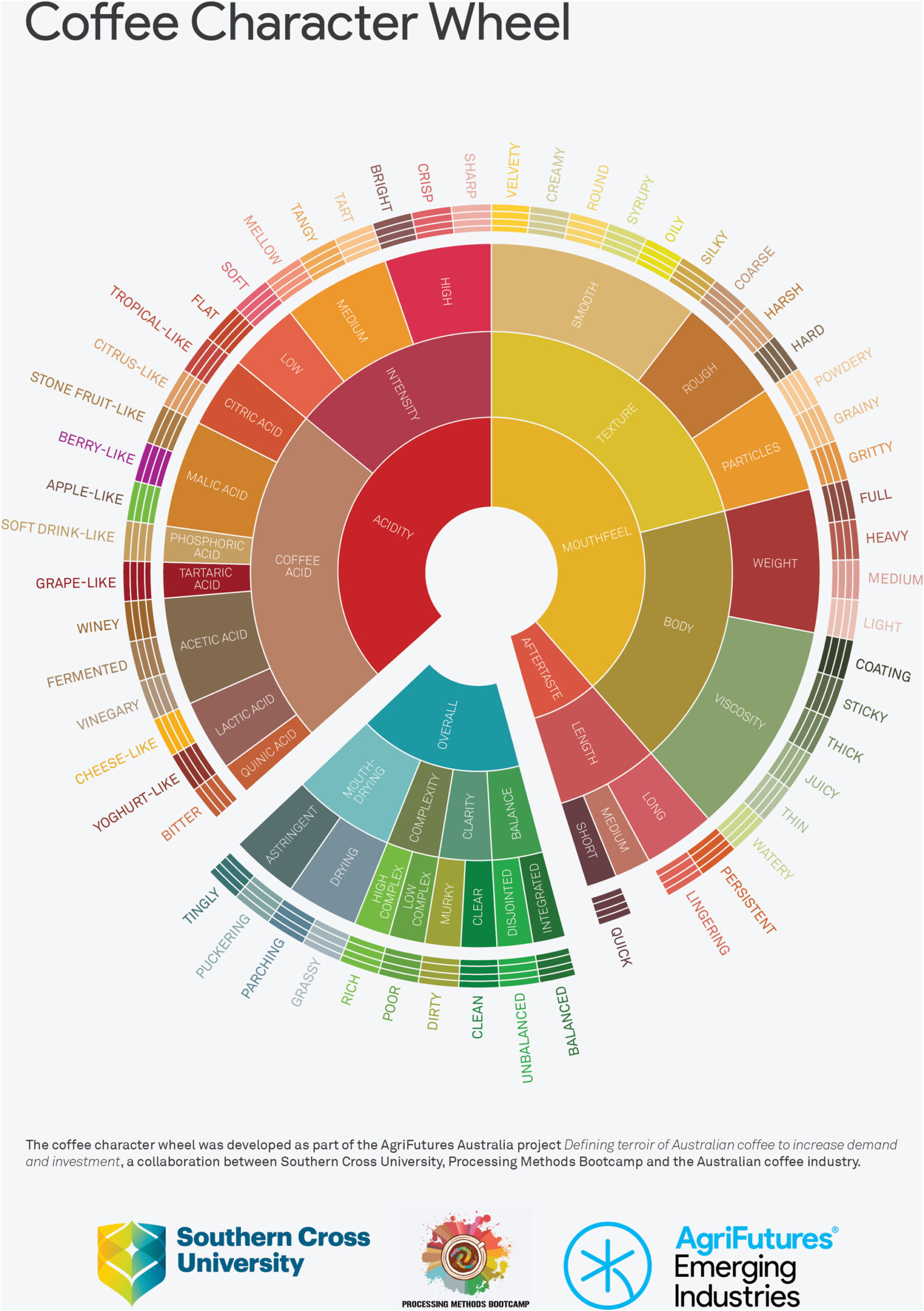
“Coffee Personality Wheel” redefines the sensory evaluation of coffee beyond the drink

In a groundbreaking endeavor to tackle the challenge of a lack of standardized terms for acidity, mouthfeel, and other nuanced coffee characteristics, a team of coffee experts has unveiled the Coffee Personality Wheel. This innovative tool aims to fill the gap that has limited the comprehensive expression of these sensory attributes in the realm of coffee evaluation.

Drawing insights from diverse sources, including coffee panels, literature, and internet resources, the researchers, led by coffee experts Simon D. Williams, Danilo de Andrade, and Li Liu, crafted the Coffee Personality Wheel. This sensory wheel reflects the terminology currently utilized by researchers and coffee professionals, providing a concise list of terms ranging from broad to specific. The format of the wheel is familiar to industry professionals, aligning with the Specialty Coffee Association’s Coffee Taster Circle.

Designed to complement the Specialty Coffee Association’s Coffee Taster Flavor Wheel, the Coffee Personality Wheel serves as a valuable tool for coffee researchers and professionals to articulate the complete sensory experience of coffee, adhering to current industry evaluation standards.

This pioneering study signifies a revolutionary change in the world of coffee evaluation. The Coffee Personality Wheel goes beyond the traditional flavor-focused approach, shedding light on often overlooked sensory dimensions such as acidity, mouthfeel, and aftertaste.

Traditionally, coffee evaluation has predominantly centered on unraveling the complex flavors within each cup, leaving a gap in exploring broader sensory elements. Williams, de Andrade, and Liu sought to address this gap by meticulously collecting 679 sensory terms from various sources, including literature, coffee bars, and online materials.

Through sophisticated statistical analyses, including text mining, big image building, and hierarchical clustering, these terms were condensed into a concise and comprehensive Coffee Personality Wheel. This tool provides a unified language for industry professionals to dissect and articulate the multi-faceted coffee experience.

The implications of the Coffee Personality Wheel extend beyond terminology, acting as a companion to existing flavor wheels and offering clear descriptions of acidity and aftertaste—elements often marginalized in quality assessments. As the coffee industry embraces a more holistic approach to sensory evaluation, the Coffee Personality Wheel emerges as a unifying force, fostering shared understanding among researchers, professionals, and enthusiasts.

The collaborative effort led by Williams, de Andrade, and Liu involved a large-scale survey of 55 specialty coffee roasters, forming the foundation for identifying 679 unique sensory terms. Rigorous statistical analyses and iterative modifications, validated through additional panels, ensured the accuracy and practicality of the Coffee Personality Wheel in real-world coffee evaluations.

The scoping study exposed a disproportionate focus on flavor terms in coffee marketing, prompting the development of a more comprehensive evaluation tool. A testament to careful analysis and validation, the Coffee Personality Wheel successfully distills countless sensory descriptions into 95 refined terms.

Organized in a visually intuitive concentric circle, this tool represents a significant leap forward in expressing and appreciating the precise dimensions of coffee. The study’s innovative approach, spearheaded by Williams, de Andrade, and Liu, marks a paradigm shift in how coffee is evaluated and valued.

By addressing biases in marketing descriptions and strategically compromising on terminology, the Coffee Personality Wheel aligns with industry practices while serving as a universal language for the global coffee community. As this transformative tool takes center stage, it signals a new era in the sensory evaluation of coffee, guided by the visionaries Williams, de Andrade, and Liu.

Beyond the intricate interplay of flavors, acidity, and aftertaste now find their rightful place in the dictionary of coffee professionals. Crafted with precision and dedication, the Coffee Personality Wheel not only aligns with existing evaluation protocols but also paves the way for future adaptations and innovations in the ever-evolving world of coffee estimation.


The most popular types of coffee in the UK

Like other people, the English love coffee. Estimates indicate that more than 80 percent of them visit cafés at least once a week to order their favorite coffee drink, and about 17 percent of them visit cafés on a daily basis, out of which 16 percent of them own a coffee maker at Home, so what are the most popular drinks they prefer and where do they come from?

Latte:

The UK’s most popular coffee type is a latte . the latte is generally a shot of espresso topped up with steamed milk and a layer of foam on the top.

While coffee has its roots in Africa and the Middle East, the concept of drinking milk with coffee was primarily a European invention, in practice since the 17th Century. According to the Oxford English Dictionary, the term “caffè e latte” (coffee with milk) was first used in English by the novelist William Dean Howells in 1867.

The latte story goes that coffee with milk was popular among American tourists in Italy who didn’t enjoy the bitter, rich flavors of Italian espresso and added large quantities of warm milk to make a sweeter drink.

It’s said they took the recipe back home with them, with the version of the latte we know today being standardized in Seattle, USA, in the 1980s. It has gone on to become one of the most popular coffee types in the world – but a word of warning if you fancy ordering one in Rome or Milan.

Cappuccino:

There’s not much difference between a cappuccino and a latte – both have the same ingredients, but it’s the quantities that change these drinks.

A cappuccino will have much more foamed milk than a latte and is considered a layered drink, often finished with chocolate or cinnamon powder on top.

While the name cappuccino comes from the Latin “caputium,” meaning hood or cloak, the drink’s origins actually come from Austria.

Coffee houses in Vienna pioneered the introduction of cream and sugar with coffee in the 18th Century. The color of the coffee resembled the color of the hooded robes worn by the Capuchin monks and nuns, and the German/Austrian variation of “kapuziner” was taken as its name.

Cappuccino versions were served across Europe from the 1930s onwards – although the drink at this time was typically espresso topped with whipped cream. As coffee machine technology improved, the version we know today was standardized, initially in Italy, before becoming popular as a ‘long’ coffee drink, meant to last, around the world.

flat white:

A flat white is an espresso-based drink that contains steamed milk.
It is made with a small amount of steamed milk and a thin layer of microfoam.

There is some debate about whether the flat white originated in Australia or New Zealand. Either way, it has been around down under since the 1980s. In the years since, it has popped up on menus in the US, UK, and elsewhere and is now a specialty café standard.

Americano:

As the name might suggest, we may have Americans to thank again for the invention of the Americano – the UK’s fourht most-popular coffee.

The drink – a shot or two of espresso, topped up with hot water – is believed to have been popularized by soldiers posted in Italy during World War Two.

It’s said that the American troops were looking for a different way to take their coffee. The local baristas came up with the option of diluting it with hot water in order to make the drink something they were more familiar with – the name Americano has stuck ever since.

The name Americano did appear in print some 20 years earlier though. Somerset Maugham’s collection of short stories, Ashenden: Or the British Agent, refers to his titular hero drinking an Americano in Naples, although we never find out what exactly the drink was.

Mocha:

While the word mocha is now synonymous with chocolate, particularly in coffee, it wasn’t always the case.

The name was taken from a variety of coffee grown in the Middle Eastern country of Yemen. The beans were named after the local Mokha port that they were shipped from.

People noticed an unusual chocolate taste to the coffee. As chocolate became more common in Europe, it began to be added to coffee to give it a sweeter taste and the mocha name was used.

Modern mochas come in many different varieties, ranging from latte-style coffees with chocolate powder or syrup added, to hot chocolates with a shot of espresso added.

Iced Coffee:

While only accounting for just under 4% of UK coffee sales in 2016, iced coffees and cold brews are becoming more and more popular around the world. A traditional iced coffee is brewed hot and poured over ice or very cold milk while a cold brew does as the name suggests – and is prepared entirely cold for a different flavor.


The Specialty Coffee Association announced the opening of applications to join the Strategic Committee for the World Coffee Championships

The Specialty Coffee Association (SCA) has announced the opening of applications for positions within the Strategic Committee for the World Coffee Championships (CSC).

This volunteer leadership group plays a pivotal role in shaping the comprehensive strategy for the World Coffee Championships, in addition to the sub-committees dedicated to competition-specific rules and regulations.

The CSC comprises individuals with diverse experiences in competitions and the coffee industry, actively collaborating on initiatives aimed at enhancing and supporting the competition community, ensuring the continuous progress of the World Coffee Championships (WCC).

Interested individuals can apply for positions involving a two-year commitment to contribute to the development of the WCC. Successful applicants are expected to participate in two monthly meetings and a full-day meeting in September 2024, either in-person or remotely.

The application period is open until January 8, 2024, with notifications to successful candidates expected in mid to late January.

The CSC is specifically seeking a committee with a wide range of experiences, geographies, and backgrounds within the specialty coffee sector.

World Coffee Championships, organized by the World Coffee Events (WCE), are dedicated to recognizing professional excellence, promoting accessibility for all, and emphasizing the collaborative effort required to create and serve specialty coffee.

It is noteworthy that the World Coffee Championships (WCCs) are supported by the Competitions Strategic Committee (CSC), a volunteer leadership group with extensive experience in competitions and the industry.

The CSC regularly convenes throughout the year to collaborate on strategic initiatives, including updates to competition formats, rules, regulations, judges, sponsorship, marketing, and communications. Additionally, smaller working groups are formed to support specific projects, and the committee provides ad-hoc support for arbitration.

The structure of the current CSC was established in 2017, focusing on aligning a vision and purpose for the WCCs, guided by six strategic objectives. In 2020, many ongoing changes were temporarily paused to assess the impact of the COVID-19 pandemic on global and national-level competitions. Resuming meetings in 2022, the CSC is reevaluating how the strategic objectives align with the current events landscape.

Recognizing the diversity of perspectives within the group, the CSC is committed to implementing changes rooted in its vision, goals, and community feedback, acknowledging that there is no single correct approach to making these changes.

Saudi Ministry of Culture Approves 20 Research Papers for “Saudi Coffee Research” Grant

In a significant development, the Saudi Ministry of Culture has formally endorsed the acceptance of 20 research papers submitted from both domestic and international researchers for the prestigious “Saudi Coffee Research” grant. Launched in December 2022 in collaboration with the Saudi Coffee Company, a key entity under the Public Investment Fund umbrella, the grant is specifically designed for researchers and specialists with a keen interest in diverse facets of coffee.

Successful researchers will receive comprehensive financial and scientific support throughout the research process, extending to the publication of scientific papers. This initiative aims to enrich cultural research output pertaining to Saudi coffee, acknowledged as an intangible cultural heritage, thereby playing a pivotal role in advancing the national cultural product.

The grant encompasses three principal tracks. The first track focuses on coffee in the Arabian Peninsula, delving into its historical roots, manufacturing evolution, and dissemination within the Kingdom. The second track is dedicated to exploring the intangible cultural heritage associated with Saudi coffee, including the examination of knowledge, skills, social traditions, practices, and cultural handicrafts intertwined with it. The third track seeks to elevate and advance local content by supporting Saudi coffee production, thereby enhancing its competitiveness and contributing to the Kingdom’s transition towards a sustainable economy.

This initiative was strategically included within the framework of the “Year of Saudi Coffee 2022” initiative, spearheaded by the Ministry of Culture with the backing of the Quality of Life Program—a key component of the Kingdom’s Vision 2030. In collaboration with the Culinary Arts Authority, the initiative aims to scrutinize the Saudi coffee market, preserve national cultural legacies and values, underscore the intangible heritage linked with Saudi coffee, bolster national identity, and promote Saudi coffee culture on the global stage.

Applications for the “Saudi Coffee Research” grants were opened on December 18, 2022. This initiative underscores a concerted effort to enhance cultural production through research endeavors focused on Saudi coffee, aligning with its status as an intangible cultural heritage intertwined with natural heritage and traditional culinary arts. The grants target a diverse range of researchers and specialists, both within the Kingdom of Saudi Arabia and abroad, fostering a collaborative and inclusive approach to advancing knowledge in various coffee-related fields.

“Coffee Desk” announced as the main sponsor for World of Coffee Dubai 2024

The Specialty Coffee Association in the United Arab Emirates announced that “Coffee Desk” has joined the World of Coffee Dubai 2024 as the main sponsor for the event.

The official Instagram account of the World of Coffee Dubai  stated, “We are pleased to welcome “Coffee Desk” as the official sponsor for the current edition of the World of Coffee Dubai 2024″.

The Account adeed:” From crafting caffeine in Poland to transforming the coffee scene in Europe, ‘Coffee Desk’ brings its impressive collection of over 3000 items from more than 150 global brands to the exhibition hall in Dubai in January.”

The specialized coffee association invited the audience to join the event for networking, learning, and exploring the best in the specialty coffee industry. The audience was encouraged to secure their tickets before prices increase at the gates.

The World of Coffee Dubai  is an annual event, and the 2024 edition, scheduled from January 21 to 23, will be the third installment. This event in Dubai has become a focal point for the global specialty coffee community, and the 2024 edition is expected to be 50% larger than the previous one, featuring new features and a refreshed program of workshops and lectures.

Best Product Competition and New Exhibition

A prominent feature of the World of Coffee Dubai 2024 is the Best Product Competition and New Exhibition, a platform recognizing and celebrating innovative products in the specialty coffee and tea industry. The competition is open only to participating companies showcasing their latest innovations that set trends in their respective categories.

The competition includes various categories such as coffee accessories, commercial coffee preparation and presentation equipment, consumer coffee preparation and presentation equipment, and an open category for products not falling under the mentioned categories.

The deadline for submissions is December 31, 2023, providing companies a short timeframe to present their latest creations to a global audience. Strict rules must be adhered to during the submission process, requiring the product to be new to the company, launched in the market for no more than a year, and commercially available on the same continent as the exhibition for at least six months. No prototypes are allowed, emphasizing the competition’s focus on real-world innovation. Judging will take place on-site, and prestigious awards will be presented during the event.

All entries, regardless of winning status, will be showcased on the New in Coffee platform, providing a source of inspiration for global audiences to innovate in the industry.

Coffee Design Award

In the spirit of celebrating the fusion of great coffee and exquisite design, the Coffee Design Awards have returned to recognize the most inspiring designs in the industry. The competition covers various categories, including vessels, spaces, packaging, and branding, with a focus on aesthetics in enriching the overall coffee experience.

Participation in the Coffee Design Awards is open until December 31, 2023, and participants are required to submit high-quality images for each entry, with a minimum size of 3 megabytes. For packaging, applicants must provide physical samples before the exhibition for inclusion and consideration during judging.

The competition is subject to strict regulations, emphasizing that products must be new in the market within a period of no more than a year from the start of the exhibition. Judging will be conducted carefully by independent judges and exhibition management to determine the winners. All entries will be sent to design.sca.coffee, a platform dedicated to showcasing inspirational designs in the coffee industry.

UAE National Barista Championship

World of Coffee Dubai 2024 will also host the National Barista Championship for the United Arab Emirates, promising to be a passionate and skillful showcase. Coffee industry experts from across the region will compete for the opportunity to represent Dubai in the prestigious World Barista Championship in Busan. This championship is not just a competition but also a platform to showcase talent within the coffee community in the region.

Specialty Coffee Association Community Lounge

Amidst the exciting competitions and exhibitions, visitors are encouraged to spend some time relaxing in the Specialty Coffee Association Community Lounge. This dedicated space provides an opportunity to experience a variety of specialty coffees, explore different preparation methods, and connect with like-minded coffee enthusiasts. It serves as a reminder that behind the competitions and awards, World of Coffee Dubai 2024 is a community of individuals united by their shared love for exceptional coffee.