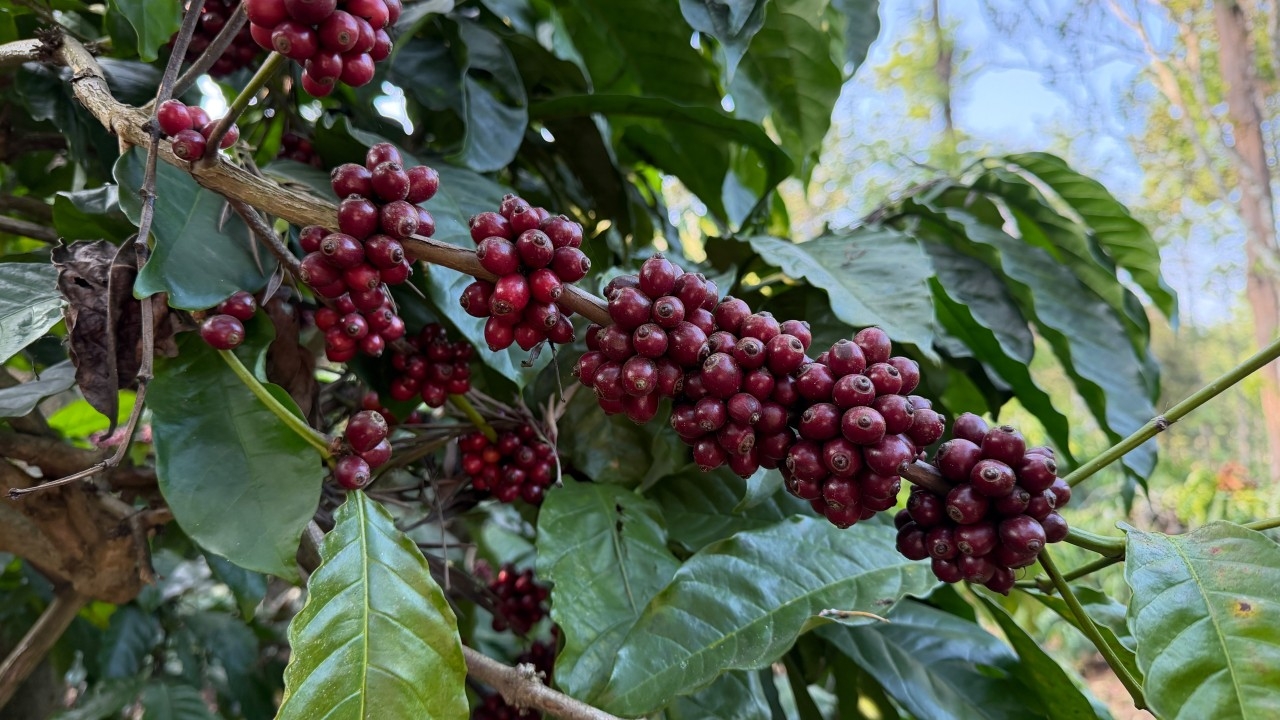
There is a word in coffee that has done more damage than most people realise. It is short, convenient, commercially familiar, and scientifically careless. The Coffea canephora Robusta myth is a prime example of how a term can become misleading in the world of coffee.
For decades, the global coffee industry has used the name “Robusta” as if it described a species, a flavour profile, a production system, a price category, and a climate promise all at once. It is a compression of botany into marketing. Like many convenient mistakes, it has quietly shaped how people think.
“Robusta” is not just a name. It is a mindset that has shaped how the industry underestimates Coffea canephora.
Say the word often enough and the assumption follows. Canephora must be robust. Tougher. Simpler. Less fragile. Less complex. Less deserving of precision. Less worthy of sensory ambition. Less in need of science.
But Coffea canephora is not a slogan. It is a species with deep genetic history, regional diversity, ecological vulnerability, breeding potential, and a future that may become central to the survival of coffee as we know it.
The false name has made the industry lazy. Worse, it has made the industry dangerously confident.

When Language Meets Climate Reality
The irony is difficult to ignore. At the moment coffee is entering one of the most unstable climatic periods in its cultivated history, the species most often described as “robust” is revealing how misleading that label can be.
Canephora can be productive. It can be vigorous. It can tolerate conditions under which many Arabica systems struggle. Yet drought does not read marketing language. Heat stress does not respect trade vocabulary.
Climate does not respond to terminology. Drought and heat expose biological reality, not branding.
Across Africa, Asia, and Latin America, the real question is no longer whether Canephora sounds strong. It is whether the right genetics, farming systems, nursery practices, disease resistance, root architecture, flowering behaviour, pollination compatibility, and processing ambitions can be brought together fast enough to make the crop resilient in the world that is arriving.
A Species of Diversity, Not Simplicity
Coffea canephora is not a single blunt instrument. It is a complex diploid species, largely outcrossing, genetically diverse, and historically rooted in the tropical forests of Central and West Africa.
Its major genetic groups, often described as Congolese and Guinean, express very different traits. Growth habit, caffeine content, bean weight, drought response, disease resistance, maturation timing, and agronomic behaviour vary across the species. The Brazilian conilon group adds further complexity, shaped by hybridisation and farmer selection.
This diversity is not a complication. It is the foundation of Canephora’s future.
The future of Canephora will not be built from a single type, but from its genetic diversity.
Progress depends on understanding which genetic resources carry the traits that matter, where they perform best, under which production systems, and for which market demands.
The Cost of Assumptions
The problem with calling a species “robust” is not linguistic. It is strategic.
It encourages underinvestment in fragility. It replaces measurement with assumption. It links lower market prices with lower intellectual attention.
Climate change is now exposing the cost of that mindset.
Assumed resilience is one of the most dangerous risks in a climate-unstable future.
Prolonged drought, higher temperatures, irregular flowering, shifting pest pressure, and changing disease dynamics cannot be addressed with outdated assumptions. They require precision.
Climate Stress Is Not Singular
Drought is perhaps the clearest example. Canephora does not simply tolerate dry conditions without consequence.
Water deficit reduces photosynthesis, increases oxidative stress, and disrupts flowering and fruit development. When combined with heat, the effects intensify.
In Uganda, prolonged drought and high temperatures have been linked with increased vulnerability to black coffee twig borer and Coffee Wilt Disease. In Asia and Brazil, drought stress and elevated soil temperatures increase the impact of root knot nematodes.
Climate stress rarely acts alone. It weakens plants, favours opportunistic pests and pathogens, and turns manageable challenges into systemic risks.
Coffee Wilt Disease and the Limits of Rhetoric
Coffee Wilt Disease remains one of the most powerful reminders that Canephora’s future cannot be secured through language alone.
Resilience is not a label. It is a result of science, systems, and execution.
Caused by Fusarium xylarioides, the disease devastated production in Uganda in the 1990s and early 2000s. Nearly half of the country’s Canephora trees were lost, with economic damage estimated at around 100 million US dollars.
This was not theoretical. It was a national agricultural crisis.
Uganda’s response was significant. Research institutions developed and released ten Coffee Wilt Disease resistant KR varieties. It was a major achievement in applied breeding.
But resistance alone does not solve the problem.
The Nursery Bottleneck
Canephora’s biology complicates propagation. As an outcrossing species, seed propagation produces variability. Seedlings do not reliably retain the characteristics of the parent plant.
For disease resistance, uniformity, and quality, clonal propagation becomes essential.
This shifts attention to nurseries, where the success or failure of breeding programmes is determined in practical terms.
The future of coffee can depend on something as simple as how a mother plant is bent.
A 2025 study examining KR1, KR3, and KR4 varieties demonstrated how simple interventions can transform outcomes. By adjusting the bending angle of mother plants and applying targeted NPK fertilisation, researchers significantly improved suckering performance.
Horizontally bent mother plants produced the strongest results. Fertiliser further enhanced growth. The interaction between variety, plant architecture, and nutrient management proved decisive.
This is not a minor technical detail. It is the logistics of resilience.

Where Science Becomes Operational
Applied coffee science is most powerful when it connects theory with practice.
Breeders may develop resistant genotypes. Pathologists may understand disease mechanisms. Geneticists may map diversity. Yet without effective nursery systems, these advances do not reach farmers.
A horizontally bent mother plant may not appear as significant as genomic innovation, but it can determine how quickly improved material is deployed at scale.
Rethinking Canephora Quality
The long standing perception of Canephora as inherently inferior in cup quality is no longer defensible.
High quality Canephora is not a contradiction. It is a frontier.
Selective breeding for cup potential, improved harvesting practices, better post harvest processing, controlled fermentation, and precise roasting are all necessary.
Canephora does not need to replicate Arabica. It has its own sensory identity, including structure, body, spice, cocoa, nutty profiles, and tactile depth.
A System That Must Work Together
The future of Canephora depends on coordination across the value chain.
Breeders, farmers, nurseries, processors, roasters, researchers, and buyers must operate within aligned systems. Without this, progress remains fragmented.
Why Naming Still Matters
Calling the species Coffea canephora is not a matter of academic correctness.
It is about restoring clarity.
Accurate language drives accurate thinking. Accurate thinking drives better coffee systems.
Accurate thinking drives investment. Investment enables science. Science shapes outcomes in the field.
The Decade Ahead
Canephora is not invincible. It is not inferior.
It is diverse, vulnerable, productive, promising, and still insufficiently understood.
- Can breeding cycles be shortened without losing rigour?
- Can resistant varieties be multiplied efficiently?
- Can quality become a primary breeding objective?
- Can climate adaptation become proactive rather than reactive?
Conclusion
The coffee industry has spent decades hiding Canephora behind the wrong name.
That era is ending.
Coffea canephora must be understood as it is. A species with its own biology, its own challenges, and its own future.
Its resilience will not be assumed. It will be built through science, precision, and attention.
And that begins with calling it by its proper name.