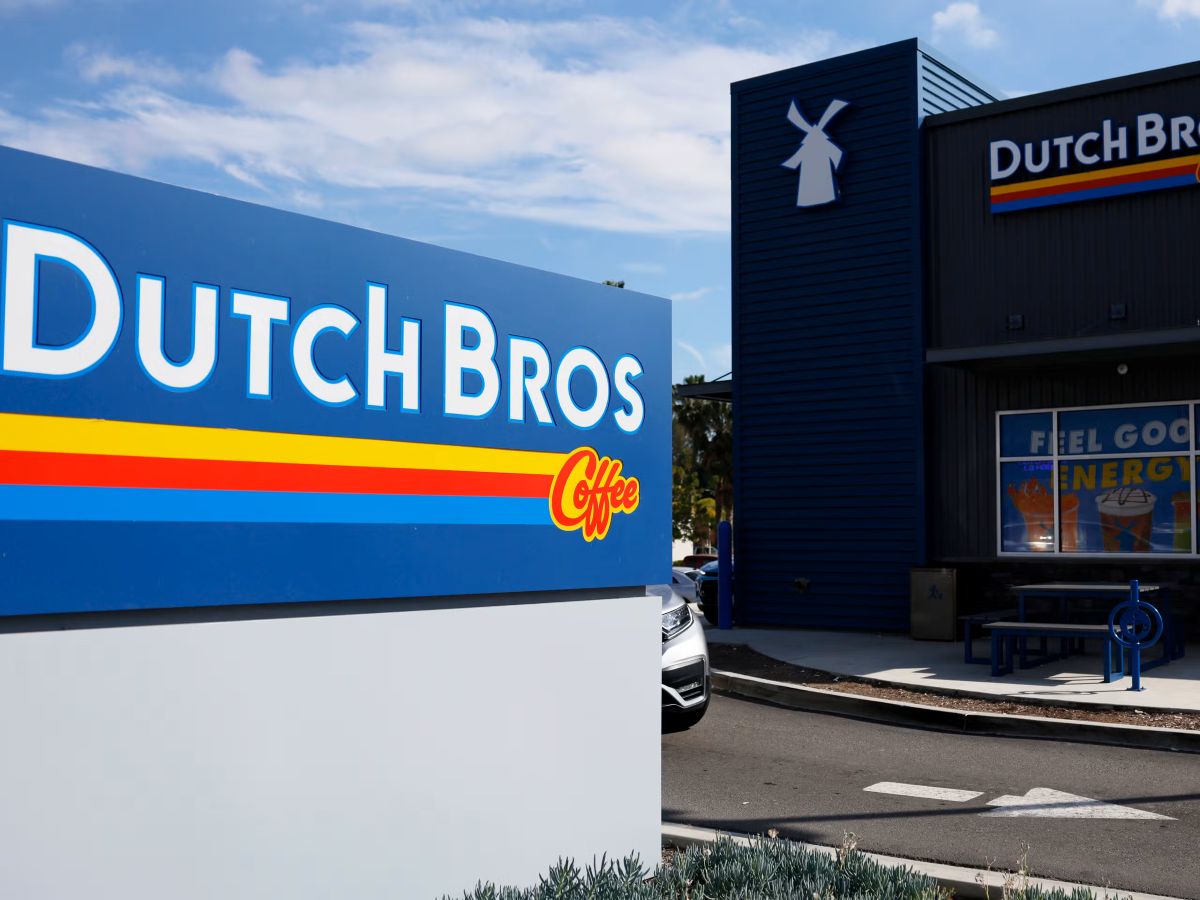
Dutch Bros Over-Indexes on Coffee and Energy Boost Ritual
- Dutch Bros holds 2.0 mental market share against 2.2 market share, a near-perfect match.
- The brand over-indexes on morning coffee (+9.3), energy boost (+9.1), and coffee to share with coworkers (+10.0).
- Dutch Bros ranks fourth on raw coffee association at ~21%, behind Starbucks, Dunkin’, and McDonald’s.
- Mental market share among 18-to-34 adults is 3.2, compared to just 1.2 among 65+.
- The brand’s reach is the real constraint: 51.8% of category buyers bring Dutch Bros to mind.
- Dutch Bros under-indexes on sit-down occasions like family breakfast (-7.1) and weekend brunch (-5.7).
- Emotional connection stands at 2.8, offering room for deeper customer loyalty.
Dutch Bros has built a national brand identity. However, its actual footprint remains concentrated in the West and Sun Belt. At 2.0 mental market share, it is a fraction of Starbucks or Dunkin’ in raw scale. Yet on the occasions that define the category’s center, it punches well above its weight.
These occasions include morning coffee, the energy boost, and coffee shared with coworkers. The ceiling is not relevance; it is reach. With mental market share and converted share nearly identical, this is not a conversion problem. It is a distribution story — an emerging regional brand whose differentiation is genuinely strong.
The Category Entry Points Dutch Bros Wins
Dutch Bros’ Mental Advantage profile reads like a coffee-led brand several times its size. The relative signal is real, even where the absolute reach is not yet there. The brand over-indexes on the coffee and energy boost ritual.
| Occasion | Mental Advantage |
|---|---|
| Bringing coffee to share with coworkers | +10.0 |
| Picking up a coffee to start my day | +9.3 |
| Need to boost energy/focus before a demanding morning | +9.1 |
| Grabbing breakfast on the way to work | −1.0 |
| Meeting someone for coffee and conversation | +2.0 |
| Treating myself to something special to start the day | +4.0 |
Given its size, Dutch Bros over-performs on these daily coffee occasions. These sit at the heart of the category. Dutch Bros leans into them more than its footprint would predict. Its identity is coherent and correctly pointed at the occasions that generate frequency.
The Reach Constraint: Fourth Place in Raw Association
Absolute reach on these same occasions is a distant fourth. On each of these coffee occasions, Dutch Bros ranks fourth on raw association at roughly 21 percent. This is well behind Starbucks (around 40 to 48 percent), Dunkin’, and McDonald’s.
The relative strength is genuine, and it is important not to overread it. Dutch Bros over-indexes because it is small and focused. It is not challenging the leaders for these occasions today. The lean is a foundation to grow from rather than a position of strength to defend. Scale context matters here too. The three chains ahead of it operate many times Dutch Bros’ store count. The national sample includes large regions where the brand has no locations at all.
The Right Absences to Have
Dutch Bros is absent from the sit-down occasions, which is the right absence to have. The brand under-indexes on family breakfast with a Mental Advantage of −7.1. It also under-indexes on weekend brunch at −5.7. For a drive-thru coffee brand, these are the correct occasions to cede. The absences are consistent with a focused coffee proposition rather than a sign of missing breadth.
Mind and Market Are Already Matched
Dutch Bros holds 2.0 mental market share against 2.2 market share. The gap of negative 0.2 is essentially even. Unlike brands whose share runs ahead of or behind their mental availability, Dutch Bros converts the mental availability it has almost exactly. There is no conversion inefficiency to fix and no share running ahead of memory to defend. What limits the brand is the raw size of its mental footprint.
| Metric | Value |
|---|---|
| Mental Market Share | 2.0 |
| Market Share | 2.2 |
| Gap | −0.2 (essentially even) |
| Category Buyers who think of Dutch Bros | 51.8% |
| Network Size | 6.5 |
| Emotional Connection | 2.8 |
Penetration is the ceiling. Dutch Bros is brought to mind by 51.8 percent of category buyers. This is far below the coffee leaders. Its associative Network Size is 6.5, narrower than the national chains. The brand’s problem is not what people think of it. It is that too few people think of it at all. Every occasion it over-indexes on is capped by this reach ceiling.
A Distinctly Younger Base
Dutch Bros’ mental market share is 3.2 among 18-to-34 adults. This compares to just 1.2 among the 65-plus group. This is the sharpest young skew of any brand in its size class. Its strength is generational, concentrated in the audience forming its coffee habits now and most open to a newer brand. This is the most valuable possible profile for a small brand with room to grow.
| Age Group | Mental Market Share |
|---|---|
| 18-34 | 3.2 |
| 35-64 | ~2.0 |
| 65+ | 1.2 |
What to Do About It
Dutch Bros has the rare combination of a focused, correctly-aimed identity and a young base. It is held back almost entirely by how few people it reaches. The strategy is expansion of mental availability on the occasions the brand already fits, without repositioning.
Grow penetration on the coffee occasions it already over-indexes on. The morning coffee, the energy boost, and coffee for coworkers are where Dutch Bros’ Mental Advantage is strongest. Building raw awareness on exactly these occasions, instead of diversifying into new ones, compounds an existing strength and moves the brand up from its fourth-place absolute standing.
Lead with the young base. The 3.2 mental market share among 18-to-34 adults is the brand’s most valuable asset. Concentrating reach-building where the brand already skews is more efficient than competing head-on with the national chains for older or broader audiences.
Continue to deepen emotional connection as reach grows. With emotional connection at 2.8, Dutch Bros should pair awareness growth with reasons to feel loyalty that go beyond recognition. For a brand this size, converting new awareness into genuine attachment on the coffee ritual is what will eventually let its mental market share climb past the specialist tier.
About the Research
Morning Consult conducts over 30,000 daily proprietary surveys in 45 countries. The research covers more than 5,000 brands and 50 economic indicators. The category advantage research measures both mental availability and emotional closeness. It uncovers Category Entry Points and pinpoints growth opportunities.