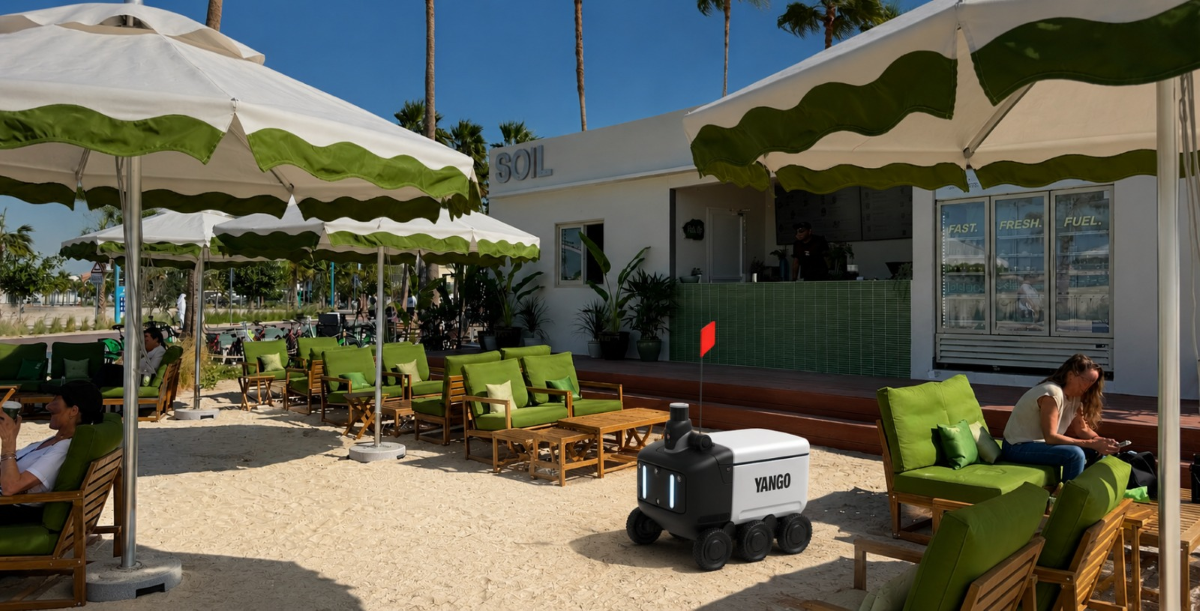
Yango Group Robots to Serve Coffee at Soil Café in Dubai

Dubai – Qahwa World

Yango Group robots will deliver coffee to guests at Soil Café on Kite Beach in Dubai from May 8 to 10, bringing the company’s robotics technology into an everyday café setting.

From 3:00 pm to 8:00 pm Yango Group robots will deliver drinks directly to customers, while Yasmina, the company’s AI assistant, will help staff with simple tasks such as answering questions, recommending drinks, and supporting order requests.

The setup is designed to reduce pressure on staff during busy periods and improve service flow, demonstrating how AI and robotics can handle routine interactions while employees focus on higher-value, human-led service. Taking place in a live café environment, the experience also provides a practical demo at how these technologies can be applied across hospitality and retail sectors, where demand for efficiency and scalable service models continues to grow.

Another experiment being conducted by Sweden: Sweden Experiments With a Café Run by an AI Manager

Yango’s delivery robots are already being deployed across urban environments, supporting last-mile logistics and food delivery operations. Designed to navigate sidewalks and pedestrian areas autonomously, they can carry multiple orders, optimize delivery routes, and operate in high-density city settings. In the GCC, Yango Group has partnered with noon to scale autonomous delivery, reflecting growing interest in robotics as a solution to rising demand in e-commerce and food delivery.

Islam Abdul Karim, Regional Head of Yango Group Middle East, said: “Dubai is one of the most dynamic markets globally for testing new technologies, with high customer expectations and a strong appetite for innovation. It’s a natural place to show how AI and robotics can work in real service environments, supporting staff during peak times, improving speed and consistency, and helping businesses manage growing demand. We show how Yango Group technology can help staff to focus on what matters most: customer interaction and experience.

The Soil Café experience forms part of Yango’s broader efforts to develop practical AI solutions across everyday use cases, including mobility, logistics, and customer service.

Nestlé to Reduce Workforce as Part of Cost-Saving Drive

Dubai – Qahwa World

Nestlé, the Swiss multinational food and beverage corporation, has revealed plans to cut roughly 6% of its global workforce over the next two years as part of a broad efficiency initiative.

Under new CEO Philipp Navratil, the company aims to eliminate about 16,000 positions. Of these, around 12,000 will be in corporate and administrative roles, while the remaining 4,000 will affect manufacturing, logistics, and supply-chain operations.

The job cuts respond to persistent cost pressures and two consecutive quarters of revenue decline. In the first nine months of 2025, Nestlé’s sales fell by 1.9% year-on-year to CHF 65.9 billion ($76.8 billion). Nonetheless, the company credited its coffee and confectionery divisions—underpinned by price increases—for delivering solid growth.

Navratil is pushing to expand Nestlé’s cost-savings target from CHF 2.5 billion to CHF 3 billion by the end of 2027. He described the cuts as “hard but necessary,” noting that while Nestlé’s size offers advantages, it also brings complexity and inefficiencies that must be addressed.

According to the company, the planned reductions in corporate staffing are expected to yield approximately CHF 1 billion in annual savings. Efficiency drives in the production and supply chain segments are intended to support further cost mitigation through automation and operational consolidation.

While Nestlé’s nutrition segment and operations in China were among the weaker performers, the coffee segment showed resilience—even as commodity prices remained elevated and consumer spending softened in many markets.

In particular, the company implemented an average price increase of 7.4% across key coffee and confectionery brands such as Nescafé and Nespresso—moves that helped support growth across all regions. Nestlé also reported strong momentum in its ready-to-drink and coffee concentrate lines, especially in Asian and Oceanic markets.

The decision to downsize globally underscores the intense cost pressures faced by one of the world’s largest food and beverage companies. Even strong-performing sectors like coffee could not completely offset rising production and raw-material expenses, particularly for green coffee and cocoa.

In the coffee commodities market, both Arabica and Robusta prices remain at historically high levels. In September 2025, Arabica futures exceeded $4 per pound for the first time since April, while Robusta prices hovered near $5,694 per tonne—strained by adverse weather, reduced yields in Brazil and Vietnam, and continued supply chain disruptions.