Coffee Prices Sharply Higher as Brazil’s Harvest Is Delayed

Source: Barchart / Rich Asplund
Author: Qahwa Wold
Date: July 27, 2026

Coffee Prices Sharply Higher as Brazil’s Harvest Is Delayed

  • September arabica rose 3.43% and robusta gained 1.12% on Monday.
  • 32.4 mm of rain fell in Minas Gerais last week—2,700% above the historical average.
  • Brazil’s 2026/27 harvest is only 64% complete, behind last year’s 77% and the 70% average.
  • ICE arabica inventories fell to a 2.5-year low of 292,810 bags.
  • USDA forecasts record global production of 189.7 million bags for 2026/27.
  • El Niño risks continue to support prices with potential impacts on Brazil’s flowering.
  • ICE robusta inventories climbed to a 4.25-month high of 4,254 lots.

Coffee prices settled sharply higher on Monday. September arabica closed up 10.75 cents, gaining 3.43%. September robusta closed up 42 points, a rise of 1.12%. The surge came amid concerns that heavy rain in Brazil will further disrupt the coffee harvest.

Somar Meteorologia reported 32.4 mm of rain in Minas Gerais for the week ended July 26. This represents 2,700% of the historical average. Minas Gerais is Brazil’s biggest coffee-growing region.

Harvest Delays Support Coffee Prices

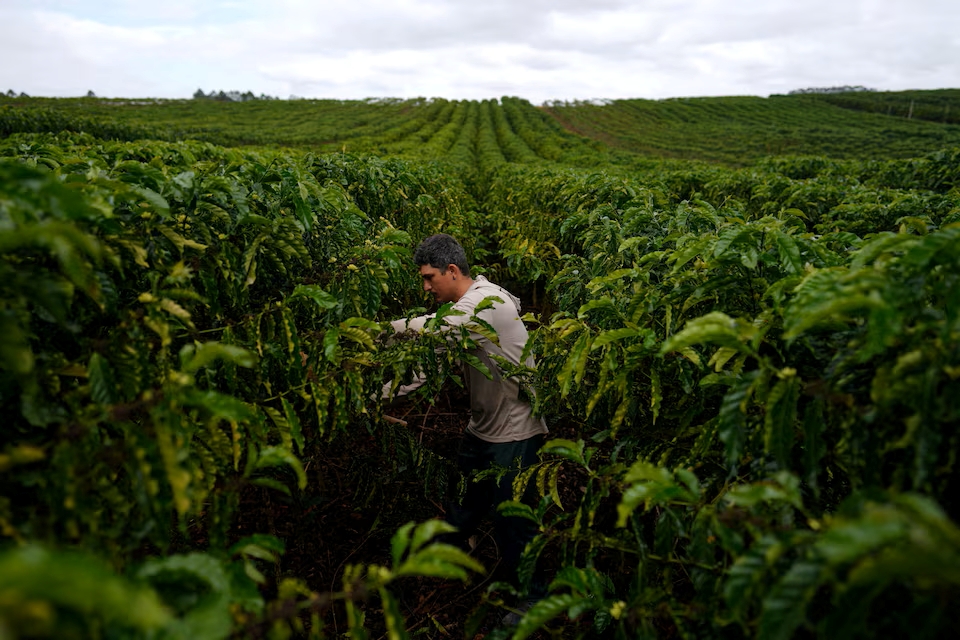
The slow pace of Brazil’s coffee harvest is supporting prices. Harvest among members of Cooxupe co-op was 47.3% complete as of July 17. This is behind the year-earlier pace of 59%. On July 17, Safras & Mercado reported Brazil’s 2026/27 coffee harvest was 64% complete as of July 15. This compares with 77% at the same time last year. The five-year average stands at 70%.

Heavy rainfall in recent weeks has disrupted harvesting operations. Coffee quality may also be affected. Brazilian farmers continue to hold back sales, hoping for higher prices.

Brazil Coffee Harvest Progress
Indicator Value
Cooxupe harvest (as of July 17) 47.3%
Cooxupe year-earlier pace 59%
Brazil overall (as of July 15) 64%
Previous year (July 15) 77%
Five-year average (July 15) 70%
Rainfall in Minas Gerais (week ended July 26) 32.4 mm (2,700% of average)

USDA Forecast and Market Reaction

Last Friday, coffee prices tumbled to 3-week lows. This followed the USDA’s forecast last Wednesday that global coffee output in the 2026/27 season will rise by 6.0% to a record 189.7 million bags. The increase is mainly due to improved growing conditions in Brazil.

The USDA expects global arabica production to rise 12% year-on-year. However, robusta production is expected to fall by 0.7%. World ending stocks are expected to rise by 1.9 million bags to 26.3 million bags. On June 3, the USDA’s Foreign Agricultural Service forecast a record Brazil coffee crop of 71.9 million bags for 2026/27, up 14% year-on-year.
Key Price Drivers for Coffee
Factor Impact Details
Brazil rainfall Bullish 32.4 mm rain, 2,700% above average, disrupting harvest
Harvest progress Bullish 64% complete vs. 77% last year and 70% average
Arabica inventories Bullish 2.5-year low of 292,810 bags
USDA production forecast Bearish Record 189.7 million bags globally
Robusta inventories Bearish 4.25-month high of 4,254 lots
El Niño risks Bullish Potential impact on flowering in September-October

Inventory Trends Support Arabica, Weigh on Robusta

Rising inventories are weighing on robusta coffee. ICE robusta inventories climbed to a 4.25-month high of 4,254 lots last Wednesday. They were mildly below that level at 4,228 lots on Monday.

By contrast, a bullish factor for arabica coffee prices was that ICE arabica coffee inventories fell to a 2.5-year low of 292,810 bags on Monday. This tight supply situation supports higher arabica prices.

El Niño Concerns Support Prices

Concerns about an El Niño weather pattern are bullish for prices. Coffee trader Commercial warned that El Niño may delay rains in Brazil. This September and October is when tree flowering normally occurs. Any delay could hurt Brazil’s 2026/27 coffee crop.

On July 8, the US Climate Prediction Center issued a warning. The El Niño pattern that emerged across the equatorial Pacific last month will likely be one of the strongest in more than 75 years. This sets the stage for possible floods, droughts, and temperature fluctuations later this year. These conditions could hinder coffee production in Asia and South America.

Bearish Factors to Consider

Despite the bullish momentum, several bearish factors exist. Soaring coffee exports from Vietnam are bearish for robusta prices. On July 3, Vietnam’s National Statistics Office reported Vietnam’s 2026 coffee exports from January to June rose 7.3% year-on-year to 1.05 million metric tons. Vietnam’s 2025 coffee exports jumped 17.5% to 1.58 million metric tons. Production for 2025/26 is projected to climb 6% to a four-year high of 1.76 million metric tons.

The USDA’s record production forecast also weighs on the market. However, the supply tightening due to harvest delays and El Niño risks may offset these bearish factors.

Frequently Asked Questions

How much did coffee prices rise on Monday?September arabica gained 3.43% and September robusta rose 1.12% on Monday, July 27.

What is driving the price increase?Heavy rain in Brazil’s Minas Gerais region—32.4 mm, 2,700% above average—is disrupting the coffee harvest and tightening supplies.

What is the status of Brazil’s coffee harvest?Brazil’s 2026/27 harvest is 64% complete as of July 15, behind last year’s 77% and the 70% five-year average.

What are ICE coffee inventory levels?Arabica inventories fell to a 2.5-year low of 292,810 bags, while robusta inventories climbed to a 4.25-month high of 4,254 lots.

What does the USDA forecast say?USDA forecasts record global production of 189.7 million bags for 2026/27, up 6% from the previous year, led by Brazil’s recovery.

How does El Niño affect coffee prices?El Niño could delay rainfall during Brazil’s critical flowering period in September-October, potentially reducing crop yields and supporting prices.

Margin Hikes Drive Coffee Prices Lower

Source: Commodity Bulletin / ICE / USDA / ICO
Author: Editorial Team
Date: July 10, 2026

Margin Hikes Drive Coffee Prices Lower

  • September arabica fell 13.65 cents (-3.92%), while robusta dropped 191 points (-4.72%) on Friday.
  • ICE raised margin requirements twice in one week, reducing liquidity and forcing fund liquidation.
  • Funds increased net-long robusta positions to 44,195 contracts, the highest in over two years.
  • Brazil’s harvest is only 52% complete, behind last year’s 60% and the 55% five-year average.
  • El Niño concerns grow as forecasts warn of delayed rainfall during Brazil’s flowering period.
  • USDA projects a record 71.9 million-bag Brazilian crop for 2026/27, up 14% from last year.
  • Global 2025/26 production is forecast at a record 178.848 million bags.

Coffee prices ended the week sharply lower. September arabica fell 13.65 cents to close at 3.92% lower. September robusta dropped 191 points, a decline of 4.72%. The selloff extended the extreme volatility seen over recent sessions.

The decline followed two margin requirement increases by the Intercontinental Exchange. Higher margins reduced market liquidity. This forced many commodity funds to liquidate positions. The result amplified one-sided price movements.

Speculative Positioning Adds Pressure

Fund positioning has added to the downward pressure. According to Friday’s Commitment of Traders report, funds increased their net-long robusta position. They added 5,607 contracts in the week ending July 7. Their total reached 44,195 contracts. This is the highest level in more than two years.

Such concentrated long positions can accelerate price declines. This happens when investors begin unwinding their holdings. The current market structure remains vulnerable to further selloffs.

Brazil Harvest Behind Schedule

Earlier this week, coffee prices had surged on supply concerns. Arabica reached a 5½-month high on Monday. Robusta climbed to a five-month high on Tuesday. These gains were supported by delays in Brazil’s harvest.

According to Safras & Mercado, Brazil’s 2026/27 coffee harvest was 52% complete as of July 1. This compares with 60% at the same time last year. The five-year average stands at 55%. The slower pace reflects persistent rainfall disruptions.

Brazil Coffee Harvest Progress (as of July 1, 2026)
Period Harvest Progress
Current year (2026) 52%
Previous year (2025) 60%
Five-year average 55%

Weather and El Niño Concerns

Weather concerns continue to underpin the market. Forecasts from Rural Clima indicate rainfall across much of Brazil during mid-July. This could negatively affect coffee crops. Heavy rains over the past month have already disrupted harvesting activities. They may have also reduced crop quality.

Growing concerns over El Niño continue to influence market sentiment. Commercial warned that the phenomenon could delay rainfall in Brazil. The critical flowering period in September and October is at risk. This could potentially affect the 2026/27 crop.

The U.S. Climate Prediction Center also issued a warning this week. The developing El Niño event could become one of the strongest in more than 75 years. This increases the risk of floods, droughts, and temperature extremes across Asia and South America.

Meanwhile, Somar Meteorologia reported that no rainfall was recorded in Minas Gerais. This is Brazil’s largest coffee-growing state. The dry spell occurred during the week ending July 5.

Inventory and Supply Data

ICE-certified coffee inventories remain an important market support. Arabica stocks fell to 344,269 bags on Friday. This is their lowest level in more than 2¼ years. Robusta inventories, however, have recovered from a two-year low. They rose from 3,631 lots on May 15 to 4,200 lots. This is the highest level in about 3½ months.

Bearish Supply Outlook

Despite recent weather-related support, the broader supply outlook remains bearish. On June 3, the USDA Foreign Agricultural Service projected a record Brazilian coffee crop. The forecast stands at 71.9 million bags for 2026/27. This represents a 14% increase from the previous year.

Rabobank also raised its forecast for the global arabica surplus. The new estimate is 9.5 million bags. This is up from 7.0 million bags previously. In addition, Cecafé reported that Brazil’s green coffee exports rose 4.2% year-on-year in May. The total reached 2.73 million bags.

Vietnam is also adding to supply expectations. The country’s National Statistics Office reported strong export figures. Coffee exports during January–June 2026 increased 7.3% year-on-year to 1.05 million metric tons. Vietnam’s 2025 coffee exports rose 17.5% to 1.58 million metric tons. Production for 2025/26 is expected to increase 6% to a four-year high of 1.76 million metric tons (29.4 million bags).

Global Coffee Supply Forecasts
Indicator Value
Global 2025/26 production (USDA) 178.848 million bags (record)
Brazil 2026/27 crop (USDA FAS) 71.9 million bags (record)
Global arabica surplus (Rabobank) 9.5 million bags
Vietnam 2025 coffee exports 1.58 million metric tons (+17.5%)
Vietnam 2025/26 production 1.76 million metric tons (4-year high)
Global ending stocks (USDA) 20.148 million bags (-5.4%)

The International Coffee Organization previously reported global coffee exports for the current marketing year. Exports declined 0.3% year-on-year to 138.658 million bags.

According to the USDA’s biannual report, global coffee production for 2025/26 is forecast to reach a record 178.848 million bags. This represents a 2% increase from the previous year. Arabica production is expected to decline 4.7% to 95.515 million bags. Robusta production is projected to rise 10.9% to 83.333 million bags.

The USDA forecasts Brazil’s 2025/26 production at 63 million bags. This is down 3.1% from the previous year. Vietnam’s output is expected to increase 6.2% to 30.8 million bags. Global ending stocks are forecast to fall 5.4% to 20.148 million bags from 21.307 million bags a year earlier.

Frequently Asked Questions

Why did coffee prices fall sharply on Friday?September arabica fell 3.92% and robusta dropped 4.72% after ICE raised margin requirements twice in one week, reducing liquidity and forcing fund liquidation.

What is the current fund positioning in coffee?Funds increased their net-long robusta position to 44,195 contracts, the highest level in more than two years, making the market vulnerable to rapid selloffs.

How is Brazil’s 2026/27 coffee harvest progressing?The harvest is 52% complete as of July 1, behind last year’s 60% and the five-year average of 55%, due to persistent rainfall delays.

What is the El Niño risk for coffee production?El Niño could delay rainfall in Brazil during the September-October flowering period, potentially damaging the 2026/27 crop, with forecasts suggesting one of the strongest events in 75 years.

What does the supply outlook show?USDA projects a record 71.9 million-bag Brazilian crop for 2026/27, while Vietnam’s exports rose 7.3% in early 2026, signaling ample global supply.

What is the global production forecast?USDA forecasts record global production of 178.848 million bags for 2025/26, with robusta up 10.9% and arabica down 4.7%.