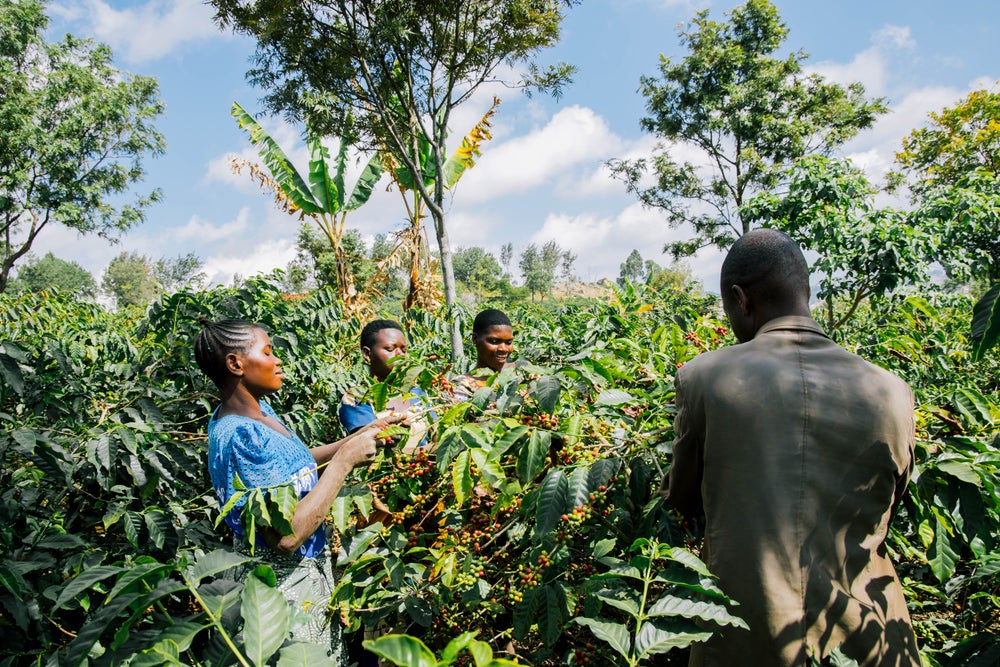
Tanzania 2026 Harvest Update: Arabica and Robusta Progress

Source: Sucafina / Cotacof (Sucafina Tanzania)
Author: Qahwa World
Date: August 5, 2026

Tanzania 2026 Harvest Update: Arabica and Robusta Progress

  • Tanzania’s 2026 coffee crop is expected to be 4-5% larger than last season.
  • New plantations entering production and improved farm management drive the growth.
  • Arabica harvest is approximately 40% complete, with peak picking over the next 2-3 weeks.
  • Robusta harvest is 80-90% complete, with 25-30% commercialized so far.
  • Processing infrastructure faces pressure from higher volumes, with washing stations at full capacity.
  • Sucafina works with 15 AMCOS cooperatives through its Loyalty Program in Tanzania.
  • Community projects include hospital upgrades and school improvements.

Tanzania’s 2026 coffee harvest is in full swing. Arabica and Robusta crops are progressing in line with expectations. Stronger volumes are testing processing infrastructure. However, quality remains stable.

New plantations are maturing and entering production. Established farms are also improving yields. These factors contribute to a larger crop volume this season.

Arabica Outlook

Tanzania’s Arabica harvest is currently around 40% complete. Most farms are approaching peak picking over the next two to three weeks. Volumes are tracking slightly above last season.

Overall production is expected to increase by 4-5%. This aligns with our forecast. New plantations are reaching their first and second harvests. Older farms have improved yields over the past three years. The market rally incentivized better farm management.

Early quality assessments suggest a profile consistent with expectations. “What we’ve analyzed so far looks similar to last season’s. There are no red flags, and we expect the crop to deliver decent quality overall,” says Kihara Victor, Trading Manager at Cotacof (Sucafina in Tanzania).

Tanzania 2026 Harvest Progress
Crop Progress Notes
Arabica ~40% complete Peak picking in next 2-3 weeks
Robusta 80-90% complete 25-30% commercialized
Overall Volume +4-5% vs last season Driven by new plantations and improved yields

Robusta Outlook

The Robusta harvest is more advanced. It is currently 80-90% complete. However, only 25-30% has been commercialized so far. The main focus now is on drying the coffee to be ready for auctions.

Quality is expected to remain consistent with last year. This depends on maintaining processing timelines. Drying capacity must also keep pace with incoming cherry.

Processing Capacity: Challenges and Opportunities

Higher volumes are creating pressure across the supply chain. Producers face labor shortages during peak harvest. Processors are running washing stations around the clock. They are also building more drying tables.

“The standout of this year’s harvest is the scale,” Kihara says. “Cooperatives are running washing stations at full capacity – and some are over capacity. This is something we haven’t seen to this extent in Tanzania before, even with steady volume growth in recent years. It reflects the combined impact of new plantations coming online, alongside improving yields on older farms.”

Support from the Tanzania Coffee Board and exporters is enabling cooperatives to expand their drying capacity. This helps manage throughput and maintain quality. “It’s a real signal that infrastructure investment will need to keep pace with production growth in coming seasons,” Kihara notes.

Processing and Quality Indicators
Indicator Status
Washing stations Running at full capacity, some over capacity
Drying capacity Expanding with support from Coffee Board
Arabica quality Consistent with last season
Robusta quality Expected consistent with last year
Labor availability Shortages during peak harvest

Strengthening Resilience in Coffee Communities

Sucafina continues to invest in projects that help farmers, cooperatives, and communities build resilience. The company now works with 15 AMCOS through its Loyalty Program. This program incentivizes improvements in yield, quality, and farming practices.

Sucafina launched a new pilot project with a partner. The project supports four AMCOS with prefinancing for inputs and working capital during the season. “The aim is to help cooperatives strengthen their operations, improve access to finance, and ensure they can continue to purchase coffee from farmers and run washing stations to the highest standards,” Kihara explains. “The funds are already being distributed, and we plan to expand this project.”

In 2026, Sucafina partnered with five AMCOS in the Loyalty Program to fund key community projects. These initiatives include upgrades to hospital beds and improvements to local schools, including building bathrooms. These projects help enhance community wellbeing.

To ensure continued access to responsibly sourced coffees, Sucafina expects to complete IMPACT re-verification this year. This includes Rainforest Alliance and C.A.F.E. Practices verification.

Outlook and Next Steps

Tanzania’s 2026 harvest reflects a sector in transition. Rising production is placing demands on supply chain infrastructure. Early indications suggest these challenges are being managed effectively. Quality is expected to remain stable.

If you are planning to book coffees from Tanzania or support sustainability initiatives, now is a good time to reach out to your trader. Discuss availability and booking options.

Frequently Asked Questions

How large is Tanzania’s 2026 coffee crop expected to be?The 2026 crop is expected to be 4-5% larger than last season, driven by new plantations and improved farm management.

What is the progress of the Arabica harvest?The Arabica harvest is approximately 40% complete, with peak picking expected over the next two to three weeks.

What is the progress of the Robusta harvest?The Robusta harvest is 80-90% complete, with 25-30% commercialized so far.

How is quality expected to compare to last season?Both Arabica and Robusta quality are expected to remain consistent with last season, provided processing timelines are maintained.

What is Sucafina’s involvement in Tanzania?Sucafina works with 15 AMCOS cooperatives through its Loyalty Program, supporting yield improvements, quality, community projects, and sustainability verification.

What community projects are being supported?Projects include upgrades to hospital beds and improvements to local schools, including building bathrooms, to enhance community wellbeing.

Tanzania Coffee Production to Rise 10 Percent in 2026/27

Author: Qahwa World
Source: USDA Foreign Agricultural Service (FAS) Dar es Salaam
Date: May 20, 2026
Executive Summary:

  • FAS Dar es Salaam forecasts Tanzania coffee production to reach 1.6 million 60 kg bags in MY 2026/27, a 10.3 percent increase year on year.
  • The growth is driven by rehabilitated fields from 2019 to 2024 reaching full maturity and rising coffee prices incentivizing farmer investment.
  • Cultivated area is expected to expand from 270,000 hectares to 275,000 hectares, with harvested area increasing to 270,000 hectares.
  • Green bean exports are projected to rise 2.9 percent to 1.4 million bags, supported by higher production and strong global demand.
  • The European Union remains Tanzania’s leading coffee importer, purchasing five times more than the United States.
  • Domestic consumption is projected to increase from 85,000 to 90,000 bags, driven by growing urban coffee culture in Dar es Salaam and Arusha.
  • Ending stocks are expected to rise sharply to 157,000 bags due to production outpacing consumption and export growth.

Tanzania’s coffee production is projected to reach 1.6 million 60 kilogram bags in the 2026/27 marketing year, up from 1.45 million bags the previous year, representing a 10.3 percent increase.

This growth is attributed to rehabilitated fields from 2019 to 2024 reaching full maturity. Rising coffee prices have incentivized farmers to expand plantations, invest in advanced fertilizers and equipment, and enhance efficiency.

Stable prices have strengthened cooperative societies, expanding support and training for growers. Favorable rainfall and steady temperatures have improved growing conditions, helping the sector recover from past droughts and increasing yields. Strong global demand continues to drive production and exports, reinforcing Tanzania’s position in the coffee market.

Crop Area Expansion

Tanzania’s coffee sector is expected to expand by nearly two percent, with cultivated area rising from 270,000 hectares in MY 2025/26 to 275,000 hectares in MY 2026/27. This rise is driven mainly by robusta farmers in Kagera and Kigoma who are opening new land and are supported by subsidized seedlings and strong farm gate prices. Harvested area is projected to increase by a similar percentage from 265,000 hectares to 270,000 hectares as new farms mature.

Coffee is the country’s leading cash crop, grown by over 40 percent of farmers and covering 39 percent of permanent cropland. Production occurs through three systems: pure stand smallholder farms in the south, coffee banana intercropping in the north and west, and larger estates. Overall, larger estates contribute under 10 percent of output. Most smallholders cultivate about 0.63 hectares with older trees and 400 to 2,000 trees per farm. Tanzania produces arabica in the northern and southern highlands and robusta almost entirely in Kagera near Lake Victoria.

Production and Inputs

Indicator MY 2024/25 MY 2025/26 MY 2026/27 (Forecast)
Area harvested (1000 HA) 265 265 270
Arabica production (1000 bags) 700 750 850
Robusta production (1000 bags) 650 700 750
Total production (1000 bags) 1,350 1,450 1,600
Bean exports (1000 bags) 1,250 1,360 1,400
Domestic consumption (1000 bags) 77 85 90
Ending stocks (1000 bags) 50 51 157

Tanzania is one of the three leading producers of the Colombian mild arabica variety, contributing about six percent of global supply. Roughly 320,000 smallholder farmers produce 90 percent of the crop, with about 100 large estates accounting for the rest.

Fertilizer subsidies in Tanzania primarily support tobacco, corn, and rice producers, with minimal assistance directed toward coffee farmers. In February 2026, the government reduced its fertilizer subsidy from covering roughly half the market price to a flat rate of approximately 0.38 US dollars per 50 kg bag. High fertilizer prices have long prevented farmers from applying adequate nutrients, keeping average use near 50 kilograms per hectare.

Policy and Trade

Tanzania is expanding climate resilient coffee varieties, widening cultivation, improving input support, and upgrading processing and agronomic practices. Recent reforms include a 30 million US dollar memorandum of understanding with Corus International that focuses on large scale seedling distribution, stronger disease control programs, digitalized auctions, and tighter export licensing rules. The policy aims to boost transparency, traceability, and competitiveness in premium markets.

The Tanzania Coffee Board’s directive of April 24, 2026, established benchmark prices of 4.61 US dollars per kilogram for processing unit parchment arabica, 3.65 dollars for home processed parchment arabica, 1.54 dollars for robusta dry cherry, and 1.96 dollars for hard arabica dry cherry.

Green bean exports are projected to rise 2.9 percent to 1.4 million bags in MY 2026/27, supported by higher production and strong global demand. The European Union remains Tanzania’s leading coffee importer, purchasing five times more than the United States. Japan also remains a key destination for Tanzanian coffee, particularly for premium arabica.

Export Destinations and Soluble Coffee Decline

Destination 2022 (bags) 2023 (bags) 2024 (bags) 2025 (bags)
European Union 588,354 749,451 652,891 596,487
Japan 281,684 204,779 200,254 193,718
United States 58,841 79,586 112,720 128,032
Morocco 49,678 93,941 52,226 69,192
India 17,928 36,326 50,934 30,594

The United States is rapidly emerging as a major growth market for Tanzanian coffee, with imports rising from 58,841 bags in 2022 to 128,032 bags in 2025. Meanwhile, soluble coffee exports from Tanzania collapsed dramatically between 2022 and 2025, falling from 10,858 bags to just 814 bags, a drop of more than 92 percent. The EU and Kenya, once the two largest buyers, slashed imports from several thousand bags to only 446 and 88 bags respectively by 2025.

Domestic Consumption and Stocks

Tanzania’s coffee consumption is projected to increase from 85,000 to 90,000 bags in 2026/27, driven primarily by a growing urban coffee culture in Dar es Salaam and Arusha. Rising incomes and urbanization are encouraging younger professional consumers to incorporate coffee into their daily routines. Tourism further reinforces demand, as hotels and operators serving visitors expand their coffee offerings.

Projected coffee stocks for MY 2026/27 are expected to rise sharply to 157,000 bags, up from 51,000 bags in MY 2025/26, reflecting a significant supply driven buildup. The surge is primarily the result of higher production outpacing the country’s relatively modest growth in domestic consumption and exports.

Frequently Asked Questions (FAQ)

1. How much will Tanzania coffee production increase in 2026/27?

FAS Dar es Salaam forecasts a 10.3 percent increase to 1.6 million 60 kg bags, driven by rehabilitated fields reaching maturity and rising prices.

2. What is driving the expansion of coffee area in Tanzania?

Robusta farmers in Kagera and Kigoma are opening new land, supported by subsidized seedlings and strong farm gate prices. Cultivated area is expected to reach 275,000 hectares.

3. Which countries are the top buyers of Tanzanian coffee?

The European Union remains the leading importer, followed by Japan and the United States, which has shown rapid growth in recent years.

4. What happened to Tanzania’s soluble coffee exports?

Soluble coffee exports collapsed by more than 92 percent between 2022 and 2025, falling from 10,858 bags to just 814 bags.

5. How is domestic coffee consumption changing in Tanzania?

Domestic consumption is projected to rise from 85,000 to 90,000 bags, driven by growing urban coffee culture in Dar es Salaam and Arusha and rising tourism demand.

6. Why are ending stocks expected to increase sharply?

Production is outpacing the relatively modest growth in domestic consumption and exports, leading to a supply driven buildup to 157,000 bags.

Qahwa World – Based on USDA FAS Coffee Annual report TZ2026-0003 by Benjamin Mtaki, approved by Damian Ferrese.
Published: May 20, 2026