Potato Taste Defect Hits Great Lakes Coffee

By: Ennio Cantergiani – Académie du Café

Specialty coffee professionals know the moment well: a Rwanda or Burundi coffee expected to showcase vibrant stone fruit notes suddenly reveals the unmistakable flavor of raw potato. This phenomenon, known as the Potato Taste Defect (PTD), affects not only flavor but also the livelihoods of farmers and the economics of the coffee trade.

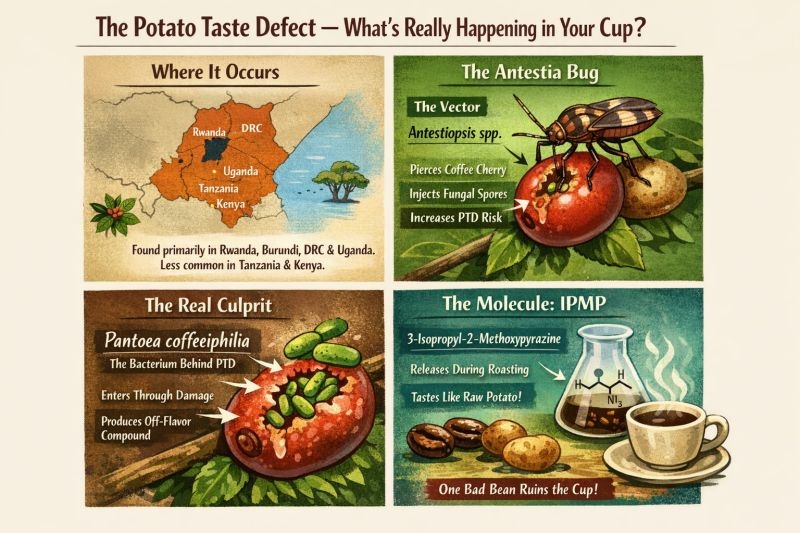
PTD is most commonly found in Rwanda, Burundi, the Democratic Republic of Congo, and Uganda, with occasional cases in Tanzania and Kenya. Researchers first documented it in eastern DRC, and its biochemical mechanisms continue to be investigated.

The defect is often linked to the Antestia bug, which pierces coffee cherries, injecting saliva and fungal spores. While the bug increases the risk of PTD, it is not the direct cause. The true culprit is the bacterium Pantoea coffeiphila, which colonizes damaged cherries. This bacterium produces compounds — IPMP and IBMP — that volatilize only during roasting, resulting in the raw potato, earthy, and starchy flavors that appear in the cup. Even a single affected bean can spoil an entire brew.

Read Also: Coffee Carbon Footprint: How Sustainable Is Your Cup?

Beyond taste, PTD has economic consequences. Studies indicate the defect can reduce the price of high-quality coffee by up to 57%, and buyers often penalize entire origins, lowering prices for lots that may contain no defective beans. For farmers who rely on coffee as their primary income, this structural challenge is significant.

Preventing PTD requires care across the supply chain. On farms, removing leftover fruit, pruning trees, and targeted use of natural insecticides reduce risk. Wet mills can use flotation, visual sorting, and technologies such as UV or laser scanning to detect damaged beans. Roasters and baristas should cup multiple samples, grind smaller test batches, and purge equipment if PTD is detected, remembering that the defect is sporadic, not systemic.

PTD is not a reason to avoid coffees from Rwanda, Burundi, or DRC. Instead, it is a reason to know the origins and producers deeply. With knowledge and careful handling, the distinctive, high-quality flavors of the Great Lakes region can still shine in every cup.
Burundi and Rwanda Coffee Harvest Update 2026

Bujumbura  – QAHWA WORLD

Preliminary reports from Burundi and Rwanda indicate promising prospects for the 2026 coffee harvest, with an estimated combined total of around 40,000 metric tonnes (MT) of high-quality green coffee. Teams in both countries have shared insights on volume, quality, and sustainability initiatives supporting farmers.

Burundi Harvest Outlook

Burundi’s coffee harvest for 2026 is expected to increase by over 60% compared to 2025, reaching approximately 24,000 MT. Favourable weather since mid-August has supported strong flowering, with the harvest expected to start fully around 10 March, about one month earlier than last year. Quality monitoring at washing stations is underway, with initial observations indicating good cherry development. The harvest is expected to continue until July, depending on rainfall.

Sustainability Initiatives in Burundi

This season marks the launch of a major public-private initiative to rejuvenate coffee production. The tree stumping programme involves 14,000 farming households and around 700,000 trees. Combined with planting new seedlings, the programme aims to quadruple productivity within three to five years.

Additionally, all Burundian coffee is now offered as IMPACT-verified, Sucafina’s responsible sourcing programme. Farmers receive training and support to improve environmental and social outcomes while enhancing traceability and quality. Approximately 30,000 smallholder farmers are engaged in these sustainability programmes this year.

Rwanda Harvest Forecast

Rwanda’s 2026 harvest is projected at around 16,000 MT, lower than the previous year due to less favourable flowering conditions, but expected to maintain high quality. The harvest began in mid-February and is expected to continue until late June.

Market and Regulatory Factors

Reduced supply is likely to increase market competition. RWACOF (Sucafina in Rwanda) continues to prioritise exceptional-quality cherry and close monitoring of processing at partner washing stations. A new scalable model has been introduced to expand sourcing areas while mitigating market risks.

Sustainability Initiatives in Rwanda

Sucafina’s sustainability programmes in Rwanda include tree rejuvenation, carbon footprint mapping, and regenerative agriculture. Since 2023, 197,782 trees have been stumped, with over 155,000 in 2025 alone. Farmers received inputs such as lime and organic fertiliser, alongside structured monitoring to track “back-to-production” timelines.

The Farmer Development Program, launched with the London School of Economics, provides training, loans, and tree-planting incentives to 3,735 farmers across five service centres. Agroforestry initiatives have distributed 110,064 shade trees, integrating sustainable practices into the supply chain.

Village Savings and Loan Associations (VSLAs) have been scaled, engaging 1,529 members (51% women) and mobilising $30,884 in savings, with 67% loaned to 924 farmers. Over the next six months, Sucafina will establish a 145,000-seedling nursery, expand refresher trainings, and conduct IMPACT verification, expected to make verified coffee available by June 2026.