Korean Innovation Transforms Coffee Waste into High-Performance Thermal Insulation

SEOUL – Qahwa World

As the global search intensifies for effective solutions to both the climate crisis and the growing burden of organic waste, a recent scientific breakthrough offers an unexpected answer from within a coffee cup. A study published in Biochar (2026) reveals that researchers from Jeonbuk National University have developed a high-performance thermal insulation material made entirely from coffee waste. In other words, the team successfully created coffee waste thermal insulation with remarkable properties.

Led by Sung Jin Kim and Seong Yun Kim, the research team successfully engineered an eco-friendly material that matches the efficiency of top-tier petroleum-based industrial insulators. This development marks an important milestone in coffee waste thermal insulation innovation.

  • The Context: Millions of Tons of Coffee Waste

Coffee is the second most traded commodity in the world after crude oil. This immense global consumption generates approximately 8 million tons of spent coffee grounds (SCG) annually. Most of this waste ends up in landfills, where it decomposes and releases methane, a greenhouse gas significantly more potent than carbon dioxide, or is incinerated, contributing to air pollution.

This environmental challenge provided the foundation for the study, which aims to convert coffee waste into a valuable resource for the construction industry by using it for coffee waste thermal insulation.

  • The Technical Challenge: Enhancing Porosity

The effectiveness of thermal insulation depends largely on a material’s ability to trap air, as stagnant air is a natural insulator. However, raw coffee waste has relatively low porosity, around 46 percent, making it unsuitable for direct use.

To overcome this, researchers subjected the coffee waste to a controlled carbonization process at 700 degrees Celsius. Unlike conventional methods that use inert atmospheres, this process was conducted in an ambient atmosphere, allowing oxygen to interact with the material. This reaction expanded the internal structure, increasing porosity to an impressive 71 percent.

The resulting material, known as biochar, features a network of macropores that effectively trap insulating air. Therefore, the study showed that coffee waste thermal insulation could provide significant benefits compared to traditional options.

  • Breakthrough Innovation: Pore Restoration Technology

A major obstacle emerged when integrating the porous biochar with binding materials. Typically, liquid polymers seep into and clog pores, reducing insulation performance.

To address this, the team developed an innovative pore restoration technique:

Protective mixture: Biochar is combined with a green solvent, propylene glycol.
Molecular shielding: The solvent temporarily fills the pores and prevents the binding polymer, ethyl cellulose, from entering during processing.
Final evaporation: After forming the panels, the solvent is removed under vacuum conditions, restoring the material’s porous structure.

This process enabled the material to achieve a thermal conductivity of 0.04 W m⁻¹ K⁻¹, comparable to conventional polystyrene insulation without the associated environmental harm.

  • Real-World Applications: Smarter Solar Buildings

The study extended beyond laboratory testing to simulate real-world applications, particularly in building-integrated photovoltaic systems. Solar panels generate electricity but also produce significant heat that can increase indoor cooling demands.

When the coffee-based insulation was applied beneath solar panels, it effectively reduced heat transfer and kept indoor spaces cooler. This dual-function solution addresses both waste management and energy efficiency.

  • Sustainability and Biodegradability

Unlike traditional insulation materials, which can persist in the environment for centuries, the coffee-based material is biodegradable. Tests showed that it lost more than 10 percent of its weight within 21 days when exposed to natural enzymes, indicating its potential to return safely to the environment as a carbon-rich soil additive.

  • A Vision for the Future

This innovation represents more than just a new building material. It reflects a broader shift toward total sustainability in the coffee sector. By transforming waste into a high-value construction resource, the research opens pathways for collaboration between coffee producers and the building industry.

It is a compelling example of how science can convert everyday waste into advanced solutions that support environmental protection and sustainable urban development, with coffee waste thermal insulation standing out as a promising advancement.
From Cup to Concrete: How Coffee Waste Is Building a Greener Future

Dubai – Qahwa World

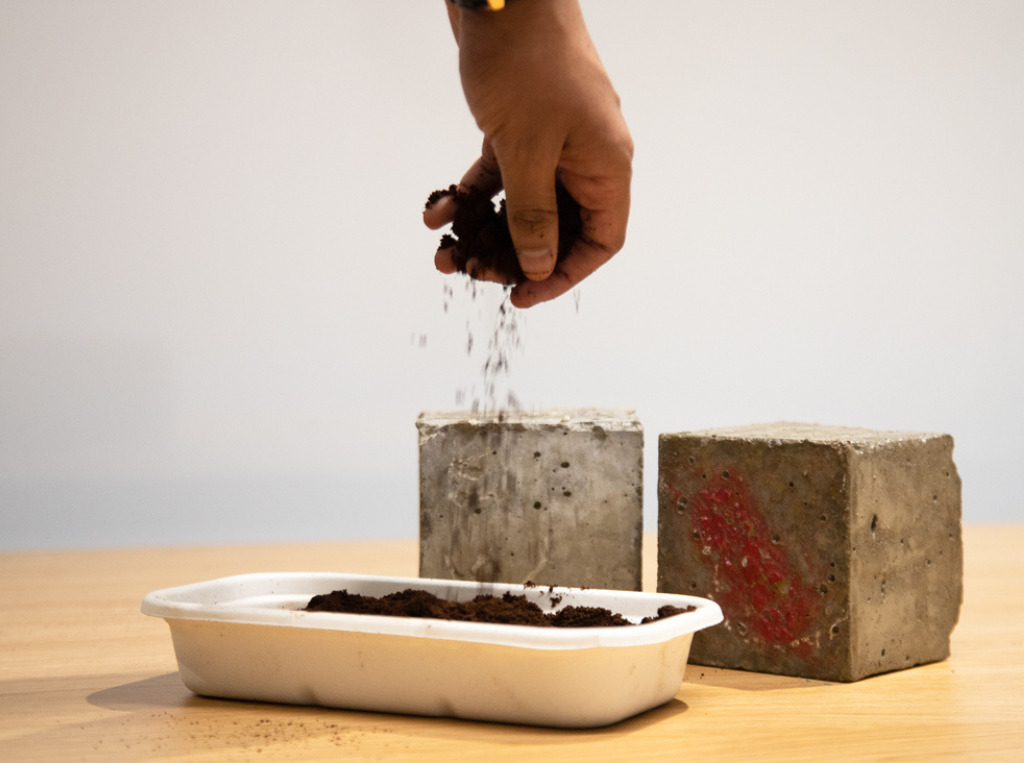
Two years after Australian researchers first turned yesterday’s espresso shots into tomorrow’s building material, the “coffee concrete” revolution is no longer a lab curiosity. It is now being used on the streets of Victoria and reshaping how the world thinks about waste.

As a coffee expert who has spent two decades tracing every bean from farm to cup, I can say this: the humble spent coffee ground, once a soggy pile thrown away without a second thought, is now a high performance material in the construction industry. In 2026, the story is getting even better.

The Science, Brewed to Perfection

Back in 2023, engineers at RMIT University discovered that pyrolyzing spent coffee grounds at 350°C in the absence of oxygen creates a porous, carbon rich biochar. Replacing up to 15 percent of the sand in a standard concrete mix with this biochar increases compressive strength by nearly 30 percent. Higher temperatures do not perform as well. The optimal point is a precise low and slow process.

This is not just stronger concrete. It is smarter concrete. A peer reviewed life cycle analysis published in November 2025 showed it can reduce the material’s carbon footprint by up to 26 percent, cut fossil fuel use by 31 percent, and ease pressure on diminishing river sand supplies.

RMIT has also reported that the same coffee derived biochar improves thermal insulation in cement composites by up to 20 percent. Buildings made with it stay cooler in summer and warmer in winter. This leads to lower energy use and reduced emissions over time.

Real Streets, Real Impact

The results are already visible in real world projects.

In October 2024, the first section of coffee biochar concrete was laid on Victoria’s Big Build project in Pakenham. Five tonnes of spent coffee grounds, equal to about 140000 cups of coffee, were converted into two tonnes of biochar for a 30 cubic metre footpath. There was no smell and no visible difference, only improved strength and sustainability.

A parallel trial in Gisborne with Macedon Ranges Shire Council tested coffee and wood chip biochar side by side. Researchers continue to monitor long term performance under foot traffic, weather conditions, and freeze thaw cycles. Early results are promising.

A Circular Gift for the Coffee Industry

This development has direct implications for café owners, roasters, and coffee drinkers.

Globally, tens of millions of tonnes of spent coffee grounds are produced each year. Most are still sent to landfill, where they release methane. Now, this waste can be reused in a way that benefits both the environment and the industry.

Cafés that join collection programs may eventually turn their daily waste into revenue or carbon credits. A single cup of coffee could contribute to building stronger and more energy efficient schools and hospitals. This is a practical example of a circular economy.

Dr Rajeev Roychand and the RMIT team have stated they are ready to scale the technology. They are working with contractors and local councils and presenting the material in major exhibitions. The next steps include commercial standards, larger pilot projects, and expanded supply chains, all progressing in 2026.

The Bigger Picture

This innovation stands out as one of the most effective responses to coffee waste. It does not require changes in how coffee is prepared. It simply redefines the value of what remains after brewing.

From coffee farms in Ethiopia and Colombia to urban infrastructure in Melbourne and beyond, coffee is proving it can play a role far beyond consumption. It can contribute to building a more sustainable and resilient world.

In 2026, the future of construction carries a subtle trace of coffee.

Ahmed Al-Qahwa is Qahwa World’s lead voice on sustainable coffee innovation. He has visited RMIT’s laboratories and walked the Pakenham trial site.

Share this story with your local café or council. The coffee grounds from your cup could one day be part of the ground beneath your feet.

Low-Emission Concrete Production from Coffee Waste

Dubai – Qahwa World

Researchers at RMIT University are developing new ways to reduce the carbon footprint of construction materials by converting spent coffee grounds into biochar for use in concrete. A life-cycle analysis conducted by RMIT University has shown, for the first time, that biochar made from used coffee grounds can help produce a lower-carbon concrete while maintaining the strength gains observed in earlier laboratory trials.

Previous experiments by the RMIT team involved heating spent coffee grounds at about 350°C without oxygen to create a fine biochar. When this material replaced 15% of sand in concrete, the 28-day strength increased by roughly 30%, offering a practical way to ease pressure on natural sand resources.

Building on these findings, a new study led by Dr. Jingxuan Zhang and Dr. Mohammad Saberian presents a full cradle-to-grave assessment measuring carbon emissions, resource consumption, and environmental impacts from production through to end-of-life. The analysis recorded CO₂ reductions of 15%, 23%, and 26% when biochar replaced 5%, 10%, and 15% of sand, along with up to 31% lower fossil-fuel use and improved impacts on waterways.

RMIT University notes that the research supports Australia’s shift toward a circular economy and net-zero ambitions by turning abundant organic waste into functional materials, reducing reliance on natural sand, and encouraging greater public engagement with resource recovery.

Low-Emission Concrete Production from Coffee Waste

Zhang said the findings strengthen the case for real-world applications. Professor Chun-Qing Li, who guided the research team, said the innovation demonstrates how organic waste can become a practical ingredient for lower-carbon infrastructure.

Saberian said the next steps include larger pilot projects, mix optimisation, and alignment with construction standards so the approach can be adopted confidently across future projects. RMIT and its partners have already advanced public demonstrations, including a footpath pilot and the first use of coffee-biochar concrete on the Victorian Big Build, and presented the concept through the National Gallery of Victoria’s Making Good: Redesigning the Everyday exhibition.

The study, “Carbon footprint reduction in concrete using spent coffee grounds biochar: a life cycle perspective,” is published in the International Journal of Construction Management (DOI: 10.1080/15623599.2025.2584549). Authors include Jingxuan Zhang, Mohammad Saberian, Rajeev Roychand, Jie Li, Chun-Qing Li, Guomin Zhang, and Dilan Robert.