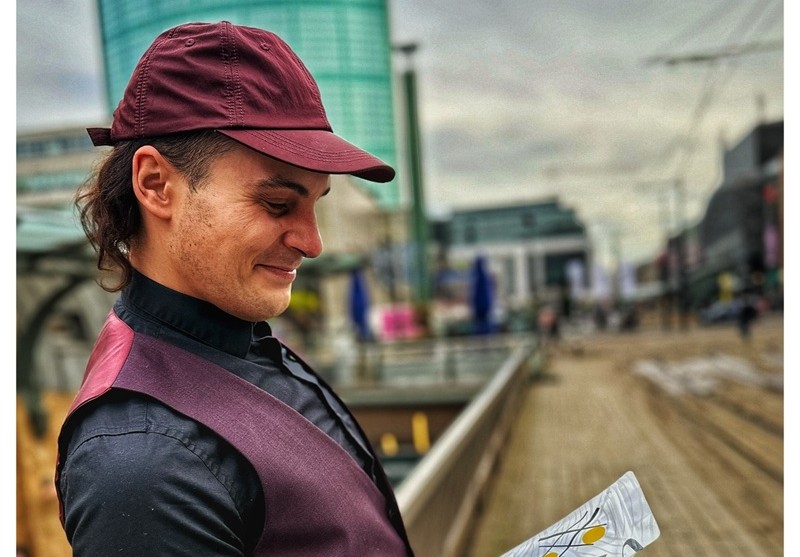
Fabricio Scocco Fioravante: Incremental Progress on a Regulation That Needed Recalibration

Netherlands – Ali Azakary | Qahwa World

On May 4, the European Commission published its “simplification” package for the Deforestation Regulation. Some saw it as genuine relief. Others called it cosmetic.

Qahwa World concludes its interview series with industry experts. After Dr. Steffen Schwarz, Kim Thompson, Burke Campbell, John Seroney, and Michael Trung, our sixth and final guest is Fabricio Scocco Fioravante, founder of Takumi Collective in the Netherlands.

Fabricio is a specialty coffee importer and roaster who works directly with smallholder producers in Latin America and Africa. He represents the voice of the European importer dealing with micro-lots and direct trade relationships, offering a different perspective from his more critical counterparts.

Here is what he said.

  • What is your overall take on the EU simplification decision? Does it truly reduce the burden, or is it mostly cosmetic?

Fabricio Scocco Fioravante: I think it’s a step in the right direction, but honestly, it’s incremental progress on a regulation that was already overdue for recalibration.

The burden reduction for small operators is real and welcome. But the structural complexity hasn’t disappeared. For those of us working with micro-lot and direct-trade supply chains, traceability was already part of how we operate. The issue was never the principle. It was the bureaucratic weight that falls unevenly across the chain.

  • Who benefits the most from this simplification in your opinion?

Fabricio Scocco Fioravante: Interestingly, large companies with compliance infrastructure absorb this more easily than anyone else. Small independent roasters and importers like us still face disproportionate administrative overhead relative to our volume.

The biggest real-world benefit goes to low-risk country exporters and small producers who now have clearer, lighter obligations. That part I genuinely welcome.

  • Soluble coffee is now fully covered, after being excluded before. How do you see this affecting coffee traders and roasters worldwide?

Fabricio Scocco Fioravante: This closes a loophole that was always philosophically inconsistent. If the regulation is about deforestation risk in the supply chain, soluble coffee was never exempt from that risk. It was just exempt from the paperwork.

Including it levels the playing field and forces industrial processors to operate under the same traceability logic that specialty roasters were already working towards. Long overdue.

  • Is the global coffee supply chain truly ready for the December 30, 2026 deadline? If not, which part of the industry will take the biggest hit?

Fabricio Scocco Fioravante: No, not fully. The geolocation requirement is technically sound but practically uneven.

In well-organized origins like Colombia or parts of Ethiopia, this is manageable. In fragmented smallholder landscapes – certain regions of Uganda, the Democratic Republic of Congo, parts of Asia – plot-level geolocation is still a serious challenge.

The part of the industry that will take the biggest hit is mid-tier importers working with aggregated lots from complex origins who don’t have direct farm relationships. Direct-trade and specialty channels are better positioned, but even we feel the pressure.

Qahwa World – With this, we conclude our six-part interview series. Thank you for following.

Read the related stories:

Michael Trung: EUDR Simplification Offers No Real Value – Just a Compliance Tax

John Seroney: The Real Cost is Farm Mapping and Digital Registration

Burke Campbell – “European Simplification is Cosmetic. The Burden Exported to Honduras Has Not Changed”

Kim Thompson: Sustainability Rules Must Not Punish the Producers Who Need Market Access Most

Dr. Steffen Schwarz: EUDR Simplification Remains an Administrative Monster

EUDR Simplification: Six Voices from the Coffee Industry Speak

European Commission Simplifies Deforestation Regulation.. What’s New?


CHARTING THE FUTURE OF SPECIALTY COFFEE IN MENA

By: Kim Thompson , Co-founder of “RAW Coffee Company

The global coffee industry is in a period of rapid flux. Record-breaking auction prices, unprecedented mergers, volatile commodity markets, and mounting climate pressures are reshaping how coffee is grown, traded, and consumed. Against this backdrop, RAW Coffee Company is setting a clear course: to lead with integrity, strengthen our role as a trusted voice in the MENA region, and focus relentlessly on creating real value at origin.

Dubai recently made headlines with a newly opened coffee business, buying a world-record-breaking Panama Geisha lot for AED 2,218,785 ($604,080) at the 2025 Best of Panama Auction. This 98-point washed Geisha is now the highest-scoring and most expensive coffee in history, an extraordinary symbol of both the passion, volatility, and marketing spend, in our sector.

At the same time, consolidation is accelerating. Keurig Dr Pepper’s planned $18 billion merger with JDE Peet’s will create a new global giant. Coca-Cola’s $1.5 billion acquisition of Costa Coffee in 2018 gave it a ready-to-drink platform, while JAB Holding continues to expand its vast portfolio. Equipment leaders, too, are changing hands, De’Longhi’s 2023 purchase of 41% of La Marzocco and its acquisition of Eversys show how deeply coffee has become embedded in corporate strategy.

Meanwhile, climate change is placing unprecedented stress on producers. Extreme weather in Brazil and Vietnam, supply shortages, tariffs, and speculative trading are pushing prices upward and amplifying volatility. This is the new reality our industry must face.

As global forces reshape coffee, there is growing debate about the role of institutions like the Specialty Coffee Association (SCA). While the SCA has historically provided technical standards and a shared framework, the concern is that prioritizing organizational profit over producer benefit risks homogenizing coffee, reducing innovation, and diluting the very authenticity that defines specialty.

RAW Coffee Company believes our future cannot rest on certifications or corporate consolidation alone. Instead, our focus is on producers, the people whose creativity, resilience, and craftsmanship give specialty coffee its soul.

Our commitment is to go beyond sourcing. We aim to actively strengthen producers’ ability to thrive, compete, and innovate on their own terms.

  1. Foster True Direct Trade Relationships
  • Cut out intermediaries so farmers retain more of the final sales value.
  • Build trust and transparency through direct communication and fair pricing.
  1. Empower Producers with Resources and Capital
  • Invest in quality improvements, from processing to soil health, including knowledge-sharing on biochar and agronomy.
  • Support producers in developing their own roasting and direct selling businesses at origin.
  1. Facilitate Access to Tools and Services
  • Improve access to essentials like exporting licenses, international payments, and digital platforms.
  • Provide education on market trends, consumer expectations, and storytelling to strengthen their positioning.
  1. Encourage Local Value Addition
  • Champion origin-based roasteries and cafés so more value stays in producing countries.
  • Advocate for barista trainings in origin countries, developing a strong foundation for advancing coffee culture.
  1. Focus on Quality and Differentiation
  • Shift the mindset from scarcity to creativity, intention, and resourcefulness.
  • Guide producers to define their unique qualities rather than replicate trends.

As the pioneer of specialty coffee in Dubai for nearly two decades, RAW is uniquely positioned to shape the next chapter of coffee in the MENA region. Our responsibility is to amplify producer voices, maintain transparency in an era of volatility, and ensure that the values of authenticity, equity, and quality remain at the heart of our industry.

The future of coffee will not be written by corporate mergers, record-breaking auction prices or new assessment forms that do not improve outcomes for producers. It will be defined by the relationships we choose to nurture, the creativity we empower at origin, and the trust we build across the value chain. At RAW, that is where our focus will remain.