Brazil Rain and Vietnam Surplus Sink Coffee Futures

NEW YORK — Qahwa World

Coffee futures saw a sharp downturn on Friday, with Arabica hitting a five-and-a-half-month low and Robusta dropping to a three-and-a-half-week trough. March Arabica (KCH26) finished the session down 13.25 cents (-3.845%), while March ICE Robusta (RMH26) fell by $66 (-1.58%).

The primary pressure stems from the weather outlook in South America. Forecasts now indicate consistent rainfall across Minas Gerais, Brazil’s premier growing region, for the upcoming week. This shift toward a more favorable moisture profile has dampened the recent rally.

Further bearish sentiment is driven by a bolstered supply outlook. On December 4, Brazil’s Conab increased its 2025 production forecast by 2.4%, now estimating a total of 56.54 million bags. Simultaneously, Vietnam—the world’s top Robusta producer—continues to flood the market. Vietnam’s National Statistics Office noted a 17.5% year-over-year surge in 2025 exports, totaling 1.58 million metric tons. Production for the 2025/26 cycle is expected to climb 6% to a four-year high of 29.4 million bags, with Vicofa suggesting output could rise by 10% if conditions remain optimal.

Market inventories are also seeing a notable recovery. ICE-monitored Arabica stocks rebounded from a nearly two-year low in November to reach 461,829 bags as of mid-January. Robusta stocks followed a similar path, recovering from a one-year low in December to reach a nearly two-month high of 4,609 lots this past Friday.

However, some factors continue to provide an underlying floor for prices. Cecafe reported a sharp 18.4% drop in Brazilian green coffee exports for December, with Robusta shipments specifically tanking by 61%. Furthermore, recent data from Somar Meteorologia highlighted that rainfall in Minas Gerais was recently only 53% of the historical average, while the ICO reported a slight 0.3% dip in global exports for the current marketing year.

Looking ahead, the USDA Foreign Agriculture Service (FAS) projects record global production of 178.848 million bags for 2025/26. While the agency expects a 4.7% dip in Arabica output, a projected 10.9% jump in Robusta production is set to offset those losses. Despite the record harvest, FAS anticipates ending stocks will tighten by 5.4% to roughly 20.15 million bags.
The SCA/Q Score Will Probably Disappear

Is This Good News or Bad News?

By Ennio Cantergiani
Owner and Managing Director, L’Académie du Café – Switzerland

For more than twenty years, we have treated a single number as the ultimate truth about coffee quality.

86.25 vs. 87.00 — as if the second coffee were objectively better.

But in sensory science, a score is not a truth. It is a measurement. And every measurement comes with uncertainty, which is almost never communicated.

In sensory science, we use statistics to validate hypotheses. Multiple measurements allow us to calculate an average, a median, and a standard deviation. A score without a standard deviation says nothing.

  • Why the “One-Score” Model Is Reaching Its Limits

1. Reliability Is Often Weaker Than We Admit

Different cuppers, different contexts, different expectations — different numbers.

This is not about “bad cuppers.” It is the nature of human perception:

Anchoring effects (the first sample sets the scale)

Contrast effects (coffee A changes how coffee B is perceived)

Semantic bias (words shape perception)

Fatigue and sensory adaptation

Calibration and alignment drift over time

When the measurement error is larger than the difference you are pricing, the number becomes fragile.

2. We Confuse Measurement with Value

A single score blends multiple dimensions:

Sensory performance (what is in the cup)

Preference (what I like)

Market narratives (what is trendy)

Rarity and social proof (what wins competitions)

Then we pretend this mixture represents one objective axis.

It does not.

  • 3. Scores Influence Money at Origin — Sometimes Unfairly

This is where it becomes uncomfortable.

When price is strongly tied to a number, producers are pushed to optimize for the scoring system, not necessarily for:

Long-term agronomy

Risk management

Climate resilience

Local sensory identity

Realistic processing constraints

  • What Comes Next (and Why It’s Better)

We will not stop evaluating coffee quality. But we should stop pretending that a single number is the best way to do it.

  • The future looks like:

Multi-dimensional assessment (descriptive, affective, and functional)

Confidence ranges, not fake precision (e.g., 86 ± 1)

Clear sensory evidence with traceable data (digital tools and better training loops)

Fit-for-purpose grading (espresso vs. filter vs. blends vs. cold brew)

Contracts combining specifications and sensory profiles, instead of worshipping one score

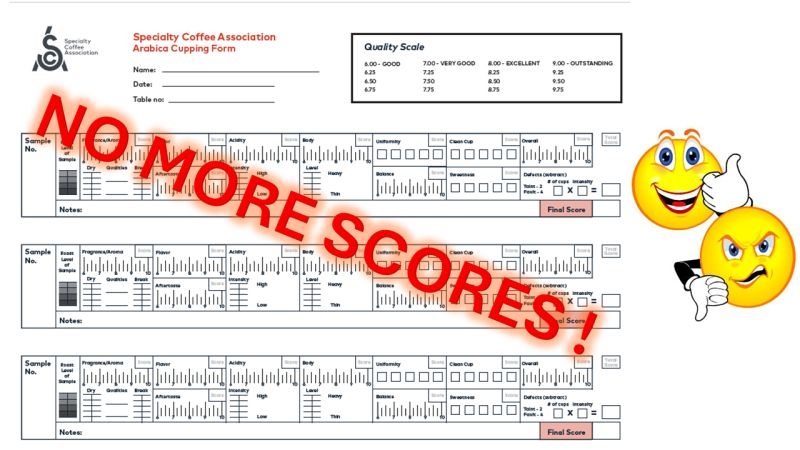
The score will not disappear overnight, but its monopoly will. No one will continue teaching the 2004 Q form indefinitely.

Will CVA replace the scoring system? Probably — but we need one to two years of feedback from major industry players. It will also need adaptation to better reflect the reality of coffee trading.

And honestly, that would be healthier — for producers, traders, roasters, and for sensory science.

  • A Question for the Industry

If tomorrow we removed the 100-point score, what would you use to trade coffee fairly and transparently?