Spent Coffee Grounds Converted Into Raw Material for Biofuels

Source: Universitat Rovira i Virgili / Biomass and Bioenergy journal
Author: Qahwa World
Date: July 27, 2026

Spent Coffee Grounds Converted Into Raw Material for Biofuels

  • Researchers developed an efficient method to extract oil from spent coffee grounds for biodiesel production.
  • Optimal conditions: 45°C for 60 minutes with 35 ml hexane per gram of dry residue.
  • The process recovers approximately 90% of available oils from coffee grounds.
  • The extracted oil has very low impurity content of 0.3% compared to 3.9% in traditional methods.
  • The remaining lignocellulosic material can be used for bioethanol, lactic acid, and sustainable aviation fuel.
  • Global coffee production generates approximately 10 million tonnes of waste annually.
  • The process supports circular economy and renewable fuel development for hard-to-electrify sectors.

Spent coffee grounds can have a second life. They are typically thrown away after brewing. However, researchers have found a way to extract oil from them efficiently. This oil can serve as a raw material for producing biodiesel.

A study by the Universitat Rovira i Virgili has evaluated how to extract oil from coffee grounds. The process preserves the rest of the plant material. This allows it to be utilized in other processes as well.

The Research Study

The research was published in Biomass and Bioenergy journal. It focuses on spent coffee grounds as an abundant waste product. Global coffee bean production stands at around 10 million tonnes per year. Only a small proportion ends up in the brewed coffee. The remainder becomes solid waste in the form of coffee grounds.

Coffee grounds contain approximately 15% lipids. These fats can serve as a basis for producing biodiesel. The research team studied how three key factors influence oil extraction: temperature, processing time, and solvent-to-coffee-grounds ratio. They used n-hexane as the solvent and applied an experimental design to analyze the combined effects.

Optimal Conditions for Oil Extraction from Coffee Grounds
Parameter Optimal Value
Temperature 45°C
Processing Time 60 minutes
Solvent-to-Coffee Ratio 35 ml hexane per gram of dry residue
Oil Recovery Approximately 90% of available oils
Oil Impurity Content 0.3%

Key Findings

The research team, comprising Jorge F. Romero, Alberto Tampieri, Daniel Montané, Magdalena Constantí, and Francesc Medina, found optimal conditions at 45°C for 60 minutes. The ratio of 35 millilitres of hexane per gram of dry residue proved most effective. With these parameters, the process recovers approximately 90% of the oil that can be obtained with Soxhlet extraction.

Soxhlet is a laboratory technique widely used as a reference. It offers high yields but requires more time and energy. It is not as suitable for industrial applications. The optimized process yields oil with very low impurity content of 0.3%. In contrast, Soxhlet yields oil with 3.9% impurities. The fatty acid profile remained stable under different test conditions. It was dominated by linoleic and palmitic acids. These components indicate the oil’s potential for biodiesel production.

Beyond Oil: Preserving the Lignocellulosic Matrix

“In our study, we also demonstrate that extracting the oil does not mean that the rest of the material cannot be used for something else,” pointed out Francesc Medina. One of the research objectives was to preserve the lignocellulosic matrix. This matrix is made up of components such as cellulose, hemicellulose, and lignin.

These ingredients can be used to obtain other products. These include bioethanol, lactic acid, polyhydroxyalkanoates, precursors for sustainable aviation fuels, and phenolic compounds. The extraction process not only recovers oils but also acts as a pretreatment. The fats in the residue can prevent solvents or catalysts from accessing the rest of the biomass. Removing this barrier leaves the fat-free residue in a better state for subsequent use.

Comparison with Other Methods

The research team compared their method with ultrasound- and microwave-assisted extraction. These alternatives can accelerate the initial extraction. However, they do not offer a sufficient advantage in terms of oil quality, overall efficiency, energy demand, and scalability. The batch process with n-hexane under moderate conditions appears to be a better, more balanced option. It is more suitable for integration into a biorefining strategy.

Circular Economy and Renewable Fuels

The research forms part of efforts to develop techniques for a circular economy. It addresses the need to develop renewable fuels for hard-to-electrify sectors, such as heavy transport. By using every part of the coffee grounds, the researchers transform a typically underused waste product into various energy vectors and bio-based chemical products. This reduces the environmental impact associated with its accumulation.

Daniel Montané explained that this approach paves the way for the sustainable production of biofuels. The research demonstrates how coffee waste can become a valuable resource rather than an environmental burden.

Implications for the Coffee Industry

This research has significant implications for the coffee industry. It offers a way to reduce waste and generate additional value from coffee production. Coffee roasters, coffee shops, and instant coffee producers could potentially benefit from this technology. The process can be scaled for industrial applications, turning waste into a revenue stream.

The circular economy approach aligns with growing consumer demand for sustainable practices. Coffee companies could enhance their sustainability credentials by adopting such technologies. The research also contributes to reducing the environmental impact of coffee production.
Frequently Asked Questions

What are spent coffee grounds?Spent coffee grounds are the solid waste left over after brewing coffee. They contain approximately 15% lipids that can be extracted for biodiesel production.

How much oil can be extracted from coffee grounds?The optimized process recovers approximately 90% of the available oils from spent coffee grounds.

What are the optimal extraction conditions?The optimal conditions are 45°C for 60 minutes with 35 ml of hexane per gram of dry residue.

What happens to the remaining coffee grounds after oil extraction?The remaining lignocellulosic material can be used to produce bioethanol, lactic acid, sustainable aviation fuels, and other valuable products.

How does this research support sustainability?It promotes a circular economy by turning coffee waste into valuable products, reducing environmental impact and supporting renewable fuel production.

How much coffee waste is generated globally?Global coffee production generates approximately 10 million tonnes of waste annually, with only a small portion ending up in the brewed coffee.

Just 90 Seconds Turns Wet Coffee Grounds into High-Grade Solid Fuel

Source: National Research Council of Science & Technology – Chemical Engineering Journal |
Author: Qahwa World |
Date: June 21, 2026

Just 90 Seconds Turns Wet Coffee Grounds into High-Grade Solid Fuel

Key Takeaways:

  • Korean researchers develop Flame Plasma Pyrolysis (FPP) technology to convert wet coffee grounds into biochar in just 90 seconds.
  • The technology eliminates the need for pre-drying, the biggest barrier to coffee waste recycling.
  • The resulting biochar achieves a heating value of 29.0 MJ/kg, comparable to high-grade anthracite coal.
  • The process achieves 83.3% mass reduction and triples fixed carbon content (from 15.6% to 46.2%).
  • The technology is 40 to 240 times faster than conventional hydrothermal carbonization.
  • Potential applications include food waste, sewage sludge, and agricultural residues with high moisture content.

Every year, global coffee consumption generates more than 10 million tons of spent coffee grounds, most of which end up landfilled or incinerated, releasing greenhouse gases and polluting the environment. While these grounds hold real energy potential, their high moisture content has long been a barrier to converting them into fuel or carbon products.

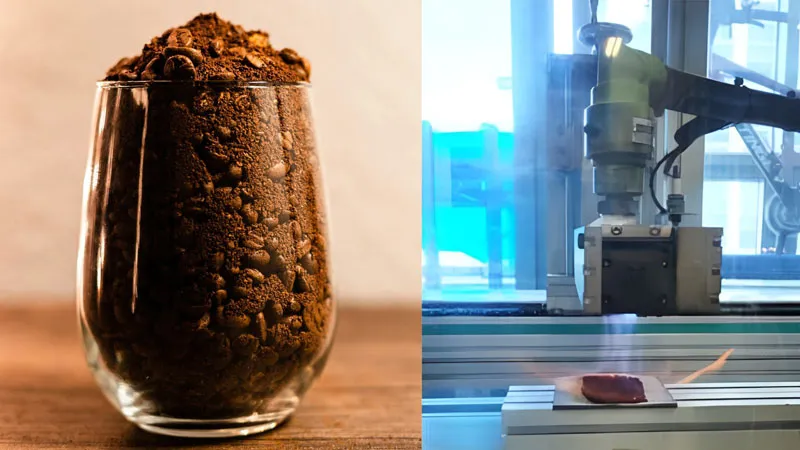
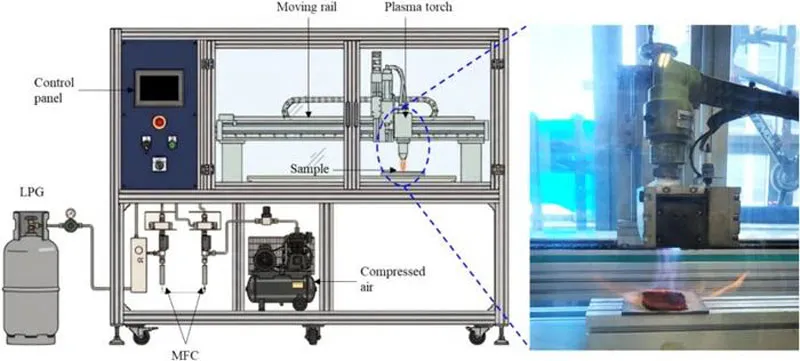
Now, a research team from the Korea Institute of Geoscience and Mineral Resources (KIGAM) has developed a revolutionary technology called Flame Plasma Pyrolysis (FPP), which directly treats biomass containing approximately 55% moisture without any pre-drying, converting it into high-quality biochar in just 90 seconds.

A Solution to the Growing Waste Challenge: From Waste to Energy

The global coffee industry faces a growing environmental challenge: more than 10 million tons of spent coffee grounds are produced annually, with most ending up in landfills or incinerators. These grounds are not just waste – they are wasted energy. Coffee grounds contain a heating value of up to 21.8 MJ/kg, but their high moisture content (approximately 55%) has been the biggest obstacle to economic utilization.

Flame Plasma Pyrolysis: A Revolution in Wet Waste Processing

The flame plasma system generates plasma flames at temperatures of approximately 800–900°C through the combustion of liquefied petroleum gas (LPG) and compressed air. Unlike conventional pyrolysis technologies, the process eliminates the need for any pre-drying treatment. During processing, the intense thermal energy rapidly vaporizes moisture trapped inside the biomass particles. The resulting pressure buildup triggers microscopic explosions known as the “popcorn effect,” which simultaneously enhance carbonization and create highly porous structures. Rather than acting as a barrier, moisture itself becomes a steam-activation agent that accelerates reactions and improves product quality.

Anthracite-Level Fuel Performance and Significant Quality Improvements

Under optimized conditions, the researchers achieved complete conversion within 90 seconds, with a mass reduction of 83.3%. The resulting biochar exhibited a heating value of 29.0 MJ/kg, approximately 33% higher than the original coffee grounds (21.8 MJ/kg) and comparable to that of anthracite coal.

Indicator Before Treatment After Treatment Improvement
Heating Value (MJ/kg) 21.8 29.0 +33%
Fixed Carbon Content (%) 15.6 46.2 ≈3×
Specific Surface Area (m²/g) 1.5 115.4 ×77
Sulfur Compounds Present Fully Removed No SOx Emissions

Dramatically Faster Than Existing Technologies

The new process offers substantial advantages in both processing speed and energy efficiency. Compared with hydrothermal carbonization (HTC), which typically requires one to six hours, the FPP process is 40 to 240 times faster. It also reduces treatment time by more than 20-fold compared with torrefaction, which generally requires at least 30 minutes. Because the system relies on combustion-generated plasma rather than electricity-intensive plasma devices, it lowers overall energy consumption while maintaining high processing performance.

Future Applications: From Coffee Waste to Decentralized Energy Systems

Beyond coffee waste, the technology is potentially applicable to a wide range of high-moisture organic wastes, including food waste, sewage sludge, and agricultural residues. Its compact process design and ultra-fast treatment capability make it particularly attractive for decentralized on-site waste-to-energy facilities, where transportation and drying costs often limit resource recovery efforts.

Researchers: “We Are Changing the Paradigm from Waste as a Problem to Waste as an Energy Resource”

Dr. Taejun Park, lead author of the study, said: “This technology presents a new paradigm in which waste is no longer viewed as a disposal problem but as a valuable energy resource.” He added: “We plan to expand the technology to various types of high-moisture organic waste and further optimize the process for industrial-scale commercialization.”

Research Context: Published in the Leading Chemical Engineering Journal

The research was published in the Chemical Engineering Journal (Elsevier, Impact Factor 13.2), a leading international journal in chemical engineering. The study demonstrates a new approach for transforming wet organic waste into valuable energy resources while advancing carbon-neutral waste management strategies. The Korea Institute of Geoscience and Mineral Resources (KIGAM) is a government-funded research institute specializing in geoscience, mineral resources, energy technologies, and Earth system science.

Frequently Asked Questions About Coffee Waste-to-Fuel Technology

Q: What is Flame Plasma Pyrolysis technology?

A: A revolutionary technology developed by Korean researchers that converts wet biomass (such as coffee grounds) into high-quality biochar in just 90 seconds, without any pre-drying.

Q: What is the heating value of the resulting biochar?

A: 29.0 MJ/kg, which is 33% higher than the original coffee grounds and comparable to high-grade anthracite coal.

Q: How long does the conversion process take?

A: Just 90 seconds – 40 to 240 times faster than conventional hydrothermal carbonization techniques.

Q: Can this technology be applied to other types of waste?

A: Yes, it can be applied to food waste, sewage sludge, and agricultural residues with high moisture content.

Q: What are the environmental benefits of this technology?

A: It reduces waste sent to landfills, lowers greenhouse gas emissions, and produces clean sulfur-free fuel, preventing SOx emissions.

Flame Plasma Pyrolysis technology represents a paradigm shift in converting wet organic waste into valuable energy resources. With rapid, cost-effective processing, this technology opens new horizons for sustainable waste management and renewable energy production. As global coffee consumption continues to grow, this technology may be the key to turning one of the biggest waste challenges into an energy and environmental opportunity.

Prepared and edited by: Qahwa World – Based on a study published in the Chemical Engineering Journal (Elsevier) by the Korea Institute of Geoscience and Mineral Resources.

All rights reserved. Republication with attribution permitted.

Publication date: June 21, 2026