Amsterdam Coffee Festival 2026 Opens in the Dutch Capital

Strong International Participation and Growing Focus on Coffee Innovation and Technology

Amsterdam – Tareq Alshameri

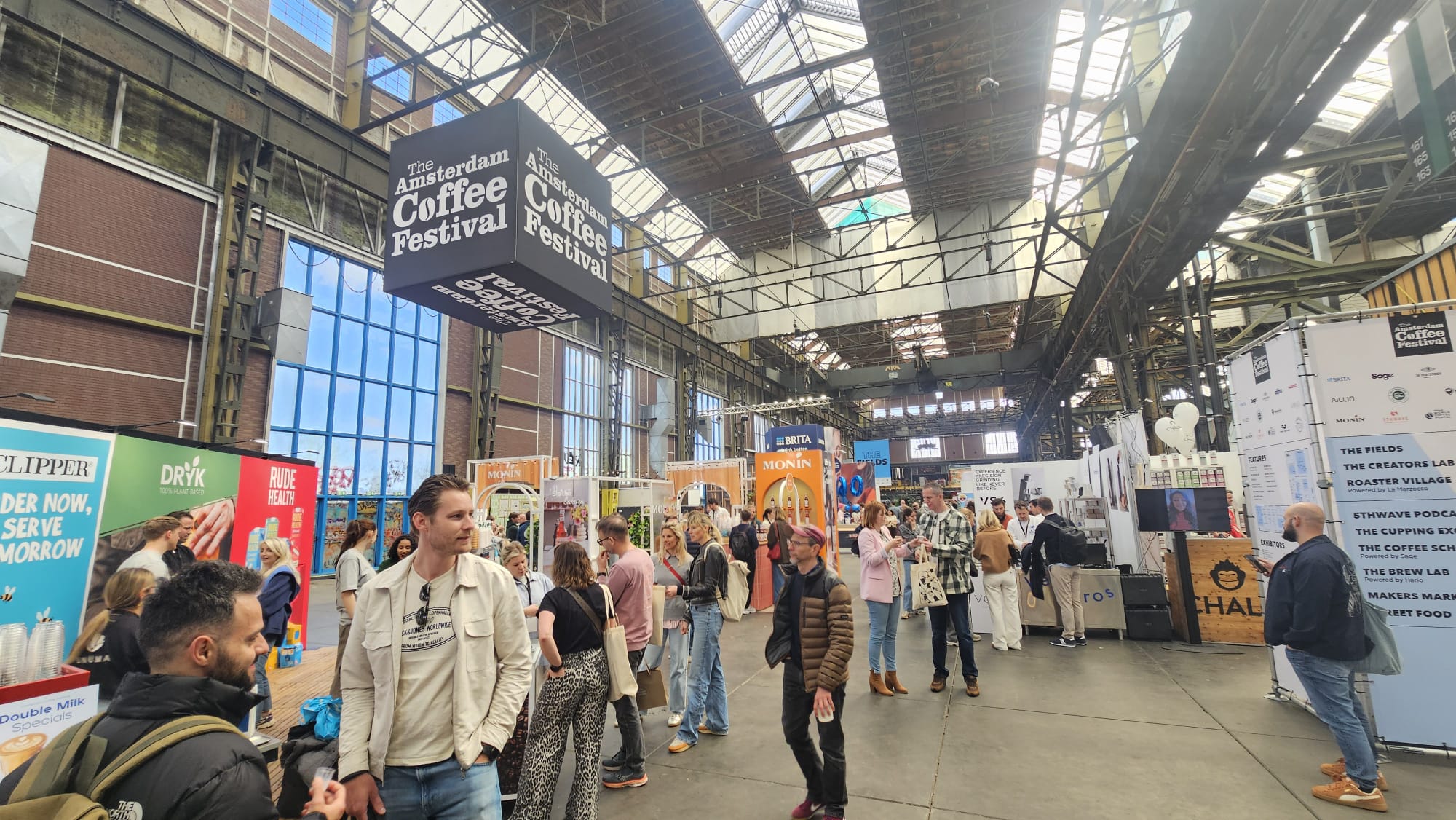
The Amsterdam Coffee Festival 2026 has officially opened in the Dutch capital, drawing a notable presence of visitors and coffee industry professionals, alongside broad participation from international companies and organizations operating in the sector. The event continues to reinforce its position as one of Europe’s leading platforms dedicated to the coffee industry.

The Amsterdam Coffee Festival 2026 is taking place from 16 to 18 April 2026 at the NDSM Loods venue, located at NDSM-Plein 85 in Amsterdam. The three-day event brings together specialty coffee activities, live roasting demonstrations, workshops, as well as entertainment elements including music, beverages, and cocktails, according to official event information.

This year’s program offers a diverse mix of educational and sensory experiences, featuring specialty coffee tasting sessions, training workshops for professional baristas, and interactive activities such as a Roasters Village concept, live latte art demonstrations, and cupping experiences, in addition to music performances and supporting entertainment events.

According to Amsterdam event listings, ticket prices start from approximately €12, making the festival accessible to a wide audience ranging from industry professionals to coffee enthusiasts.

This year’s edition has also seen a strong commercial and public turnout, with exhibition spaces dedicated to showcasing the latest innovations in coffee equipment and technology, including brewing machines, roasting systems, and digital solutions across the production and consumption chain.

A noticeable trend in this edition is the increasing integration of modern technologies. Several companies are presenting solutions based on artificial intelligence to enhance coffee preparation experiences through interactive systems capable of analyzing user preferences and offering personalized recommendations. Advanced equipment also enables greater precision in roasting and extraction processes.

The festival program also includes a series of training workshops for baristas and coffee professionals, alongside live competitions and professional cupping sessions, offering visitors the opportunity to explore modern brewing techniques and develop practical skills in the field.

The event hosts a diverse range of international organizations and institutions active in the coffee sector, along with companies from various European and global markets, reflecting the growing international dimension of the industry in both commercial exchange and knowledge sharing.

Economically, the festival contributes to boosting tourism and commercial activity in Amsterdam, attracting visitors from within the Netherlands and abroad. It also serves as an important networking platform for industry professionals to explore partnerships and business opportunities.

Overall, the Amsterdam Coffee Festival 2026 highlights the ongoing shift toward innovation and sustainability within the coffee industry, as companies continue to develop solutions that combine quality, efficiency, and evolving global consumer expectations.

The festival further strengthens its position as a platform that blends professional, commercial, and cultural dimensions within an industry that continues to expand and evolve rapidly worldwide.

JDE Peet’s Transfers Shares to Employees Under Incentive Plans

Amsterdam – Qahwa World

JDE Peet’s N.V. today announced the transfer of shares to participants under its employee incentive plans, in line with applicable Dutch regulations and ongoing corporate governance practices.

This announcement is made pursuant to section 13, paragraph 1, and section 17, paragraph 3, of the Dutch Decree on Public Takeover Bids, in connection with the recommended public offer by Keurig Dr Pepper, Inc. for all issued and outstanding shares in JDE Peet’s.

The company confirmed that a total of 431,238 shares have been transferred, free of charge, to 22 participants under previously granted or committed incentive awards.

You may like: KDP Acquires JDE Peet’s, Names Oliveira Coffee CEO

The transfers were executed in accordance with Dutch offer rules, which require disclosure of share movements during the offer period. Each share has a nominal value of EUR 0.01.

Following the transaction, JDE Peet’s total issued share capital remains unchanged at 488,178,642 shares, including 2,713,719 treasury shares held by the company.

JDE Peet’s also stated that it does not hold any shares in Keurig Dr Pepper, Inc., while noting that the offeror currently holds 466,712,270 shares in JDE Peet’s.

This press release does not constitute an offer or solicitation to buy or subscribe for securities. Any such offer will be made solely through an official offer memorandum approved by the Dutch Authority for the Financial Markets. Distribution of this release may be restricted in certain jurisdictions in accordance with applicable laws and regulations.

Fecal Bacteria Found in Tap Water Disrupts Coffee Service in Utrecht, Netherlands

Utrecht – Qahwa World
Coffee and tea service has been temporarily suspended in many cafés, restaurants, universities, and hospitals across the Dutch city of Utrecht after the discovery of Enterococcus bacteria in the tap water — a sign of possible fecal contamination. The incident has raised public concern and disrupted daily routines across the city.

The water company Vitens has advised residents to boil water for at least three minutes before drinking or cooking with it. The restrictions are expected to remain in place until at least Tuesday, November 4, pending confirmation that the water is safe. As a result, getting a cup of coffee or tea has become difficult in public institutions, including Utrecht University and the University Medical Center.

Hospitality businesses have had to adapt quickly to the emergency. Jan Hagenouw, head of the Utrecht branch of Koninklijke Horeca Nederland (KHN), said the sector is showing “remarkable flexibility.” Some establishments have begun rinsing glasses with Spa Rood mineral water, while others have stopped serving dishes like salads that require washing with tap water. Customers may also notice the absence of ice cubes in cold drinks — existing ice stocks are being reserved for select beverages such as whisky.

Cultural venues have also been affected. The Stadsschouwburg Theater is now using coffee machines filled only with boiled water and has advised visitors to bring bottled water. The TivoliVredenburg concert hall has temporarily reduced coffee and tea service as well.

At Utrecht University, all coffee machines in campus buildings have been shut down, although lectures and exams continue as planned. The university has urged students and staff not to drink tap water or use electric kettles and to bring boiled water and ready-made meals from home, since campus cafeterias may be closed.

Meanwhile, coffee producer Douwe Egberts, headquartered in Utrecht and owned by JDE Peet’s, confirmed that its production “remains completely safe and operational.” The company said it has implemented additional measures, including disabling cold-water dispensers and setting up dedicated water stations, while continuing to follow Vitens’ guidance closely.

The water contamination has also triggered a rush on bottled water in local supermarkets. Shelves at Aldi, Jumbo, and Albert Heijn were emptied quickly as customers stocked up. Jumbo reported delivering 7,500 liters of water to regional stores in a single day, while Albert Heijn urged customers to stay calm and “avoid panic buying.”

Within the city’s hospitality community, the water crisis has become a dominant topic of conversation — particularly about washing, rinsing, and water management. As KHN’s Hagenouw noted, “In hospitality, creativity is always essential. But we hope clean water will return soon — people’s patience won’t last forever.”